 Skip to content

A small automatic liquid filling machine is a compact conveyor-based filler that detects, positions and fills bottles with limited operator handling. It is designed for businesses that have outgrown manual or tabletop production but do not yet need a high-speed industrial line. The right machine is selected from five inputs: product behavior, fill range, container and cap, sustained output, and the next 12–24 months of growth.
Bottles per minute alone is not enough. A machine advertised at a high empty-cycle speed may run much slower with a 500 ml foaming liquid, a viscous cream, a narrow-neck bottle or a frequent changeover schedule. Buyers should compare sustained good containers per hour, labor, cleaning time and the upgrade path.
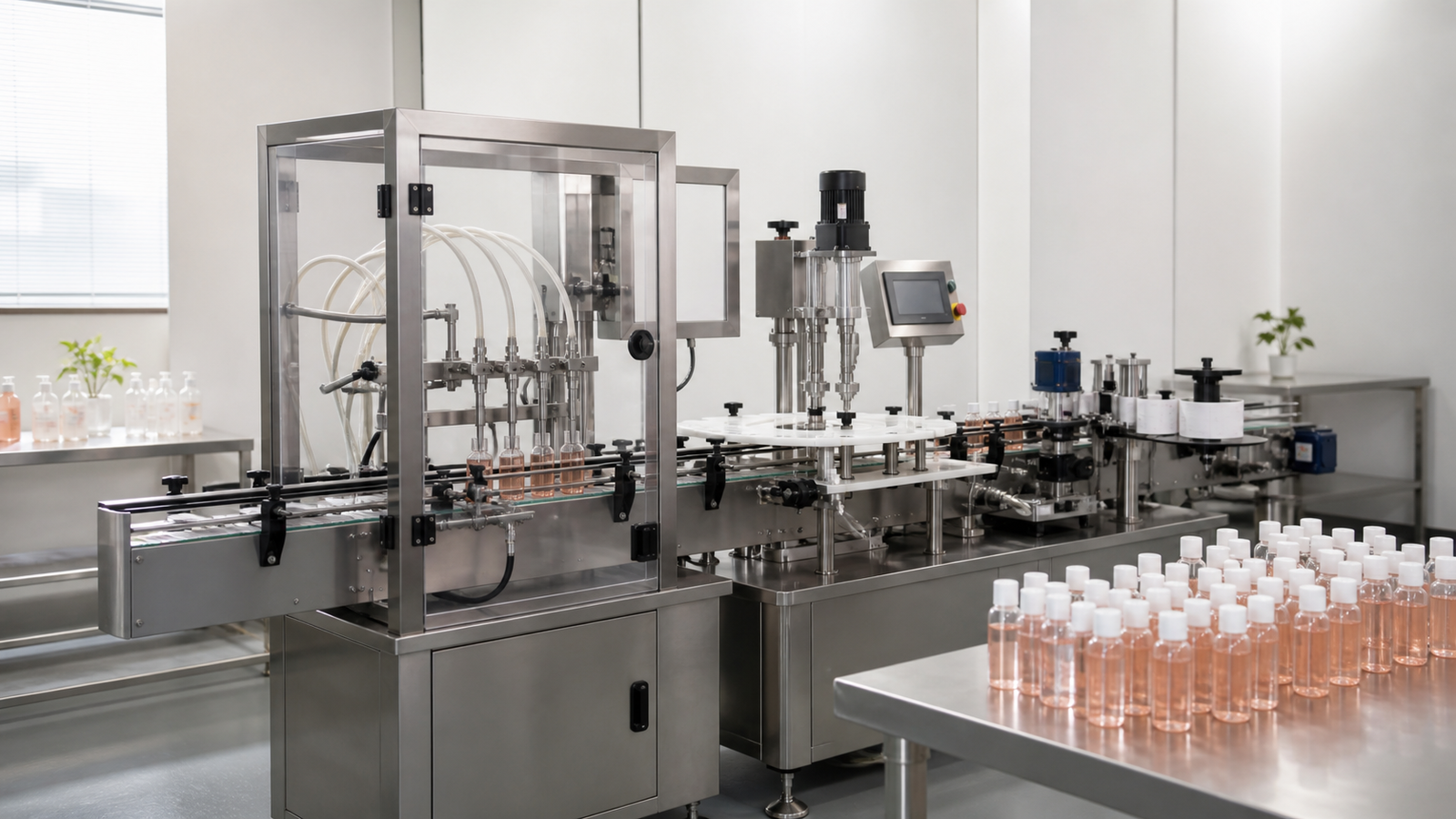
Small Automatic Filling Machine Quick Selection Table
| Production need | Recommended starting configuration | Main benefit | Watch-out |
|---|---|---|---|
| Frequent small batches and manual bottle placement is acceptable | Semi-automatic one- or two-head filler | Low entry cost and flexible operation | Operator pace controls output and consistency |
| Stable bottle flow with separate capping | Compact inline automatic filler | Automated indexing and scalable nozzle count | Manual cap handling may become the next bottleneck |
| Small bottles with plugs, droppers or caps | Compact filling-and-capping monoblock | Small footprint and coordinated operations | Format changes can require dedicated parts |
| Several bottle sizes and future stations | Modular mini linear line | Independent machines can be added or upgraded | Requires more floor space and line balancing |
| Pilot product with uncertain demand | Upgradeable base filler with recipe control | Avoids overbuilding the first phase | Confirm that conveyors, PLC and frame support expansion |
The terms “small,” “compact” and “desktop” are not standardized capacity classes. Compare the actual layout, nozzle count, filling cycle, closure operations and changeover parts rather than the product name.
Who Needs a Small Automatic Liquid Filling Machine?
- Startups with repeat orders: manual filling has become a shipment bottleneck or creates avoidable overfill.
- Pilot plants: products must be produced with repeatable recipes before a larger line is justified.
- Contract packers: frequent format changes require flexible recipes and fast cleaning.
- Cosmetic brands: growing demand for serums, lotions, shampoos or oils requires cleaner filling and more stable presentation.
- Food producers: sauces, dressings, oils and syrups need improved consistency and traceable batches.
- Chemical producers: cleaners, oils, reagents or adhesives require safer handling and compatible wetted materials.
- Established factories launching a new SKU: a compact line can protect the main high-speed line from inefficient short campaigns.
A small automatic line is not always the first step. If daily demand is low and containers vary constantly, a well-designed semi-automatic filler may offer better utilization. Automation becomes more attractive when operators repeat the same loading, filling and capping tasks for several hours per shift.
Typical Output and Automation Levels
The following bands are planning examples, not guaranteed specifications. Actual output depends on dose volume, product flow, nozzle count, container handling, capping and inspection.
| Automation level | Container handling | Common operating profile | Best fit |
|---|---|---|---|
| Manual or benchtop dosing | Operator positions and removes every pack | Short campaigns, laboratory and sampling work | Product validation before automation |
| Semi-automatic filling | Operator loads containers; machine controls dose | Flexible small batches with moderate labor | Low SKU volume or frequent changeover |
| Compact inline automatic filler | Conveyor indexes bottles automatically | Continuous filling with manual or separate capping | Growing output and stable bottles |
| Compact monoblock | Filling and closure operations share one coordinated platform | Small footprint and reduced bottle transfers | Small bottles, plugs, droppers, pumps and caps |
| Modular mini-line | Separate linked stations | Expandable filling, capping, labeling and inspection | Factories with several formats and growth plans |
Calculate required capacity from demand and available production time. If the business needs 12,000 good bottles in one eight-hour shift and expects 70% effective production time after cleaning, breaks and small stops, the filler and downstream equipment must collectively sustain:
12,000 ÷ (8 × 60 × 0.70) = about 36 good bottles per minute.
This example shows why buying a nominal 36-bottle-per-minute machine would be risky. The required rate already assumes a 70% effective window; the selected line needs margin for product and format conditions.
Choose the Filling Pump by Product Behavior
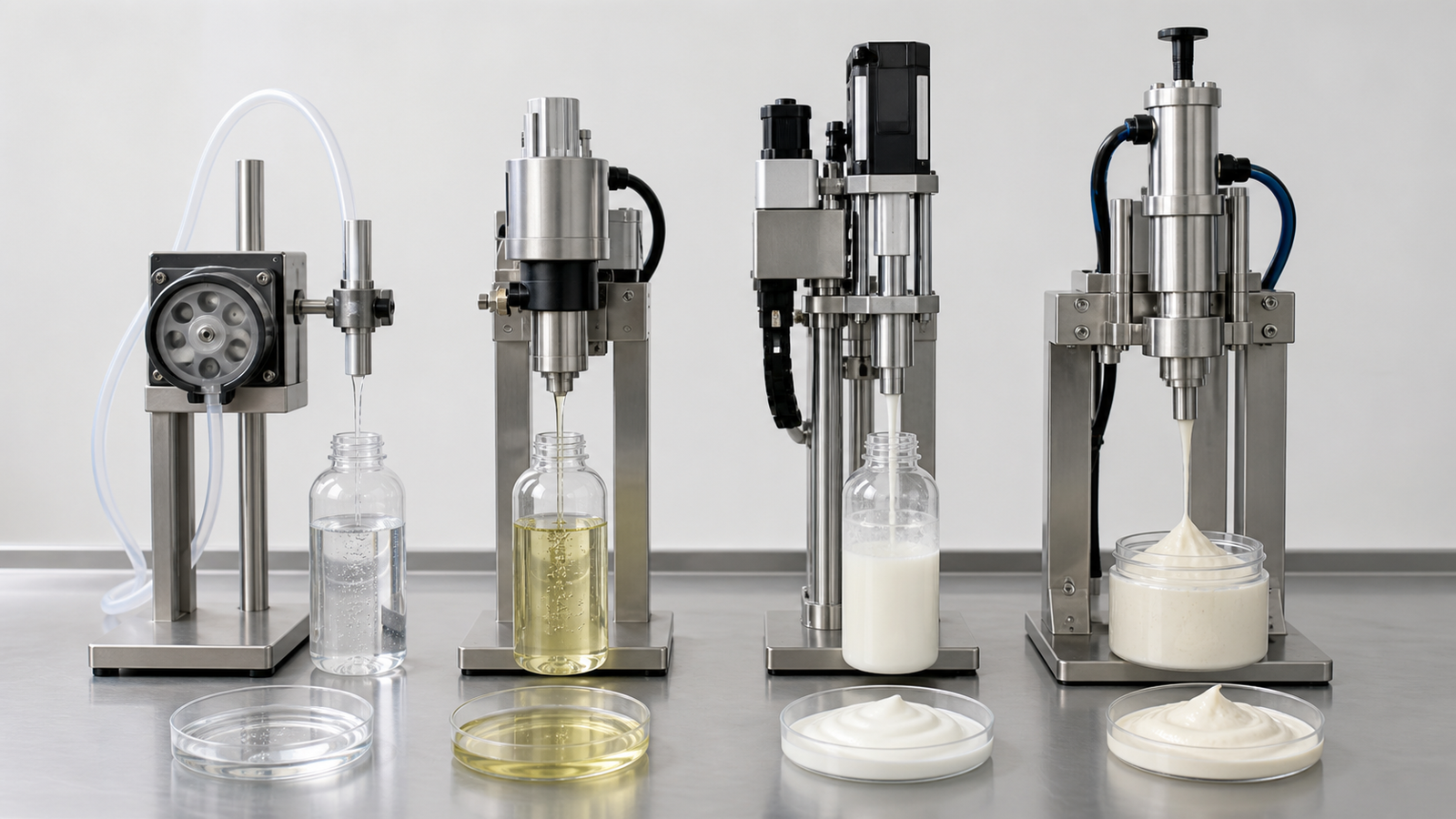
| Product | Useful starting technology | Critical test |
|---|---|---|
| Water-like toner, essence or cleaner | Magnetic pump, peristaltic, timed-flow or flow-controlled system | Foam, volatility, supply level and nozzle cutoff |
| Small-volume high-purity liquid | Peristaltic or another validated precision system | Tubing compatibility, dose range and campaign life |
| Shampoo, syrup or medium-viscosity lotion | Piston or positive-displacement pump | Temperature, air, stringing and diving nozzle |
| Cream, gel, paste or thick sauce | Servo piston, lobe or progressive-cavity system | Hopper feed, clean cutoff and cleaning time |
| Particle-containing product | Large-port piston or product-matched low-shear pump | Particle passage, distribution and damage |
| Corrosive or solvent product | Chemistry-matched pump and product path | All wetted materials, vapors and area safety |
Do not buy one filling principle for every future product unless the range has been tested. A modular frame may accept interchangeable pump or piston modules, but the control system, nozzle movement and cleaning procedure must be designed for the change.
Bottle, Cap and Label Compatibility
Small lines frequently handle more formats than large dedicated lines. That flexibility requires accurate samples and a documented changeover plan.
- Bottle stability: tall, narrow or lightweight bottles may need timing screws, pucks or side belts.
- Neck opening: nozzle diameter and positioning must prevent splash and contact.
- Container material: thin plastic may deform under guides or capping force, while glass needs controlled handling.
- Closure structure: screw caps, pumps, droppers, inner plugs, press-on parts and crimp closures require different feeding and application systems.
- Cap presentation: irregular or soft closures may not orient reliably in a simple bowl feeder.
- Label area: tapered, oval or flexible containers affect labeler selection and line orientation.
- Change parts: buyers should see which guides, star wheels, chucks, nozzles or pucks change between SKUs.
Provide the widest, narrowest, tallest and shortest containers during the proposal stage. Sending only the easiest bottle produces an incomplete line design.
Compact Monoblock vs Modular Mini-Line
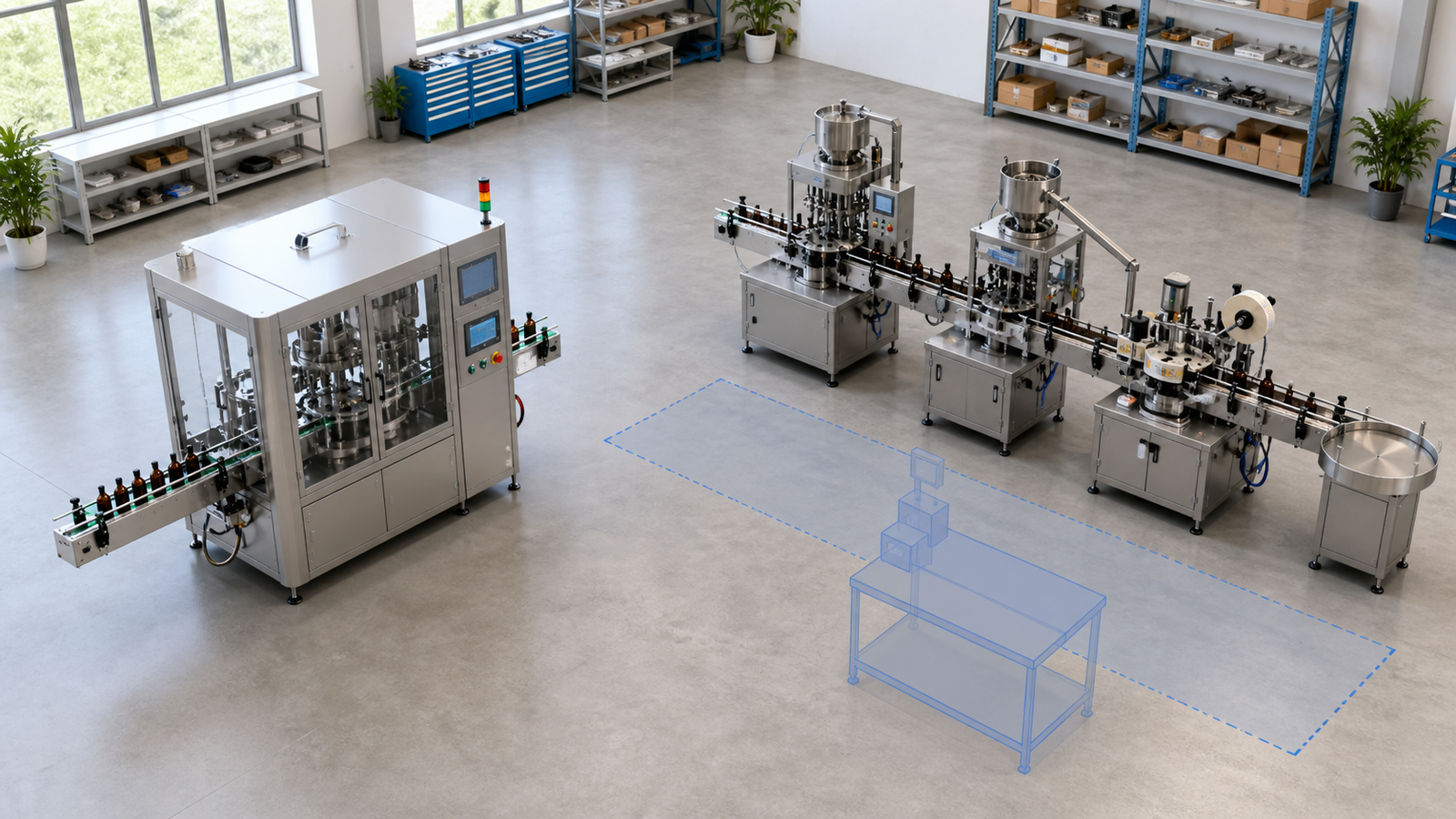
| Factor | Compact monoblock | Modular mini-line |
|---|---|---|
| Footprint | Usually smaller because operations share one platform | Requires conveyors and space between stations |
| Synchronization | One controller coordinates filling and capping | Independent stations need line balancing and accumulation |
| Format flexibility | Efficient for a defined family of bottles and closures | Individual stations can be changed or bypassed more easily |
| Expansion | Limited by the original frame and available stations | Labeling, inspection or cartoning can be added progressively |
| Maintenance impact | One machine stop can stop all operations | A stand-alone station may be serviced or replaced separately |
| Best use | Small containers and a stable closure family | Multiple formats and a planned upgrade path |
King Pack offers compact machines and expandable filling and capping lines. The decision should be made from container movement and future formats, not from footprint alone.
Labor, Footprint and Utilities
A compact machine can still require several operators if bottles, caps and labels are supplied manually. Map every task for one production hour:
- Load empty bottles and refill the accumulation table.
- Prepare or transfer product to the filler.
- Refill caps, pumps or plugs.
- Remove finished bottles and pack cartons.
- Inspect fill level, weight, torque, label and code.
- Clean spills and respond to minor stops.
- Perform product and format changeovers.
Then confirm utilities: electrical supply, compressed-air pressure and consumption, product transfer, ventilation, drainage and cleaning-water access. Measure the real installation envelope including doors, electrical cabinets, operator access, maintenance clearance, upstream tables and finished-product collection.
Changeover and Cleaning
For a small producer with many SKUs, changeover can consume more capacity than nominal filling speed. Request a live demonstration that includes:
- Draining or recovering product from the tank, hoses and metering system.
- Removing and reinstalling contact parts without damaging seals.
- Cleaning or replacing tubing and nozzles.
- Changing bottle guides, capping heads and label settings.
- Loading a saved recipe and verifying access control.
- Priming the new product and separating start-up containers.
- Completing accuracy, torque and label-position checks.
In cosmetic production and food filling applications, hygienic contact parts and easy inspection are essential. If products contain allergens, active ingredients, colors or fragrances, the cleaning strategy must prevent cross-contamination.
Cost Drivers and Payback Worksheet
The purchase price rises with nozzle count, filling technology, sanitary design, closure feeding, inspection, safety equipment, documentation and change parts. Evaluate total project cost rather than the base filler alone.
| Cost or benefit | How to estimate |
|---|---|
| Direct labor saving | Operators reassigned × loaded hourly cost × productive hours per year |
| Extra contribution | Additional good packs sold × contribution per pack |
| Reduced giveaway | Current average overfill reduction × annual packs × product cost per unit |
| Reduced rejects and rework | Current annual cost minus expected validated cost |
| Consumables and maintenance | Seals, tubing, cleaning supplies, service and planned downtime |
| Net annual benefit | Annual savings and contribution minus added operating cost |
| Simple payback | Total installed investment ÷ net annual benefit |
Use conservative utilization. If sales demand supports only two production days per week, do not calculate payback as if the machine will run two shifts every day. Also include product launch risk, training and the time needed to stabilize the new process.
For a broader investment framework, see how to calculate an automatic filling machine payback period. Although that article focuses on tube filling, the labor, waste and utilization logic also applies to compact bottle lines.
Upgrade Path from Pilot to Mass Production
- Phase 1—controlled dosing: automate the fill to improve consistency while operators load and remove containers.
- Phase 2—automatic indexing: add a conveyor, bottle detection and multiple filling nozzles.
- Phase 3—closure integration: add plug insertion, cap feeding and controlled capping.
- Phase 4—quality and identification: add checkweighing, vision, coding and labeling.
- Phase 5—line feeding and packing: add bottle unscrambling, cartoning and case packing when demand justifies them.
Plan PLC capacity, conveyor width, communication interfaces, line direction and factory utilities for the later phases. A cheap machine that cannot exchange signals with a future capper or labeler can make expansion more expensive than buying a scalable platform initially. Review when to upgrade to a fully automated filling line for the next-stage decision.
Why the Cheapest Tabletop Filler Can Become Undersized
A tabletop pump may solve the first filling problem but leave bottle positioning, cap handling, inspection and finished packing unchanged. As orders grow, the operator must coordinate more containers around a machine that was designed only to meter product. The result can be queues of open bottles, inconsistent pacing and extra handling rather than a balanced process.
Before buying, calculate the total cycle from picking up an empty bottle to placing a closed, accepted bottle in the finished-product area. If filling occupies only a small share of that cycle, a faster dosing pump will not deliver the expected line output. A compact conveyor or monoblock may cost more initially but remove transfers, stabilize bottle spacing and provide signals for future capping or labeling.
Controls, Safety and Documentation to Specify
- PLC and touchscreen recipes with controlled access to critical fill parameters.
- No-bottle-no-fill detection and confirmation that containers are correctly positioned.
- Guards, interlocks, emergency stops and alarms appropriate to the moving parts.
- Low-product or supply interruption alarm to prevent air entering the dosing path.
- Batch counters, production totals and reject records needed by the factory.
- Electrical drawings, pneumatic diagrams, parts manuals and recommended spare-parts list.
- Calibration instructions and a documented method for checking every filling head.
- Remote support connection only under the factory’s approved access procedure.
For food, cosmetic, pharmaceutical or chemical projects, specify the applicable contact materials, surface finish, certificates and validation documents before quotation. Adding documentation after machine completion can be more difficult than designing the project around the requirement.
Also confirm who is responsible for installation, operator training and production start-up. A compact machine may be mechanically simple, but stable output still depends on correct leveling, product priming, sensor adjustment, recipe control and maintenance. Request a start-up checklist that the production team can repeat after relocation or a major format change.
Small Automatic Filler RFQ Checklist
- Product samples and viscosity range at operating temperature.
- Minimum and maximum fill volume for every planned SKU.
- Bottle and closure samples, drawings and acceptable orientation.
- Required sustained good containers per minute or per shift.
- Accuracy target and measurement method.
- Product-contact materials and hygiene requirements.
- Batch size, change frequency and maximum cleaning time.
- Available length, width, height and line direction.
- Electrical power, compressed air and product-supply method.
- Current operator count and desired labor reduction.
- Expected 12- and 24-month demand.
- Future stations: capping, labeling, coding, inspection or cartoning.
- FAT product, sample size and acceptance protocol.
Frequently Asked Questions
How small can an automatic filling line be?
A compact filler may fit on a benchtop or short conveyor, while a filling-and-capping monoblock combines several operations on one platform. The usable footprint must include operators, product supply, caps, maintenance clearance and finished bottles.
Is a semi-automatic machine better for a startup?
It can be when demand is uncertain, batches are small or formats change frequently. A compact automatic machine becomes attractive when repetitive handling limits shipments, quality or labor efficiency.
Can one small machine fill water, oil and cream?
Not always with the same dosing system. Water-like liquids, oils and creams can require different pumps, nozzles and cleaning. A modular machine may support changeable dosing modules if specified from the start.
Should capping be automatic from day one?
Automatic capping is valuable when closure handling is already a bottleneck or torque consistency matters. For early-stage production, buyers may begin with automatic filling and controlled semi-automatic capping, provided the layout supports future integration.
What should be tested before shipment?
Test real product, all critical bottles and closures, minimum and maximum fill volumes, sustained output, accuracy, drips, capping, changeover, cleaning, alarms and safety. Record results in an agreed FAT protocol.
Size a Compact Line for Your Growth Plan
Send King Pack your current daily output, 12- and 24-month demand, product behavior, fill sizes, bottle and cap samples, available space and desired automation level. Our engineers can compare a semi-automatic filler, compact monoblock and modular mini-line, then recommend a scalable configuration.
Contact King Pack for a compact filling-line proposal and product test.
