 Skip to content

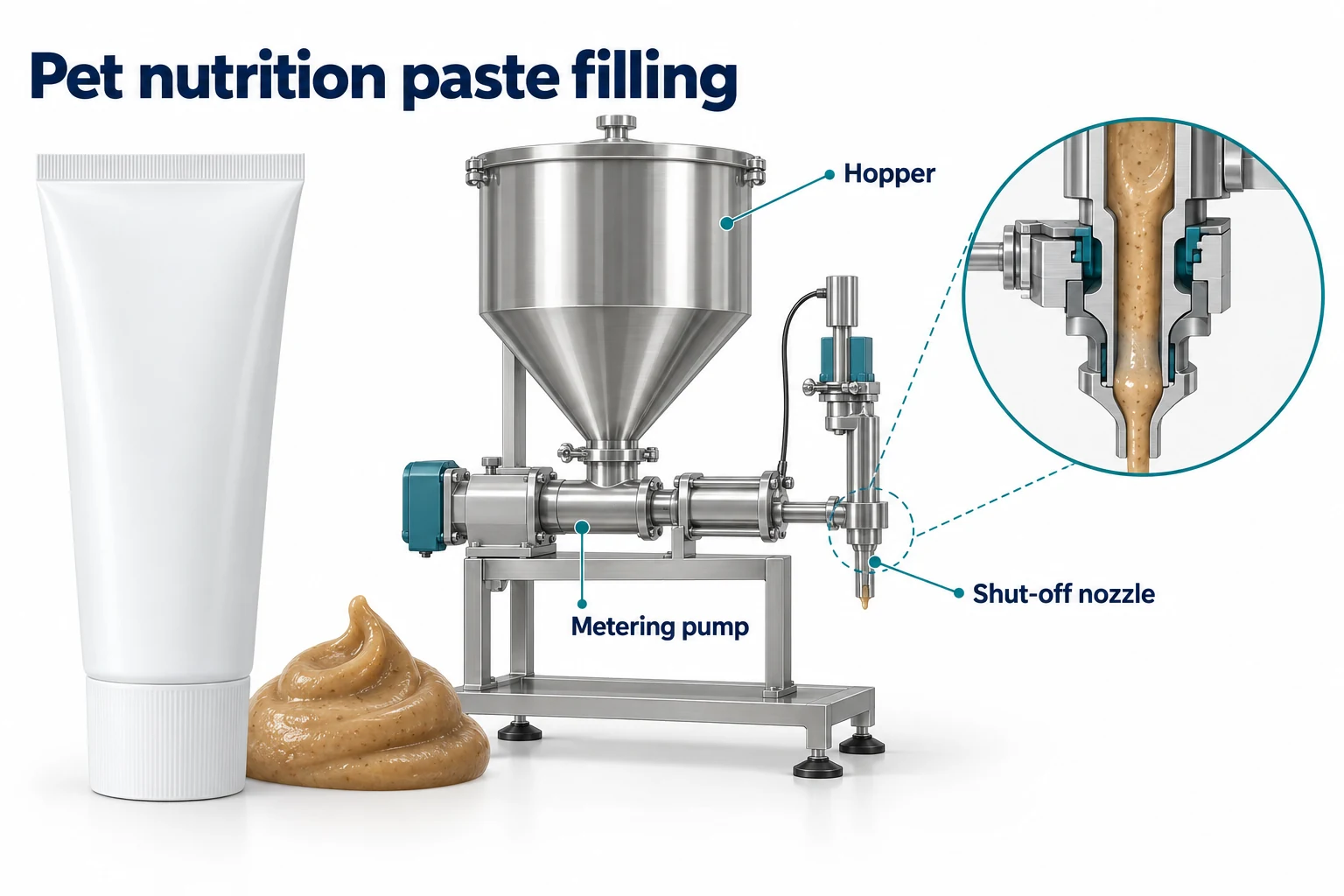
Pet nutrition pastes include vitamin gels, digestive-support pastes, calorie supplements and other dense formulations that must be dosed into a convenient tube. The product may contain oils, powders, fibers or suspended particles, so the filling system must manage viscosity, air and clean cut-off without damaging the formula. A reliable project starts with the hopper and dosing path, then connects those choices to open-tail tube filling, sealing, cleaning and installation.
This guide helps buyers compare equipment for pet nutritional paste tube filling. It covers product information, hopper design, pump selection, nozzle control, tube handling, hot-air or ultrasonic sealing, factory testing, shipment inspection and operator preparation.
Start with the product profile
Share the product temperature, apparent viscosity, particle or fiber content, density, oil level, shear sensitivity and storage condition. “Paste” describes a broad range of behaviors. A smooth gel may flow through a small nozzle, while a thick supplement with particles needs a larger passage and a slower transfer route.
Air and settling
Some pet nutrition pastes trap air during mixing or transport. A hopper that allows controlled refill and a low-level sensor can reduce the risk of the pump drawing air. If ingredients settle, the product may need gentle agitation or a defined recirculation method. Do not add aggressive mixing without checking whether it changes the formula.
Hopper selection
Working volume
Size the hopper for the production rhythm, not only the largest batch. A smaller working volume can reduce residence time and make cleaning faster, while a larger volume may support a long run. The supplier should explain the usable volume, minimum level, refill method and drain points.
Agitation and temperature
Agitation may be useful when the formula separates, but the impeller, speed and seal must match the product. Heating may be required for a high-viscosity paste, but the temperature limit should come from the formula owner. Measure temperature at a defined point and confirm that the product near the nozzle remains within the approved range.
Hygienic access
The hopper should be easy to open, drain and inspect. Review the gasket, outlet valve, level sensor and agitator shaft. Cleaning instructions should identify removable parts and the inspection points used after washing. If the product is animal-health related, line clearance and residue control should be documented clearly.
Dosing system choices
Piston dosing is common for thick pastes because the stroke and volume can be controlled directly. Servo-driven pistons may help when the recipe needs adjustable speed or a controlled profile. Other products may use a progressive cavity or other pump arrangement. Selection should be based on flow behavior, particle sensitivity, required dose and cleaning method.
Nozzle diameter and cut-off
A nozzle that is too small can increase shear and pressure; one that is too large can make cut-off and tail cleanliness difficult. Test the intended nozzle with the actual product or a clearly documented substitute. If the paste strings, review retract, shut-off and nozzle lift timing before increasing speed.
Fill-weight control
Define the target weight, tolerance, sample size and adjustment method before FAT. Collect samples from start-up, stable running, after a short pause and near batch end. Weigh samples from each filling position if the machine has more than one head. Record product condition and recipe version with the results.
Tube presentation and filling sequence
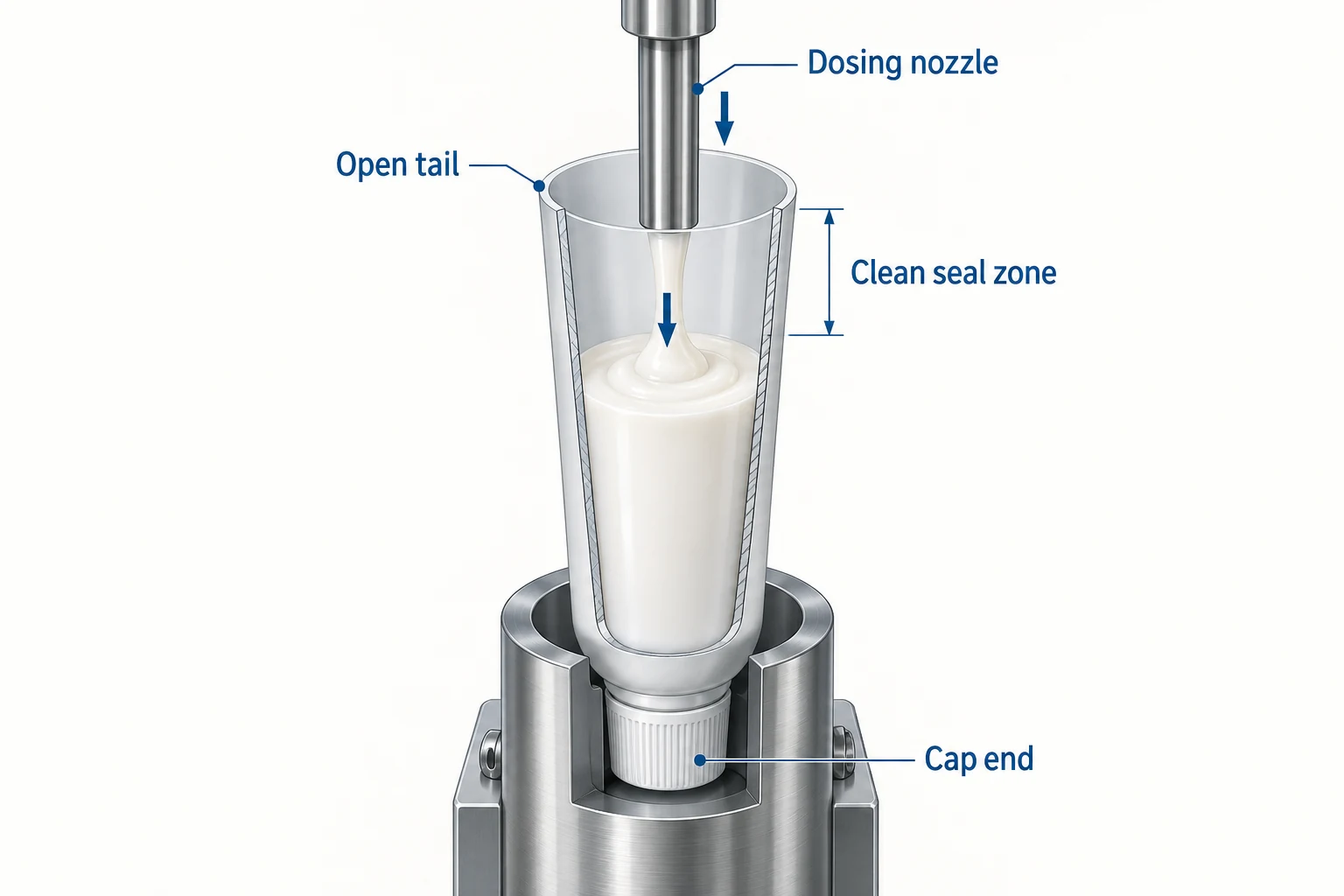
The open tail of the tube faces upward in the filling pocket. The nozzle enters the unsealed tail and doses the paste from the bottom upward or according to the selected filling profile. After the dose is complete, the tube moves to the heating and sealing station. A sealed cap end is not a filling entry point.
Plastic and laminate tubes
Flexible tubes need support to prevent deformation during nozzle insertion. The holder should protect the print and keep the tail centered. Check how the machine detects a missing or tilted tube and how it rejects a tube with product in the sealing area.
Tail sealing
Plastic or laminate tubes may use hot-air sealing, while compatible thermoplastic structures may be tested with ultrasonic sealing. The tail must be clean before closure. The process should be described as filling through the open tail, heating when required, sealing, then embossing, trimming or coding as specified.
Seal inspection
Inspect seal width, wrinkles, contamination, incomplete closure and code position. A leak or integrity test may be appropriate for the package. Define the method before FAT and use the same method during site acceptance.
Cleaning and changeover
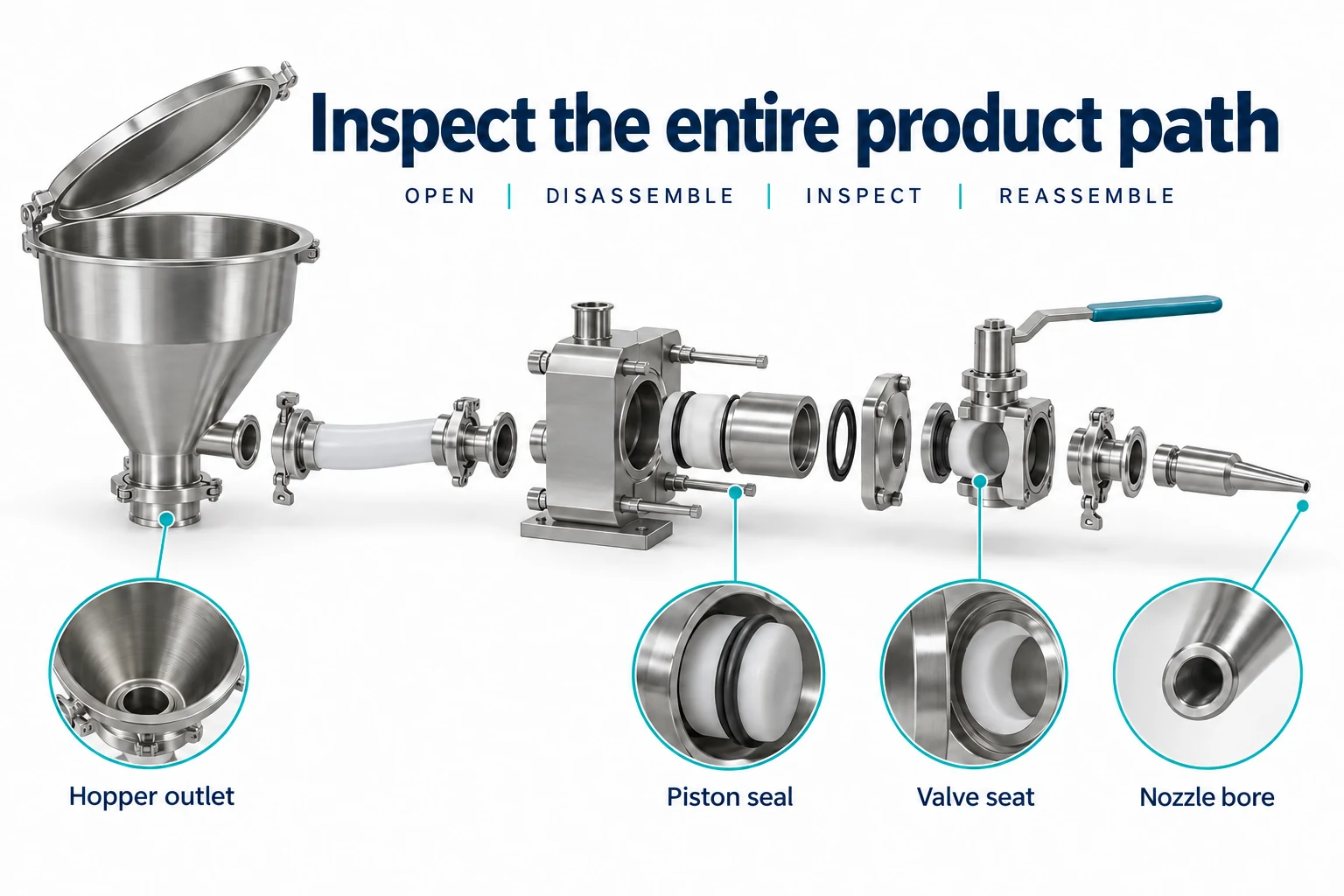
Pet nutrition products often contain oils, flavors or powders that can cling to product-contact parts. Review drainability, hose routing, pump disassembly, nozzle cleaning and gasket replacement. If several formulas share a line, define the clearance check and the order of production from light to heavy colors or from low-risk to high-risk residues.
Spare parts and wear
Ask for part numbers for piston seals, valve seats, gaskets, nozzles, sensors and tubing. Abrasive ingredients can accelerate wear. The maintenance file should state how an operator identifies a worn seal and what symptoms appear in fill-weight checks or tail cleanliness.
Factory testing and shipment inspection
A useful factory trial uses representative tubes and the actual product when possible. Confirm hopper refill, agitation, dose control, open-tail filling, tail sealing, coding, reject handling and cleaning access. If a substitute is used, label the result and list which tests must be repeated with the customer’s formula.
Before shipment, inspect the machine frame, product-contact parts, electrical cabinet, tooling, spare kit, manuals and packing list. Photograph the packed equipment and verify the destination utilities. Installation preparation should cover floor access, power, air, product storage, drainage, operator space and safe maintenance access.
Procurement questions
- What is the product viscosity range and particle size?
- Is agitation required, and how is its speed controlled?
- Which nozzle, pump and seal materials contact the paste?
- What dose test and sampling plan will be used?
- Which tube materials, diameters and tail profiles are approved?
- How are cleaning, changeover and wear-part replacement documented?
Discuss your requirements: Send your pet nutrition paste data, tube drawings and target dose to King Pack for a hopper and dosing review.
Managing difficult formulations
Pet nutrition pastes can change during a batch as temperature, residence time or ingredient distribution changes. Establish whether the product should be gently mixed in the hopper, circulated before filling or left undisturbed after preparation. The procedure should state when the operator may refill the hopper and whether a short pause requires a new first-piece check.
Particles, fibers and abrasives
Particles or fibers require a clear passage through the pump, valve and nozzle. Share the maximum particle size and concentration with the supplier. Check whether the material can settle at the hopper outlet or collect at a valve seat. If the product is abrasive, identify the parts most likely to wear and plan replacement intervals around actual observation.
Oils, flavors and sticky residues
Oil-rich formulas may wet the tube tail and reduce seal cleanliness. Flavor systems can leave strong residues during changeover. Confirm the cut-off behavior and cleaning chemistry with the product team. Use a line-clearance checklist that includes the nozzle tip, pump outlet, holder, tail tools and coding area.
Compare the proposed station and tooling scope with the tube filling and sealing equipment overview; suitability still depends on the actual product and tube samples.
Trial protocol for the dosing system
Prepare a trial protocol before the equipment arrives. Define the product condition, tube size, target dose, sampling points, weighing method and adjustment limits. Run the first set at the proposed recipe, then make one controlled change at a time. This makes it easier to identify whether a difference comes from pump stroke, speed, temperature, product conditioning or tube position.
Start-up and recovery samples
Collect samples when the line starts, after the hopper reaches a stable level, after a short stop and after a refill. Compare weight, appearance, tail cleanliness and seal quality. If the machine has two filling heads, record the head identity. Keep approved samples with the FAT record so the site team can compare its first production run.
Operator workflow and safety
Place the bulk product, empty tubes and finished cartons so the operator does not cross the moving machine path. Mark the product-flow direction, isolation points and cleaning access on the layout. Operators should be able to see the hopper level, tube-present signal, alarm message and active recipe. A clear procedure should explain how to remove a damaged tube without reaching into a moving station.
Recipe and format control
Save recipes using a format and product naming convention that cannot be confused. The recipe should include dose, speed, retract, delay, nozzle height, tail-seal settings and code position. Require a first-piece approval whenever a new tube lot, product lot or tool kit is introduced.
Service and lifecycle support
Ask the supplier how technical support is provided during installation and what information is needed to diagnose a dose or sealing problem. Request drawings, spare-part numbers, electrical lists and maintenance intervals in a language the plant can use. For export projects, confirm the time zone, remote-support method and packaging of replacement parts.
Future products
If the plant expects new supplements, gels or ointments, review the limits of the proposed hopper, pump and nozzle. It may be practical to keep a second nozzle kit or a larger passage for future products. The decision should be based on the product roadmap and confirmed tube formats, not on an unsupported promise of universal compatibility.
Recommended project sequence
- Share product profile, tube drawings and target dose.
- Review hopper, agitation, pump and nozzle options.
- Run a controlled trial with representative paste and tubes.
- Approve dose, tail cleanliness and sealing criteria.
- Complete FAT with records for start-up and stable operation.
- Perform shipment inspection and installation preparation.
- Repeat first-piece checks during site commissioning.
This sequence gives the engineering, quality and purchasing teams one reference and reduces the chance that a machine is approved only from a short demonstration.
Keep the final acceptance criteria connected to the customer’s actual release process. If the customer weighs every start-up sample manually, include a practical sampling table. If quality staff inspect the tail under magnification, include that inspection point in the FAT. If a substitute product is used at the factory, list the limitations and schedule the confirmation test during commissioning.
After acceptance, retain a labeled sample set from the factory and site. Identify the tube supplier, product lot, recipe, nozzle and sealing settings. The sample set helps the team judge whether later variation comes from packaging material, product preparation or machine condition.
Distinguish nutrition-paste packaging from dose administration
A squeeze tube for a pet supplement and a graduated dosing syringe serve different user needs. Tube filling equipment should be specified for the selected package, not borrowed from a syringe drawing because both products are called paste. Confirm the cap, outlet, intended dispensing behavior and nominal pack size before the supplier designs holders and nozzles.
Define what the trial can demonstrate
A factory run can provide evidence about mechanical handling, fill mass, tail cleanliness and closure. It cannot establish nutritional benefit, dose suitability for a particular animal or shelf life. Those questions belong to the product owner and its appropriate technical specialists. Keep equipment claims within the tested packaging scope.
Account for ingredient carryover during changeover
Different nutrition formulas may contain oils, powders, flavor systems or other components that remain in seals and valve cavities. Provide the site’s cross-contact assessment when discussing cleaning access. The supplier can identify dismantling and drainage points; the customer establishes the acceptance method and any product-sequencing restrictions.
Challenge the difficult locations
During a cleaning review, inspect the hopper outlet, low points in transfer hoses, pump valve seat, nozzle shut-off parts and any shaft seal. Removing visible paste from the hopper does not demonstrate that the entire path is clear. Reassemble the system using identified components and verify that the first dose does not contain water or cleaning residue.
If dry powders are added upstream, confirm that the filler receives a sufficiently prepared bulk product. A packaging hopper should not be assumed to complete mixing or dissolve ingredients. Describe the expected handover state so the mixer, transfer route and filler have compatible responsibilities.
Include training, spares and commissioning requirements in the equipment service and handover scope so the plant can prepare its own personnel and utilities.
Build a product-specific RFQ pack
Include a sample quantity agreed with the supplier, tube drawings, fill range, product preparation method, maximum hold condition and the cleaning procedure. Add available floor space, utility data and finished-pack handling. If the paste changes consistency during storage, supply a representative aged sample or describe how it should be conditioned before the trial.
Ask for observations rather than a generic pass statement: did the paste bridge at the outlet, did the dose contain air, did the nozzle string, and was the tail clean before closure? Record the tested conditions and unresolved items. A disciplined answer makes it easier to compare proposals without relying on an unsupported capacity or accuracy promise.
Handover to production
Provide operators with the approved recipe, tool list, first-piece criteria and stop/restart instruction. Include photographs of acceptable tube presentation and common defects. Keep the test sample separate from saleable stock and confirm how rejected packs are reconciled. These practical controls help preserve the distinction between an engineering trial and a released batch.
Send your specifications: Use the King Pack technical enquiry form to share the product profile, tube drawings and the conditions you need verified.
Pack identification and storage
Confirm the lot-code area on the tube drawing and inspect it after sealing, trimming and handling. Oils or surface contamination can affect a printed code even when the fill and seal are acceptable. Use production tubes for the coding trial and define the customer’s legibility criteria.
After filling, handle samples under the storage conditions specified by the product owner. Inspect whether product movement affects dispensing or whether a cap becomes soiled during discharge. Record those observations separately from fill-weight results so the investigation addresses the correct packaging function.
Paste-handling selection matrix
| Observation | Review |
|---|---|
| Settling | Permitted conditioning and agitation |
| Particles | Passages, valves and wear |
| Stringing | Nozzle shut-off and withdrawal |
| Residue | Drainage and dismantling |
FAQ
Can a thick pet paste be filled with a standard cream filler?
Sometimes, but the pump, nozzle, hopper outlet and cut-off must be checked against the paste’s viscosity and particles.
Does the hopper need an agitator?
Only when the product tends to settle or separate. Confirm the requirement with a product trial.
How do I prevent paste from entering the seal?
Use suitable nozzle insertion, controlled cut-off, clean tail presentation and a defined first-piece inspection.
What should FAT prove?
FAT should prove hopper handling, dosing, tube orientation, sealing, coding, reject control and cleaning access under agreed conditions.
Can a packaging trial prove nutritional benefit?
No. The trial assesses equipment and package behavior under its recorded conditions. Nutritional claims, product suitability and release belong to the product owner and its technical specialists.
Conclusion
Pet nutrition paste tube filling is a product-handling project as much as a packaging project. Select the hopper, pump, nozzle and cleaning method from the real formula, then validate the open-tail filling and sealing sequence with representative tubes. Document FAT, shipment inspection and installation preparation before delivery.
Request a technical review: Contact King Pack with your product profile and tube sample information. Request a technical proposal and factory trial checklist.
