


AI-generated illustration: recover a stopped line without losing the identity or status of retained packages.
Introduction
An intramammary applicator line restart should begin with the condition of the packages still inside the machine. Confirm which barrels are empty, filled, partly assembled or capped; identify material affected by the stop; restore the approved configuration; and verify the first assemblies before returning to routine production. Restarting motion alone does not establish that every package has completed its intended sequence.
This guide explains how to plan recovery for veterinary intramammary applicator handling. It addresses the hand-off between equipment controls, operator observations and material decisions. The exact recovery procedure must match the delivered equipment, customer requirements and approved site instructions. Examples below are conditional engineering guidance, not reports of measured King Pack customer results.
Why a stop creates several different package states
A filling and assembly line contains more than one process stage. At the moment of a stop, a barrel may be approaching a nest, waiting beneath a nozzle, receiving product, approaching plunger insertion or leaving cap application. Another assembly may already have passed an inspection point but remain inside a transfer or discharge area. Each position needs a different recovery decision.
Treating all retained packages as equivalent hides that difference. An empty barrel can often be reviewed mechanically, while a partly filled or partly assembled unit may require a material-status decision. Whether it can continue, be sampled, be held or be discarded depends on the product owner’s procedure. The machinery supplier should explain how the equipment retains and tracks parts; the customer should define the disposition of affected product.
Begin by creating a station map. It should show each normal package state, the relevant presence checks and what an operator can actually see. Where the state cannot be determined reliably after an interruption, define an explicit hold or removal route. An uncertain state should remain identifiable until the authorised role resolves it.
Classify the interruption before choosing recovery steps
Different stops need different instructions. A planned pause for replenishment, a missing-component warning, a jam, a loss of utilities and an emergency stop do not produce the same conditions. A useful recovery plan groups them by the information needed to restart safely and control the material.
| Interruption | Main question | Evidence before restart |
|---|---|---|
| Planned pause | Did any package remain between process stages? | Station occupancy and approved pause conditions |
| Component feed fault | Is the correct component present and oriented? | Feeder condition, affected nests and rejected parts |
| Transfer jam | Was a package displaced or tooling disturbed? | Cleared transfer, inspected contact zones and setup check |
| Utility interruption | Did the process or actuators lose their expected condition? | Restored utilities and equipment-specific recovery instruction |
| Emergency stop | What prompted the stop and what must be reset? | Cause resolved and authorised recovery under supplied instructions |
The table is a planning aid. It does not prescribe control logic for an unspecified machine. At quotation or design review, ask the supplier which interruption states the proposed controls distinguish and which require operator confirmation. That question is more useful than requesting a general promise of automatic recovery.
Map retained packages at every station
The recovery map should follow the complete applicator route. Include feeder exits, transfer points, filling nests, plunger and cap stations, inspection points, reject chutes and discharge. Low-visibility areas deserve attention because an apparently cleared line can still contain a part between sensors.
Before filling
Check the incoming component identity and the location of empty barrels. A tilted or overlapping barrel should be removed through the approved route rather than pushed into position while the mechanism remains active. If a feed guide was moved to clear a problem, restore and verify it before normal cycling. Review the relevant component presentation guide when incoming trays or bulk packing repeatedly cause interventions.
At and after filling
Identify any units whose fill sequence may have been interrupted. Do not infer their status from the nozzle position alone. A control display, batch record and physical inspection may each provide part of the answer. Where a package cannot be confidently linked to a completed sequence, use the site’s hold procedure. The restart plan should make that route accessible and prevent the operator from placing uncertain units beside accepted material.
During plunger and cap assembly
Look for missing, misoriented or partly seated components. A stationary applicator may appear complete while a process step remains unfinished. Confirm how the equipment handles an occupied assembly station after a reset. The correct question is whether the intended sequence can resume for that package, not whether the actuator can move again.
At discharge and rejects
Inspect retained units in discharge guides and reject paths. Keep rejected or held assemblies separate from accepted output. Account for parts removed manually during recovery so that a later component reconciliation does not rely on memory. An empty reject bin does not prove there was no rejection if someone has already cleared it.
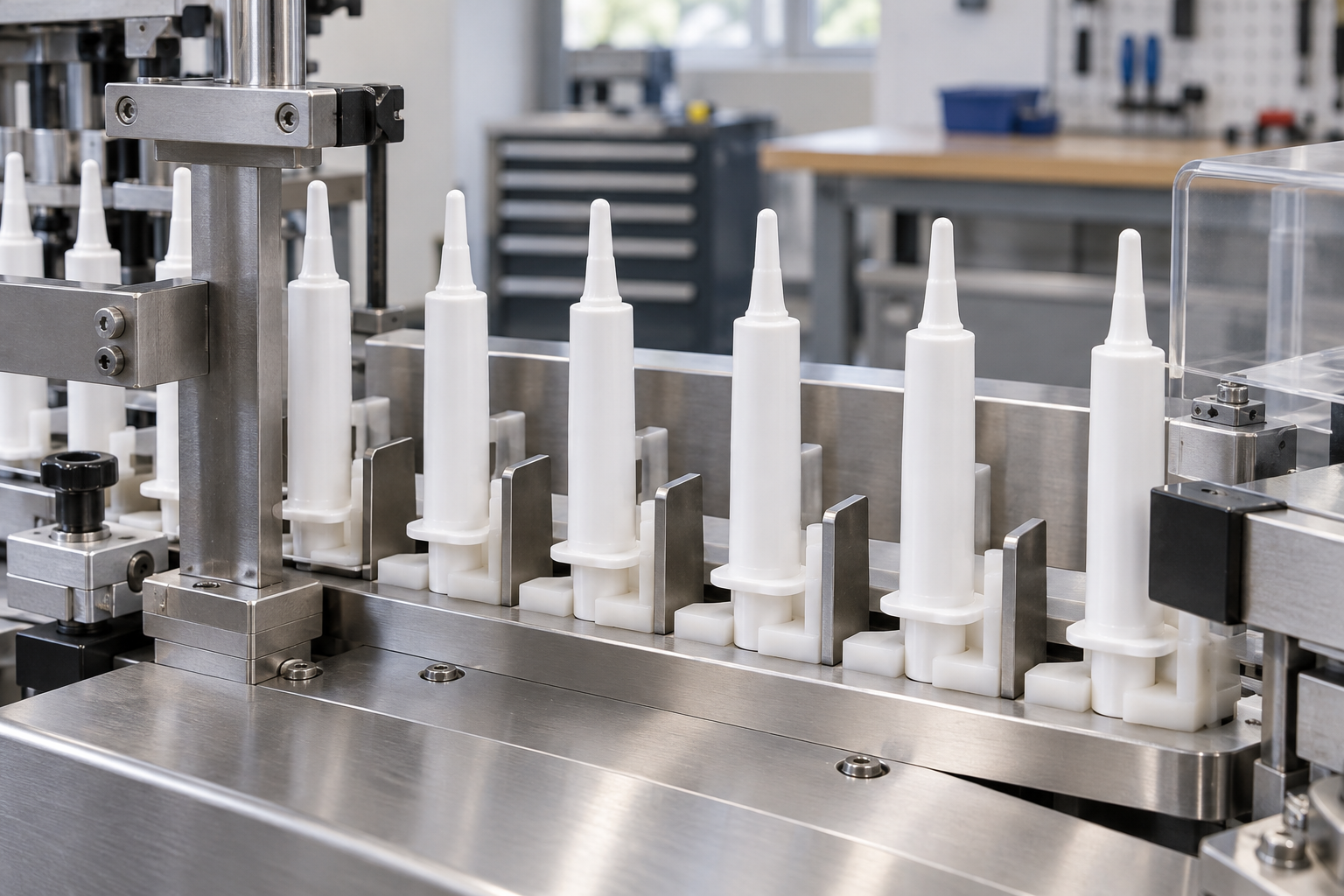
AI-generated illustration: retained package locations should be reviewed before recovery.
Preserve the setup while clearing the cause
Clearing a jam can disturb a guide, sensor bracket, pocket or format part. The recovery instruction should say which adjustments operators may make, which require maintenance support and how the approved position is restored. Using a narrow dispensing tip as a convenient handle or forcing a barrel through a guide can introduce a new issue during recovery.
Check tooling before adjusting settings
Confirm the installed format kit and its condition. A loose fastener, worn pad or incorrectly fitted nest may explain a repeated interruption. Increasing force or changing timing without reviewing the physical setup can obscure the cause. Record any adjustment and retain the previous setting where the site’s procedure requires it.
Respect protected package zones
Recovery should maintain the same contact-zone principles as normal operation. Support the barrel at its intended structural features and keep the fine dispensing end clear where contact is not allowed. The fine-tip tooling guide explains how to define those zones for the package drawing and representative samples.
Restore utility conditions
If air, power or another supplied utility was interrupted, follow the equipment-specific procedure. The team should understand which mechanisms return to a reference position, which remain occupied and which settings require confirmation. Never turn a general article into a substitute for the manufacturer’s machine safety instructions.
Send Your Requirements: Share your line sequence, package drawings and common interruption scenarios. Request a recovery review that identifies retained packages, operator checks and material-hold points.
Verify first assemblies after the restart
A first-piece review should answer whether the restored line is producing the intended package under the agreed conditions. The sample quantity and release criteria belong to the customer procedure. The important engineering principle is to connect the observation to the process steps affected by the stop.
If the interruption involved barrel transfer, inspect seating and subsequent handling. If it involved cap supply, check presence and visible seating at the designated point. If a plunger station was reset, review the agreed end-position condition. Where filling may have been affected, use the customer’s approved assessment method rather than treating visual appearance as complete product evidence.
Record the recovery condition
A short record can identify the stop category, affected station, package state, intervention, tooling or setting changes, material disposition and first-piece result. The format can be paper or electronic. The record should be timely enough that the next shift can understand what happened without an oral reconstruction.
Decide when repeated stops require escalation
Recurring interruptions deserve investigation. Useful evidence includes component lot and presentation, installed format kit, station photographs, the exact warning shown and observations before adjustment. A repeated stop should not automatically become an accepted loss factor. Review whether the cause belongs to component variation, feed presentation, tooling condition, utilities or recovery instructions.

AI-generated illustration: first-piece inspection should address the process steps affected by the stop.
Include recovery in factory testing
Factory testing can demonstrate the recovery behaviour included in the supplied scope. Agree suitable interruption scenarios before the test. A dry component run may be appropriate for observing missing components or transfer recovery; product-related questions may require a separate customer-approved trial. Do not introduce faults that could damage the equipment merely to create a dramatic demonstration.
Record the components, format parts, control configuration and conditions used. Observe where retained packages remain, how the operator is informed and which steps require confirmation. Include the reject and hold route as well as the motion restart. A successful recovery with identified trial samples supports that stated condition; it does not establish all future product or batch outcomes.
During shipment inspection, preserve the agreed recovery instructions and configuration references with the documentation pack. Installation preparation should ensure that operators can see the relevant stations and access hold containers safely. If the site adds a downstream transfer or changes the discharge route, review whether the recovery map needs updating.
Train the handover between operations and quality
An operator should know how to stop, identify affected material, clear an authorised mechanical issue and request help. Quality should know how affected units are identified and which evidence is available. Maintenance should know how to verify that tooling and settings match the approved setup after intervention.
Training is stronger when it follows a realistic example: a feed warning appears, one barrel remains before filling, another unit waits at capping and finished assemblies remain at discharge. Walk through which observations belong to each role. Keep illustrative scenarios clearly separate from actual production records.
Prepare a compact restart checklist
- Identify the stop cause and confirm it has been resolved.
- Locate retained packages and assign uncertain material to its approved route.
- Confirm component identity, installed tooling and any restored settings.
- Verify utilities and follow the supplied machine recovery procedure.
- Check the first assemblies at the points affected by the interruption.
- Record interventions, material disposition and open follow-up actions.
Use this list to develop a machine-specific instruction. It should become more precise during commissioning, using the actual station names and authorised checks.
Distinguish a short pause from an intervention
A brief pause in supply and an intervention inside a station are not equivalent recovery conditions. In the first case, the package route may remain physically unchanged. In the second, an assembly may have been moved, a format part adjusted or a station returned to a different position. The restart instruction should identify which circumstances need additional verification rather than relying only on the duration of the stop.
Protect the record before clearing the condition
When safe, capture the station condition and warning information before intervention changes the evidence. Identify the last known good observation and the point at which package status became uncertain. This supports a proportionate review of affected material. It does not authorise an operator to reduce a hold boundary without the appropriate decision.
A common documentation weakness is recording only the correction: “guide adjusted” or “cap supply restored.” Record the observed condition as well. Otherwise a later recurrence cannot be compared with the earlier event. Details such as a particular component lot, partly depleted tray or recently changed kit can direct a more useful investigation than an assumed cause.
Return adjusted stations to a controlled basis
If a technician changes a guide, nest or station position, compare the new condition with the approved setup references. Confirm the actual component’s seating and protected surfaces. Then perform the checks relevant to subsequent assembly. A barrel that sits differently after intervention may affect both filling access and plunger or cap handling.
The customer should define who can approve the revised setup and whether the change needs a controlled record. Do not silently overwrite a baseline that was established during factory testing. A changed condition can be appropriate, but its reason and verification should remain visible.
Review the discharge hand-off after recovery
The line’s recovery map should extend to the point where accepted assemblies leave the supplied equipment. Identify any units waiting between discharge and downstream packaging. If a downstream conveyor stops while the filling equipment pauses, material may remain on both sides of the interface.
Agree which team controls that retained material and how its status is communicated. A downstream operator should not have to infer acceptance from the fact that the filling line has restarted. Where the integration is supplied by another party, document the boundary and coordinate its recovery procedure without claiming control functions that are outside the delivered scope.
Following a restart, compare the first-piece inspection record with the material movement record. The two answer different questions: whether checked assemblies met the stated observations, and whether uncertain material remained segregated. Keeping both records clear helps a shift handover avoid mixing verified first pieces with units awaiting review.
FAQ
Can all packages inside the line continue after a stop?
Only when their state and the approved procedure permit it. Packages at different stations may have completed different steps. Define a hold route for units whose status cannot be established.
Should restart always be automatic?
The appropriate recovery depends on the interruption and supplied controls. Ask which states are detected, which need operator confirmation and how retained packages are handled.
Is a visual first-piece check sufficient?
It may answer visible assembly questions. Filling, product quality and other requirements need the assessment methods defined by the customer’s procedure.
What information helps investigate repeated stops?
Record the station, warning, component lot, incoming presentation, format kit, previous settings and the observed condition before adjustment. These details help separate likely causes.
Can recovery be checked before shipment?
Yes, within agreed factory-test conditions. Use safe planned scenarios and document the samples and configuration. Site-specific recovery still needs review after installation.
Conclusion
A controlled restart links the cause of the stop to retained package states, the restored machine setup and meaningful first-piece checks. For intramammary applicators, the strongest recovery instructions cover barrel handling, filling hand-off, plunger and cap assembly, rejects and discharge as one connected route.
Contact Us: King Pack can discuss recovery requirements within a proposed intramammary applicator line, including factory-test observations, documentation and operator handover. Send your package format and process sequence to define the review scope.
—