 Skip to content


Introduction
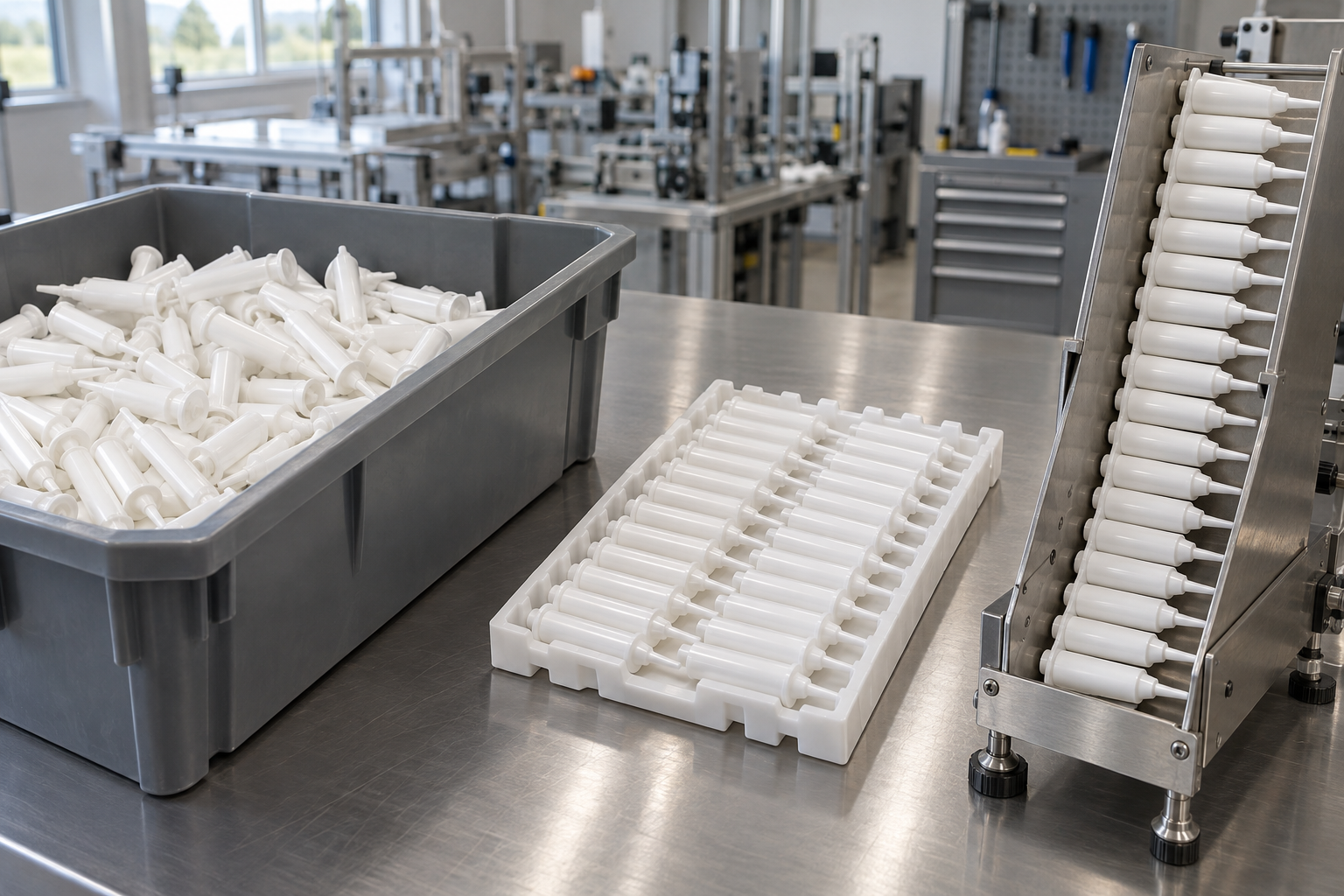
Before an intramammary barrel reaches a filling nozzle, it has to leave its supplied package, separate, orient and transfer into controlled tooling. The same barrel can behave very differently when supplied in a bulk bag, a tray, a magazine or a nested holder. Component presentation is therefore an engineering input, not a purchasing afterthought.
This guide helps veterinary manufacturers specify presentation for non-sterile intramammary barrel, plunger and cap feeding. The final feeder configuration must be confirmed with representative components and the customer’s real supply conditions.
The direct answer
Specify component presentation by describing the component, incoming pack, orientation state, allowable contact surfaces, supply-lot variation and expected transfer into the line. Select bulk, tray or magazine presentation around the package geometry and production route rather than assuming one feeder suits every intramammary format.
Request a feeding-route review
Send photos of incoming barrels, plungers and caps in their supplied packaging. We can identify the questions that affect separation, orientation and transfer into the line.
Describe what arrives at the factory
The supplier needs more than “loose components.” Record container type, quantity per pack, whether components are nested, whether caps face a repeatable direction, bag or tray material and any protective separators. Include actual photos, not only a drawing. Static charge, surface condition and packing compression can alter how a lightweight cap or barrel separates.
Compare the common supply routes
| Presentation | Often useful when | Main issue to verify |
|---|---|---|
| Bulk | components are robust and can be separated without damage | orientation, tangling and cosmetic contact |
| Tray | package orientation or protection is important | tray-to-feeder transfer and replenishment |
| Magazine/nested holder | controlled presentation is needed at entry | interface geometry and holder replenishment |
No option is universally superior. Bulk presentation can simplify incoming logistics but may need more orientation control. Trays can protect fine tips but introduce an additional transfer. Magazines can offer controlled presentation but must match the actual component and replenishment process.
Protect the package while creating orientation
The goal is to orient the barrel or cap without using a fine cannula or cosmetic surface as an uncontrolled guide. Identify safe location features, such as a flange or defined body area, and show them in the handling review. For caps, define which feature identifies orientation and which surface can receive feeder contact.
During factory testing, observe the route at normal starts, controlled stops and replenishment. Record manual interventions. A feeder that runs briefly after hand-arrangement should not be treated as proof that the incoming presentation is suitable for routine operation.
Link presentation to component approval
Component lot qualification should include supply state. A compatible barrel supplied in a different tray or a cap supplied by a new mold may no longer behave the same at the feeder. When purchasing changes packaging, suppliers or nesting, route the change through the customer’s engineering and quality controls.
Include replenishment and operator access
An elegant feeder layout can still cause downtime if it is difficult to replenish safely or if an operator must reach across a moving transfer. Discuss the expected replenishment method, access, cleaning boundaries and the customer’s guarding procedures during layout review. The correct design depends on the agreed production environment and responsibility split.
Specify each component stream separately
Barrels, plungers and caps do not necessarily benefit from the same presentation. A barrel may need tip protection and stable orientation; a lightweight cap may need separation without interlocking; a plunger may need support that prevents neighbouring stems from tangling. Define each stream and then review how their replenishment cycles interact at the complete line.
Purchasing specifications should identify the received package as part of the supply item. Include pack quantity, physical arrangement, protective materials and permitted alternatives. If a supplier can substitute a bag for a tray without approval, the feeder design is being asked to accept an undefined input. The appropriate response is to clarify the supply boundary before tooling is finalised.
Barrels: protect the features that determine transfer
Show the barrel in its supplied orientation and document which features remain exposed during removal. Fine tips and flanges can become catch points when components are densely packed. A trial should observe whether separation changes their condition before the barrel reaches its nest.
Do not assume a tray protects every relevant surface. A pocket may support the body well while allowing a tip to touch the tray wall during handling. Review contact zones with the component drawing and physical samples. If the customer changes tray geometry, repeat the review of the affected interface rather than relying solely on the unchanged barrel drawing.
Plungers: describe nesting and stem behaviour
Plungers can arrive loose, aligned or partially nested. Describe whether stems overlap and how the packing opens. A feeder demonstration with carefully separated samples does not answer how the actual supplied pack behaves. Include samples that represent ordinary packing variation, with lot identity preserved.
Where a component has more than one visually similar orientation, identify the feature that controls correct presentation. Ask how the proposed route establishes that orientation and what happens when it cannot. Confirm delivered detection and rejection features in writing; do not assume an inspection device is included simply because the feeding system is automatic.
Caps: review separation as well as direction
Cap shape, wall stiffness and mating features affect whether neighbouring caps nest or interlock. During sample preparation, photograph the supplied condition before disturbing it. Observe whether the agreed handling route separates the caps without unacceptable marks or deformation.
A cap feeder also needs a defined response to depleted supply or an uncertain orientation. Ask what the operator sees, what intervention is permitted and how affected assemblies are identified. These are project questions, not claims that every feeder automatically detects every cap condition.
Compare presentation routes against the buyer’s actual constraints
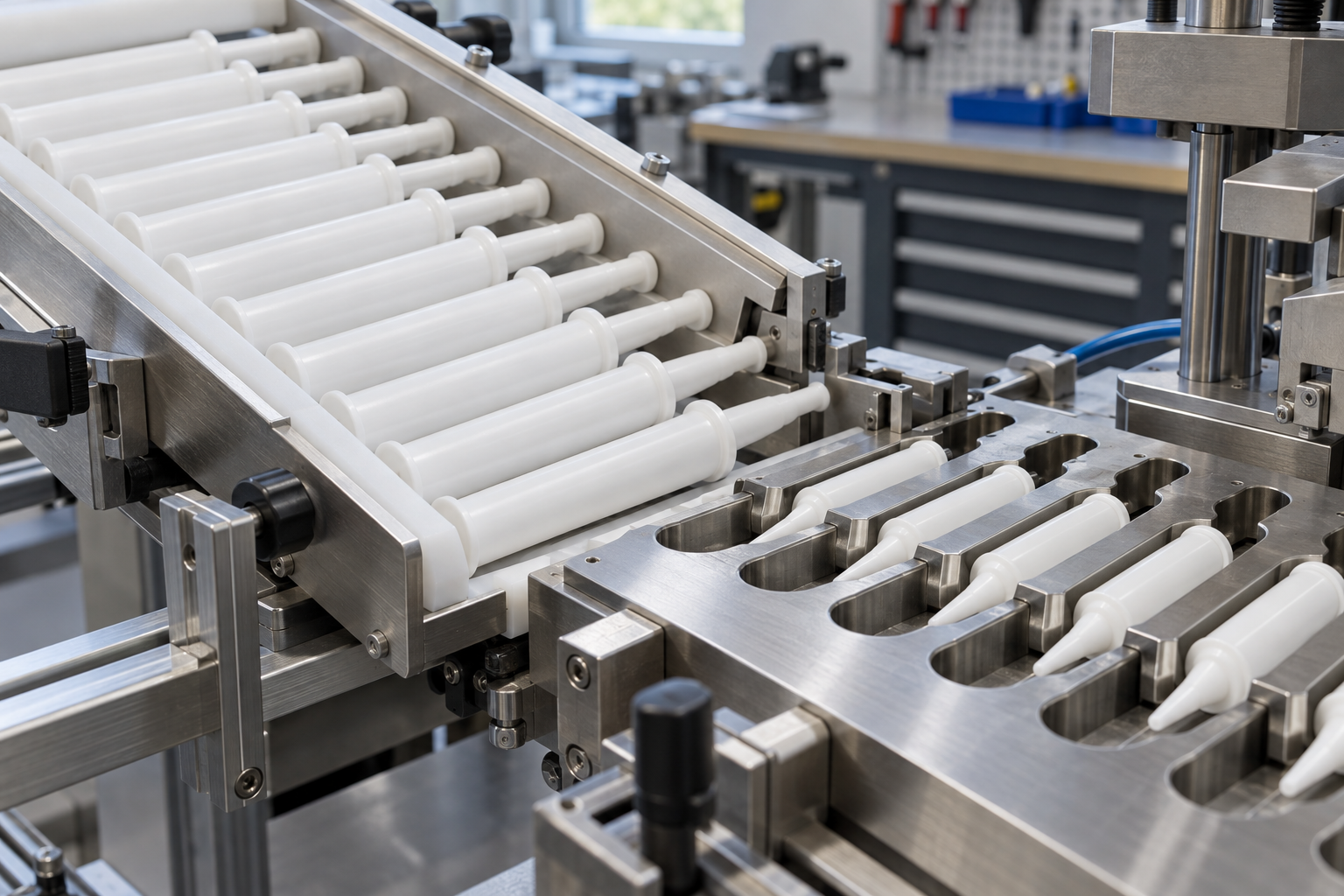
The practical comparison is not “which feeder is best?” but “which presentation can this component supply chain maintain?” A proposed magazine route may offer clear orientation yet require the component supplier to supply compatible holders. A tray route may protect parts but introduce return logistics. Bulk supply may use simpler containers while requiring more separation and contact during feeding.
Review these consequences with purchasing, production and the component supplier. Confirm who supplies trays or holders, whether they are single-use or returned, how damaged packs are handled and whether the line needs a buffer between replenishment and transfer. Do not claim a lower total cost without a project-specific calculation covering these tasks.
Use an interface comparison rather than a preference
For each proposed route, document the input condition, separation method, orientation reference, contact surfaces, transfer point and operator task. Identify the evidence already available and the questions still requiring physical samples. The comparison can support a decision even when no measured performance figure is yet available.
A clear specification may eliminate a route early. For example, a customer may need the fine tip to remain protected until a defined step, while a proposed bulk route exposes it to uncontrolled contact. That is a handling-boundary question. The next action is to review another presentation or a different separation method, not to make an unsupported promise that cosmetic damage will never occur.
Mid-article CTA — Send your incoming-pack photos
Share the actual carton, tray, bag or magazine used for your applicator components. We can structure a sample-trial review around the required feeding and transfer route.
Test the received pack, not only the isolated part
A representative trial should start with the package in the state the line will receive. Open it using the intended procedure, replenish the proposed interface and observe separation through transfer. Record interventions and retain the link between the supplied pack and the component lot.
Include realistic replenishment conditions
Prepare a review plan for a full incoming pack, a partly depleted pack and the transition to the next pack where relevant. The purpose is to observe the agreed handling sequence, not to establish a universal sample size or operating rate. The customer and supplier should set trial quantities according to the decision being made and the available materials.
Keep ordinary supply variation distinct from artificial fault scenarios. If a damaged tray is introduced deliberately, label it as a planned challenge. If damage is observed in received material, record it as that condition. Mixing the two makes later interpretation difficult.
Record unsuccessful transfers usefully
When a component fails to separate or locate, document where it came from and its orientation before intervention. Photograph the condition where safe and record the affected tooling or interface. An observation such as “feed issue” is too vague to distinguish interlocking, tray clearance, replenishment handling or a component mismatch.
Change one relevant factor at a time where practical and permitted. If the team changes the supplied arrangement and tooling simultaneously, the next successful run may not explain which change mattered. Preserve both the original observation and the revised trial condition. A supplier should explain what was demonstrated and what remains unverified.
Define replenishment as part of the operator workflow
A replenishment method should specify where the operator stands, how the incoming pack is opened and which actions take place while the machine is running or stopped. Follow supplied guarding instructions and the site’s procedures. Never make reaching into an active transfer a routine solution to irregular supply.
Discuss how the operator distinguishes replenishment stock from rejected or returned components. Locate containers so their identities remain visible. If a tray is reused, agree the inspection and cleaning responsibility before it re-enters service. Those responsibilities may belong to the customer or component supplier rather than the machine supplier.

Plan for interrupted supply
A component stream may become unavailable before the other streams are depleted. Define the appropriate line response and treatment of retained packages using the machine instructions and customer procedures. Do not infer the state of an assembly solely from the presence of a barrel at discharge.
Review replenishment alongside the line stop and restart plan. That plan owns recovery decisions; the presentation specification owns the condition delivered to the feeder. Keeping these questions separate makes the documents complementary rather than duplicative.
Control presentation changes after the first project
A supply change can alter feeding even when the part number remains unchanged. Examples include a new pack material, changed tray pocket, different packing density or a supplier’s revised component orientation. Require the purchasing process to identify such changes before they reach routine production.
The review should focus on the interface affected. A changed carton may only require handling review; a changed tray pocket may affect separation and transfer. Component lot approval and presentation approval should be linked but should not be collapsed into a single undocumented “compatible” decision.
Prepare useful evidence for a supplier review
Send photographs of the complete pack, close-ups of the component arrangement and the relevant drawings. Identify revisions and include representative physical samples when requested. State whether the presentation shown is already in routine supply or only proposed. That distinction helps prevent tooling being designed around a pack the component supplier cannot deliver.
For factory testing, preserve the presentation details in the test record. During shipment inspection, confirm the supplied interfaces and format parts against the agreed list. Installation preparation should arrange the real incoming containers and replenishment area, not merely a tray of hand-selected components. This connects the original decision to the operating site without overstating what the trial proves.
Send Your Requirements: Share barrel, plunger and cap packs as actually received, together with your replenishment workflow. Ask for a presentation-interface review before selecting the feeding route.
Write a presentation specification that purchasing can maintain
A useful specification should name the approved component pack and identify which alternatives require review. Include photographs with revision references and describe the orientation expected when the container is opened. Do not leave critical details in a supplier conversation that purchasing cannot later retrieve.
Ask the component supplier to identify changes before shipment. The customer should decide which changes can be reviewed from drawings and which need physical trial evidence. This keeps the requirement practical: not every carton update requires a complete feeding trial, but a changed interface should not be treated as an administrative detail.
Connect the presentation reference to receiving instructions so that the site can recognise the expected pack. When an unexpected supply condition arrives, hold it for the defined review rather than hand-arranging it to resemble an approved trial. That distinction preserves the evidence behind the original feeder decision.
FAQ
Can loose bulk barrels feed directly into any intramammary line?
No. The barrel geometry, cannula protection, incoming condition and required orientation determine whether the line needs separation, nests or another controlled route.
Are trays always safer for fine-tip applicators?
They can improve protection and orientation, but the tray-transfer interface must still be verified with physical samples.
What should be sent for a trial?
Send representative components in their real incoming presentation, with drawings and lot identification where available.
Does a change in incoming packaging need a feeding review?
It may. Identify whether the change affects separation, orientation, contact or transfer. A revised outer carton and a revised tray pocket are different changes. Use drawings, supplied-pack photographs and representative samples to determine the evidence needed before routine use.
Should a feeder trial use hand-arranged components?
Hand-arranged samples can answer a limited station question, but they do not represent the full incoming presentation. State that limitation in the record and separately review opening, replenishment and separation with components in their actual supplied pack.
Conclusion
Component presentation shapes the first engineering decision in an intramammary filling line: how the package becomes stable, oriented and ready for the next station. Define the real incoming condition early, then prove the route with representative samples.
Discuss your component feeding requirements
Contact Us: KINGPACK can review incoming applicator-component presentation as part of a proposed intramammary filling and handling route. Contact us with package photos, samples and target production requirements.
—
