
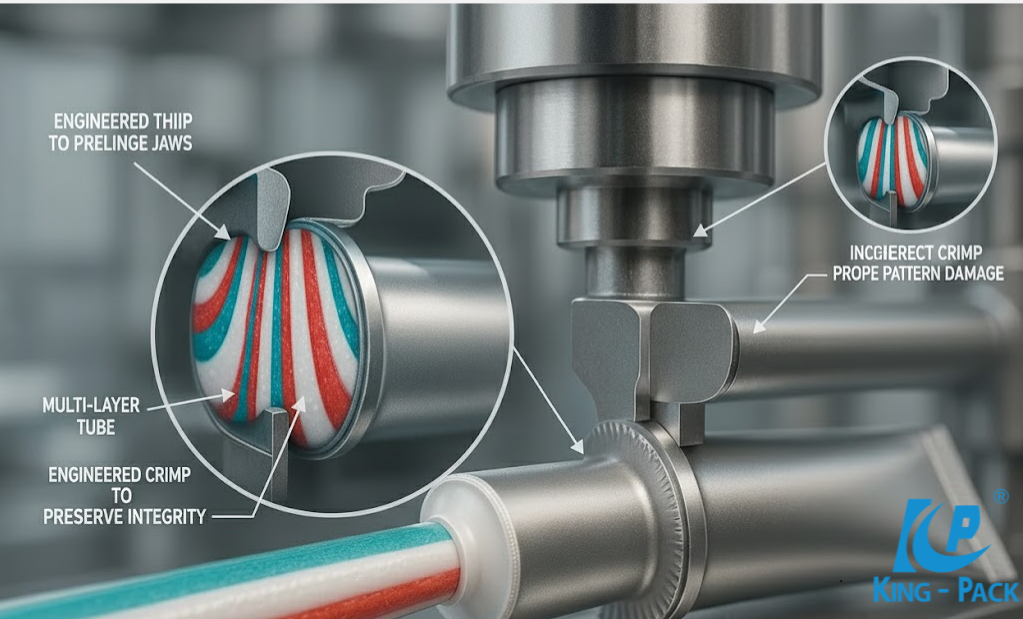
Striped toothpaste works by keeping a main paste and one or more colored pastes sufficiently separated during storage, then bringing them together in a controlled pattern as the product passes through the tube shoulder and nozzle. The exact mechanism depends on the package design: some use an internal striping insert near the outlet, while others use separate chambers or segmented product arrangements. The toothpaste formulation, dispenser geometry and filling process must be developed together.
Quick Answer: Why the Stripes Do Not Immediately Mix
Toothpaste is a structured, highly viscous material that does not flow freely like water when it is undisturbed. If the main paste and stripe paste have compatible rheology and stability, normal storage does not necessarily create enough movement to blend them quickly. When the tube is squeezed, pressure moves the components through defined passages, and small ports or divided outlet geometry place the colored material on or beside the main strand.
This is not one universal design. A 1957 striping-dispenser patent describes a main passage with lateral striping ports, while later designs include multi-chamber, segmented and pump-dispenser arrangements. The package supplier’s actual design determines where each paste is stored and how it reaches the outlet.
Two Common Striped-Toothpaste Package Concepts
| Concept | How the components are arranged | How the pattern is formed |
|---|---|---|
| Single tube with a striping insert | Main paste and stripe material occupy controlled regions near an internal outlet structure | Stripe material enters through small side ports as the main paste passes through the central outlet |
| Multi-chamber or segmented package | Components remain in separate chambers or defined segments | Separate passages bring the components together at or near the dispenser outlet |
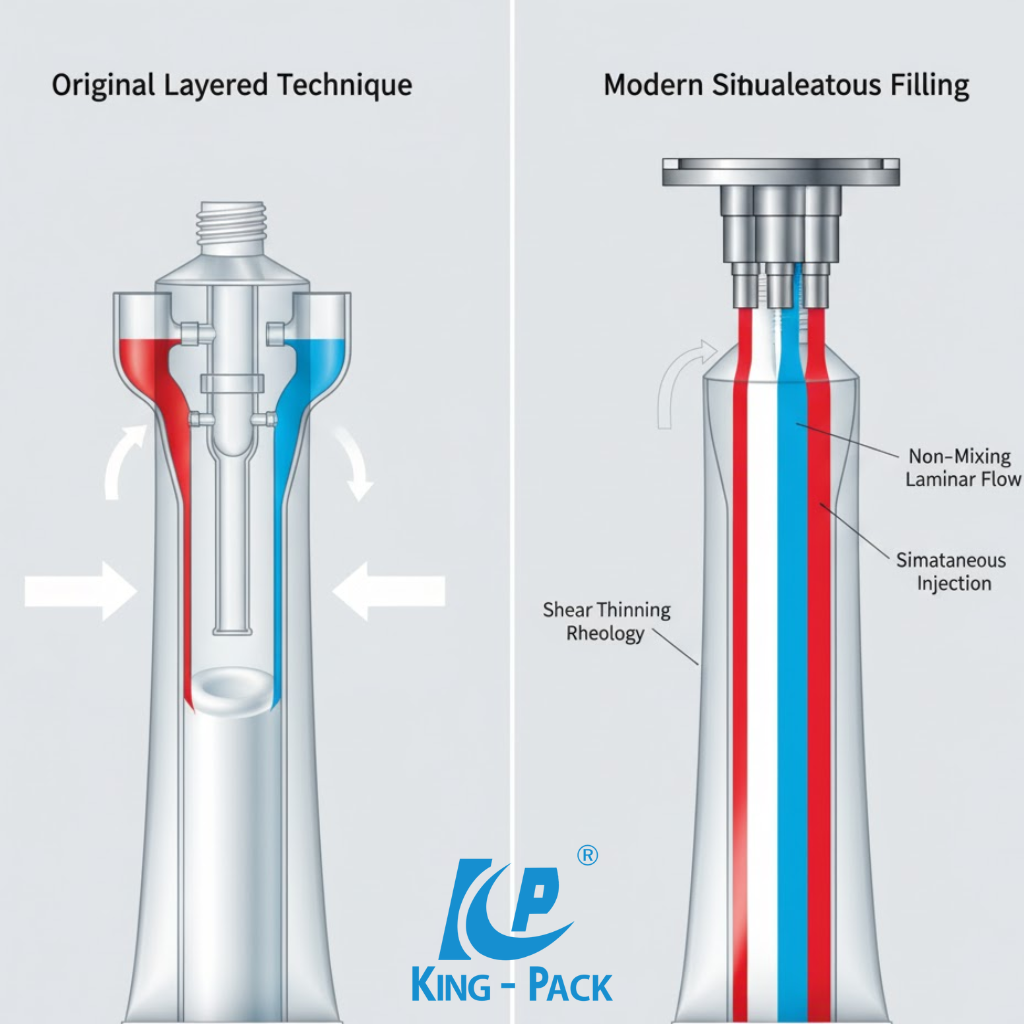
The terms “striped” and “layered” are sometimes used loosely, but the package architecture can be different. A later toothpaste-dispenser patent distinguishes a colored stripe deposited through outlet features from layered products that rely on multiple chambers. For manufacturing, that difference changes the number of product feeds, filling sequence, nozzle design and quality checks.
How the Nozzle Creates the Stripe Pattern
In an insert-type design, the main paste moves through a central passage. The colored paste reaches small openings around that passage. As pressure pushes both materials toward the nozzle, the colored paste is deposited onto the surface of the main strand. The number, size and location of the ports influence stripe count and width.
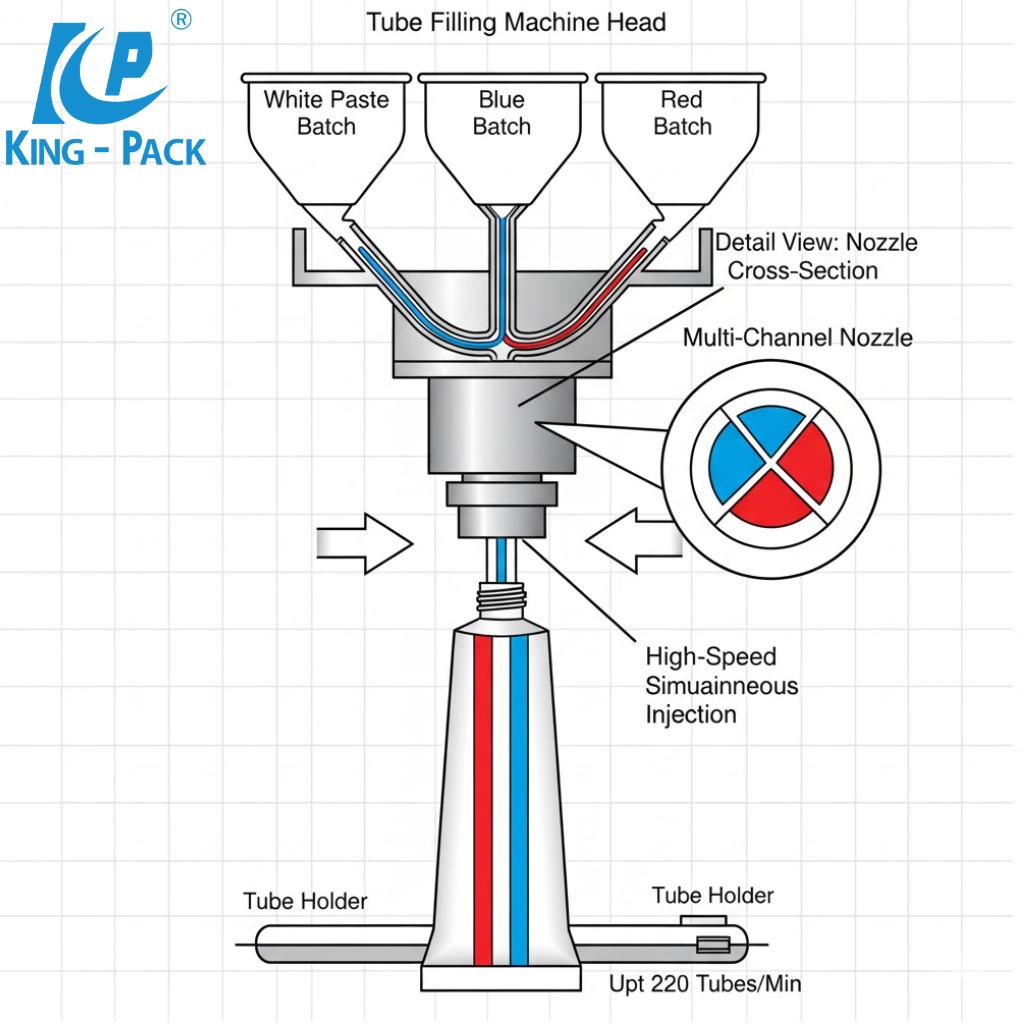
In a multi-chamber design, each component has a separate storage and flow path. The outlet geometry brings the streams together as adjacent bands, concentric layers or another defined pattern. The consumer sees the result only after dispensing; the internal arrangement may not look like a finished striped strand throughout the entire tube.
The Role of Rheology and Formulation
Package geometry cannot compensate for incompatible pastes. The main and colored components need suitable viscosity, yield behavior, density, lubrication, stability and pressure response. If one component flows much more easily, the stripe ratio can change as the tube is squeezed. If the components migrate, react or separate during storage, the pattern and product quality may deteriorate.
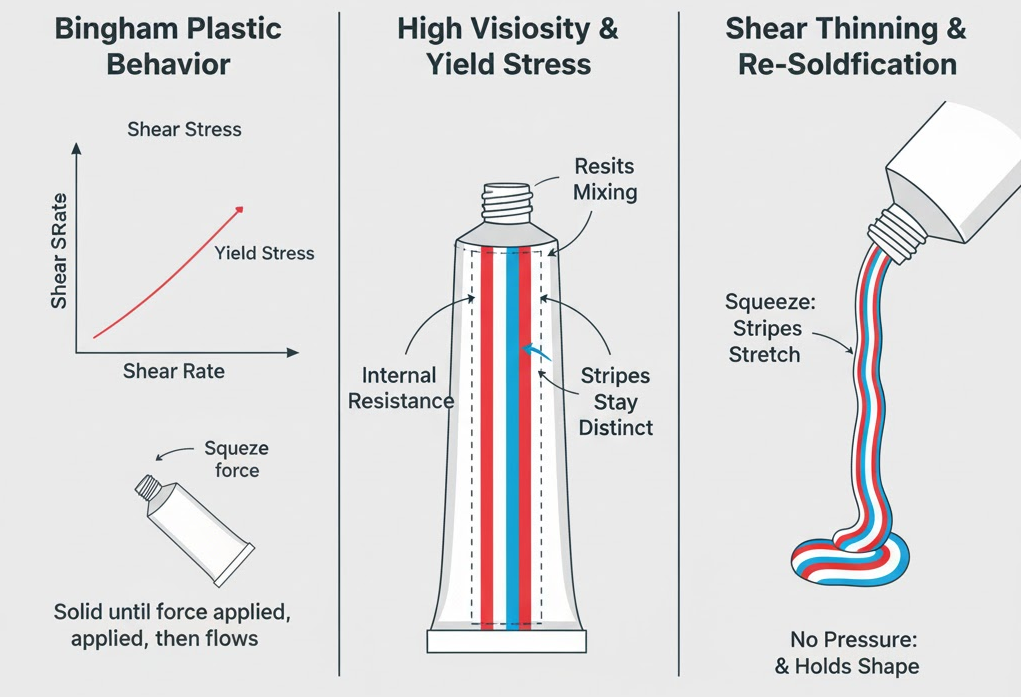
- Viscosity and yield behavior: influence storage stability and the pressure needed for dispensing.
- Flow ratio: determines the relative amount of main and stripe paste in the dispensed strand.
- Density and stability: affect migration or separation during shelf storage.
- Particle and abrasive content: affect pumps, valves, seals and nozzle wear.
- Air content: can interrupt stripes, change dose repeatability and create voids.
Does Each Toothpaste Color Have a Different Function?
Not necessarily. A stripe may be a colored version of the base formulation, or it may contain a different ingredient system. The original striping-dispenser patent explicitly allowed the stripe material to be either colored base material or an active component. The current product formula and label—not the color alone—determine its function.
How Striped Toothpaste Is Filled
The filling sequence depends on the package. A single-tube insert system may require controlled placement of the stripe material near the outlet region and a separate fill for the main paste. A multi-chamber tube requires each component to be delivered to the correct chamber. The equipment supplier must work from the actual tube and insert drawings rather than assuming a standard toothpaste nozzle.
- Prepare and deaerate each toothpaste component under controlled conditions.
- Transfer each component to its dedicated product feed without introducing excessive air.
- Load and orient the tube or dispenser body.
- Position the striping insert or verify the multi-chamber package geometry where applicable.
- Meter the stripe and main pastes in the validated sequence and ratio.
- Keep product away from the tail-seal area.
- Seal or fold the tube, code it and discharge it for inspection.
Tube Filling Machine Requirements
| Requirement | Why it matters |
|---|---|
| Separate product circuits | Prevents unintended mixing and enables independent control of each component |
| Ratio and timing control | Maintains stripe width and appearance through start, run and restart conditions |
| Low-air transfer and dosing | Reduces voids and interruptions in the dispensed pattern |
| Tube and insert positioning | Aligns the internal package feature with the filling arrangement |
| Clean nozzle cut-off | Protects the tube tail and avoids contamination of the seal |
| Recipe and changeover control | Supports repeatable settings across tube sizes and color combinations |
A standard single-component toothpaste filler may not be sufficient. The machine may need multiple hoppers, pumps, cylinders or channels, plus custom nozzles and package tooling. Review our toothpaste tube filling machine options for the base equipment platform.
Critical Quality Checks
- Stripe count, width and continuity: inspect the full dispensed strand, including the beginning and end of tube life.
- Component ratio: define how the stripe-to-base proportion will be measured.
- Net content: verify total fill weight or volume independently from visual appearance.
- Air pockets: check for voids that interrupt dispensing or change the stripe pattern.
- Storage stability: evaluate color migration, phase separation and dispensing after the required aging conditions.
- Tube seal: confirm tail cleanliness, appearance and leak performance.
Common Stripe Defects and Possible Causes
| Observed defect | Areas to investigate |
|---|---|
| Stripe disappears intermittently | Air in the stripe feed, blocked port, low stripe pressure or unstable ratio |
| Stripe becomes too wide or narrow | Viscosity change, pressure imbalance, port dimensions or temperature |
| Colors smear inside the package | Formulation compatibility, migration, excessive movement or unsuitable storage |
| Pattern changes after restart | Line priming, residual pressure, timing or product settling |
| Tube tail is contaminated | Overfill, nozzle withdrawal, stringing or incorrect dose position |
Information to Include in Your RFQ
- Tube, insert, shoulder and nozzle drawings plus normal production samples
- Number of paste components, colors and required pattern
- Viscosity range, density, temperature, abrasiveness and air sensitivity of each component
- Target component ratio and permitted visual variation
- Fill range and required accepted output
- Cleaning method, color-change frequency and target changeover time
- Tube sealing, coding, inspection and downstream packaging requirements
Factory Acceptance Test for Striped Toothpaste
Use the actual components and package whenever practical. The test should cover start-up, stable production, a normal stop and restart, and the end of a batch. Record fill weight, component ratio, stripe appearance, interruptions, air pockets, seal condition, accepted output and changeover time. Dispense samples from the beginning, middle and end of selected tubes instead of judging only the first squeeze.
Striped Toothpaste FAQ
Are the stripes already formed throughout the whole tube?
Not in every design. Some packages store the components in controlled regions and form the visible stripe as the pastes pass through an internal insert or outlet. Other designs use separate chambers or segments.
Why do the colors stay separate?
The components are formulated to remain stable and resist flow when undisturbed, while package geometry limits unwanted movement. Compatibility still has to be proven through storage and dispensing tests.
Can an ordinary toothpaste filling machine make striped toothpaste?
Usually not without special product circuits, metering controls, nozzles and package tooling. The required configuration depends on the striped-toothpaste package design.
Does each stripe contain a different active ingredient?
Not necessarily. The stripe can be colored base material or a distinct formulation. The product specification and label provide the correct answer for a particular toothpaste.
Plan a Striped Toothpaste Filling Project
KING PACK can evaluate product feeding, multi-component dosing, tube filling, sealing and inspection around your formula and package. Review the related toothpaste filling machine guide, explore our packaging solutions, or send your tube and stripe requirements for a technical proposal.