
Introduction
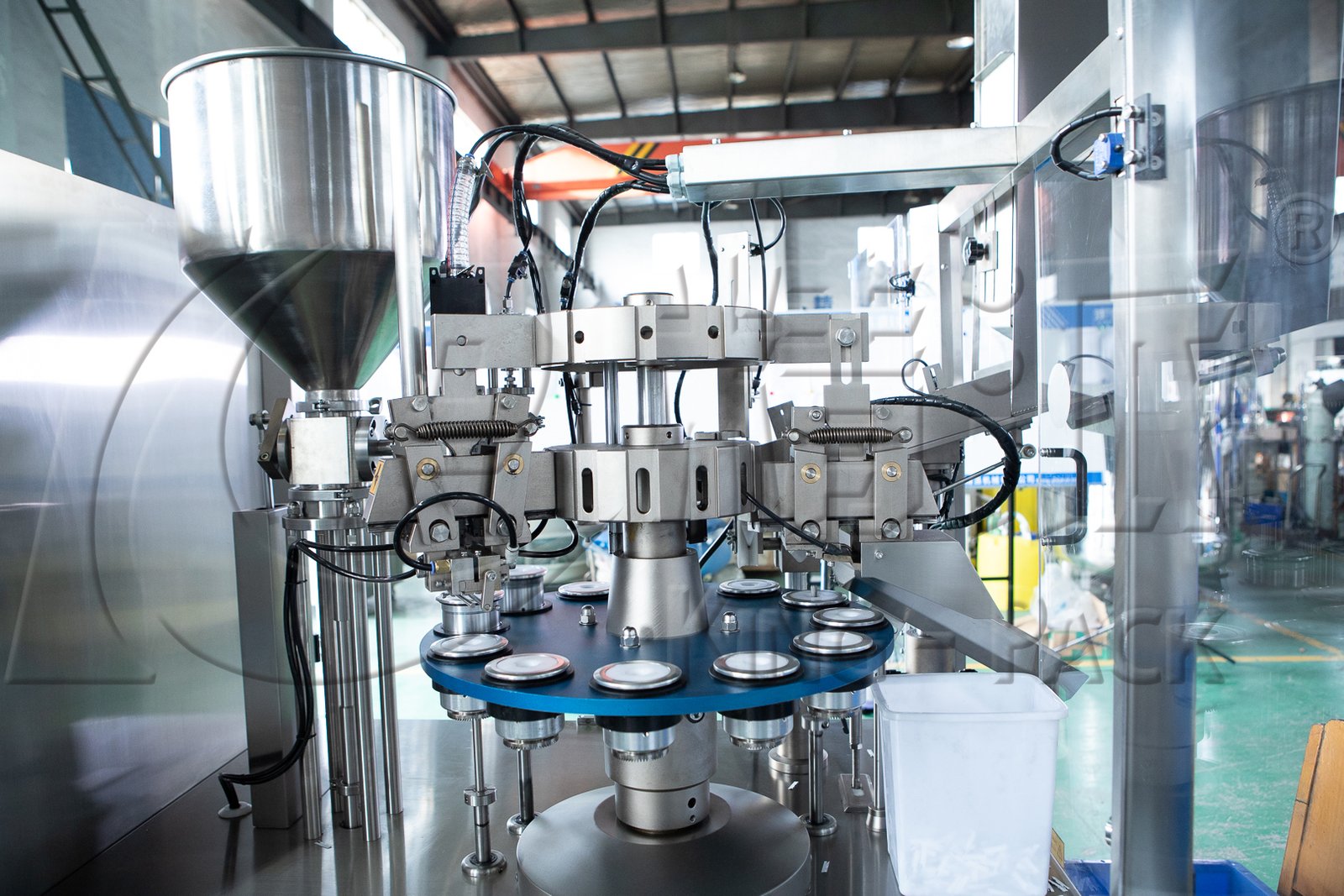
Standard toothpaste filling is a solved problem. Multi-color striped toothpaste and herbal formulations are a different challenge entirely. Both require filling technology that goes beyond the basics, either to keep colors sharply separated inside the tube, or to protect sensitive natural ingredients from shear and heat damage during the fill cycle.
This article covers what makes multi-color toothpaste filling and herbal toothpaste filling technically demanding, what precision equipment looks like in practice, and how to match machine capability to formulation requirements.
Why Precision Matters More Than Ever in Toothpaste Filling
The Rise of Premium Toothpaste Formulations
Toothpaste brands increasingly differentiate products through formulation, visual appearance, and ingredient positioning. Those choices make the filling process more sensitive to viscosity, particle content, colour separation, temperature, and the required tube format. Validate the actual formulation and acceptance criteria before selecting equipment.
Multi-color striped toothpaste uses visual differentiation as part of the product presentation. Whether that supports a commercial premium depends on the brand, channel, formulation, and demand; it should be validated from the buyer’s own production and sales data rather than assumed.
Challenges Beyond Standard Plastic Tubes Paste Filling
A single-color standard toothpaste filling machine handles one paste from one hopper through one nozzle. Add a second or third color stripe, and you immediately introduce the risk of color bleeding if flow rates, viscosities, or nozzle pressures are mismatched. Add herbal actives like neem oil, clove extract, or aloe vera, and excessive shear force or temperature during filling can degrade those active compounds before the tube is even sealed.
Standard filling equipment does not account for these variables. Precision toothpaste filling machines do.
Understanding Multi-Color Toothpaste Filling Process
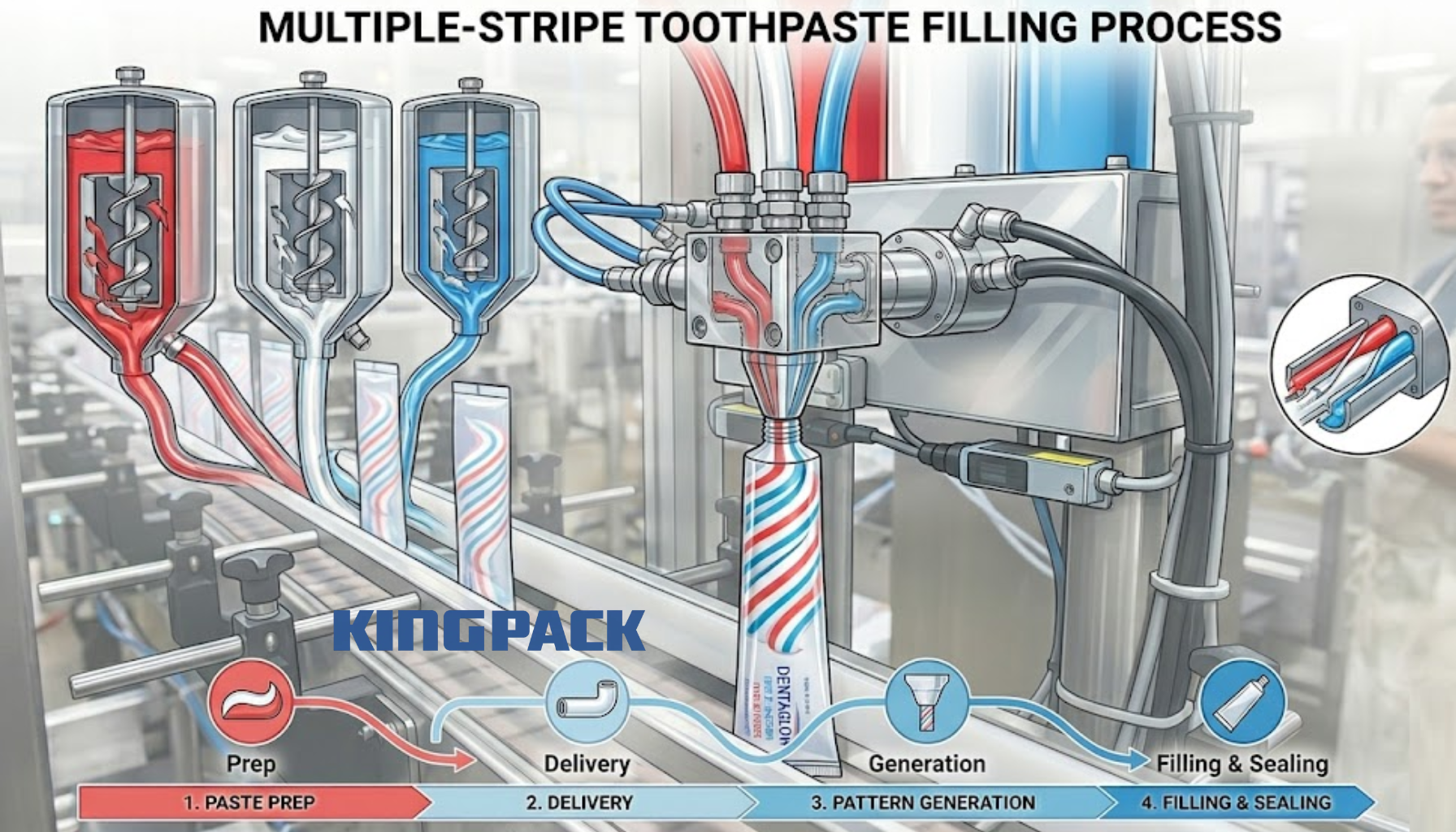
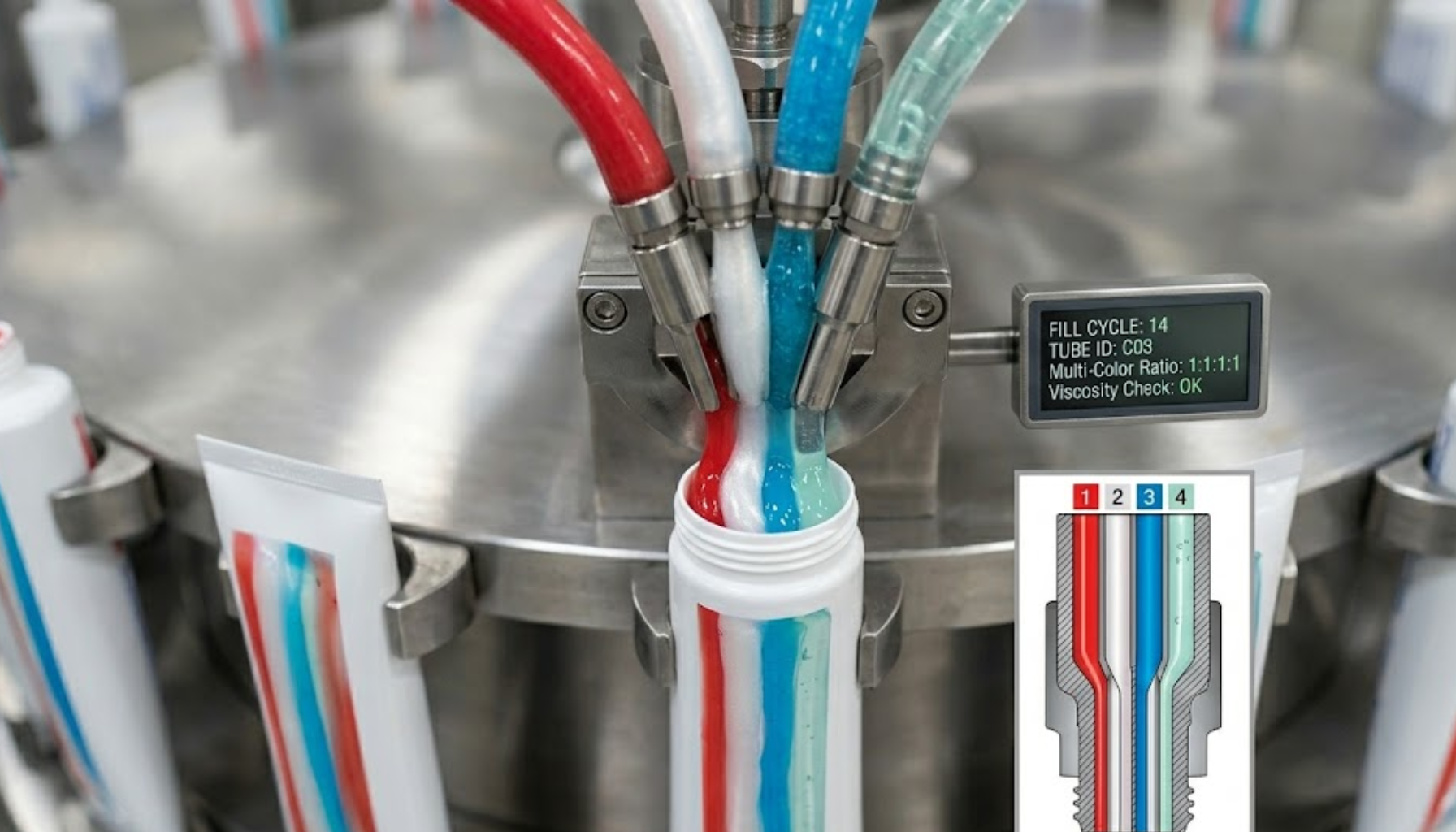
Multi-color toothpaste filling requires separate material supply for each color: individual hoppers, dedicated pumps, and isolated flow paths leading to a shared multi-channel nozzle. Each channel must deliver its paste at a precisely controlled flow rate so that the stripe proportions remain consistent tube to tube.
Basic Working Principle
The nozzle assembly for a multi-color toothpaste filler positions separate channels concentrically or side by side, depending on the stripe pattern required. As the nozzle enters the tube and paste is dispensed, each color flows through its own channel and fills its designated section of the tube cross-section.
Toothpaste rheology varies materially by formulation, temperature, particle loading, and shear history. A sample test should confirm the usable viscosity window, colour separation behaviour, and tube-material compatibility instead of relying on a universal viscosity range.
A suitable semi-automatic or automatic tube filler must be configured and tested for the number of colour channels, paste rheology, fill volume, and sealing method. Equal flow cannot be assumed without channel calibration and a documented sample run.
Two-color systems use two hoppers and pumps, while three-color systems use three. Each channel must be calibrated to properly fill tubes. If one channel runs faster, stripe balance shifts during production.
Ultrasonic or other sealing methods may be appropriate depending on the tube material, seal geometry, and process requirements. The sealing method should be selected and verified during a sample test alongside the filling setup.
Key Technical Requirements for Color Separation in Sealing Machine in Laminated Tubes
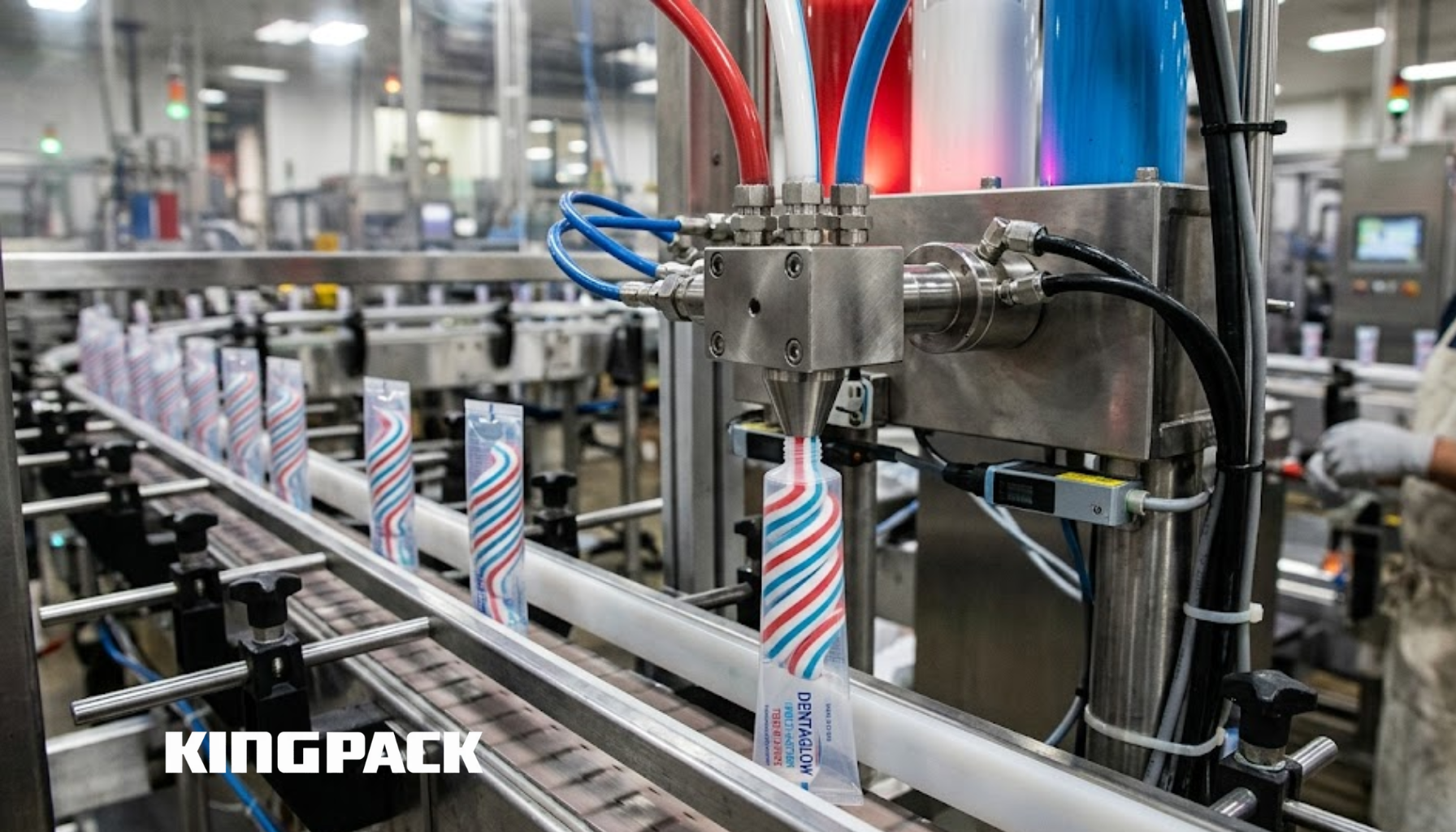
The critical parameters for clean color separation:
- Matched viscosity profiles across all color pastes to maintain equal flow pressure
- Synchronized pump timing so all channels start and stop simultaneously
- Nozzle geometry that keeps channels physically separated up to the point of dispensing
- Controlled fill speed to prevent turbulence at the tube entrance
Sealing is equally important for visual quality. If the tail crimping or folding process applies uneven force, it can compress and smear the stripe pattern at the tube tail. Our machines are engineered to crimp without distorting the stripe geometry, maintaining sharp visual separation from shoulder to seal.
Advantages of Multi-Color Filling Systems
Stripe differentiation serves multiple product functions. Different colored zones can contain different active ingredients, whitening agents in one stripe, sensitivity protection in another, and fresh breath compounds in a third. The visual separation is both aesthetic and functional.
Multi-color presentation can support a differentiated product, but commercial value depends on the formulation, packaging, channel, and demand. Evaluate the business case using the buyer’s own volumes, labour, waste, changeover, and sales assumptions.
Precision Filling for Herbal and Natural Toothpaste
Herbal toothpaste formulations place higher demands on toothpaste filling and tube sealing systems. Active ingredients such as neem, clove, and aloe vera are sensitive to stress, and improper handling can affect product quality, shelf life, and brand reputation.
Unique Properties of Herbal Formulations
Herbal toothpaste viscosity tends to be less consistent than synthetic formulations. Natural extract concentrations affect rheology. Particle-containing formulations, those with charcoal, miswak, or botanical powders, add further variability to flow behavior.
Herbal and particle-containing formulations need formulation-specific process checks. Neem extract, charcoal, miswak, and similar ingredients can change rheology or particle behaviour; confirm pump shear, temperature, hold time, cleanability, and suspension requirements with the product team before selecting the filling path.
Filling Challenges with Natural Ingredients
The main technical problems in herbal toothpaste filling:
- Excessive shear can be unsuitable for some formulations; confirm the formulation’s shear sensitivity in a sample test
- Temperature rise can affect heat-sensitive formulations; monitor and validate the allowable process temperature
- Particle-containing pastes can settle in hoppers or partially block nozzle openings during sustained production runs
- Variable viscosity between batches requires fill weight recalibration more frequently than standardized synthetic formulations
Gentle and Accurate Dosing Solutions
Piston-based systems are widely used for filling toothpaste with natural ingredients. This approach moves material through controlled displacement instead of forceful pumping.
Lower-shear conveying can help reduce avoidable stress on some formulations, but it does not by itself prove contamination control or ingredient stability. Confirm the pump, cleanability, temperature, and hold-time requirements with formulation-specific testing.
Accurate stroke control can support repeatable dosing, but fill performance still depends on calibration, formulation behaviour, tube format, and inspection criteria. Verify fill-weight capability during commissioning and record the acceptance limits.
A stable filling process also supports a secure seal, which is critical for maintaining shelf life and protecting product quality across storage and distribution. These systems are also suitable for related applications such as facial cleanser and other containers that require gentle handling.
Comparison: Standard vs. Precision Toothpaste Filling Technology
| Factor | Standard Toothpaste Filler | Precision Multi-Color or Herbal Filler |
| Color handling | Single hopper and nozzle | Multiple isolated hoppers, synchronized nozzles |
| Fill accuracy | Must be defined by the product and acceptance test | Confirm through calibration and a formulation-specific sample test |
| Shear force | Moderate to high | Low shear piston mechanism |
| Viscosity handling | Optimized for standard paste | Configurable for particle-containing or variable-viscosity pastes |
| Hygienic design | Specify cleanability and contact-material requirements | Confirm material grade in the final specification |
| Changeover | Simple single-product setup | More complex, requires per-channel calibration |
| Speed | Set from the tested format and cycle | Confirm output with the configured channel count and tube format |
Key Features of Modern Multi-Color and Herbal Toothpaste Filling Machines
Multi-Nozzle and Multi-Hopper Systems
In a multi-color toothpaste line, each colour may use its own path from hopper to nozzle. Hopper size, agitation, and the need for separate channels depend on the formulation, target output, and selected machine configuration.
These functions may be included in a configured tube filling and sealing line; confirm the actual scope in the machine proposal.
Advanced Control for Color Proportion and Alignment
Accurate stripe control depends on synchronized flow. In automatic tube filling machines, PLC systems manage each channel independently. The human machine interface allows operators to store and recall product settings for different variants.
Sensors track empty tubes during tube feeding and confirm alignment before filling toothpaste begins. This maintains consistency across every toothpaste tube on the production line.
Gentle Handling and High-Precision Volumetric or Piston Filling
Piston pump systems can be considered where controlled displacement suits the formulation. Stroke control helps set fill volume, but achievable accuracy depends on calibration, viscosity, temperature, and the acceptance test.
A lower-shear nozzle design may help preserve product behaviour for some formulations. Confirm the nozzle, tube-size range, and sealing settings with a sample run; changing tube size can require new tooling or parameters.
Technical Considerations for Optimal Performance
Maintaining Color Integrity During Filling
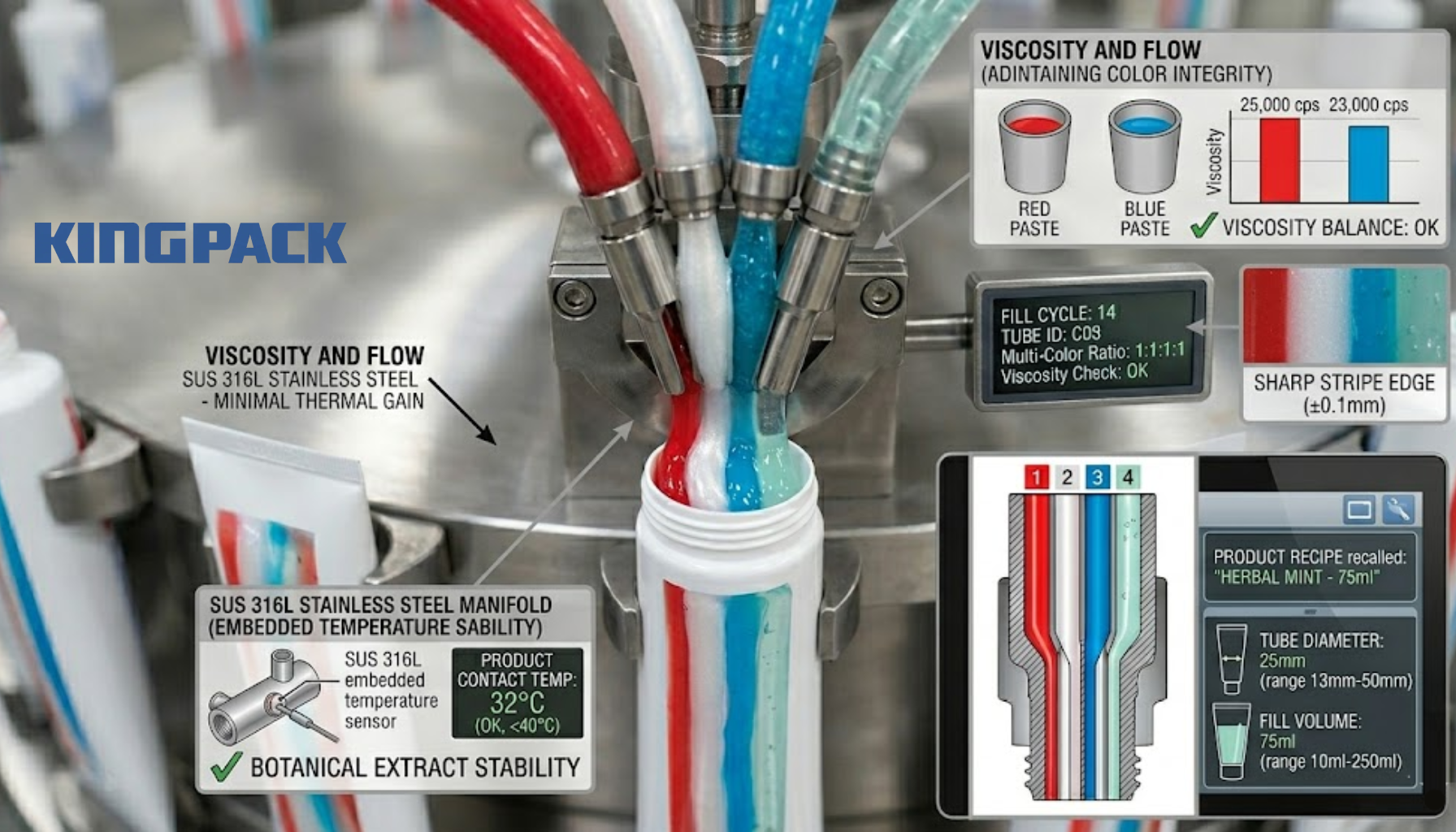
Sharp stripe definition depends on nozzle design and viscosity balance. If one layer flows faster, it spreads inside the toothpaste tube and distorts the pattern.
In tube filling and sealing operations, formulation alignment is as important as machine setup. Correct calibration of the filling and sealing machine improves stripe clarity and reduces defects.
Preserving Herbal Ingredient Stability
Temperature control is critical during toothpaste filling. Heat-sensitive ingredients require stable conditions during the manufacturing process. Product contact parts in stainless steel reduce heat transfer during continuous runs.
Well-designed tube filler systems remove dead zones in the flow path. This prevents material buildup and protects product quality across long production cycles.
Adaptability to Different Tube Sizes and Formulations
Modern tube filling and sealing machine designs handle a wide range of tube sizes and filling volume requirements. Parameter sets for each product are stored and recalled instantly.
This flexibility supports toothpaste manufacturers working with multiple formulations and packaging formats, including laminate and aluminum tubes.
Common Pitfalls in Toothpaste Filling for Special Formulations Production Line
Color bleeding or mixing: Most often caused by viscosity mismatch between colors, nozzle channel geometry that allows cross-contamination, or fill speed that generates turbulence at the tube entrance. Fix begins with formulation viscosity alignment, not machine adjustment.
Potential degradation during filling should be investigated through formulation-specific checks of shear, temperature, and hold time. A piston-based or other low-shear configuration may help, but it does not remove the need for validation.
Inconsistent fill weights and appearance: Caused by pump calibration drift across color channels, viscosity variation between batches, or nozzle wear. Servo-controlled piston systems with fill weight monitoring address this at the system level.
When to Invest in Specialized Precision Filling Solutions for Production Needs
A precision multi-color or herbal toothpaste filling machine is worth evaluating when:
- The product’s visual differentiation and demand are supported by the buyer’s own commercial data
- The herbal formulation contains active compounds whose efficacy is a brand claim that must be supported by manufacturing integrity
- Regulatory or clean-label requirements demand documented fill accuracy and ingredient preservation
- Production volumes justify automated multi-color capability over manual or semi-automatic alternatives
Before investing, confirm the formulation’s stability, cleaning requirements, target output, changeover frequency, and evidence needed for any ingredient or clean-label claims. Equipment should be selected against those documented requirements, not against a generic market forecast.
How to Select the Right Precision Toothpaste Filling and Sealing Machine
| Selection Factor | Multi-Color Priority | Herbal/Natural Priority |
| Number of color channels | Two or three channel nozzle system | Single channel, piston-based |
| Pump mechanism | Synchronized positive displacement | Low-shear piston filling |
| Viscosity range | Match channels from measured formulation data | Confirm particle compatibility by sample test |
| Fill accuracy | Define from the product and acceptance test | Confirm through calibration and a formulation-specific sample test |
| Material contact | Specify the required contact material | Confirm the selected grade in the final specification |
| Hopper design | Separate insulated hoppers per color | Agitated hopper for particle suspension |
| Control system | Per-channel PLC synchronization | Stroke-based volume control |
Start with a formulation data review before selecting equipment. Viscosity range, particle content, temperature sensitivity, and required fill volume all define the machine specification. Selecting a machine and then trying to adapt the formulation is the more expensive path.
Why King Pack Precision Filling Solutions
We supply precision toothpaste filling machines configured specifically for multi-color striped and herbal natural toothpaste applications. Our cosmetics and personal care filling line covers standard paste filling and configured options for complex oral care products. Review the tube filling machine range with the formulation and tube data before requesting a final configuration.
Multi-color configurations can use separate hoppers, dedicated pump systems, and synchronized controls. Stripe proportion is verified through channel calibration and sample runs; parameter storage and changeover behaviour depend on the selected control system.
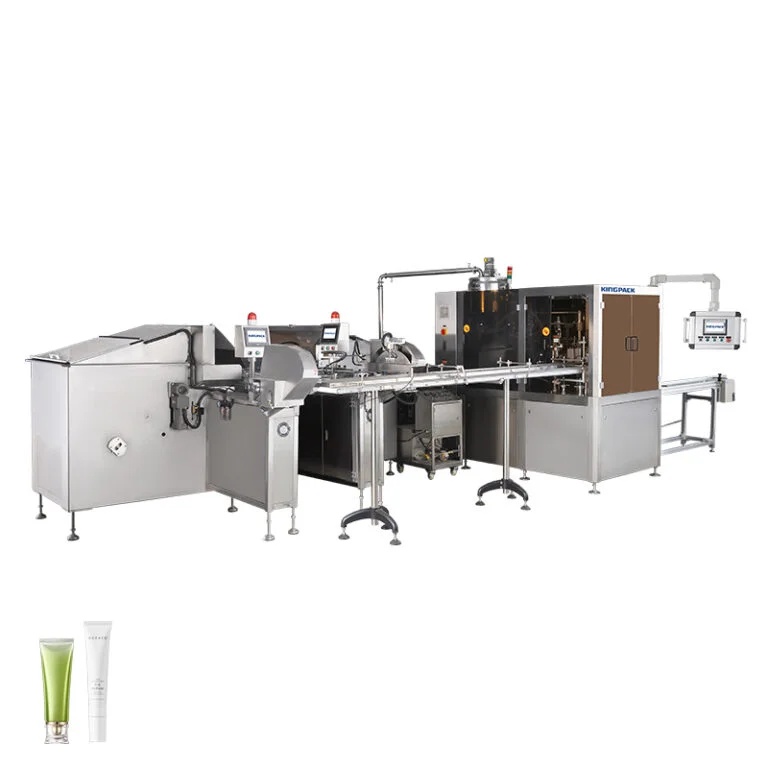
KPGFW-160 Fully Automatic Filling and Sealing Machine – King Pack Machinery
For herbal toothpaste applications, we can review piston-based and other suitable filling configurations against the formulation, particle content, cleaning method, tube size, and required acceptance limits. Material grade and achievable accuracy are confirmed from the final machine specification and sample test rather than assumed for every configuration.
We configure machines for the specific tube sizes, fill volumes, and formulation characteristics each client brings. Our engineering team reviews viscosity data, particle content, and color stripe requirements before finalizing the machine specification, so the system is validated for your product before commissioning begins.
Conclusion
Multi-color striped toothpaste and herbal natural toothpaste share one requirement: filling equipment that is precise enough to protect what makes the product valuable. For striped toothpaste, that means sharp, consistent color separation from the first tube to the last. For herbal formulations, it means low-shear, temperature-controlled filling that preserves active ingredient integrity.
Standard toothpaste filling machines are not built for either of these demands. Precision filling solutions for multi-color toothpaste and herbal toothpaste filler applications are. The gap between them shows up in product quality, brand claims, and ultimately in consumer trust.
Contact King Pack today to discuss your multi-color or herbal toothpaste formulation. Let our experts recommend a precision filling solution that delivers consistent, high-quality results while maximizing your production performance. Reach our team at kpfillingmachine.com/contact.