

This guide explains the architecture, filling options, controls and selection factors for multilane sachet and stick-pack machines. It covers powders, granules and liquids. If your project is specifically for sauces, creams or other viscous products, use our multi-lane liquid and paste sachet guide. You can also compare King Pack’s wider packaging machine solutions.
Introduction to Multilane Packing Machines
What Is a Multilane Packing Machine?
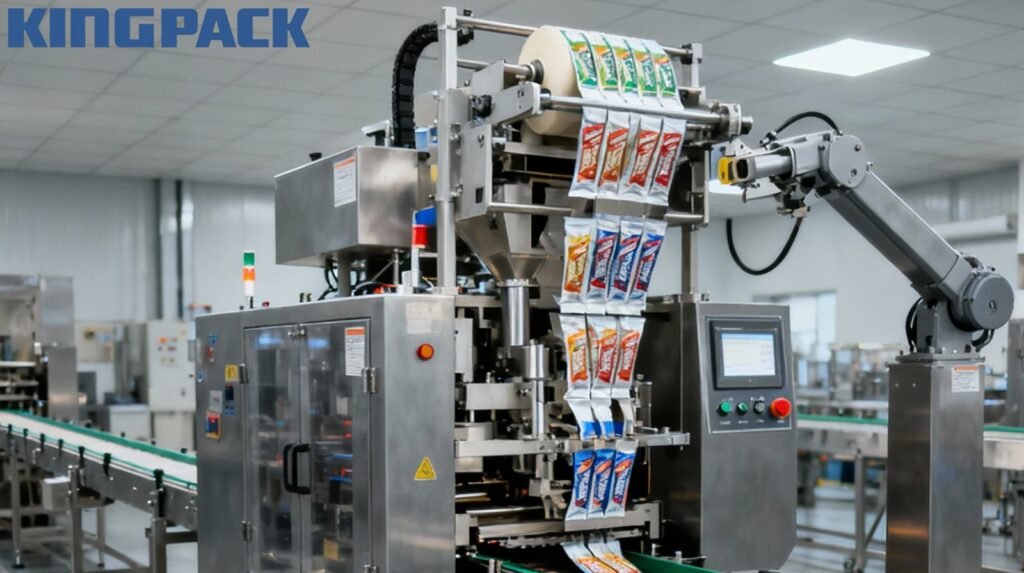
A multilane packing machine is a vertical form-fill-seal (VFFS) system that forms, fills and seals several sachets or stick packs in parallel. Compared with a single-lane machine, the key difference is the shared film web and synchronized operation across multiple packaging lanes.
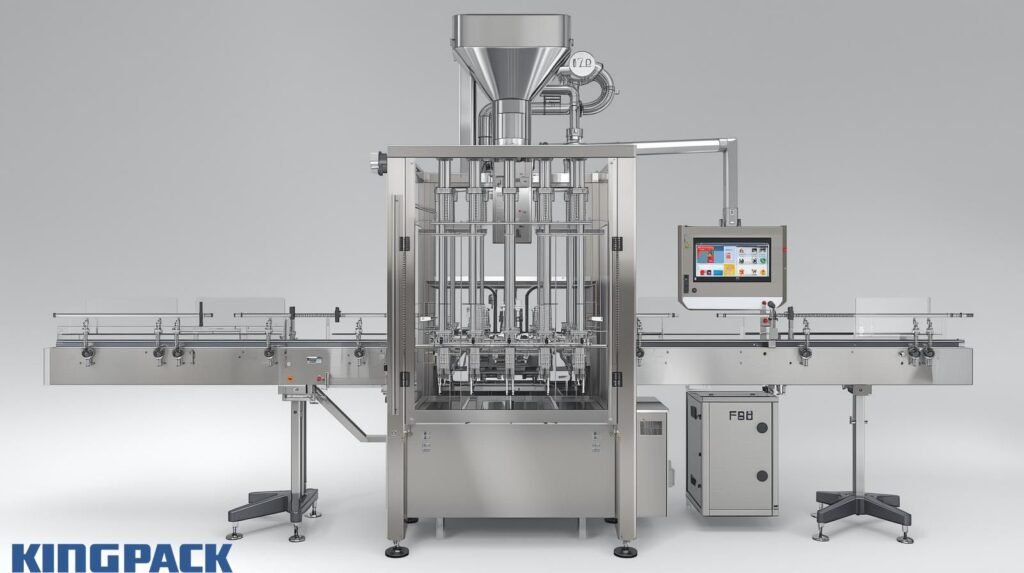
These machines use a wide roll of film that is split and formed into parallel tubes, or lanes. Each lane acts as a packaging channel that receives product, seals the pack and cuts it to length. Total output depends on lane count, validated cycle rate, package dimensions, product flow and seal dwell time.
Why Multilane Machines Are Important for High-Speed Production
Multilane equipment is useful when the required output cannot be met efficiently with one packaging lane. A suitable lane count is chosen from the target pack size, film width, product characteristics, cleaning needs and the stable speed demonstrated during trials. This makes the technology relevant to high-volume food, pharmaceutical and cosmetic projects, but the final configuration should be based on production evidence rather than general market forecasts.
Key Advantages Over Single-Lane Packing Machines
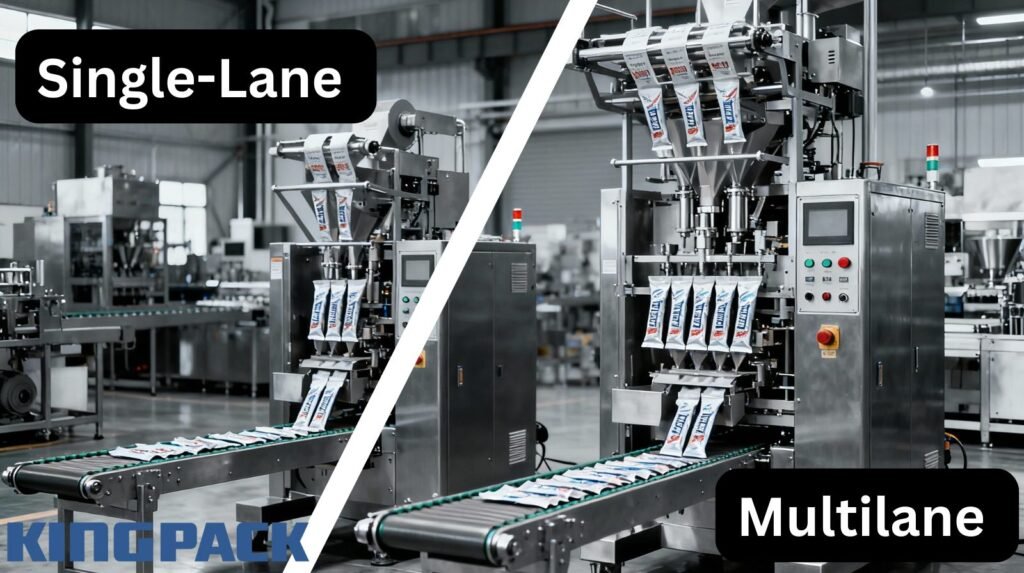
| Aspect | Multilane packing machine | Single-lane packing machine |
| Production capacity | Packs multiple sachets or sticks in each cycle across several lanes, delivering very high total output on a single frame. | Forms only one pack per stroke, so matching high volumes usually requires several machines in parallel. |
| Line speed vs stability | Reaches high throughput by adding lanes, allowing moderate film speed and more stable sealing and registration. | Must run the web faster to increase output, which can make sealing, cutting, and print alignment less stable. |
| Floor space utilization | Concentrates many lanes in one compact frame, giving high packs‑per‑square‑meter. | Each unit needs its own footprint, so capacity increases expand the line length and occupied area. |
| Packaging quality and consistency | Central control keeps temperatures, pressures, and timings synchronized across lanes, improving seal and print uniformity. | Each machine is tuned separately, so quality can vary between units and is harder to keep aligned. |
| Integration with downstream equipment | Provides a single, high‑density product discharge that is straightforward to feed into counters, cartoners, or case packers. | Multiple discharges must be merged or handled separately, complicating conveyors and secondary packaging. |
| Investment vs unit cost | Higher initial price than one small machine, but can replace several units, reducing cost per pack at medium and high volumes. | Lower entry cost per machine, yet total capital, labor, and utility costs rise quickly as more units are added. |
| Suitability by plant size | Best fit for large or fast‑growing plants that need high throughput with limited floor space. | Suits smaller operations or low‑volume SKUs where extreme speed and density are not critical. |
Core Components & Technology
PLC and HMI Control Systems for Smart Operation
Two main systems work in a modern multilane Filling machine, controlling all smart operations. they are:
- Programmable Logic Controller (PLC): The PLC coordinates film transport, filling, registration, sealing and cutting across the lanes. Depending on the machine configuration, servo drives can provide recipe-based adjustment and electronic synchronization. The controller brand and required functions should be specified in the URS.
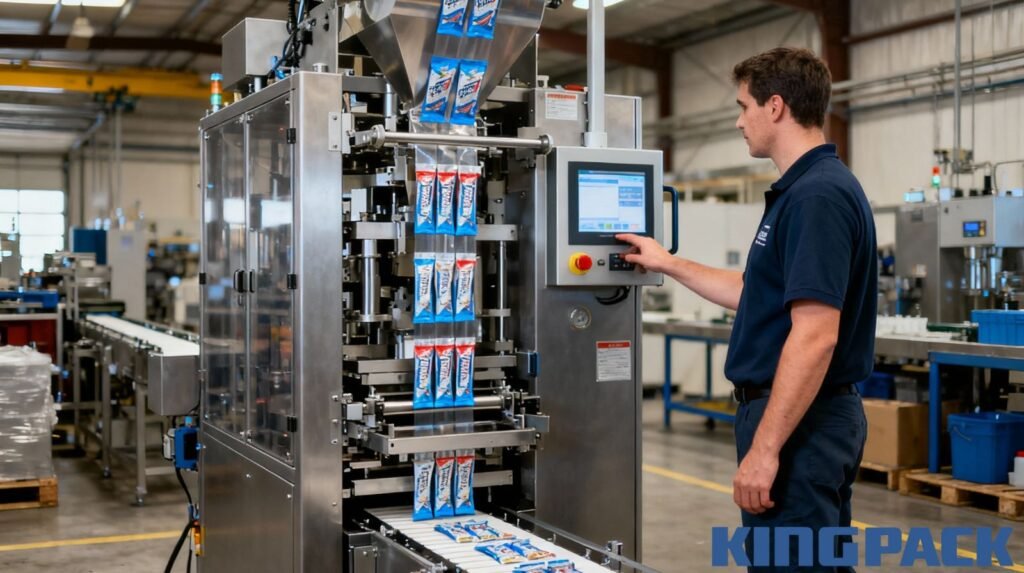
- Human-Machine Interface (HMI): It is typically a user-friendly touchscreen. It allows operators to set bag length, heat sealing temperature, sealing pressure, filling volume, and target output, often with password‑protected recipe storage for multiple products and formats. Diagnostic pages display alarm histories, sensor status, and production counters, helping maintenance teams quickly locate causes of film jams, seal failures, or dosing faults.
Filling Mechanisms: Liquid Pumps, Auger, Volumetric Systems
Multilane machines are versatile because they can work with different filling technologies. Each technology suits specific product features.
- For powders and fine granules, Auger Fillers are the industry standard. These systems use a precisely controlled rotating screw to dispense a consistent volume of product into each sachet.
- For free-flowing granular products like sugar or salt, Volumetric Fillers offer a simple, fast, and reliable dosing method.
- When packaging liquids, gels, or pastes, piston or rotary pumps are employed to ensure accurate and drip-free filling.
The filling arrangement depends on the product and filler type. Some configurations use individual dosing paths for each lane, while others distribute product from a shared system. Dose repeatability must be confirmed with the actual material, target weight and operating speed.
Sensor Systems and Dead-Film Protection for Accuracy
To maintain high accuracy and minimize waste at high speeds, Sachet Packing Machines are equipped with an array of sophisticated sensors.
- Photo-eye sensors track registration marks so the controller can correct film position and keep cutting and sealing aligned with the printed artwork.
- Other sensors monitor film tension, detect the end of a film roll, and verify that the product has been dispensed correctly.
An essential feature is dead-film protection, where sensors detect if the film has stopped advancing. This immediately halts the sealing and cutting processes to prevent wasted product and film, as well as damage to the sealing jaws—a critical safeguard in a continuous, high-speed environment.
Design & Build Features
Stainless Steel Construction for Hygiene and Durability
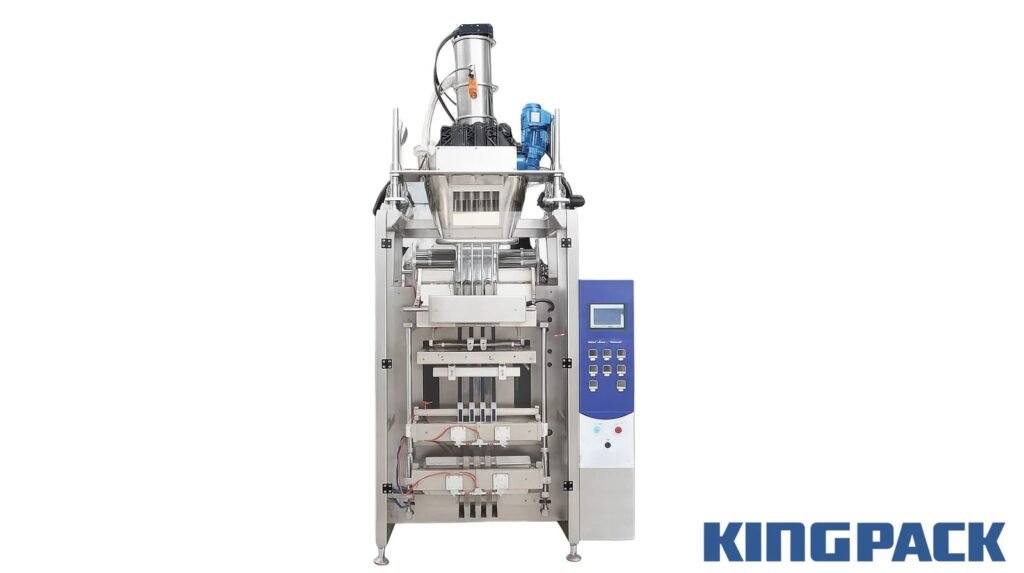
For food, pharmaceutical and cosmetic projects, frame and product-contact materials should be specified separately. Stainless-steel construction can improve corrosion resistance and cleanability, while product-contact grade, surface finish, access for cleaning and documentation should be defined in the URS and verified during acceptance. GMP suitability depends on the complete process, facility and operating procedures—not the frame material alone.
Compact Multi-Lane Layout for Space Efficiency
Despite their massive output capabilities, multilane filling machines are designed with a remarkably compact footprint. By arranging the packaging channels vertically, these machines maximize production capacity per unit of floor space. This vertical VFFS design saves space. It lets manufacturers increase packaging speed a lot without making their facilities bigger. This intelligent layout is a key consideration for factories where floor space is at a premium.
Tool-Free Changeover and Modular Design
Modern multilane stickpack machines are designed to reduce downtime. They also increase operational flexibility by allowing quick changeovers. Many key components, such as forming tubes and dosing nozzles, are designed for tool-free removal and installation. This allows operators to quickly switch between different shaped sachet sizes or product types with minimal interruption. The modular design further enhances this flexibility, enabling easier maintenance, upgrades, and integration of different filling systems. This focus on user-centric engineering ensures that the machine spends more time running and less time idle.
Operational Advantages
High-Speed Output with Minimal Downtime
The main benefit of multilane technology is parallel output within one machine footprint. Actual production rate and uptime depend on the lane count, filler, product behavior, film, sealing window, changeover plan and maintenance. Servo control, diagnostics and film-end detection can support stable operation, but performance should be demonstrated with the project materials.
Consistent Product Quality Across All Lanes
High output is valuable only when filling and sealing remain consistent across lanes. Centralized recipes can control target fill settings, seal temperature and package length, while operators should monitor lane-to-lane variation, seal integrity and registration. Acceptance limits should be agreed in advance and verified during trials and FAT.
Easy Integration into End-of-Line Packaging Systems
A multilane packing machine is rarely a standalone unit; it is typically the core of a larger, integrated packaging line. These machines are designed for seamless integration with downstream equipment. The high-volume output of sachets can be synchronized with conveyors, check weighers, cartoning machines, and case packers to create a fully automated Repackaging Line. This end-to-end automation reduces manual handling, improves traceability, and further streamlines the entire production process from primary packaging to final shipment.
Applications Across Industries
Food – Sauces, Powders, Granules, Beverages
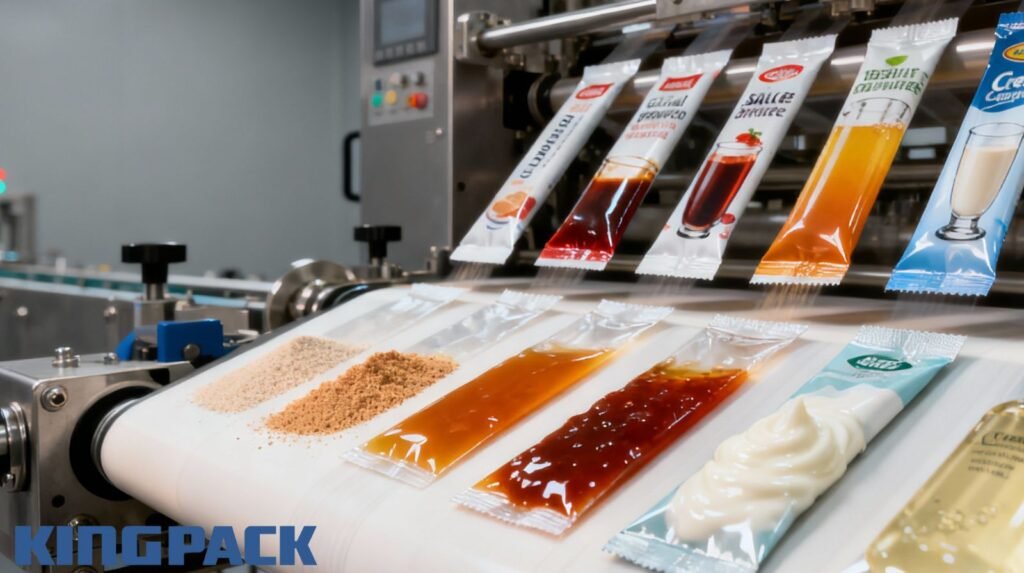
In the food industry, multilane machines are invaluable for packaging a wide range of products. They handle everything from single-serve ketchup and mayonnaise sachets to stick-packs of instant coffee, drink mixes, and spices. For Powders and granules, the Granule Stick Pack Machine is equipped with servo Auger Fillers and Volumetric Fillers, which provide the necessary accuracy. The speed and efficiency of these machines are ideal for the high-volume, liquid, pasty, powdery and granular products
Pharmaceuticals – Oral Powders, Sachets, Granules
Multilane sachet and stick-pack systems can be considered for pharmaceutical powders, effervescent granules and oral rehydration products. The project must define dosing limits, product-contact materials, cleaning, containment, line clearance, data requirements and validation responsibilities. Product safety and GMP compliance depend on the validated process and quality system as a whole.
Cosmetics & Personal Care – Creams, Gels, Serums
The cosmetic industry uses a multilane Vertical Packaging Machine to package single-use samples and travel-size products like shampoos, lotions, face creams, and serums. These formats are popular for product trials and on-the-go convenience. The machines must handle viscous liquids, pasty products, and delicate emulsions without compromising the product’s quality as they are equipped with auger pumps offering smooth and plus-free flow. A perfect, clean seal is essential not only for product integrity but also for the aesthetic appeal of the final package, reflecting the high standards of the cosmetic industry.
Choosing the Right Multilane Machine
Lane Count Selection Based on Production Volume
The first consideration when selecting a multilane machine is the required production volume. The number of lanes directly correlates to the machine’s maximum output. A wise consideration would be :
- 2- or 4-lane model of a small sachet packaging machine for a small but growing business
- 10- or 12-lane system may be needed for a large-scale manufacturer
It is essential to analyze current production needs and forecast future growth to select a machine with the appropriate lane count to serve as a long-term investment.
Matching Filling Technology to Product Characteristics
The nature of the products being packaged will dictate the necessary filling technology. It is crucial to match the filler to the product’s characteristics—its viscosity, flowability, and density.
- Auger Fillers with micro-dosing systems are ideal for non-free-flowing powders.
- Volumetric cup fillers are better for granular products.
- Piston pumps are necessary for thick liquids and pastes.
Choosing a supplier like King Pack, which can offer and integrate the correct filling system for your specific products, is key to achieving optimal performance and accuracy. while these sachet packing machines can be customized for different sealing patterns and filling mechanisms to meet customer needs.
Evaluating Support, Maintenance, and After-Sales Service
A high-performance machine is only as good as the support behind it. When investing in a multilane packing system, it is vital to evaluate the manufacturer’s after-sales service. This includes the availability of technical support, spare parts, and maintenance programs. A strong partnership with your equipment provider ensures that any potential issues are resolved quickly, minimizing downtime and protecting your investment for years to come. King Pack supports its customers with ultimate after-sales service.
Conclusion
Multilane sachet and stick-pack machines process several packages in parallel and can improve output per unit of floor space. The business case depends on product range, changeover frequency, waste, staffing, cleaning and the stable rate achieved with production materials.
Ready to invest and grow your business?
To compare a suitable configuration, prepare your product, target dose, sachet or stick dimensions, film specification, required output, cleaning method and downstream equipment. Contact King Pack to review these requirements and plan material trials or FAT acceptance criteria.
Related resources: Review our sachet packaging machine range and emulsifying, filling and packaging resources.