 Skip to content

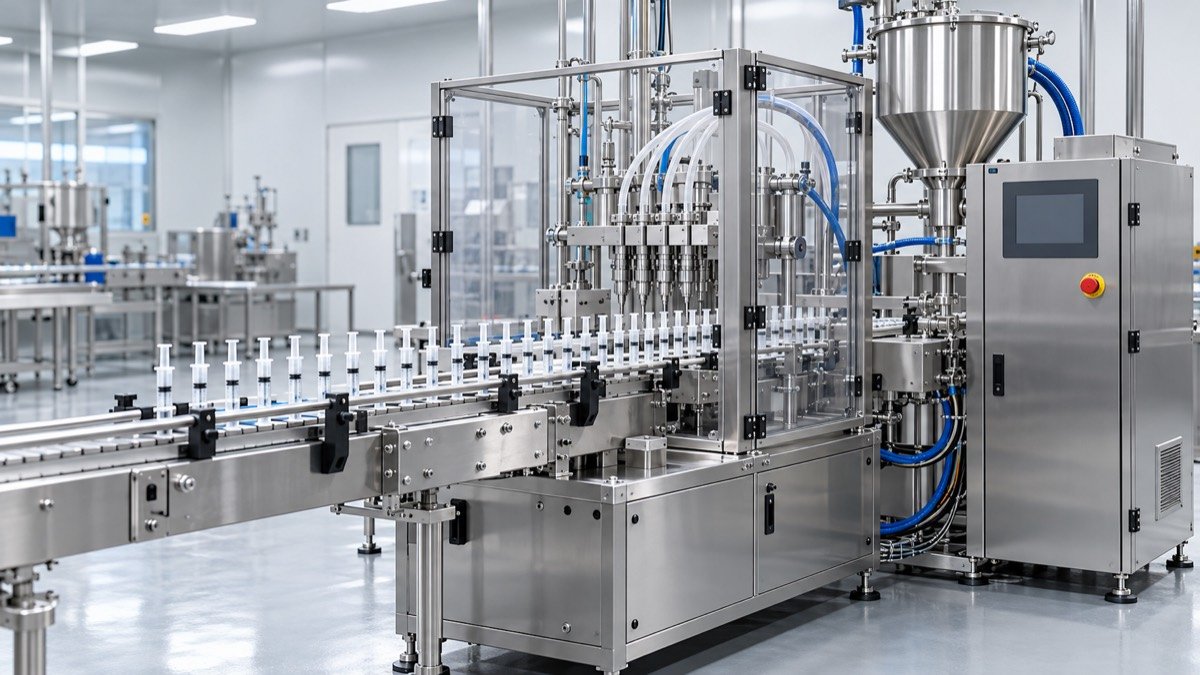
Before a syringe filling machine is delivered, the installation site needs more than a place on the floor and a nearby power outlet. A dependable installation starts with a configuration-specific utility schedule: the approved list of electrical, pneumatic, product-handling, cleaning, drainage, and environmental connections for the exact filling line being supplied.
The key word is exact. A basic filler, a line with plunger insertion, a capping station, a product hopper, an inspection module, or a cleaning arrangement may not need the same services. Product behavior also matters. A viscous veterinary paste, a temperature-sensitive cosmetic, and a free-flowing liquid may call for different product-feed and cleaning decisions. For that reason, use this article as a site-preparation framework—not as a substitute for the approved machine drawing or utility schedule.
Start with the machine configuration, not a generic utility list
Utilities affect layout, installation timing, operating stability, maintenance access, and acceptance testing. When they are considered late, teams can end up moving connection points, adding temporary hoses or cables, or delaying product trials while an unplanned service is installed.
Before civil, mechanical, or electrical work is finalized, ask the equipment supplier for the utility schedule and connection drawings for the proposed configuration. In parallel, confirm what the site can actually provide at the intended installation point. This simple comparison turns “utilities” from an assumption into a documented project input.
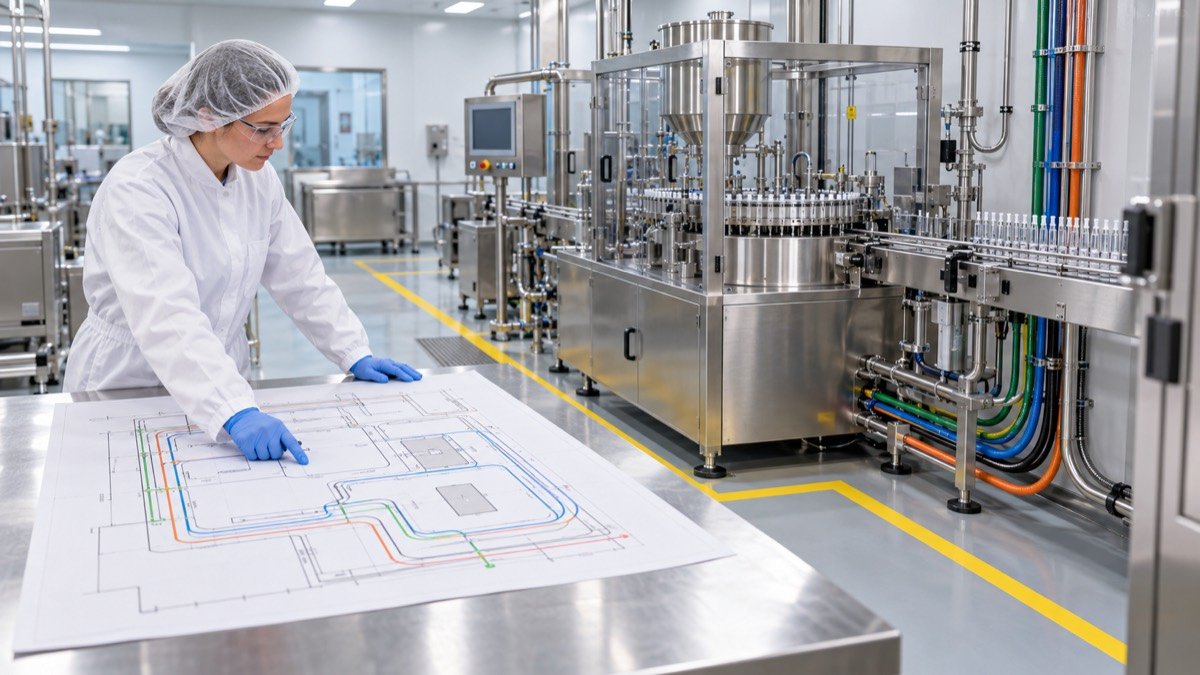
Utility responsibility matrix
The following matrix separates the information that should come from the equipment side from the checks that belong to the project/site side. It is deliberately non-numerical: connection size, demand, air quality, and other values must be confirmed for the final machine specification.
| Service area | Why it matters | Ask the equipment supplier to define | Verify at the installation site |
|---|---|---|---|
| Electrical supply | Controls, drives, guards, and optional modules need a safe, compatible supply. | Required supply characteristics, protective devices, connection point, isolation requirements, and any optional loads. | Available supply, local electrical-code review, grounding, isolator location, cable routing, and access for service. |
| Compressed air | Pneumatic actuators, valves, and auxiliary devices may depend on stable, clean air. | Whether air is needed, demand and quality for the selected configuration, connection point, and treatment expectations. | Pressure stability, air preparation, filtration/drying policy, condensate handling, hose routing, and maintenance access. |
| Vacuum or extraction | Some product, package, or auxiliary processes may use integrated or site-provided vacuum/extraction. | Whether it applies, whether it is machine-integrated, and the required interface. | Capacity, routing, noise and safety considerations, and compatibility with the room/process plan. |
| Product feed | Product conditions influence filling consistency and cleanability. | Preferred feed interface, product-contact path, pump/hopper options, and any temperature or agitation interfaces. | Tank/pump ownership, product-transfer route, hose support, cleaning access, and material compatibility review. |
| Water, cleaning, and drainage | Cleaning choices determine room readiness and waste handling. | Approved cleaning approach, machine interfaces, and whether any site connection is needed. | Water availability where applicable, drain suitability, recovery/disposal rules, and cleaning-area controls. |
| Room environment | Temperature, condensation, dust, access, and cleaning practices affect operation. | Machine placement, clearance, and environmental constraints for the proposed design. | Room layout, access route, lighting, ventilation/HVAC coordination, and local quality-system requirements. |
Electrical supply: define the connection, protection, and access
The electrical discussion should cover more than voltage. The supplier’s documentation should identify the supply characteristics for the machine configuration, the machine-side connection point, and the expected protective and isolation arrangement. The project team should then have the installation reviewed against applicable local requirements by qualified personnel.
For the site plan, clarify where the disconnect/isolator will sit, how operators and maintenance staff will access it, and how cables will be routed without obstructing cleaning or service access. Also account for equipment that is not part of the base filler but is planned as part of the line, such as a product-transfer system, coding device, conveyor, inspection equipment, or environmental-support equipment. A line can be mechanically complete but still not ready for trials if one of these interfaces was left outside the electrical plan.
Send the proposed destination country/region, site supply characteristics, and any customer electrical standards during the quotation stage. That gives the equipment supplier a chance to align the machine documentation and helps avoid field modifications after delivery.
Compressed air: specify quality as well as availability
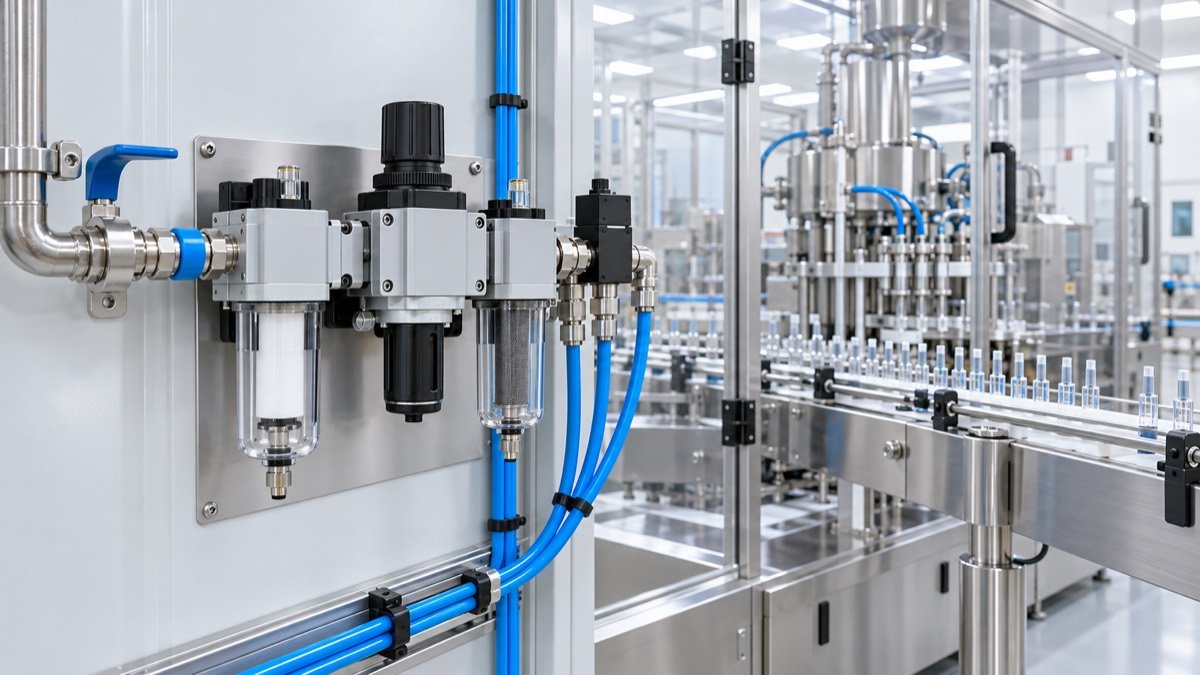
Many syringe filling configurations use compressed air for pneumatic functions, but whether it is required and how much is configuration-dependent. Do not assume that a nearby plant-air drop is enough. The relevant question is whether the available air is stable and treated to the quality required by the selected machine and the customer’s process policy.
Ask for the machine’s approved air requirement and for the expected air-preparation arrangement. Then check the site-side distribution system: route length, potential pressure losses, shutoff location, filtration and drying practices, condensate management, and the ability to maintain the air-treatment equipment. If the process environment is sensitive to moisture or contamination, resolve the responsibility for air treatment before installation rather than treating it as a commissioning adjustment.
It is also worth mapping which added stations are pneumatic. Plunger insertion, capping, reject handling, and other auxiliary functions may change the final demand compared with a filling-only concept. When multiple formats or modules are planned, use the final line scope—not an early outline—to request the utility schedule.
Vacuum and extraction: confirm whether they apply
Vacuum and extraction are often mentioned in early discussions, but they are not universal requirements for every syringe filler. The first task is to establish whether the selected process uses a machine-integrated vacuum function, a site-provided vacuum connection, a product-handling interface, or no vacuum at all.
The same principle applies to extraction. Product characteristics, packaging operations, cleaning practices, and the surrounding process may create a need for local extraction or a particular room arrangement. The project team should not design a connection from a generic assumption. Request a clear statement of applicability and interface responsibility from the supplier, then coordinate the resulting requirement with the facility and safety teams.
Product-side utilities: the filling machine is part of a product path
A syringe filler is only one part of the product path. The product may arrive from a prepared batch vessel, a hopper, a transfer pump, or another upstream system. The most useful site-preparation question is therefore: How will product reach the filling point in the required condition, and how will that path be cleaned and released?
Document who supplies each element of that path. Confirm the ownership and interface of the feed vessel, agitator, transfer pump, hose assembly, temperature-conditioning equipment where needed, and any product-contact fittings. Product viscosity, settling, temperature sensitivity, foaming tendency, and batch-handling method can affect the proposed solution. These factors should be discussed with actual product information and, where appropriate, representative samples—not guessed from the product category alone.
For veterinary applications, the package format and dosing process should be reviewed together with the product path. A veterinary medicine filling solution may include different upstream and downstream choices than a simple laboratory demonstration. Likewise, a syringe filling machine should be planned alongside the available product feed and cleaning approach, not in isolation.
Water, cleaning, drainage, and waste handling
Cleaning is a design topic, not just an operating task. Before the machine arrives, agree on the approved cleaning approach for the final process. The required interfaces may differ depending on whether cleaning is manual, uses a defined circulation arrangement, relies on removable product-contact parts, or follows a customer-specific procedure.
The facility should determine how wash water, product residue, cleaning liquids, and other waste will be contained, recovered, or disposed of under its own operating and local requirements. Do not assume that a floor drain or a general utility sink is suitable. Review the process with the responsible quality, environmental, and facility teams, including access for cleaning personnel and protection of nearby equipment.
Where product-contact parts are removed for cleaning, plan a practical route for transport, staging, inspection, and reassembly. The best machine layout leaves enough space for these activities without forcing operators to cross a production flow or store components in uncontrolled locations.
Room conditions, access, and maintainability
Facility conditions influence whether a line can be operated and serviced consistently. Review the room layout for operator circulation, material flow, container infeed and discharge, access around guards, electrical-panel access, cleaning access, and safe handling of format parts. Consider the delivery route too: doors, corridors, lifting arrangements, and floor/loading constraints may affect when and how the machine can be installed.
Temperature, humidity, ventilation, condensation, dust, and lighting can also affect the product, the package, cleaning work, or normal maintenance. The appropriate room controls depend on the process and the customer’s quality system. This article does not assign a cleanroom class or environmental limit; those must come from the applicable product, facility, and regulatory requirements.
Commissioning starts before the machine arrives
A useful commissioning plan begins with documentation, not with the first product run. Create a joint list of documents and checks that will be available before installation. It should include the approved machine layout, utility schedule, connection drawings, product-contact information, cleaning plan, format details, and the responsibilities for factory and site acceptance activities.
At the equipment side, a factory acceptance test is an opportunity to verify the agreed machine scope against a documented test approach before shipment. At the site, utility readiness should be confirmed before product trials. A sensible sequence is: verify the installed connections and safety interfaces, perform a dry run, confirm format and product-feed readiness, conduct agreed trials, record results, train relevant personnel, and close open items through the agreed process.
This is also why installation and commissioning should be planned as a cross-functional activity. Procurement, engineering, production, quality, maintenance, and the equipment supplier may each own part of the readiness package. Giving each item a named owner reduces last-minute ambiguity.
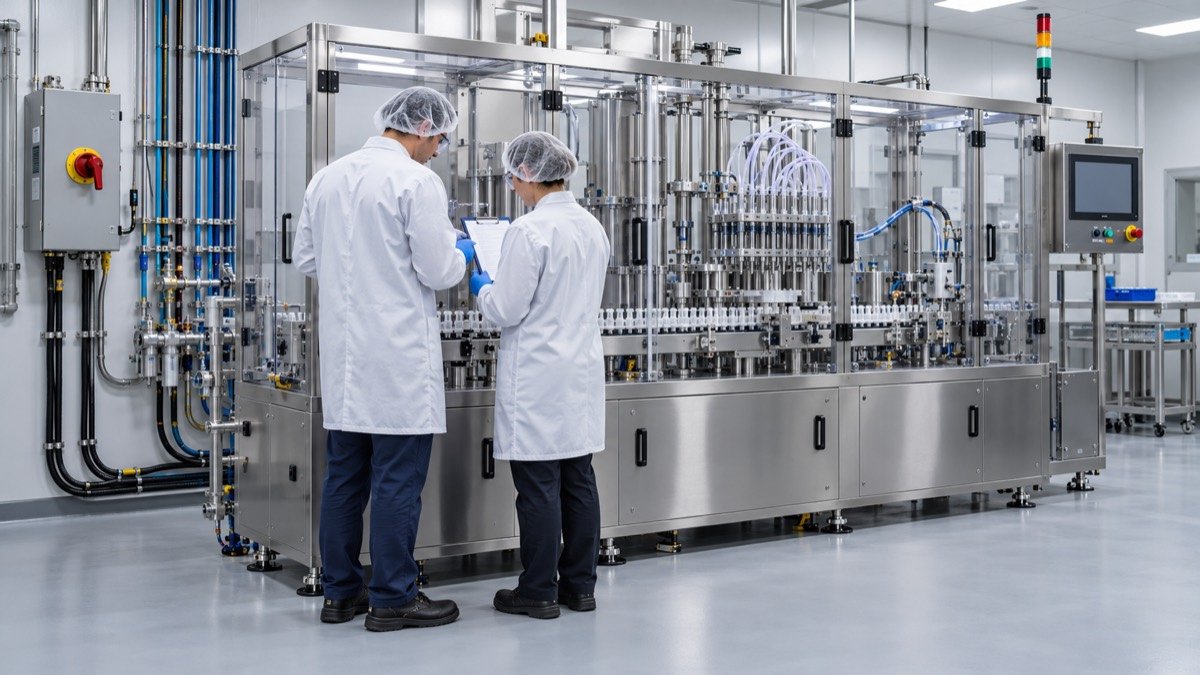
Pre-installation checklist for buyers
Use this checklist before the purchase order is finalized and again before site installation:
- Confirm the final line scope, including filling, plunger insertion, capping, conveyors, inspection, coding, and any auxiliary modules.
- Request the supplier-approved utility schedule, general arrangement, connection drawings, and machine-side interface list.
- Share the destination-country/region electrical information and site standards for review.
- Confirm whether compressed air, vacuum, extraction, water, drainage, or temperature-conditioning interfaces apply to the chosen configuration.
- Define the product path: batch vessel, transfer method, product-contact interfaces, product condition, cleaning route, and ownership of each component.
- Review room layout, access, material flow, maintenance clearance, cleaning access, and the delivery/installation route.
- Assign owners for utility installation, connection verification, acceptance records, operator training, and open-item closure.
- Provide representative syringes, components, and product information early enough for the agreed testing plan.
Frequently asked questions
What utilities are normally needed for a syringe filling machine?
Electrical supply is a core requirement. Depending on the selected line, compressed air, a defined product-feed interface, cleaning-related services, drainage arrangements, and environmental support may also be needed. Always use the supplier-approved schedule for the final configuration.
Does every syringe filler need compressed air?
No. The need for compressed air depends on the machine design and auxiliary stations. Confirm applicability, required quality, and connection details for the exact proposed machine instead of relying on a generic specification.
Do I need a vacuum or chilled-water connection?
Not necessarily. Some configurations or product processes may use vacuum, extraction, or temperature conditioning, while others may not. Ask the supplier to identify whether these interfaces are required and who supplies them.
What electrical information should be included in an RFQ?
Provide the destination region, available supply characteristics, relevant site standards, preferred installation point, and any constraints on isolation, cable routing, or panel access. Request a configuration-specific electrical interface document in return.
Who supplies the product feed tank and transfer system?
That is a project-scope decision. It may be provided by the equipment supplier, the buyer, or another integrator. Record the owner and the mechanical, controls, product-contact, and cleaning interfaces before the line is built.
What should be checked before site acceptance?
Check that utilities match the approved documentation, safety interfaces are complete, access is available, the product/feed path is ready, format components are on site, and the agreed test and training materials are prepared.
Turn utility planning into a cleaner installation
The practical answer to “What utilities are needed?” is not a fixed list of numbers. It is an approved, configuration-specific agreement between the filling-line design and the facility that will operate it. Establish that agreement early, assign ownership for every connection, and verify readiness before the machine arrives.
King Pack Machinery can review your syringe format, product-handling approach, line scope, and site information to help define the required interfaces. Contact King Pack Machinery to discuss a proposed project, or request a technical quotation with your available utility and product details.
