 Skip to content

Veterinary gels can range from low-viscosity topical products to dense, stringy formulations. Equipment selection must consider product rheology, dose, tube construction, cleaning, coding and the required tail-sealing process. A reliable project starts with representative product and tube data, then validates the complete process through factory testing.
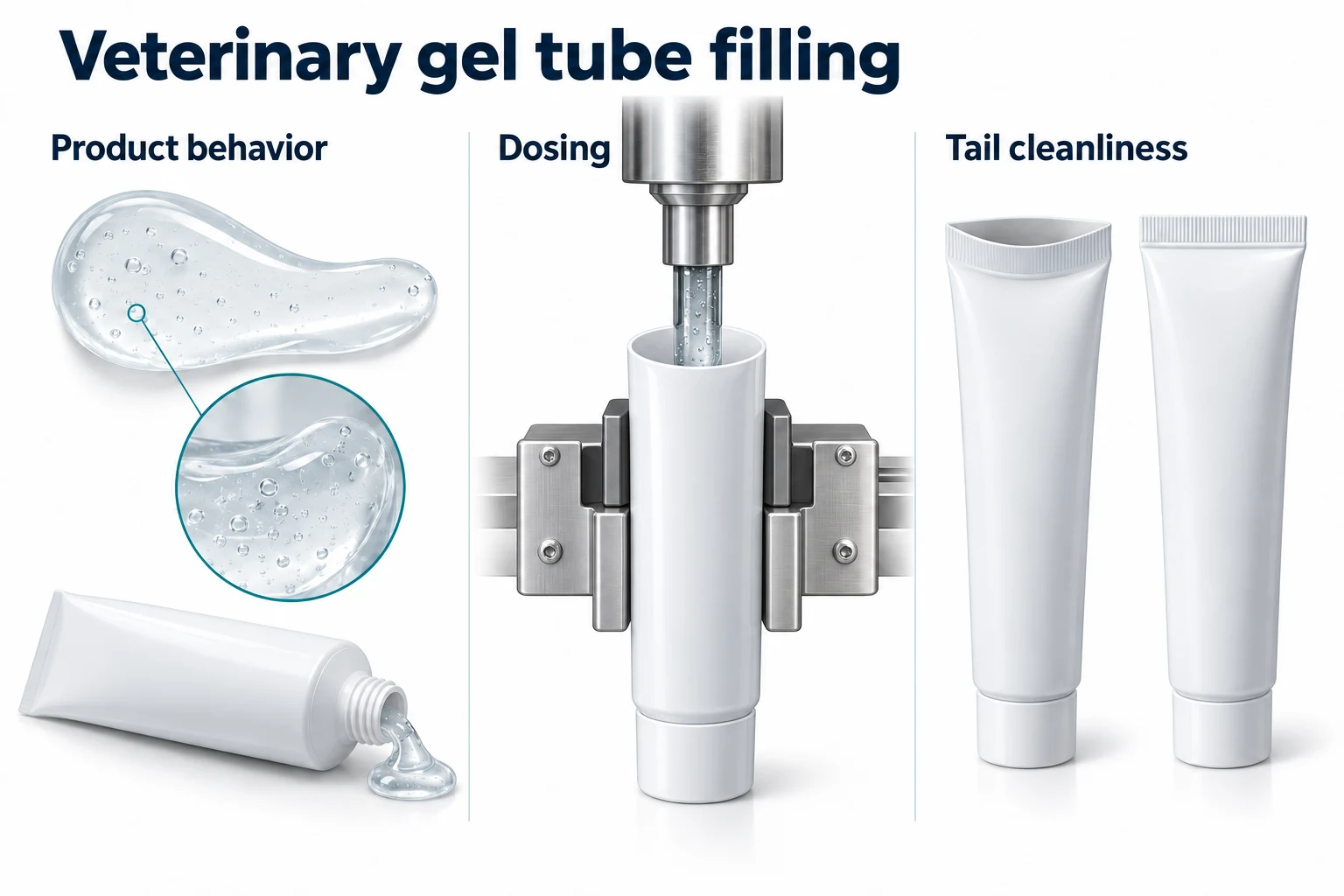
Product information required
Provide viscosity range, density, active ingredients, particles, temperature limits, shear sensitivity and storage condition. Explain whether the product is filled at ambient temperature or requires controlled warming. If the gel is stringy, request a cut-off trial before approving the nozzle.
Hopper and transfer
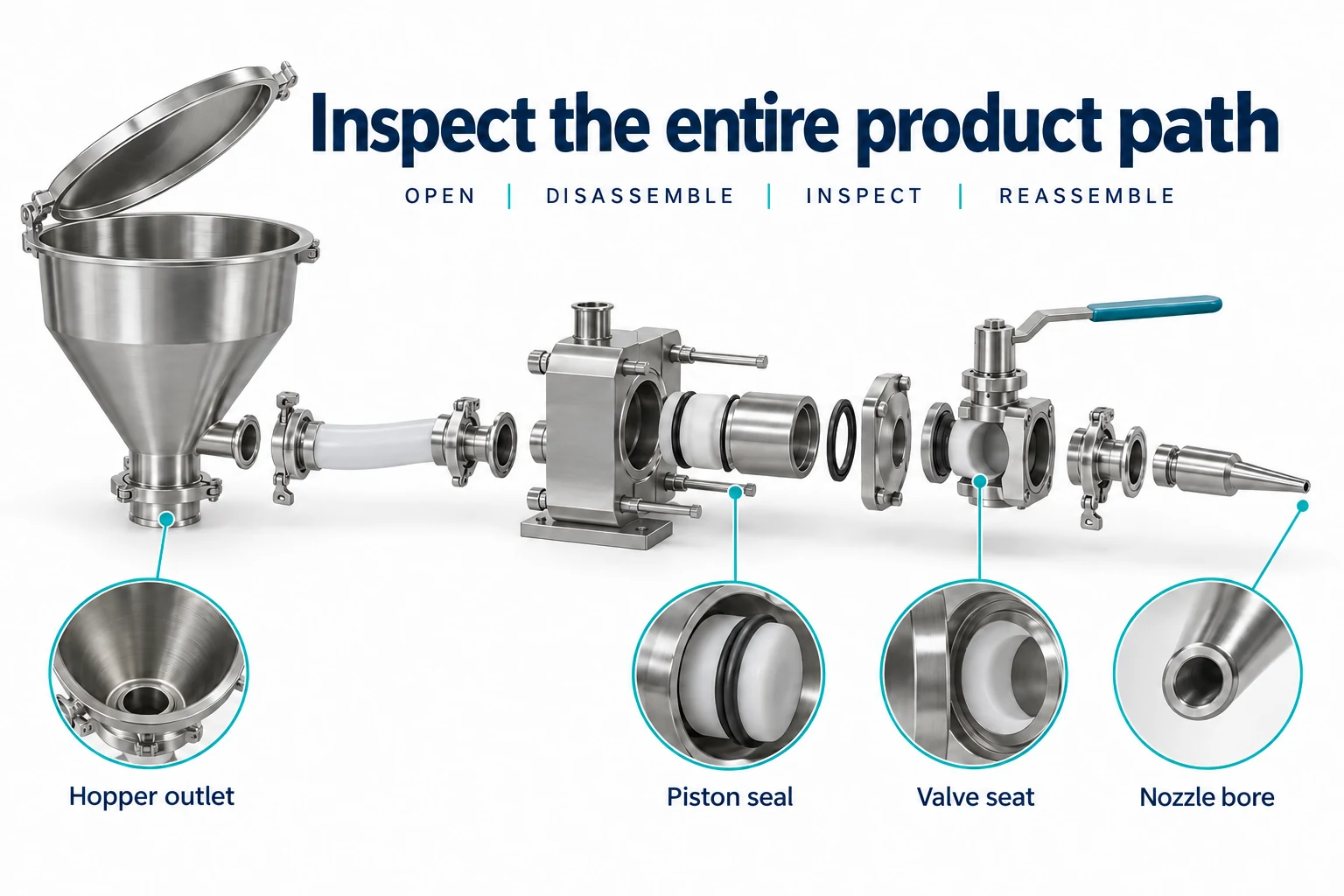
The hopper should drain well, allow inspection and prevent air from entering the pump. If the gel settles, confirm whether gentle agitation is allowed. Hose diameter, valve seat and nozzle bore must provide a suitable passage without unnecessary shear.
Dosing and tube presentation
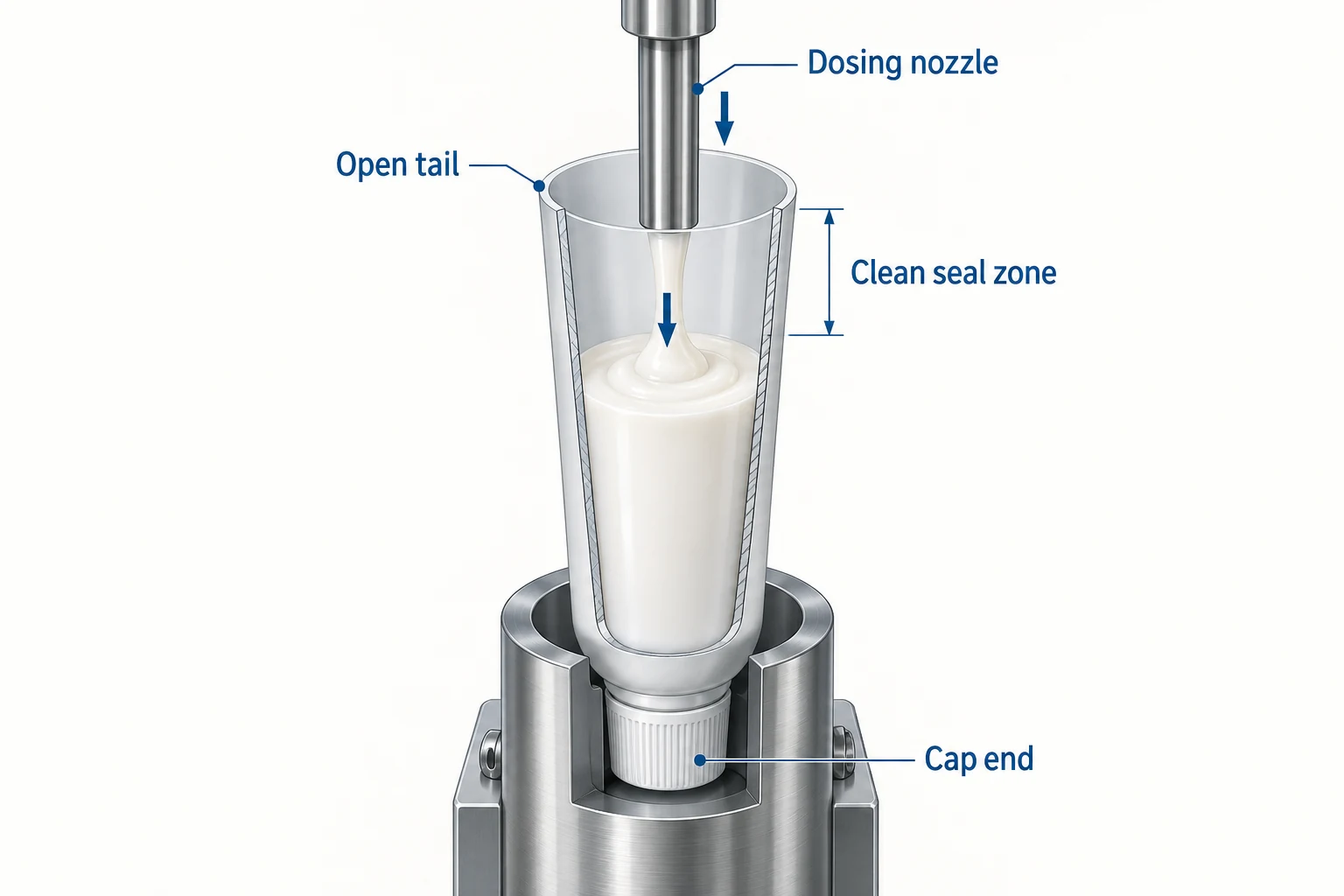
Piston or servo dosing can support repeatable gel volumes when the stroke and speed are defined. The tube is held upright with its open tail facing upward. The nozzle enters the unsealed tail, doses the gel and retracts cleanly before the tube moves to sealing.
Tail cleanliness
Product in the tail can weaken a hot-air or ultrasonic seal. Review nozzle insertion depth, cut-off, retract and overfill control. Inspect first-piece samples after start-up, refill and short stops.
Sealing and coding
Confirm tube material, tail profile and closure method. Plastic laminate may use hot air; compatible thermoplastic structures may be tested with ultrasonic sealing. Include embossing, trimming and coding if required. Inspect seal width, contamination, wrinkles and code position.
Cleaning and changeover
Veterinary gels may contain colors, oils or active ingredients that require a defined clearance procedure. Review pump disassembly, nozzle cleaning, hose flushing, gasket inspection and tail-tool cleaning. Store change parts in labeled kits.
FAT and installation
FAT should cover product transfer, dose, tube loading, sealing, coding, reject handling, cleaning access and recovery after a stop. If a substitute is used, label the limitation. Shipment inspection should verify tools, guards, electrical labels, manuals and spares. Installation preparation should confirm power, air, floor access, drainage and operator training.
Buyer checklist
- Gel viscosity and temperature range
- Target dose and tube dimensions
- Nozzle and cut-off requirements
- Seal material and inspection method
- Cleaning and changeover procedure
- FAT and site acceptance criteria
Discuss your requirements: Send your veterinary gel profile and tube drawings to King Pack for a dosing and sealing review.
Define the package and intended manufacturing scope
A veterinary gel in a squeeze tube is a different packaging project from a gel in a graduated oral syringe, pipette or pump bottle. Confirm the actual container and closure before selecting tooling. Do not choose a tube filler simply because another product with the same description used one. Package drawings, dispensing requirements and release criteria should drive the discussion.
Keep equipment claims separate from treatment claims
The machine supplier can review filling, closure and handling. It should not infer animal dose, treatment efficacy or product approval from the package. The product owner defines the formulation, administration information and regulatory context. This guide addresses the packaging process, not veterinary prescribing or evidence of clinical performance.
Characterize how the gel behaves during the run
Describe the product at rest, during pumping and after a pause. Some gels resist initial movement and then flow more readily under shear; others form long strings when the nozzle withdraws. A laboratory viscosity value is useful only when the method and temperature are known. Supply practical observations alongside the measurement.
Air, particles and residence conditions
Identify visible air, suspended solids and any settling. Confirm the permitted hold condition and whether gentle agitation is appropriate. Do not add agitation automatically: it can introduce air or change the product. If a gel changes during residence, the formula team should define its acceptable handover and waiting conditions before packaging equipment is selected.
Review the lowest planned hopper level and the refill method. A product may fill consistently under one inlet condition and behave differently as the supply falls. Include those changes in the trial rather than approving the pump from one full-hopper demonstration.
Choose the product path before comparing features
Map the vessel outlet, transfer pump, hose, hopper, metering chamber, valve and nozzle. Identify air-entry points, retained volume, cleaning access and measurement locations. Keep the route sufficiently defined that the factory trial can be compared with the installed arrangement.
Metering options
A piston arrangement may provide a practical metered chamber when the gel and valve passages are suitable. Controlled motion can help adjust suction, discharge and cut-off profiles. Other pumps may be considered for product or transfer reasons. Ask the supplier to explain the chosen architecture using the actual flow behavior, particles and cleaning needs.
Servo control and pneumatic actuation describe different aspects of machine motion; neither label alone guarantees a product result. Compare the complete metering system and its test evidence. State which settings are adjustable and how the approved recipe is identified.
Contact materials and compatibility
Review metals, elastomers, hoses and valve components against the formula and cleaning conditions. Oils, active ingredients or other formulation components may require specific compatibility review. Obtain the information from the relevant product and material owners rather than assuming that a stainless frame proves the suitability of every contact part.
Control stringing without confusing it with dose error
Stringing is the thread of gel that remains as the nozzle withdraws. It can contaminate the tube tail or neighboring tooling even when the dose meets the mass requirement. Review nozzle bore, shut-off design, withdrawal and retract as a coordinated profile. Test the intended gel rather than promising a universal anti-drip result.
Observe before the tube reaches the sealer
Inspect the upper tail immediately after dosing. If gel remains there, preserve the sample and record the filling condition. An apparently weak seal can originate in nozzle behavior rather than the closure station. Conversely, a clean tail with a repeating position-specific defect deserves a tooling and alignment review.
Do not change several settings at once during diagnosis. Record one adjustment and compare the result against dose, tail cleanliness and finished closure. This helps the site maintain a useful recipe instead of a collection of untraceable corrections.
Match the tube, closure and dispensing expectation
Provide tube construction, size, shoulder, cap, tail width and decoration. Consider how the user dispenses the gel, while leaving administration and dose claims with the product owner. The equipment should preserve the package and deliver a clean finished tube; it does not establish the product’s suitability for an animal.
Plastic, laminate and metal routes
For plastic or laminate tubes, review the compatible sealing method and actual inner layers. For aluminum tubes, specify the folding process. An aluminum-barrier laminate still needs its thermoplastic closure evaluated. Use representative tubes and the package owner’s integrity method rather than transferring a recipe from a visually similar format.
The tube filling and sealing equipment range is the relevant machine category for this project. Ask which tooling and product path are proposed for the gel and which claims remain conditional on samples.
Build a test plan around meaningful conditions
Agree the trial objective before shipping product. Identify target dose, acceptance limits, available material, tube lot, product conditioning and sample handling. Use actual product where possible. If a surrogate is necessary, state whether it represents flow, particles or another particular feature and list the conclusions it cannot support.
| Condition | Observation | Reason |
|---|---|---|
| Start-up | Air, dose and first clean tails | Establish release readiness |
| Stable run | Head-specific results and closure | Assess normal operation |
| Refill | Inlet behavior and new air | Assess bulk-supply method |
| Pause recovery | Stringing, product condition and dose | Define restart checks |
| Changeover | Residual product and reassembly | Review cleaning practicality |
Preserve the raw observations
Record individual fill measurements, not only a mean. Identify head or lane, tube supplier, recipe and sample time. Keep photographs where they explain a string or closure defect. The report should show what was tested, what passed, what failed and how the team decided the next action.
Review cleaning for the product portfolio
List the gels and other products that will share the machine. Identify the customer’s cross-contact and residue concerns. The supplier can show removable parts and drainage, while the site determines the cleaning procedure and its acceptance. A handover instruction is not the same evidence as a product-specific cleaning study.
Dismantling and reassembly
Inspect hopper outlets, valve seats, gasket grooves, piston seals and nozzle shut-off components. Review the space and tools needed to remove them. Store parts so that clean and dirty items remain distinguishable. Label components and their orientation to prevent a mistaken assembly at the next run.
After cleaning, verify physical parts and recipe together. A saved touch-screen setting cannot compensate for a different nozzle or holder. Follow the site’s procedure for initial product and any cleaning residue, then approve the first piece before routine filling resumes.
Connect acceptance evidence to site operation
Define FAT, shipment inspection and site commissioning as related but distinct activities. FAT can identify functional and handling issues before delivery. Shipment inspection confirms what is packed. Site acceptance addresses the installed utilities, bulk transfer, personnel and final production conditions that may not have been represented at the factory.
Documentation and training
Request final drawings, contact-part identification, approved recipes, spare-part recommendations, cleaning-access information and training as agreed. Clarify who approves protocols and releases the line. FDA’s process-validation guidance includes human and animal drugs in its scope; applicability to a particular project belongs to the customer’s quality and regulatory assessment.
Include the installation and commissioning responsibilities in the proposal. Identify power, compressed air, access, product connections and the people needed for trial sampling. This prevents a machine delivery from being mistaken for complete production readiness.
Compare proposals using a written scope
Separate the base filler, product-transfer equipment, feeding, closure, coding, inspection, format tools, spares and service. Ask which samples supported the proposal and which requirements still need testing. Compare total required scope rather than machine names or unsupported performance claims.
Request a veterinary gel configuration review: Send the gel profile, tube drawings, cleaning requirements and target fills through the King Pack technical enquiry form to agree the next engineering and trial steps.
A hypothetical trial: diagnosing three different gel defects
Consider a plant assessing a tube filler for a veterinary gel that changes texture after standing. The following examples illustrate investigation logic; they are not actual customer cases or measured King Pack results. Each begins with an observation and separates the equipment question from the product-quality decision.
Observation one: visible air after a hopper refill
Compare product before refill, the transfer connection and the first doses afterwards. Check whether air enters the supply, whether the pump loses its normal inlet condition or whether the bulk already contains bubbles. Retain sample identity at each point. A filler adjustment should address an observed cause rather than merely hide air by changing the target mass.
Once a correction is proposed, repeat the refill under the agreed conditions and inspect both dose and appearance. Record the revised operating instruction. If the bulk-preparation method also changes, the product owner should assess that change separately. A successful packaging run does not automatically establish the acceptability of a revised formulation process.
Observation two: a clean gel dose leaves a dirty tail
Observe the nozzle during shut-off and withdrawal. Look for a string that stretches above the product and adheres to the tube tail. Review insertion, cut-off and movement before changing the sealer. Keep a sample before closure so the team can distinguish a filling-origin defect from one created during sealing.
After adjustment, repeat the normal pause and restart as well as continuous operation. Some conditions are visible only on the first dose after standing. Record the accepted restart method and disposition of questionable units. Do not let partially processed pieces return to the acceptable stream without the site’s approved decision.
Observation three: one format behaves differently
Compare holder support, tube dimensions, nozzle clearance and closure tools. A smaller tube may need a different nozzle or motion even when it contains the same gel. Check that the correct recipe and physical parts are installed. A compatible nominal diameter does not establish that every tail, shoulder or printed finish will behave the same way.
If the tube construction changes, repeat the relevant closure checks. Maintain the drawing revision and supplier lot in the record. This allows the package team to review material differences without assuming that every change is a machine fault.
Make handover useful for the production team
Convert accepted trial conditions into an operator setup sheet. Identify the product, tube, format parts, recipe, pre-start checks, sampling and escalation route. Keep the full FAT evidence and open-action list with the technical file. A practical setup sheet helps the shift team maintain the demonstrated condition without memorizing the project discussion.
Define maintenance triggers
A recurring need to correct the dose, new dripping or a change in stringing may justify inspection of product supply and wear parts. Identify the relevant nozzle, valve, seal or holder before ordering replacements. Keep the replaced part and observations where they support diagnosis, and verify the repair before production release.
Review future products before making commitments
If the plant adds a different gel, collect the same product and package information used for the original selection. Assess contact materials, rheology, cleaning and closure instead of assuming that the earlier recipe applies. State the approved range and what needs a further sample trial. This gives sales and production a defensible boundary when accepting new work.
FAQ
Can a cream filler handle veterinary gel?
It may, but pump, nozzle, cut-off and cleaning must be checked against the actual gel.
How is gel stringing controlled?
Use a suitable nozzle, controlled retract and cut-off, and verify the result with representative samples.
What is checked at FAT?
Check dose, open-tail filling, seal, code, reject handling, cleaning and restart behavior.
Can a gel trial establish veterinary product approval?
No. The trial provides packaging-equipment evidence under recorded conditions. Product approval, clinical claims, formulation suitability and release remain with the appropriate product and regulatory owners.
What should be done when the gel changes after standing?
Ask the formulation team to define the permitted condition and waiting period. Test the relevant pause and restart rather than assuming that more mixing, heating or a different pump speed will preserve the product.
Does the same recipe work for every tube size?
Not necessarily. Holder, nozzle, tail clearance and closure tools may change. Verify the physical parts and the recipe together, then approve representative samples before routine production.
Which samples should be retained?
Keep identified samples from the agreed trial conditions and any defects needed for investigation. Follow the customer’s storage and retention procedure so later observations can be interpreted against the original product and packaging conditions.
Should trial material be released automatically?
No. Keep engineering samples identified and segregated. Product disposition requires the customer’s authorized quality decision, including any requirements beyond mechanical filling and sealing.
Conclusion
Select veterinary gel tube filling equipment from product behavior, tube design, sealing method and cleaning requirements. Validate the process with representative trials, FAT and installation preparation.
Request a technical review: Contact King Pack for a veterinary gel tube filling proposal and trial checklist.
The following visuals are illustrative production and inspection references. They do not represent guaranteed output or measured validation results.
Related equipment and project resources
For equipment selection, compare the relevant filling machine product range with the packaging solution overview. Application context is available in the veterinary medicine solutions and pharmaceutical packaging guide. Where the process includes a closure step, review the filling and capping line and tube sealing equipment.
Before a trial, document product rheology, fill volume, container dimensions, contact materials, cleaning method, closure requirements and inspection points. Related planning resources include tube filling and sealing machine selection, how to choose a tube filling machine, tube sealing quality control, manual to automatic syringe filling and syringe format changeover planning.
For a project-specific review, contact the technical team, send your requirements for a quote or review the syringe filling machine range. Include samples or drawings when available so the machine scope can be assessed against real product and packaging conditions.
Need help with the next step? Request a quote with the product, package, fill volume and target checks.
