 Skip to content
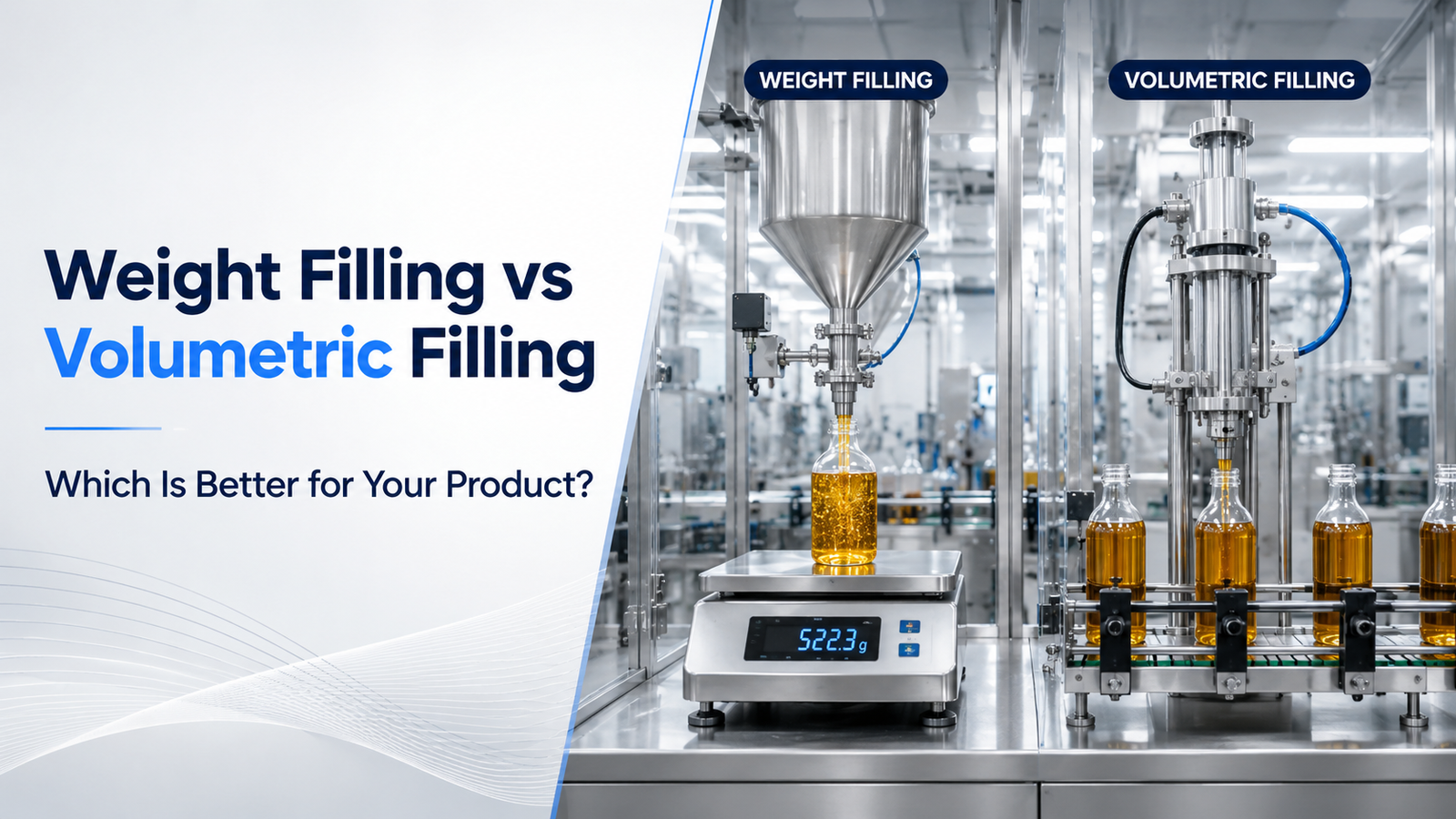
Choose weight filling when the declared quantity is based on mass, product density changes between batches or temperatures, containers are large, or overfill is expensive. Choose volumetric filling when the product is stable, containers are smaller, output is the priority, and a piston, pump or flow-based dose can remain repeatable.
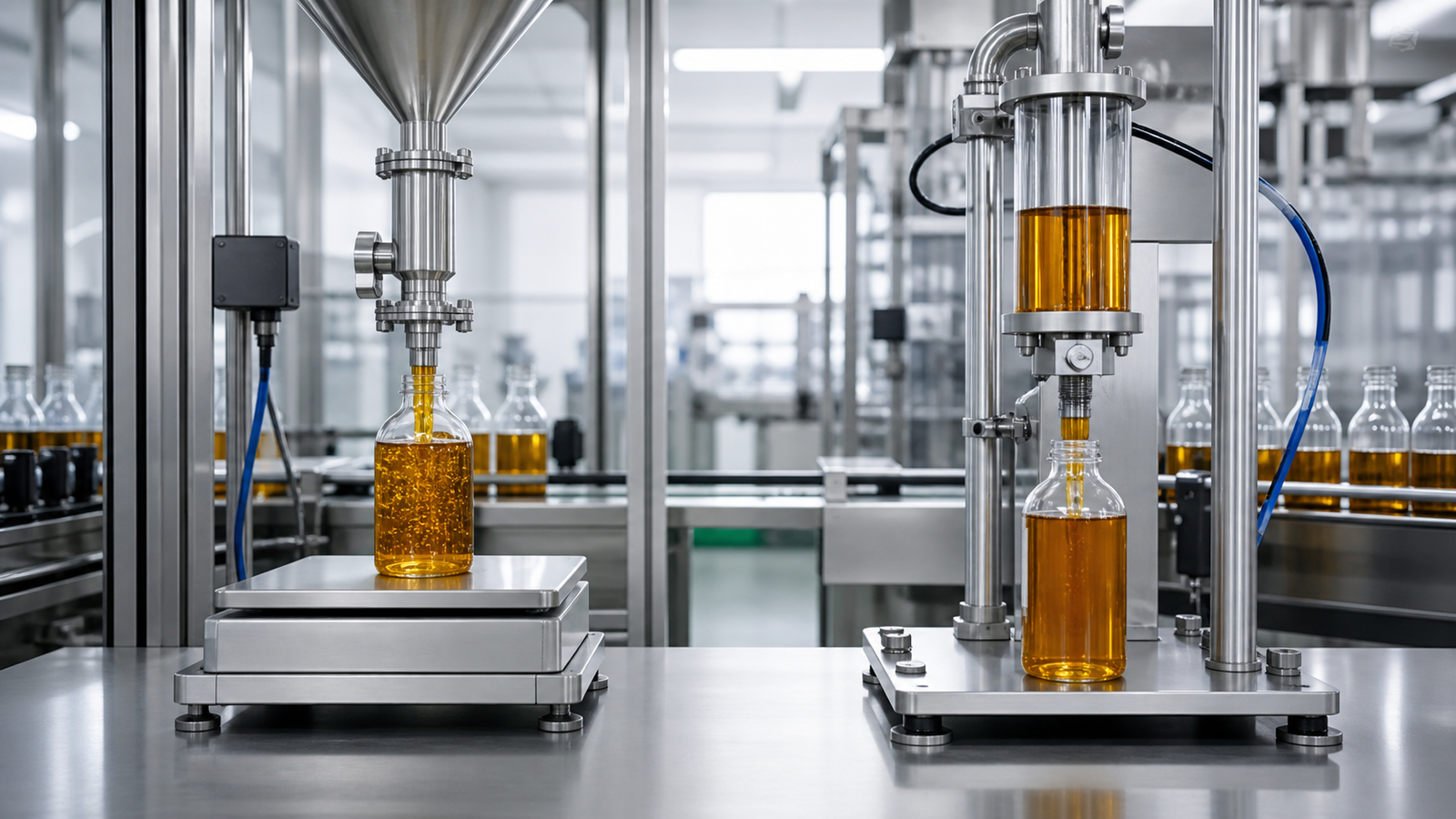
Both methods can be accurate, but they measure different things. A weight filling machine measures the product added to each container through a load cell. A volumetric filling machine meters displacement, flow, pump motion or filling time. The better choice depends on what your label promises, how the product behaves and what the complete packaging line must achieve—not on one headline accuracy percentage.
Weight Filling vs Volumetric Filling: Quick Selection Matrix
| Decision factor | Weight filling | Volumetric filling |
|---|---|---|
| Primary measurement | Net or gross mass measured by load cell | Volume defined by displacement, flow, pump revolutions or time |
| Density variation | Generally tolerant because the target is mass | Equal volume can create different mass when density changes |
| Typical speed profile | Filling and weighing must settle before the final cutoff | Often faster for stable products and small-to-medium doses |
| High-value product control | Useful when every gram of giveaway matters | Can also be economical when the product and dosing system are stable |
| Large containers | Strong option for drums, pails, jerrycans and other bulk packs | Possible, but metering size and flow control must be matched carefully |
| Multi-head adjustment | Each station measures its actual container weight | Each dosing head may need calibration and mechanical condition control |
| Best starting point | Variable-density, premium, bulk or legally mass-declared products | Stable liquids, creams and pastes where throughput and repeatability matter |
This table is a shortlist. Product foam, viscosity, particles, container stability, required tolerance, cleaning and line speed can change the recommendation. The correct method should be confirmed with representative product and containers during testing.
How Does a Weight Filling Machine Work?
A weight filling machine places an empty container on a load cell or weighing platform, establishes the tare value and then adds product until the programmed target is reached. The controller reads the changing mass in real time and closes the filling valve at the correct cutoff point.
- Container arrives: the conveyor or operator positions a stable container on the weighing station.
- Tare is confirmed: the system records the empty container and ignores its mass.
- Bulk filling starts: a high flow rate moves most of the required product quickly.
- Fine filling begins: the machine reduces flow near the target to limit overshoot.
- Cutoff is calculated: the controller accounts for product still falling between the nozzle and container.
- Final weight is checked: the filled container is accepted, corrected or rejected according to the recipe.
Fast and slow filling stages are important. If the machine runs at one high flow rate until the exact target appears, liquid already in flight can create overfill. If it slows too early, the fill cycle becomes unnecessarily long. Product viscosity, nozzle height, valve response and container size determine the best transition point.
How Does a Volumetric Filling Machine Work?
A volumetric filler repeats a defined dose without weighing every container during filling. A piston can displace a known cylinder volume. A positive-displacement pump can rotate a programmed number of turns. A peristaltic pump can complete a defined motion, while a timed-flow or flow-meter system can stop after the programmed dose condition is met.
Volumetric systems are productive when product temperature, viscosity, density, tank supply and the condition of valves or tubing remain inside the validated window. The system should be calibrated with the actual product; water is not a meaningful substitute for a cream, foaming cleaner or viscous sauce.
For a broad introduction to dosing options, see what you should know about liquid filling machines. King Pack can integrate either method into an automatic filling and capping line.
Which Method Holds Accuracy When Density Changes?
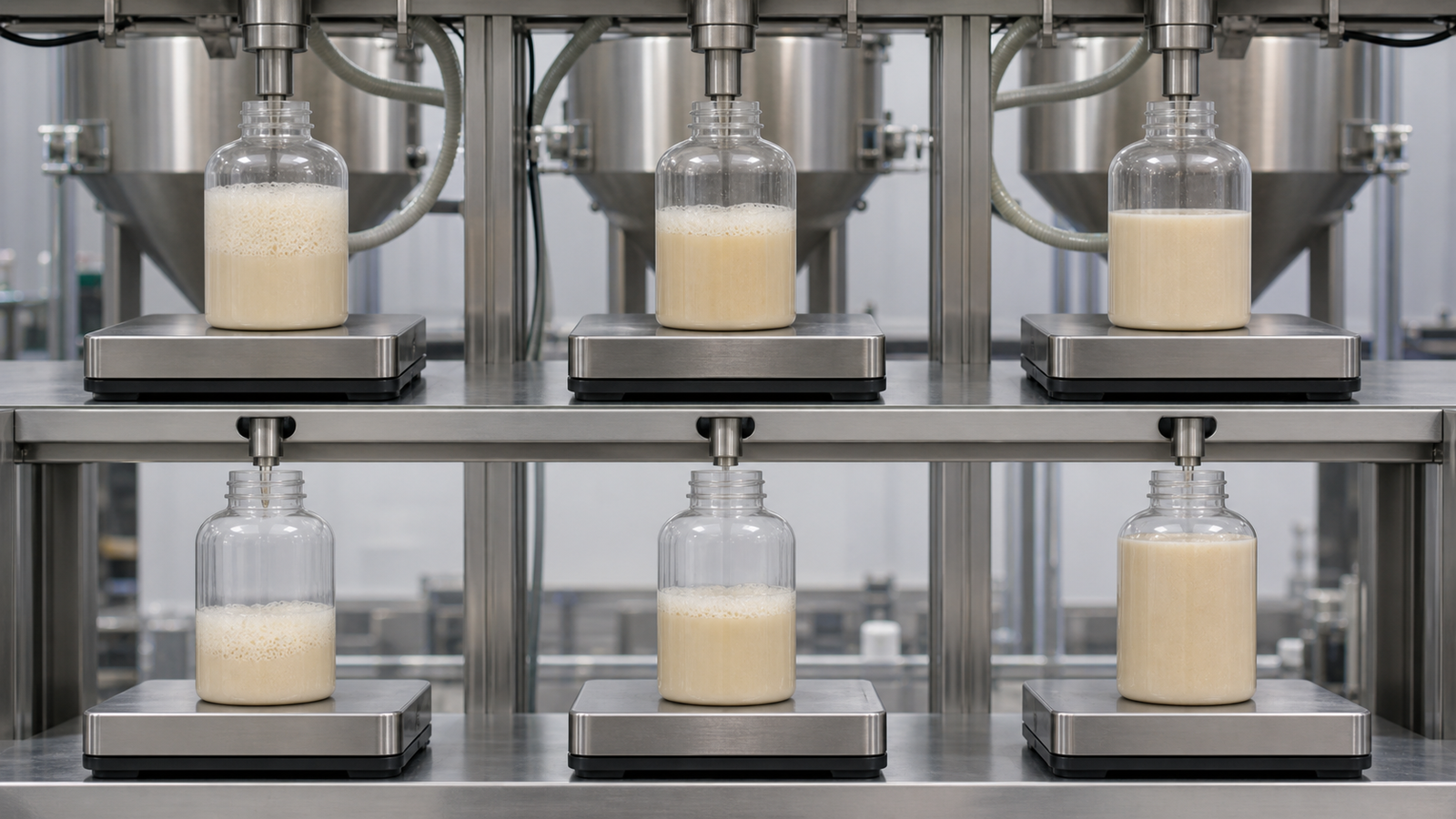
Density is mass divided by volume. If product density changes, the same volumetric dose does not have the same mass. A liquid may become less dense as temperature rises; a product with entrained air may occupy more volume without adding equivalent mass; a batch with a slightly different solids content may also behave differently.
A net-weight filler continues aiming for the programmed mass, so it naturally compensates for many density changes. The container may receive a slightly different volume, but the mass target remains stable. That is useful when the label claim and commercial value are based on weight.
A volumetric filler can still perform well when density is controlled. Manufacturers can stabilize product temperature, remove air, maintain mixing, set batch release limits and recalibrate recipes. If shelf appearance depends on a consistent liquid level, however, changing density can produce a visible level difference even when net weight is correct. The commercial requirement must be defined first.
Accuracy Is More Than a Percentage
Suppliers often quote accuracy as a percentage, but the number is incomplete without the test conditions. A fair comparison states:
- The actual product or justified test liquid.
- The target dose and allowed tolerance.
- The number of containers sampled.
- Whether the result is based on mass or converted volume.
- The machine speed and tank condition.
- Whether the first containers after start-up are included.
- Whether all filling heads are analyzed separately.
- The product temperature and density used for any conversion.
Load cells also need stable mechanics. Conveyor vibration, air movement, container contact with guides, product impact and insufficient settling time can disturb a weight reading. Volumetric systems depend on metering condition: worn piston seals, valve leakage, tubing fatigue, air bubbles and supply pressure can all create drift. Neither method is accurate merely because the controller displays more decimal places.
Speed and Container-Size Trade-Offs
Volumetric filling is often favored for high-throughput small containers because multiple dosing heads can complete repeatable cycles without waiting for each individual weight reading to settle. A piston or servo-pump system can use rapid acceleration, multi-stage flow and diving nozzles to control foam while maintaining output.
Weight filling becomes increasingly attractive as the container and product value grow. A few grams of unnecessary overfill in a bottle may seem small; in a pail or drum, systematic giveaway can become expensive. Load-cell systems also avoid the need to size a large metering chamber for every bulk dose.
| Production situation | Likely starting point | Reason |
|---|---|---|
| Small bottles, stable water-like liquid, high output | Volumetric or flow-controlled | Fast repeated cycles and scalable nozzle count |
| Jars of stable cream or gel | Servo piston volumetric | Positive displacement and controlled nozzle cutoff |
| Pails or drums of expensive chemical | Net weight | Direct mass control and reduced giveaway risk |
| Food product with density affected by temperature or solids | Weight filling shortlist | Mass target remains independent of density |
| Small premium pack with tightly controlled formulation | Compare both | Speed, product value and tolerance determine ROI |
Product Giveaway and ROI Example
Consider a hypothetical product with a 1 kg declared target. The plant intentionally overfills by an average of 8 g to protect against underweight packs. At 10,000 packs per day and 250 production days, annual giveaway is:
0.008 kg × 10,000 packs × 250 days = 20,000 kg of product per year.
Multiply this amount by the variable manufacturing cost per kilogram to estimate the annual material value. If better process control reduces average overfill by only part of the 8 g, the saving may still justify a more capable filling method. This example is not a promise that weight filling will remove all giveaway. The true saving must be measured from current production data and confirmed during trials.
A complete ROI model should also include line speed, labor, changeover time, calibration, maintenance, rejected product and downtime. A faster volumetric system may create more annual contribution even with slightly higher giveaway; a slower weight filler may win when the product is very expensive. Use contribution per good pack, not machine price alone.
Best Applications by Industry
Food and Sauce Filling
Edible oils, sauces, dressings and syrups can use either method. Stable recipes in smaller retail containers often suit piston or pump volumetric filling. Products with density variation, expensive ingredients or bulk packs may benefit from weight control. Review King Pack’s food filling and packaging solutions.
Chemical Filling
Lubricants, coatings, cleaning products and industrial fluids may be sold by mass and packaged in large containers. Weight filling can reduce giveaway and handle density variation, but wetted materials, fumes, hazardous-area requirements and nozzle cutoff remain critical. See chemical filling machine solutions.
Cosmetics and Personal Care
Lotions, shampoos, gels and creams are frequently filled volumetrically because piston and positive-displacement systems handle their viscosity and deliver clean, fast cycles. Premium bulk products or formulations with significant aeration may justify a weight-filling comparison.
Pharmaceutical and Healthcare Products
The selection begins with dosage requirements, process validation, product-contact design and container format. Small liquid doses often use precision volumetric technologies, while bulk preparation or mass-declared packs may require gravimetric control. Compliance and cleaning strategy take priority over a generic industry rule.
Integration with Capping, Checkweighing and Rejection
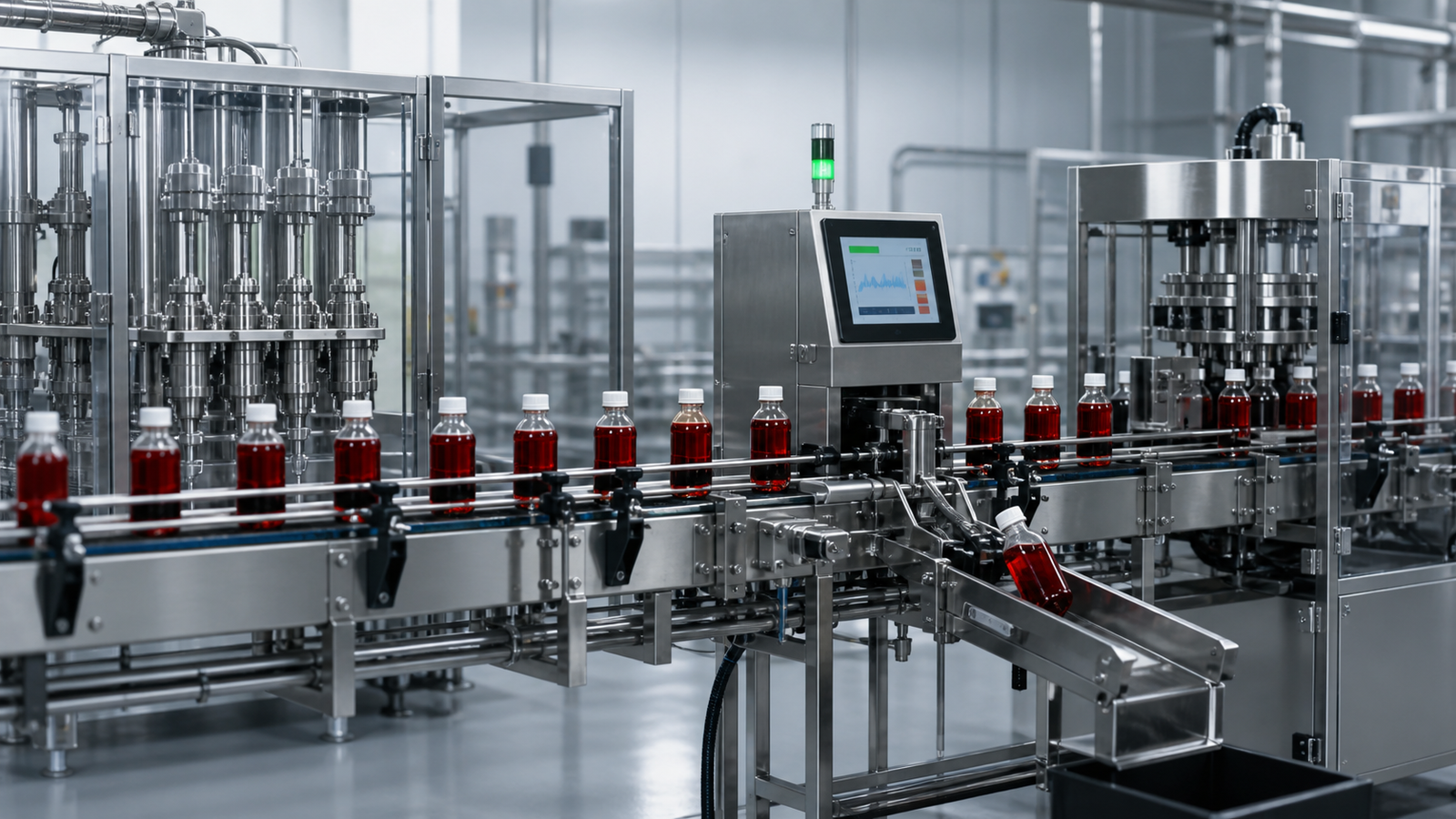
A filling method should be evaluated inside the whole packaging line. Weight filling requires a stable weighing station that is isolated from conveyor forces. Volumetric filling needs consistent container positioning and supply conditions. Both methods must coordinate with no-container-no-fill control, cap or plug insertion and downstream inspection.
- Checkweigher: a downstream checkweigher can verify finished packs even when the primary filler is volumetric.
- Reject station: nonconforming containers should be removed and recorded without stopping the line unnecessarily.
- Feedback control: trend data can prompt recipe correction before a process reaches the reject limit.
- Container tare: container-weight variation must be considered when gross weight is checked after filling.
- Capping timing: product settling, foam and contamination around the neck can affect closure quality.
- Data records: regulated applications may require controlled recipes, audit trails and calibration history.
If you are replacing a stand-alone filler, review how to integrate new filling equipment into an existing line before finalizing the layout and controls.
Validation and Calibration Checklist
- Define whether acceptance is based on net mass, volume, average quantity or individual container limits.
- Use calibrated reference weights and document load-cell checks for a weight filler.
- Calibrate every volumetric head with representative product.
- Test minimum, normal and maximum fill sizes.
- Test the coldest and warmest expected product conditions.
- Include low-tank, normal-tank, start-up and restart conditions.
- Record individual fills instead of reporting only an average.
- Confirm cutoff, drips, foam and container cleanliness.
- Verify recipe security, alarms, reject logic and no-container-no-fill protection.
- Set routine verification frequency based on process risk and historical drift.
A Six-Question Final Decision Test
Before approving the filling method, ask six questions in order. Is the saleable quantity defined by mass or volume? How much can density change across released batches and operating temperatures? What is the financial value of one gram of average overfill? Can the required output tolerate weighing and settling time? Which contact path is easier to clean and validate? Finally, can the machine reproduce the agreed result after a changeover and restart?
If mass compliance, density variation and giveaway dominate, weight filling deserves priority in the trial. If stable product behavior, smaller containers and high throughput dominate, volumetric filling is usually the stronger shortlist. When the answers are mixed, run both methods with the same product and compare good output, standard deviation, giveaway and cleaning time.
Frequently Asked Questions
Is weight filling always more accurate?
No. It directly measures mass, which is advantageous when density varies, but vibration, container contact, unstable flow and poor cutoff can still create errors. A correctly designed volumetric filler may be faster and equally suitable for a stable product.
Can a volumetric filler be checked by weight?
Yes. Quality control often weighs samples and uses a verified density to evaluate a volumetric process. A downstream checkweigher can also monitor finished containers.
Which method is better for foaming liquids?
Either method can work with the right flow profile and diving nozzle. Foam can delay stable weight readings and can also make volumetric cutoff difficult. Product testing is essential.
Which method is better for large drums?
Net-weight filling is often the stronger starting point because it controls actual mass and supports bulk quantities without a very large metering chamber. Container handling, grounding and safety may dominate the final design.
How should buyers compare two machine proposals?
Give both suppliers the same product, density range, fill sizes, containers, speed, cleaning requirements and acceptance protocol. Compare sustained good output, giveaway, changeover and maintenance—not only nominal speed.
Get a Filling-Method Recommendation
Send King Pack your target net quantity, minimum and maximum product density, viscosity and temperature range, container samples, required output and permitted tolerance. Our engineers can compare load-cell weight filling with piston, pump and flow-controlled volumetric systems, then define a representative FAT.
Contact King Pack for a product-based filling recommendation.
