 Skip to content

Last reviewed: August 5, 2026
A cosmetics or pharmaceutical manufacturer comparing tube filling machines may receive two technically credible but very different proposals.
One may come from an Italian supplier with a mature packaging platform, strong format flexibility, refined machine design and extensive experience connecting filling with downstream packaging.
The other may come from a Chinese manufacturer offering direct engineering communication, project-specific customization, shorter decision paths and a more accessible initial investment.
The comparison is not simply:
Italian quality versus Chinese price.
Both countries have large machinery industries, multiple supplier levels and different areas of technical strength.
Italy is one of the world’s most important packaging machinery manufacturing centers. UCIMA reports that the Italian packaging machinery industry generated approximately €10.46 billion in turnover in 2025, including more than €8.1 billion in exports. The association describes the industry as a combination of large integrated groups and highly specialized small and medium-sized manufacturers, with flexibility and customization among its central strengths.
China has a wider and more uneven supplier base. It includes basic equipment workshops, price-focused exporters, specialized tube filling manufacturers and companies capable of delivering customized emulsifying, filling, sealing, cartoning and end-of-line systems.
For buyers, the right question is therefore not:
Is an Italian machine better than a Chinese machine?
It is:
Which supplier can deliver the required tube quality, stable output, project flexibility and lifecycle support at an investment level that makes sense for the factory?
This guide compares Chinese and Italian tube filling machines across the factors that matter most:
- Product-specific filling technology
- Plastic, laminate and aluminum tube capability
- Sealing and folding quality
- Format flexibility
- Changeover
- Production output
- Emulsification integration
- Secondary packaging
- Documentation
- Service
- Total cost of ownership
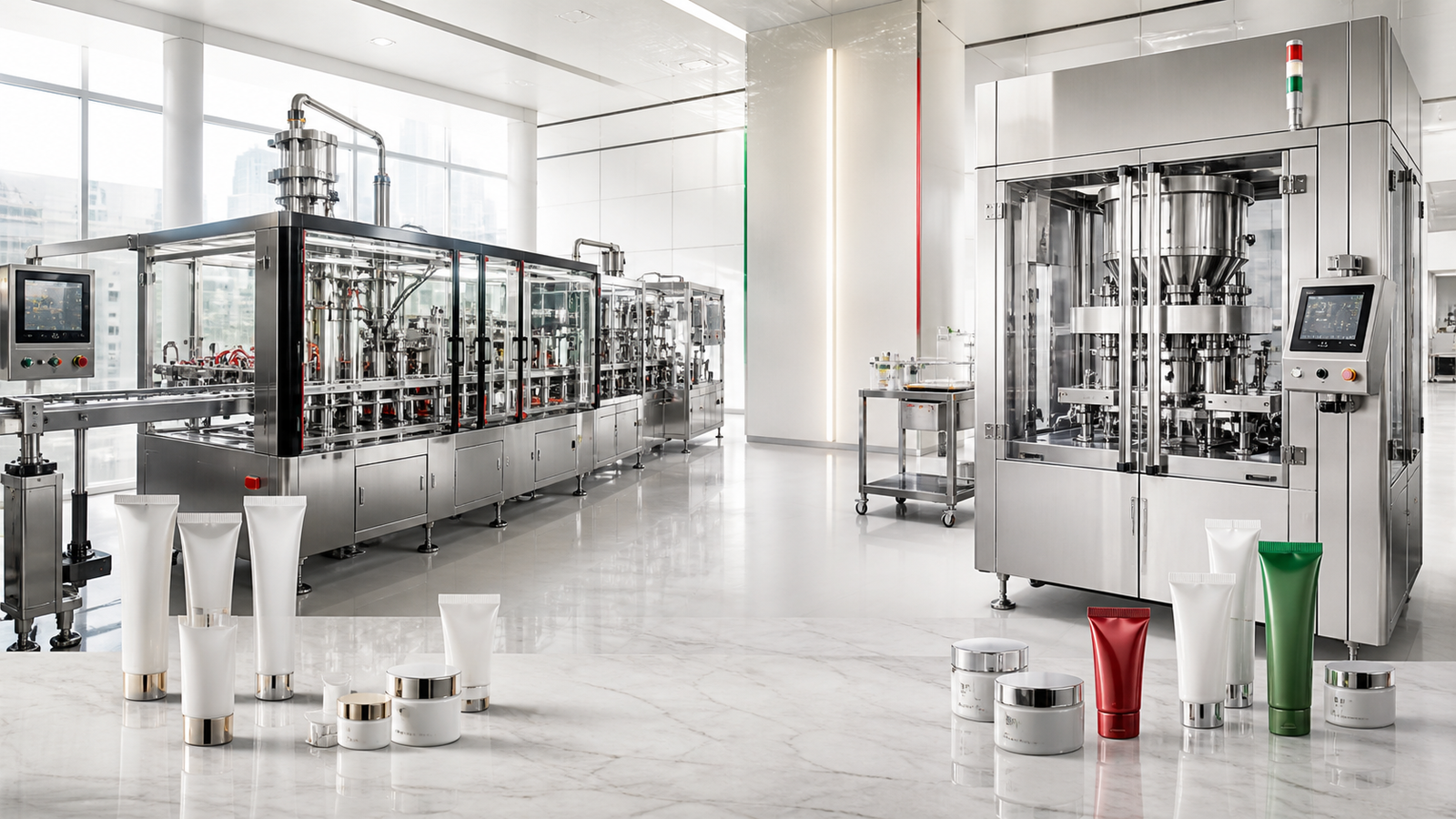
China vs Italy Tube Filling Machines at a Glance
| Comparison area | Qualified Chinese manufacturer | Established Italian manufacturer |
|---|---|---|
| Initial investment | Generally more accessible | Generally higher |
| Supplier variation | Very wide | More concentrated among specialized manufacturers |
| Customization | Highly flexible, often project-driven | Strong flexibility built around mature platforms |
| Cosmetics and beauty applications | Strong among selected suppliers | Long-established strength |
| Pharmaceutical applications | Supplier- and project-dependent | Mature among specialist suppliers |
| Medium-speed tube filling | Competitive | Particularly strong |
| High-speed platforms | Available from selected manufacturers | Established platforms available |
| Special seal designs | Available with customization | Often well developed |
| Emulsifier and tube filler integration | Available from integrated suppliers | Strong among process-focused specialists |
| Cartoning integration | Available as a customized line | Mature packaging ecosystem |
| Documentation | Must be confirmed in detail | Generally more structured |
| Local European service | Requires planning | Usually stronger |
| Engineering communication | Often direct and fast | Structured but still highly application-focused |
| Best fit | Customized projects with controlled investment | Flexible, packaging-intensive projects requiring mature European engineering |
This table should not be treated as a country-level quality guarantee.
A qualified Chinese supplier may offer better product matching than an Italian supplier whose standard platform does not suit the application. An experienced Italian specialist may substantially reduce project risk compared with a poorly engineered low-cost machine.
The comparison must be made at the supplier, configuration and acceptance-standard level.
Why Italy Is a Different Comparison from Germany
Germany and Italy are both major European packaging machinery manufacturing countries, but buyers do not necessarily choose them for exactly the same reasons.
German equipment is commonly associated with:
- Highly standardized engineering platforms
- Validation-intensive pharmaceutical projects
- Ultra-high-speed production
- Long-term lifecycle systems
- Structured global standardization
Italian equipment is also technically mature, but its packaging machinery industry is particularly recognized for combining:
- Specialized engineering
- Production flexibility
- Customized formats
- Compact machine design
- Primary and secondary packaging integration
- Large groups supported by specialist companies
UCIMA states that Italian and German manufacturers together account for almost half of automatic packaging machinery sold worldwide. It attributes the Italian sector’s position to technological quality, production flexibility, customization, after-sales support and the coexistence of large groups with highly specialized manufacturers.
For a tube filling buyer, Italy is therefore a particularly relevant comparison when the project involves:
- Multiple tube formats
- Cosmetics or personal care products
- Special tail shapes
- Plastic and aluminum tubes
- Medium-speed production
- Compact factory layouts
- Emulsification and filling
- Filling and cartoning integration
Understanding the Italian Tube Filling Model
The Italian machinery market includes both large integrated packaging groups and smaller specialist manufacturers.
Two relevant examples are IMA Comadis and Axomatic.
IMA Comadis
IMA Comadis offers several tube filling platforms.
Its C1060 and C1075 machines operate at up to 60 and 75 tubes per minute respectively, with filling ranges of 2–250 ml and optional extensions to 350 ml. Their published features include automatic or robotic tube feeding, positive shut-off diving nozzles, quick interchangeability of closing heads, tool-free size-part changes and batch-data collection.
The higher-output CD180 platform reaches a stated mechanical speed of up to 180 tubes per minute. It includes a servo-driven dosing system, optional robotized feeding, quick-change closing heads, tool-free format-part changes, customized seal shapes and batch-data collection.
These platforms illustrate several common Italian strengths:
- Strong medium-speed positioning
- Flexible machine configuration
- Attention to format changeover
- Refined tube handling
- Compact equipment layouts
- Special seal designs
- Connection between automation and operator accessibility
Axomatic
Axomatic is part of Marchesini Group Beauty and has more than 30 years of experience in equipment for cosmetics, pharmaceutical and chemical products.
Its portfolio is especially relevant to King Pack because it covers both:
- Vacuum emulsifying and melting systems
- Tube filling and closing machines
It also produces equipment for jars, syringes, monodose containers, mascara, lip gloss and filling and capping lines.
Axomatic’s tube filling range covers plastic, laminate and aluminum tubes. Its published machine portfolio spans filling volumes from approximately 3 to 450 ml and outputs from around 1,000 to 21,000 units per hour, depending on the model.
Its AXO 1000, for example, supports aluminum folding, hot-jaw sealing, hot-air sealing and ultrasonic sealing. It also offers simple, double or saddle folds and customized curved or shaped seals based on customer drawings.
This demonstrates that Italian tube filling engineering is not based only on speed. It also places substantial value on:
- Packaging presentation
- Format flexibility
- Special closure designs
- Application diversity
- Connection between product preparation and filling
Understanding the Chinese Tube Filling Model
The Chinese market is more difficult to describe with one set of characteristics.
A buyer may encounter:
- Basic semi-automatic equipment
- Standard rotary machines sold mainly by price
- Specialized tube filling manufacturers
- Pharmaceutical machinery companies
- Complete-line system integrators
The technical and commercial differences between these supplier levels can be greater than the difference between countries.
A basic Chinese machine may provide:
- A standard piston filling system
- Limited format flexibility
- Basic electrical controls
- Minimal documentation
- Remote support only
- Few application tests
A qualified Chinese manufacturer may provide:
- Servo-controlled filling
- Product-specific nozzles
- Heated or agitated hoppers
- Plastic, laminate and aluminum tube systems
- Hot-air, ultrasonic and mechanical closing
- International controls and pneumatic components
- Customer-tube FAT
- Emulsifier and transfer-system integration
- Cartoning and end-of-line equipment
- Project-specific documentation
The main potential advantage is the ability to communicate directly with the team that designs and builds the machine.
Modifications to the hopper, nozzle, filling system, tube holders, station layout or transfer connection may be discussed without passing through several corporate and distributor layers.
The risk is that some manufacturers may accept technical changes without enough design control or testing.
Buyers must distinguish between:
Controlled engineering customization and unverified modification.
Detailed Comparison: Chinese vs Italian Tube Filling Machines
1. Product-Specific Filling Technology
Tube filling begins with the product—not the tube.
The filling system may be affected by:
- Viscosity
- Density
- Temperature
- Air content
- Stringing behavior
- Foaming
- Particle content
- Abrasiveness
- Filling volume
- Required cutoff
- Cleaning method
A smooth facial cream and a stringing veterinary paste may use identical tubes but require different nozzle and dosing configurations.
Typical Italian strength
Italian specialists commonly serve a broad range of cosmetic and pharmaceutical products.
This experience is reflected in features such as:
- Diving nozzles
- Positive shut-off valves
- Servo-driven dosing
- Easy-to-disassemble pumps
- Product-specific filling modules
- Special container handling
IMA Comadis’ CD180, for example, uses independently controlled servo-driven dosing pistons, servo-controlled valves and diving injectors.
Axomatic combines tube filling with emulsifying, melting and special-container equipment, indicating a strong focus on how product processing affects packaging.
Potential Chinese advantage
A qualified Chinese supplier may be more willing to modify:
- Nozzle diameter
- Nozzle movement
- Suck-back function
- Hopper geometry
- Hopper agitation
- Product-contact piping
- Filling cylinder
- Heating system
- Product transfer
- Machine footprint
This is valuable when the customer’s product falls outside a standard platform.
Buyer conclusion
Italian manufacturers often combine established application modules with mature packaging experience.
Chinese suppliers may offer greater engineering freedom, but the modified filling system must be verified through real-product or representative-material testing.
2. Format Flexibility and Changeover
Many contract manufacturers and cosmetics factories run several tube sizes and product formulas.
For these customers, changeover can be more important than maximum speed.
A production line that runs at 100 tubes per minute but requires several hours to change format may be less productive than a slightly slower machine with a faster, repeatable changeover.
Italian approach
Italian tube fillers frequently emphasize:
- Quick-change closing heads
- Tool-free size-part changes
- Recipe-controlled settings
- Compact access
- Automatic or robotic tube feeding
- Specialized seal designs
IMA Comadis lists quick interchangeability of closing heads and tool-free size changes on both its medium-speed and higher-output platforms.
Axomatic describes rapid size change across its tube filling range and offers customer-specific closure shapes.
Chinese approach
Chinese manufacturers can offer fast format changeover, but the actual scope must be confirmed.
Buyers should ask:
- Which parts are replaced?
- Which settings are adjusted electronically?
- Are alignment positions marked?
- Are all format parts included?
- How are recipes stored?
- Does changeover require an engineer?
- How long does cleaning take?
- Is a changeover demonstration included in FAT?
Buyer conclusion
Italy has a strong industry reputation for combining customization with refined changeover engineering.
A Chinese machine can offer comparable practical flexibility in selected projects, but the supplier should demonstrate the complete changeover rather than describe it as “easy.”
3. Plastic, Laminate and Aluminum Tube Capability
Tube material determines the closing process.
Plastic and laminate tubes
These may use:
- Internal hot-air sealing
- Heated-jaw sealing
- Ultrasonic sealing
- Cooling
- Tail trimming
- Batch coding
Aluminum tubes
These require:
- Mechanical folding
- Controlled compression
- Double, triple or saddle folds
- Batch embossing
- A clean, product-free tail area
Italian suppliers such as Axomatic offer multiple closing technologies on one machine family, including mechanical folding for aluminum tubes, hot-air or hot-jaw sealing for plastic and laminate tubes and ultrasonic sealing for selected plastic tubes.
King Pack’s published portfolio also includes plastic, laminate, metal and aluminum tube equipment, with hot-air sealing, ultrasonic sealing and mechanical folding configurations.
What buyers should compare
Do not compare only the number of supported tube materials.
Compare:
- Stable output for each material
- Required closing modules
- Changeover time
- Tooling included
- Tail appearance
- Seal or fold strength
- Coding and embossing
- Tube-diameter limitations
- Future upgrade potential
A machine that technically accepts three tube materials may still be impractical if changing between them requires extensive mechanical work.
4. Aluminum Tube Folding Quality
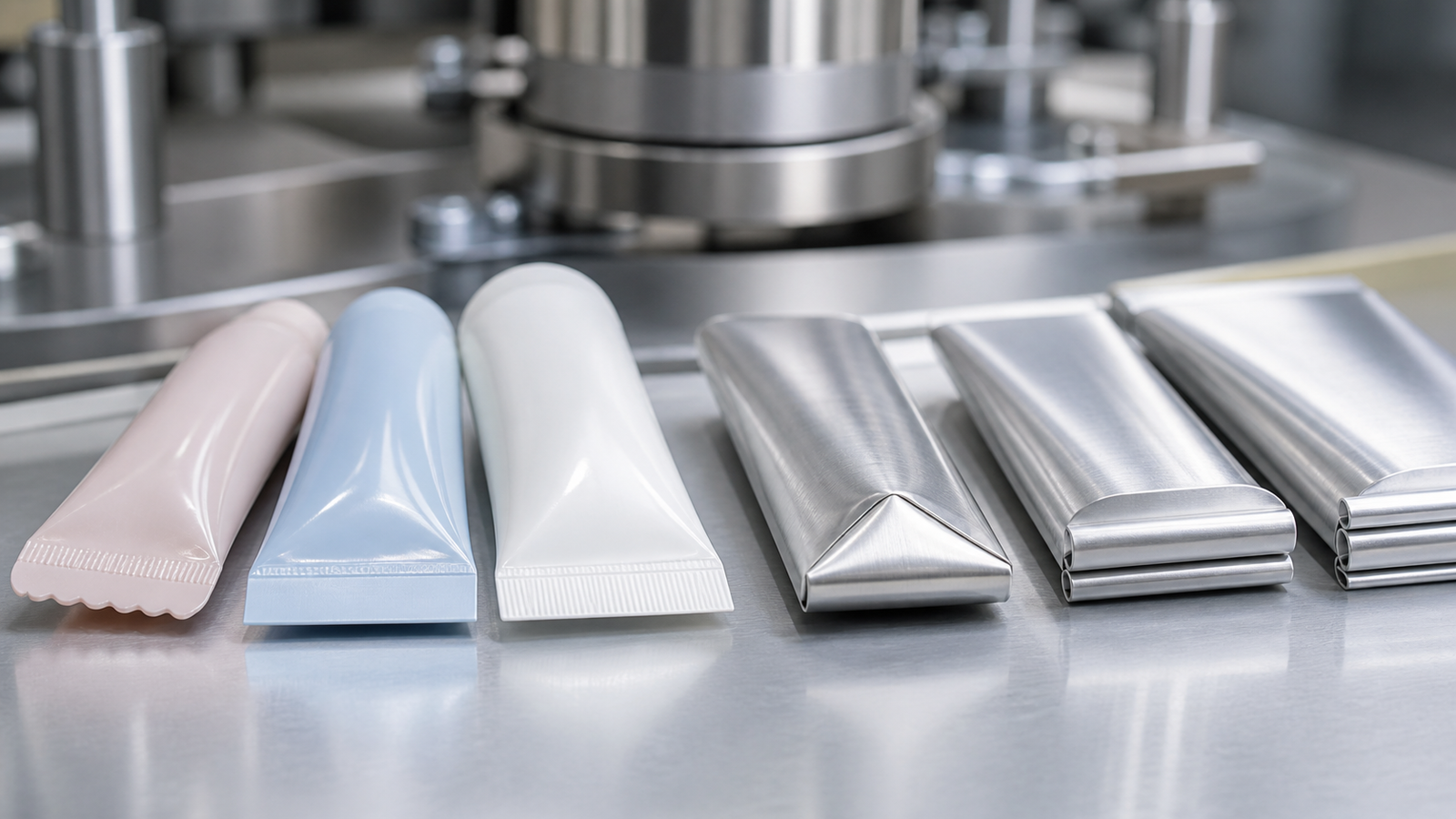
Aluminum tube capability deserves separate evaluation.
A machine may have a folding station but still produce poor finished tubes if the filling nozzle contaminates the tail area.
The complete process includes:
- Tube positioning
- Product filling
- Nozzle withdrawal
- Product cutoff
- Tail-area clearance
- Mechanical folding
- Compression
- Embossing
- Inspection
Axomatic’s AXO 1000 supports simple, double and saddle folds for aluminum tubes.
King Pack’s metal-tube portfolio includes controlled multi-fold systems for tube diameters and filling volumes that vary by model, including applications up to around 60 tubes per minute.
Italian strength
Italian suppliers may offer:
- Mature folding modules
- Refined mechanical tooling
- Several fold formats
- Special appearance options
- Strong integration between filling and closure design
Qualified Chinese opportunity
A Chinese supplier may offer:
- Customized fold geometry
- More accessible tooling costs
- Product-specific nozzle changes
- Special embossing
- Combined plastic and aluminum platforms
- Direct modification after tube trials
Buyer conclusion
Italian machines may have an advantage in established tooling and closure refinement.
Chinese systems can be competitive when the actual aluminum tubes and product are tested and the acceptance criteria cover both filling cutoff and final fold quality.
5. Special Seal Shapes and Packaging Appearance
Packaging appearance is particularly important in cosmetics and premium personal care.
The tube tail can contribute to:
- Brand presentation
- Shelf appearance
- Product differentiation
- Coding visibility
- Perceived package quality
Italian equipment portfolios often reflect this requirement.
IMA Comadis offers customized “designer seals,” while Axomatic supports round, curved, wave-shaped and other customer-defined seal profiles.
This does not mean Chinese manufacturers cannot produce customized tails.
It means buyers should compare:
- Tooling precision
- Seal symmetry
- Trimming consistency
- Decoration protection
- Batch-code position
- Repeatability across long runs
- Tooling replacement cost
Buyer conclusion
Italy may be particularly attractive for projects where packaging appearance and format differentiation are central to the brand.
Chinese suppliers can offer special tooling more economically, but samples should be approved before final machine acceptance.
6. Medium-Speed and High-Speed Production
Italy has strong equipment coverage across medium and high output levels.
IMA Comadis offers platforms at approximately:
- 60 tubes per minute
- 75 tubes per minute
- 180 tubes per minute
Axomatic’s published range extends from around 1,000 to 21,000 tubes per hour, depending on the system.
This makes Italy particularly relevant for manufacturers that require more than entry-level output but do not necessarily need an ultra-high-speed toothpaste platform.
King Pack’s published range includes:
- Plastic and aluminum systems around 50–75 tubes per minute
- Metal tube systems up to approximately 60 tubes per minute
- Higher-speed platforms with stated actual production around 120–150 tubes per minute, depending on product and configuration
What buyers should compare
The most useful performance measure is not the highest mechanical speed.
It is:
Accepted finished tubes per production hour.
Consider:
- Product viscosity
- Filling volume
- Tube diameter
- Seal or folding cycle
- Rejected tubes
- Changeover
- Cleaning
- Cartoner synchronization
- Operator intervention
Buyer conclusion
Italy has established medium- and high-speed platforms with mature engineering.
A qualified Chinese supplier can offer an attractive investment balance in similar output ranges, particularly where customization and integration matter more than a standardized European platform.
7. Emulsification and Tube Filling Integration
This is one of the most important differences between the Italian comparison and the German comparison.
Some Italian suppliers combine product preparation and filling within the same equipment portfolio.
Axomatic manufactures vacuum turbo-emulsifiers, hot melters and tube filling machines for plastic, laminate and aluminum tubes. It also provides special filling and capping systems for several cosmetics and pharmaceutical formats.
This reflects an important production reality:
Tube filling performance begins upstream.
For creams, ointments, gels and pastes, filling can be affected by:
- Emulsification quality
- Vacuum deaeration
- Product temperature
- Viscosity stability
- Transfer pressure
- Holding time
- Hopper agitation
- Product separation
| Upstream issue | Possible filling effect |
|---|---|
| Insufficient vacuum | Air pockets and weight variation |
| Unstable temperature | Changing viscosity |
| Poor homogenization | Irregular flow |
| Long transfer path | Heat and pressure loss |
| Incorrect feeding pressure | Unstable filling |
| Inadequate agitation | Product separation |
| Excessive stringing | Contaminated tube tails |
King Pack also manufactures vacuum emulsifying systems and tube filling equipment. Its emulsifiers cover applications such as cosmetics, creams and pharmaceutical ointments, with available capacity ranges depending on the project.
King Pack has also documented a project in which an Australian customer evaluated and confirmed a production line combining a vacuum emulsifying mixer with a tube filling and sealing machine.
Buyer conclusion
For semi-solid products, Italy and qualified Chinese integrated suppliers can both offer an important advantage over a company focused only on the filling machine.
The buyer should compare how well the supplier connects:
Emulsification → holding → transfer → filling → sealing or folding.
8. Secondary Packaging and Complete-Line Capability
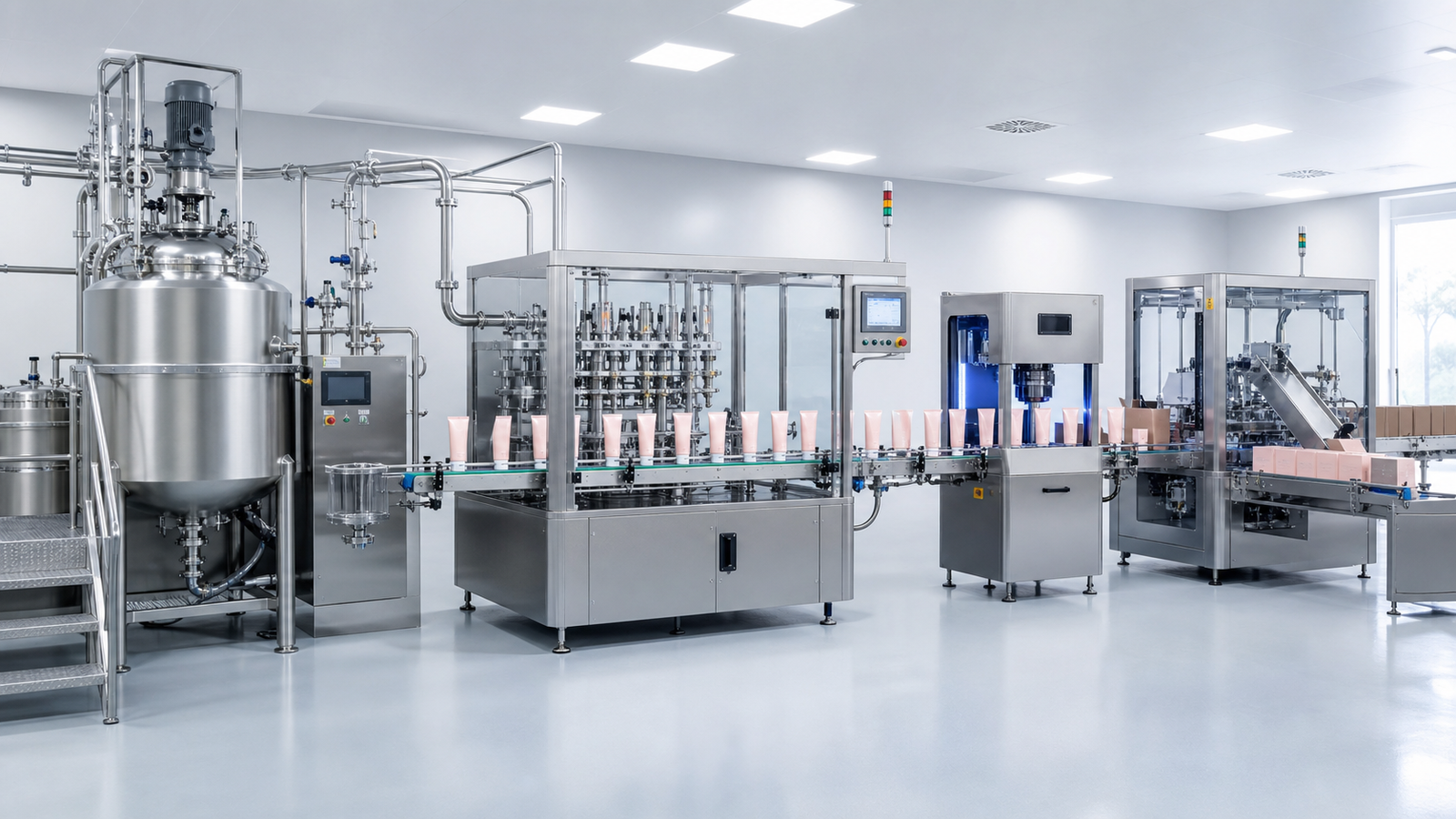
Italy has a particularly mature packaging machinery ecosystem.
Large Italian groups and specialized companies can connect:
- Tube filling
- Inspection
- Checkweighing
- Cartoning
- Leaflet insertion
- Case packing
- Robotic handling
- Palletizing
Axomatic’s membership in Marchesini Group Beauty places its process and filling technologies within a broader automatic packaging organization, while it continues to manage its own products and projects.
IMA also operates across a broad range of processing and packaging technologies, and its tube platforms can be combined with related feeding, data and secondary-packaging solutions.
Chinese complete-line model
Qualified Chinese manufacturers can also integrate:
- Vacuum emulsifying mixers
- Holding tanks
- Transfer pumps
- Tube filling and sealing
- Inspection
- Cartoning
- Case packing
The possible advantage is one commercial and engineering contact for the complete project.
The potential risk is that the supplier may be strong in the primary machine but weaker in one of the connected systems.
Questions to ask both suppliers
- Who is responsible for line speed?
- Who designs the tube transfer?
- Are the machines controlled independently or centrally?
- How is reject logic coordinated?
- Is the complete line included in FAT?
- Who resolves interface problems during installation?
- Are all communication protocols documented?
- Is one project manager responsible for the final result?
Buyer conclusion
Italy offers a mature integrated packaging ecosystem.
China can offer strong project flexibility and competitive integration, but the buyer must verify the supplier’s actual competence across every major line section.
9. Controls, Data and Documentation
Italian machine platforms generally include established control and documentation structures.
Published IMA Comadis features include:
- HMI-controlled servo dosing
- Stored operating parameters
- Batch-data collection
- Automatic or robotic feeding
- Controlled reject handling
- Tool-free format adjustment
A professional Chinese manufacturer may provide:
- Siemens PLC and HMI
- Servo-controlled filling
- Recipe storage
- User levels
- Alarm history
- Electronic parameter control
- FAT documents
- Electrical and pneumatic drawings
- Optional IQ/OQ support
King Pack’s published configurations include servo filling, PLC/HMI controls, hot-air sealing, ultrasonic sealing, aluminum folding and options for internationally recognized electrical and pneumatic components.
However, component brands do not prove the completeness of the machine.
Buyers should confirm:
- Software functionality
- User-access levels
- Recipe management
- Alarm history
- Data export
- Audit-trail requirements
- Calibration documents
- FAT format
- IQ/OQ scope
- Source-code and backup policy
- Drawing revision control
Buyer conclusion
Italian suppliers generally offer more mature standard documentation.
A Chinese supplier can meet many project requirements, but the exact document list and software scope should be written into the contract.
10. Factory Acceptance Testing
FAT is important for both Italian and Chinese machines.
A mature Italian platform may reduce design uncertainty because more of the machine is based on established modules.
A customized Chinese project may require a more detailed FAT because more elements have been configured around the customer’s application.
FAT should verify
- Actual tube feeding
- Orientation
- Filling accuracy
- Nozzle cutoff
- Tail cleanliness
- Sealing or folding
- Batch coding
- Reject handling
- Stable output
- Changeover
- Alarms
- Safety functions
- Downstream communication
King Pack has documented FAT for a dual-head tube filling system supplied to a Slovenian pharmaceutical manufacturer. It has also conducted customer testing on a dual-type machine for plastic and aluminum tubes.
Buyer conclusion
Italian platform maturity is valuable, but it should not replace product-specific FAT.
Chinese customization can be valuable, but it increases the importance of measurable acceptance standards.
11. Service and Spare Parts
An established Italian supplier may provide:
- European service engineers
- Regional subsidiaries or agents
- Training
- Spare-parts systems
- Retrofit services
- Long-term platform support
These capabilities can justify part of the higher investment.
A Chinese supplier needs to address the overseas service question directly.
Useful measures include:
- Internationally available components
- Recommended spare-parts packages
- Complete electrical drawings
- PLC and HMI backups
- Remote diagnostics
- Operator training
- Preventive-maintenance schedules
- Defined engineer-travel terms
The buyer should not accept “24-hour support” as a complete service plan.
Ask:
- Who answers mechanical problems?
- Who can modify the software?
- Which parts should be stocked?
- How quickly can critical parts ship?
- Can a technician travel to the factory?
- What happens after the warranty?
- Will parts remain available for the expected equipment life?
Buyer conclusion
Italy generally has an advantage in established European support.
A Chinese project can reduce the service gap through preparation, transparent documentation and local availability of key components.
12. Initial Investment and Total Cost of Ownership
Italian tube filling equipment generally requires a higher initial investment than a comparable Chinese system.
The additional investment may reflect:
- Established engineering
- European manufacturing costs
- Refined mechanical design
- Mature format systems
- Documentation
- Service infrastructure
- Group-level packaging integration
- Long-term product support
Chinese equipment may offer a more accessible initial investment, but buyers must verify what is included.
Potential exclusions include:
- Additional tube holders
- Closing modules
- Format tooling
- Product transfer
- Cooling equipment
- Spare parts
- FAT materials
- Validation documents
- Installation
- Training
- Cartoner integration
Total cost of ownership includes
- Equipment price
- Freight and import costs
- Installation
- Product waste
- Rejected tubes
- Changeover time
- Cleaning time
- Labor
- Spare parts
- Downtime
- Technical support
- Future formats
- Machine service life
| Cost factor | Qualified Chinese machine | Established Italian machine |
|---|---|---|
| Initial investment | Generally lower | Generally higher |
| Customization cost | Often more accessible | Structured and project-dependent |
| Special tooling | Usually more economical | Often highly refined |
| Documentation | Must be specified | More commonly standardized |
| European service | Requires planning | Usually stronger |
| Spare-parts prices | Often lower | Commonly higher |
| Format flexibility | Strong when correctly designed | Established strength |
| Packaging aesthetics | Customizable | Frequently a key strength |
| Long-term predictability | Supplier-dependent | Generally more established |
| Investment efficiency | Strong for well-defined projects | Strong when flexibility and support justify the investment |
When Should You Choose an Italian Tube Filling Machine?
An Italian system may be the better choice when:
- Packaging appearance is highly important
- The project requires special seal shapes
- Several tube formats require frequent changeovers
- Medium- or high-speed production is required
- The customer wants mature European engineering
- Tube filling must connect with advanced cartoning
- Local European support is a priority
- The cosmetics or personal care application is complex
- The project requires both mature platforms and customization
- Initial investment is less important than lifecycle predictability
Italian equipment can be particularly attractive for premium cosmetic, pharmaceutical and personal care projects where format flexibility, machine accessibility and finished-package presentation carry significant value.
When Should You Choose a Chinese Tube Filling Machine?
A qualified Chinese system may be more suitable when:
- The required output is medium or moderately high
- The product needs a customized filling system
- The project includes plastic and aluminum tubes
- The factory layout is non-standard
- The customer needs direct engineering communication
- Initial investment must remain controlled
- An emulsifier and tube filler are required together
- The project requires customized transfer and auxiliary equipment
- The buyer can conduct detailed FAT
- Spare parts and service are planned before shipment
- A full Italian packaging platform would be over-specified
The key is not selecting a machine because it is Chinese and less expensive.
It is selecting a qualified supplier that can prove:
- Relevant product experience
- Tube-material competence
- Filling and cutoff control
- Stable output
- Clear documentation
- FAT capability
- Spare-parts support
- Complete-line responsibility
The Better Question: Which Supplier Fits the Production Model?
Country is only the beginning of the comparison.
A buyer should evaluate the supplier against the actual production model.
For a high-mix contract manufacturer
Priorities may include:
- Rapid changeover
- Multiple diameters
- Product cleaning
- Recipe control
- Flexible tooling
- Special seal designs
An Italian platform may offer strong advantages, but a properly configured Chinese machine may be commercially attractive if the formats are clearly defined.
For a pharmaceutical ointment manufacturer
Priorities may include:
- Product-contact materials
- Filling accuracy
- Tail cleanliness
- Aluminum folding
- Documentation
- Validation
- Service
The choice will depend more on validation scope and supplier experience than country alone.
For a growing cosmetics manufacturer
Priorities may include:
- Controlled investment
- Several product formulas
- Attractive tube tails
- Emulsification integration
- Future cartoning
- Expansion capability
A Chinese integrated line may offer a lower entry point, while an Italian platform may provide stronger established packaging refinement.
For a multinational brand
Priorities may include:
- Global standardization
- Local service
- Long equipment life
- Repeatable documentation
- Common spare parts
- Multi-site support
An established Italian group may justify its higher cost.
How King Pack Positions Its Tube Filling Solutions
King Pack was established in 2009 and focuses on filling, emulsifying, sealing, capping and packaging equipment for pharmaceutical, veterinary, cosmetics and personal care applications.
Its position is not to replace every Italian packaging platform.
A more accurate position is:
A professional and customizable solution for manufacturers that need application-specific tube filling, aluminum folding and emulsification-to-packaging integration without automatically investing in a premium European system.
Product-based filling configuration
King Pack can configure tube filling projects according to:
- Viscosity
- Temperature
- Filling volume
- Tube material
- Required output
- Nozzle cutoff
- Hopper agitation
- Product transfer
- Cleaning requirements
Multiple tube-closing technologies
Its published range includes:
- Plastic and laminate hot-air sealing
- Ultrasonic sealing
- Aluminum mechanical folding
- Batch coding and embossing
- Customized tube-format handling
Medium- and higher-output projects
King Pack’s current product range includes plastic and aluminum machines around 50–75 tubes per minute and higher-speed platforms whose published actual production range reaches approximately 120–150 tubes per minute, subject to product and format conditions.
Emulsifier-to-filling integration
King Pack can plan:
Vacuum emulsification → product holding → transfer → tube filling → sealing or folding → coding → cartoning
This is one of the areas where its product structure resembles the integrated process-and-filling approach seen among selected Italian manufacturers.
Project verification
King Pack can organize FAT around:
- Customer tube samples
- Product or representative material
- Filling accuracy
- Nozzle cutoff
- Seal or fold appearance
- Stable production
- Changeover
- Safety and alarms
Customization only creates value when the finished configuration can be verified against agreed conditions.
Final Buyer Decision Matrix
| Buyer requirement | More likely direction |
|---|---|
| Premium packaging appearance | Italian specialist |
| Complex designer seal shapes | Italian specialist or proven custom supplier |
| Mature European service | Italian supplier |
| Flexible medium-speed European platform | Italian supplier |
| Highly integrated European packaging ecosystem | Italian group |
| Controlled initial investment | Qualified Chinese supplier |
| Customized product feeding or machine layout | Qualified Chinese supplier |
| Emulsifier plus tube filler project | Compare integrated suppliers |
| Plastic and aluminum formats | Compare actual configurations |
| Medium or moderately high output | Either, depending on project scope |
| Lowest price only | High risk regardless of country |
| Real-product FAT | Essential for both |
Frequently Asked Questions
Are Italian tube filling machines better than Chinese machines?
Not universally. Italian manufacturers generally have strong packaging expertise, mature format systems and established European service. Chinese manufacturers vary more widely, but qualified suppliers can offer competitive customization and project value.
Why are Italian tube filling machines expensive?
The investment may include mature engineering platforms, European production costs, refined changeover systems, special closure capabilities, documentation, service infrastructure and access to a broader packaging ecosystem.
Are Italian machines more flexible than German machines?
Both countries offer flexible equipment. Italian machinery is particularly associated with customized formats, specialized SMEs, compact design and packaging-focused applications, while German systems are often associated with standardization, validation and high-speed platforms. Actual differences depend on the manufacturer.
Can Chinese machines produce special tube-tail shapes?
Yes, customized tooling can create different tail profiles. Buyers should approve physical samples and verify trimming, symmetry, seal strength and repeatability during FAT.
Which country is better for cosmetics tube filling?
Italy has a strong cosmetics and beauty machinery ecosystem. A qualified Chinese supplier may still be appropriate where the project prioritizes customization, emulsifier integration and controlled investment.
Can one machine fill plastic and aluminum tubes?
Potentially, but separate closing systems are normally required. Plastic and laminate tubes use thermal or ultrasonic sealing, while aluminum tubes use mechanical folding.
Which country is better for aluminum tubes?
Both countries have capable suppliers. Buyers should compare nozzle cutoff, tail cleanliness, fold styles, tooling, embossing, leakage testing and actual tube samples.
Is Axomatic similar to King Pack?
Both product structures include vacuum emulsifying equipment and tube filling systems. Axomatic is an established Italian manufacturer within Marchesini Group Beauty, while King Pack provides a Chinese alternative focused on customized filling, emulsification and packaging projects.
Is IMA Comadis only for high-speed production?
No. Its published platforms include approximately 60, 75 and 180 tubes per minute, covering medium- and higher-output applications.
How should buyers make the final decision?
Compare the actual product, tube formats, stable output, changeover, FAT, documentation, service, spare parts and total cost of ownership—not country or purchase price alone.
Conclusion
The China-versus-Italy comparison is not the same as a simple low-cost-versus-premium decision.
Italy has one of the world’s most mature packaging machinery industries. Its strengths include specialized manufacturers, flexible machine platforms, refined format handling, packaging appearance and integration between primary and secondary packaging.
China has a much wider variation in supplier quality. At the professional end, Chinese manufacturers can offer application-specific engineering, direct communication, custom layouts, emulsification integration and competitive investment levels.
An Italian machine may be the right choice when the project requires:
- Mature European support
- Frequent format changes
- Refined package presentation
- Complex secondary packaging
- Long-term platform predictability
A qualified Chinese machine may be the better choice when the project requires:
- Controlled investment
- Product-specific customization
- Non-standard layouts
- Plastic and aluminum tube capability
- Emulsifier-to-filler integration
- Direct engineering support
King Pack does not position itself as a replacement for every Italian packaging system.
Its role is to provide a practical professional option for manufacturers that need reliable tube filling, aluminum folding, customized product handling and complete-line coordination without automatically moving to the highest European investment level.
Discuss Your Tube Filling Project
To prepare a technical proposal, provide:
- Product name and viscosity
- Filling temperature
- Filling volume
- Tube material
- Tube diameter and length
- Required sealing or folding method
- Target stable output
- Number of formats
- Special tail requirements
- Upstream emulsification needs
- Downstream cartoning requirements
- Destination voltage
- Documentation and service expectations
Recommended CTA:
Request a Tube Filling Solution
