 Skip to content

Last reviewed: August 5, 2026
A pharmaceutical or cosmetic manufacturer receives two proposals for a new tube filling line.
One comes from an established German equipment specialist with a mature machine platform, extensive documentation and a strong international service structure. The other comes from a Chinese manufacturer offering greater configuration flexibility, direct engineering communication and a more accessible initial investment.
The price difference may be significant, but price alone does not answer the most important question:
Which tube filling machine will deliver the required product quality, stable output and long-term production value?
Germany is one of the world’s most established manufacturing centers for pharmaceutical and cosmetic production equipment. The VDMA Pharmaceutical and Cosmetic Machinery Division represents around 114 manufacturers covering mixing, filling, capping, sealing, cleaning and packaging technologies. According to VDMA, approximately one in four pharmaceutical and cosmetic machines worldwide comes from Germany.
China, by comparison, has a much wider and more varied machinery supplier base. It includes basic equipment workshops, price-focused exporters, specialized filling-machine manufacturers and companies capable of delivering customized pharmaceutical and packaging lines.
The result is that neither “German machine” nor “Chinese machine” represents one uniform quality level.
This guide compares Chinese and German tube filling machines across the factors that matter most to pharmaceutical, veterinary, cosmetic and personal care manufacturers:
- Filling technology
- Stable production output
- Tube-material compatibility
- Aluminum tube folding
- Customization
- Controls and validation
- Factory acceptance testing
- Service and spare parts
- Initial investment
- Total cost of ownership
The purpose is not to declare one country universally better. It is to help buyers identify which manufacturing model is more appropriate for their actual production requirements.
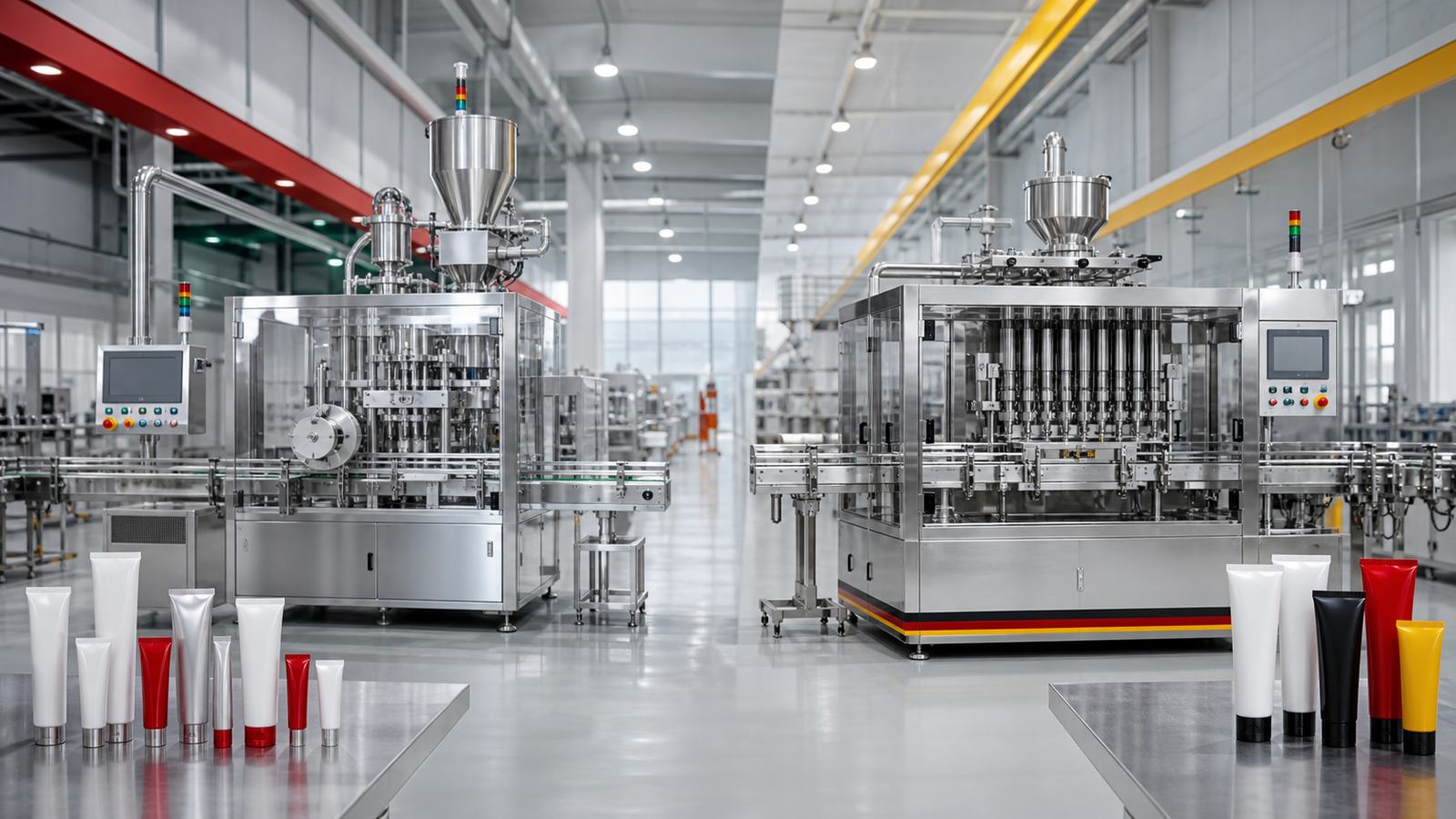
China vs Germany Tube Filling Machines at a Glance
| Comparison area | Qualified Chinese manufacturer | Established German manufacturer |
|---|---|---|
| Initial investment | Generally more accessible | Generally higher |
| Supplier variation | Very wide | More concentrated among established engineering companies |
| Customization | Usually flexible and project-specific | Structured around mature modular platforms |
| Ultra-high-speed capability | Available from selected suppliers | Strong and well-established |
| Medium-speed projects | Often cost-effective | Technically strong but potentially over-specified |
| Documentation | Must be confirmed supplier by supplier | Generally more standardized |
| Pharmaceutical validation | Project- and supplier-dependent | Usually more mature |
| Engineering communication | Often direct and fast | More formal and process-driven |
| Tube-material flexibility | Available with correct configuration | Mature modular options |
| Local service | Depends heavily on the supplier and market | Often supported by an established global network |
| Spare-parts cost | Generally more accessible | Commonly higher |
| Best fit | Customized medium- and high-level projects | High-speed, validation-intensive and globally standardized projects |
This comparison should only be used as a starting point.
A capable Chinese supplier may outperform a weak European integrator in a specific application. An established German platform may also deliver much lower long-term risk than an inadequately engineered low-cost machine.
The real comparison must take place at the level of:
Machine configuration, proven performance, project execution and lifecycle support.
Understanding the Two Manufacturing Models
The German tube filling machine model
German pharmaceutical machinery has developed around long-term specialization, structured product platforms and highly standardized engineering processes.
IWK provides a useful example in the tube filling sector. Its current equipment portfolio covers aluminum, plastic and laminate tubes and includes output classes from approximately 40 to 760 tubes per minute. Its tube fillers can be configured with modular filling, heating and sealing systems, recipe-controlled HMIs, tool-free format changeovers and optional CIP/SIP-capable designs.
This manufacturing model typically emphasizes:
- Proven modular machine platforms
- High mechanical consistency
- Repeatable engineering standards
- Hygienic and accessible design
- Mature software architecture
- Structured qualification documentation
- Global service and training
- Long-term spare-parts and retrofit support
IWK, for example, states that its pharmaceutical systems are manufactured in Germany and supported through a global service network. It also operates dedicated training programs for operators, maintenance technicians, production managers and quality personnel.
These capabilities are particularly valuable when:
- Several international factories must use the same platform
- Production downtime carries a very high cost
- The project requires extensive validation
- The line must run at several hundred tubes per minute
- The manufacturer expects structured support for many years
The trade-off is that the buyer may pay for a highly developed platform, formal engineering procedures and lifecycle infrastructure even when the project does not require the highest level of speed or standardization.
The Chinese tube filling machine model
The Chinese supplier market is more difficult to generalize.
At the lower end, buyers can find basic machines designed primarily around purchase price. These may use simple controls, limited documentation and a standard configuration that is not fully adapted to the product.
At the professional end, Chinese manufacturers can offer:
- Application-specific filling systems
- International electrical and pneumatic components
- Plastic, laminate and aluminum tube configurations
- Hot-air, ultrasonic and mechanical closing technologies
- Customized layouts
- Real-format FAT
- Upstream emulsification
- Downstream cartoning and line integration
The main advantage is often not simply lower labor cost.
It is a shorter engineering decision chain.
The customer may communicate directly with the machine designer, automation engineer and project manager. Changes to the hopper, filling nozzle, tube holder, station layout or upstream transfer system can often be discussed without passing through several distributor and corporate approval levels.
This flexibility can be valuable for:
- Unusual product viscosities
- Special tube dimensions
- Multiple tube materials
- Limited factory space
- Customized process layouts
- Medium-output pharmaceutical projects
- Emulsifier-to-filler integration
However, flexibility must be controlled.
A supplier that agrees to every modification without risk assessment, testing or documentation may create more problems than a supplier using a stricter standardized platform.
The buyer must distinguish between:
Engineering flexibility and uncontrolled improvisation.
Detailed Comparison: Chinese vs German Tube Filling Machines
1. Tube filling specialization
The first question should not be where the machine is manufactured.
It should be:
How well does the supplier understand the product being filled?
Tube filling performance is affected by:
- Viscosity
- Density
- Temperature
- Foaming
- Stringing
- Air content
- Particle content
- Abrasiveness
- Filling volume
- Tube-tail clearance
- Cleaning requirements
A general-purpose piston filler may dose a smooth cosmetic cream adequately but struggle with a stringing veterinary paste or a temperature-sensitive pharmaceutical ointment.
Typical German strength
Established German specialists generally develop standardized filling modules based on many years of application experience.
The buyer may have access to:
- Several dosing technologies
- Proven nozzle designs
- Hygienic filling modules
- CIP/SIP options
- Pharmaceutical configurations
- Documented process parameters
IWK states that its modular filling stations can be adapted to different products and viscosities, with filling accuracy below ±0.5% on selected platforms.
Potential Chinese advantage
A qualified Chinese supplier can be more willing to redesign:
- Hopper geometry
- Agitation
- Filling valve
- Nozzle cutoff
- Product-transfer connection
- Heating system
- Filling height
- Machine layout
This is useful when the customer’s product does not fit a standard machine configuration.
Buyer conclusion
German specialization is generally strongest when the application fits a mature, validated platform.
Chinese engineering flexibility becomes valuable when the product or layout requires meaningful customization—but only when the supplier can prove the final result through testing.
2. Maximum speed versus sustainable production output
German tube filling manufacturers have a strong position in high-speed production.
IWK’s current range covers output classes up to 760 tubes per minute, and it offers platforms intended for pharmaceutical, cosmetic, food and industrial applications.
This level of performance is relevant for:
- Global toothpaste production
- Large-volume pharmaceutical ointments
- High-output consumer products
- Multi-shift manufacturing
- Lines connected directly to high-speed cartoners
Most factories, however, do not require several hundred tubes per minute.
Many need:
- 40–60 tubes per minute
- 60–80 tubes per minute
- Stable output around 120 tubes per minute
- Flexible operation across several SKUs
- More frequent changeovers
- Smaller production batches
King Pack’s current tube equipment includes platforms for approximately 50–75 tubes per minute as well as higher-speed configurations designed for stable output around 120 tubes per minute, depending on the model, tube and application.
What should buyers compare?
Do not compare only:
German machine: 300 tubes/min
Chinese machine: 120 tubes/min
First determine whether the project actually requires 300 tubes per minute.
Then compare:
- Stable accepted tubes per hour
- Product used during testing
- Filling accuracy during continuous operation
- Seal or fold quality
- Reject handling
- Changeover frequency
- Cleaning time
- Downstream equipment capacity
- Operator intervention
A machine rated for 180 tubes per minute but producing stable, accepted tubes at 120 may still be a better investment than a higher-speed platform that the factory cannot fully utilize.
Buyer conclusion
Choose the output class based on the production plan—not on the highest number available in the market.
German equipment has a clear advantage in established ultra-high-speed platforms.
A professional Chinese system may provide a better investment balance when the required output is medium or moderately high.
3. Plastic, laminate and aluminum tube capability
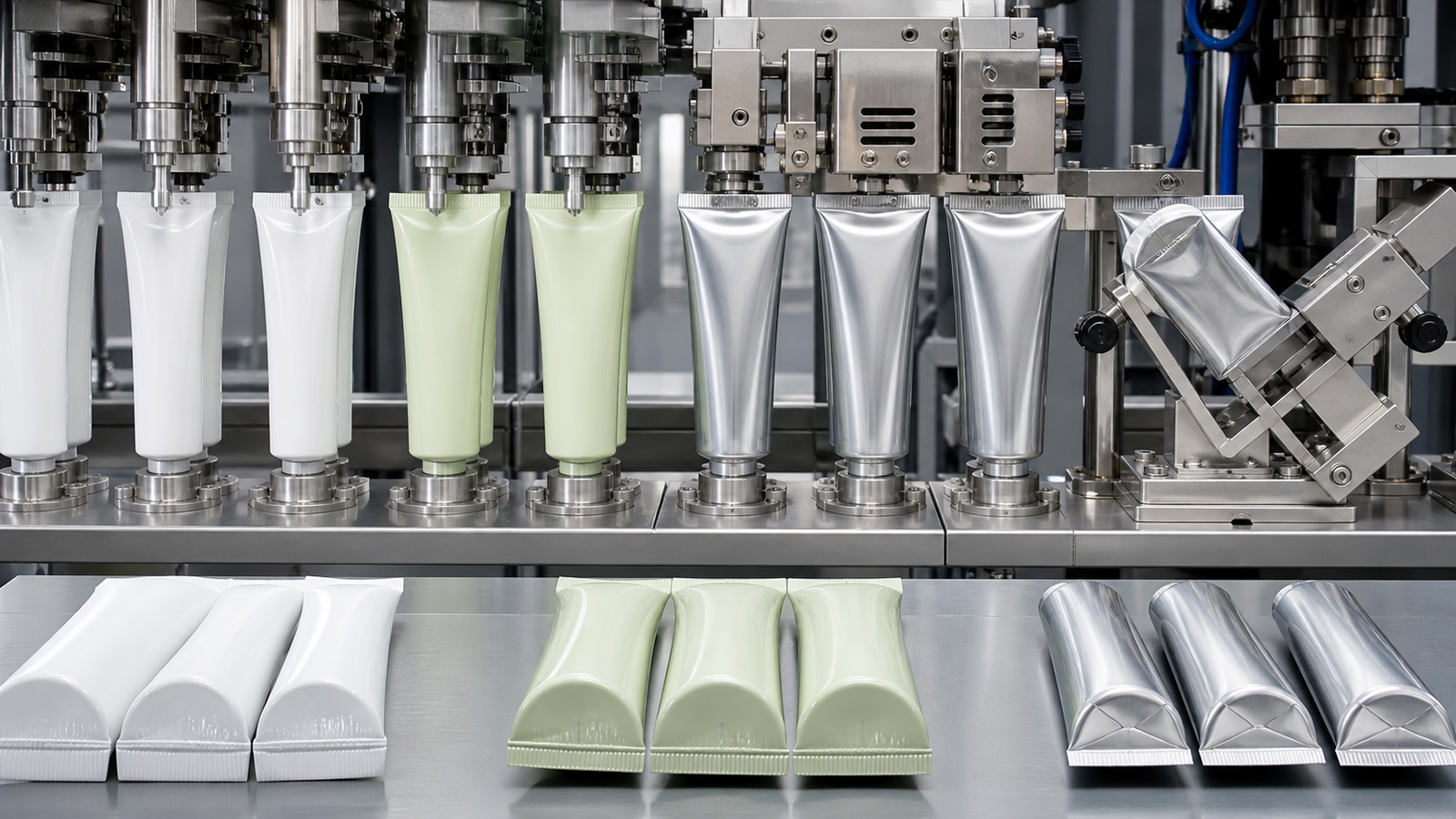
A statement such as “suitable for all tube materials” is not enough.
Plastic, laminate and aluminum tubes require different closing processes.
Plastic and laminate tubes
These commonly use:
- Internal hot-air sealing
- Heated-jaw sealing
- Ultrasonic sealing
- Cooling
- Tail trimming
- Batch coding
Aluminum tubes
These require:
- Mechanical folding
- Controlled compression
- Double, triple or saddle folding
- Batch embossing
- Clean product cutoff
Both IWK and King Pack offer equipment directions for aluminum, plastic and laminate tube applications. IWK describes these three materials as standard options on its tube-filling platforms. King Pack’s published range includes plastic and aluminum tube systems, metal tube folding machines and product-specific hot-air or ultrasonic configurations.
The critical point for aluminum tubes
The buyer should not ask only:
Does the machine have an aluminum folding station?
A good aluminum closure depends on the complete process:
- Accurate filling height
- Clean nozzle cutoff
- Product-free tail area
- Correct folding geometry
- Consistent compression
- Clear batch embossing
- Leakage inspection
If the product contaminates the folding area, even well-made folding tooling may produce inconsistent results.
German strength
A mature German platform may offer:
- Proven closing modules
- Reproducible format settings
- Short format changeovers
- High mechanical precision
- Established process documentation
Qualified Chinese advantage
A Chinese supplier may be more flexible in combining:
- Plastic hot-air sealing
- Ultrasonic sealing
- Aluminum folding
- Special fold formats
- Customized embossing
- Non-standard tube dimensions
King Pack has conducted customer testing using both plastic and aluminum tubes on one project platform, illustrating the importance of proving each material under actual test conditions.
Buyer conclusion
Do not select a machine because the quotation lists several tube materials.
Ask the supplier to demonstrate each required combination of:
Product + tube material + filling volume + closing method + target output.
4. Customization and engineering flexibility
Customization is one of the most important differences between many German and Chinese machinery projects.
German engineering model
German manufacturers generally begin with an established modular platform.
The customer selects from proven modules for:
- Filling
- Cleaning
- Heating
- Sealing
- Folding
- Inspection
- Cartoning
- Data handling
This approach provides:
- Lower engineering uncertainty
- Better documentation consistency
- Established spare-parts structures
- Repeatable production results
However, substantial deviations from the standard platform may increase:
- Engineering cost
- Project lead time
- Approval procedures
- Software modification work
- Validation requirements
Chinese engineering model
Professional Chinese manufacturers may be more open to modifying:
- Machine footprint
- Station sequence
- Filling volume
- Tube-holder dimensions
- Hopper capacity
- Product feeding
- Electrical brands
- Downstream connections
- Factory voltage
- Guarding and layout
This flexibility can reduce project friction when the customer has limited space or a highly specific process.
The risk
Customization can also create a machine that has never been fully tested as one complete system.
Buyers should therefore ask:
- Which elements are already proven?
- Which elements are new?
- Is the modification mechanical, electrical or process-related?
- How will the new design be tested?
- Will drawings and software be updated?
- Will the change affect spare parts?
- Is the modification included in FAT?
Buyer conclusion
Standardization reduces uncertainty.
Customization improves project fit.
The best solution uses a proven platform with controlled, documented customization.
5. Controls, data and validation
A Siemens PLC does not automatically make a Chinese machine equivalent to a German machine.
International components are important, but machine quality also depends on:
- Software structure
- Alarm logic
- Recipe control
- User permissions
- Data storage
- Mechanical coordination
- Electrical installation
- Documentation
- Validation procedures
German positioning
German pharmaceutical equipment manufacturers typically have mature systems for:
- Recipe management
- User access
- Alarm history
- Audit trails
- Electronic records
- Qualification
- Calibration
- Change control
- Documentation packages
IWK promotes GMP-compliant equipment, validated CIP/SIP processes and dedicated qualification and validation support for pharmaceutical projects.
Chinese positioning
A professional Chinese manufacturer may offer:
- Siemens PLC and HMI
- Servo-controlled filling
- Recipe storage
- User access levels
- Alarm records
- Electronic parameter control
- IQ/OQ support
- FAT documentation
However, buyers must confirm what is actually included.
The quotation should state clearly:
- Standard software functions
- Optional functions
- Documentation list
- FAT documents
- IQ/OQ scope
- Data-recording scope
- Customer responsibilities
- Third-party validation responsibilities
King Pack states that its tube-filling systems can be configured with servo filling, PLC/HMI control, international pneumatic components and project-specific technical options.
Buyer conclusion
Do not evaluate compliance by component brand or brochure language.
Evaluate the actual software functions, documents and acceptance deliverables included in the contract.
6. Factory Acceptance Testing
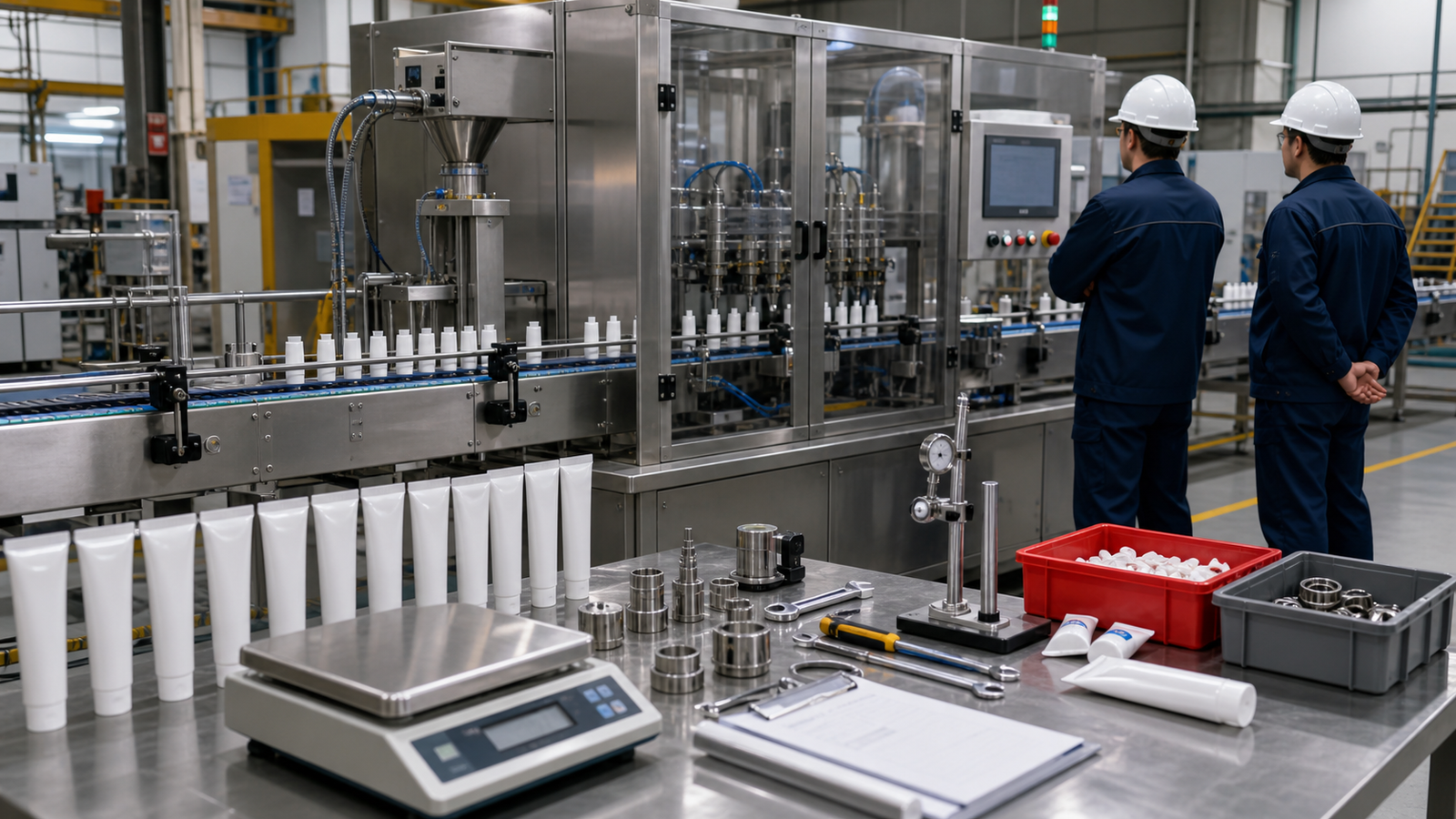
FAT is especially important when purchasing an overseas machine.
A German manufacturer may have a larger installed base and longer documented experience with a particular platform. This reduces some technical uncertainty, but it does not remove the need for project-specific testing.
A qualified Chinese supplier can reduce buyer risk through a detailed FAT using the customer’s packaging format and an agreed product or test material.
FAT should verify
- Tube feeding
- Tube orientation
- Filling accuracy
- Nozzle cutoff
- Tail cleanliness
- Hot-air or ultrasonic sealing
- Aluminum folding
- Coding or embossing
- Reject handling
- Safety interlocks
- Alarm functions
- Stable production speed
- Format changeover
King Pack completed FAT on a dual-head tube filling and sealing system for a Slovenian pharmaceutical customer, with a published output capacity of up to 120 tubes per minute. It has also conducted live testing with both plastic and aluminum tubes for another project.
What FAT cannot prove
FAT cannot fully demonstrate:
- Several years of mechanical life
- Local service responsiveness
- Long-term spare-parts availability
- Performance under every future product
- Operator discipline
- Factory utility stability
It is one risk-control tool—not a replacement for supplier experience.
Buyer conclusion
A strong FAT protocol can make a customized Chinese project much more predictable.
But FAT should be combined with supplier audits, reference projects, documentation review and a clear after-sales plan.
7. Lead time and project communication
Chinese machinery companies often have a shorter path between customer, sales engineer, mechanical designer and automation engineer.
This can improve:
- Technical response speed
- Drawing revisions
- Sample assessment
- Layout modification
- Option confirmation
- FAT scheduling
German companies generally use a more structured project process.
This can improve:
- Responsibility definition
- Change control
- Document consistency
- Risk assessment
- Long-term traceability
Neither approach is automatically better.
Fast communication without control may cause repeated modifications.
Structured communication without flexibility may slow a time-sensitive project.
Buyers should evaluate
- Is there a named project manager?
- Are technical decisions recorded?
- Are drawing revisions controlled?
- Does the supplier provide an approval schedule?
- Who confirms product-contact design?
- Who manages software changes?
- How are contract variations priced?
- How are FAT conditions approved?
The goal is:
Fast enough to support the project, structured enough to prevent mistakes.
8. Service, training and spare parts
Lifecycle support is one of the strongest reasons manufacturers choose an established German platform.
IWK provides global service, spare-parts coordination, training programs, digital support and retrofit services. Its training can be delivered at its German center, at customer sites or digitally.
This structure is valuable when:
- Downtime costs are extremely high
- The customer has several machines globally
- Local service response is mandatory
- The line must operate for many years
- Regular upgrades are expected
Questions Chinese suppliers must answer
“24-hour online service” is not enough.
Buyers should ask:
- Who handles mechanical troubleshooting?
- Who can modify the PLC program?
- Can an engineer travel to the customer’s factory?
- What is the expected response time?
- Which parts should be stocked locally?
- How quickly can critical parts be shipped?
- Are electrical drawings supplied?
- Is the PLC program backed up?
- Can the machine be diagnosed remotely?
- Will parts remain available after ten years?
Planning can reduce the service gap
A Chinese machine project can be made more secure through:
- Internationally available components
- A two-year recommended spare-parts package
- Clear electrical and pneumatic drawings
- Remote diagnostic access
- Operator and maintenance training
- Preventive maintenance schedules
- Backup software and parameters
- Defined on-site service terms
Buyer conclusion
Germany generally has the advantage in established lifecycle service.
A Chinese supplier needs to compensate through careful spare-parts planning, accessible components, technical transparency and a specific service agreement.
9. Initial cost versus total cost of ownership
German machines usually require a higher initial investment.
That investment may include more than the physical machine:
- Established technology
- Detailed engineering
- Validation systems
- Global service infrastructure
- Training
- Documentation
- Long-term upgrade planning
- Lower project uncertainty
A qualified Chinese machine generally offers a more accessible starting investment, but buyers must confirm whether the quotation includes:
- All tube-format parts
- Required closing stations
- Product feeding
- Cooling equipment
- Air compressor
- Spare parts
- Documentation
- Installation
- Training
- FAT materials
- Downstream integration
Total cost of ownership
The correct calculation includes:
- Equipment investment
- Freight and import costs
- Installation
- Product waste
- Tube rejects
- Changeover time
- Cleaning time
- Labor
- Maintenance
- Spare parts
- Unplanned downtime
- Technical support
- Future upgrades
- Useful machine life
| Cost factor | Chinese equipment | German equipment |
|---|---|---|
| Initial investment | Generally lower | Generally higher |
| Custom engineering | Often more accessible | More formally structured |
| Documentation | Scope must be confirmed | Usually more standardized |
| Spare-parts prices | Often lower | Commonly higher |
| Local service | Requires project planning | Often stronger in established markets |
| High-speed productivity | Supplier-dependent | Strong established capability |
| Validation support | Supplier- and contract-dependent | Generally mature |
| Long-term predictability | Depends strongly on supplier quality | Usually more established |
| Investment efficiency | Strong when matched to the project | Strong when risk and output justify the platform |
Buyer conclusion
A German machine may be economically justified when one hour of downtime creates a very large loss or when the factory needs a globally standardized platform.
A professional Chinese machine may provide better investment efficiency when the required output, validation scope and service model do not justify the full cost of a German system.
When Should You Choose a German Tube Filling Machine?
A German platform is more likely to be the right choice when:
- The line requires several hundred tubes per minute
- Production runs continuously across multiple shifts
- Downtime has an exceptionally high financial impact
- Several international factories need identical equipment
- Validation and documentation requirements are extensive
- Local service availability is mandatory
- The buyer requires a mature retrofit and upgrade path
- The project budget can support a premium platform
- The application fits an established modular design
In these situations, the higher investment may be justified by:
- Proven high-speed performance
- Greater lifecycle predictability
- Mature validation processes
- Established support infrastructure
- Lower implementation uncertainty
The buyer is not simply paying for the “Made in Germany” label.
The buyer is paying for a complete engineering and lifecycle system.
When Should You Choose a Chinese Tube Filling Machine?
A qualified Chinese supplier may be the better choice when:
- Required output is medium or moderately high
- The product needs application-specific customization
- Several tube sizes or materials must be handled
- The factory needs plastic and aluminum tube capability
- The project includes a vacuum emulsifying mixer
- Layout or space is highly customized
- The buyer wants direct engineering communication
- Initial investment must remain controlled
- A detailed FAT can be completed
- Spare parts and after-sales support can be planned in advance
- The project does not require an ultra-high-speed European platform
The key word is qualified.
The buyer should not select a Chinese machine only because it is less expensive.
The supplier must demonstrate:
- Relevant tube filling experience
- Similar product applications
- Real machine manufacturing capability
- Clear technical documentation
- Actual tube testing
- Stable-speed verification
- Defined spare-parts support
- Transparent project responsibilities
The Better Question: Which Supplier Can Prove the Required Result?
Country of origin is useful for building an initial shortlist.
It should not make the final decision.
Before selecting either a Chinese or German supplier, ask:
Product understanding
- Has the supplier processed a product with similar viscosity?
- How will stringing, foaming or air content be controlled?
- What nozzle and filling system are proposed?
- How will the product reach the hopper?
Tube handling
- Has the supplier tested the actual tube material?
- Can it process the required diameter and length?
- How is orientation controlled?
- How are tail cleanliness and sealing verified?
Production performance
- Is the quoted speed maximum or sustainable output?
- What product and tube are used to establish the speed?
- How long will the continuous FAT run?
- What reject criteria will apply?
Documentation
- Which drawings and manuals are included?
- Are FAT and validation documents included?
- Are recipe, user and audit functions required?
- Which certificates are supplied?
Service
- Who provides remote support?
- Can an engineer travel to the factory?
- Which spare parts should be stocked?
- Are critical components available locally?
- What happens after the warranty period?
The best supplier is the one that can turn these questions into:
A clear configuration, measurable acceptance standard and realistic lifecycle plan.
How King Pack Positions Its Tube Filling Solutions
King Pack was founded in 2009 and manufactures filling, emulsifying, capping and packaging equipment for pharmaceutical, cosmetic and personal care applications. Its main product areas include tube filling systems, vacuum emulsifying mixers and integrated production lines.
King Pack does not position every machine as a replacement for every German high-speed tube filling platform.
Its more realistic position is:
A professional and customizable option for manufacturers that require more than an entry-level general machine but do not necessarily need an ultra-high-speed European platform.
Professional tube filling focus
King Pack systems can be configured for:
- Pharmaceutical ointments
- Veterinary gels and pastes
- Cosmetic creams
- Personal care products
- Toothpaste
- Adhesives
- Other semi-solid formulations
Its current equipment range covers plastic, laminate, metal and aluminum tubes with filling, hot-air sealing, ultrasonic sealing, mechanical folding, coding and discharge options.
Medium- and high-level production projects
King Pack’s portfolio includes:
- Flexible machines for approximately 50–75 tubes per minute
- Metal tube filling and folding systems
- Dual-material configurations
- Higher-speed platforms with stable output around 120 tubes per minute
- Customized complete-line systems
Published King Pack specifications show that the KPGFW-180 platform supports tube diameters from 12 to 45 mm, tube lengths from 70 to 200 mm, stable output around 120 tubes per minute and maximum speed up to 150 tubes per minute, depending on the application.
These systems are intended for buyers that need professional output and customization without moving directly to an ultra-high-speed platform.
Aluminum tube filling and folding
King Pack’s aluminum-tube project approach considers:
- Filling cutoff
- Product-free tail area
- Folding geometry
- Compression
- Embossing
- Finished appearance
- Leakage risk
Its metal-tube range includes systems for approximately 5–150 ml fills and output up to around 60 tubes per minute, as well as combined plastic and aluminum configurations at higher output levels.
Emulsification-to-filling integration
One area in which King Pack differs from a supplier focused only on the tube filler is its ability to connect product preparation with packaging.
A project can include:
Vacuum emulsification → holding and transfer → tube filling → sealing or folding → coding → cartoning
King Pack has delivered projects combining vacuum emulsifying mixers with tube filling and sealing equipment, including a production-line project confirmed after an Australian customer’s factory visit and technical evaluation.
This approach is particularly relevant for:
- Creams
- Ointments
- Gels
- Veterinary pastes
- Toothpaste
- Other high-viscosity formulations
Product temperature, deaeration, viscosity and transfer conditions can therefore be considered together with the filling-machine design.
FAT and project verification
King Pack can organize FAT around:
- Customer tube samples
- Comparable product materials
- Filling accuracy
- Nozzle cutoff
- Sealing or folding quality
- Stable operation
- Format changeover
- Safety and alarm functions
This is important because customization only creates value when the final configuration is tested under agreed conditions.
Final Buyer Decision Matrix
| Buyer requirement | More likely direction |
|---|---|
| Ultra-high-speed tube production | Established German platform |
| Global factory standardization | Established German platform |
| Extensive validation and lifecycle support | Established German platform |
| Strong local service in established markets | German supplier or local integrator |
| Customized medium-output project | Qualified Chinese manufacturer |
| Controlled investment with professional configuration | Qualified Chinese manufacturer |
| Plastic and aluminum tube flexibility | Compare actual machine configurations |
| Non-standard product or layout | Supplier with proven customization |
| Mixer, tube filler and cartoner integration | Qualified complete-line supplier |
| Lowest possible purchase price | High risk regardless of country |
| Real-product FAT and contractual acceptance | Essential for both |
Frequently Asked Questions
Are German tube filling machines always better than Chinese machines?
No. German manufacturers generally have stronger high-speed platforms, mature engineering standards and established lifecycle-support systems. Chinese manufacturers vary more widely. A qualified Chinese supplier can be competitive for customized medium- and high-level projects when performance is verified through testing.
Why are German tube filling machines more expensive?
The investment can include mature machine platforms, advanced engineering, standardized documentation, global service systems, validation experience, training and long-term upgrade support. Buyers should compare complete scope rather than the machine frame alone.
Can Chinese tube filling machines meet pharmaceutical requirements?
Selected Chinese manufacturers can provide pharmaceutical configurations, stainless-steel product-contact parts, controlled filling systems, PLC/HMI functions and validation-support documents. The buyer must confirm the exact configuration and documentation instead of relying on a general pharmaceutical claim.
Can one Chinese machine process plastic and aluminum tubes?
Yes, a platform can potentially include thermal sealing for plastic or laminate tubes and mechanical folding for aluminum tubes. Buyers should confirm station layout, tooling, changeover time, stable output and FAT requirements for both materials.
Which country is better for high-speed tube filling?
Germany has a strong established position in ultra-high-speed tube filling. IWK currently offers platforms with performance classes reaching up to 760 tubes per minute. For output around 40–150 tubes per minute, qualified Chinese suppliers may offer a more accessible investment, depending on the application.
Is a Siemens PLC enough to prove machine quality?
No. A recognized PLC improves component availability, but it does not prove mechanical quality, software structure, filling performance, seal quality, documentation or after-sales capability.
How should filling accuracy be compared?
Ask how accuracy is measured, how many samples are tested, what product is used, how long the machine runs and whether the stated result applies across the complete filling range.
What documentation should a pharmaceutical buyer request?
Typical requirements may include operation manuals, electrical and pneumatic drawings, component lists, maintenance schedules, material certificates, calibration documents, FAT records and agreed IQ/OQ support.
How should overseas after-sales service be evaluated?
Confirm remote-support methods, response time, engineer availability, spare-parts delivery, local component availability, software backup, training and post-warranty support.
Is King Pack a direct replacement for every German tube filling machine?
No. King Pack is not positioned as a replacement for every ultra-high-speed or highly validated German platform. It is a practical alternative for manufacturers requiring professional tube handling, application-specific customization, aluminum tube folding and integrated project support at a more accessible investment level.
Conclusion
The choice between a Chinese and German tube filling machine should not be reduced to:
Lower price versus higher quality.
The real comparison is more specific.
German manufacturers generally offer mature machine platforms, highly developed high-speed technology, structured validation and established lifecycle support.
Chinese suppliers vary much more widely. At the professional end of the market, they can provide strong customization, direct engineering communication, international components, real-format FAT and integrated production solutions at a more accessible initial investment.
The correct decision depends on:
- Required stable output
- Product characteristics
- Tube material
- Closing technology
- Validation scope
- Local service requirements
- Factory engineering capability
- Total cost of ownership
- Long-term production strategy
For an ultra-high-speed global platform with extensive validation and service requirements, a German machine may justify its higher investment.
For a customized medium- or high-level project involving plastic, laminate or aluminum tubes—and potentially connecting vacuum emulsification with filling and downstream packaging—a qualified Chinese manufacturer may offer a more practical route.
King Pack’s position is not to imitate every German platform.
It is to provide professional, application-based tube filling solutions for manufacturers that need controlled performance, project customization and complete-line support without automatically moving to the highest European investment level.
Discuss Your Tube Filling Project
To prepare a technical proposal, provide:
- Product name and viscosity
- Filling temperature
- Filling volume
- Tube material
- Tube dimensions
- Required sealing or folding method
- Target stable output
- Number of formats
- Documentation requirements
- Upstream emulsification needs
- Downstream packaging requirements
- Destination voltage and service expectations
Recommended CTA:
Request a Tube Filling Solution
