 Skip to content

Last reviewed: August 5, 2026
King Pack attended CPHI & PMEC China 2026 in Shanghai with a clear focus: understanding how pharmaceutical manufacturers are changing the way they evaluate tube filling machines.
Held from June 16 to 18, 2026, the exhibition brought together more than 3,600 exhibitors and an expected 110,000-plus attendees. Its pharmaceutical machinery area included nearly 1,000 machinery and equipment suppliers from China and other markets, covering intelligent manufacturing, digital systems, equipment selection, line integration and validation services.
Rather than looking only for one new machine or one higher speed, we paid particular attention to the questions buyers were asking around tube filling:
- Can one platform process more than one tube material?
- How can filling contamination at the tube tail be reduced?
- Is maximum speed representative of actual production?
- When should hot-air, ultrasonic or mechanical closing be used?
- Should the emulsifying mixer and tube filler be planned together?
- How much integration is needed between filling, inspection and cartoning?
These questions point to a broader shift. Buyers are no longer treating the tube filler as an isolated machine. They are evaluating how the product, filling system, tube material, closing process and surrounding production equipment work together.
The same development direction can be seen in the current portfolios of specialist international manufacturers such as Norden and IWK, as well as process-and-filling equipment supplier Axomatic.
Brand reference note: Norden, IWK and Axomatic are discussed as international tube filling technology benchmarks. This article does not claim that each company exhibited at CPHI & PMEC China 2026.
The following six tube filling trends were among the most relevant takeaways for pharmaceutical, veterinary, cosmetic and personal care manufacturers.
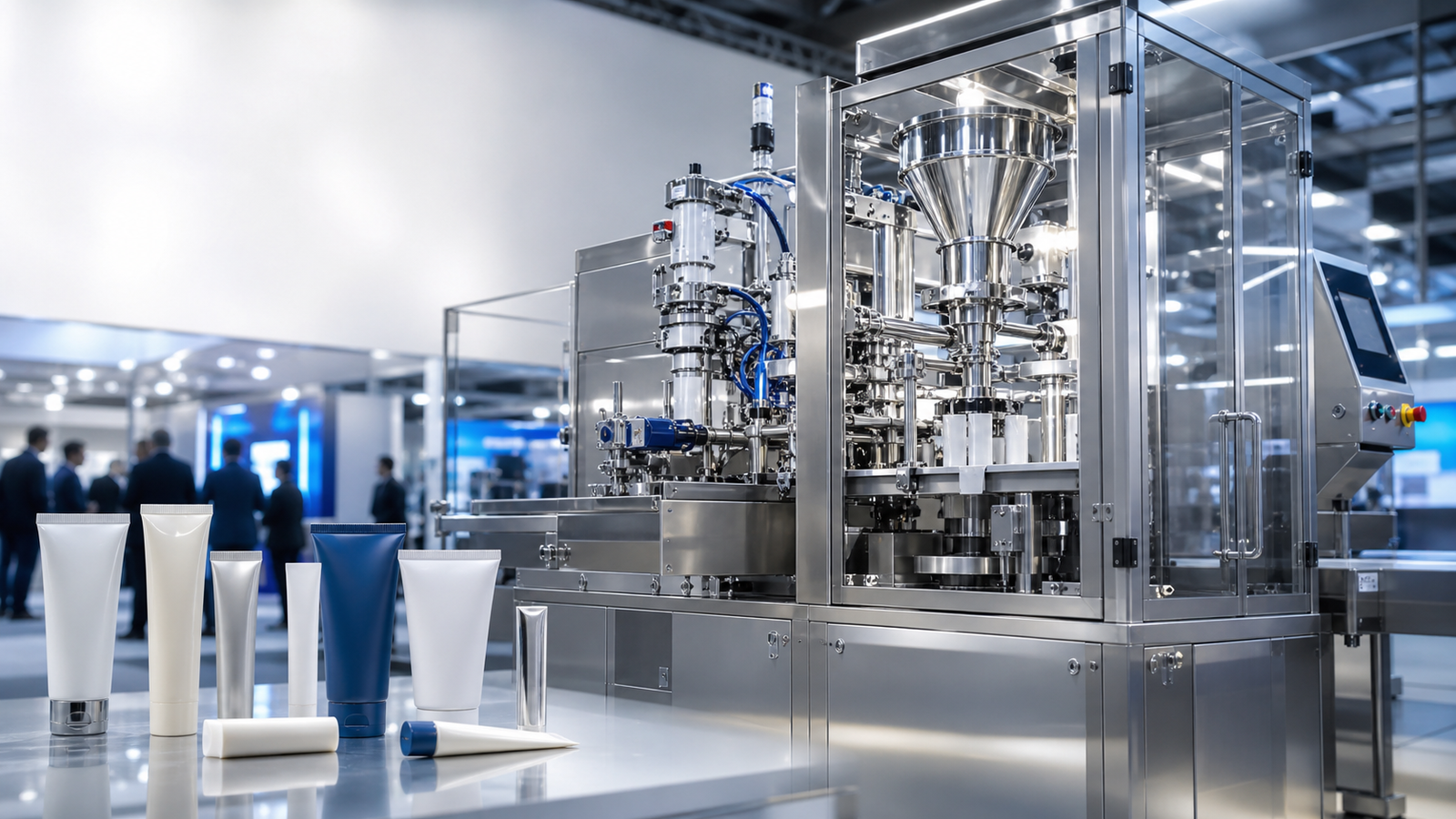
1. Tube Filling Machines Are Becoming More Product-Specific
A tube filling project often begins with three basic pieces of information:
- Filling volume
- Tube diameter
- Required speed
These specifications remain necessary, but they are no longer sufficient.
Two products using the same tube and filling volume may behave very differently inside the machine. A smooth cosmetic cream, a stringing veterinary paste, an aerated ointment and an abrasive toothpaste cannot automatically use the same filling pump, valve, nozzle or hopper configuration.
The filling system needs to be selected according to the physical behavior of the product.
Product characteristics that affect tube filling
Important variables include:
- Viscosity
- Density
- Filling temperature
- Foaming tendency
- Stringing behavior
- Air content
- Particle content
- Abrasiveness
- Sensitivity to shear
- Sensitivity to temperature
- Cleaning requirements
- Batch-to-batch consistency
For example, a product that forms long strings after dosing may contaminate the inside of the tube tail. A product whose viscosity changes with temperature may require a heated or insulated hopper. A formulation containing air may produce unstable filling weights even when the dosing mechanism itself is mechanically accurate.
This means a tube filling machine should not be selected only from a standard speed chart.
The filling pump is only one part of the solution
Depending on the application, the configuration may involve:
- Servo-controlled piston filling
- Volumetric piston dosing
- Positive displacement systems
- Special shut-off nozzles
- Bottom-up filling
- Nozzle lifting during dosing
- Heated product paths
- Hopper agitation
- Product-level control
- Pressure-controlled product feeding
The correct choice depends on the relationship between the product and the required production result.
A technically sound proposal should therefore explain not only how much product the machine can dose, but also:
- How the product reaches the filling cylinder
- How air is controlled
- How the nozzle cuts off the product
- How the filling height is maintained
- How the system is cleaned
- How repeatability will be tested
What buyers should provide before machine selection
A supplier should ideally receive:
- Product sample or technical data
- Minimum and maximum viscosity
- Normal filling temperature
- Target filling volume
- Tube drawing and samples
- Required output
- Cleaning method
- Number of product formulations
- Future product plans
The most important change is that tube filling is becoming application-driven, rather than model-driven.
Instead of starting with “Which machine do you want?”, the better starting point is:
What product and finished tube must the production system deliver?
2. Multi-Material Tube Flexibility Is Becoming a Practical Requirement
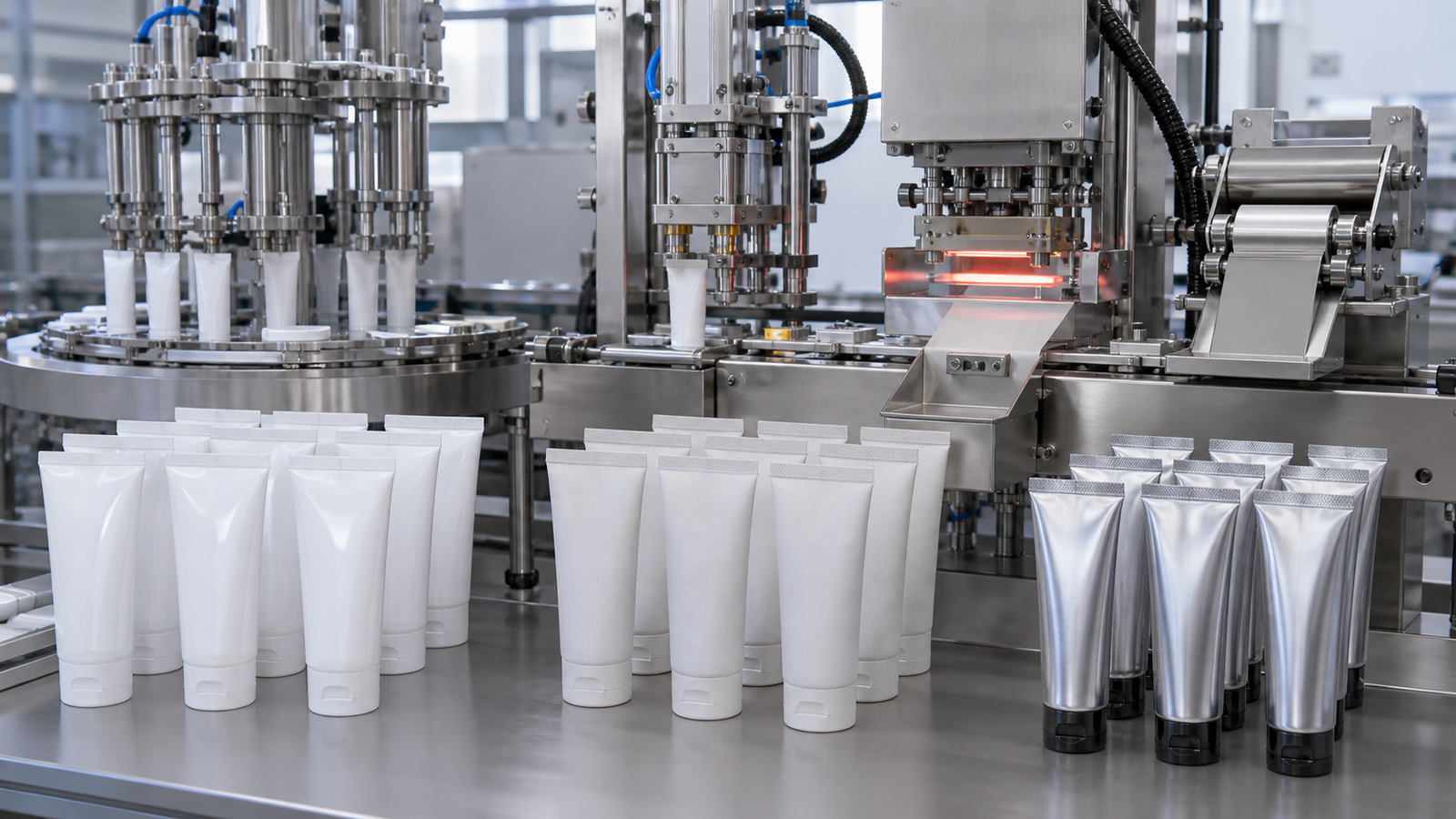
Many factories no longer use only one conventional plastic tube.
Their current or future portfolios may include:
- Plastic tubes
- Laminate tubes
- Aluminum tubes
- Mono-material plastic tubes
- Barrier laminate structures
- Recycled-content tubes
- Different caps and closures
- Several diameters and lengths
International tube filling portfolios increasingly reflect this need. Norden currently offers tube filling machines covering plastic, laminate and aluminum tubes, with rated outputs across a broad range from approximately 40 to 1,000 tubes per minute. IWK states that its tube filling systems can process aluminum, plastic and laminate tubes, with different performance classes ranging from approximately 40 to 760 tubes per minute.
Axomatic also offers tube filling and closing systems for aluminum, plastic and laminate tubes, using mechanical closing for aluminum and hot-jaw or hot-air systems for plastic and laminate materials.
This does not mean every manufacturer should purchase a machine equipped for every possible tube material.
Multi-material flexibility has a cost.
It may require:
- Additional closing stations
- Different tube holders
- Additional format parts
- Separate tooling sets
- More HMI recipes
- Longer FAT procedures
- More operator training
- Additional cleaning and validation work
Buyers should define realistic flexibility
The objective should not be to purchase the machine with the longest list of theoretical capabilities.
The objective should be to identify which formats are likely to enter production during the machine’s expected service life.
For example:
- A pharmaceutical ointment factory may currently use only aluminum tubes but plan to introduce laminate tubes.
- A cosmetic contract manufacturer may need several diameters but only one tube material.
- A veterinary producer may require both metal tubes and dosing syringes, but not plastic cosmetic tubes.
- A toothpaste producer may need plastic and laminate tubes with several cap styles.
Each of these projects requires a different type of flexibility.
Questions buyers should ask
Before selecting a multi-material machine, clarify:
- Can the closing module be changed or upgraded later?
- Does the machine have enough station space for two closing systems?
- Which parts must be replaced during format changeover?
- How is the tube orientation sensor adjusted?
- Are recipes stored by product and tube format?
- How long does the full changeover take?
- Which adjustments require tools?
- Can the machine maintain the required speed with each material?
- Are all required tooling sets included in the quotation?
A machine designed only around one current SKU may create restrictions later.
A machine equipped with unnecessary modules may create avoidable cost and complexity.
The right solution is planned flexibility, based on a realistic product and packaging roadmap.
3. Aluminum Tube Folding Quality Begins at the Filling Nozzle
Aluminum tube projects require a different engineering approach from plastic and laminate tube projects.
Plastic and laminate tubes are generally closed by creating a controlled thermal or ultrasonic bond across the tube wall. Aluminum tubes are closed through mechanical folding and compression.
The folding station is important, but it cannot compensate for an unstable filling process.
Norden’s NM 3002, for example, can be equipped with closing stations for aluminum tubes, sealing units for plastic and laminate tubes, or a combined system incorporating both closing types. This reflects the need to treat metal folding and thermal sealing as distinct processes.
Why tail contamination matters
After filling, the upper section of the aluminum tube must remain sufficiently clean for controlled folding.
If product drips, strings or splashes into this area, it may become trapped between the folded layers.
Potential consequences include:
- Uneven folds
- Incomplete compression
- Visible product contamination
- Poor tail appearance
- Leakage
- Reduced package integrity
- Higher reject rates
This leads to one of the most important principles in aluminum tube production:
A clean, tight fold begins with a clean filling cutoff.
The machine should therefore be evaluated as one connected sequence:
- Tube positioning
- Internal tube cleaning, where required
- Nozzle entry
- Product filling
- Nozzle withdrawal
- Product cutoff
- Tail-area clearance
- Mechanical folding
- Compression
- Batch embossing
- Finished-tube inspection
Filling nozzle design becomes critical
For high-viscosity or stringing products, nozzle design can affect both filling accuracy and fold quality.
Possible solutions may include:
- Positive shut-off nozzles
- Suck-back control
- Servo-controlled nozzle movement
- Bottom-up filling
- Controlled filling height
- Tail clearance settings
- Product-specific cutoff timing
The appropriate system needs to be tested with the actual product or with a material that behaves similarly.
Folding geometry should be agreed before tooling production
The buyer should define:
- Double fold or triple fold
- Saddle fold, where applicable
- Finished tail width
- Embossed batch information
- Embossing direction
- Tail length
- Acceptable fold alignment
- Leakage test method
- Cosmetic appearance criteria
Physical tube samples and technical drawings should be provided before tooling is finalized.
Different aluminum tube suppliers may produce tubes with differences in:
- Wall thickness
- Hardness
- Internal coating
- Tail length
- Dimensional tolerance
A tooling set that performs well with one tube may require adjustment for another.
FAT should assess the complete result
A meaningful aluminum tube FAT should not evaluate only filling accuracy.
It should also examine:
- Product-free tail area
- Fold consistency
- Embossing clarity
- Tail alignment
- Leakage resistance
- Continuous operating stability
- Performance after format changeover
For aluminum tube applications, the filling and folding results should be accepted together.
4. Sustainable Tube Filling Output Matters More Than Maximum Speed
Speed remains a major purchasing criterion, especially for toothpaste, pharmaceutical ointment and high-volume personal care production.
However, there is an important difference between:
- Maximum mechanical speed
- Stable filled-tube output
- Accepted finished-tube output
Norden’s portfolio spans low-speed through ultra-high-speed tube filling systems, while IWK offers several performance classes for different production requirements. The existence of these different platforms shows that there is no single correct output level for every tube filling project.
The most important question is therefore not:
What is the highest speed shown in the brochure?
It is:
At what speed can the machine continuously produce acceptable finished tubes using the customer’s product, tube and closing method?
Real output is affected by more than the main indexing speed
Production performance can be influenced by:
- Tube loading stability
- Tube dimensions
- Orientation-mark recognition
- Product viscosity
- Filling volume
- Number of filling heads
- Nozzle cutoff
- Sealing time
- Folding time
- Cooling time
- Batch coding
- Inspection
- Reject handling
- Downstream cartoner speed
- Changeover frequency
- Cleaning frequency
- Operator intervention
A machine may reach a high rate during an empty-tube demonstration but operate more slowly with a dense ointment or a product that requires controlled bottom-up filling.
Similarly, a thermal sealing process must allow enough heating, compression and cooling time to create an acceptable seal.
Maximum speed can hide production losses
Consider two machines:
- Machine A runs at a higher nominal speed but requires frequent adjustment and creates more rejects.
- Machine B runs at a slightly lower nominal speed but maintains stable filling, sealing and discharge.
The second machine may produce more accepted tubes during a full shift.
This is why buyers should evaluate:
Good tubes per hour, not only machine cycles per minute.
Better questions for a tube filling supplier
| Basic question | More useful question |
|---|---|
| What is the maximum speed? | What stable output is expected with our product? |
| Can the machine run at 150 tubes/minute? | Under which volume, viscosity and tube diameter? |
| What is the filling accuracy? | How will accuracy be measured during continuous production? |
| Can it fill aluminum tubes? | At what output and with which fold style? |
| How long is changeover? | Which parts are replaced and which settings are adjusted? |
| Has the machine been tested? | Was it tested with comparable product and packaging? |
FAT should reproduce production conditions
A useful FAT protocol may define:
- Tube material
- Tube diameter and length
- Filling volume
- Product or test material
- Target operating speed
- Test duration
- Sampling frequency
- Filling accuracy
- Seal or fold acceptance
- Reject criteria
- Alarm tests
- Changeover demonstration
For a higher-output system, a short test using empty tubes is not enough to prove stable production.
The customer and supplier should agree in advance on what constitutes acceptable finished output.
5. Tube Sealing Technology Is Becoming More Application-Specific
Plastic and laminate tube closing was once discussed mainly as a choice between different heating systems.
Today, the decision is becoming more application-specific because tube structures, recycled materials, decoration requirements and production expectations are changing.
The main technologies include:
- Internal hot-air sealing
- Heated-jaw sealing
- Ultrasonic sealing
- Mechanical folding for aluminum tubes
Each method has appropriate applications and limitations.
Hot-air sealing
Hot-air sealing is widely used for plastic and laminate tubes.
A typical process includes:
- Internal heating
- Tube-tail compression
- Cooling
- Trimming
- Coding
Its advantages can include:
- Established process knowledge
- High production capability
- Good compatibility with many conventional tube structures
- Controlled seal appearance
- Integration with trimming and coding
Critical parameters may include:
- Air temperature
- Airflow
- Heating time
- Tube structure
- Compression pressure
- Cooling time
- Tube alignment
Ultrasonic sealing
Ultrasonic sealing uses high-frequency mechanical vibration to create heat in a localized weld area.
IWK expanded its tube filling portfolio with an ultrasonic sealing solution presented at interpack 2026. Its system is intended for plastic, laminate and recycled-content tubes and is integrated into a servo-controlled tube filling platform.
Potential reasons for considering ultrasonic sealing include:
- Reduced external heat exposure
- Selected heat-sensitive decoration
- Localized energy input
- Narrow seal geometry
- Certain mono-material or recycled tube structures
- Application-specific appearance requirements
However, ultrasonic sealing should not automatically be treated as superior to hot-air sealing.
Suitability depends on:
- Tube-wall construction
- Barrier layer
- Material thickness
- Surface treatment
- Tube dimensions
- Required speed
- Seal-strength standard
- Product contamination risk
The tube supplier and machinery supplier should test the actual structure before the final configuration is confirmed.
Mechanical aluminum folding
Aluminum tubes are not closed by melting the tube walls together.
They require controlled folding and compression.
Important factors include:
- Tail cleanliness
- Tool geometry
- Folding sequence
- Pressure
- Tube hardness
- Fold alignment
- Embossing
- Finished appearance
One technology should not be forced onto every application
The choice should be based on:
- Tube material
- Tube supplier
- Product characteristics
- Required output
- Package appearance
- Leakage requirements
- Coding requirements
- Sustainability objectives
- Future format plans
The correct question is not:
Which sealing technology is the newest?
It is:
Which closing process produces the most repeatable result for this product and tube under the required production conditions?
6. Tube Filling Is Becoming Part of a Connected Production System
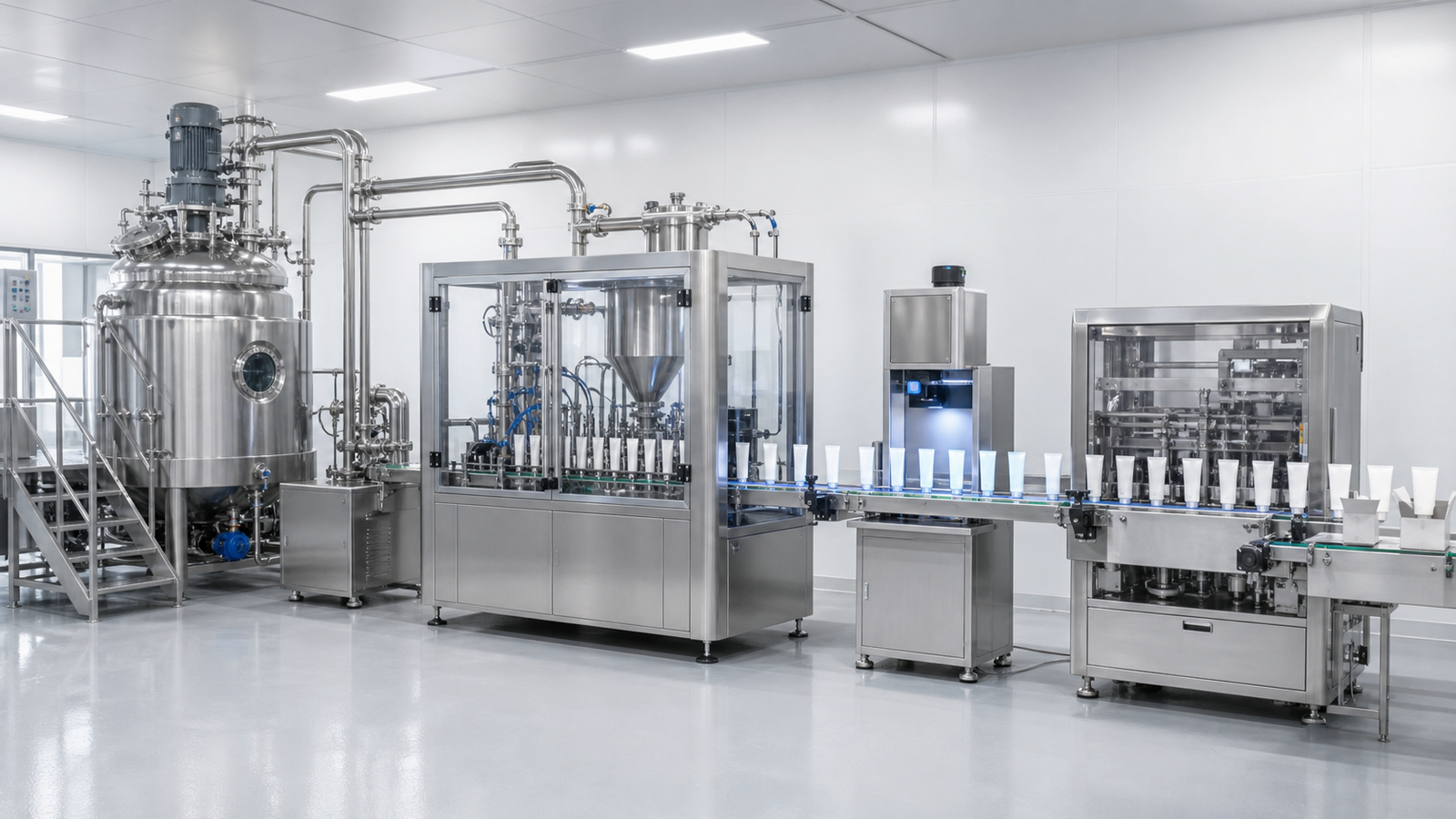
The sixth trend is the movement from a standalone tube filler toward an integrated production process.
At the downstream end, tube filling machines are increasingly connected with:
- Inspection
- Checkweighing
- Cartoning
- Leaflet insertion
- Case packing
- Palletizing
Norden’s portfolio extends from tube filling to cartoning, tray packing and case packing. IWK also offers a compact line connecting an FP tube filling platform with a vertical cartoner, processing mono-plastic, laminate and metal tubes at up to 70 tubes per minute.
At the upstream end, semi-solid product preparation is becoming more closely connected with filling.
Axomatic’s portfolio combines vacuum turbo-emulsifiers, hot melters, tube filling machines and other filling systems for cosmetic, pharmaceutical and chemical applications. This combination illustrates the practical relationship between product preparation and tube filling.
A complete tube production process may include
- Raw material preparation
- Heating and mixing
- Homogenization
- Vacuum deaeration
- Cooling
- Product holding
- Product transfer
- Tube loading
- Filling
- Sealing or folding
- Coding
- Inspection
- Cartoning
- Case packing
Why upstream conditions affect tube filling
For creams, gels, ointments and pastes, filling performance may be affected by:
- Viscosity stability
- Product temperature
- Air content
- Homogeneity
- Transfer pressure
- Transfer-pipe size
- Holding time
- Hopper level
- Hopper agitation
| Upstream condition | Possible filling result |
|---|---|
| Insufficient vacuum deaeration | Air pockets and unstable dosing |
| Uncontrolled temperature | Changing viscosity |
| Poor homogenization | Irregular flow |
| Inadequate transfer pressure | Inconsistent feeding |
| Excessively long transfer path | Temperature and pressure loss |
| Insufficient agitation | Product separation |
| Excessive aeration | Filling-weight variation |
| Stringing product | Contaminated tube tails |
A buyer can select a technically capable tube filler and still experience production problems if the product preparation and transfer system are poorly matched.
Why downstream integration matters
When a tube filler and cartoner are purchased separately without sufficient interface planning, problems may include:
- Speed mismatch
- Tube accumulation
- Unstable transfer
- Different control systems
- Unclear reject logic
- Separate FAT criteria
- Responsibility disputes
- Longer commissioning time
An integrated project can provide:
- Coordinated layout
- Matched line speed
- Defined transfer logic
- Common safety strategy
- Unified acceptance criteria
- One integration responsibility
- Better project documentation
This does not necessarily mean every machine must be manufactured by one company.
It means one project party should be responsible for confirming that the complete line works as a connected system.
What These Tube Filling Trends Mean for Buyers
The main lesson from CPHI & PMEC China 2026 was not that every manufacturer needs the fastest or most complex tube filling system.
It was that a mature purchasing process needs to evaluate more than one machine specification.
| Traditional comparison | More complete evaluation |
|---|---|
| Maximum speed | Sustainable accepted output |
| Filling range | Performance with the actual product |
| Tube diameter | Product, tube and closing combination |
| Sealing station | Complete filling and closing process |
| Machine price | Complete project and lifecycle cost |
| One current tube | Realistic future format requirements |
| Empty-machine test | Product and tube FAT |
| Standalone machine | Upstream and downstream integration |
| Mixer selected separately | Preparation, transfer and filling matched together |
Buyer preparation checklist
Before requesting a final tube filling proposal, prepare:
Product information
- Product type
- Viscosity range
- Filling temperature
- Density
- Foaming behavior
- Stringing behavior
- Particle content
- Filling volume
- Cleaning requirements
Tube information
- Plastic, laminate or aluminum
- Tube diameter
- Tube length
- Tail dimensions
- Tube-wall structure
- Cap style
- Orientation mark
- Required sealing or folding method
- Physical samples
- Technical drawing
Production information
- Required stable output
- Batch size
- Operating shifts
- Number of SKUs
- Changeover frequency
- Inspection requirements
- Cartoning requirements
- Future product formats
- Documentation expectations
The supplier should use this information to define the filling system, nozzle, hopper, closing station, controls and format tooling.
How King Pack Is Responding to These Tube Filling Trends
King Pack participated in CPHI & PMEC China 2026, presenting pharmaceutical filling, packaging and customized production solutions. Its tube filling portfolio is positioned around creams, gels, pastes, ointments, toothpaste and other semi-solid products packed in plastic, laminate, metal and aluminum tubes.
The trends identified at the exhibition align with several areas in which King Pack is developing its tube filling project approach.
1. Product-based filling configuration
King Pack does not need to apply the same filling system to every cream, paste or ointment.
A proposed configuration can be selected according to:
- Product viscosity
- Temperature
- Filling volume
- Tube material
- Target output
- Nozzle cutoff requirements
- Cleaning method
- Upstream product feeding
Available project directions may include servo-controlled dosing, piston filling, specialized nozzles, heated product handling and hopper agitation, depending on the application.
2. Plastic, laminate and aluminum tube capability
King Pack develops systems for:
- Plastic tube hot-air sealing
- Laminate tube sealing
- Ultrasonic sealing applications
- Aluminum tube mechanical folding
- Batch coding or embossing
- Tail trimming
- Finished-tube discharge
The final closing configuration should be confirmed from the actual tube samples rather than only from a general material description.
3. Greater focus on aluminum tube filling and folding
For aluminum projects, King Pack evaluates the relationship between:
- Filling cutoff
- Tail cleanliness
- Folding geometry
- Compression
- Batch embossing
- Leakage risk
- Finished appearance
The goal is not simply to demonstrate that the machine can perform a fold. It is to produce a controlled and repeatable finished tube under the agreed production conditions.
4. Stable output verified through FAT
A proposed tube filling speed needs to be considered together with:
- Product viscosity
- Filling volume
- Tube diameter
- Tube material
- Closing method
- Downstream equipment
FAT can be used to verify:
- Tube feeding
- Orientation
- Filling accuracy
- Nozzle cutoff
- Seal or fold quality
- Coding
- Continuous operation
- Changeover
- Alarm and safety functions
The agreed FAT conditions should be documented before production of the machine is completed.
5. Integration with vacuum emulsification
King Pack also manufactures vacuum emulsifying mixers for creams, ointments and other high-viscosity products, allowing projects to be planned from product preparation through tube filling and packaging.
A connected project can cover:
Vacuum emulsification → holding and transfer → tube filling → sealing or folding → coding → cartoning
This approach helps the customer evaluate product temperature, viscosity, deaeration, transfer and filling as one process rather than several disconnected equipment purchases.
6. A practical route for professional tube filling projects
International specialists such as Norden and IWK demonstrate the upper levels of tube filling speed, modularity, precision and line integration.
Not every manufacturer requires a machine operating at several hundred tubes per minute.
At the same time, pharmaceutical, veterinary and cosmetic manufacturers may require more than a basic, general-purpose machine.
Their requirements may include:
- Application-specific filling design
- Plastic and aluminum tube capability
- Stable production output
- International control components
- Real-format FAT
- Technical documentation
- Customized layouts
- Emulsification integration
- Cartoning support
For these projects, King Pack aims to provide a professional and customizable route between entry-level machinery and ultra-high-speed European platforms.
The value should not be measured only by initial equipment price.
It should be measured by how well the machine matches the product, tube, production target and future manufacturing plan.
Frequently Asked Questions
What products can a tube filling machine handle?
A tube filling machine can be configured for creams, ointments, gels, pastes, toothpaste, adhesives and other liquid or semi-solid products. The correct filling system depends on viscosity, temperature, air content, particle content and cutoff behavior.
Can one tube filling machine process plastic and aluminum tubes?
One machine platform can potentially be equipped with different closing modules for plastic or laminate sealing and aluminum folding. Buyers should confirm station space, tooling, changeover requirements and whether both systems are included in the proposed configuration.
What is the difference between tube filling and tube sealing?
Filling controls the dose and places the product inside the tube. Sealing or folding closes the tube after filling. The two processes are connected because filling height, nozzle cutoff and tail contamination can directly affect closing quality.
Why is aluminum tube filling different?
Aluminum tubes are closed through mechanical folding rather than thermal fusion. The filling nozzle must leave a clean tail area so the folding tools can create a consistent and compressed closure.
Is hot-air sealing or ultrasonic sealing better?
Neither is universally better. Hot-air sealing is established and widely used for plastic and laminate tubes. Ultrasonic sealing may suit selected materials, tube structures and decoration requirements. Actual tube samples should be tested before final selection.
How should tube filling speed be evaluated?
Evaluate stable accepted finished tubes per hour under the actual filling and closing conditions. Maximum empty-machine speed does not account for product viscosity, filling volume, sealing time, rejects or downstream equipment.
Should FAT use the customer’s actual tube?
Where possible, yes. Actual tubes allow the supplier to test orientation, filling height, sealing or folding, coding and discharge. The real product or a material with similar flow properties should also be used where practical.
Why should the emulsifying mixer and tube filler be planned together?
Product temperature, air content, viscosity and homogeneity affect filling accuracy and nozzle cutoff. Matching preparation, holding, transfer and filling equipment can reduce production instability.
Does every tube filling project need a cartoning machine?
No. The decision depends on output, labor availability, packaging format and regulatory requirements. Higher-output or more automated factories may benefit from direct tube filler and cartoner integration.
What information does King Pack need before recommending a tube filling machine?
King Pack normally needs the product type, viscosity, filling temperature, filling volume, tube material, tube dimensions, required output, closing method, number of formats, destination voltage and documentation requirements.
Conclusion
The central message from CPHI & PMEC China 2026 was clear:
Tube filling performance can no longer be evaluated through one speed number or one filling range.
Product properties affect the dosing system. Nozzle cutoff affects aluminum folding. Tube material determines the closing method. Upstream emulsification affects filling stability. Downstream cartoning affects real line output.
International tube filling specialists such as Norden and IWK demonstrate the direction of advanced tube handling, flexible closing systems and integrated production. Axomatic demonstrates the connection between product preparation and tube filling.
For buyers, the practical lesson is to define the complete production requirement before comparing machines.
King Pack is responding to this direction through application-based filling systems, plastic and aluminum tube configurations, multiple closing technologies, FAT testing and integration from vacuum emulsification through filling, sealing and downstream packaging.
Discuss Your Tube Filling Project
To prepare an appropriate technical proposal, provide:
- Product name and viscosity
- Filling temperature
- Filling volume
- Tube material
- Tube dimensions
- Required sealing or folding method
- Target stable output
- Number of formats
- Upstream emulsification requirements
- Downstream packaging requirements
- Destination voltage
- Required technical documentation
Recommended CTA:
Request a Tube Filling Solution
