
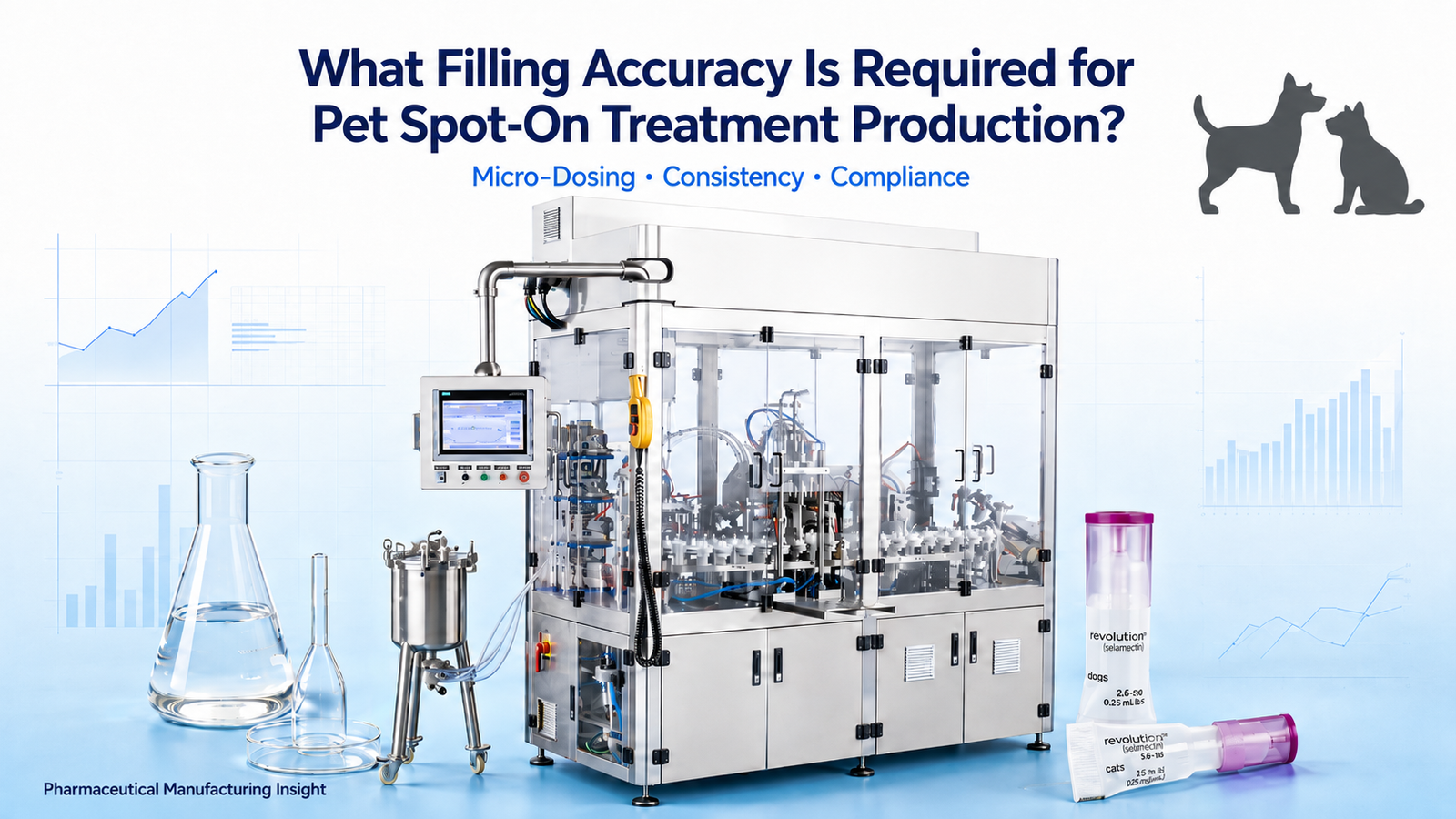
Pet flea and tick spot-on treatments are normally packaged as single-dose liquids in small plastic pipettes. Each applicator is intended to deliver one defined quantity of veterinary formulation directly onto an animal’s skin.
This makes filling accuracy a critical production requirement.
An underfilled pipette may provide less product than intended. An overfilled pipette can increase formulation costs, contaminate the sealing area, cause leakage, and create unnecessary variation between finished units.
For many pet spot-on production projects, a filling-machine performance target of approximately ±1% under defined and validated test conditions is a useful engineering benchmark. However, ±1% is not a universal regulatory limit that automatically applies to every veterinary spot-on product.
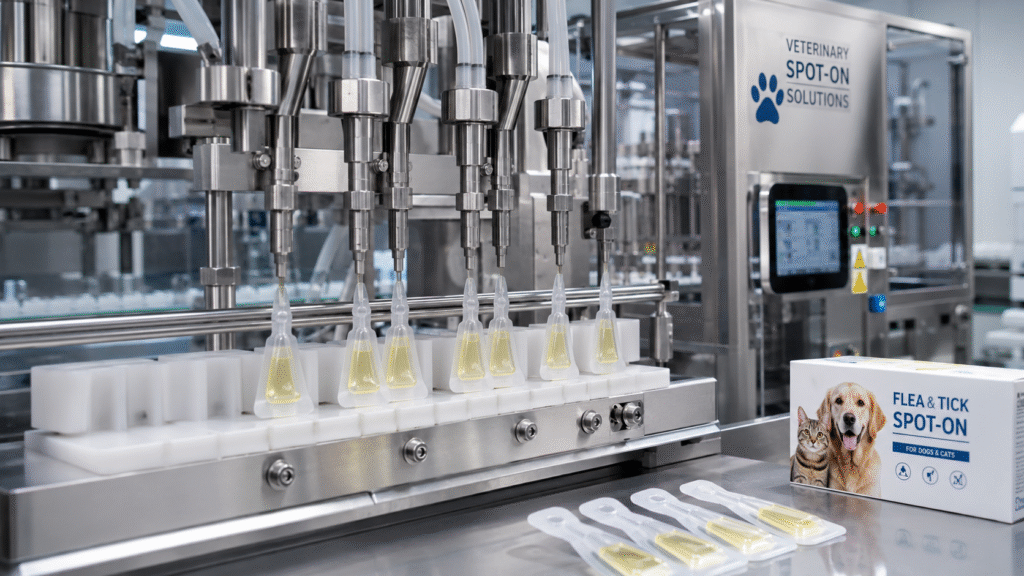
The final acceptable filling range must be determined according to:
- The registered product specification
- The labeled dose
- The formulation concentration
- The nominal fill volume
- The extractable or deliverable volume
- Container retention
- Process development data
- Filling-machine capability
- Applicable veterinary medicine regulations
A high-precision pet spot-on filling machine must therefore do more than dispense an approximate volume. It must maintain a stable average fill, low unit-to-unit variation, clean nozzle cutoff, and repeatable performance throughout the production batch.
Quick Answer: Is ±1% Filling Accuracy Required?
There is no single international rule stating that every flea and tick pipette must be filled within exactly ±1%.
Regulatory guidance generally requires manufacturers to establish justified, product-specific acceptance criteria supported by development data, in-process controls, statistical evaluation, process validation, and finished-product specifications.
The European Medicines Agency’s guideline for single-dose veterinary spot-on products states that fill-volume limits should be defined based on development studies. FDA’s VICH GL39 guidance similarly explains that veterinary medicinal-product quality depends on design, development, in-process controls, GMP controls, process validation, and justified specifications.
Therefore:
- ±1% may be an appropriate equipment-performance target
- It is not automatically the finished-product release specification
- The pharmaceutical manufacturer must define and validate the permitted range
- The machine supplier must demonstrate that the equipment can consistently operate within the agreed range
For very small volumes, an absolute tolerance may be more meaningful than percentage alone.
For example, ±1% means:
| Target Fill Volume | ±1% Variation | Corresponding Range |
|---|---|---|
| 0.50 mL | ±0.005 mL | 0.495–0.505 mL |
| 1.00 mL | ±0.010 mL | 0.990–1.010 mL |
| 2.50 mL | ±0.025 mL | 2.475–2.525 mL |
| 4.00 mL | ±0.040 mL | 3.960–4.040 mL |
At a 0.50 mL dose, maintaining ±1% means controlling the delivered quantity within five microliters. That is substantially more demanding than holding ±1% on a larger-volume product.
The target should therefore be evaluated against the actual formulation, container, pump technology, operating speed, and measurement system.
Why Filling Accuracy Matters in Pet Spot-On Production
Each Pipette Contains a Complete Dose
Unlike a multi-dose bottle, a pet spot-on applicator normally contains one complete treatment dose.
The pet owner does not measure the product before application. The entire contents of the pipette are intended to be applied to the animal.
Consequently, variation between individual pipettes directly affects the amount of formulation available for administration.
The production process must control both:
- The quantity placed into the pipette
- The quantity that can actually be removed and applied
These values may not be identical because a small quantity of liquid can remain inside the pipette body, narrow tip, shoulder, or sealed tail.
Underfilling Can Reduce the Available Dose
If a pipette is filled below its validated lower limit, the user may not be able to apply the intended quantity.
The potential effect depends on:
- Active-ingredient concentration
- Animal weight category
- Product dosing instructions
- Residual liquid inside the applicator
- The way the user empties the pipette
The permitted lower limit must therefore be established with reference to the usable or extractable quantity, not simply the theoretical stroke volume of the filling pump.
Overfilling Increases Cost and Process Risk
Overfilling may appear safer than underfilling, but excessive overfill creates several production problems.
It can:
- Increase active-ingredient consumption
- Reduce batch yield
- Contaminate the pipette sealing area
- Cause liquid to splash during indexing
- Increase leakage risk
- Affect package appearance
- Create inconsistent headspace
- Increase solvent or odor release
For a high-value veterinary formulation, even a small systematic overfill can create significant product loss over a large batch.
A correctly adjusted spot-on filling machine should center the process close to the target rather than compensating for poor repeatability with excessive overfill.
Filling Variation Can Affect Sealing Quality
Filling accuracy is closely connected to closure integrity.
If a pipette is overfilled, liquid may enter the thermal sealing zone. Residue near the open tail can interfere with heat sealing or ultrasonic welding.
This can result in:
- Incomplete seals
- Uneven sealing profiles
- Pinholes
- Weak welds
- Deformed pipettes
- Leakage during storage
A combined tube filling and sealing machine for pipettes must therefore coordinate filling volume, nozzle position, indexing movement, sealing level, and cooling time.
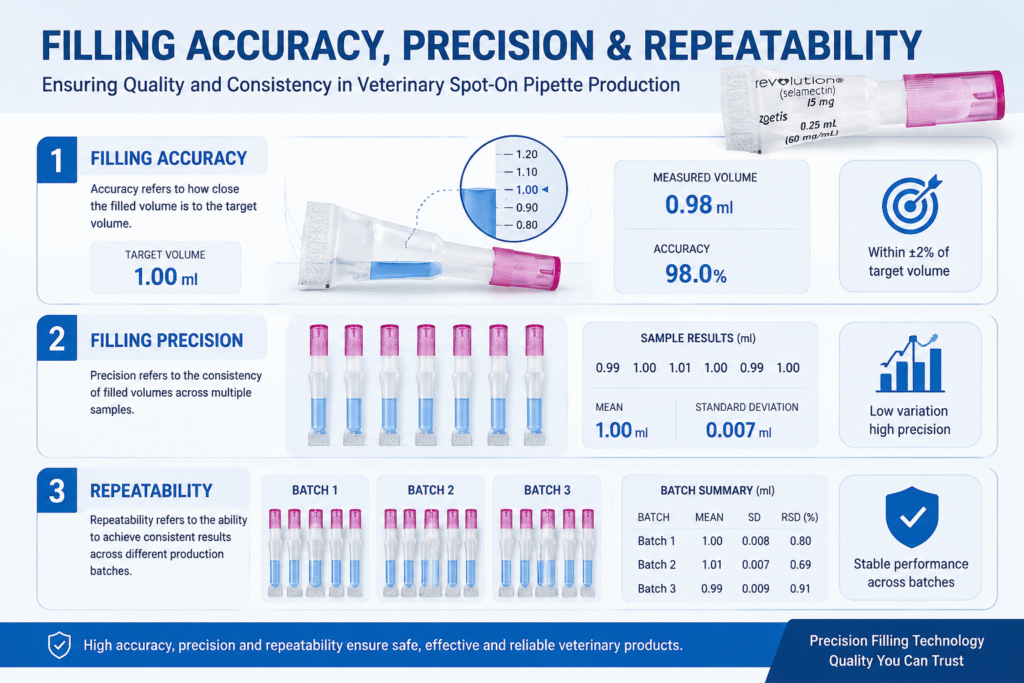
Filling Accuracy, Precision, and Repeatability Are Not the Same
These terms are often used interchangeably, but they describe different aspects of machine performance.
Filling Accuracy
Accuracy describes how close the measured fill is to the target value.
For a 1.00 mL target:
- 1.001 mL is highly accurate
- 1.050 mL has a positive filling bias
- 0.950 mL has a negative filling bias
The filling error can be calculated as:
Filling Error (%) =
(Measured Fill − Target Fill) ÷ Target Fill × 100
Filling Precision
Precision describes how closely individual results group together.
A machine may repeatedly fill 1.03 mL into every pipette. It is precise because the variation is low, but it is not accurate because the process average is above the 1.00 mL target.
Repeatability
Repeatability refers to the ability of the machine to reproduce the same result under the same conditions.
These conditions should include:
- The same machine
- The same filling head
- The same formulation
- The same target volume
- The same operating speed
- The same temperature
- The same measurement method
Process Capability
Process capability assesses whether the normal variation of the filling process fits reliably inside the approved limits.
A single test showing all samples within tolerance does not necessarily prove that the process is capable over extended production.
For validated manufacturing, the company may evaluate:
- Mean fill
- Standard deviation
- Minimum and maximum values
- Range
- Process drift
- Filling-head differences
- Cp and Cpk, where appropriate
The required statistical approach should be defined by the pharmaceutical manufacturer’s quality system.
How Should the Filling Tolerance Be Defined?
Start with the Product Requirement, Not the Machine Brochure
A machine specification such as “accuracy up to ±1%” is not sufficient by itself.
The user requirement specification should define:
- Nominal fill volume
- Minimum acceptable quantity
- Maximum acceptable quantity
- Test formulation
- Test temperature
- Production speed
- Number of filling heads
- Measurement method
- Sampling quantity
- Permitted mean deviation
- Permitted individual-unit deviation
- Acceptance and rejection rules
The equipment supplier can then select an appropriate dosing system and demonstrate performance against those conditions.
Distinguish Nominal Fill from Extractable Volume
The nominal fill is the quantity placed into the container.
The extractable or deliverable volume is the quantity that can be removed from the pipette during normal use.
These may differ because liquid can remain on:
- The inner walls
- The pipette tip
- The narrow discharge channel
- The shoulder area
- The sealed tail
- Internal ribs or molded structures
The EMA guideline for veterinary spot-on products treats fill-volume control as a product-development issue rather than prescribing one universal numerical limit. The permitted range should therefore reflect product performance, container design, manufacturing capability, and the amount available for use.
Consider Active-Ingredient Concentration
Fill-volume control and formulation assay work together.
For example, a pipette may meet its volume requirement while the formulation concentration is outside specification. Conversely, the bulk formulation may have the correct concentration while an individual pipette contains insufficient liquid.
Both controls are needed:
- Bulk formulation homogeneity and assay
- Individual pipette fill quantity
FDA regulations require written in-process controls to monitor manufacturing output, validate processes that can create variability, and derive valid in-process specifications from acceptable process averages and variability estimates where possible.
What Is a Practical Machine-Accuracy Target?
For many commercial projects, requesting a pipette filling machine accuracy of approximately ±1% under defined conditions is a reasonable starting point.
However, this target must be qualified.
The equipment specification should state:
Filling accuracy: approximately ±1% of target volume under validated conditions, subject to product characteristics, filling range, operating speed, pump configuration, container design, and approved test method.
This is more technically defensible than stating that the machine will always achieve ±1% for every liquid and every filling volume.
When ±1% May Be Achievable
A ±1% target may be achievable when:
- The formulation is homogeneous
- Product temperature is stable
- Viscosity remains within a controlled range
- The pump is correctly sized
- Air is removed from the liquid path
- Nozzles close cleanly
- The dosing system is calibrated
- Filling speed remains within the validated range
- Pipettes are positioned consistently
- The measurement system is sufficiently accurate
When ±1% May Be More Difficult
Maintaining ±1% can become more difficult when:
- The target dose is extremely small
- The formulation contains entrained air
- Product viscosity changes with temperature
- The liquid is highly volatile
- The product drips or forms strings
- Flexible tubing changes dimension
- The liquid contains suspended material
- Multiple filling heads are poorly balanced
- Production speed is increased beyond the validated range
- The filling nozzle becomes partially blocked
- Pipette openings vary significantly
In these cases, the equipment supplier and product manufacturer may need to optimize the pump, nozzle, product tank, tubing, agitation, temperature control, and filling sequence.
Factors That Affect Pet Spot-On Filling Accuracy
Formulation Viscosity
Viscosity influences how quickly liquid enters and exits the dosing system.
A higher-viscosity product may require:
- Slower suction
- Slower discharge
- Larger tubing
- A larger filling nozzle
- More valve-closing time
- Longer nozzle dwell
A low-viscosity product may flow rapidly and continue dripping after the pump has stopped.
The selected oil-based liquid filling machine should allow independent adjustment of filling speed, suction speed, cutoff timing, and suck-back parameters.
Product Temperature
Many liquids change viscosity as temperature changes.
A formula tested at 25°C may behave differently at 15°C or 30°C. This can affect:
- Pump intake
- Valve response
- Nozzle cutoff
- Filling time
- Dripping behavior
- Gravimetric volume calculations
The filling-validation protocol should therefore define an acceptable product-temperature range.
Air Bubbles
Air inside the pump chamber or product tubing can compress during dosing.
This causes inconsistent liquid delivery and may produce:
- Short fills
- Intermittent flow
- Foaming
- Delayed nozzle discharge
- Unstable weight results
The production system may require:
- Vacuum deaeration
- Low-level alarms
- Controlled tank return
- Short liquid lines
- Air-purge procedures
- Proper pump priming
Product Density
Filling tests are often performed by weight because weighing is usually more practical than directly measuring a small liquid volume.
The volume can be calculated as:
Volume = Net Liquid Weight ÷ Liquid DensityDensity should be determined at the relevant test temperature.
Using water density to calculate the volume of an oil-based or solvent-based formulation can produce an incorrect result.
Nozzle Dripping and Tailing
A droplet remaining on the nozzle may fall into the current pipette, the next pipette, or the machine fixture.
This creates unpredictable variation even when the pump stroke itself is accurate.
A no-drip nozzle filling system may include:
- Positive shut-off valves
- Mechanical nozzle closure
- Suck-back control
- Diving-fill movement
- Fine nozzle tips
- Controlled nozzle withdrawal
- Anti-tailing geometry
- Delayed container indexing
Container Positioning
Small plastic pipettes must be centered accurately beneath the filling nozzle.
If the pipette is tilted or positioned too low, some liquid may contact the opening or outer wall rather than entering the container.
A customized tube filling machine should use dedicated fixtures that control:
- Pipette height
- Angular orientation
- Filling-end position
- Neck centering
- Vertical stability
Which Filling Technology Provides the Best Accuracy?
Servo Piston Filling
A servo piston filling machine uses a controlled piston stroke to meter a defined liquid quantity.
It is commonly considered for pet spot-on products because it offers:
- Adjustable filling volume
- Repeatable piston movement
- Multi-stage filling speed
- Recipe storage
- Controlled acceleration
- Controlled deceleration
- Suck-back adjustment
- Multi-head filling capability
Servo piston systems can handle many low- and medium-viscosity formulations when product-contact components are properly selected.
The piston diameter and stroke should match the required filling range. Using an oversized piston for a very small dose can reduce dosing resolution.
Peristaltic Pump Filling
A peristaltic pump moves the product through flexible tubing.
It can be useful when:
- Product contact must be minimized
- Changeover is frequent
- Small batches are manufactured
- Tubing replacement is preferred to extensive cleaning
- Cross-contamination control is important
However, filling performance can be affected by:
- Tubing material
- Tubing diameter
- Tubing fatigue
- Compression setting
- Product viscosity
- Pump speed
- Temperature
Tubing should be inspected and replaced according to a validated maintenance schedule.
Ceramic or Precision Metering Pumps
Ceramic pumps and other precision metering pumps can be suitable for micro-dose applications.
Their suitability depends on:
- Chemical compatibility
- Product lubricity
- Particle content
- Cleaning requirements
- Dose range
- Required production speed
No single pump technology is best for every product. Actual formulation testing is required.
How a Tube Filling and Sealing Machine Maintains Accuracy
Certain flea and tick applicators are filled through an open tubular end and then heat-sealed or ultrasonically sealed.
These products can be processed using a customized tube filling and sealing machine designed for miniature spot-on pipettes.
The machine typically performs:
- Pipette loading
- Container detection
- Pipette orientation
- Precision filling
- Nozzle withdrawal
- Heat or ultrasonic sealing
- Seal cooling
- Inspection
- Finished-product discharge
Customized Pipette Fixtures
Standard cosmetic tube holders are generally too large for spot-on applicators.
The machine requires custom fixtures that keep each small pipette stable during filling and sealing.
The fixtures should prevent:
- Container tilting
- Incorrect filling height
- Seal misalignment
- Pipette deformation
- Product spillage during indexing
Controlled Filling-Nozzle Movement
The filling nozzle can descend into or close to the pipette opening before dosing.
This diving-fill movement reduces:
- Splashing
- Liquid contact with the sealing zone
- Air entrainment
- Droplet formation
After filling, the nozzle withdraws using a controlled speed profile to reduce tailing.
Immediate Transfer to Sealing
The filled pipette should move directly to the sealing station.
A short and controlled transfer reduces the chance of:
- Liquid spilling
- Unsealed pipettes falling
- Product entering the sealing area
- Solvent evaporation
- Pipette contamination
A central PLC coordinates the tube filling machine, sealing station, cooling station, inspection system, and discharge conveyor.
How to Test and Validate Filling Accuracy
Gravimetric Fill-Weight Testing
Gravimetric testing is commonly used to evaluate small-volume filling.
The basic procedure is:
- Weigh the empty pipette
- Fill the pipette
- Weigh the filled pipette
- Subtract the empty-container weight
- Convert the net liquid weight to volume using product density
- Compare the result with the approved target and limits
The balance must have sufficient resolution for the target dose.
For a very small pipette, a low-resolution production scale may not detect meaningful variation.
Test Every Filling Head
A multi-head automatic pipette filling machine should be evaluated by individual nozzle.
A combined average can hide a problem where:
- One nozzle consistently overfills
- One nozzle consistently underfills
- The remaining heads compensate in the total average
Results should be traceable to the filling position.
Test Different Production Stages
Samples should be collected at appropriate points, such as:
- Start of the batch
- After machine stabilization
- During normal running
- After a temporary stop
- After product replenishment
- Near the end of the batch
This helps identify process drift, air introduction, temperature effects, or changing product levels.
Test the Operating Range
Filling accuracy should be verified at relevant:
- Minimum speed
- Normal operating speed
- Maximum validated speed
- Minimum filling volume
- Maximum filling volume
- Product-temperature limits
A machine that performs well at low speed may show greater variation when operated at maximum capacity.
Factory and Site Acceptance Testing
The acceptance process may include:
- Factory Acceptance Test
- Site Acceptance Test
- Installation Qualification
- Operational Qualification
- Performance Qualification
The specific responsibilities should be agreed between King-Pack, the customer, and the customer’s quality team.
Final pharmaceutical-process validation remains the responsibility of the product manufacturer.
FDA requirements state that sampling and testing plans must be described in written procedures, and acceptance criteria should use appropriate statistical quality controls to determine whether a batch meets its specifications.
Common Filling-Accuracy Problems and Solutions
| Problem | Possible Cause | Recommended Action |
|---|---|---|
| All pipettes are consistently overfilled | Incorrect pump setting or calibration | Recalibrate the target stroke or pump count |
| All pipettes are consistently underfilled | Air in the liquid path or incorrect target setting | Prime the system and verify product supply |
| Results vary randomly | Air bubbles, dripping, unstable viscosity | Deaerate the product and stabilize temperature |
| One filling head is different | Head-specific calibration or valve issue | Calibrate and inspect each head separately |
| Accuracy decreases at high speed | Insufficient suction or discharge time | Reduce speed or optimize filling profile |
| Product contaminates the seal | Overfill, dripping, or incorrect nozzle height | Adjust dose, suck-back, and diving-fill position |
| Fill weight changes during the batch | Product temperature or density drift | Control tank conditions and verify density |
| Peristaltic dosing gradually changes | Tubing fatigue or compression variation | Replace tubing and recalibrate |
| Pipettes are partially filled externally | Poor fixture alignment | Modify holder and nozzle-centering system |
Why Choose King-Pack for Pet Spot-On Filling Equipment?
King-Pack develops customized filling, sealing, and packaging systems for pet spot-on and veterinary liquid products.
Depending on the applicator design, King-Pack can provide:
- Standalone pipette filling machines
- Automatic pet spot-on filling machines
- Servo piston micro-filling systems
- Peristaltic filling systems
- Customized tube filling machines
- Integrated tube filling and sealing machines
- Pipette capping and plugging systems
- Complete veterinary liquid filling lines
Accuracy Based on Actual Product Testing
Equipment selection should be based on the actual production conditions rather than water testing alone.
King-Pack can review:
- Pipette samples
- Container drawings
- Target filling volume
- Permitted filling range
- Product viscosity
- Product density
- Product temperature
- Solvent characteristics
- Required production speed
- Closure and sealing method
Representative-liquid testing helps identify the correct:
- Pump size
- Filling nozzle
- Filling-speed profile
- Suck-back setting
- Pipette holder
- Sealing configuration
Servo-Controlled Micro-Dosing
Available functions may include:
- Servo piston dosing
- Recipe storage
- Individual filling-head calibration
- Multi-stage filling speed
- No-container-no-fill detection
- Automatic fill counting
- Product-level alarms
- Filling-data recording
- Automatic rejection
No-Drip Filling for Oil-Based Products
For oil-based flea and tick formulations, the machine can be configured with:
- Positive shut-off nozzles
- Suck-back control
- Diving-fill movement
- Controlled nozzle withdrawal
- Short product pipelines
- Closed product tanks
- Solvent-compatible product-contact parts
Integrated Filling and Sealing
For open-ended plastic pipettes, King-Pack’s customized tube filling and sealing machine can combine micro-filling, heat sealing, cooling, inspection, and discharge on one enclosed rotary platform.
This reduces manual transfer and protects the filled pipettes before closure.
FAQs About Pet Spot-On Filling Accuracy
Is ±1% accuracy mandatory for every pet spot-on product?
No. There is no universal requirement stating that every spot-on product must use exactly ±1%.
The permitted limits should be established from product-development data, dosage requirements, process capability, regulatory documentation, and finished-product specifications.
Is ±1% a good machine specification?
It can be a useful engineering target under defined conditions.
The specification should state the applicable liquid, volume range, production speed, temperature, pump technology, and test method.
Can a tube filling machine achieve ±1% accuracy?
A customized tube filling machine may achieve approximately ±1% under validated conditions when it uses a properly sized precision pump, stable formulation, accurate fixtures, no-drip nozzles, and controlled operating parameters.
Performance must be confirmed with the actual product and pipette.
Which pump provides the highest accuracy?
Servo piston, peristaltic, ceramic, and other precision pumps can all provide good performance when correctly selected.
The best choice depends on dose volume, viscosity, solvent compatibility, cleaning requirements, and production speed.
Should accuracy be measured by volume or weight?
Weight-based testing is commonly practical for micro-dosing.
The net liquid weight can be converted to volume using the formulation density at the relevant temperature.
Does an accurate pump guarantee accurate finished pipettes?
No.
Finished-unit accuracy can also be affected by:
- Nozzle dripping
- Air bubbles
- Product temperature
- Container position
- Pump priming
- Liquid remaining outside the pipette
- Measurement-system error
How often should the filling machine be checked?
The manufacturer should define an in-process sampling plan based on its validated procedure, product risk, batch size, process capability, and quality system.
Checks may be conducted at batch start, during production, after stoppages, following adjustments, and near batch completion.
Can different filling heads be calibrated separately?
Yes. Individual head calibration is recommended for multi-head machines because each liquid path, valve, piston, or tube may show slightly different performance.
How can overfilling be reduced without risking underfilled units?
The process should first be stabilized and centered close to the target.
This requires reducing variation through correct pump selection, calibration, temperature control, deaeration, nozzle cutoff, and in-process monitoring rather than simply lowering the average setting.
Request a Filling Accuracy Assessment for Your Pet Spot-On Product
The correct filling tolerance for a pet spot-on treatment cannot be determined from machine speed or nominal volume alone.
It must consider:
- The labeled dose
- Product concentration
- Pipette design
- Extractable volume
- Filling range
- Product viscosity
- Pump capability
- Sealing requirements
- Applicable quality specifications
King-Pack can configure a standalone pet spot-on filling machine, a customized tube filling and sealing machine for pipettes, or a complete veterinary liquid filling and packaging line.
To evaluate your project, provide:
- Empty pipette samples and drawings
- Target filling volume
- Minimum and maximum permitted fill
- Product density and viscosity
- Product temperature range
- Required output
- Closure or sealing method
- Current filling-test data
- Retail packaging format
- Factory layout
Contact King-Pack to discuss a high-precision filling and sealing solution for flea, tick, and other pet spot-on products.
Related King Pack Solutions
For equipment configuration, compare King Pack’s pet drops filling solution and automatic filling and capping lines. Veterinary projects with hygiene and validation requirements can also reference our pharmaceutical filling solutions.