 Skip to content

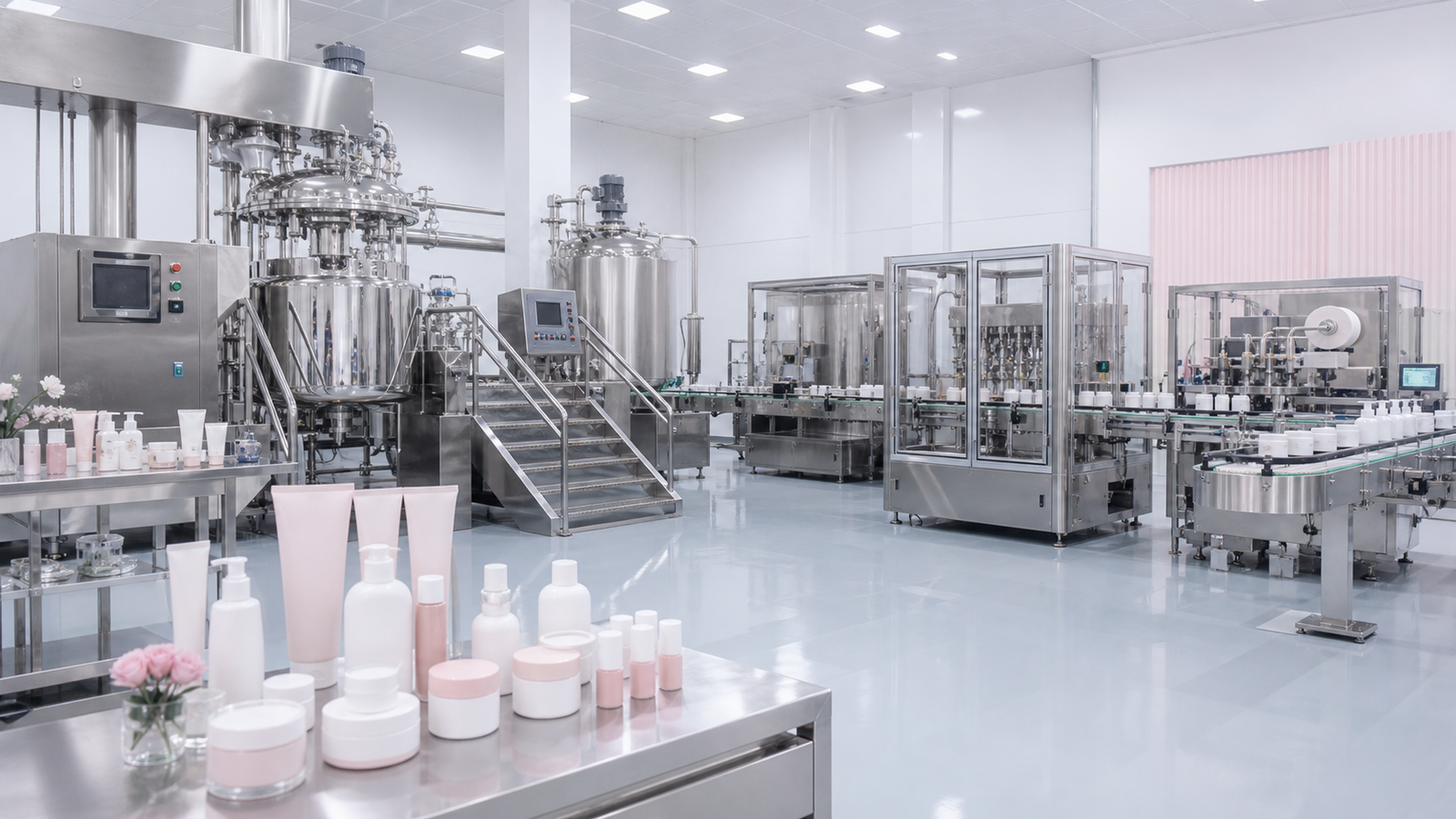
What Equipment Do You Need to Start a Cosmetics Manufacturing Business?
Buying a cosmetic filling machine does not automatically give you a functioning cosmetics factory.
The equipment you need depends first on your business model. A brand that outsources all manufacturing may need no production machinery. A company that purchases finished bulk product may only need filling and packaging equipment. A manufacturer producing creams, lotions or gels from raw materials requires a much wider system covering water preparation, mixing, emulsification, storage, transfer, filling, closing and secondary packaging.
This is why a cosmetic manufacturing equipment project should begin with the product, process and production target—not with a machine catalogue.
This guide explains which machines are normally required at different stages, which equipment may be postponed, how product characteristics affect machine selection, and what buyers should evaluate before ordering a cosmetic production line.
Do You Need Manufacturing Equipment to Start a Cosmetics Business?
Not every cosmetics business needs its own factory.
Before preparing an equipment list, determine which of the following operating models applies to your project.
| Business model | Activities performed in-house | Typical equipment requirement |
|---|---|---|
| Brand with outsourced manufacturing | Branding, sales and distribution | Normally no production machinery |
| Bulk product with in-house packaging | Filling, closing, labeling and packing | Filling machine, capping machine, labeler and inspection equipment |
| Partial in-house manufacturing | Mixing selected formulas and completing packaging | Mixing tanks, transfer equipment and packaging line |
| Full cosmetic manufacturing | Raw-material processing through final packaging | Water preparation, mixing, emulsification, storage, transfer, filling, capping, labeling and end-of-line equipment |
| Contract manufacturing facility | Multiple products, brands and packaging formats | Flexible processing and packaging systems with frequent changeover capability |
A startup should not automatically purchase a fully automatic cosmetic production line. Likewise, a growing contract manufacturer should not select small semi-automatic equipment solely because its initial price is lower.
The correct configuration depends on the production model expected over the next several years, including batch sizes, SKU frequency, packaging formats and available operators.
Start with the Cosmetic Product, Not the Machine
“Cosmetics” is too broad to serve as a machine specification.
A toner, shampoo, face cream and thick ointment can require very different mixing, transfer and filling systems. Even two products both described as “lotion” may behave differently because of their oil content, polymer system, temperature sensitivity and viscosity.
Before contacting a machine supplier, define at least:
- Product category
- Formula type
- Minimum and maximum viscosity
- Viscosity measurement temperature
- Product density
- Filling temperature
- Foaming tendency
- Presence and size of particles
- Sensitivity to shear
- Batch size
- Required cleaning method
- Container and closure specifications
Creams and Lotions
Creams and many lotions are emulsions containing water and oil phases. Their production may involve separate phase preparation, controlled heating, ingredient addition, homogenization, cooling and deaeration.
Equipment planning commonly focuses on:
- Water- and oil-phase preparation
- Controlled heating and cooling
- High-shear homogenization
- Wall-scraping agitation
- Vacuum deaeration
- Hygienic product transfer
- Filling of viscous or shear-thinning material
A simple open mixing tank may be sufficient for some formulas. More demanding emulsions may require a vacuum emulsifying mixer with separate phase vessels and controlled homogenization.
Gels
Gel manufacturing often depends on powder dispersion and correct hydration.
Poor powder addition can produce agglomerates or “fisheyes.” Excessive air incorporation can leave visible bubbles, while unsuitable shear conditions may change the final texture.
The equipment may therefore require:
- Controlled powder addition
- Appropriate agitator and homogenizer arrangement
- Vacuum capability
- Heating or cooling
- Wall scraping
- A transfer system capable of handling yield-stress material
Serums, Toners and Other Low-Viscosity Products
Low-viscosity products usually do not require the same dosing mechanism as thick creams.
Their production may prioritize:
- Accurate small-volume filling
- Low-drip nozzles
- Gentle handling of sensitive ingredients
- Foam control
- Clean container transfer
- Dropper, pump or inner-plug insertion
Peristaltic, gravity, time-pressure, magnetic-pump or other filling systems may be considered, depending on the formula, required accuracy and product-contact requirements.
Shampoos, Body Washes and Liquid Cleansers
Surfactant-containing products can foam during mixing, transfer and filling.
The project may require:
- Lower-turbulence mixing
- Controlled ingredient addition
- Anti-foam transfer arrangements
- Bottom-up or diving filling nozzles
- Stable hopper or buffer-tank supply
- Product-specific nozzle cutoff
Higher machine speed is not useful if foaming forces the operator to slow the line or leaves product around the bottle neck.
Ointments, Balms and High-Viscosity Products
Thick ointments and wax-based products create different engineering challenges:
- Limited flow under gravity
- High transfer resistance
- Temperature-dependent viscosity
- Product stringing at the nozzle
- Residual product in pipes and tanks
- Difficult cleaning and changeover
These applications may require jacketed vessels, heavy-duty agitation, positive-displacement transfer, heated product paths or specialized piston and pump filling systems.
Essential Upstream Cosmetic Manufacturing Equipment
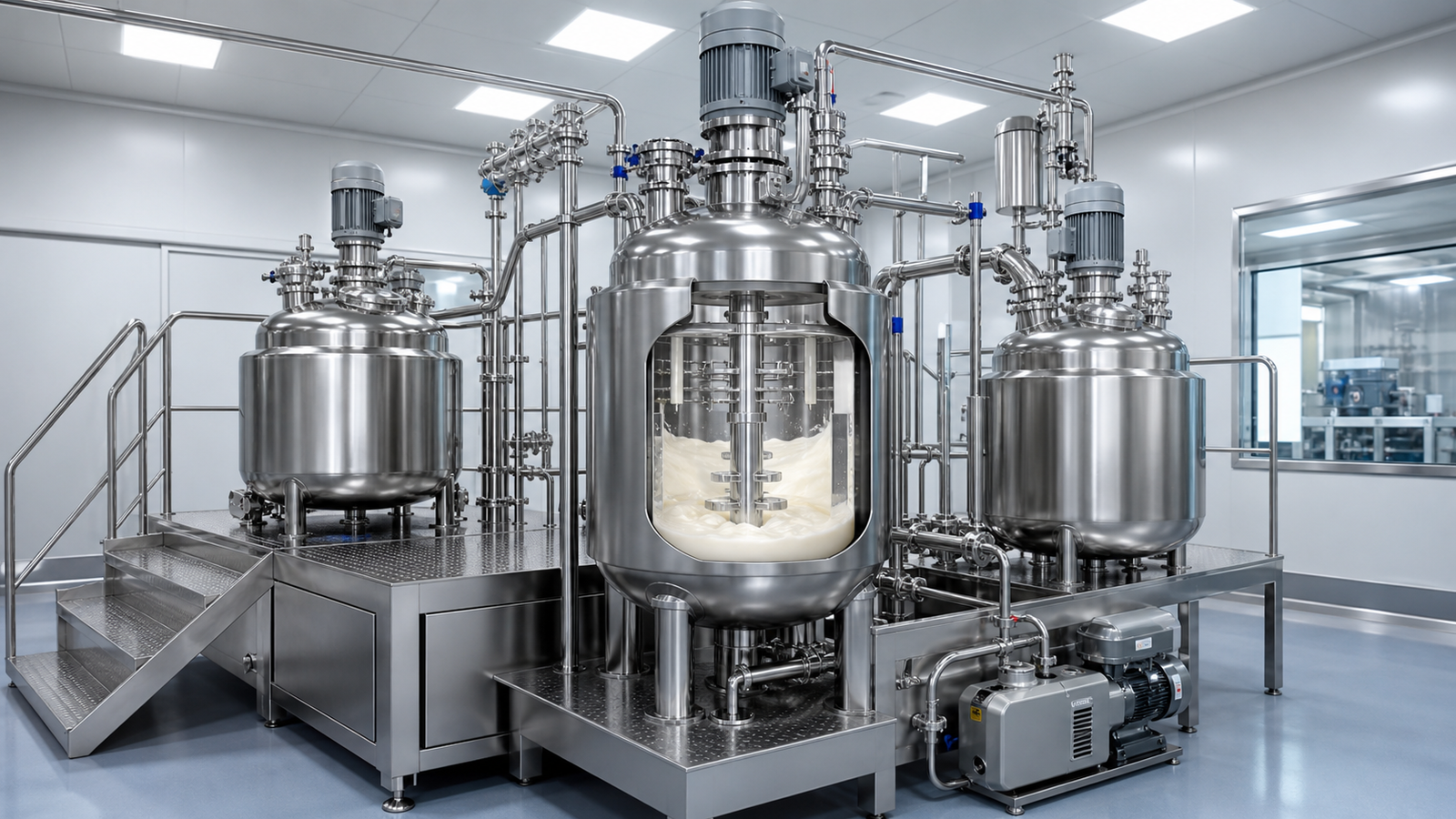
A complete cosmetics factory normally begins before the filling machine.
The upstream system determines whether the product reaching the filler has the correct texture, temperature, density and air content. A filler cannot correct an unstable emulsion or an improperly hydrated gel.
1. Water Treatment and Water Storage
Water is a major ingredient in many cosmetic formulations. However, the required treatment system cannot be selected solely from the product name.
Buyers should evaluate:
- Incoming water quality
- Formula requirements
- Required purified-water specification
- Daily consumption
- Storage time
- Distribution-loop design
- Microbiological control
- Local regulatory expectations
The final system may include pretreatment, filtration, reverse osmosis, disinfection and storage, but the configuration should be determined from actual water analysis and process requirements.
A machinery supplier should not promise a standard water-treatment package without first reviewing these conditions.
2. Premixing and Phase-Preparation Vessels
Some formulas require water- and oil-phase ingredients to be prepared separately before final emulsification.
These vessels may provide:
- Heating
- Agitation
- Ingredient dispersion
- Controlled transfer
- Temperature monitoring
- Load-cell or metering integration
The number and size of preparation vessels should be matched to the production schedule. A main mixer may become idle if operators must wait for the next phase to be prepared.
3. Vacuum Emulsifying Mixer
A vacuum emulsifying mixer can combine several process functions:
- Mixing
- Dispersion
- Homogenization
- Emulsification
- Heating
- Cooling
- Wall scraping
- Vacuum deaeration
King Pack’s current vacuum emulsifying mixer range includes configurations with jacketed vessels, high-speed homogenizers, vacuum systems and scraping agitators. The final vessel size, agitator arrangement, contact material and control system must still be specified for the actual formula and batch process.
A vacuum emulsifier is not automatically necessary for every cosmetic product. Toners and simple liquid cleansers may only require a suitable mixing tank. Dense creams, lotions, ointments and other emulsified products are more likely to justify a controlled emulsification system.
4. Agitator Mixing Tank
An agitator mixing tank may be suitable for:
- Toners
- Liquid soaps
- Some shampoos
- Cleaning products
- Premixes
- Buffer storage
- Products that do not require intensive homogenization
The agitator type should be selected according to viscosity, tank geometry and process objective.
Common configurations include:
- Propeller agitator
- Paddle agitator
- Anchor agitator
- Wall-scraping agitator
- Bottom-mounted mixer
- Inline recirculation mixer
The question is not which agitator is universally better, but which flow pattern is required to wet, blend, suspend or transfer the specific material.
5. Holding and Buffer Tanks
A buffer tank separates batch manufacturing from packaging.
For example, a 500-liter mixing batch does not need to be filled immediately at the same rate at which it was produced. A correctly selected holding tank can provide controlled supply to the filler while the main vessel begins the next batch or undergoes cleaning.
Buffer tanks may require:
- Slow-speed agitation
- Temperature control
- Level monitoring
- Closed covers
- Vacuum or pressure capability
- Sanitary outlet design
Too little buffer capacity can leave the filling line waiting. Excessive storage time can also create quality or scheduling risks. Tank sizing should therefore follow the batch and packaging plan.
6. Product Transfer System
The transfer pump and piping are part of the process, not minor accessories.
An unsuitable transfer system can:
- Introduce air
- Damage particles
- Change product texture
- Increase pressure loss
- Leave excessive residual material
- Make cleaning more difficult
- Create an unstable supply to the filler
Pump selection may involve rotary-lobe, progressive-cavity, diaphragm, centrifugal or other pumping technologies. The decision depends on viscosity, shear sensitivity, solids, temperature, required flow and cleaning method.
Pipe diameter, bend design, valve passages and transfer distance should be evaluated together.
Essential Cosmetic Filling and Packaging Equipment
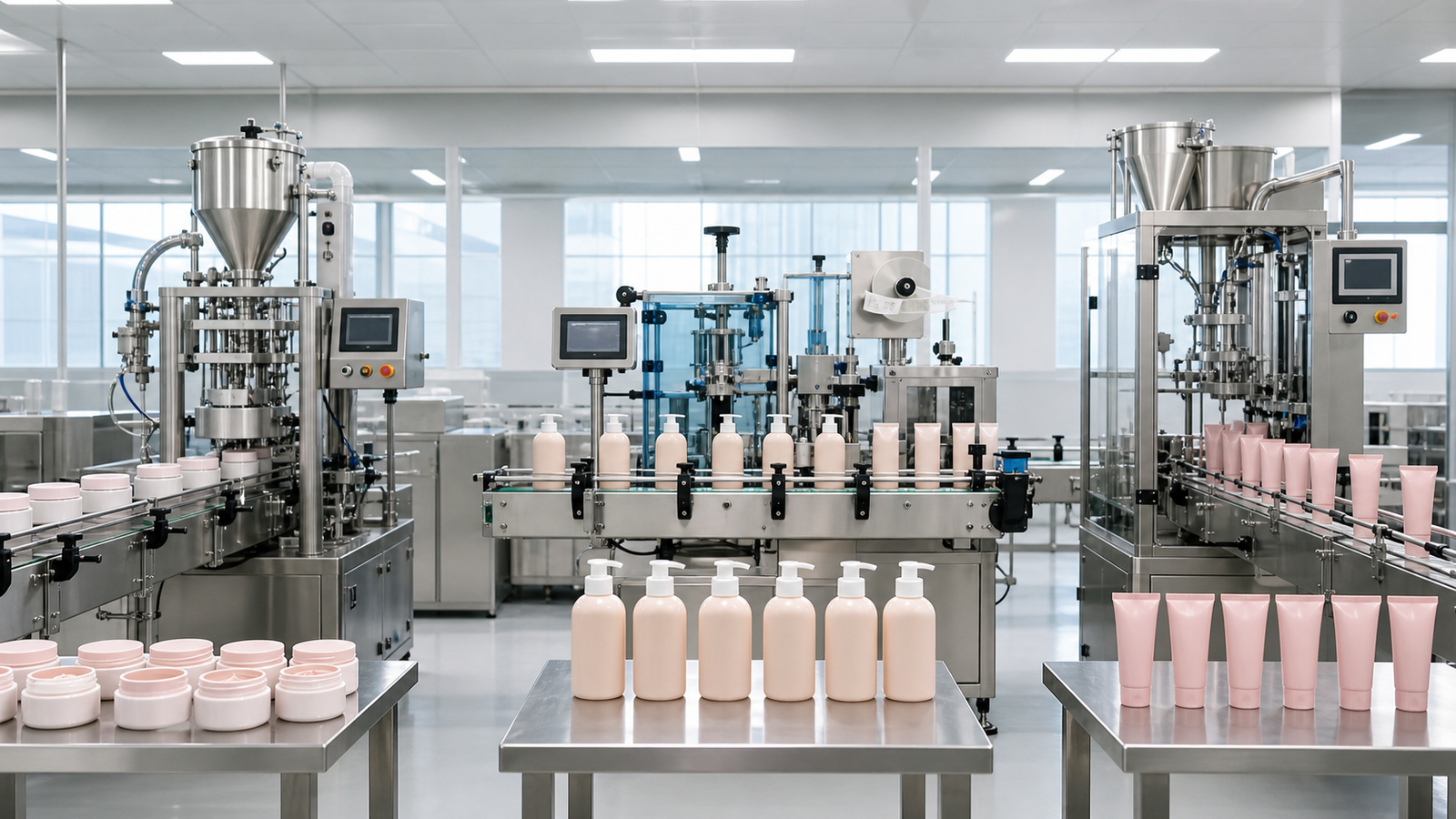
Once a stable bulk product is available, the packaging system must dose it accurately, handle the container and apply the correct closure.
1. Cosmetic Filling Machine
There is no single filling principle for all cosmetics.
| Filling technology | Typical application | Advantages | Limitations |
| Servo piston filling | Creams, lotions, gels and homogeneous viscous products | Positive displacement, adjustable volume and recipe control | Valve and cylinder design must match particles, viscosity and cleaning requirements |
| Peristaltic filling | Low-viscosity, small-volume or high-value products | Limited product contact and convenient tubing change | Not normally the first choice for very viscous, high-output filling |
| Gravity filling | Free-flowing liquids | Simple product path and suitable for many low-viscosity products | Unsuitable for many thick creams and gels |
| Pump filling | Wide viscosity range, depending on pump type | Flexible dosing and transfer options | Pump selection and calibration are product-dependent |
| Time-pressure filling | Some low- to medium-viscosity liquids | Compact configuration | Accuracy depends strongly on pressure, time and product stability |
The supplier should explain why a particular dosing principle is being proposed.
King Pack’s filling and capping systems can be configured with different filling technologies according to product characteristics, filling volume, containers, closures, output and hygiene requirements. Its current filling-line information lists peristaltic, magnetic, piston, servo-gear and gravity options for different applications.
2. Hopper and Product-Feed System
A filler cannot dose consistently if the product supply changes continuously.
The feed system may require:
- Level control
- Gentle hopper agitation
- Jacket heating or cooling
- Pressure-assisted supply
- Pump-assisted feeding
- Vacuum deaeration upstream
- Short, low-residual product paths
High-viscosity material that bridges inside a hopper may create incomplete fills even when the dosing cylinder itself is correctly sized.
3. Filling Nozzles
Nozzle design affects more than fill speed.
A suitable nozzle may help control:
- Dripping
- Stringing
- Foaming
- Splashing
- Container-neck contamination
- Air pockets
- Product tailing
- Bottom-up filling
Possible configurations include shut-off nozzles, suck-back control, diving nozzles and nozzles with larger passages for particulate products.
The nozzle should be tested with the real product whenever possible.
4. Capping and Closure-Assembly Equipment
Cosmetic packages use a wide variety of closures:
- Screw caps
- Pump caps
- Trigger sprayers
- Droppers
- Inner plugs
- Press-on caps
- Roll-on assemblies
- Discs
- Lids and jars
- Crimped closures
A capping system may include:
- Closure sorting
- Closure feeding
- Inner-plug insertion
- Pump or dropper placement
- Cap positioning
- Torque-controlled tightening
- Presence or height inspection
- Rejection of defective containers
Packaging samples should be provided before the machine is finalized. A cap described as “standard” may still differ in thread, height, liner, flexibility and application method.
5. Tube Filling and Sealing Machine
Creams, gels, ointments, facial cleansers and other cosmetic products are frequently packed in tubes.
The tube material determines the closing process:
| Tube type | Common closing method |
| Plastic tube | Hot-air or ultrasonic sealing |
| Laminate tube | Hot-air or ultrasonic sealing, depending on structure |
| Aluminum tube | Folding and crimping |
A tube filling and sealing machine may integrate tube loading, orientation, filling, sealing or folding, coding, trimming and discharge.
King Pack supplies equipment for plastic, laminate and aluminum tubes, with configurations covering tube filling, hot-air or ultrasonic sealing and aluminum-tube folding according to the project.
Machine selection should be based on:
- Tube material
- Tube diameter and length
- Fill volume
- Product viscosity
- Required output
- Registration-mark orientation
- Coding method
- Seal appearance
- Changeover requirements
6. Labeling and Coding Equipment
Labels and printed codes support both presentation and traceability.
A line may include:
- Wrap-around labeling
- Front-and-back labeling
- Top or bottom labeling
- Tube coding
- Inkjet printing
- Laser coding
- Thermal-transfer coding
- Batch-number and date printing
Label material, container shape and surface condition affect application stability. A tapered, flexible or oily container may require additional testing.
7. Inspection and Checkweighing
Inspection functions may include:
- Container presence detection
- Closure detection
- Cap-height inspection
- Label presence and position
- Code verification
- Fill-level inspection
- Checkweighing
- Automatic rejection
A checkweigher does not replace correct filler setup, but it can help identify trends, reject nonconforming packs and provide production data.
8. Cartoning and End-of-Line Packaging
Secondary packaging may involve:
- Leaflet insertion
- Horizontal or vertical cartoning
- Tamper-evident labeling
- Bundling
- Case packing
- Case sealing
- Palletizing
The downstream section must be sized for the stable output of the filling and closing equipment. A fast filler connected to a slower cartoner can simply move the production bottleneck downstream.
Which Machines Are Essential at Different Production Stages?
There is no universal startup package. A staged investment plan is often more practical.
| Production stage | Normally essential | Often added later |
| Laboratory and formulation development | Laboratory mixer, weighing equipment and quality-control instruments | Commercial filling and packaging equipment |
| Pilot or very small commercial batches | Small mixer, semi-automatic filler, basic capper and labeler | Conveyor, automatic feeding and inspection |
| Growing in-house manufacturer | Production mixer, product-transfer system, automatic filler, capper and labeler | Checkweigher, automatic bottle feeder and cartoner |
| Multi-product contract manufacturer | Flexible mixers, buffer tanks, modular filling systems and format-change equipment | Additional lines dedicated to high-volume products |
| Industrial production facility | Integrated preparation, storage, transfer, filling, closing, inspection and secondary packaging | Robotic case packing, palletizing and warehouse automation |
The lowest-cost configuration is not necessarily the equipment with the lowest purchase price. Equipment that requires excessive labor, cleaning time or format change can become expensive after production begins.
Semi-Automatic vs Automatic Cosmetic Equipment
| Factor | Semi-automatic equipment | Automatic equipment |
| Initial capital requirement | Usually lower | Usually higher |
| Labor involvement | Higher | Lower per finished unit |
| Output | Lower | Higher |
| Format flexibility | Often practical for frequent small batches | Strong when changeovers are properly engineered |
| Container feeding | Mostly manual | Can be automated |
| Process coordination | Operator-dependent | PLC- and sensor-coordinated |
| Floor-space requirement | Often smaller | Varies; integrated systems may require more space |
| Best fit | Startups, pilot production and many low-volume SKUs | Repeated medium- or high-volume production |
Semi-automatic equipment is not inherently inferior. It may be the correct choice when batch sizes are small, packaging changes frequently and the available investment must be controlled.
Automatic equipment becomes more attractive when labor dependency, output consistency and line coordination are more important than minimum initial cost.
How to Estimate Required Production Capacity
Do not select a machine using the daily production target alone.
First calculate the minimum effective output:
Required hourly output = Daily production target ÷ Effective production hours
Example
Assume:
- Daily target: 10,000 bottles
- Scheduled shift: 8 hours
- Cleaning, changeover, replenishment and planned stops: 1.5 hours
- Effective production time: 6.5 hours
The basic required output is:
10,000 ÷ 6.5 = approximately 1,539 bottles per hour
However, a quoted nominal machine speed is not the same as stable production output.
The final selection should also consider:
- Bottle feeding
- Product foaming
- Filling time for viscous material
- Cap feeding
- Labeling speed
- Operator replenishment
- Reject handling
- Batch changes
- Preventive maintenance
- Future demand
A machine advertised at a high theoretical rate may produce less if the product requires slow filling or the closure is difficult to feed.
Total Cost of Ownership
The equipment price is only one component of the project cost.
| Cost component | Buyer consideration |
| Machine purchase | Base equipment, optional modules and format parts |
| Site preparation | Floor, drainage, utilities and environmental conditions |
| Installation | Mechanical, electrical and line-integration work |
| Change parts | Additional containers, tubes and closure formats |
| Labor | Operation, cleaning, inspection and material replenishment |
| Product loss | Tank residue, pipe residue, overfill and changeover waste |
| Cleaning | Labor, water, cleaning agents and production downtime |
| Maintenance | Preventive maintenance and technical capability |
| Spare parts | Critical-parts inventory and local component availability |
| Downtime | Lost output while faults are diagnosed or parts are obtained |
| Documentation | Manuals, drawings, recipes, maintenance schedules and records |
| Future expansion | Additional heads, modules, inspection or packaging equipment |
For high-value creams and serums, reducing residual product may be as important as increasing nominal machine speed.
A technically appropriate proposal should explain where product remains after a batch and how the system will be drained, recovered or cleaned.
Regulatory and Quality Planning
Equipment selection should support the manufacturer’s quality system, but buying a machine does not by itself make a factory compliant.
United States
Under the Modernization of Cosmetics Regulation Act of 2022, applicable cosmetic facilities and responsible persons may have facility-registration and product-listing obligations. FDA states that marketed cosmetic products must be listed by the responsible person and that safety-substantiation records must be maintained, subject to applicable provisions and exemptions. FDA also continues to develop cosmetic GMP requirements under MoCRA, so buyers should verify the current regulatory position during project planning.
Product classification also matters. In the United States, intended use and marketing claims can affect whether a product is regulated as a cosmetic, a drug or both. Equipment suppliers should not determine regulatory classification on behalf of the brand owner.
European Union
Cosmetic products placed on the EU market are governed by Regulation (EC) No 1223/2009. The framework includes requirements relating to responsible persons, safety assessment, product information, good manufacturing practice and product notification. Information must be submitted through the Cosmetic Products Notification Portal where applicable.
ISO 22716
ISO 22716 provides guidelines for the production, control, storage and shipment of cosmetic products. ISO explicitly notes that its scope addresses product-quality aspects and does not, as a whole, cover worker safety or environmental protection. It should therefore be used as part of a broader factory and quality-system plan, not as a complete facility-design standard.
Requirements vary by market, product and business model. Regulatory statements should be confirmed with qualified compliance specialists before the factory layout and documentation system are finalized.
Common Cosmetic Equipment Buying Mistakes
Buying the Filler Before Finalizing the Package
A filling machine must be designed around the container opening, dimensions, stability and closure. Changing from a jar to a narrow-neck bottle after the machine is ordered may require new nozzles, guides and handling parts.
Providing Only the Product Name
“Face cream” is not a machine specification.
The supplier needs viscosity, temperature, density, particle information, fill volume and sample material wherever possible.
Testing with Water Instead of the Actual Product
Water can confirm basic machine movement, but it cannot reproduce:
- Cream stringing
- Shampoo foaming
- Gel bridging
- Particle damage
- High transfer pressure
- Product residue
- Temperature-dependent behavior
Representative product testing is more useful for final configuration.
Selecting by Maximum Advertised Speed
The relevant number is stable output using the actual product, container and closure.
Ask what assumptions were used to calculate the quoted speed.
Ignoring Cleaning and Changeover
A machine that fills quickly but requires several hours to clean may not suit a multi-SKU factory.
Evaluate:
- Tool requirements
- Number of product-contact parts
- Residual product
- Drainability
- Disassembly procedure
- Recipe change
- Container change
- Closure change
Treating the Mixer and Filler as Separate Projects
The transfer system between them affects product condition and line stability.
A complete review should cover:
Mixer → Holding Tank → Transfer Pump → Filler Hopper → Filling Nozzle
Over-Automating the First Production Stage
Automatic feeding, robotic packing and extensive inspection may not be justified for low-volume launches.
A modular line can allow later expansion without requiring the buyer to automate every operation immediately.
Underestimating Utilities and Layout
Equipment planning must account for:
- Electrical supply
- Compressed air
- Steam or hot water
- Cooling water
- Vacuum
- Drainage
- Ventilation
- Operator access
- Cleaning access
- Material flow
- Finished-product flow
Machine dimensions alone are not sufficient for layout planning.
How to Compare Cosmetic Manufacturing Equipment Proposals
Two quotations may include very different technical scopes even when both use the same machine name.
| Evaluation area | Questions to ask |
| Product review | Has the supplier reviewed viscosity, temperature, particles and formula behavior? |
| Process design | Why was this mixer, agitator, pump or filler selected? |
| Capacity | Is the quoted output nominal or demonstrated with a comparable product? |
| Product contact | Which parts contact the product, and what materials and finishes are proposed? |
| Cleaning | Which parts are cleaned in place and which require disassembly? |
| Changeover | What must be changed for each container, tube, cap or fill volume? |
| Utilities | What electrical, pneumatic, vacuum, heating and cooling services are required? |
| Controls | Are recipes, alarms, counters and operating parameters recorded? |
| Components | Are replacement electrical and pneumatic parts available in the destination market? |
| Safety | Which guards, interlocks and emergency functions are included? |
| Documentation | Which drawings, manuals, component lists and maintenance instructions are supplied? |
| Testing | What products and packaging materials will be used during FAT? |
| Expansion | Can labeling, inspection, cartoning or case packing be integrated later? |
| Support | How are installation, training, troubleshooting and spare parts handled? |
A technically stronger proposal explains its assumptions. A vague promise that the equipment can fill “all cosmetic products” should not replace product-specific engineering.
Supplier Evaluation Checklist
Before selecting a supplier, confirm that the project has documented:
Product Information
- Product category
- Formula or representative description
- Viscosity range
- Viscosity test method and temperature
- Density
- Filling temperature
- Foaming tendency
- Particle dimensions
- Shear sensitivity
- Cleaning requirements
Packaging Information
- Container or tube drawings
- Physical samples
- Minimum and maximum dimensions
- Fill-volume range
- Closure samples
- Label drawings
- Coding requirements
- Carton samples
Production Information
- Daily output
- Shift pattern
- Batch size
- Number of SKUs
- Changeover frequency
- Operator availability
- Planned future capacity
- Available floor space
- Utility conditions
Acceptance Information
- Target fill tolerance
- Stable operating-speed definition
- Closure-quality criteria
- Seal-quality criteria
- Container cleanliness
- Reject conditions
- FAT duration
- Required test quantity
- Documentation deliverables
How King Pack Supports Cosmetic Manufacturing Projects
King Pack Machinery provides mixing, filling, closing and packaging equipment for cosmetic and personal-care applications.
The company was established in 2009. Its core management and technical team has more than 20 years of industry experience. This distinction is important: the company does not claim to have been established for more than 20 years.
Application-Based Configuration
Rather than selecting equipment from the product name alone, a cosmetic project can be reviewed according to:
- Product rheology
- Formula and process
- Batch size
- Filling temperature
- Container or tube
- Closure
- Fill volume
- Output target
- Cleaning method
- Factory layout
Mixing and Emulsification
King Pack can configure vacuum emulsifying mixers, preparation vessels, mixing tanks and product-transfer systems for creams, lotions, gels, ointments and other formulations.
Available project considerations may include:
- High-shear homogenization
- Low-speed wall scraping
- Vacuum deaeration
- Heating and cooling
- Separate water- and oil-phase vessels
- Buffer storage
- PLC and HMI controls
- Customized vessel configuration
The final specification should be confirmed through formula review and process testing rather than generic viscosity or particle-size claims.
Filling and Capping
King Pack’s filling and capping lines can integrate:
- Container feeding
- Filling
- Inner-plug insertion
- Pump or dropper placement
- Cap feeding
- Capping
- Labeling
- Coding
- Inspection
- Cartoning and downstream packaging
The existing filling-line platform is configured according to product characteristics, filling volume, container shape, closure structure, target capacity, cleaning requirements and available factory space.
Tube Filling and Sealing
For tube-packaged products, King Pack provides configurations for:
- Plastic tubes
- Laminate tubes
- Aluminum tubes
- Hot-air sealing
- Ultrasonic sealing
- Aluminum-tube folding
- Batch coding
- Tube orientation
- Downstream cartoning
Tube specifications and real samples should be reviewed before the forming, sealing or folding tooling is finalized.
Complete-Line Integration
A cosmetic manufacturing project may connect:
Water Preparation → Phase Vessels → Vacuum Emulsifying Mixer → Holding Tank → Transfer Pump → Filling → Capping or Sealing → Labeling → Inspection → Cartoning → Case Packing
King Pack’s site currently presents both filling-and-capping systems and cosmetic packaging-line modules covering mixing, emulsifying, filling, capping and labeling.
Factory Acceptance Testing
A practical FAT should use agreed test materials and packaging samples.
Depending on the project, the protocol may evaluate:
- Machine functions
- Safety interlocks
- Recipe and alarm functions
- Product transfer
- Fill repeatability
- Nozzle cutoff
- Container handling
- Capping or sealing quality
- Label application
- Line synchronization
- Changeover procedure
- Documentation completeness
Acceptance criteria should be agreed before testing begins.
Documentation, Training and Spare Parts
Project support can include:
- Operating manuals
- Electrical drawings
- Pneumatic diagrams
- Recommended spare-parts lists
- Maintenance instructions
- Operator training
- Troubleshooting support
- After-sales technical assistance
Internationally recognized electrical and pneumatic components can also be considered to improve replacement-part availability in the destination market.
Frequently Asked Questions
1. What equipment is needed to start a cosmetic manufacturing business?
A full in-house manufacturing operation may require water preparation, mixing or emulsifying equipment, holding tanks, transfer pumps, filling machines, capping or sealing equipment, labeling, coding, inspection and secondary packaging. A brand that outsources production may not need manufacturing equipment.
2. What is the most important machine in a cosmetic production line?
There is no single most important machine for every product. For creams and lotions, the emulsification system may determine product quality. For a company purchasing finished bulk product, the filling and closing equipment may be the main production asset.
3. Do all cosmetic factories need a vacuum emulsifying mixer?
No. A vacuum emulsifying mixer is useful for many creams, lotions, gels and ointments, but simple liquid products may only require a correctly designed mixing tank. The formula and process should determine the equipment.
4. Can one filling machine handle creams, lotions and serums?
Sometimes, but compatibility must be verified. The viscosity range, fill volume, nozzle, pump or piston design, cleaning procedure and container formats may require different parts or machine settings. Very different products may justify separate filling systems.
5. Is a semi-automatic filling machine suitable for a startup?
It can be. Semi-automatic equipment may suit small batches, frequent product changes and limited initial capital. The buyer should also evaluate labor, cleaning time and future capacity before deciding.
6. What information should I send to a cosmetic-machine supplier?
Provide product samples or technical data, viscosity conditions, density, filling temperature, particles, batch size, fill volume, container and closure samples, required output, factory layout and utility information.
7. How do I choose between jar, bottle and tube packaging equipment?
The choice depends on product behavior, consumer use, brand positioning, fill volume, closure requirements and distribution conditions. The packaging format should normally be finalized before the filling machine is engineered.
8. Can a complete cosmetic line be expanded later?
Yes, when the original equipment is planned as a modular system. A buyer may begin with mixing, filling and capping, then add automatic feeding, labeling, inspection, cartoning or case packing as output grows.
9. What should be tested during FAT?
FAT should verify agreed machine functions, safety systems, product handling, filling performance, closure or seal quality, container transport, alarms, recipes, changeover and documentation. Representative products, containers and closures provide more useful results than water-only testing.
10. Does purchasing GMP-designed equipment make the factory GMP compliant?
No. Equipment can support hygienic manufacturing and documentation, but compliance also depends on facility design, personnel, procedures, cleaning, quality control, records, maintenance and the applicable market requirements.
Conclusion
The right cosmetic manufacturing equipment list begins with three decisions:
- Which activities will be performed in-house?
- Which products and packaging formats will be manufactured?
- What level of output and automation is commercially justified?
A startup buying finished bulk product may only require filling, capping and labeling. A cream or lotion manufacturer may need phase vessels, a vacuum emulsifying mixer, holding tanks and sanitary transfer before packaging begins. A contract manufacturer may need greater flexibility, changeover capability and documentation than a factory dedicated to one high-volume SKU.
Do not select equipment solely from a product name or advertised maximum speed. Review the complete process from raw-material preparation to finished-case packing, and define testing and acceptance criteria before the purchase order is issued.
CTA: Discuss Your Cosmetic Production Requirements
Send King Pack your:
- Product description
- Viscosity information
- Batch size
- Filling volume
- Container or tube samples
- Closure samples
- Target output
- Factory layout
King Pack can review the mixing, transfer, filling, closing and downstream packaging requirements and prepare an application-based technical proposal.
