 Skip to content

Last reviewed: August 5, 2026
For US pharmaceutical, cosmetic, personal care and veterinary product manufacturers, the quoted price of a tube filling machine is no longer the same as the final project cost.
A machine imported from China may be affected by several separate cost layers, including its normal US tariff classification, China-specific Section 301 duties, newly introduced trade measures, customs fees, ocean freight, inland transportation, rigging, commissioning and spare parts.
This does not automatically mean that a Chinese tube filling machine is no longer cost-effective. It does mean that buyers need to compare suppliers using the complete landed cost and long-term production value—not the equipment quotation alone.
This guide explains how tube filling machines may be classified, how current tariff layers can affect imports from China, which costs are often overlooked, and how buyers can determine whether an imported machine still represents a sound investment.
Important notice: Tariff treatment changes frequently. The classification and rates discussed below are for general educational purposes. US importers should confirm the final HTSUS code, Chapter 99 provisions, exemptions and applicable duty rates with a licensed customs broker before shipment.
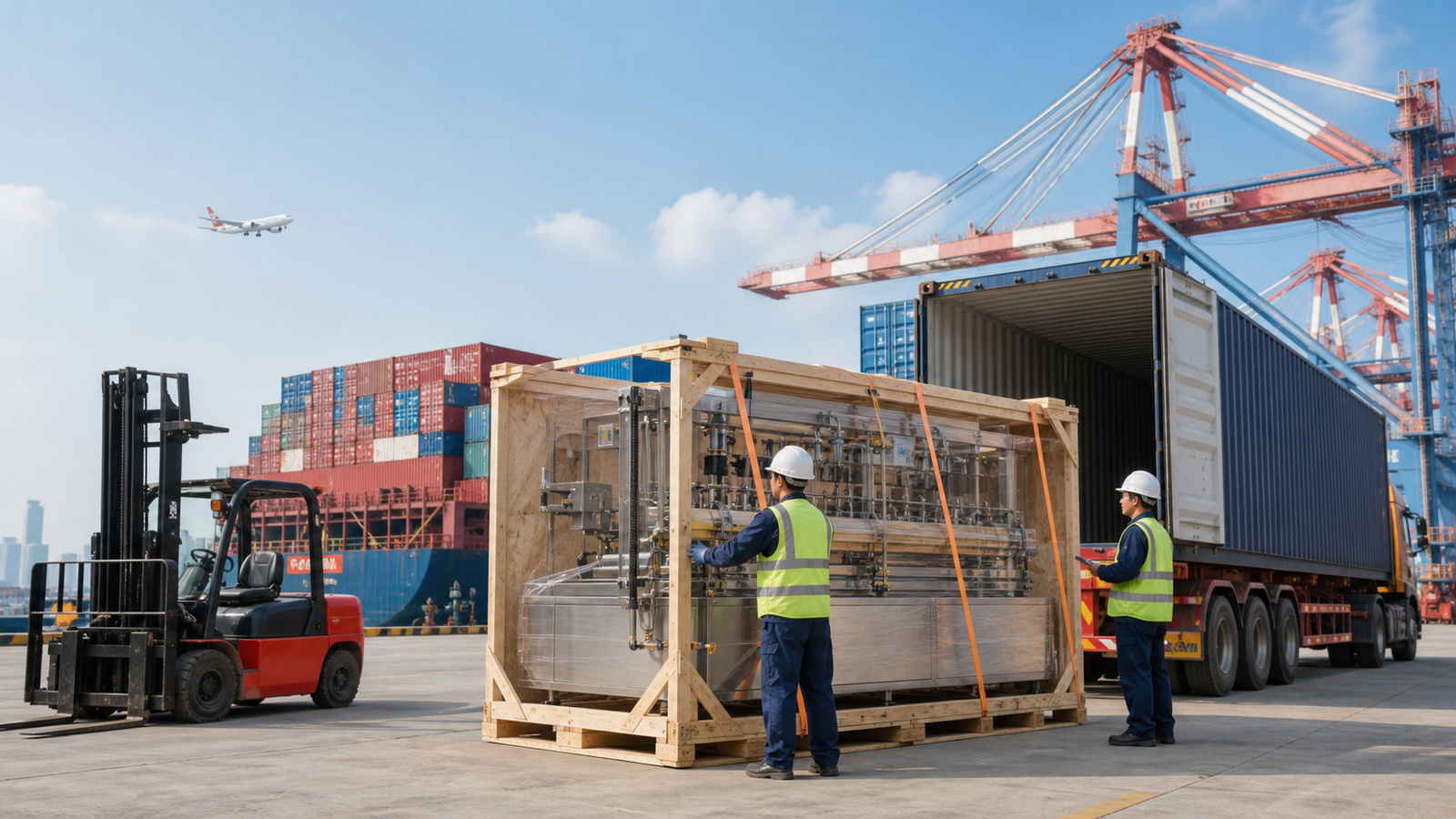
What Has Changed for US Machinery Importers?
US importers should separate three different concepts:
- The machine’s normal HTSUS classification
- Country-specific additional duties
- Temporary or newly introduced tariff measures
A tariff line showing a normal duty rate of “Free” does not necessarily mean that a machine imported from China enters the United States without duties.
The current US Harmonized Tariff Schedule places machinery used for filling, closing, sealing or labeling containers under heading 8422.30. Under subheading 8422.30.91, the normal Column 1 general duty rate is listed as Free.
However, the country of origin can trigger additional Chapter 99 duties. USTR instructs importers to identify the correct eight- or ten-digit HTS subheading first and then determine whether that classification is covered by a Section 301 action.
The US tariff environment also changed during 2026.
A temporary 10% import surcharge imposed under Section 122 took effect on February 24, 2026 and continued through July 24, 2026, unless extended by Congress.
Separately, USTR announced a new Section 301 action effective July 24, 2026. Under that action, products of China are generally subject to an additional 12.5% duty unless covered by a stated exemption.
This means buyers should not rely on an old landed-cost calculation prepared earlier in the year. The tariff treatment applicable on the date the goods enter for consumption may differ from the assumptions used when the machinery was originally quoted.
What Is the HTS Code for a Tube Filling Machine?
There is no responsible way for a machine supplier to guarantee the final US customs classification without reviewing the machine’s complete function and configuration.
A typical automatic tube filling and sealing machine may perform several operations:
- Automatic tube feeding
- Tube positioning and orientation
- Product filling
- Heating or preparation of the tube tail
- Hot-air or ultrasonic sealing
- Aluminum tube folding
- Batch coding
- Tail trimming
- Finished-tube discharge
Because the machine’s principal function is normally filling tubes and subsequently closing or sealing them, heading 8422.30 may be relevant.
The current HTSUS describes heading 8422.30 as machinery for filling, closing, sealing or labeling bottles, cans, boxes, bags or other containers, together with machinery for capsuling bottles, jars, tubes and similar containers. Within this heading, 8422.30.91.40 covers certain filling machines capable of performing other operations.
A recent CBP ruling classified a compact perfume filling and closing system under 8422.30.9140 because its primary function was filling bottles, even though it also performed pressing, tightening and crimping operations.
Another CBP ruling classified a machine that both filled and sealed coffee capsules under heading 8422.30, demonstrating that a combination of filling and closing functions can remain within this heading.
Possible classification directions
| Equipment configuration | Possible HTS direction | Final confirmation required |
|---|---|---|
| Automatic tube filling and sealing machine | 8422.30 | Yes |
| Filling machine with additional sealing operations | 8422.30 | Yes |
| Filling-only machine | 8422.30 | Yes |
| Sealing-only machine | May use a different statistical suffix | Yes |
| Filling, sealing and cartoning line | Principal function must be assessed | Yes |
| Separate cartoning machine | May fall under another 8422 subheading | Yes |
| Change parts and spare parts | May require separate classifications | Yes |
The statistical suffix can depend on whether the equipment fills bottles or similar containers, packages bags, performs sealing only, or forms part of a more complex line.
Therefore, import documents should contain a clear technical description rather than a generic description such as “packing machine.”
A more useful description would be:
Automatic rotary machine for feeding, orienting, filling, sealing, coding and discharging plastic or laminate tubes containing pharmaceutical, cosmetic or veterinary products.
King Pack’s Previous Export Classification Experience
In a previous King Pack export shipment, a semi-automatic filling and sealing machine and separate single-head filling machines were declared under Chinese export HS code 8422303090.
The customs declaration described the semi-automatic unit as equipment used for filling liquid cosmetic products and the single-head machines as equipment used for filling paste and liquid products.
This provides useful evidence of King Pack’s previous export-classification practice, but it does not establish the final US HTSUS code.
Chinese export codes and US import classifications use related Harmonized System structures, but the national statistical digits and customs treatment can differ. A US importer should therefore provide the machine’s technical description, process flow and configuration list to its customs broker for an independent classification decision.
How the Current Tariff Stack May Work
For a China-origin tube filling machine potentially classified under 8422.30.91, the import cost may include several layers.
1. Normal HTSUS duty
The normal Column 1 rate for 8422.30.91 is currently listed as Free.
2. Existing China Section 301 duty
Products of China covered by relevant Section 301 lists can be subject to an additional 25% duty under the applicable Chapter 99 provision. The HTS notes state that covered China-origin products remain subject to the normal duty plus the additional 25% Section 301 rate unless a valid exclusion applies.
The importer must verify whether the exact eight-digit classification is included and whether any current product-specific exclusion applies.
3. New 2026 Section 301 duty
USTR’s July 2026 action imposed a 12.5% duty on goods from China, except products included in the published exemption annexes. The measure applies to goods entered for consumption or withdrawn from warehouse on or after July 24, 2026, subject to a limited in-transit exception.
The published general exemption schedules do not identify heading 8422.30 as a broad machinery exemption. On that basis, a tube filling machine classified in this heading may face the new 12.5% layer, although the importer should ask its broker to review the full annexes and current HTS implementation before entry. This is an inference from the published action and exemption schedule, not a binding customs determination.
4. Customs and entry fees
Other costs may include:
- Merchandise processing fees
- Customs bond
- Broker service fees
- Entry filing fees
- Port and terminal charges
- Customs inspection expenses
- Harbor-related fees where applicable
5. Logistics and project costs
These may include:
- Export packaging
- Ocean freight
- Cargo insurance
- Destination port charges
- Inland transportation
- Forklift or crane unloading
- Rigging and machine positioning
- Electrical and utility connection
- Installation and commissioning
- Operator training
- Initial spare parts
An Illustrative Tariff Calculation Without Disclosing Machine Prices
Because machine values vary significantly by speed, filling system, tube format and level of automation, it is more useful to demonstrate the tariff structure as a percentage of customs value.
Assume the entered customs value of the equipment is represented as 100 units.
| Cost layer | Illustrative amount |
|---|---|
| Entered customs value | 100 |
| Normal duty under 8422.30.91 | 0 |
| Existing Section 301 duty, if applicable | 25 |
| New 2026 China duty, if applicable | 12.5 |
| Tariff subtotal | 37.5 |
| Brokerage, bond and customs fees | Additional |
| Freight, inland transport and rigging | Additional |
| Installation and spare parts | Additional |
Under this scenario, the tariff portion could reach approximately 37.5% of the entered customs value before customs fees and logistics costs.
This is not a universal rate quotation. The final result depends on:
- The confirmed HTSUS classification
- The machine’s country of origin
- The entry date
- Applicable Chapter 99 provisions
- Product exemptions
- The declared customs value
- Whether accessories enter with the machine
- How separately shipped parts are classified
Importers should avoid using one percentage taken from an online article as the final project budget.
Does a Higher Tariff Eliminate the Advantage of Buying from China?
Not necessarily.
A tariff increases the initial cost of an imported Chinese machine, but the correct comparison is not:
Chinese quotation versus European quotation.
The more useful comparison is:
Complete Chinese landed project cost versus complete alternative project cost at an equivalent technical scope.
A locally quoted or European-manufactured machine may avoid some China-specific duties, but its initial equipment cost, customization fees, change parts, installation, software options and documentation charges may be different.
Likewise, the lowest Chinese quotation may not remain the lowest-cost solution when all necessary components are included.
Buyers should compare equivalent scope
| Comparison factor | Questions to ask |
|---|---|
| Filling range | Are all required filling volumes included? |
| Tube compatibility | Does the machine handle plastic, laminate and aluminum tubes? |
| Sealing system | Are hot-air, ultrasonic or folding stations included as required? |
| Change parts | How many tube sizes are covered by the quotation? |
| Stable output | Is the stated speed theoretical or FAT-verified? |
| Feeding system | Is an automatic tube elevator or magazine included? |
| Utilities | Are the chiller, air compressor or extraction systems included? |
| Documentation | Are manuals, electrical drawings and validation documents included? |
| Installation | Are travel, commissioning and training included? |
| Spare parts | Is a startup or two-year package included? |
| After-sales service | What is the response and parts-delivery arrangement? |
A tariff does not make an incomplete quotation more complete, and it does not make an appropriately engineered machine less productive.
Purchase Price Is Only One Part of Total Cost of Ownership
For a production machine expected to operate for many years, initial purchase price and customs duty are only part of the economic decision.
The total cost of ownership may include:
- Product loss caused by overfilling
- Rejected tubes caused by weak or contaminated seals
- Labor required for loading and inspection
- Cleaning and changeover time
- Production interruptions
- Replacement tooling
- Preventive maintenance
- Spare parts inventory
- Technical-support costs
- Unplanned downtime
- Lost output during repairs
- Future product-format changes
How engineering quality affects long-term cost
| TCO factor | Possible low-cost machine risk | Value of a better-matched system |
|---|---|---|
| Filling accuracy | Overfill and product giveaway | Better material control |
| Nozzle cutoff | Dripping and contaminated tube tails | Cleaner sealing area |
| Sealing control | Leaks and cosmetic defects | More consistent seals |
| Sustainable speed | Output below quoted capacity | Predictable production planning |
| Changeover | Long mechanical adjustment | Faster SKU conversion |
| Component selection | Difficult overseas replacement | More accessible international brands |
| Documentation | Incomplete operating information | Easier maintenance and training |
| Spare parts | Reactive emergency purchasing | Planned inventory |
| Controls | Limited diagnostics | Faster fault identification |
For pharmaceutical ointments, high-value cosmetic creams and veterinary products, even a small reduction in filling loss or rejected tubes can affect the economics of the line over its working life.
Why Machine Selection Matters More When Tariffs Are High
When import duties increase the replacement cost of a machine, buyers have a stronger reason to confirm the application before ordering.
The machine should not simply work with one sample tube during a short demonstration. It should be selected for the buyer’s expected product portfolio.
Product characteristics
The supplier should understand:
- Filling volume
- Product viscosity
- Product temperature
- Density
- Foaming tendency
- Stringing or dripping behavior
- Presence of particles
- Sensitivity to air
- Cleaning requirements
- Batch size
A toothpaste, pharmaceutical ointment, cosmetic cream and veterinary gel may all be supplied in tubes, but they do not necessarily require the same hopper, filling valve, nozzle or agitation system.
Tube characteristics
The buyer should provide:
- Tube material
- Tube diameter
- Tube length
- Tail shape
- Cap style
- Orientation mark
- Artwork and registration mark
- Required coding position
- Required seal width
- Leak-test standard
Production requirements
The buyer should distinguish between maximum mechanical speed and sustainable production speed.
A machine briefly reaching a high cycle rate with empty tubes is not equivalent to a line continuously filling and sealing the buyer’s actual product at acceptable accuracy and reject levels.
Plastic, Laminate and Aluminum Tubes Require Different Solutions
A tube filling machine should be configured according to the packaging material.
Plastic and laminate tubes
These tubes are commonly closed using:
- Internal hot-air sealing
- Ultrasonic sealing
- Controlled cooling
- Tail trimming
- Batch coding or embossing
Hot-air sealing is widely used for stable, high-speed production. Ultrasonic sealing may be suitable for selected applications and tube structures, particularly where the customer has specific sealing conditions.
Aluminum tubes
Aluminum tubes are mechanically folded rather than thermally sealed.
The machine may require:
- Double fold
- Triple fold
- Saddle fold
- Crimping
- Batch embossing
The filling nozzle and cutoff are especially important because contamination in the folding area can contribute to poor tail appearance or leakage.
A buyer planning to run several tube materials should confirm whether one platform can be converted between the required sealing systems or whether separate machine configurations are more practical.
Hidden Costs That Are Often Missing from the First Quotation
A low headline quotation may exclude components that are necessary for production.
Potential additional items include:
- Automatic tube elevator
- Additional tube holders
- Additional filling nozzles
- Change parts for other diameters
- Heated hopper
- Product agitation
- Level control
- Transfer pump
- Mixing or holding tank
- Chiller
- Air compressor
- Dust extraction
- Nitrogen supply
- Batch coding unit
- Leak detection
- Checkweigher
- Cartoning machine
- Discharge conveyor
- Vision inspection
- Extra guarding
- US voltage configuration
- Validation documentation
- Recommended spare-parts package
- Installation and commissioning
Before comparing suppliers, buyers should request a clear division between:
- Included equipment
- Optional equipment
- Buyer-supplied utilities
- Site-installation responsibilities
- Future change parts
This approach makes the landed-cost calculation more accurate and reduces variation orders after the machine has entered production.
China, Europe or a US-Based Supplier: Which Is the Better Choice?
There is no single answer for every project.
| Dimension | China direct manufacturer | European manufacturer | US distributor or integrator |
|---|---|---|---|
| Initial equipment cost | Often more competitive | Commonly higher | Often includes local margin |
| China-specific tariff exposure | Yes | Usually no | Depends on equipment origin |
| Customization | Can be highly flexible | Strong but may cost more | Depends on the manufacturer |
| Local support | Supplier-dependent | Often distributor-based | Usually easier to arrange |
| Lead time | Often competitive | Project-dependent | Depends on stock and integration |
| Documentation | Varies substantially | Often mature | Varies by source |
| Component standards | Can use global brands | Commonly global brands | Commonly global brands |
| Line integration | Strong with capable factories | Strong | Strong |
| Communication | Supplier-dependent | Generally structured | Local communication advantage |
A US manufacturer with strict local service requirements may reasonably prefer a domestic integrator.
A buyer with an experienced engineering team, several packaging formats and a need for customized integration may find that a qualified Chinese manufacturer offers greater flexibility.
The right decision depends on the buyer’s risk profile—not simply the country shown on the quotation.
How to Evaluate a Chinese Tube Filling Machine Supplier
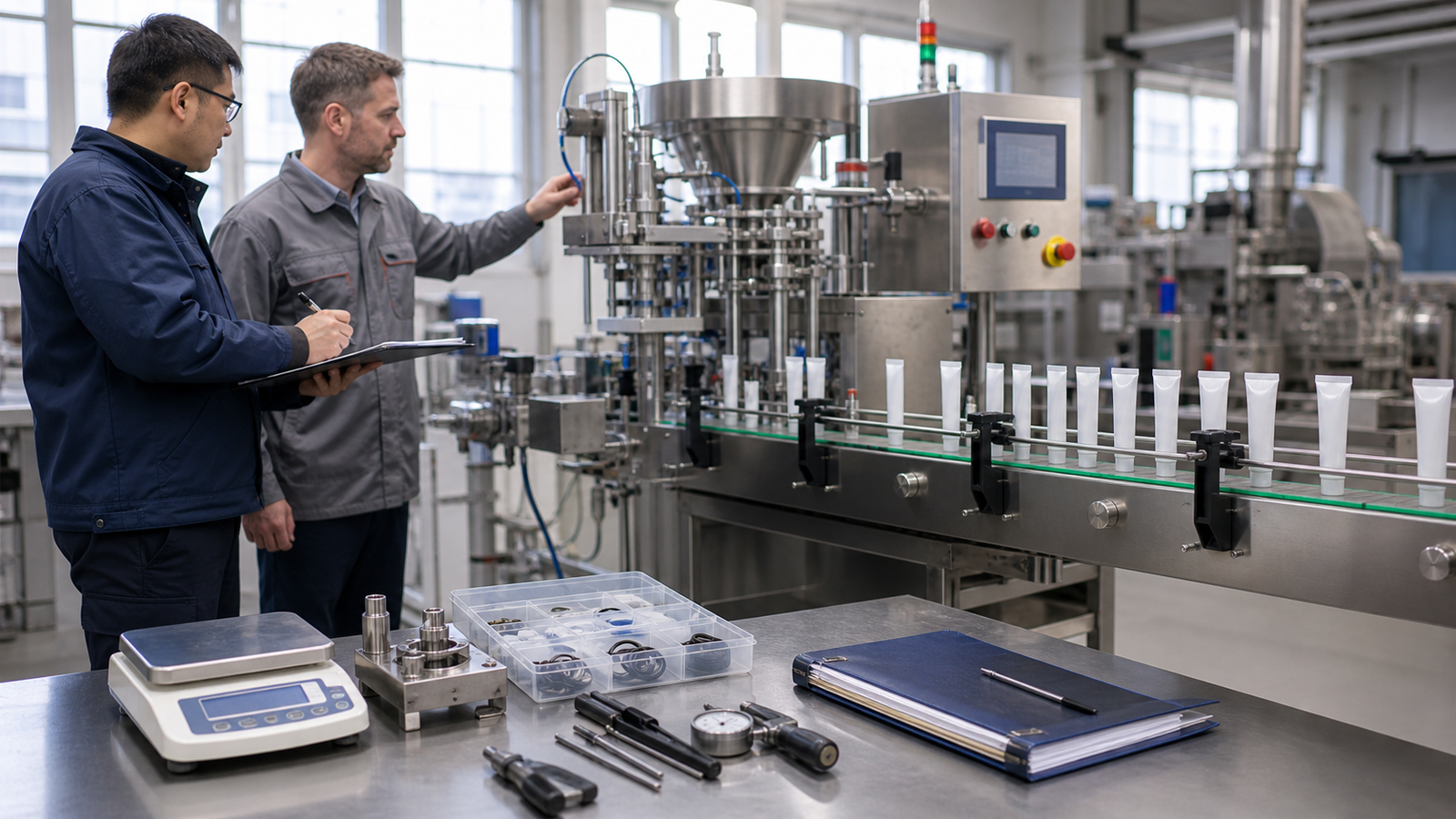
Higher tariffs make supplier verification more important because changing suppliers after delivery can be expensive.
A capable supplier should provide enough technical information for both engineering review and customs classification.
Technical information to request
- Complete machine process flow
- Equipment layout
- Station-by-station description
- Filling-system design
- Tube-size range
- Filling-volume range
- Stable production speed
- Accuracy acceptance criteria
- Utility requirements
- Electrical-component list
- Safety-interlock description
- Changeover procedure
- Recommended spare-parts list
- FAT protocol
- Warranty and service scope
Documents to request
- Technical proposal
- Commercial invoice
- Packing list
- Operation manual
- Electrical drawings
- Pneumatic diagrams
- Maintenance schedule
- Spare-parts manual
- FAT report
- Material certificates where required
- Qualification documents where included
Questions to ask before placing an order
- Has the supplier filled a product with similar viscosity?
- Has the machine run the proposed tube material?
- What speed will be demonstrated during FAT?
- How long will the continuous FAT run last?
- How will filling accuracy be measured?
- How will seal quality be checked?
- How many tube formats are included?
- Which components can be sourced locally?
- What happens when remote troubleshooting is insufficient?
- What parts should be stored at the customer’s site?
How King Pack Supports Tube Filling Projects
King Pack was founded in 2009 and combines its company manufacturing history with more than 20 years of industry experience from its core technical and management team.
Its tube filling and sealing systems are developed for applications including:
- Pharmaceutical creams and ointments
- Veterinary medicines
- Cosmetic creams and gels
- Personal care products
- Toothpaste and oral care
- High-value functional products
Depending on the model and application, King Pack systems can be configured for plastic, laminate and aluminum tubes, with hot-air sealing, ultrasonic sealing or mechanical folding.
Typical machine configurations can cover filling ranges such as 10–150 ml, with higher-speed platforms designed around stable production requirements rather than short-duration maximum output.
Application-based configuration
King Pack evaluates the product and packaging before defining the machine.
The proposal can consider:
- Product viscosity and temperature
- Tube diameter and length
- Required fill volume
- Target production speed
- Tube-tail structure
- Filling-nozzle design
- Hopper heating or agitation
- Cleaning requirements
- Number of SKUs
- Future expansion
This avoids applying one standard filling system to every product.
Internationally recognized components
Depending on the project, King Pack can use components such as:
- Siemens PLC and HMI
- Siemens or Yaskawa servo systems
- Schneider electrical components
- Omron control devices
- Festo pneumatic components
- NSK bearings
The value is not the brand name alone. Internationally available components can make overseas maintenance, replacement and troubleshooting more manageable.
Factory acceptance testing
Before shipment, FAT can be organized around the actual tube format and application requirements.
Testing may include:
- Tube feeding
- Orientation accuracy
- Filling accuracy
- Nozzle cutoff
- Seal appearance
- Batch coding
- Tail trimming
- Leakage inspection
- Stable-speed operation
- Alarm and safety checks
- Changeover demonstration
The final FAT scope should be agreed in the purchase contract so that both parties use the same acceptance criteria.
Complete-line integration
Where required, King Pack can also support upstream and downstream equipment, including:
- Vacuum emulsifying and mixing systems
- Product holding and transfer
- Tube feeding
- Filling and sealing
- Coding and inspection
- Cartoning
- Case packing
Using one project team for several production stages can reduce interface risks between different machinery suppliers.
How King Pack Supports Accurate Import Documentation
King Pack cannot make the final US customs-classification decision on behalf of an importer.
It can, however, provide the technical information needed by the importer and customs broker, including:
- Accurate machine name
- Function description
- Station list
- Model number
- Country of origin
- Equipment quantity
- Net and gross weight
- Packing dimensions
- Commercial invoice
- Packing list
- Technical brochures
- Process description
King Pack’s previous export documentation shows that certain filling and sealing machines have been declared under Chinese HS code 8422303090.
For a US shipment, the importer should use these materials as supporting information while independently confirming the US HTSUS code and applicable Chapter 99 entries.
Neither the supplier nor the importer should attempt to reduce duties through:
- Artificially reduced invoice values
- Incorrect product descriptions
- Unsupported tariff classifications
- False country-of-origin declarations
- Simple transshipment through a third country
- Undeclared separation of essential machine components
Accurate documentation protects both the importer and supplier from delays, reassessment and penalties.
Seven Steps Before Importing a Tube Filling Machine
Step 1: Define the application
Provide the supplier with product samples, tube drawings, fill volume, viscosity and speed requirements.
Step 2: Confirm the complete configuration
Identify all required change parts, utilities, auxiliary equipment, spare parts and documentation.
Step 3: Obtain a detailed technical proposal
The quotation should be supported by a station list, technical specifications and responsibility matrix.
Step 4: Ask a US broker to review the classification
Provide the broker with the technical proposal, process flow, images and complete function description.
Step 5: Calculate the complete landed cost
Include tariffs, customs fees, freight, inland transport, rigging, installation and initial spare parts.
Step 6: Complete FAT under agreed conditions
Test the relevant tubes, product characteristics, filling volume and sustainable output.
Step 7: Prepare the factory before shipment arrives
Confirm floor loading, electrical supply, compressed air, cooling water, extraction, access doors and unloading arrangements.
What Should Importers Continue to Monitor?
The tariff situation should be reviewed at several project milestones:
- Before requesting final approval
- Before signing the contract
- Before shipment
- Before US customs entry
Important variables include:
- HTSUS revision
- Section 301 coverage
- Product exclusions
- Chapter 99 entries
- Entry date
- Country-of-origin rules
- Customs valuation
- New trade actions
- Port and freight conditions
USTR began the second statutory four-year review of the China technology-transfer Section 301 actions in May 2026. This means the long-standing China tariff measures remain subject to a formal review process and should not be treated as permanently fixed.
Frequently Asked Questions
What is the US HTS code for a tube filling machine?
Heading 8422.30 may be relevant because it covers machinery for filling, closing, sealing or labeling containers. A filling machine capable of performing additional closing or sealing operations may potentially fall under 8422.30.9140, but the final code depends on the machine’s principal function and actual configuration.
Is the normal US duty rate for tube filling machines zero?
The normal Column 1 general rate under 8422.30.91 is currently listed as Free. However, additional duties may apply based on country of origin and Chapter 99 provisions.
Are tube filling machines from China subject to Section 301 tariffs?
A China-origin machine under a covered HTS classification may be subject to an additional Section 301 duty. Importers must search using the correct eight-digit HTS subheading and check current exclusions.
Does the new 2026 tariff apply to Chinese machinery?
USTR’s July 2026 action generally imposed an additional 12.5% duty on products of China unless they fall within a stated exemption. The applicable treatment of a particular tube filling machine should be confirmed using its exact HTSUS code.
Who is responsible for the final customs classification?
The US importer is responsible for the entry declaration. The machinery supplier can provide technical documents, but the importer should confirm classification with its customs broker or seek a binding ruling where appropriate.
Are spare parts taxed under the same code as the main machine?
Not always. Parts, molds, tools, electrical components and separately shipped accessories may require different classifications. The packing and invoice structure should be reviewed before shipment.
Can the declared value be reduced to lower the tariff?
The declared value must follow applicable US customs-valuation rules. Artificially lowering the invoice value or issuing false documents can create serious customs and legal risks.
Is a Chinese tube filling machine still cost-effective after tariffs?
It can be, depending on the initial equipment cost, technical configuration, customization, output, filling accuracy, service arrangement and long-term production cost. Buyers should compare complete landed cost and total cost of ownership rather than tariffs alone.
What information does King Pack need to prepare a proposal?
King Pack normally needs the product name, viscosity, filling volume, tube material, tube diameter, tube length, target output, number of formats, sealing requirement, destination voltage and documentation requirements.
Conclusion
US tariffs have made the purchase of Chinese tube filling machinery more complex, but they have not reduced the decision to a simple question of country of origin.
A responsible buyer should first confirm the machine’s classification and applicable duty layers. The buyer should then compare the complete landed project cost, technical scope, FAT conditions, documentation, after-sales support and expected long-term production performance.
The lowest quotation may not deliver the lowest cost of ownership. At the same time, a higher tariff does not automatically eliminate the technical or economic value of a well-configured Chinese machine.
King Pack supports this decision by providing application-based machine configurations, transparent technical documentation, FAT testing and integration options for tube filling, sealing and downstream packaging.
Discuss Your Tube Filling Project with King Pack
Send the following information to receive a technical proposal:
- Product and viscosity
- Filling volume
- Tube material and dimensions
- Target production speed
- Required sealing method
- Number of tube formats
- Destination country and voltage
- Required documentation
King Pack will use this information to recommend the appropriate machine configuration and provide the technical documents needed for project planning and customs review.
