
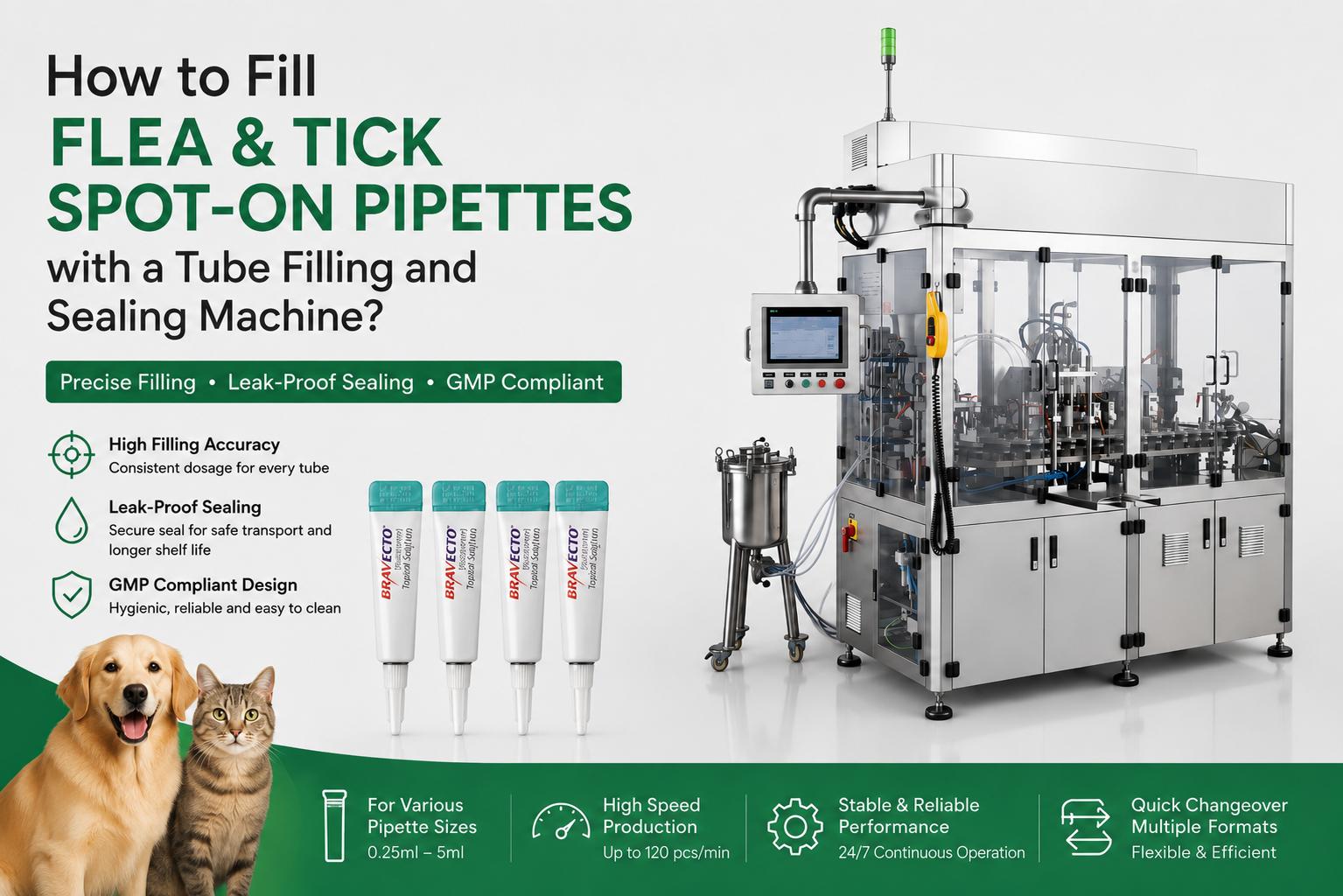
Flea and tick spot-on products are usually packaged in small, single-dose plastic pipettes. Although these containers are often called pipettes, many designs are structurally similar to miniature plastic tubes: they have an open filling end, a narrow body, and a tip or tail section that must be sealed after dosing.
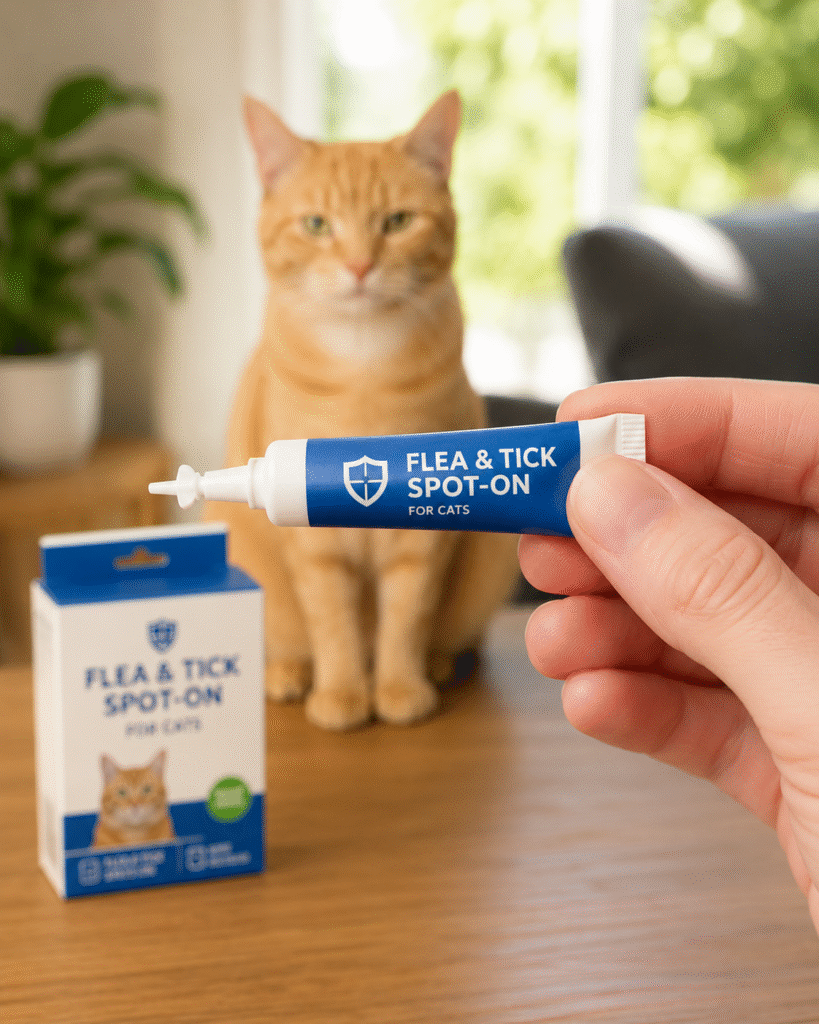
For this reason, some pet spot-on products can be manufactured using a customized tube filling machine or an integrated tube filling and sealing machine.
However, a standard cosmetic tube filler cannot normally be used without modification. Flea and tick pipettes require smaller filling volumes, more accurate micro-dosing, specialized container holders, fine filling nozzles, and carefully controlled sealing.
A complete production line may include:
- Liquid preparation and filtration equipment
- Automatic pipette feeding and orientation
- A high-precision pipette filling machine
- Heat sealing, ultrasonic sealing, plugging, or capping
- Leak inspection
- Coding and labeling
- Blister, pouch, or carton packaging
This guide explains the complete spot-on manufacturing process and shows how a customized tube filling and sealing machine for pipettes can combine accurate filling, leak-proof sealing, and continuous packaging.
Introduction to Flea & Tick Spot-On Pipette Manufacturing
A flea and tick spot-on pipette contains a single measured dose of veterinary liquid for direct application to an animal’s skin.
The user normally opens, twists, cuts, or breaks the pipette tip before applying the product between the animal’s shoulder blades or along the back.
The packaging format must meet several important requirements:
- Accurate single-dose volume
- Secure sealing
- No leakage during transportation
- Chemical compatibility with the formulation
- Easy opening by the final user
- Clear batch and dosage identification
- Reliable shelf-life protection
Depending on the animal size and formulation concentration, the filling volume may range from less than one milliliter to several milliliters.
Because each pipette contains one complete dose, even a small volume variation may affect product consistency. Accurate dosing is therefore one of the most important requirements when selecting a pet spot-on filling machine.
The complete process usually includes:
- Formulation preparation
- Mixing and filtration
- Empty pipette feeding
- Pipette positioning
- High-precision micro-filling
- Heat sealing, ultrasonic sealing, plugging, or capping
- Leak and appearance inspection
- Coding and labeling
- Blister, pouch, or carton packaging
The correct production method depends on the pipette construction.
Some applicators are filled through an open tail and then thermally sealed. These containers can often be handled by a customized small plastic tube filling machine.
Other applicators are filled through a neck and closed with a cap or plug. These products normally require a dedicated pipette filling machine and capping system.
The Role of Ingredients and Formulation in Spot-On Production
Flea and tick formulations may contain active ingredients, oil-based carriers, solvents, antioxidants, stabilizers, fragrances, and other functional components.
Their physical properties directly affect filling performance.
Important factors include:
- Viscosity
- Density
- Surface tension
- Volatility
- Foaming tendency
- Oil content
- Solvent strength
- Temperature sensitivity
- Light sensitivity
- Tendency to drip or form strings
Low-viscosity formulations may flow quickly and drip from the nozzle after filling.
Oil-based products may form a thin tail between the filling nozzle and the pipette opening. This can contaminate the sealing area and reduce closure integrity.
Volatile formulations may also require:
- Closed liquid tanks
- Short transfer pipelines
- Vapor control
- Suitable sealing materials
- Appropriate electrical protection
- Controlled room ventilation
For these products, the filling unit should include a no-drip nozzle filling system, controlled suck-back, nozzle shut-off, or diving-fill movement.
Before final equipment selection, the formulation should be tested using actual pipette samples. Water-only tests cannot reliably reproduce the behavior of oily, solvent-based, or high-surface-tension liquids.
Can a Tube Filling Machine Be Used for Flea & Tick Spot-On Pipettes?
Yes, a tube filling machine can be used for certain flea and tick pipettes, but the equipment must be adapted to the container structure and micro-dose requirements.
A conventional tube filling machine is usually designed for:
- Cosmetic cream tubes
- Pharmaceutical ointment tubes
- Toothpaste tubes
- Gel tubes
- Adhesive tubes
- Personal-care product tubes
These conventional tubes are generally larger than pet spot-on pipettes and often contain tens or hundreds of milliliters.
By comparison, flea and tick pipettes usually have:
- Much smaller filling volumes
- Narrower openings
- Lightweight plastic bodies
- Irregular applicator shapes
- Higher positioning sensitivity
- More demanding micro-dosing requirements
- Specialized sealing profiles
Therefore, a standard machine normally requires the following modifications:
- Customized pipette holders
- Smaller indexing fixtures
- Precision servo piston or peristaltic pumps
- Fine-diameter filling nozzles
- No-drip filling control
- Pipette presence detection
- Dedicated heat-sealing or ultrasonic tooling
- Low-force container handling
- Vision or sensor inspection
The resulting machine may be described as:
- A pipette filling and sealing machine
- A spot-on tube filling machine
- A small plastic tube filling machine
- A veterinary pipette filling machine
- A customized tube filling and sealing machine for pipettes
The most important consideration is not the machine name, but whether its filling, handling, and sealing systems are engineered for the actual pipette.
Pipette Filling Machine vs. Conventional Tube Filling Machine
| Equipment Type | Typical Containers | Filling Range | Closing Method | Main Application |
|---|---|---|---|---|
| Pipette filling machine | Small rigid or semi-rigid pipettes | Micro to small volumes | Cap, plug, heat seal, or ultrasonic seal | Veterinary spot-on products |
| Tube filling machine | Cosmetic or pharmaceutical tubes | Small to large volumes | Heat seal, hot-air seal, or metal fold | Creams, gels, ointments |
| Customized tube filling and sealing machine | Open-ended miniature plastic tubes or pipettes | Micro to small volumes | Thermal or ultrasonic sealing | Flea and tick spot-on products |
| Micro filling machine | Various small containers | Micro volumes | Separate closing equipment | Veterinary, diagnostic, and laboratory liquids |
A customer should not select a machine based only on whether the container is called a pipette or a tube. The actual container drawing, filling direction, plastic material, opening size, and sealing design must be evaluated.
Key Steps in Filling Flea & Tick Spot-On Pipettes
Step 1: Liquid Preparation, Mixing, and Filtration
The first stage is preparing a uniform and stable formulation.
Raw materials are added to a stainless-steel preparation vessel according to the validated manufacturing process.
The preparation system may include:
- Stainless-steel mixing tanks
- Jacketed heating and cooling vessels
- High-shear emulsifiers
- Variable-speed agitators
- Vacuum mixing systems
- Inline homogenizers
- Transfer pumps
- Filtration units
- Buffer tanks
The required equipment depends on whether the product is a simple solution, oil-based formulation, emulsion, or suspension.
Mixing speed should be controlled carefully. Excessive agitation may introduce air bubbles, while insufficient mixing may cause uneven active ingredient distribution.
If the product contains suspended components, controlled agitation may also be needed during the filling operation.
Filtration removes foreign particles and undissolved materials before the liquid reaches the spot-on filling machine.
This helps prevent:
- Filling nozzle blockage
- Pump damage
- Volume inconsistency
- Seal contamination
- Visible particles in finished pipettes
After filtration, the formulation is transferred to a holding tank connected to the filler.
For solvent-rich products, the liquid path should be as short and closed as practical to reduce evaporation and product retention.
Step 2: Automatic Pipette Feeding and Orientation
Empty spot-on pipettes are usually lightweight and difficult to handle.
Their narrow, tapered, or irregular shapes make automatic orientation more complex than handling conventional cosmetic tubes.
An automatic pipette feeder may use:
- Vibratory bowl feeding
- Centrifugal feeding
- Step feeding
- Belt orientation
- Robotic pick-and-place
- Tray loading
- Puck or carrier systems
The feeder must identify the filling end and transfer each pipette to the correct machine position.
For a customized tube filling and sealing machine, the pipettes may be loaded into dedicated holders mounted on a rotary indexing table or linear conveyor.
Each holder keeps the pipette upright and stable during:
- Filling
- Transfer
- Sealing
- Cooling
- Inspection
- Discharge
Sensors can confirm that a pipette is present before filling begins. This supports a no-container-no-fill function and reduces liquid waste.
For small production batches, manual loading may be used. For medium- and high-speed production, automatic feeding improves line efficiency and reduces operator contact with the packaging.
Step 3: High-Precision Micro-Filling into Pipettes
Micro-filling is the core process in flea and tick pipette manufacturing.
Each applicator must receive the programmed dose consistently. The filling system must also avoid dripping, splashing, foaming, and contamination of the sealing area.
A suitable flea tick pipette filler may use one of several dosing technologies.
Servo Piston Filling
A servo piston filling machine measures liquid through a controlled piston stroke.
The filling volume, piston speed, acceleration, and discharge profile can be adjusted through the machine control system.
Advantages include:
- Repeatable volumetric filling
- Flexible volume adjustment
- Recipe storage
- Controlled filling speed
- Compatibility with low- and medium-viscosity liquids
- Multi-nozzle filling options
- Integration with diving nozzles
Servo piston filling is often suitable for oil-based spot-on liquids, provided that the valves, seals, and product contact materials are chemically compatible.
Peristaltic Pump Filling
A peristaltic pump moves liquid through flexible tubing without the formulation contacting the pump mechanism.
This method can be useful when:
- Product changeover is frequent
- Small batches are produced
- Product contact parts must be minimized
- Cleaning must be simplified
- Cross-contamination control is important
The tubing must be compatible with the formulation. Tubing wear and compression may affect dosing performance, so regular inspection and calibration are required.
Ceramic Pump and Precision Pump Filling
Ceramic pumps or other precision metering pumps may be suitable for very small filling volumes.
These systems can provide stable micro-dosing when properly matched to the product viscosity and machine speed.
The final pump choice should be based on:
- Minimum filling volume
- Maximum filling volume
- Target accuracy
- Product viscosity
- Chemical compatibility
- Cleaning method
- Production capacity
- Batch size
- Changeover frequency
Under validated conditions, an automatic pipette filling machine may achieve approximately ±1% filling accuracy.
Actual accuracy depends on:
- Filling volume
- Product density
- Product temperature
- Pump technology
- Nozzle design
- Filling speed
- Calibration method
- Machine maintenance
Accuracy should always be verified using the actual formulation and packaging material.
Step 4: Heat Sealing, Ultrasonic Sealing, Plugging, or Capping
After filling, the pipette must be closed immediately.
The closing method depends on the container design.
Common closure methods include:
- Heat sealing
- Hot-air sealing
- Ultrasonic sealing
- Thermal tip sealing
- Press-fit plugging
- Snap-on capping
- Screw capping
- Foil sealing
For an open-ended miniature tube, a tube filling and sealing machine can fill the container and then thermally close the open end.
The sealing station may control:
- Temperature
- Sealing pressure
- Dwell time
- Cooling time
- Seal depth
- Seal width
- Tool position
For ultrasonic sealing, the system controls:
- Ultrasonic amplitude
- Energy
- Pressure
- Welding time
- Hold time
The sealing parameters must be matched to:
- Plastic material
- Wall thickness
- Container geometry
- Product temperature
- Residue near the sealing area
If liquid remains on the inside wall near the seal, the closure may become weak or uneven. This is why filling nozzle positioning and no-drip performance are directly connected to seal quality.
For cap-based pipettes, a pipette capping machine may feed, orient, place, and press the closure onto the container.
The capping system should monitor:
- Cap presence
- Cap orientation
- Insertion depth
- Pressing force
- Torque, where applicable
- Finished cap height
Step 5: Leak Testing and Seal Inspection
Leak testing is essential for single-dose spot-on packaging.
A small defect can lead to:
- Product loss
- Contaminated cartons
- Reduced dosage
- Odor release
- Shelf-life problems
- Customer complaints
Possible inspection methods include:
- Vacuum leak testing
- Pressure decay testing
- Compression testing
- Vision inspection
- Seal profile inspection
- Cap height detection
- Manual sampling tests
The inspection level depends on the packaging design and production requirements.
The filling and sealing line can automatically reject pipettes with:
- Missing seals
- Deformed seals
- Raised caps
- Incorrect fill levels
- Contaminated sealing areas
- Missing containers
Step 6: Labeling, Coding, and Final Packaging
After sealing and inspection, the finished pipettes proceed to coding and secondary packaging.
The production line may include:
- Inkjet coding
- Laser coding
- Thermal transfer printing
- Pressure-sensitive labeling
- Blister packaging
- Pouch packaging
- Card loading
- Leaflet insertion
- Cartoning
- Checkweighing
- Case packing
A labeling machine for spot-on products may apply labels to:
- Individual pipettes
- Plastic trays
- Blister cards
- Pouches
- Folding cartons
- Shipping cases
Because spot-on pipettes are small, the available print area may be limited. Important information is therefore often printed on the outer packaging.
Typical coding information includes:
- Batch number
- Manufacturing date
- Expiration date
- Product code
- Animal weight range
- Traceability data
The finished pipettes may be packed individually or in multi-dose retail cartons.
An integrated veterinary liquid filling line can connect the filler directly with blister packing, pouch packing, or cartoning equipment.
Essential Machines in Spot-On Pipette Production
Mixing and Filtration Equipment
The preparation system ensures that the formulation remains stable before and during filling.
Available configurations may include:
- Agitated holding tanks
- Jacketed mixing tanks
- Vacuum emulsifying systems
- Inline filtration
- Sanitary transfer pumps
- Closed product pipelines
For volatile or flammable formulations, the machine design should be evaluated according to the product safety data and factory conditions.
Relevant considerations may include:
- Explosion-protected electrical components
- Grounding
- Ventilation
- Solvent-resistant seals
- Closed transfer systems
- Static electricity control
These requirements should be confirmed during the engineering stage.
Automatic Pipette and Tube Feeding Systems
Automatic feeding is one of the most customized sections of the line.
Unlike standard tubes, flea and tick pipettes may not have a flat or symmetrical body. The feeder must therefore be tested with actual samples.
Possible solutions include:
- Bowl feeder plus orientation track
- Robot loading
- Tray denesting
- Manual tray loading
- Carrier-based indexing
The objective is to deliver each pipette to the tube filling machine with consistent orientation and without deformation.
Automatic Pipette Filling Machines
A high-quality automatic pipette filling machine combines:
- Container presence detection
- Precision dosing
- Nozzle positioning
- Recipe control
- Filling calibration
- Automatic rejection
- Batch counting
- Alarm management
Optional features may include:
- Servo piston pumps
- Peristaltic pumps
- Ceramic pumps
- Diving nozzles
- Suck-back filling
- Multi-head filling
- Nitrogen flushing
- Closed product tanks
- Clean-in-place support
For multiple pipette formats, the machine may use interchangeable holders, nozzles, and sealing tools.
Tube Filling and Sealing Machines for Pipettes
A customized tube filling and sealing machine for pipettes performs several operations on one platform:
- Pipette loading
- Container detection
- Micro-filling
- Nozzle withdrawal
- Heat or ultrasonic sealing
- Seal cooling
- Inspection
- Discharge
The machine may use a rotary indexing platform or linear transport system.
Compared with a conventional tube filler, the pipette version requires:
- Smaller fixtures
- Lower handling force
- More precise filling
- Finer nozzle control
- Shorter filling cycles
- Specialized seal tooling
- More accurate position detection
A combined machine reduces intermediate handling between filling and sealing. This is particularly important because unsealed pipettes can spill during transfer.
Pipette Capping and Plugging Machines
Not every spot-on applicator is heat-sealed.
Some products use plugs, caps, or breakable closures.
A pipette capping machine may include:
- Cap feeding
- Cap orientation
- Pick-and-place
- Pressing
- Torque control
- Cap height inspection
- Missing-cap rejection
The closing system must match the pipette neck and closure geometry.
Labeling, Blistering, and Cartoning Systems
Finished pipettes may be placed into:
- Blister packs
- Pouches
- Plastic trays
- Folding cartons
- Multi-dose kits
A complete downstream system may include:
- Pipette collation
- Blister or tray loading
- Leaflet insertion
- Carton erection
- Product loading
- Carton closing
- Date coding
- Vision inspection
- Checkweighing
- Case packing
The packaging design should be considered early because the orientation and output format of the filling line affect downstream automation.
How Pipette Filling and Tube Sealing Systems Work Together
The filling and sealing sections must operate as a coordinated process.
After an empty pipette enters the holder, sensors verify its presence and position.
The filling nozzle then moves to the programmed position. Depending on the product, the nozzle may enter the pipette opening before dosing.
The machine dispenses the required volume and withdraws the nozzle using a controlled motion.
The pipette then moves directly to the sealing or capping station.
A central PLC can synchronize:
- Feeding
- Container detection
- Filling
- Nozzle movement
- Sealing
- Cooling
- Inspection
- Rejection
- Discharge
This integration reduces product loss and improves line stability.
Precision Micro-Filling Technology
Servo piston and peristaltic technologies are the most common options for pet spot-on applications.
Servo piston filling is often selected when:
- Broader viscosity handling is required
- Filling volumes change frequently
- Recipe control is important
- Multiple filling heads are needed
Peristaltic filling may be selected when:
- Small batches are common
- Tubing replacement is easier than full cleaning
- Product isolation is important
- Cross-contamination risk must be reduced
A flexible micro filling machine may be designed to accommodate either technology.
No-Drip Nozzles and Anti-Tailing Control
Oil-based spot-on products can drip or form strings after the main dose has been delivered.
This may cause:
- Product loss
- Dirty pipette surfaces
- Contaminated holders
- Weak heat seals
- Packaging contamination
A no-drip nozzle filling system may include:
- Positive shut-off nozzles
- Suck-back control
- Small-diameter nozzle tips
- Diving fill
- Bottom-up filling
- Controlled withdrawal speed
- Delayed shut-off
- Anti-tailing nozzle geometry
The exact setting should be established during filling trials.
Diving Fill for Narrow Pipettes
Diving-fill technology moves the nozzle into or close to the container before dosing.
This reduces:
- Splashing
- Air entrainment
- Liquid contact with the pipette opening
- Uncontrolled droplet formation
For narrow pipettes, the nozzle position must be accurate enough to avoid touching or damaging the container.
Integrated Filling and Sealing
A combined tube filling and sealing machine transfers the filled pipette directly to the closure station.
This is more stable than using separate machines with manual handling between them.
The integrated design can also include:
- Seal cooling
- Leak inspection
- Batch coding
- Vision inspection
- Automatic rejection
For continuous production, the machine can connect with downstream labeling and cartoning equipment.
How to Choose the Right Machine for Your Spot-On Pipettes
The correct machine depends on the packaging design and production requirements.
Before selecting a system, provide the equipment manufacturer with:
- Pipette drawings
- Physical pipette samples
- Plastic material
- Filling direction
- Filling volume range
- Liquid viscosity
- Liquid density
- Product safety data
- Required filling accuracy
- Production speed
- Closure method
- Retail packaging format
- Factory layout
Choose a Pipette Filling Machine When:
- The container has a narrow filling neck
- The product is closed with a cap or plug
- Micro-volume filling is the main requirement
- Heat sealing is not required
- Multiple pipette shapes must be handled
Choose a Customized Tube Filling Machine When:
- The pipette has an open tubular end
- Filling is followed by heat or ultrasonic sealing
- Filling and sealing should occur on one platform
- The container can be held in a custom tube holder
- Continuous automatic production is required
Choose a Separate Filling and Sealing Line When:
- Different machines are needed for filling and closure
- The packaging design is highly specialized
- Production capacity is low or variable
- Manual transfer is acceptable
- Multiple closure types are used
Actual filling and sealing tests should be completed before the machine design is finalized.
Why Choose King-Pack’s Flea & Tick Spot-On Equipment?
King-Pack develops filling, sealing, and packaging systems for liquid products requiring accurate dosing and stable container handling.
For flea and tick spot-on applications, King-Pack can configure:
- A standalone pipette filling machine
- A customized tube filling machine
- An integrated tube filling and sealing machine
- A pipette filling and capping machine
- A complete veterinary liquid filling line
The machine configuration is based on the customer’s actual:
- Pipette design
- Filling volume
- Product viscosity
- Closure structure
- Required capacity
- Packaging format
High-Precision Micro-Dosing
The filling system can use servo piston, peristaltic, ceramic, or other precision pump technologies.
Available control functions may include:
- Servo-driven dosing
- Recipe management
- Multi-stage filling speed
- Filling volume calibration
- Product-level monitoring
- No-container-no-fill
- Automatic rejection
Handling Oil-Based and Solvent-Based Products
For oil-based spot-on formulations, the machine can be equipped with:
- No-drip filling nozzles
- Suck-back control
- Diving-fill movement
- Closed product tanks
- Short product pipelines
- Solvent-compatible seals
- Customized product contact parts
The actual configuration should be confirmed after reviewing the formulation data.
Customized Pipette Handling
King-Pack can develop container handling systems based on the actual pipette shape.
Options may include:
- Automatic bowl feeding
- Robotic loading
- Tray loading
- Customized holders
- Rotary indexing
- Linear transport
Integrated Filling, Sealing, and Packaging
The production line can connect:
- Pipette feeding
- Micro-filling
- Heat sealing
- Ultrasonic sealing
- Capping
- Leak inspection
- Coding
- Labeling
- Blister packing
- Cartoning
- Case packing
This integrated approach reduces transfer risk and improves overall line efficiency.
FAQs About Pipette and Tube Filling Machines
Can a tube filling machine fill flea and tick spot-on pipettes?
Yes. A customized tube filling machine can fill spot-on pipettes when the container has an open tubular end and is suitable for heat or ultrasonic sealing.
Standard cosmetic tube filling machines normally require customized holders, pumps, nozzles, and sealing tools.
What is the difference between a pipette filling machine and a tube filling machine?
A pipette filling machine is designed primarily for small applicators and micro-volume dosing.
A conventional tube filling machine is designed for larger cosmetic, pharmaceutical, or personal-care tubes.
A customized tube filling and sealing machine for pipettes combines micro-filling technology with miniature tube handling and sealing.
Can one tube filling and sealing machine handle different pipette sizes?
Yes, provided the machine uses interchangeable holders, nozzles, sealing tools, and recipe settings.
The available size range should be confirmed using actual pipette samples.
What filling system is suitable for oil-based spot-on products?
Servo piston pumps are often suitable for oil-based liquids because they provide controlled volumetric dosing.
Peristaltic or precision pump systems may also be used depending on the viscosity, filling volume, and chemical compatibility.
How accurate is a pet spot-on filling machine?
Under validated conditions, some systems may achieve filling accuracy of approximately ±1%.
Actual accuracy depends on the product, filling volume, pump technology, machine speed, and calibration method.
How can dripping be prevented?
Dripping can be reduced by using:
- Shut-off nozzles
- Suck-back control
- Diving filling
- Controlled nozzle withdrawal
- Fine nozzle tips
- Anti-tailing design
Product trials are required to determine the correct settings.
How are flea and tick pipettes sealed?
They may be closed by:
- Heat sealing
- Ultrasonic sealing
- Thermal tip sealing
- Plugging
- Snap-on capping
- Screw capping
The closure method depends on the pipette design and plastic material.
Is an automatic pipette feeder required?
Automatic feeding is recommended for medium- and high-speed production.
Manual or tray loading may be more suitable for small batches or frequent product changeovers.
Can the filling machine connect to a cartoning line?
Yes. The filler can be integrated with sealing, inspection, blister packing, pouch packaging, labeling, coding, and cartoning equipment.
What samples are needed before machine design?
The equipment supplier should receive:
- Empty pipette samples
- Pipette drawings
- Closure samples
- Product information
- Filling volume requirements
- Final retail packaging samples
Physical samples are important because container handling and sealing cannot be determined from filling volume alone.
Request a Quote for Your Pet Spot-On Filling and Sealing Line
A reliable flea and tick spot-on production line must accurately fill micro-volumes, handle lightweight pipettes, prevent dripping, create secure seals, and deliver properly packaged single-dose applicators.
King-Pack can provide:
- Standalone pipette filling machines
- Spot-on filling machines
- Customized tube filling machines
- Tube filling and sealing machines for pipettes
- Pipette capping systems
- Complete veterinary liquid filling lines
To receive a suitable equipment proposal, please provide:
- Pipette photos, drawings, or samples
- Minimum and maximum filling volumes
- Product viscosity and density
- Product safety information
- Required output
- Closure or sealing method
- Number of pipettes per retail pack
- Required automation level
- Factory layout
Contact King-Pack to discuss a customized pipette filling and tube sealing solution for flea, tick, and other pet external parasite products.
Related King Pack Solutions
Explore King Pack’s pet spot-on drops filling solution for application-specific handling, or review a complete filling and capping line when pipette feeding, dosing, sealing and downstream packaging must work as one system. Veterinary and regulated projects can also reference our pharmaceutical packaging solutions.