
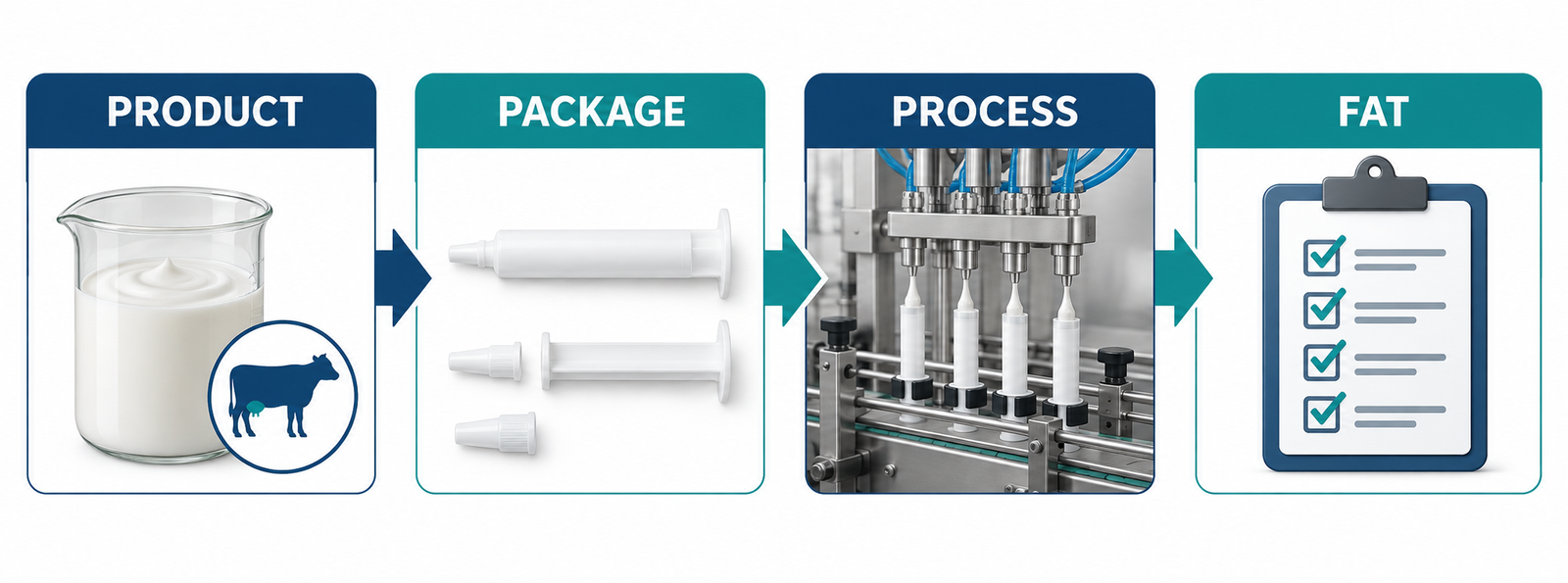
An intramammary filling line user requirements specification (URS) should describe the product, package, process, quality checks, utilities, documentation and acceptance evidence in one controlled document. A short request such as “automatic intramammary syringe filler, 10 ml, high accuracy” does not give a supplier enough information to define a reliable line.
The factory acceptance test (FAT) then turns the URS into observable evidence. It should demonstrate the agreed operations with representative product and syringe components, or clearly identify where a substitute is being used. The purpose is not to create an impressive machine video. It is to confirm that the proposed configuration addresses the buyer’s actual production risks before shipment.

This checklist is written for veterinary intramammary applicators and related non-sterile filling projects. It does not replace sterile-process qualification, product validation or local regulatory review where those are required. For a broader equipment brief, see King Pack’s veterinary filling machine URS and RFQ guidance.
Quick answer: what belongs in the URS?
The URS should define:
- what product is filled;
- what syringe and closure components are handled;
- which process steps are inside the line boundary;
- what dose and inspection criteria apply;
- what capacity is required under stated assumptions;
- how cleaning and changeover are performed;
- what utilities and installation conditions are available;
- what documents, training and FAT evidence the supplier must provide.
The FAT should test the functions that matter to release and operation: filling, air control, cut-off, cap or plunger assembly, inspection, reject handling, changeover, cleaning access, alarms and recorded process settings.
1. Define the project boundary first
Start the URS with a one-page scope statement. Identify whether the project includes only filling or a complete line.
Possible boundaries include:
- Empty syringe feeding.
- Orientation and indexing.
- Product filling.
- Nozzle cut-off or withdrawal.
- Cap placement or pressing.
- Plunger or piston insertion.
- In-process weighing or inspection.
- Reject handling.
- Coding and labelling.
- Cartoning or other downstream packaging.
State which operations are included, excluded or supplied by another contractor. This avoids a common quotation problem where two suppliers use “complete line” to describe different scopes.
The scope page should also identify the owner of each interface. If a filler discharges into a labelling machine, who supplies the transfer conveyor and who verifies the hand-off? If a cap is supplied in bulk, who confirms the cap feeder’s orientation rate? If a checkweigher rejects a unit, where does the rejected unit go and how is it reconciled? These questions belong in the URS because they affect line acceptance even when the main filler itself performs correctly.
2. Product requirements section
The product section should be specific enough for engineering review without pretending that one number describes the whole process.
| URS field | Information to provide |
|---|---|
| Dosage form | liquid, suspension, cream, ointment, gel, paste or sealant |
| Target dose | nominal quantity and approved tolerance |
| Measurement basis | mass, volume, delivered dose or other method |
| Temperature | filling range and allowable conditioning |
| Viscosity | measured data or practical flow description |
| Density | required when converting mass and volume |
| Settling | whether agitation or recirculation is needed |
| Air sensitivity | bubble, void, foam or headspace restrictions |
| Cleaning | agents, temperature and residue concerns |
| Contact materials | approved and prohibited materials |
If the formulation data are not final, mark them as provisional and identify the sample or engineering test required before design freeze. Conditional engineering guidance should not be turned into a fixed machine guarantee.
3. Package and component requirements
Attach drawings and sample photographs, but also state the real supply condition. A barrel supplied loose in a carton is different from one supplied in trays or nested carriers.
Include:
- barrel material and dimensions;
- tip and nozzle geometry;
- cap type, orientation and closure force;
- plunger or piston type and insertion position;
- component tolerances;
- packaging orientation and bulk presentation;
- acceptable cosmetic defects;
- label and code area;
- expected format range.
The URS should require the supplier to identify which component dimensions are critical to handling. For example, a small change in flange diameter or cap geometry may affect a fixture, gripper or pressing tool even when the nominal fill volume is unchanged.
4. Process sequence and filling direction
Write the intended sequence in plain language. A typical sequence may include feeding, orientation, filling, cut-off, cap placement, plunger insertion, inspection and discharge. The exact sequence depends on the applicator design.
The URS should ask the supplier to state whether the proposed route is front filling or rear filling and why. The project team can cross-check the changeover implications with the related veterinary filling-line changeover validation guidance. The URS should also describe:
- product entry point;
- component assembly order;
- venting or air-release method;
- nozzle withdrawal or cut-off;
- conditions for a stop and restart;
- startup-unit handling;
- manual interventions and recovery steps.
This makes the design review more useful than simply listing a model name.
5. Capacity and performance requirements
State the required output with assumptions. “Units per minute” is incomplete unless the document also states the number of heads, working hours, planned changeovers, cleaning events and expected inspection or reject conditions.
A practical capacity statement may include:
- target units per hour at steady state;
- number of shifts and working days;
- number of SKUs and formats;
- planned batch size;
- changeover frequency;
- startup and restart procedure;
- acceptable planned downtime;
- downstream equipment speed;
- whether the target is rated speed or saleable output.
Do not convert a catalogue maximum directly into a commercial production promise. The FAT should show the agreed performance under a defined test condition.
6. Quality and acceptance criteria
The URS should distinguish a machine function from a product-quality claim. For example, “the line records a weight” is a machine function. “Every unit meets a specific delivered-dose requirement” is a product and process acceptance claim that requires an approved method and sampling plan.
Define:
- fill measurement method;
- sample size and sampling points;
- startup, steady-state and restart samples;
- allowed variation;
- air or void criterion;
- cap or plunger position criterion;
- label or code verification;
- reject criteria;
- data recording and traceability.
If the product is opaque, visual bubble inspection may have limitations. The URS should identify what method is practical and who approves it.
Mid-article CTA
Need help converting a product specification into a machine URS? Send the formulation details, syringe drawings, complete component samples and target output to King Pack. We can help organize the required process modules and FAT evidence.
7. Cleaning, changeover and maintenance requirements
The URS should describe cleaning access rather than simply requesting “easy cleaning.” Include:
- product-contact parts and removal method;
- tools required;
- cleaning agent restrictions;
- inspection points;
- residue-prone areas;
- hose and nozzle handling;
- line-clearance record;
- format-part identification;
- lubrication boundaries;
- preventive-maintenance access;
- spare-parts and wear-part expectations.
For multiple products, specify whether the buyer expects dedicated parts, shared parts or a validated cleaning approach. Changeover time should be reported with the activities included. It should not hide cleaning, line clearance or first-off approval outside the stated time.
8. Utilities and installation preparation
The supplier should provide a utility schedule that separates confirmed requirements from final values subject to configuration.
Typical topics include:
- electrical supply and frequency;
- compressed-air quality, pressure and consumption;
- vacuum requirement if used;
- exhaust or ventilation needs;
- product heating or cooling connections;
- drainage and cleaning provisions;
- floor loading and access route;
- operator and maintenance clearances;
- upstream and downstream interface points;
- environmental conditions.
The buyer should verify local electrical standards, air quality expectations, room layout and installation access before shipment. A utility figure copied from a similar machine may be misleading if the number of heads, heating modules, inspection devices or downstream units changes.
Installation preparation should include an information hand-off, not only a utility table. Request the machine footprint, service clearances, lifting points, door or elevator dimensions, anchor requirements, cable and air entry points, drainage or wash-down restrictions and the expected sequence for mechanical, electrical and software commissioning. This allows the plant team to identify access problems before shipment inspection is complete and gives the supplier a clear list of site assumptions to verify during installation.
9. Documentation and training requirements
Include the documents required before shipment and at installation. Depending on the project, this may include:
- approved technical proposal;
- general arrangement drawing;
- utility list;
- electrical and pneumatic diagrams;
- component and contact-material list;
- operating manual;
- cleaning and maintenance instructions;
- spare-parts list;
- recommended change parts;
- FAT protocol and test record;
- deviation and punch-list record;
- installation and training plan.
Where IQ/OQ or other qualification support is required, define the supplier’s responsibility and the owner’s responsibility separately. Equipment documentation does not by itself qualify the product or the entire manufacturing process.
10. FAT checklist
Use the following structure as a starting point. Adapt the acceptance values and sampling plan to the approved project specification.
| FAT area | Evidence to record |
|---|---|
| Machine identity | model, serial number, software version and configuration |
| Safety | guards, interlocks, emergency stops and alarm response |
| Feeding | component presentation, orientation and indexing |
| Filling | dose method, setpoints, sample IDs and measurements |
| Product path | hopper, pump, hose, nozzle and cut-off behavior |
| Air control | priming, venting, visible air or void inspection |
| Cap handling | orientation, pressing, seating and reject condition |
| Plunger insertion | force, position, venting and package appearance |
| Inspection | presence, weight, code or visual checks |
| Rejects | trigger, physical separation and record of rejected units |
| Changeover | parts, recipe, cleaning access and first-off approval |
| Restart | performance after a planned stop and restart |
| Documentation | drawings, manuals, open items and responsibilities |
FAT results should include actual observations, not only a pass/fail signature. If the customer’s product is unavailable, record the substitute product, why it was used and which items remain to be confirmed later. The acceptance method should also remain consistent with the FAT protocol principles for pharmaceutical and veterinary filling lines.

11. Common URS mistakes
Mistake 1: specifying only the syringe volume
The same nominal volume can appear in different barrel, tip, cap and plunger designs. The component set controls handling and assembly.
Mistake 2: asking for a universal accuracy promise
Accuracy depends on product behavior, dose range, measurement method, temperature, refill stability and package tolerances. Define the test condition.
Mistake 3: mixing sterile and non-sterile requirements
Sterile injectable production and non-sterile veterinary applicator filling may require different environments, validation and package handling. Define the actual process category first.
Mistake 4: excluding cleaning from FAT
If cleaning access and change parts are not inspected before shipment, a later factory discovery can be expensive to correct.
Mistake 5: testing an empty machine only
An empty-machine demonstration cannot prove dosing, residue, air control or cap compatibility. Use product and package samples whenever possible.
What happens after FAT?
FAT is a decision point, not the end of the project record. After the agreed tests, classify every deviation as accepted, corrected before shipment, transferred to site commissioning or requiring a new product trial. The final FAT report should identify the tested configuration, software or recipe version, sample identity, measured results, photographs where useful and the person responsible for each open item.
Before shipment, confirm that the machine is restored to the agreed transport condition and that loose change parts, samples, manuals and spare parts are identified. Shipment inspection should check the packing list, visible machine condition, protected contact parts and the documents needed for installation preparation. At site, installation and commissioning should re-check utilities, component handling, safety functions and the first production-intent samples.
This sequence preserves the evidence chain from URS to FAT to installation. It also prevents a common misunderstanding: a successful factory demonstration does not automatically prove that the line will meet every production or validation requirement at the customer’s site. Site conditions, utilities, operators, cleaning procedures and approved product parameters still matter.
FAQ
What is a URS for an intramammary filling line?
A URS is the buyer’s controlled statement of product, package, process, capacity, quality, utilities, documentation and acceptance requirements.
What should a veterinary syringe FAT prove?
It should prove the agreed filling, assembly, inspection, reject, safety, restart, cleaning-access and documentation functions under defined test conditions.
Do I need complete syringe samples for a quotation?
Complete samples are strongly recommended. Drawings are useful, but physical samples reveal feeding, gripping, closure and insertion behavior.
Can FAT replace validation?
No. FAT verifies equipment functions at the supplier’s site. Product, process, cleaning, installation and operational qualification responsibilities must be defined separately.
Should capacity be specified as units per minute?
Use units per minute together with test conditions, changeover assumptions, working hours, reject handling and downstream constraints.
Conclusion
A useful intramammary filling-line URS gives the supplier enough information to configure the product path and package path, while a useful FAT shows whether that configuration behaves as agreed. The strongest documents connect each requirement to a test method, sample, acceptance rule and responsible party.
Final CTA
Send your URS draft, product data, syringe drawings and complete package samples to King Pack. We can review the scope, identify missing acceptance criteria and prepare a practical sample-testing and FAT checklist for your intramammary filling project.