
Choosing an intramammary syringe filling machine starts with the formulation and the complete applicator set, not with a catalogue speed. The product may be a cream, suspension, ointment or teat-sealant formulation. The syringe may arrive as an empty barrel, a partially assembled applicator or a package with a fixed tip and cap. Those details determine the filling direction, dosing method, air-control strategy, cap handling and inspection points.
For a reliable purchase decision, freeze five inputs before comparing suppliers: product behavior, target dose, syringe geometry, component presentation and acceptance criteria. A supplier can then evaluate the actual product and package through sample testing and define what the line should prove during factory acceptance testing (FAT).

This guide is for manufacturers, contract fillers, engineers and procurement teams evaluating equipment for veterinary intramammary products. It covers non-sterile applicator filling unless the project specification separately defines a qualified sterile process. A veterinary applicator should not automatically be treated as the same equipment category as a sterile pharmaceutical prefilled syringe. For broader equipment context, see King Pack’s veterinary syringe applicator filling solutions.
Quick answer: what should the machine be selected around?
Select the machine around the interaction between the formulation, the applicator and the acceptance test. At minimum, review:
- Product viscosity, temperature range, density, settling and air sensitivity.
- Syringe barrel, tip, cap, plunger or piston, dimensions and tolerances.
- Front-filling or rear-filling route.
- Dose definition: mass, volume, delivered dose or another approved attribute.
- Required operations: filling, cut-off, cap placement, plunger insertion, inspection, labelling and packing.
- Cleaning, changeover, documentation and FAT requirements.
The right machine is the one that demonstrates repeatable behavior with the customer’s product and package. A nominal speed or a generic syringe size is not enough evidence.
1. Define the intramammary product before selecting the filler
Product behavior affects every wetted and moving component. A low-viscosity suspension may need stable agitation and controlled transfer to limit settling. A cream or ointment may need a jacketed hopper, a positive-displacement dosing system and a nozzle cut-off that limits stringing. A teat sealant may be highly resistant to flow and sensitive to trapped air.
Prepare a product sheet with:
- formulation name and dosage form;
- target fill quantity and allowable variation;
- viscosity or a practical flow description at the actual filling temperature;
- density if the process uses gravimetric verification for a volumetric claim;
- suspended solids, particles or abrasive ingredients;
- temperature limits and whether heating or agitation is allowed;
- foam, stringing, settling and air-retention behavior;
- cleaning agent restrictions and contact-material requirements.
Do not use a generic “veterinary liquid” or “high-viscosity paste” label as the complete specification. Two products with the same nominal dosage form may require different feed, nozzle and cut-off settings.
2. Confirm the complete syringe and applicator configuration
The empty barrel is only one part of an intramammary package. Send the complete component set for review whenever possible:
| Component | What the supplier should verify |
|---|---|
| Barrel | diameter, length, wall flexibility, flange and orientation features |
| Tip or nozzle end | opening, tip geometry, insertion route and closure interface |
| Cap | feeding direction, pressing force, seating depth and contamination risk |
| Plunger or piston | presence, location, insertion force and venting sequence |
| Labels or coding area | orientation, readable surface and downstream clearance |
| Bulk presentation | trays, bags, cartons, nests or manual loading condition |
Drawings help, but they do not replace physical samples. Flexible plastic components can behave differently from their dimensional drawing during indexing, gripping and cap placement. A sample run can reveal deformation, misalignment, friction and product residue that are difficult to predict from a PDF.
Before comparing quotations, ask each supplier to return a short configuration summary. It should state the proposed filling route, dosing principle, product-contact materials, component presentation, number of filling heads, assembly steps, inspection points and open assumptions. This makes it easier to compare two quotations with different machine names. It also exposes whether a supplier has priced only a filling station while the buyer expects cap placement, plunger insertion, inspection and discharge to be included.
3. Decide whether the process is front filling or rear filling
Front filling introduces the product through the nozzle end before the remaining components are assembled. It can fit applicators whose component sequence and tip geometry are designed for that route. Rear filling introduces product through the open barrel end and is often associated with controlled venting and plunger insertion.
The correct route depends on where the package is open, how the components are supplied, whether the tip is already closed, the formulation’s viscosity and the required air condition. Neither route is universally better. For a related product-engineering view, review the guidance on intramammary syringe viscosity and air control.
Ask the supplier to document:
- the product entry point;
- when the cap is installed;
- when the plunger or piston is inserted;
- how trapped air is reduced or detected;
- how the applicator is supported during filling;
- what happens after a planned stop and restart.
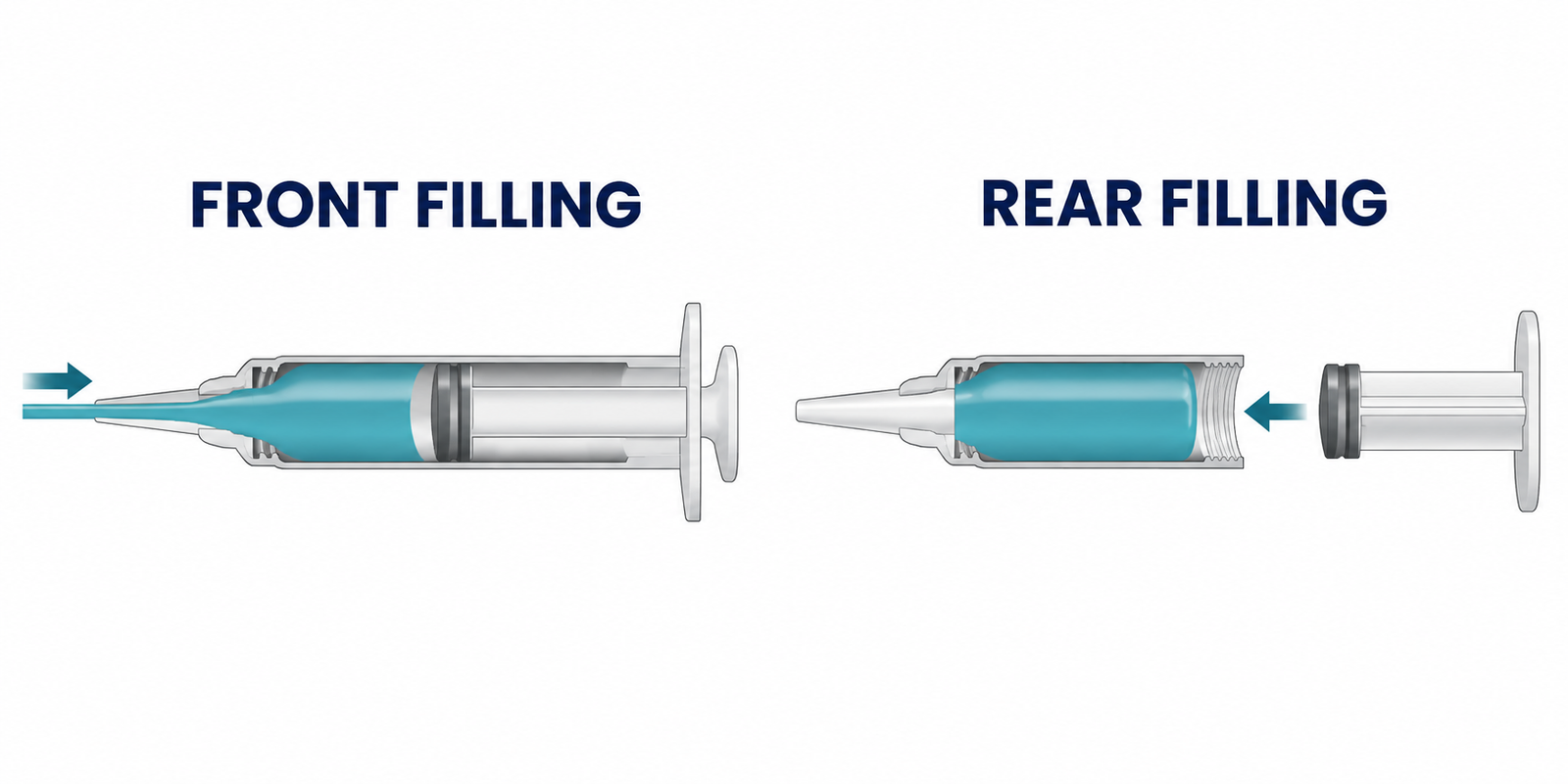
For a new intramammary package, include both route options in the sample-test discussion if the component design permits them. The result should be based on filled samples and the agreed inspection method, not on a default machine layout.
4. Match the dosing system to the product and dose definition
Dosing can be described as volumetric, gravimetric or another process-specific method. The important question is not which label sounds most precise. It is how the system behaves across the target dose range and operating conditions.
Review:
- piston or servo movement;
- number of filling heads;
- nozzle internal diameter and length;
- product-contact dead volume;
- refill behavior and hopper level;
- temperature changes during a batch;
- startup, stop and restart units;
- sampling frequency and measurement method.
If the finished requirement is net mass, define tare handling and weighing conditions. If the requirement is delivered dose, define how the filled unit will be dispensed and measured. A fill-weight check alone may not answer a delivered-dose question.
Avoid adopting a universal ±1% statement without the product, dose, package and test method. The acceptance criterion should be approved for the specific project and then challenged during sample testing and FAT.
Mid-article CTA
Planning an intramammary syringe project? Send the formulation details, complete syringe samples, target dose and production target to King Pack. Our engineering team can review the filling route and prepare a sample-test scope before a quotation is finalized.
5. Control air, stringing and nozzle residue
Air control begins before the dosing head. Air may enter during mixing, transfer, hopper refill, hose connection, pump priming or an unstable return path. A thick formulation can retain bubbles long enough to affect appearance, mass, plunger position or delivered use.
The equipment review should ask:
- Is upstream vacuum deaeration appropriate for the formulation?
- How is the product path primed?
- Can the hopper refill create a vortex or foam?
- Is the nozzle designed for clean cut-off?
- Does nozzle withdrawal create a tail or string?
- How are first-off units handled after a stop?
- What visual or gravimetric check is used for air-related defects?
Nozzle residue can contaminate a closure interface or create an inconsistent visible finish. The practical solution may involve nozzle geometry, cut-off timing, withdrawal motion, product temperature or a combination of these. The correct setting should be established with the real formulation.
6. Specify cap placement and assembly as part of filling
An intramammary line is not complete when the product enters the barrel. Cap seating, plunger or piston handling and component presence can affect package integrity and usability.
For cap placement, define:
- cap orientation and bulk presentation;
- cap insertion or pressing force;
- seating depth or position check;
- acceptable cosmetic condition;
- product contamination at the closure interface;
- reject handling for missing or partly seated caps.
If a plunger is inserted after filling, include venting, insertion force, final position and trapped-air inspection in the FAT. If the line only fills and caps, state clearly which assembly operations remain manual or downstream.
7. Plan inspection and rejection logic
Inspection should follow the actual quality risks. A practical inspection plan may include:
| Risk | Possible check |
|---|---|
| wrong or missing component | presence sensor or visual inspection |
| fill variation | periodic weighing or another approved measurement |
| trapped air or visible void | defined visual method or validated inspection method |
| nozzle residue | visual check at the tip and closure interface |
| cap not seated | position, force or visual inspection |
| damaged barrel | appearance and dimensional check |
| wrong label or code | code verification and line-clearance control |
The inspection method must be defined before FAT. Otherwise, the parties may disagree after the run about whether a sample passes. The FAT protocol should state the sample size, production condition, measurement device, acceptance rule and disposition of nonconforming units.
8. Evaluate changeover and cleaning before buying multi-SKU equipment
If the line will run more than one intramammary product or syringe format, include changeover in the original specification. Review product-contact parts, nozzles, guides, fixtures, cap tooling, recipes and inspection settings.
The supplier should explain:
- which parts are dedicated and which are shared;
- how parts are identified and stored;
- how residual product is removed;
- how line clearance is recorded;
- how the first-off units are approved;
- which settings are recipe-controlled;
- which changeover activities remain manual.
Do not treat a short theoretical changeover time as a guaranteed production result. The time depends on the number of parts, cleaning method, product residue, operator practice and required verification.
9. Use FAT to compare suppliers on evidence
A useful FAT is a controlled product-and-package test. It should cover more than an empty-machine demonstration.
Request evidence for:
- Filling with the agreed formulation or a documented substitute.
- The target package and approved component set.
- Startup and steady-state samples.
- A planned stop and restart.
- Fill-quantity measurement using the agreed method.
- Cap, plunger and component presence checks.
- Changeover or a representative change-part demonstration.
- Cleaning access and product-contact-part removal.
- Recorded settings, sample IDs and deviations.
- Open items, responsibilities and corrective actions.

King Pack’s confirmed support scope includes custom configuration, sample testing, FAT, documentation, training and after-sales support. The final scope should be written into the technical proposal and acceptance documents. A useful related reference is the filling-line FAT acceptance protocol.
Buyer checklist
Before requesting a quotation, prepare:
- product description and representative sample;
- target dose and test method;
- syringe, cap and plunger samples;
- component drawings and tolerances;
- bulk presentation and orientation requirements;
- target output and working schedule;
- cleaning and changeover expectations;
- inspection and reject requirements;
- site utilities and available floor space;
- documentation, training and FAT requirements.
How to compare two supplier quotations fairly
Put both proposals into the same comparison sheet. Record whether each supplier has included product trials, filling heads, hopper conditioning, nozzles, fixtures, cap or plunger handling, inspection, reject collection, change parts, commissioning, training, spare parts and documentation. Mark each item as included, optional, excluded or subject to sample confirmation.
Then compare the assumptions behind the output. A quoted maximum may assume one format, stable product temperature, continuous feeding and no changeover. Another supplier may quote a lower figure based on a more conservative test condition. The numbers are not comparable until the test basis is aligned. Ask both suppliers to describe startup handling, planned stops, cleaning, format changes and downstream constraints.
Also separate capital scope from lifecycle scope. A lower initial quotation may exclude format parts, product-contact spares, installation preparation or FAT support. Those exclusions do not necessarily make the supplier unsuitable, but they should be visible before a purchase decision. A simple responsibility matrix can show who supplies samples, who approves the acceptance method, who records deviations and who closes open items before shipment.
FAQ
What is the best intramammary syringe filling machine?
There is no universal best machine. The suitable configuration depends on the product, dose, syringe geometry, filling direction, component sequence, inspection method and output target.
Can one machine fill different intramammary products?
It may be possible when the products, dose ranges, contact parts and changeover method are compatible. This must be confirmed through representative product and package trials.
Should intramammary syringes be filled from the front or rear?
The route depends on the package structure, component supply state and formulation. The decision should be proven with samples and a defined air and closure inspection method.
What should be tested during FAT?
Test dose repeatability, startup and restart behavior, air or void control, nozzle cleanliness, cap or plunger assembly, inspection, reject logic, cleaning access and documented settings.
Is a veterinary applicator the same as a sterile prefilled syringe?
No. A non-sterile veterinary applicator and a sterile prefilled injectable syringe have different process, environment and validation boundaries. The project specification must define which category applies.
Conclusion
Choose an intramammary syringe filling machine by connecting the product path, package path and acceptance path. Start with formulation behavior and complete component samples. Then decide the filling direction, dosing method, air-control approach, cap or plunger sequence, inspection plan, cleaning strategy and FAT evidence. This process produces a more useful quotation and reduces the risk of discovering package or product problems after installation.
Final CTA
Send your formulation details, intramammary syringe samples, target dose and production requirements to King Pack. We can review the filling route, identify the required modules and prepare a technical proposal with a practical sample-test and FAT plan.