 Skip to content
Last reviewed: September 9, 2026.
A veterinary filling machine URS should define the product, package, performance, cleaning, control and acceptance boundary before suppliers are asked to quote. The strongest document does not prescribe hardware too early. It states what the line must handle, what evidence the buyer expects and which assumptions still require sample testing. That structure lets engineering, quality and procurement compare proposals on the same basis.
This page is a practical RFQ asset, not another general buying guide. The existing KING PACK pet drop filling machine buying guide helps buyers understand an equipment category. This checklist instead turns one defined veterinary project into 25 reviewable requirements. Detailed chemical compatibility remains on the separate wetted-parts and gasket compatibility decision matrix, so the two pages serve different search intents.
Quick answer: Before issuing an RFQ, define 25 requirements across seven groups: product, package, dosing and output, cleaning and changeover, utilities and environment, automation and records, and lifecycle acceptance. Attach representative samples and a requirement-to-evidence matrix. Do not accept a catalogue speed or accuracy statement as proof; require the supplier to identify the test material, package, method, operating state and acceptance rule used to demonstrate each critical requirement.

1 Use a Requirement-to-Evidence URS Structure
Direct answer: Write each URS item as a required outcome, its operating boundary and the evidence that will confirm it.
A usable line item answers three questions: what must the system do, under which defined conditions, and how will the result be accepted? Avoid statements such as high accuracy, easy cleaning or advanced control. Replace them with the buyer's product range, package range, sampling method, cleaning boundary, record expectation and responsible test stage. Mark each item mandatory, preferred or informational so quotations do not hide exceptions.
Assign a unique requirement number and ask every supplier to respond comply, deviate or clarify. A deviation should explain the proposed alternative and its effect on operation, qualification, cost and schedule. This turns the URS into a traceable comparison rather than a collection of marketing descriptions.
EU GMP Annex 15 describes a lifecycle in which equipment, facilities, utilities and systems are defined in a user requirements specification and the URS remains a reference through validation. Applicability depends on the product and market, but the discipline is useful for veterinary projects in any jurisdiction.
| URS field | What the buyer writes | What the supplier returns |
|---|---|---|
| Requirement | Observable function or result | Compliance statement and design response |
| Operating boundary | Product, pack, range and environment | Assumptions, limits and required options |
| Acceptance | Method, sample plan and decision rule | Proposed FAT, SAT or qualification evidence |
| Priority | Mandatory, preferred or information | Deviation and commercial impact |
| Owner | Engineering, production, QA or IT | Document or action owner |
2 Requirements 1-5: Define the Product
Direct answer: Freeze the product inputs that can change filling, transfer, cleaning or contact-material decisions.
Requirement 1 — product identity and regulatory status. List each veterinary medicine, supplement or care product intended for the line, its dosage form and the markets or site quality system that govern the project. State whether products are potent, sensitizing, solvent-containing, biologically active or otherwise subject to special containment or cleaning controls. The equipment supplier should not infer regulatory status from a trade name.
Requirement 2 — rheology and physical behavior. Provide density where gravimetric checks require it, viscosity across the real operating-temperature range, thixotropy or yield behavior, suspended particles, foaming, air retention, stringing and separation risk. Requirement 3 — formulation sensitivities. Define known limits for shear, temperature, oxygen, light, pressure or prolonged recirculation, supported by development data rather than a universal machine setting.
Requirement 4 — batch and hold conditions. Give minimum, normal and maximum batch size; bulk-vessel outlet condition; transfer distance; permitted bulk, hopper and line hold; and planned pauses. Requirement 5 — product-contact restrictions. State approved or prohibited metals, polymers, elastomers, lubricants and cleaning agents. Use the detailed compatibility page for the test matrix, while keeping the approved contact list controlled in the project URS.
- 1. Product identity, dosage form, intended use and regulatory/site quality context
- 2. Density, viscosity versus temperature, rheology, particles, foam and air behavior
- 3. Sensitivity to shear, heat, oxygen, light, pressure and recirculation
- 4. Batch range, transfer condition, maximum hold and planned stop profile
- 5. Approved and prohibited product-contact materials and cleaning exposures
3 Requirements 6-10: Define the Package and Line Boundary
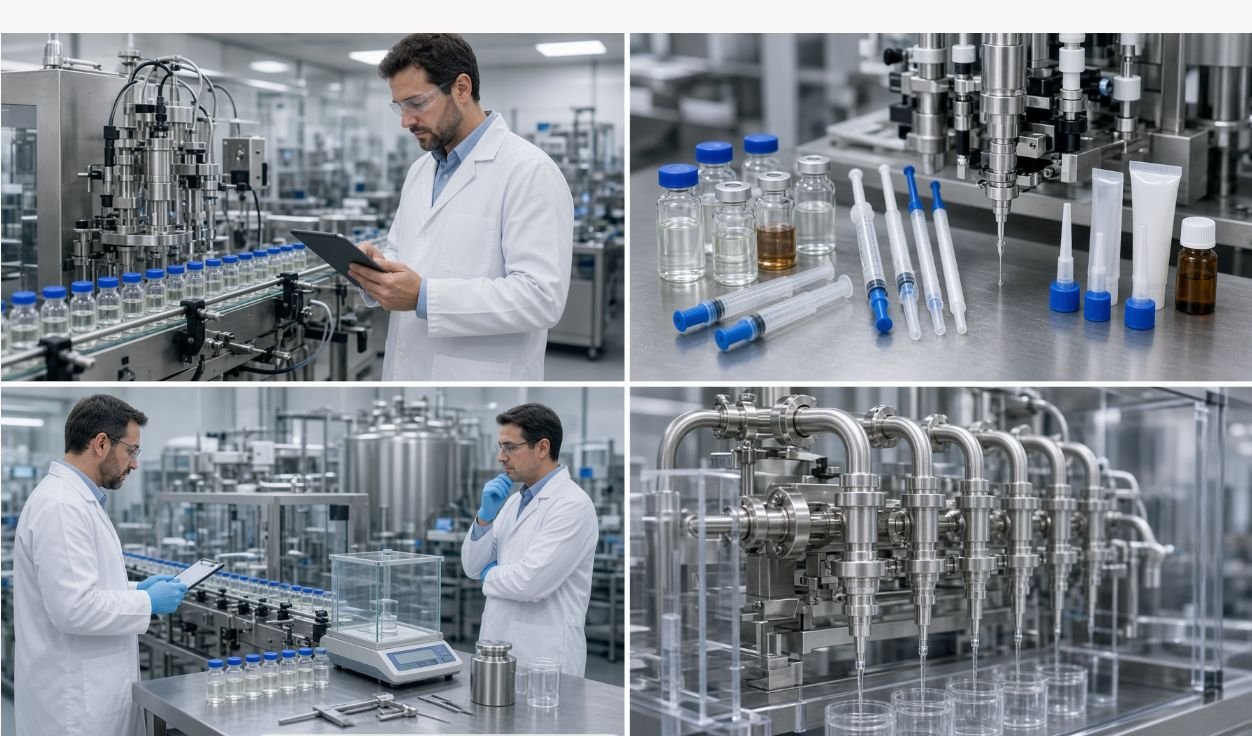
Direct answer: Supply controlled component information; nominal container volume alone is not enough to engineer handling and closure operations.
Requirement 6 — primary-container specification. Attach revision-controlled drawings, critical dimensions, tolerances, materials, supplier details and samples for bottles, vials, tubes, spot-on pipettes, oral syringes or veterinary applicators. Requirement 7 — closure and accessory specification. Include caps, plugs, pumps, tips, pistons, plungers, seals or overcaps, together with orientation and seating requirements.
Requirement 8 — format range and change parts. State every current size, the likely future envelope and which parts may be dedicated. Do not ask for universal flexibility without showing the dimensional range. Requirement 9 — component quality and feeding. Define incoming presentation, allowable defect range, cleanliness state, accumulation limits and whether components arrive in bags, trays, bulk cartons or controlled nests.
Requirement 10 — line boundary and interfaces. Mark where the supplier's responsibility starts and ends: bulk connection, container infeed, coding, inspection, labeling, cartoning, utilities, data and reject transfer. Identify signals exchanged with upstream and downstream equipment. A clear boundary prevents duplicate equipment, missing conveyors and disputed performance during SAT.
- 6. Controlled primary-container drawings, tolerances, materials and representative samples
- 7. Closure and accessory specifications, orientation and functional acceptance
- 8. Current and future format envelope, change parts and dedicated tooling
- 9. Component presentation, feeding quality, accumulation and cleanliness state
- 10. Mechanical, electrical, product, data and responsibility interfaces
4 Requirements 11-14: Define Fill Performance and Output
Direct answer: Performance is meaningful only when the product, package, method and operating condition are stated together.
Requirement 11 — fill range and setpoints. Give minimum, normal and maximum target quantity for each format, plus the measurement basis: mass, volume, delivered or expelled dose, or an approved assay. Requirement 12 — accuracy and precision acceptance. Define how samples are tared, conditioned, weighed or tested; sample count; calculation; limits; and treatment of startup, rejects and adjustments. The supplier should state which elements are machine capability and which depend on product or package behavior.
Requirement 13 — output basis. State the required sustained good-unit rate by format, not only an instantaneous mechanical speed. Include feed condition, operator assumptions, inspection, planned sampling, changeover and the permitted reject logic. If OEE is a project goal, define the observation period and exclusions instead of turning it into an unsupported supplier guarantee.
Requirement 14 — yield, rejects and reconciliation. Define acceptable startup loss, product recovery expectation, reject categories, reject verification and the records needed to reconcile components and filled units. Valuable veterinary products may justify special end-of-batch recovery, but recovery must not create an uncontrolled contamination or dosing step.
| Performance item | Define before RFQ | Evidence to request |
|---|---|---|
| Fill result | Range, setpoints and mass/volume/delivered-dose basis | Traceable samples by format and operating state |
| Accuracy | Method, sample count, calculations and limits | Raw results, summary and deviations |
| Output | Sustained good units under named conditions | Timed run with stops and rejects recorded |
| Yield | Startup, residual, recovery and reject treatment | Material balance or agreed proxy |
| Rejects | Defect classes, detection and disposition | Challenge record and reconciliation |
5 Requirements 15-18: Define Cleaning and Changeover
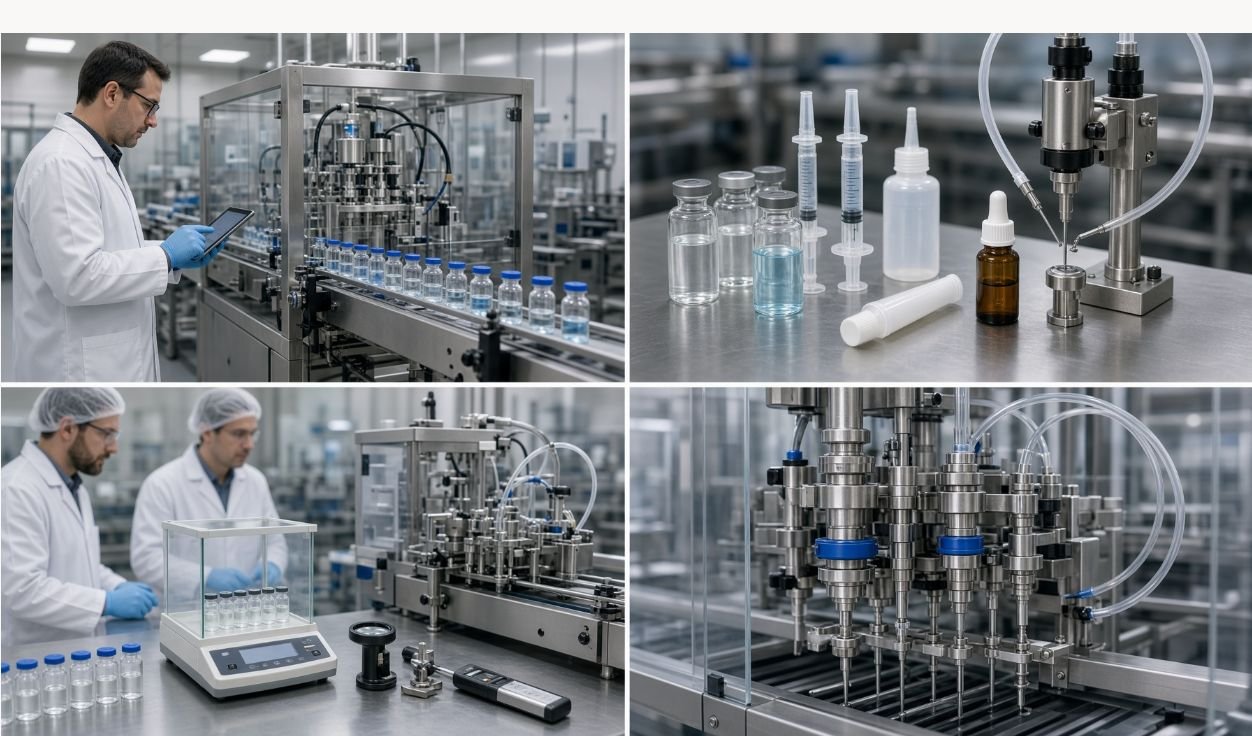
Direct answer: Specify the product-contact boundary and the proof of restored, controlled condition after cleaning or format change.
Requirement 15 — cleaning method and boundary. Identify parts cleaned in place, out of place, manually or as single use. State permitted agents, temperatures, sequence, rinse source, drainage, inspection and sampling expectations. 21 CFR 211.67 provides current U.S. drug-manufacturing context for written cleaning and maintenance procedures where applicable; the manufacturer must determine the actual requirement for its veterinary product and market.
Requirement 16 — materials, surface condition and certificates. Define required product-contact materials, surface finish where justified, elastomer identification, weld or passivation documentation and material certificates. Keep detailed formulation compatibility work in its own controlled assessment. Requirement 17 — drainability, hold-up and access. Ask for the product-path drawing, low points, removable residual, sampling points and access to valves, manifolds and nozzles.
Requirement 18 — changeover and line clearance. List format and product change scenarios; parts, tools and adjustment points; cleaning verification; recipe control; part identification; and expected staffing. A short advertised changeover time has little value unless the starting and finishing conditions are defined and the activity is demonstrated by the intended operators.
- 15. Cleaning boundary, method, agents, inspection, sampling and clean-hold expectations
- 16. Product-contact materials, elastomers, surface requirements and certificates
- 17. Drainability, hold-up, product recovery, sampling and maintenance access
- 18. Product and format changeover, line clearance, tools, parts and recipe restoration
6 Requirement 19: Utilities and Operating Environment
Direct answer: Declare available utilities and the intended room conditions before the vendor fixes the machine design.
Requirement 19 should cover electrical supply, compressed-air quality and pressure, vacuum, water, steam, chilled or hot-water services, exhaust, drainage, network connection and room constraints. Add ambient temperature and humidity range, cleaning exposure, floor loading, access route, noise target if required and the intended hazardous-area or containment assessment.
State which utilities are generated by the machine and which are supplied by the site. For each critical utility, identify normal range, permitted fluctuation, connection point and monitoring or alarm expectation. Confirm whether upstream product temperature control depends on a jacketed hopper, traced hose or site-supplied loop.
Room classification, aseptic status and containment cannot be assumed from the term pharmaceutical. They are product- and process-specific decisions owned by the manufacturer. The RFQ should state the approved environmental concept and ask the supplier to identify any open assumptions.
- 19. Site utilities, room conditions, access, drainage, networking, containment and environmental assumptions
7 Requirements 20-22: Define Controls, Data and Traceability
Direct answer: Specify what the control system must protect, record and make reviewable instead of naming a fashionable platform alone.
Requirement 20 — recipes, access and operating states. Define user roles, authentication, recipe creation and approval, parameter limits, manual mode, maintenance access, language, backup and restore. State how startup, pause, restart, product recovery and end-of-batch states are controlled. If electronic signatures or records are required, define the applicable site and market expectation for assessment.
Requirement 21 — alarms, interlocks and production records. Request an alarm and interlock matrix with cause, machine response, reset authority and record behavior. Define counters, rejects, batch identifiers, process values, changes, audit-trail expectations and report format. Do not ask for data integrity as a slogan; identify the records and decisions that must be reconstructable.
Requirement 22 — identification, calibration and traceability. List instruments requiring calibration, requested ranges and accuracy, calibration access, certificate expectations and status labeling. Require traceable identification for critical sensors, dosing assemblies, format parts and software versions so changes can be assessed throughout the lifecycle.
- 20. User roles, recipes, parameter limits, operating states, backup and restore
- 21. Alarms, interlocks, counters, rejects, batch records and audit-trail expectations
- 22. Instrument calibration, critical-part identification and hardware/software traceability
8 Requirements 23-25: Define Documents and Acceptance
Direct answer: The RFQ is complete only when the required evidence, test ownership and sample conditions are explicit.
Requirement 23 — documentation deliverables. List the language, format and approval stage for layouts, product-path drawings, materials lists, manuals, electrical and pneumatic drawings, I/O list, alarm matrix, software and recipe description, spare-parts list, maintenance schedule, calibration information, certificates and training material. Tie final payment or acceptance milestones to an agreed document register where commercially appropriate.
Requirement 24 — FAT, SAT and qualification support. Annex 15 distinguishes design, FAT/SAT and IQ/OQ/PQ activities within a risk-based lifecycle. Define what is tested at the supplier, repeated at site, documented by the vendor and executed or approved by the manufacturer. FAT cannot replace site qualification or product process validation; it should retire defined equipment and interface risks before shipment.
Requirement 25 — representative samples and acceptance matrix. Specify product or justified surrogate, component lots, quantity, temperature, format extremes, operating duration, planned stops, low-feed condition, challenge defects, sample method, raw-data format, deviations and open-action closure. Ask the supplier to confirm sample deadlines and storage or disposal responsibilities before the quotation schedule is accepted.
- 23. Controlled document register, review language, format and delivery milestones
- 24. FAT, SAT, installation, IQ/OQ support, training and responsibility split
- 25. Product and package samples, test conditions, acceptance matrix and deviation closure
9 The 25-Requirement RFQ Gate
Direct answer: Do not release the RFQ until every requirement is defined, deliberately marked not applicable or assigned to a named open action.
Engineering should confirm the product and machine boundary, production should confirm the real operating states, quality should approve acceptance methods and documentation needs, IT or automation should review data interfaces, and procurement should preserve the same response format for every supplier. A cross-functional gate prevents one department from buying speed while another later discovers a cleaning, record or package constraint.
Attach a requirements response sheet. The supplier should reference drawing numbers, option descriptions or test clauses rather than responding yes to a complete section. Ask for a list of exclusions, buyer-supplied items, long-lead samples and unresolved development work. Price comparisons are meaningful only after these exceptions are visible.
If product or package development is incomplete, issue a staged request: concept study or sample trial first, then the controlled equipment RFQ. That approach is more transparent than embedding unknown performance in a fixed-price machine promise.
| Gate review | Owner | Release question |
|---|---|---|
| Product and process | Development / production | Are ranges, sensitivities and operating states defined? |
| Package | Packaging engineering | Are drawings, tolerances, closures and samples controlled? |
| Quality evidence | QA / validation | Are methods, records and responsibilities approved? |
| Controls and data | Automation / IT | Are access, records, interfaces and backup defined? |
| Commercial comparison | Procurement | Must every supplier answer the same numbered matrix? |
10 Convert Critical Requirements into FAT Tests

Direct answer: Every critical URS claim should point to a document review, inspection, measurement or challenge test.
Build traceability before FAT. A product-path requirement may be verified by approved drawings, material certificates and inspection. A dose requirement needs representative product, containers, a controlled method and raw results. A reject requirement needs deliberately introduced defects. A stop-and-restart requirement needs a defined pause followed by assessment of drips, air, dose and recovery units.
Use normal, minimum and maximum conditions where they materially affect risk, but do not create an unrealistic test burden. The test matrix should explain the chosen worst case and what remains for SAT or PQ. Record actual product temperature, format, settings, sample identifiers, alarms and deviations so the result is reproducible.
Close open actions through objective evidence. A photograph may close a label issue; it may not close an unresolved dose test. Track each action to an owner, due date and acceptance record before shipment or explicitly transfer it to SAT through change control.
11 Compare Suppliers on Evidence, Not Feature Counts
Direct answer: Prefer the supplier that exposes assumptions and proposes a credible verification path over the one that simply checks every box.
Review the proposed dosing principle, product path, cleaning split, format handling, control architecture, inspection limits and test method. Ask why each choice fits the supplied product and package. A capable supplier should identify when representative material is needed and where a catalogue result cannot predict the final process.
Compare deviations in a common matrix. Separate base scope, required options, buyer-supplied items, qualification documents, sample trials, installation, training, spares and after-sales support. Confirm how design changes are approved and how drawings or software revisions are controlled.
KING PACK provides veterinary and pharmaceutical filling solutions including pet drops filling equipment, liquid and high-viscosity fillers, tube filling and sealing, syringe filling and related preparation systems. The selected configuration still depends on project inputs and sample evidence rather than a brand-level claim.
12 Send a Complete Project Package to KING PACK
Direct answer: A complete URS and representative samples allow the technical discussion to move from generic equipment to a testable proposal.
KING PACK Machinery is a China-based manufacturer of pharmaceutical, veterinary, cosmetic and liquid filling and packaging equipment. Its core equipment families include pet spot-on filling and sealing, liquid and high-viscosity filling, tube filling and sealing, syringe filling and vacuum emulsifying systems. This entity description links the veterinary application to the equipment scope without claiming that one standard machine suits every product.
For the initial review, provide the numbered URS, formulation behavior, dose and output range, container and closure drawings, tolerance samples, batch and hold profile, cleaning concept, available utilities, line layout, control and documentation expectations, and proposed FAT methods. Identify confidential or shipment restrictions early.
Send the completed package through the KING PACK contact page. KING PACK can then identify open tests, prepare a technical response and propose a sample-based FAT scope. The product owner retains responsibility for regulatory strategy, approved specifications, qualification and release decisions.
Frequently Asked Questions
What is a veterinary filling machine URS?
It is the buyer-controlled specification that defines required product, package, performance, cleaning, control, documentation and acceptance outcomes for the equipment project.
Should the URS name a pump type?
Only when development evidence or a site standard justifies it. Otherwise define the product behavior, dose range, cleaning needs and acceptance method and require the supplier to explain its dosing choice.
How should fill accuracy be written?
State the product and temperature, target range, package, measurement basis, sample count, calculation, limits and operating conditions. Do not use a catalogue percentage without a test method.
What package information belongs in the RFQ?
Provide controlled drawings, critical tolerances, materials, closures, component presentation, orientation, defect assumptions and representative lots for every intended format.
How many products should be tested at FAT?
Use a documented risk assessment to select representative or worst-case products and formats. The URS should state what each test represents and what remains for site qualification.
Does FAT replace SAT or qualification?
No. FAT confirms agreed supplier-site evidence before shipment. SAT checks the installed system and site interfaces; qualification and product validation remain within the manufacturer's lifecycle.
How should suppliers respond to the URS?
Require a line-by-line comply, deviate or clarify response with references to drawings, options and test clauses, plus a consolidated assumptions and exclusions list.
What should be sent to KING PACK for a useful proposal?
Send the 25-point URS, product and rheology data, dose and batch ranges, package drawings and samples, cleaning concept, utilities, layout, document needs and proposed acceptance methods.
