

Last reviewed: September 7, 2026.
An intrauterine infusion syringe filling line should be designed from the formulation's contact-material risks, dose behavior and stringing tendency, then matched to the applicator and closure geometry. The critical interfaces are the product path, the dosing and nozzle shutoff sequence, repeatable presentation of the syringe, closure placement and the cleaning method. Each interface needs an acceptance method before equipment purchase.
This guide is a technical child of the KING PACK veterinary syringe and applicator solutions overview. It owns a narrow intrauterine infusion application and does not compete with broad veterinary syringe automation, oral-paste syringe selection or sterile injectable prefilled syringe content. Sterility, environmental classification and market compliance must be defined by the product manufacturer.
Quick answer: Specify the line by linking formulation compatibility, viscosity and air behavior, target dose, applicator and closure tolerances, cleaning limits and required records. Verify product-contact materials, dose repeatability, nozzle shutoff, syringe positioning, closure seating and reject logic with representative materials during FAT, then complete site qualification under the manufacturer's quality system.
1 Set the Application Boundary Before Requesting a Quote
Direct answer: Define the intrauterine product, applicator and closure as a specific project rather than a generic syringe format.
Provide the dosage form, target and minimum or maximum dose, density where relevant, viscosity over the operating temperature range, suspension behavior, air sensitivity, stringing tendency, volatile or aggressive components, bulk hold and the state in which product arrives at the filler. State whether the process requires controlled agitation or recirculation during filling.
For the package, provide drawings and samples that show barrel, flange, dispensing tip, cap, piston or plunger components, allowable orientation and contact surfaces. Long or narrow dispensing geometries may require different support and cutoff decisions from an oral dosing syringe even when the barrel volume looks similar.
The quote should identify assumptions and unresolved tests. A supplier can propose the machine concept, but product development and quality teams must define the final dosage form, package compatibility, environmental control and market-specific acceptance requirements.
| Project input | Machine decision | Required confirmation |
|---|---|---|
| Formulation and contact risks | Wetted materials, seals and hose | Documented compatibility assessment |
| Viscosity and stringing | Pump, valve, nozzle and shutoff | Representative product trial |
| Dose and package retention | Dosing range and verification method | Approved gravimetric or assay method |
| Applicator tolerances | Holders, guides and station alignment | Samples across dimensional range |
| Closure design | Feeding, placement and inspection | Seating or functional acceptance test |
2 Evaluate Product Contact Material Compatibility
Direct answer: Compatibility is a documented product-system decision; stainless steel alone does not answer it.
List every wetted material in the transfer and filling path, including vessel outlet, hose, seals, pump chamber, valve seats, manifold, nozzle and any lubricant or cleaning-agent exposure. Review potential corrosion, swelling, adsorption, extraction, leaching, discoloration and loss of seal function under expected concentration, temperature, time and cleaning conditions.
EMA veterinary development guidance calls for consideration of sorption and leaching from container and administration components. The same risk-based thinking is useful when assessing the equipment path, but the product owner should perform the appropriate compatibility studies and set limits. A vendor material certificate does not prove formulation compatibility.
Create an approved wetted-parts list and control changes to it. If an alternate gasket or hose is offered, assess it before installation. Small material substitutions can change product recovery, cleaning or extractables risk even when the part fits mechanically.
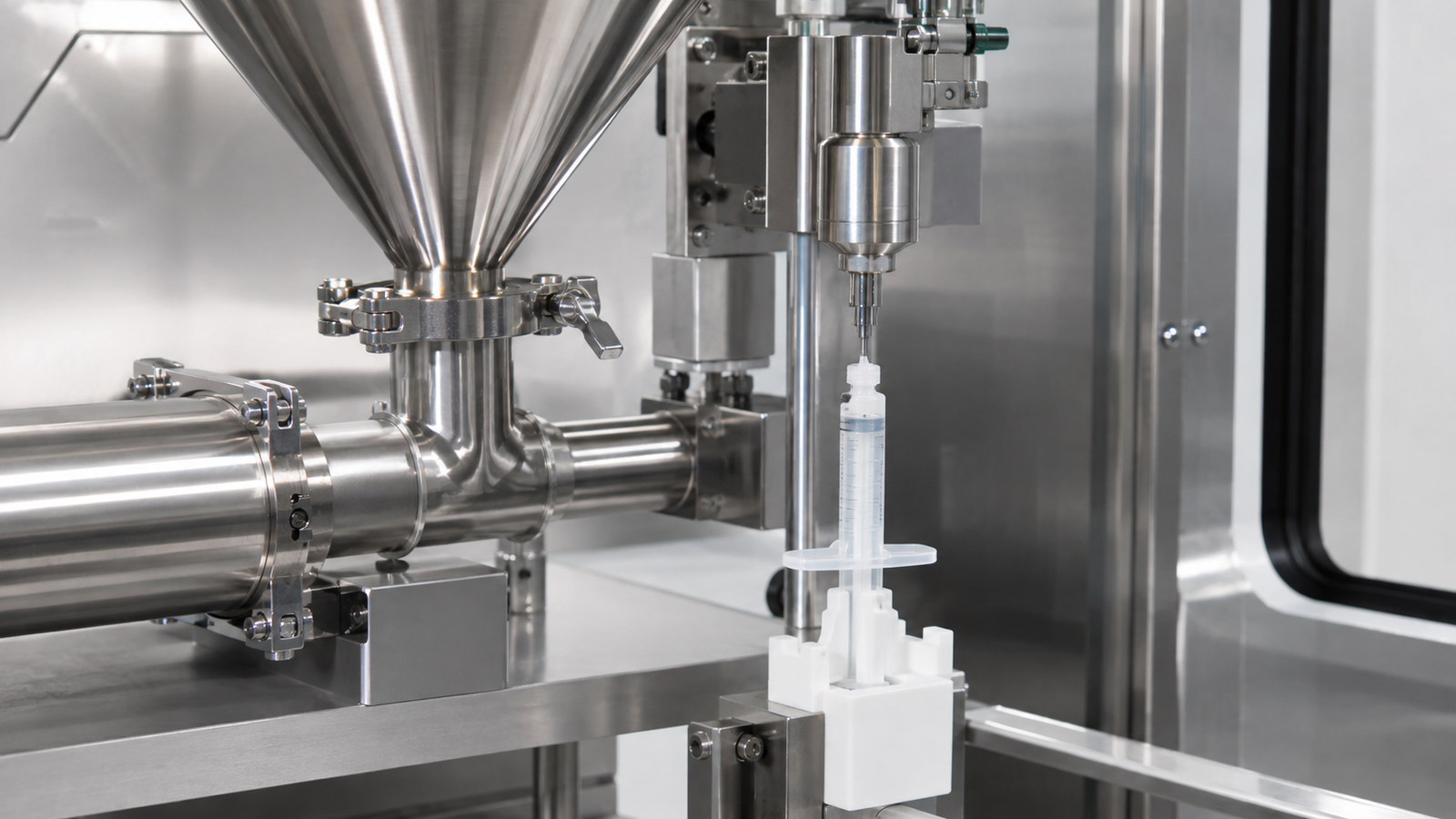
3 Keep the Bulk Product Uniform During Filling
Direct answer: The filler needs a representative feed throughout the batch, including after holds and refills.
Determine whether the infusion is a solution, suspension, emulsion or gel and what maintains uniformity. Define the maximum allowed bulk and hopper hold, mixing purpose, speed range and restart method. A suspension may require controlled motion, while an air-sensitive gel may be harmed by vigorous agitation.
Map transfer distance, pump, hose diameter, valves, level control and return path. Avoid an uncontrolled recirculation loop used only to compensate for unstable feed. If recirculation is necessary, define duration, flow and temperature monitoring and include the condition in representative product studies.
Sample the bulk, hopper and filled units as required by the approved plan. Tie results to time and operating state so production can distinguish formulation drift from dosing-machine variation.
4 Select the Dosing System from Product Behavior
Direct answer: Use sample data to choose the dosing chamber, valve action and operating range rather than relying on a generic viscosity label.
Review dose range, batch size, product value, cleaning method, acceptable residual volume, particulates, shear sensitivity and pressure. The dosing system should fill the requested range without using an unstable extreme of its adjustment. Ask how settings scale across formats and how calibration is controlled.
Define the feed condition for accuracy testing, including product temperature, hopper level, mixing state and startup sequence. Compare beginning, middle, low-level and restart samples. A mean result alone can hide drift or intermittent air pockets.
The KING PACK high-viscosity veterinary gel accuracy guide explains dose-control fundamentals. This intrauterine page remains distinct by centering material compatibility, long-tip package handling, shutoff and closure evidence.
5 Control Air Entrapment and Product Stringing
Direct answer: Air and stringing must be addressed through preparation, feed, nozzle and timing as one sequence.
Inspect upstream deaeration, transfer connections, hopper refill height, surface vortexing and priming. Thick products can retain air introduced much earlier in the process. A nozzle setting cannot remove bubbles already dispersed through the bulk.
For cutoff, evaluate valve closing speed, suck-back where appropriate, tip geometry, product temperature, nozzle travel and dwell above the applicator. Excess suck-back can pull air or cause variable refill; too little can leave a tail that touches the applicator rim or closure area.
Test after a defined stop because stationary product can relax, cool or thicken. Record stop duration, restart sequence, rejected units and time to return to the approved condition. This makes the operating procedure repeatable.
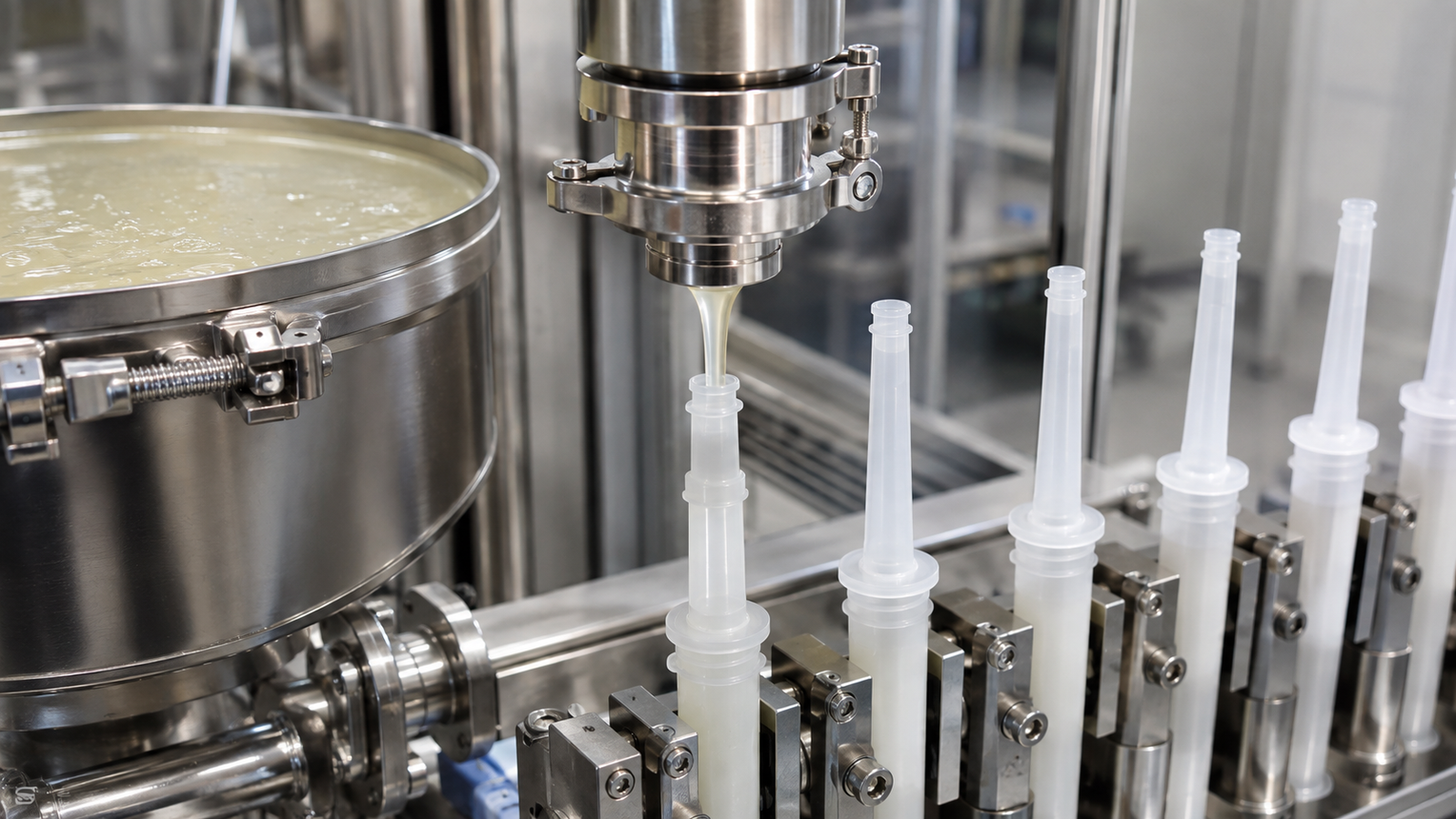
6 Support and Orient the Applicator at Every Station
Direct answer: The transport system should control the barrel and long dispensing geometry without bending, scuffing or misalignment.
Use dimensioned samples to design nests, pucks or holders. Check the flange and barrel support, centerline at the fill nozzle and cap station, and clearance around the applicator tip. A holder that is too tight may mark or deform plastic; one that is too loose can create variable insertion or cap seating.
If the syringe requires a fixed printed, molded or tip orientation, define the detection method and reject response. Test the lowest-contrast and highest-tolerance samples. Sensors must detect the real component condition, not only a laboratory reference part.
Review manual loading ergonomics and jam recovery. Operators should not need to touch product-contact or closure surfaces to restore the line. The approved procedure should identify what happens to components removed during recovery.
7 Develop the Nozzle and Fill Motion Together
Direct answer: Nozzle geometry, insertion depth, withdrawal and dosing timing should be qualified as one recipe.
A long-tip applicator may need controlled nozzle entry or a specific filling position to avoid contact and trapped air. Confirm clearances over the full package tolerance. If bottom-up filling is used, synchronize product delivery and withdrawal to prevent voids and rim contamination.
Test the operating window rather than one favorable setpoint. Challenge reasonable changes in temperature, speed and hopper condition within the proposed range. Record when adjustments cause stringing, bubbles, splashing or incomplete dose delivery.
The KING PACK syringe filling machine range can be used to review machine formats. The applicator drawing and product trial determine the final nozzle, holder and motion configuration.
8 Define Closure Feeding and Seating Evidence
Direct answer: Closure control needs evidence of orientation, placement and final function, not just component presence.
Map how caps or tip closures are sorted, delivered, picked and placed. Confirm that feeding does not damage sealing surfaces or introduce debris. Product stringing should not reach the cap track or placement tooling; define a cleaning and recovery response if it does.
Select a measurable acceptance check suited to the package. Options may include seating height, alignment, insertion force, torque, removal force, leak or another approved functional test. The product owner and package developer determine which test demonstrates acceptable closure performance.
At FAT, challenge missing, reversed, doubled or damaged closures and verify sensor, stop or reject behavior. Record how rejected units are contained and reconciled. A successful challenge should be repeatable after recipe and format change.

9 Connect Inspection to the Defect List
Direct answer: Each important defect needs a detection or sampling method, a record and a defined disposition.
Create a list covering fill result, air, tip contamination, missing closure, poor seating, damaged applicator, wrong orientation, coding and any product-specific appearance attribute. Decide what the machine inspects automatically and what operators or quality staff sample offline.
For automatic vision, test package color, gloss, transparency and dimensional range. Define false-reject and false-accept investigations rather than selecting a camera from resolution alone. Keep reference samples controlled and representative.
Confirm reject verification, bin status and reconciliation. Link repeat defects to the station and recipe condition so maintenance and process teams can investigate the cause instead of repeatedly clearing alarms.
10 Engineer Cleaning Access and Changeover
Direct answer: The line should expose or clean every wetted surface and restore the approved configuration without hidden manual assumptions.
Define the product-contact boundary and identify which parts remain in place, which are cleaned out of place and which are single use. Review hose routing, valve cavities, dosing chamber, nozzle, sampling points, drainage and end-of-run residuals. Provide identified tools and part storage where disassembly is required.
Evaluate the cleaning agent against both residue removal and equipment compatibility. Establish rinse, inspection, sampling and clean-hold requirements under the manufacturer's quality system. If several formulations share the line, document product-family and worst-case rationale rather than assuming one cycle fits every product.
21 CFR 211.65 and 211.67 offer relevant U.S. context for equipment construction and written cleaning procedures in applicable drug manufacturing. EU GMP Annex 15 provides risk-based qualification and validation principles. Neither source supplies a universal cleaning recipe for intrauterine veterinary products.
11 Turn the URS into a Challenge Based FAT
Direct answer: FAT should test the defined formulation, package and control risks, including transient conditions that a short demonstration may miss.
Use representative product where feasible, or document the limits of the surrogate. Specify applicator and closure lots, fill range, product temperature, hopper band, normal speed, startup, planned stops, low-level condition, cleaning demonstration and required records. Set the acceptance methods before testing.
Collect dose results, bubble and stringing observations, tip cleanliness, closure seating, rejects, alarms and recipe values. Include the end-of-run and recovery sequence so residual product and manual intervention are visible. Track each deviation to an owner and closure action.
Repeat the relevant tests at site with final utilities, room conditions, operators and procedures. FDA process-validation guidance supports lifecycle evidence from process design through qualification and continued verification; FAT is one part of that body of evidence.
| Risk | FAT challenge | Acceptance evidence |
|---|---|---|
| Compatibility | Review complete wetted-parts list | Approved materials and unresolved study list |
| Dose variation | Start, normal, low level and restart | Traceable results using defined method |
| Air and stringing | Planned stop and nozzle restart | Bubble and tip-cleanliness record |
| Package handling | Tolerance samples and misload | Alignment, sensor and reject evidence |
| Closure placement | Missing, reversed and seating challenge | Placement result and reject reconciliation |
12 Assess the Supplier and Documentation Scope
Direct answer: Evaluate whether the supplier can translate the URS into controlled hardware, software and acceptance evidence.
Request product-path and pneumatic drawings, wetted-parts list, dosing and nozzle rationale, format drawings, component list, recipe and access design, alarm and interlock matrix, I O list, layout, utilities, spare parts, maintenance plan and proposed FAT protocol. Resolve assumptions before design approval.
Confirm deliverables for installation, SAT, IQ and OQ support, training, calibration information and change parts. Ask how software and mechanical revisions are identified and how deviations will be recorded. Product-specific PQ and final release remain with the manufacturer.
Use the KING PACK pharmaceutical and veterinary solution overview to connect the filler with upstream preparation and downstream handling. Keep the intrauterine URS specific to the formulation and applicator rather than copying a generic pharmaceutical line specification.
13 Review the Intrauterine Application with KING PACK
Direct answer: KING PACK can review the formulation, applicator and closure inputs needed for a project-specific syringe filling and capping configuration.
KING PACK Machinery is a China-based manufacturer of pharmaceutical, veterinary, cosmetic and liquid filling and packaging equipment, with core solutions covering tube filling and sealing, vacuum emulsifying, liquid filling, pet spot-on filling and prefilled syringe production systems.
For an intrauterine infusion syringe project, the technical review can cover material compatibility inputs, transfer and hopper design, dosing, nozzle shutoff, applicator support, closure handling, inspection, rejects, cleaning access and FAT documentation. The manufacturer retains responsibility for product studies and approved specifications.
Share the formulation contact requirements, viscosity and temperature data, dose range, batch size, applicator and closure drawings, samples, desired output, cleaning limits and test methods through the KING PACK contact page. These inputs provide the basis for a focused URS and sample trial.
Frequently Asked Questions
What should be specified first for an intrauterine infusion syringe line?
Start with formulation compatibility, viscosity and air behavior, dose range, applicator and closure tolerances, cleaning limits and the approved acceptance methods.
Does stainless steel prove product compatibility?
No. Compatibility covers every wetted metal, polymer, elastomer, hose and seal under the expected product, temperature, time and cleaning conditions.
How is stringing controlled?
Develop product temperature, nozzle geometry, valve shutoff, suck-back where appropriate, motion and stop-restart rules together using representative product.
Why test at low hopper level?
A low level can change inlet pressure, expose vortexing or disturb uniformity. Testing it helps define the validated operating band.
Can the line use the same holder as an oral syringe?
Only if drawings, tolerances, orientation and long-tip clearances support it. The applicator must be tested at every station.
What proves the closure is correctly placed?
Use a package-specific measure such as seating height, alignment, force, torque, removal force or functional testing. Presence detection alone is not enough.
What belongs in FAT?
Include materials review, dosing across operating states, air and stringing checks, applicator tolerance samples, closure challenges, inspection, reject logic and documented deviations.
How does this topic differ from a general veterinary syringe article?
It owns intrauterine formulation compatibility, long-tip applicator handling, nozzle shutoff and closure-control evidence; broad automation and oral dosing remain separate intents.