

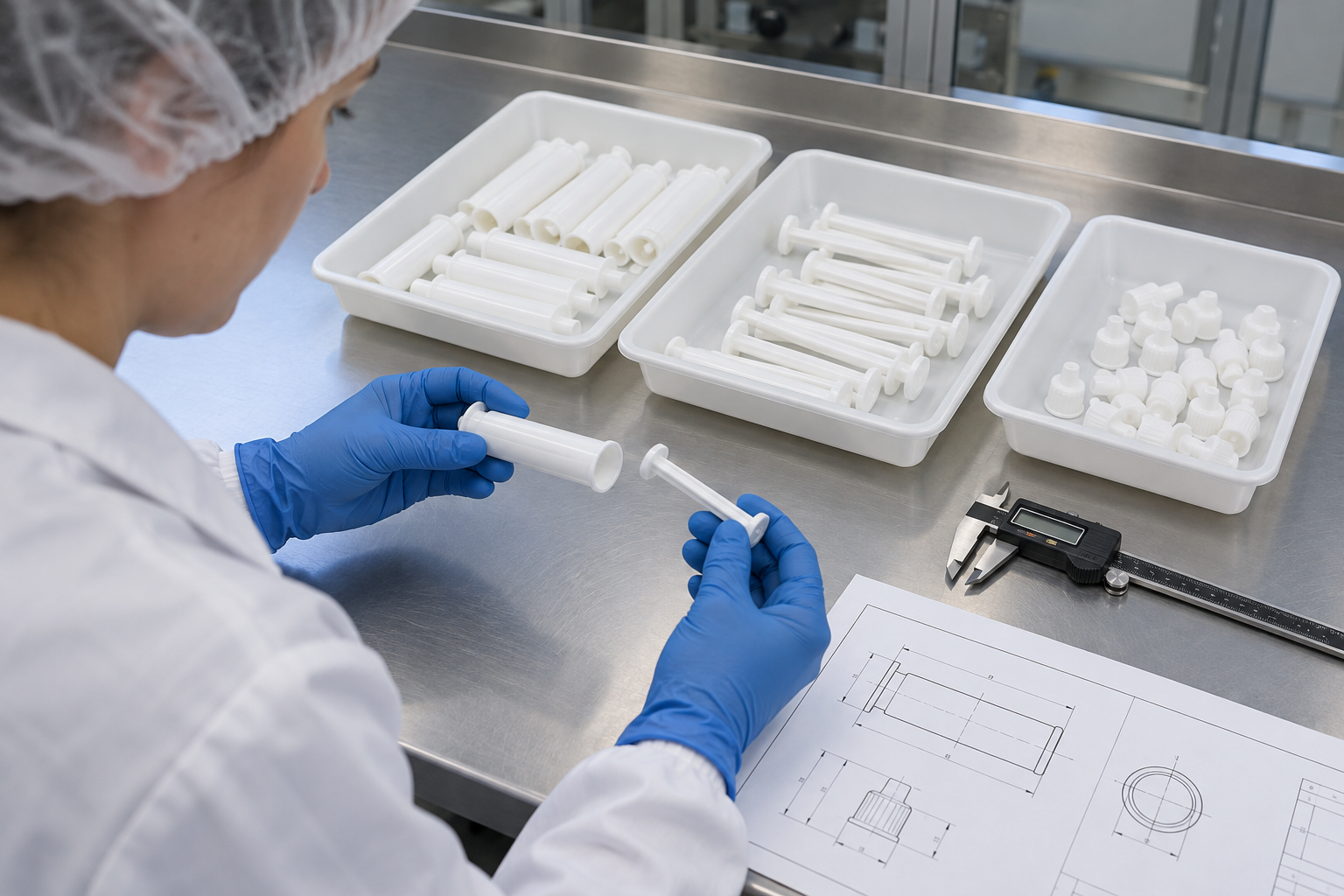
AI-generated illustration: approve identified incoming component lots for the intended project.
Introduction
An intramammary filling line is configured around physical components, not only a nominal syringe volume. A barrel that looks unchanged on a purchase order can differ in flange thickness, tip geometry, surface finish or nesting behaviour. A plunger can change insertion resistance. A cap can alter feeder orientation or seating. These differences become expensive when they first appear during FAT, installation or routine production.
The practical answer is to qualify each barrel, plunger and cap lot against the project’s agreed handling route before treating it as interchangeable. This is conditional package-engineering guidance for non-sterile veterinary applicators; the product owner remains responsible for approved component specifications and release decisions.
The direct answer
Component-lot qualification should connect a controlled drawing and supplier lot to representative physical samples, incoming observations, machine-contact points and an agreed disposition. It is not a universal dimensional checklist. The right checks depend on the barrel, cannula, plunger, closure and supply presentation used by the project.
Request a component review
Send the barrel, plunger and cap drawings with representative samples. We can identify the line-contact features and trial observations that should be agreed before tooling is released.
Start with a component identity record
For every sample set, retain the supplier name, lot reference, drawing revision, material declaration where available, quantity received and arrival presentation. Photograph the outer packing and a representative component before it enters a feeder. This record gives the team a way to compare later observations without relying on a memory of “the same” part.
The record should also identify the intended package configuration. A barrel drawing alone does not explain whether a cap is supplied loose or in trays, whether plungers are nested, or whether the applicator is expected to enter the line with a particular orientation. These details affect the feeder and transfer route.
Review the features that touch the line
The question is not whether every possible dimension was measured. It is whether the features that locate, guide or close the applicator are controlled. For the barrel, this may include the flange, outside diameter, shoulder, taper and fine cannula. For the plunger, it may include the stem, stopper or interface feature. For the cap, it may include orientation geometry, seating feature and the surfaces used by feeder tooling.
| Component | Machine interaction to review | Evidence to retain |
|---|---|---|
| Barrel | infeed separation, nest location, filling presentation | drawing revision, lot, fixture photos |
| Plunger | transfer, insertion route, final position check | sample condition, insertion observation |
| Cap | feeding, orientation, seating and discharge | supply presentation, visual seating record |
Use the agreed drawing as the dimensional authority. If samples fall outside the expected range, record the fact and refer it to the product owner or component supplier. Do not silently compensate with an undocumented guide adjustment.
Combine incoming review with a representative trial
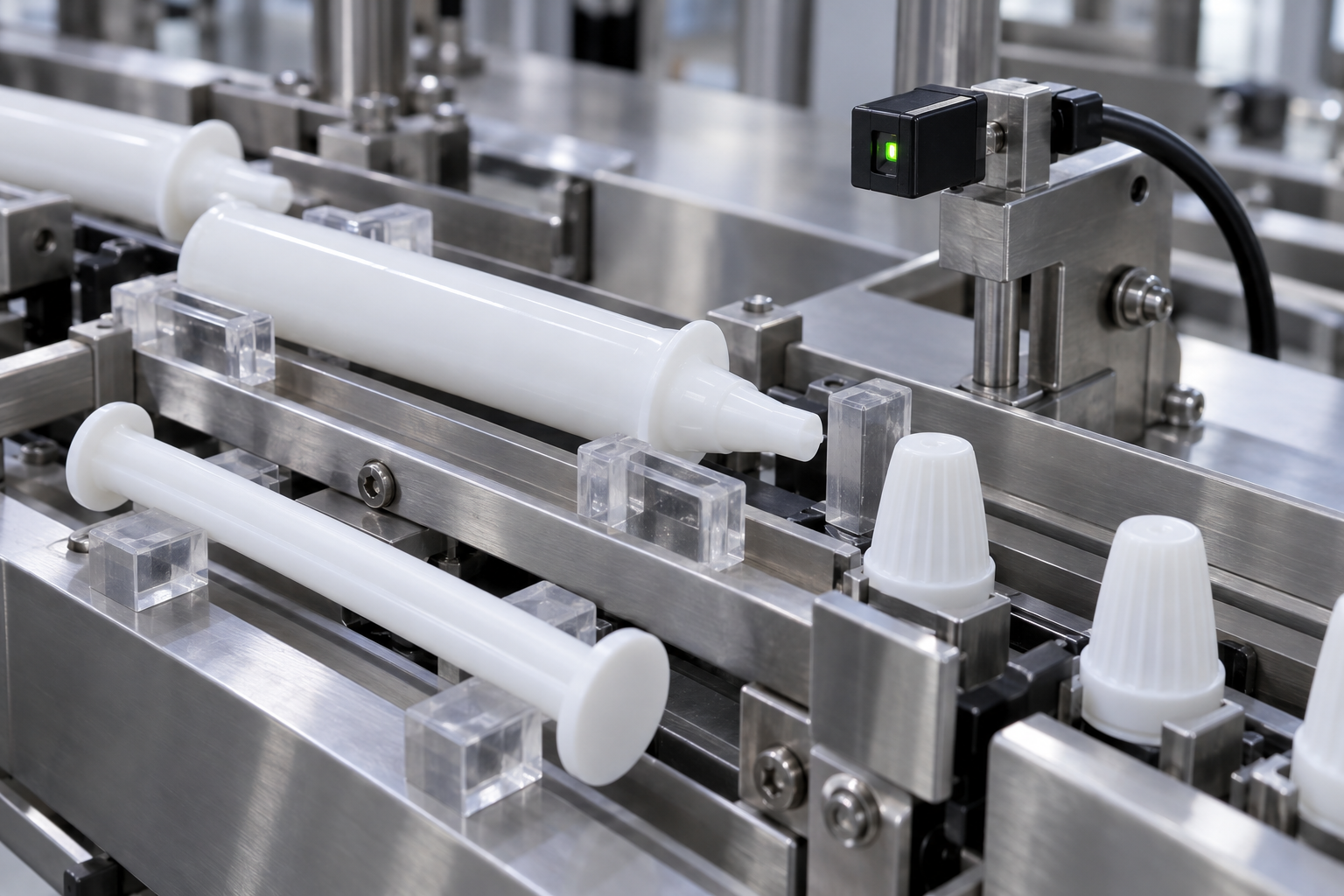
AI-generated illustration: A representative trial checks the real component contacts and transfer route, not only drawing dimensions.
Incoming review identifies visible damage, contamination, deformation, mixed parts and obvious packaging issues. It cannot prove stable operation. The representative trial shows whether the components feed, locate, fill, receive plungers and caps, and leave the line as intended.
Agree before the trial which lots will be used, what sequence will be observed and which conditions are out of scope. During factory testing, take notes at feeding, transfer, location, closing and reject points. If more than one lot is available, use it where practical; a route proven on one ideal sample should not be described as proof for all future supply.
Decide what “qualified for the project” means
For equipment engineering, a qualified lot may mean that the samples were identified, physically reviewed and run through the agreed configuration without an unresolved handling issue. It does not mean the machine supplier has approved the component for all product, regulatory, sterilisation or distribution conditions. Those decisions belong to the customer’s quality system.
The project record should label the outcome clearly:
- accepted for the stated factory trial;
- accepted with a documented machine or tooling adjustment;
- pending component-supplier clarification; or
- not suitable for the tested configuration.
This language protects the evidence boundary. It helps procurement understand whether new component sourcing will require a new review rather than assuming all lots are interchangeable.
Manage changes after FAT
After FAT, retain the sample identification and the settings or change parts used. At site acceptance, compare incoming production components with the reviewed drawings and samples. If a supplier, mold, drawing revision or supply presentation changes, use the customer’s change-control process to decide whether engineering review is needed.
The same principle applies to shipment inspection. Confirm that the supplied change parts are identified, protected and connected to the tested format. The inspection does not certify future components; it preserves a traceable starting point for installation preparation.
Turn the drawing review into a practical sampling plan
The component drawing is the starting point, but the trial team also needs a practical sampling plan. Define how many pieces are available for visual review, set-up, normal cycling, intentionally stopped-cycle observation and post-run inspection. The correct quantity depends on project scope and the samples available; it should be agreed rather than presented as a universal production qualification number.
Keep samples from different component lots separated throughout the review. A simple tray, container or controlled bag can be enough when it is linked to the sample record. The important point is that an observation can be traced to the lot and drawing revision used. If a barrel is removed because it is visibly distorted, place it in a hold location and record the reason. Do not let a removed part return to the general sample pool by accident.
Inspect supply presentation before the first feeder is adjusted
Component presentation can change the engineering answer. Barrels in a nested tray, loose bulk container or magazine may have the same nominal geometry but require different separation and orientation logic. Plungers may arrive stacked, bagged or in a form that changes how an operator introduces them to the line. Caps may be loose, oriented in a tray or protected by a secondary carrier. Record the presentation actually supplied to the test.
At the machine, observe the first hand-off from presentation to feeder. Is the component introduced one at a time? Is there an opportunity for two components to overlap? Can an operator see and safely clear a non-standard part? Where is the path for material that does not enter the machine? These operational details matter as much as the fixture dimension because they determine whether a component lot can be handled consistently in normal work, not just placed manually for a demonstration.
Use a contact-zone review
For each component, identify intended support points, permitted guide contact and protected zones. The barrel flange, shoulder or body may be used for location; a narrow dispensing tip may need clearance. A plunger stem may need guidance while another feature must remain free to move. A cap may need a defined orientation surface but should not be compressed by a feeder in a way that changes its seating function.
During factory testing, observe whether the actual contact matches this plan. A photograph can record the setup, but it should be accompanied by a note of the sample lot, station and purpose of the observation. When a guide or nest is adjusted, record the reason and the resulting condition. This record is more useful than a generic statement that the line “ran well.”
Mid-article CTA — Send your component list
Share the barrel, plunger and cap list, drawing revisions and intended supply state. We can prepare a sample-trial and tooling-review checklist for your intramammary project.
Define acceptance and exception paths before the trial
A component review is credible only when the project team knows what it will do with an exception. Agree which observations mean the lot can continue through the trial, which require adjustment and repeat observation, and which need escalation to the component supplier or customer quality team. This avoids making an improvised production decision at the machine.
Examples of evidence-bound outcomes
- Suitable for the stated trial: identified samples completed the agreed route with no unresolved observation under the documented configuration.
- Suitable after an adjustment: an identified tooling or guide adjustment was made, documented and observed with the agreed samples; future changes still require review.
- Awaiting clarification: a drawing, material, presentation or visible feature needs confirmation before the team can make a decision.
- Not used in the trial: samples were not representative, were damaged, or were excluded from the agreed scope.
These outcomes deliberately do not use language such as “universally approved” or “validated for all lots.” The factory test is evidence for a defined configuration. It can reduce uncertainty for the next decision, but it does not transfer quality ownership from the product owner to the machine supplier.
Connect qualification to FAT and site startup
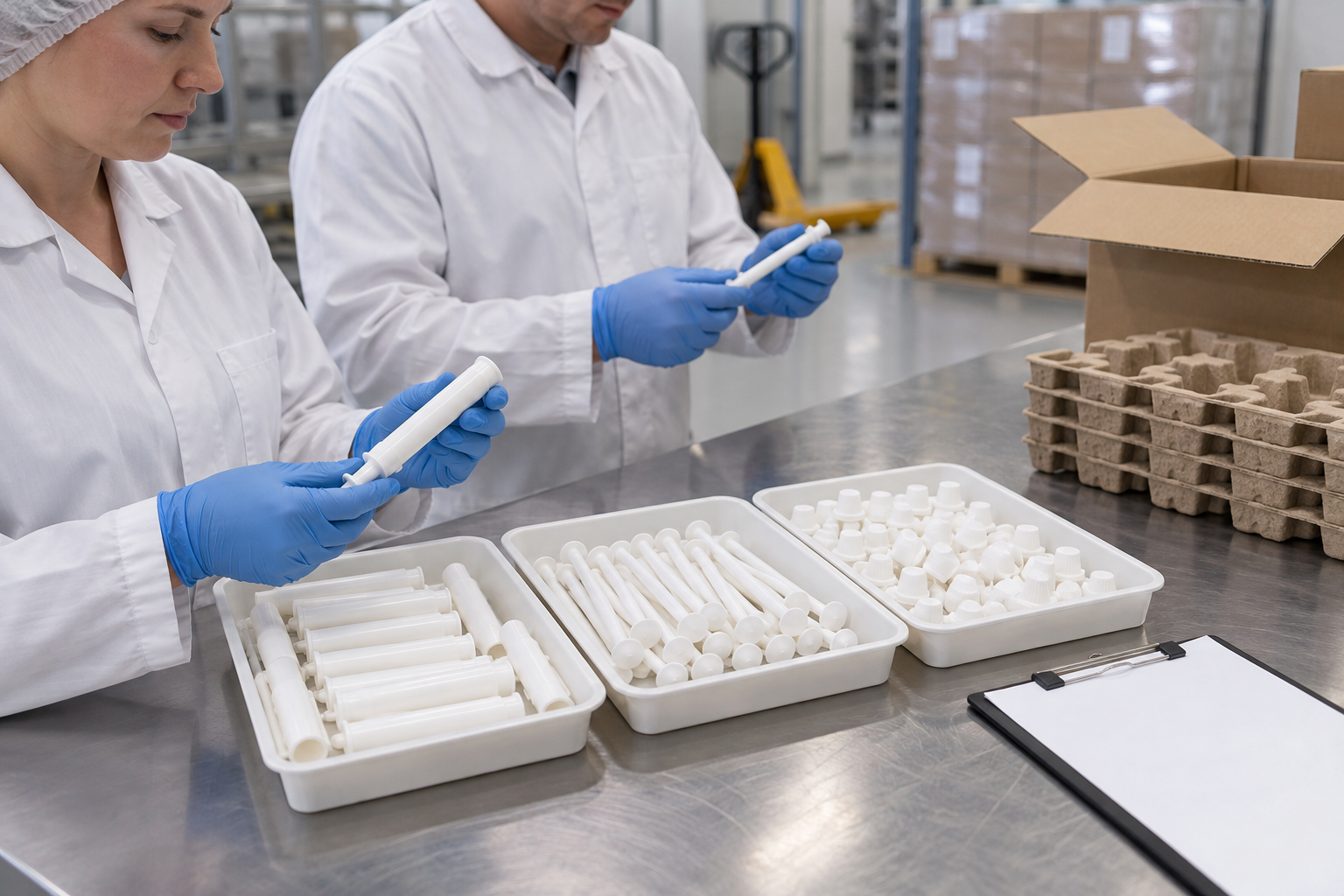
AI-generated illustration: Shipment inspection preserves the link between identified trial components, change parts and installation preparation.
The FAT protocol should identify the components supplied and the machine configuration used. If a change part is specific to the barrel, cap or plunger format, record its identification and storage method. At shipment inspection, check that such format parts are protected and travel with the documentation needed to identify them. A loose, unmarked set of tooling can break the connection between the trial and installation.
Installation preparation should repeat the identity discipline. Before site commissioning, compare the available production components to the drawing revision and sample condition reviewed at the factory. If the site receives a different supplier lot, a changed presentation or a revised drawing, use the site’s change-control process to determine whether a fresh engineering review is needed. The right response may be simple confirmation, a controlled test or a new trial; it should not be an undocumented assumption of equivalence.
Questions for procurement and quality
Before asking for a final equipment proposal or release, confirm the intended component supplier, current drawing revisions, expected packaging state, probable lot-change frequency, available sample quantities and the persons authorised to resolve a component question. These inputs make it possible to plan realistic trials and avoid a late request for tooling around components that have not yet been defined.
Maintain a concise evidence pack
The final record does not need to become an uncontrolled archive of every photograph and email. It should be a concise evidence pack that another project team can understand: the drawing revisions reviewed; component and sample identifiers; supply presentation; fixture or change-part identity; trial date and conditions; material observations; adjustments made; exceptions; and the agreed next action. Link to controlled records where the site requires them instead of duplicating information in uncontrolled notes.
This pack is especially useful when a question reappears months later. A new operator, purchasing contact or service engineer can see whether a barrel was actually run, whether the cap was supplied loose or in a tray, and whether an observed issue belonged to the component or the handling configuration. It supports informed discussion without turning a trial note into an unsupported certification claim.
Review the evidence after the trial, not only during it
Schedule a short review after factory testing, before shipment. Compare the open points with the original component list and identify any action that must be completed at site acceptance. If an observation was not resolved because the final product, production lot or site utility was unavailable, state that limit clearly. Installation preparation can then include the necessary sample, owner and acceptance observation instead of relying on an informal memory of the factory run.
The practical result is a controlled starting point for the project, not a promise that every future component delivery will behave identically. That distinction keeps the evidence useful and keeps change control proportionate.
Common mistakes
The first mistake is relying on nominal volume rather than geometry. Two nominally similar applicators can need different nests or guides. The second is treating a successful short run as a blanket component approval. The third is changing a feeder setting after a component deviation without recording the original condition. Each makes later root-cause work harder.
Preserve the lot decision beyond the trial
The qualification record should state which lots and package combinations were reviewed, which observations support the decision and which limitations remain. Keep this record connected to receiving and purchasing so that a later delivery is compared with the relevant basis.
If the next lot behaves differently, record the incoming condition and affected station before adjustment. Do not assume that a prior accepted sample proves every future lot. The customer should decide the review route according to its component controls and the nature of the change.
During installation preparation, supply the actual approved component references to the site team. This helps them recognise a lot substitution or presentation change before using the factory-tested setup.
FAQ
Should every incoming lot be run at the machine supplier’s factory?
No. The customer’s quality and change-control process should decide the review level. The supplier can support representative trials and identify features that affect the supplied line.
Can drawings replace physical samples?
No. Drawings are necessary, but physical samples reveal supply presentation, stiffness, surface condition and handling behaviour that a drawing cannot fully show.
Does component qualification include product compatibility?
Not by itself. Product compatibility, shelf-life and final package qualification need customer-defined methods and approvals.
What if one component lot changes but the others stay the same?
Identify the changed part and review its interfaces with the unchanged parts and tooling. A new cap lot, for example, may require a focused separation and seating review rather than an unrelated full-line retest. The customer should define the scope from the change and its existing controls.
Who should approve a component-lot decision?
The customer should assign the authority under its component and quality procedures. The equipment supplier can provide handling observations and configuration evidence from agreed testing, but that evidence should not be presented as automatic approval of product compatibility or release.
Conclusion
Reliable intramammary filling begins with identified components, not assumptions about “standard” syringes. A controlled lot record, relevant contact-feature review and representative trial create usable evidence for FAT, installation and later change control.
Discuss your applicator components
Contact Us: KINGPACK can review representative intramammary barrels, plungers and caps with the proposed feeding and handling route. Contact us to request a component review or sample-trial plan.
—