
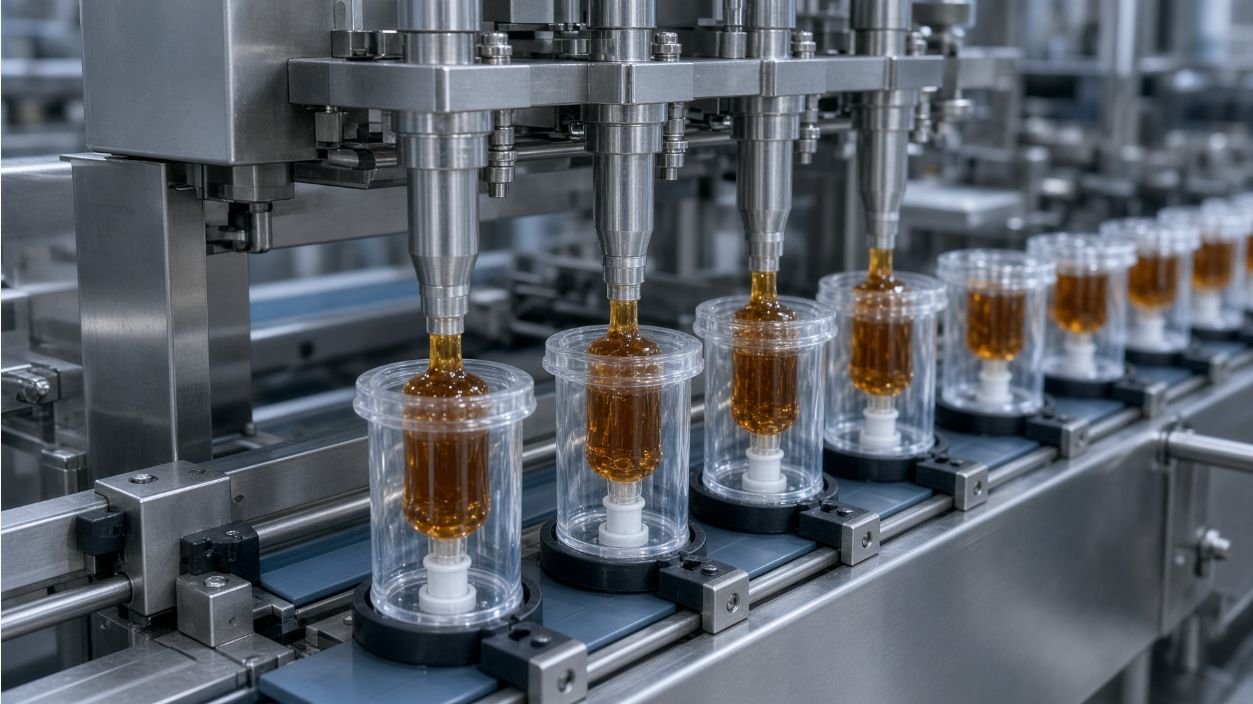
Before a quote for cockroach gel bait syringe filling equipment means anything, a manufacturer has to answer a question that is easy to skip: what exactly arrives at the infeed, and what must the finished syringe look like when it leaves the line? Gel baits look similar on a shelf, but the parts that make up a single syringe—barrel, piston, plunger rod, tip, and cap—arrive at a filler in very different states depending on the brand, the contract, and the assembly strategy. That incoming state, more than rated speed, decides the filling route, the metering system, and the inspection plan. This guide walks through the decisions that sit behind a cockroach gel bait syringe filling project so that a buyer can brief suppliers with the right information and compare proposals on the same basis.
What a “Syringe” Actually Means in Gel Bait Packaging
In pest-control packaging, the word “syringe” is used loosely. Most cockroach gel baits are packaged as a barrel that holds a high-viscosity paste, sealed at one end with a tip or cap and closed at the other by a piston. The consumer or technician either pushes the paste out with a hand plunger or mounts the cartridge in a bait gun. A widely sold example is Syngenta’s Advion Cockroach gel bait, which is supplied as 30-gram tubes used with a plunger and application tips (Last reviewed: 2026-09-09).
Three distinctions matter for filling equipment:
- Syringe vs. cartridge. The same barrel may be sold as a stand-alone syringe (plunger included) or as a cartridge for a bait gun. The barrel geometry can be identical; what changes is how the plunger rod is supplied and assembled.
- Piston vs. plunger rod. The piston is the elastomer wiper inside the barrel. The plunger rod is the separate part the end user presses. Some lines fill and close a barrel with the piston already loaded; others insert both piston and rod on the line.
- Tip vs. cap. A barrel may be filled through the open tail (rear filling) or through the tip (front filling), and the closure may be a separate cap, an attached tip, or a tip-and-cap combination.
None of this is standardized across the industry. The same “cockroach gel bait syringe” can describe a pre-assembled cartridge ready for a bait gun, or a kit of loose components. That is why the incoming component state is the first input to any filling project—not a detail to resolve after the machine is ordered.
Confirm the Incoming Syringe and Component State
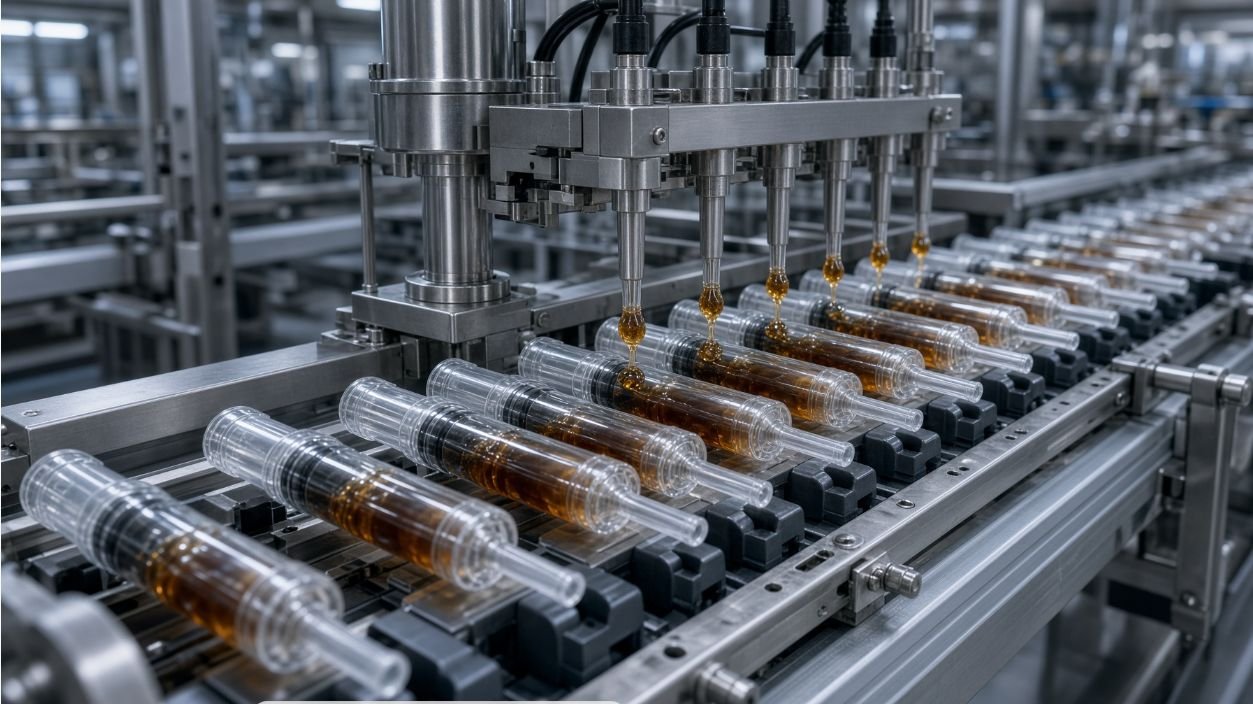
The first stage of a cockroach gel bait syringe filling project is to freeze the incoming bill of materials. For each syringe format, record:
- Barrel: material, wall thickness, internal diameter tolerance, flange or collar geometry, and whether the barrel arrives with or without the piston.
- Piston: material, hardness, sealing profile, and whether it is pre-inserted or supplied loose.
- Plunger rod: length, engagement feature, and whether it is assembled by hand, by the end user, or on the filling line.
- Tip and cap: interface geometry (thread, snap, Luer-style), fit requirements, and the required finished orientation.
- Bulk packing: how barrels and components are delivered—oriented, bulk, or in trays—and whether the line must orient them automatically.
A clear answer to these points determines whether the line needs a feeding and orientation station, an automatic piston-insertion station, or only a dosing and closure station. Suppliers cannot quote a like-for-like price until these inputs are fixed, because the station count—and therefore the footprint and cost—changes with them.
Front Filling vs. Rear Filling: a Consequence, Not a Preference
A common first question is whether the gel should be filled through the tip (front filling) or through the open barrel tail (rear filling). For high-viscosity gel bait, this is usually decided by the package, not by taste. Front filling suits a barrel that arrives pre-assembled with the piston already seated and sealed at the tail, so the only open path is the tip; it requires a narrow nozzle and higher fill pressure, which a paste must tolerate. Rear filling suits an open-tail barrel where the piston is inserted after dosing, which is often simpler for viscous material but adds an assembly step and a venting consideration.
The decision also interacts with the plunger: a cartridge that is filled and then closed with the piston may still need the plunger rod added later, by hand or on the line. This topic is covered in more depth in a separate comparison of front and rear filling routes.
Matching Product Behavior to Equipment Requirements
Gel baits are not all the same viscosity. Some flow like thick toothpaste; others are thixotropic and thin under shear; still others carry particles or fibres. The equipment consequence is real:
- Metering principle. A viscous paste is best dosed with a positive-displacement system—a piston, rotary piston, or progressive-cavity pump—rather than a time–pressure or gravity fill. The choice depends on dose size, viscosity at filling temperature, and sensitivity to shear.
- Air control. Thick pastes trap air when transferred from bulk containers. A line may need deaeration or a feed path that avoids re-entraining air, or bubbles appear in the finished barrel. This is a dedicated troubleshooting topic on its own.
- Cut-off and stringing. When the nozzle retracts from a paste, the material can string or leave a residue at the tip. Controlled suck-back, correct nozzle geometry, and a matched seal/closure sequence reduce the problem but do not eliminate it for every formulation.
The right sequence is to measure the product first and then select the dosing technology, rather than the reverse. Product viscosity, density, particle content, and behaviour across the intended temperature range should be documented before equipment is specified.
The Process Roadmap, from Bulk to Finished Syringe
A cockroach gel bait syringe filling line is a sequence of stations whose order depends on the incoming state and the filling route. A representative rear-fill, piston-insertion line looks like this:
| Station | Function | Decided by |
| Feed & orient | Present empty barrels in a consistent orientation | Barrel geometry and bulk packing |
| Dose | Fill a target mass or volume of paste | Metering system and cut-off behaviour |
| Piston insertion | Seat the piston after dosing | Rear-fill route and piston supply state |
| Tip / cap closure | Apply and secure the closure | Closure geometry and retention requirement |
| Inspection | Check net fill, defects, and closure | Quality standard and market requirements |
| Reject / accumulate | Separate rejects and buffer output | Throughput and downstream packing |
The same project input drives every row. When a buyer changes the incoming state—for example, from pre-inserted pistons to loose pistons—the middle of the line changes, and the price changes with it. The table below summarises the inputs a supplier needs to turn this roadmap into a proposal.
| Project input | Examples to provide |
| Product | Paste identity, SDS, viscosity and density data, temperature range |
| Packaging | Barrel, piston, plunger, tip and cap samples and drawings |
| Fill requirement | Target net content (mass and/or volume), tolerance expectation |
| Output | Required good units per shift, batch sizes, format range |
| Quality | Defects to prevent, inspection points, acceptance criteria |
Inspection and Acceptance: What “Good” Means

Because gel bait is sold by mass, a filling line must produce a repeatable net content, not just a repeatable volume. Whether the product is controlled by grams or millilitres—and how gross, tare, and net weight are separated—is a distinct subject. For line specification, the practical points are:
- Define the fill target and its tolerance in the units the product is labelled and sold in.
- Agree how fill level, air pockets, and stringing at the tip will be measured and scored.
- Decide which defects are automatic rejects versus rework.
Inspection and acceptance criteria should be agreed before the factory acceptance test, not discovered during it.
What to Send Before You Ask for a Quote
A supplier can only give a meaningful technical proposal once it has the product and the packaging. Before requesting a quote, prepare:
- Complete syringe samples—a full set of barrels, pistons, plunger rods, tips, and caps, in both loose and assembled states where relevant.
- Drawings with dimensions and tolerances for every component.
- Product information—SDS, viscosity and density data, particle content, and the allowed temperature window.
- Fill and output targets—net content in the selling unit, required good output, and the number of formats.
- The defect list—what the trial should investigate (air, stringing, net content, closure).
Sending these items allows a supplier to run a sample trial and return a proposal tied to the actual material, rather than a generic machine.
Common Risks and Mistakes
- Treating all gels as the same viscosity. A line sized for a thin paste can stall on a stiff one; a line over-built for a stiff gel may be unnecessary for a free-flowing product.
- Equating grams and millilitres. Mass and volume are different controls, and a syringe’s rated volume is not its net mass.
- Buying on rated speed. A machine’s maximum mechanical rate is not its sustainable good output once rejects, restarts, and changeovers are counted.
- Fixing the incoming part state too late. Whether pistons are pre-inserted changes the station count and the price; changing it after quotation invalidates the proposal.
How King Pack Supports This Application
King Pack Machinery (Wuxi King-Pack / Wuxi Jingpai Machinery Co., Ltd., founded 2009, with a core technical team carrying more than 20 years of industry experience) approaches a gel bait syringe filling project as an application-engineering task rather than a catalogue sale. The useful starting points for this application are:
- Application-based configuration. The line is assembled around the confirmed incoming component state, filling route, and product behaviour, rather than a fixed station layout.
- Product and packaging testing. Sample trials establish that the metering and cut-off work with the actual paste and the actual barrel, piston, tip, and cap before a configuration is fixed.
- Stable production over theoretical maximum speed. Capacity is discussed in terms of sustainable good output, not headline speed.
- Factory acceptance testing. Run conditions, measurement methods, and acceptance criteria are agreed and recorded before the line ships.
- Documentation, training, and spare-parts planning. International component availability and technical documentation support the line after installation.
King Pack does not claim a verified, dedicated gel-bait machine from a standard catalogue; a specific configuration is developed against the product and packaging a buyer supplies. That is the difference between a quote for a machine and a proposal for a working line.
Conclusion
Cockroach gel bait syringe filling is defined by the incoming packaging and the behaviour of the paste far more than by machine speed. A buyer who can describe the barrel, piston, plunger, tip, and cap—and who sends the full component set with product data—gets a proposal that matches the actual line it will run. A buyer who cannot may receive a generic machine and discover the mismatch during installation.
Ready to define your line around your product? Send your syringe samples, component drawings, product data, and net-content and output targets to discuss your gel bait syringe filling requirements.