
Short answer: Compare veterinary syringe filling machine suppliers on the evidence behind their proposed scope, not only on quotation total or nominal output. Give every supplier the same applicator, product, closure, quality, and integration inputs; then compare their response for tested assumptions, format coverage, product-contact design, factory acceptance testing, documentation, changeover, spares, commissioning, and ownership of open items.
For veterinary syringes, the equipment must handle a specific barrel or applicator, formulation, and agreed sequence of filling, plunger or closure placement, inspection, rejection, and transfer. A proposal is comparable only when it says what is included, what has been demonstrated, what remains conditional, and who must approve each requirement.

Why price alone is a weak comparison
Two quotations may use the same headline terms while covering different package formats, product conditions, safety interfaces, documentation, and site work. One may include only a fill station; another may include nests, closure handling, guarding, reject logic, change parts, and an agreed test. Start by giving every supplier a common RFQ with package samples or drawings, target dose, product information, closure components, utilities, layout restrictions, expected changeovers, and acceptance expectations.
| Comparison area | Questions to ask | Evidence to request |
|---|---|---|
| Application fit | Has the proposal addressed this applicator, product behavior, dose and closure sequence? | Written assumptions, format list and proposed test conditions |
| Scope boundary | Which stations, interfaces, guards, rejects and controls are included? | Line layout, scope list and exclusions |
| Testing | What can be tested with representative product and packaging? | FAT protocol, materials list and open-point process |
| Changeover and cleaning | Which parts change and how is the product path accessed? | Change-parts list and access documentation |
| Handover | What manuals, training and records are supplied? | Document index, training outline and responsibility matrix |
1. Check application fit before comparing features
Ask whether the supplier has worked from the right package geometry and product description. A veterinary applicator may need dedicated mechanical handling for its barrel, flange, outlet, plunger, and closure arrangement. A proposal based only on a nominal fill volume can overlook nozzle clearance, orientation, fill position, downstream travel, or component feeding.
Also compare how each supplier treats the formulation. Viscosity or density figures can help, but structured products, gels, creams, and suspensions often require a controlled trial to understand filling and stop/start behavior. A responsible proposal differentiates between a confirmed feature, a preliminary engineering recommendation, and an item that needs product testing. For product-path context, see the viscous product filling solution.
2. Make the scope boundary visible
Ask for a station-by-station scope list: infeed, orientation, filling, nozzle motion, closure handling, inspection, reject, discharge, guarding, controls, and handoff to other equipment. It should also state the customer-supplied interfaces: product feed, utilities, building works, validation criteria, and packaging materials. Use a line layout to make transfer points visible and compare answers rather than component names.

3. Compare sample testing and FAT as evidence
A factory acceptance test should state the configuration, test materials, conditions, recorded observations, customer-supplied acceptance criteria, and treatment of open points. “FAT included” is not enough without those boundaries. Use intended applicators and closure components where practical, and request observations at start-up, steady operation, stop, and restart—not only a short stable run.
- What sample quantity and packaging components are needed?
- Which settings and observations will be recorded?
- Who defines sampling and acceptance criteria?
- How are deviations and unresolved items documented?
- Which items are rechecked at site acceptance?

4. Review format changes, cleaning, and maintenance together
Different syringe sizes or closure versions may require nests, guides, height adjustment, feeders, recipes, tooling, or nozzles. Request a format matrix that lists every included format and the physical parts or settings it needs. Evaluate cleaning on the complete product-contact path, not the visible nozzle alone. The product owner defines cleaning acceptance; the supplier should make product-contact components, access, and dismantling boundaries clear enough for that procedure to be assessed.
5. Compare documentation, controls, and service realistically
Request a document index with the proposal: drawings, manuals, parts information, utility requirements, safety documentation, test records, and training content. Avoid broad claims such as “validated equipment”; requirements depend on the product, jurisdiction, site procedures, and the customer’s quality system. Request a recommended spare-parts list that separates commissioning spares, wear items, critical parts, and optional change components. Confirm service and response expectations contractually where they matter.
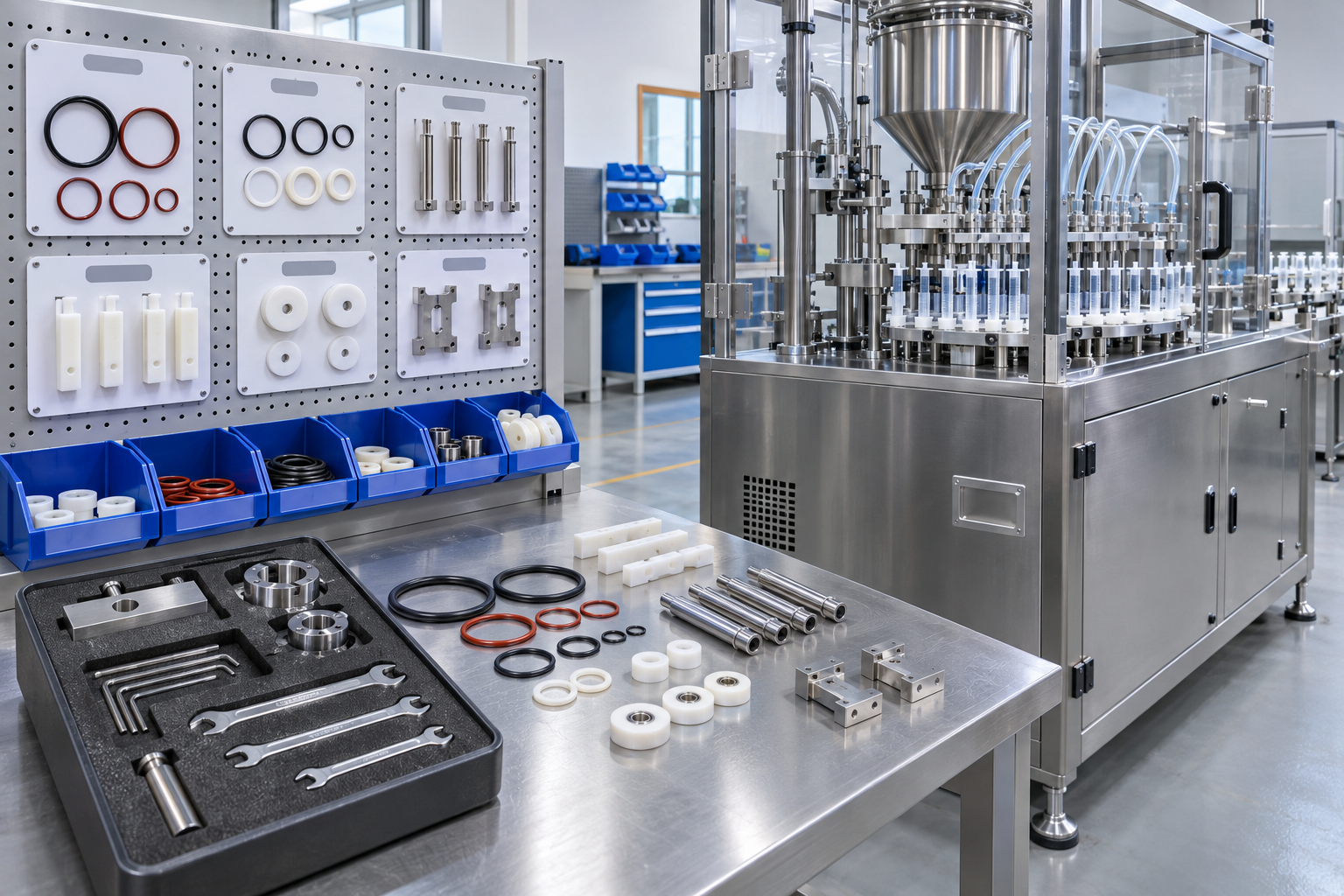
Supplier comparison checklist
- Issue the same RFQ package and log clarifications.
- Require an included/excluded/optional list for stations, formats, inspection, integration, and documents.
- Ask which elements are confirmed and which need a trial.
- Compare FAT materials, evidence, acceptance ownership, and open-point handling.
- List every change part and product-contact component.
- Review utilities, guarding, safety interfaces, and downstream handoffs.
- Request the document index, training outline, spare-parts recommendation, and commissioning matrix.
- Normalize commercial comparisons only after scope gaps are visible.
Need a structured technical proposal? Share your syringe/applicator drawings, product notes, closure components, target dose, and integration needs via Request a Quote. A useful response should state what can be configured from your inputs and what needs representative testing.
How King Pack Machinery fits into an evaluation
King Pack Machinery provides configurable filling and capping equipment, veterinary filling solutions, factory acceptance testing, documentation, training, and line integration support. The useful comparison is a documented review of how a proposed configuration addresses your syringe format, product path, closure sequence, test scope, and handoff requirements. Use the syringe filling machine information as a starting point, then request a proposal that separates standard features, application-specific configuration, customer-supplied requirements, and items awaiting trial.
How to Compare Suppliers for Intramammary and Veterinary Syringe Filling
For a fair comparison, an intramammary filling machine supplier should state the product and package assumptions, included stations, format parts, FAT evidence, documents, training, spare parts and open items. Automatic intramammary syringe filling machines and veterinary syringe filling equipment should be compared on demonstrated application fit, not on a headline quotation or catalogue speed.
| Item to confirm | Why it matters | Evidence |
|---|---|---|
| Product and viscosity | Controls feed, dosing and nozzle behavior | Product notes and representative samples |
| Syringe and closure | Defines format handling and assembly sequence | Drawings, components and format matrix |
| Test and acceptance | Shows how the proposed scope is proven | FAT protocol, records and open-point log |
FAQ
What should be included in an RFQ?
Include product information, syringe and cap drawings, target dose, utilities, expected sequence, changeover requirements, test samples and acceptance responsibilities.
What should a supplier prove at FAT?
The FAT should record the agreed configuration, test materials, conditions, observations, acceptance criteria and unresolved items.
Related: How to Choose a Veterinary Syringe Filling Machine · Intramammary Filling Line URS and FAT Checklist · Request a Quote
FAQ
What is the first question to ask a supplier?
Ask whether the quotation is based on your actual syringe/applicator, closure, product information, target dose, and production sequence.
Does a FAT prove the finished product is approved?
No. A FAT verifies the agreed equipment test scope. Product release and regulatory compliance remain with the product owner and applicable authorities.
Should spares be compared at the start?
Yes. Request a categorized recommendation and the identification process so the maintenance boundary is visible.
What makes proposals difficult to compare?
Undefined formats, untested product assumptions, vague FAT wording, missing interfaces, and unclear exclusions prevent a fair comparison.
Conclusion
The strongest supplier proposal makes technical and commercial risks visible: package fit, product assumptions, test evidence, scope, cleaning/changeover, documents, spares, and commissioning ownership. Use a common RFQ and matrix before price negotiation. Discuss your product and packaging requirements with King Pack Machinery to build a proposal and FAT scope around the application rather than a generic machine label.