
Short answer: A dry cow therapy syringe filling solution should be designed around the actual applicator, formulation behavior, closure sequence, and cleaning/changeover requirements—not around a generic liquid filler. Start with the finished syringe drawing, target dose, product data, and the required downstream closure or plunger operation. Then confirm the proposed product path and test scope with representative materials before the purchase specification is frozen.
Dry cow therapy syringe filling is a veterinary packaging application. It should be kept distinct from a claim that every project is a sterile prefilled injectable process. The product owner is responsible for the applicable product, market, quality, and regulatory requirements; the equipment supplier should clearly define the machine scope, product-contact arrangement, testing method, and assumptions that still need customer approval.
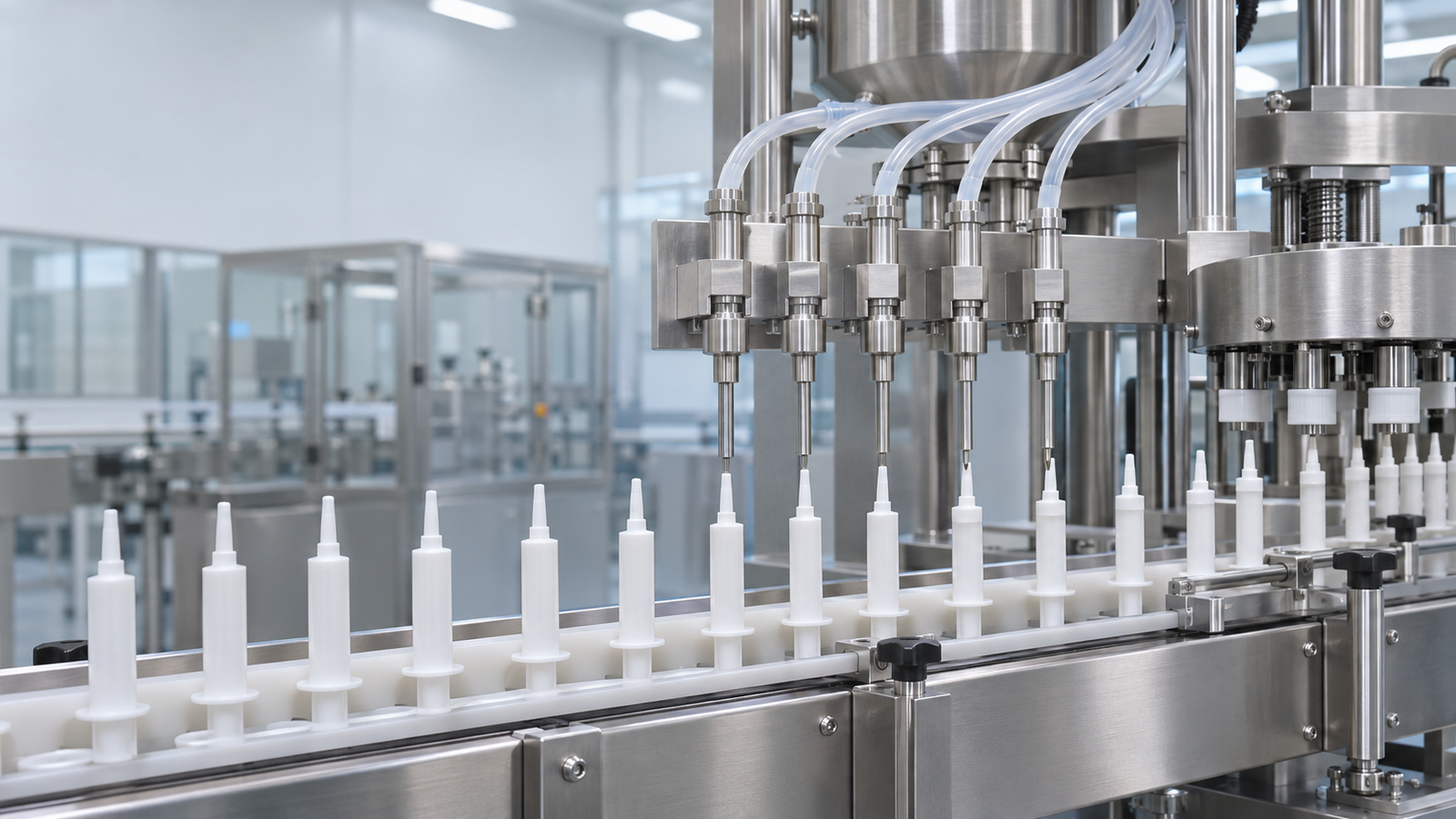
What makes dry cow therapy syringe filling different?
The applicator is both the primary package and the dispensing interface. Its barrel geometry, outlet, flange, plunger or closure design, and acceptable fill position affect the filling station and every handoff after it. A line also has to manage the product’s real flow behavior. Creams, suspensions, gels, and structured pastes can respond differently to pressure, temperature, stop/start conditions, and nozzle withdrawal.
The practical question is therefore not simply “Can this machine fill a syringe?” It is: can the proposed line repeatedly present this applicator, dispense this product under the intended operating conditions, hand it safely to the closure step, and be cleaned or changed over using the plant’s approved procedure?
Start with the applicator and product data
Send the supplier an applicator drawing or physical samples early. Record the barrel internal diameter, fillable length, opening dimensions, flange features, closure/plunger arrangement, and any orientation feature used by downstream equipment. A sample prevents a quotation from relying only on a nominal syringe size when the actual shape, moulded details, or component tolerances determine the handling design.
For the product, provide the information that is available and permitted to share: product type, expected temperature range, density, viscosity or flow observations, sensitivity to shear, tendency to trap air, particulates, and cleaning restrictions. A single viscosity number is useful context, but it is not a substitute for a representative filling trial. The same formulation can behave differently at a different temperature or after it sits in a hose during a production pause.
| Project input | Why it matters | What to ask the supplier to confirm |
|---|---|---|
| Applicator sample and drawing | Defines nests, guides, nozzle clearance and transfer positions | Format parts, orientation method and proposed change parts |
| Target dose and fill position | Determines dosing range and downstream clearance | Test method and which acceptance criteria remain customer-defined |
| Product behavior and temperature | Affects product path, nozzle choice and start/stop behavior | Assumptions, trial conditions and limitations of the proposed configuration |
| Closure or plunger components | Controls component feed, placement and inspection approach | Component handling scope and rejection/handoff logic |
| Cleaning and changeover expectations | Influences removable parts, access, documentation and downtime planning | Parts list, dismantling points and customer responsibilities |
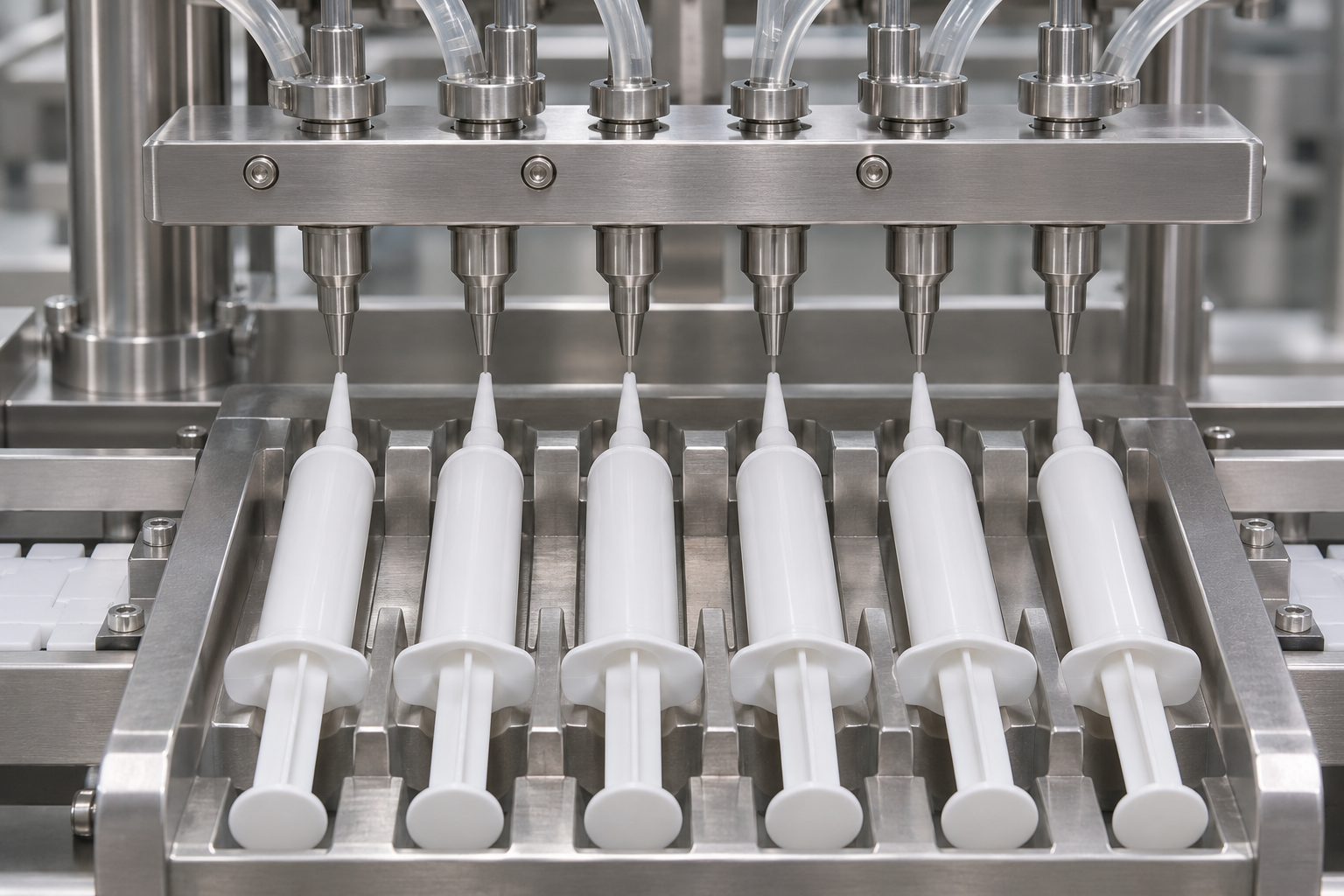
Build the filling sequence around the package
A typical sequence may include applicator infeed, orientation where required, positioning in a nest, filling, nozzle withdrawal, placement of a plunger or other closure component, inspection, rejection or handoff, and discharge. The exact order depends on the product and pack design. A rear-filling arrangement may need different product placement and closing logic from a format filled through the opposite end.
At the filling station, nozzle geometry and motion matter as much as the dosing principle. A nozzle needs adequate clearance from the barrel opening and an agreed approach to insertion depth, non-contact operation, and withdrawal. For products that tail, string, or continue moving after the dose, the supplier and customer should compare controlled settings instead of assuming a generic anti-drip feature is sufficient.
Verify the conditions most likely to expose a problem: first units after priming, steady operation, the last units before a pause, and the first units after restart. Record the product condition and the machine settings used. That record becomes more useful than a single photograph because it shows the conditions under which the observed result was obtained.
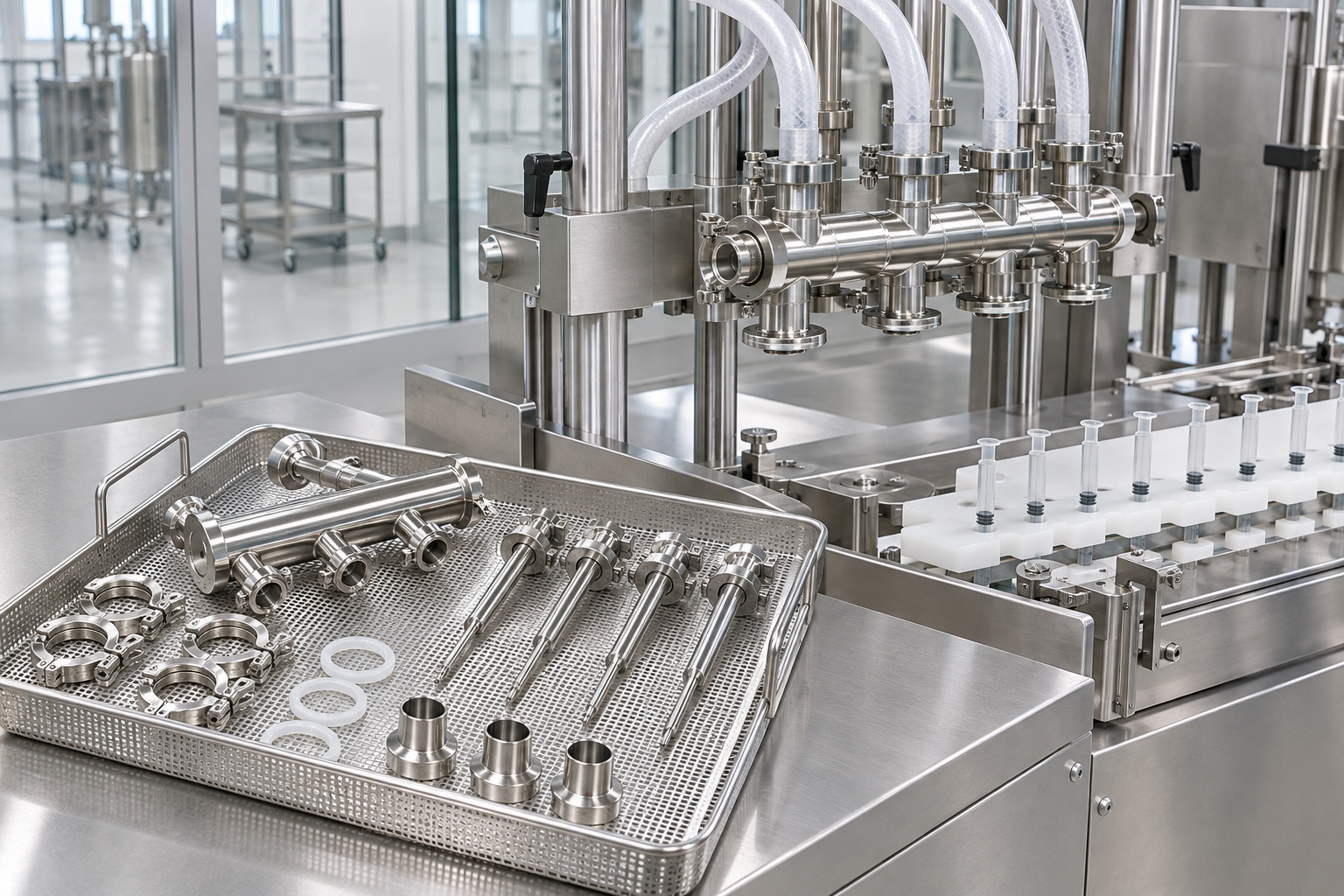
Choose the product path with cleanability in mind
Product-contact components should be reviewable as a system: feed vessel or connection, transfer line, manifold, dosing device, valves where used, and nozzle. The appropriate arrangement depends on the formulation, plant procedure, and validation needs. Ask how parts are removed, identified, inspected, reassembled, and documented; do not treat access to a single nozzle as proof that the complete path is easy to clean.
For a campaign that handles multiple veterinary products, distinguish between a product-specific format change and a product-contact cleaning change. A format change may require nests, guides, height settings, or component feeders. A product change may additionally require a controlled cleaning process, line clearance, and documentation. The product owner should decide what constitutes acceptable cleaning and release; an equipment supplier can make the relevant access points and product path visible for that decision.
Control closure placement and downstream handoff
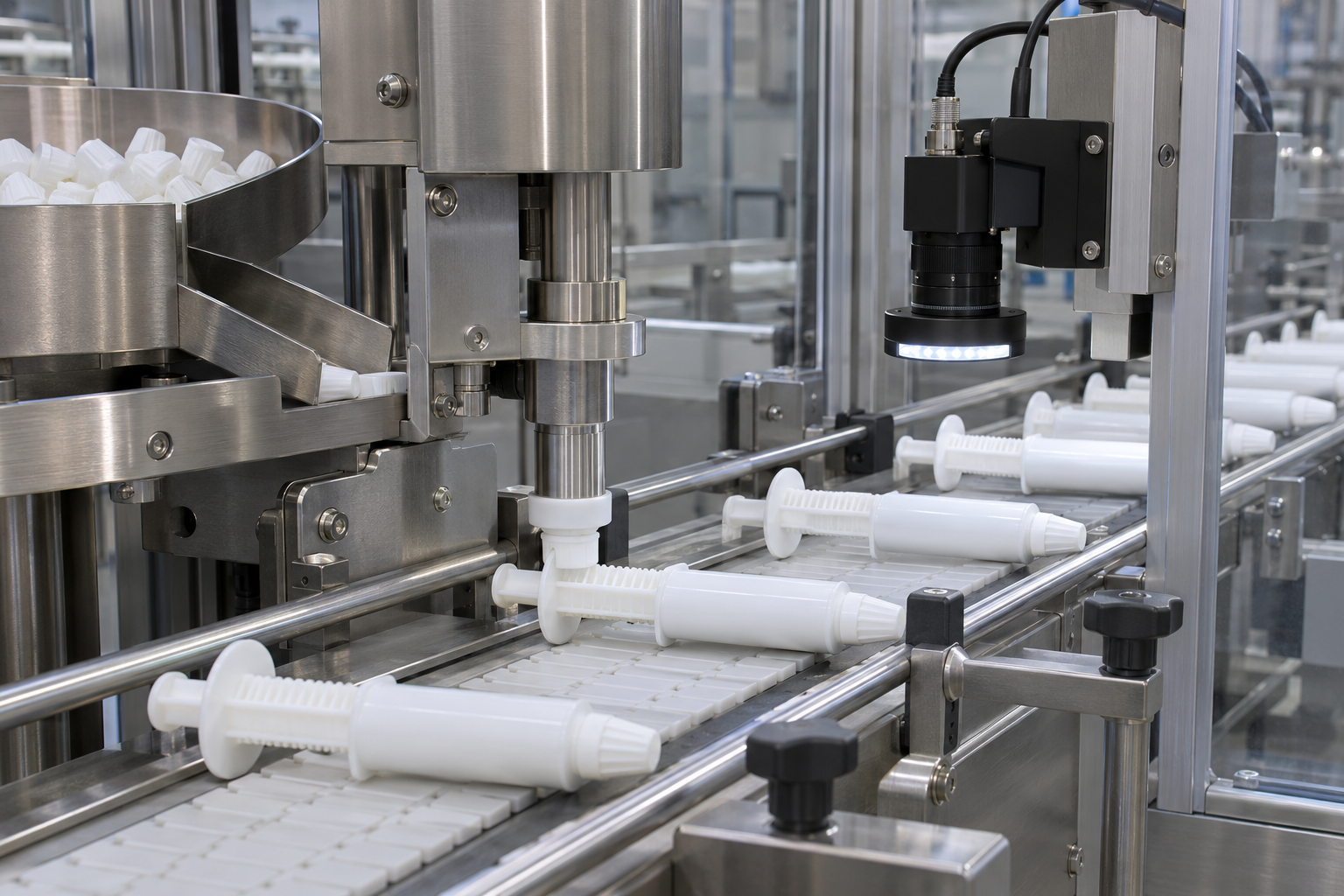
A good filled applicator still needs to arrive at the next station in a defined condition. Closure or plunger components should be specified with samples, dimensions, material information, and any orientation requirement. The supplier should identify whether its scope includes feeding, placement, force monitoring, visual presence checks, rejection, or only a mechanical handoff to another station.
Review the available clearance above the product, the fill level, and the motion of the plunger or closure tool together. An apparently correct fill can still create downstream issues if product is placed where the closure must travel or if a product tail contaminates the sealing area. Define the observations and acceptance rules before a factory test instead of trying to infer them from an uncontrolled demonstration.
Use a practical test and acceptance plan
A representative factory acceptance test can align the quotation with the project’s technical evidence. It should state what product and packaging are supplied, which configuration is tested, who provides the acceptance criteria, how samples are checked, and what evidence is recorded. A FAT can demonstrate the agreed scope; it does not transfer product-market approval or the site’s final quality responsibility to the equipment supplier.
- Use the intended applicator and closure components where possible.
- Record product condition, trial settings, start/stop sequence, and observed results.
- Check applicator handling, fill appearance, closure handoff, and inspection/rejection logic relevant to the scope.
- List deviations, open points, and any format or product assumptions that were not tested.
- Define what will be checked again during site acceptance and commissioning.
For a broader system discussion, review the veterinary medicine filling solution alongside the packaging format and the intended plant workflow. If the formulation is structured or viscous, the viscous product filling approach is also relevant to the product-path discussion.
Dry cow therapy syringe filling RFQ checklist
A quotation is easier to compare when every candidate supplier works from the same project input. Prepare the following checklist before requesting a proposal:
- Representative applicator, plunger/closure, and any secondary-pack interface sample.
- Drawing or dimensions for all product-contact and transfer-sensitive package features.
- Target dose, planned product range, desired fill direction, and required fill position.
- Available product behavior information and the temperature conditions for production and testing.
- Expected line sequence: infeed, filling, closure, inspection, reject, and discharge.
- Changeover frequency, cleaning approach, line-clearance process, and documentation needs.
- Utilities, room constraints, electrical standards, and integration interfaces.
- FAT evidence required, site acceptance responsibilities, training, recommended spares, and service expectations.
Planning a dry cow therapy syringe project? Send the applicator drawing, product notes, target dose, closure sample, and line sequence through King Pack Machinery’s contact page. A technical review can identify which machine elements can be configured from the information supplied and which should be tested with representative material.
How King Pack Machinery can support the project
King Pack Machinery provides configurable filling and capping equipment and complete filling and packaging lines for veterinary applications. For a dry cow therapy applicator project, the useful discussion is application-specific: product path, syringe or applicator handling, filling and closure sequence, format change parts, FAT scope, documentation, training, and line integration. The final acceptance criteria should remain defined by the product owner and confirmed in the agreed test plan.
Where the line includes additional stations, review the filling module in the context of the complete packaging equipment and the available handoff interfaces. This helps avoid treating filling, closure, inspection, and downstream packing as unrelated purchases.
How to Compare Suppliers for Intramammary and Veterinary Syringe Filling
For a fair comparison, an intramammary filling machine supplier should state the product and package assumptions, included stations, format parts, FAT evidence, documents, training, spare parts and open items. Automatic intramammary syringe filling machines and veterinary syringe filling equipment should be compared on demonstrated application fit, not on a headline quotation or catalogue speed.
| Item to confirm | Why it matters | Evidence |
|---|---|---|
| Product and viscosity | Controls feed, dosing and nozzle behavior | Product notes and representative samples |
| Syringe and closure | Defines format handling and assembly sequence | Drawings, components and format matrix |
| Test and acceptance | Shows how the proposed scope is proven | FAT protocol, records and open-point log |
FAQ
What should be included in an RFQ?
Include product information, syringe and cap drawings, target dose, utilities, expected sequence, changeover requirements, test samples and acceptance responsibilities.
What should a supplier prove at FAT?
The FAT should record the agreed configuration, test materials, conditions, observations, acceptance criteria and unresolved items.
Related: How to Choose a Veterinary Syringe Filling Machine · Intramammary Filling Line URS and FAT Checklist · Request a Quote
FAQ
Is every dry cow therapy applicator filling line a sterile injectable line?
No. Packaging and product requirements depend on the product and target market. The project must not assume a sterile injectable scope unless it is specified and supported by the product owner’s requirements.
What sample should be supplied for a filling trial?
Provide the intended applicator and closure components, representative product where appropriate, and the available product and package information. Confirm quantities, handling, and test boundaries with the supplier before shipment.
Can one line handle different applicator sizes?
It may be possible when compatible format parts, height settings, product path, and component handling are defined. Each additional format should be listed in the quotation and testing plan rather than assumed to be included.
How should cleaning be evaluated?
Review the whole product-contact path, access, dismantling points, parts identification, and the plant’s approved cleaning procedure. The product owner determines the cleaning and release requirements.
What should be agreed before FAT?
Agree the tested configuration, materials, documented observations, acceptance criteria, sample method, open-point handling, and the division between factory and site acceptance.
Conclusion
A dry cow therapy syringe filling solution is strongest when it begins with the actual package and product rather than a generic speed claim. Define the applicator, product path, closure sequence, cleaning expectations, and test evidence early; then use a documented FAT and site plan to turn the proposal into a controlled project. Request a technical proposal with your applicator and product inputs to discuss a filling and capping configuration matched to your process.