
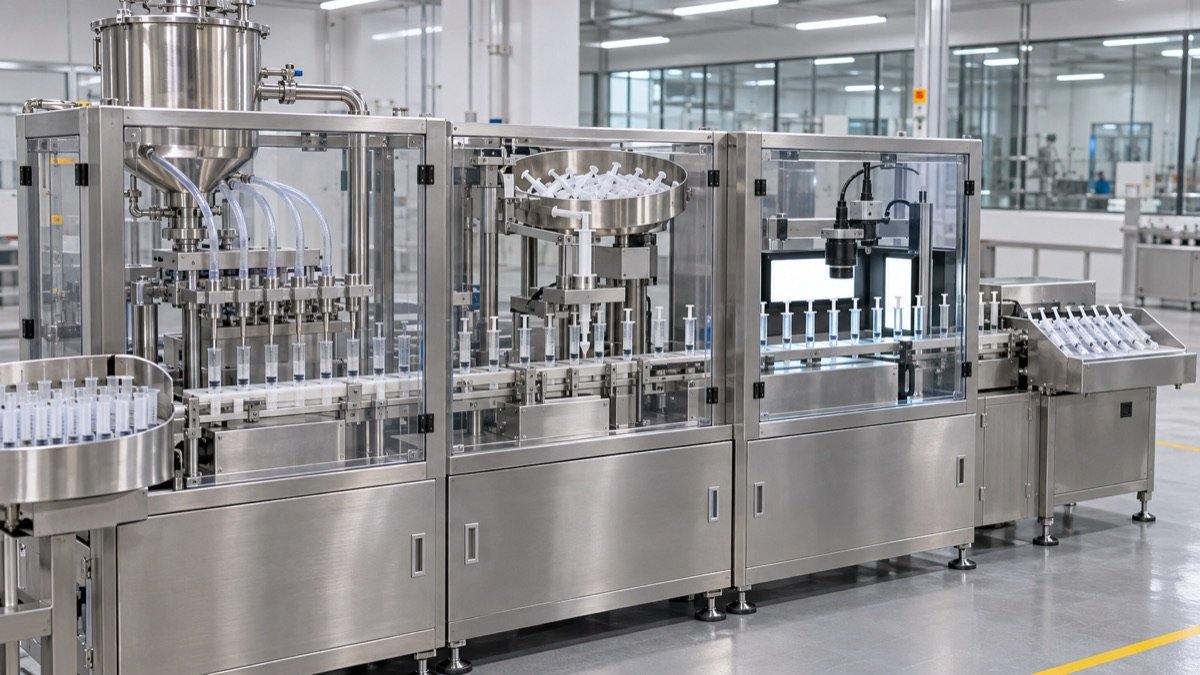
To calculate veterinary syringe filling-line capacity, start with the slowest connected process—not the highest speed quoted for the filling station. Then multiply that bottleneck rate by the time the line is genuinely available to run and by the proportion of units that meet the agreed acceptance criteria. This produces a planning estimate for saleable output, which is more useful than a headline station speed when comparing equipment or sizing a project.
The calculation is only as reliable as its assumptions. Syringe format, product behavior, component supply, plunger or closure handling, inspection, changeovers, cleaning, sampling, and downstream handoff can all affect the result. Use the model below to structure an RFQ and an acceptance plan; do not treat its illustrative values as a production promise for a specific machine.
What capacity should a buyer calculate?
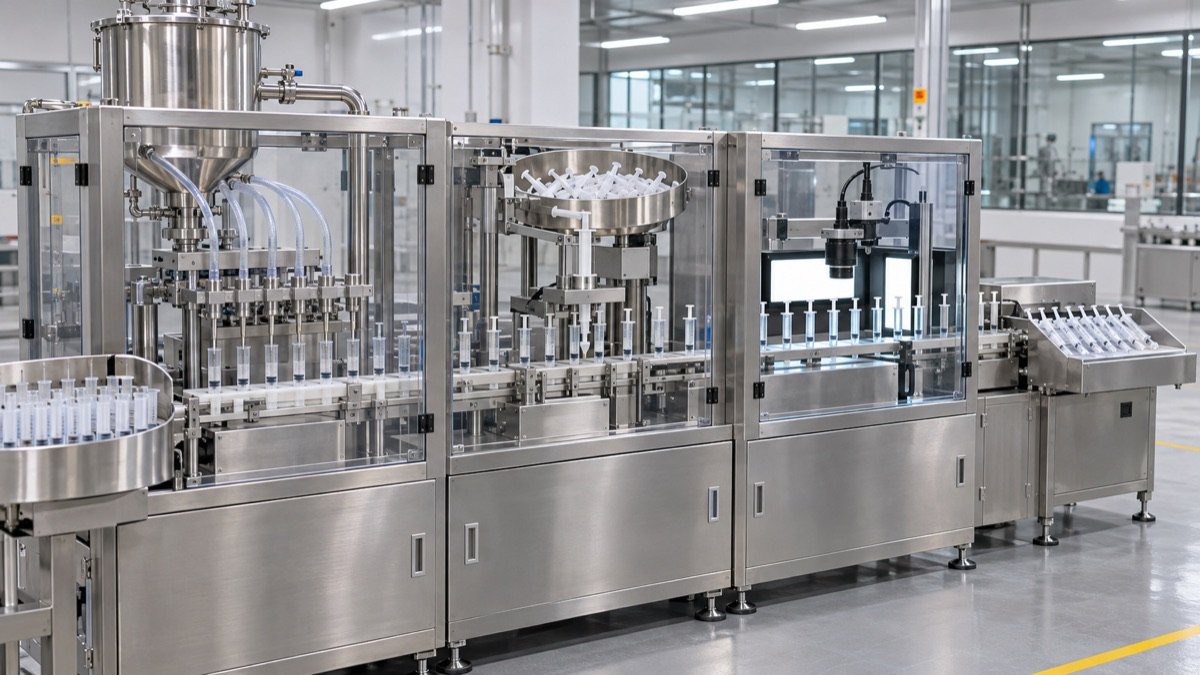
For project planning, capacity should mean the number of accepted syringes available for the next agreed step over a defined period: a run, shift, week, or year. A filling head may be capable of cycling at one rate while the complete line is constrained by syringe feeding, product replenishment, plunger insertion, tip or cap application, inspection, tray loading, cartoning, or a manual handoff.
Before requesting a calculation, define the period and the scope. Ask whether the figure covers filling only, filled-and-closed syringes, or fully inspected and transferred units. This prevents a common RFQ problem: two suppliers may use the word “capacity” while measuring different endpoints.
Use a saleable-output model
A practical planning model is:
Estimated saleable units = bottleneck rate × planned productive time × accepted-unit factor
Each term must be tied to the final proposed configuration. “Planned productive time” is not simply the length of a shift. It is the planned production window after planned non-running activities have been accounted for. The accepted-unit factor is not a generic industry percentage; use the site’s historical data where it exists, or define a conservative project assumption that will be checked during testing.
| Input | What to define | Typical data owner |
|---|---|---|
| Demand period | Required saleable syringes per run, shift, month, or year; any buffer policy. | Buyer planning / operations |
| Format mix | Syringe sizes, barrel geometry, plunger or closure variants, and planned mix. | Buyer technical team |
| Bottleneck rate | Rate of the slowest applicable connected station for the defined product and format. | Equipment supplier, confirmed with buyer |
| Planned productive time | Available time after planned changeovers, cleaning, checks, breaks, and other scheduled activities. | Operations / production planning |
| Acceptance factor | Fraction of output meeting the agreed quality criteria at the chosen measurement point. | Quality and operations |
| Constraints and buffer | Replenishment, downstream handoff, maintenance plan, demand peaks, and contingency approach. | Cross-functional project team |
Map the complete syringe line before choosing a bottleneck
Capacity analysis begins with a process map. For a veterinary application, the applicable sequence may include empty-syringe feeding, product transfer and filling, plunger insertion or other closure handling, visual or automated inspection, reject handling, and transfer to a downstream packing step. Not every project uses every station, and the exact order depends on the package and process.
For each station, note the normal flow path, the component feed method, the accumulation available between stations, and what happens when that station stops. A station that intermittently waits for components or for an operator can constrain a line even if its nominal mechanical cycle looks fast on its own.
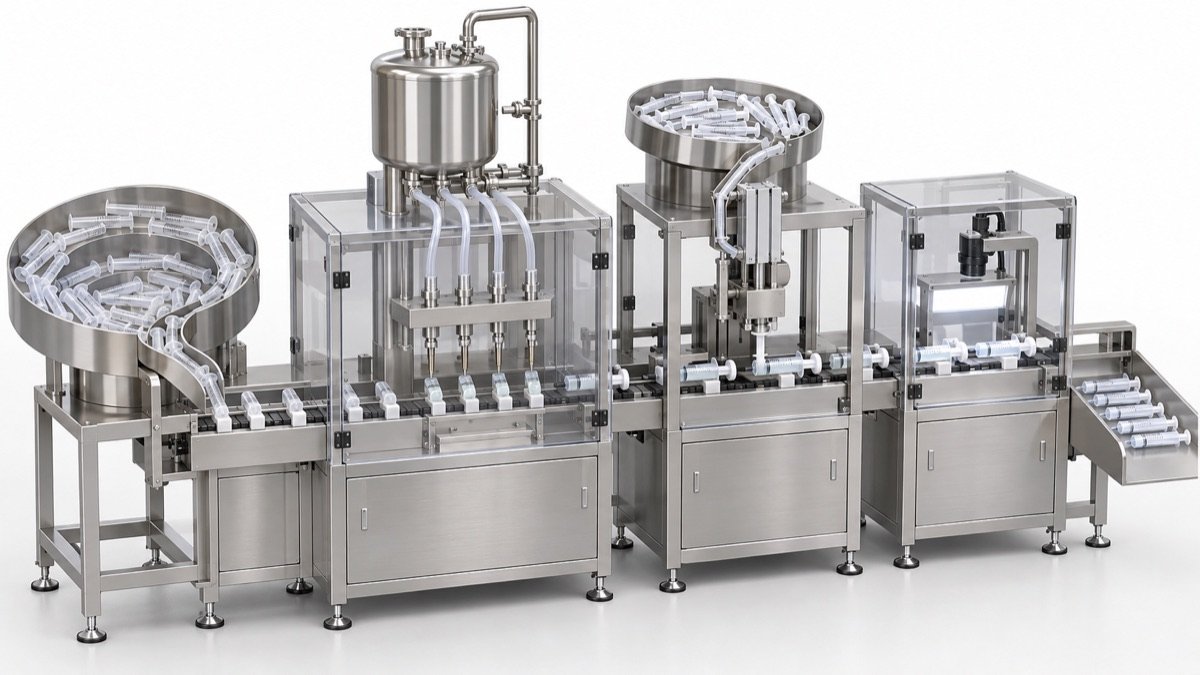
When reviewing a syringe filling machine, also include the upstream and downstream interfaces that are supplied by the site or another vendor. A product vessel that needs frequent replenishment or a packaging handoff with limited accumulation can determine line output even when it sits outside the filler supply scope.
Rated speed is not automatically sustainable line output
Rated speed is useful, but it needs context. It may describe a station under a particular product, syringe format, operating sequence, and test condition. It does not by itself state how much time is lost to planned work or how many units will pass the buyer’s acceptance criteria. A buyer should therefore ask what configuration and test sequence support any stated rate, and what evidence will be available at FAT and site trials.
It is equally important not to assume that the filling station must be the constraint. Component orientation, closure placement, inspection dwell time, product-flow stability, or the interface to a packaging machine range may become the controlling step. The right question is: Which applicable station has the lowest proven sustainable rate for this product, format, and operating sequence?
Account for time that is planned not to produce
Separate scheduled time from planned productive time. Depending on the site, planned non-running time may include format changeovers, cleaning, product preparation or replenishment, line clearance, quality sampling, routine checks, breaks, planned maintenance, and start-up or shutdown activities. These are not failures in the calculation; they are normal parts of an operating plan and should be made visible.
For a mixed-format line, build the model around the actual sequence of batches. A small syringe, a different plunger, or a change in product rheology can require a different setup and may define the practical rate for part of the schedule. Do not average formats before confirming that their time requirements are comparable.
Illustrative calculation: show the method, then replace the assumptions
The following example demonstrates the calculation only. It is not a claim about a King Pack machine, a product, or a production site.
| Illustrative input | Example value | Why it must be verified |
|---|---|---|
| Defined bottleneck rate | 100 units per minute | Must reflect the actual format, product, connected stations, and agreed test sequence. |
| Planned productive time | 100 minutes | Must exclude the site’s planned changeover, cleaning, and other scheduled activities. |
| Accepted-unit factor | 0.95 | Must come from approved assumptions or actual acceptance data. |
| Illustrative result | 100 × 100 × 0.95 = 9,500 saleable units | This is a method demonstration, not a capacity guarantee. |
In an RFQ, replace every example value with a documented source. If no history exists, identify the assumption as provisional and assign how it will be verified. This is especially important when product viscosity, settling behavior, foaming tendency, component tolerances, or closure design may affect the line’s stable operating sequence.

Include quality loss without inventing a reject rate
The accepted-unit factor should reflect the agreed measurement point and the buyer’s own quality approach. It may include rejection at a defined inspection step, but it should not be copied from a generic online benchmark. Existing operations can use their own period-specific, format-specific data. New projects should identify the factor as an assumption and define how sample runs, commissioning, and acceptance testing will evaluate it.
Keep the distinction between a unit that has been filled and a unit that is accepted. If later stations reject, quarantine, or rework a unit, the team needs to agree whether those units are included in the capacity metric. Clear terminology makes supplier comparisons more meaningful and prevents a quote from appearing higher simply because it counts output earlier in the process.
Turn the calculation into RFQ and FAT evidence
A useful technical proposal states the configuration, test format, product information, intended operating sequence, and capacity measurement point. It should also identify site-supplied interfaces that may constrain the result. Provide representative syringes, plungers or closures, and product information early enough for the agreed test approach. Where appropriate and agreed, representative materials can be used during a factory acceptance test to document the supplied scope before shipment.
At the site, treat the capacity model as an installation-and-commissioning document rather than a one-time quotation calculation. Confirm utilities, product feed, components, operator roles, inspection method, and downstream handoff before comparing a trial to the model. For veterinary projects, a veterinary medicine filling solution should be discussed as an integrated process, not only as a filling head.

Capacity-planning checklist
- Define the period, required saleable units, and the exact point where output is counted.
- List every syringe size, component variant, product behavior, and batch pattern in scope.
- Map every applicable station and identify the slowest sustainable connected step.
- Separate planned productive time from cleaning, changeovers, checks, replenishment, and other planned activities.
- Use buyer-specific accepted-unit data when available; otherwise flag the factor as an assumption for testing.
- Confirm the ownership of product feed, component feed, inspection, downstream handoff, and accumulation.
- Write the format, product, sequence, measurement point, and evidence requirements into the RFQ and FAT plan.
Frequently asked questions
How do I calculate veterinary syringe filling-line capacity?
Multiply the bottleneck rate for the agreed line scope by planned productive time and by the accepted-unit factor. Define each input for the actual syringe, product, operating sequence, and output measurement point.
Is filling speed the same as complete-line capacity?
No. Filling speed is only one station measure. Complete-line capacity can be limited by component feed, closure handling, inspection, product replenishment, or downstream packaging handoff.
What is the bottleneck on a syringe line?
It is the applicable connected step with the lowest sustainable rate for the agreed configuration. It should be identified from the final line map, not assumed from the filler alone.
How should changeovers be included?
Record them as planned non-productive time in the defined production period. For mixed formats, model the actual batch sequence rather than using a simple average.
Should I use a standard reject percentage?
No. Use site-specific accepted-unit history when available. For a new project, state the factor as a provisional assumption and define how it will be checked during agreed testing.
What should I send with an RFQ?
Share expected demand, time period, shift pattern, syringe and closure drawings or samples, product behavior, format mix, cleaning expectations, upstream/downstream interfaces, and the exact output point to be counted.
Plan with a documented model, not a headline number
Capacity planning becomes more reliable when it turns a single speed figure into a shared set of technical assumptions. The buyer defines the demand and operating context; the supplier defines the proposed machine scope and configuration; quality and operations define how accepted units and planned time will be measured. The resulting model can then guide quotation, testing, installation, and future scale planning.
King Pack Machinery can review syringe formats, product-handling needs, line scope, and the capacity inputs available for your project. Request a technical quotation with your demand and format details, or contact King Pack Machinery to discuss a configuration-specific line proposal.