
Choosing between hot-air and ultrasonic tube sealing depends on laminate construction, tail geometry, product contamination risk, decoration sensitivity, required appearance and the process evidence available from a representative trial. Neither method is automatically better for every tube. The correct decision is the one that creates a stable seal window and fits the customer’s filling, cleaning and inspection procedure.
This guide compares the two methods for laminated plastic tubes. It starts from the correct process sequence: the open tail is filled, the tube is indexed to the sealing station, the tail is closed, and downstream embossing, trimming or coding is completed when specified.
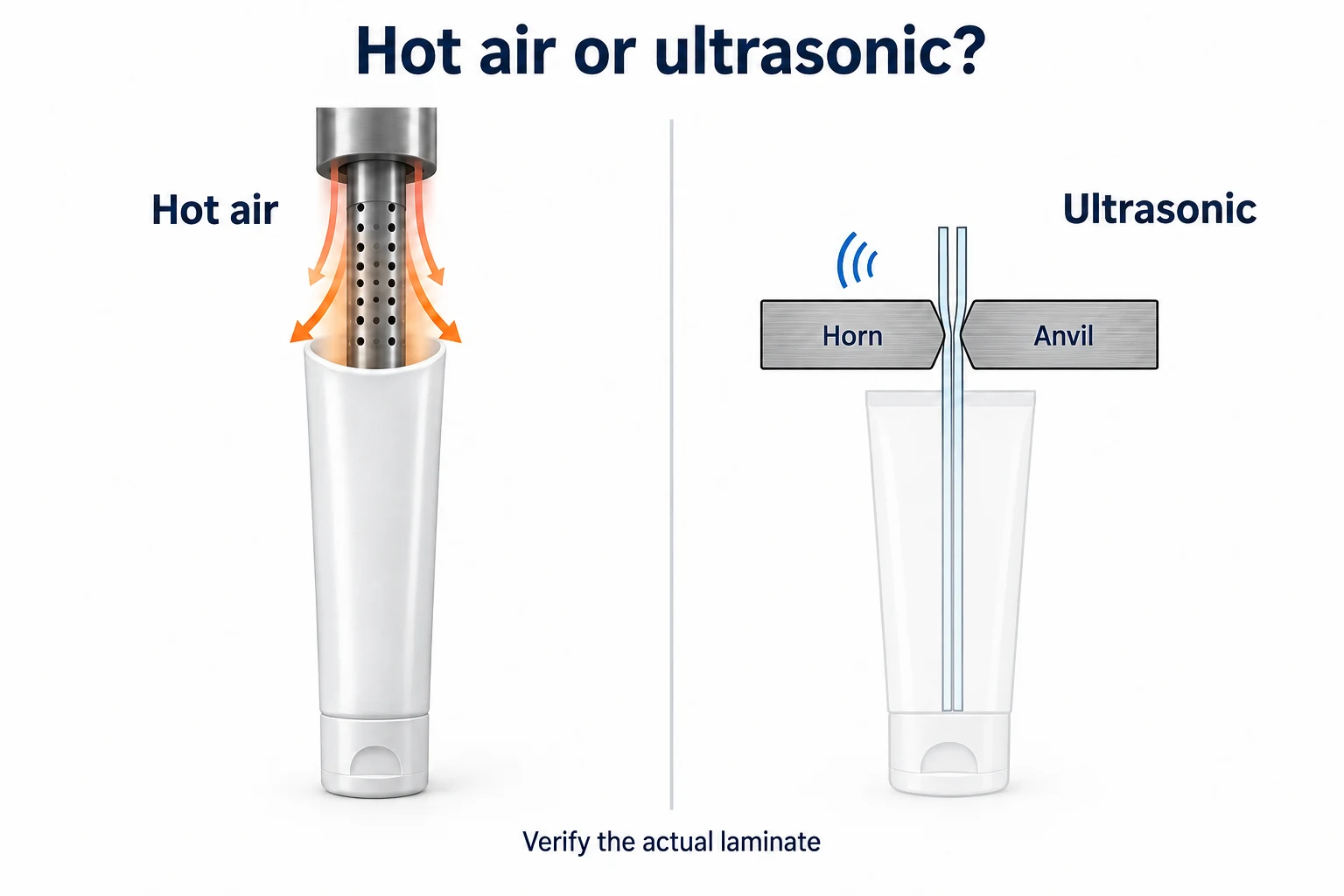
What hot-air sealing does
Hot air raises the temperature of the tail layers so jaws can form the closure. The process is familiar, flexible and suitable for many PE or laminate tubes. Its performance depends on air temperature, flow, dwell, jaw pressure, alignment, cooling and tail cleanliness.
Strengths
Hot air can support a broad range of tube sizes and seal profiles when the laminate is compatible. The heating station can be adjusted for the material and the machine can integrate embossing, trimming and coding after the seal. The method is easy to inspect visually because the tail profile is visible.
Limits
Heat can affect nearby decoration or product if the settings are too aggressive. A long warm-up, unstable airflow or residue in the tail can narrow the process window. The supplier should prove the actual laminate rather than rely on a generic “plastic tube” claim.
What ultrasonic sealing does
Ultrasonic sealing uses high-frequency vibration at the horn and anvil to create localized heat in compatible thermoplastic layers. It can limit broad heat exposure and may be useful when decoration or product temperature is sensitive. The result depends on layer structure, horn geometry, contact pressure, amplitude, energy and hold time.
Strengths
Ultrasonic sealing can provide a compact station and controlled energy delivery. It may reduce the heat-affected area around the seal. In a suitable laminate, the cycle can be repeatable when the horn, anvil and tube position are stable.
Limits
It is not universal. The laminate must respond to the ultrasonic process and the horn must match the seal profile. Tool alignment, tube stiffness and product contamination are important. A trial with the actual tube construction is essential.
Material compatibility comparison
Review each laminate layer, thickness, tie layer, decoration location and tail finish. Ask the tube supplier for recommended sealing conditions. Two tubes with the same outer appearance may have different inner layers and different sealing behavior.
Tail cleanliness
Both methods require a clean seal zone. The filler must dose through the open tail, retract cleanly and leave enough material above the product for closure. A stringy cream or overfill can contaminate either hot-air jaws or an ultrasonic horn. The filling and sealing process should be tested together.
Parameter windows
Hot-air parameters
Record air temperature, airflow, heater warm-up, dwell, jaw pressure, cooling and line speed. Measure temperature at a defined point and verify it after a pause. Check both sides of the tail and compare the seal profile with an approved sample.
Ultrasonic parameters
Record amplitude, energy, weld time, pressure, hold time, horn part number and anvil. Define an acceptable window rather than one unexplained setting. Test both station positions if the line has dual sealing stations.
Appearance and integrity inspection
Inspect seal width, wrinkles, incomplete closure, marks, decoration damage, product contamination and code position. Add a leak or integrity test suitable for the package. Define sample quantity, conditioning and acceptance criteria before FAT. Use the same method during commissioning.
Changeover and cleaning
Hot-air changeover may involve heater position, jaws and recipes. Ultrasonic changeover may involve horn, anvil, guides and energy settings. Label all format parts and save the approved recipe. Cleaning should include nozzle, pump outlet, holder and sealing tools. Avoid abrasive cleaning that changes a horn face or jaw profile.
FAT and installation preparation
Run representative laminate tubes with the actual product when possible. Compare hot-air and ultrasonic samples if both methods remain under consideration. Record dose, seal, integrity, code, reject handling and changeover. Shipment inspection should protect heaters, horns, jaws, guides and spare kits. Confirm power, air, floor access and operator training before site acceptance.
Decision checklist
- Which laminate layers must be sealed?
- How sensitive is the decoration to heat?
- What product may remain in the tail?
- Which method has a wider validated window?
- Which tooling and spare parts are required?
- What inspection evidence will release the process?
Discuss your requirements: Send your laminate drawing, tube samples, seal profile and product information to King Pack for a method comparison and trial plan.
Use a selection matrix before choosing a technology
Begin with requirements the package must meet, then compare how each method addresses them. Avoid awarding a process a high score merely because it has a shorter heating description or more attractive demonstration. The same laminate may respond differently when its tail width, longitudinal seam or printed finish changes.
| Decision factor | Hot-air review | Ultrasonic review |
|---|---|---|
| Material | Sealing layer and heat response | Sealing layer and acoustic response |
| Tooling | Air tooling, support and clamping | Horn, anvil and contact geometry |
| Process control | Air delivery, time and closure condition | Energy, amplitude, force and hold |
| Appearance | Wrinkles, distortion and decoration | Tool impression, thinning and marking |
| Changeover | Format parts and heat setup | Format tools and acoustic setup |
| Evidence | Finished-pack tests across conditions | Finished-pack tests across conditions |
Ask for the actual layer structure
The terms plastic, laminate and aluminum barrier describe broad packaging families. They do not identify every sealing layer or construction detail. Obtain the drawing revision, material information and production samples from the tube supplier. A foil barrier inside a laminate does not turn the pack into a collapsible metal-body tube requiring a folded tail.
The Tube Council’s sealing overview provides context for the different closure methods used with tube packaging. Use that industry reference to frame the discussion, then base the equipment decision on the particular tube and finished-pack results.
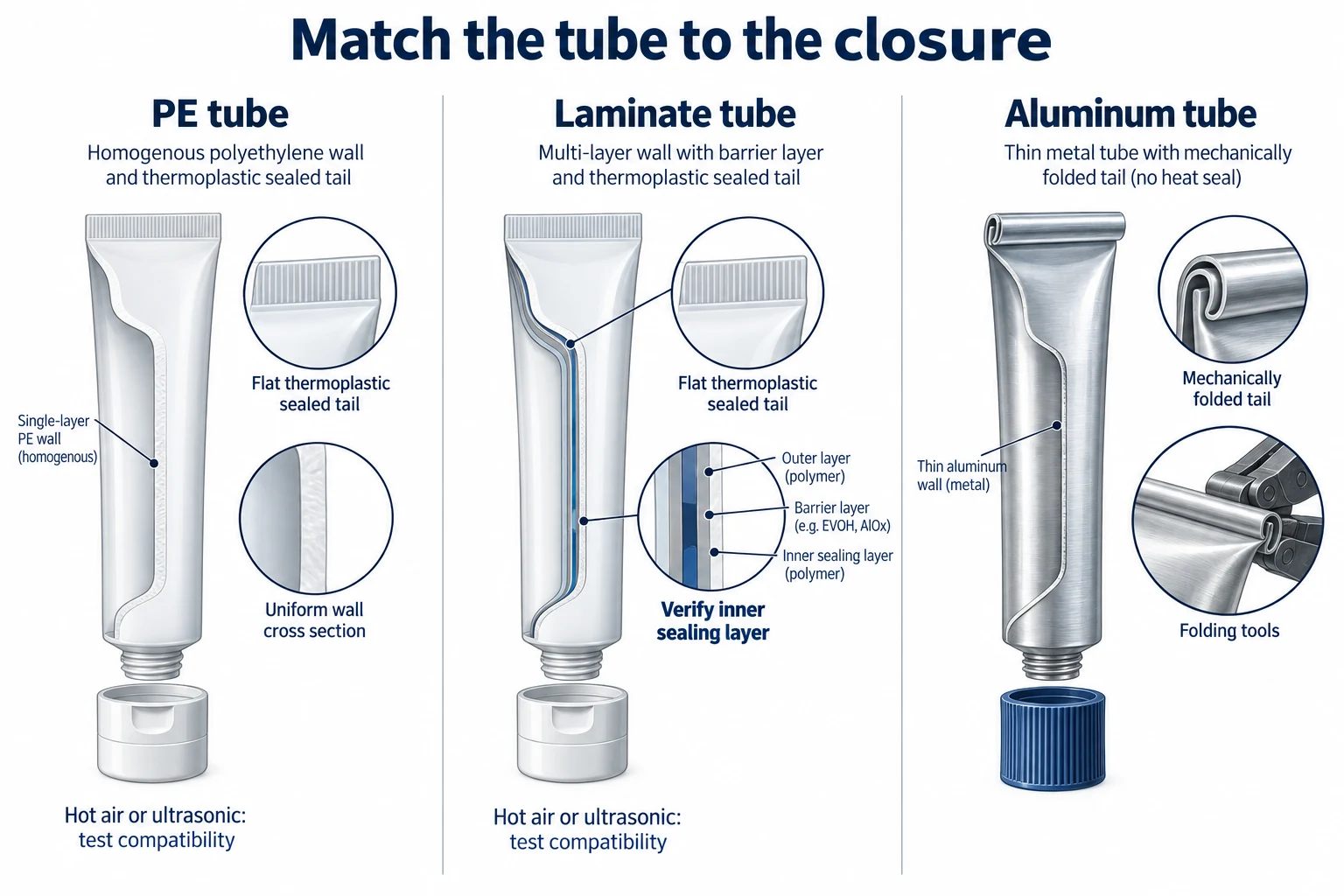
Compare heat exposure carefully
Hot air applies heat to the tail before clamping. Ultrasonic welding generates heat locally through the vibration process. Calling ultrasonics a process with no thermal effects would therefore be misleading. Ask where the product and decoration may be affected, what the permitted conditions are and how the trial will observe them.
Product sensitivity needs a product-specific answer
A temperature-sensitive cream may justify a closer review of tail heating and product clearance. That does not prove that one closure method is automatically suitable. The product owner should identify the relevant quality limits, while engineering records the operating conditions. Keep any laboratory or stability conclusions separate from a brief machine run.
Likewise, a short ultrasonic cycle does not prove a lower total operating cost. Compare the full arrangement, including controls, tooling, utilities, cleaning, start-up and service. State the conditions behind any energy or productivity measurement rather than borrowing figures from unrelated equipment.
Design a fair side-by-side trial
If both technologies remain candidates, agree a trial plan before samples are prepared. Use the same tube construction, representative product and finished-pack criteria where feasible. Record material lots and identify any differences between the two test arrangements. An attractive sample from one system and an unstable setup on another do not make a fair comparison.
Establish each process’s own setup
Do not carry a hot-air setting into an ultrasonic test or vice versa. Each technology needs appropriate tools and a justified operating window. Allow the supplier to establish a suitable setup within agreed limits, then retain that configuration and the resulting samples for review.
Inspect both acceptable and defective samples. Record wrinkles, channels, contamination, excessive marks and damage after trimming. If the test has multiple stations, identify the source of every sample. A common average can conceal a problem isolated to one fixture or closure head.
Include the normal operating disturbances
Consider start-up, a planned pause, restart, product refill and a representative tube-lot change. The purpose is to examine conditions the customer expects to encounter, not to create unsafe extremes. A process that produces one acceptable tube but is difficult to recover after a normal pause may need a different control or operating procedure.
Define the integrity method, sample conditioning and acceptance rule before comparing the results. A visual inspection and a package leak test answer different questions. Use the package owner’s methods and keep raw observations so the conclusion can be reviewed later.
Review maintenance and changeover as part of the decision
Hot-air systems may require attention to heating components, air paths and format tooling. Ultrasonic systems require correct acoustic components, horn and anvil condition and tool identification. Neither arrangement should be described as requiring no maintenance. Ask how the site recognizes wear and which tasks require specialist support.
Tool replacement and future formats
Identify the supplied tools by part number and approved tube range. Ask what is required for a new tail width or seal profile. If a new ultrasonic horn is needed, clarify how it will be specified and installed. For hot air, clarify which air and support parts change with the format. Keep these requirements in the quotation.
Compare the complete changeover procedure, including removal, cleaning, installation, recipe selection and first-piece approval. A statement that a tool can be changed quickly may omit the work needed to approve the next pack. Use the customer’s actual format pattern when evaluating that difference.
Compare commercial scope without invented savings
Ask each supplier to separate the base machine, sealing module, format kits, inspection, coding, spares, training and installation. Include any dedicated power or utility support. A price comparison is useful only when the proposals cover the same required functions and evidence.
Use lifecycle questions rather than universal cost claims
How many tools must be stored? Which parts need regular inspection? Who can service the system? What happens if the tube supplier changes? How does a fault affect the rest of the line? These questions reveal practical operating costs without inventing a payback period or claiming that one technology always saves energy.
The King Pack tube filling and sealing range includes different closure routes. Ask for a proposal identifying which configuration suits the samples, what remains conditional and how the final method will be accepted.
Make the final decision traceable
Write a short decision record with the product, tube drawing, tested configurations, inspection methods and reasons for selection. Include unresolved risks, additional work and the person who accepts them. This record helps engineering explain the choice if a later material or product change requires reassessment.
Keep factory and site responsibilities separate in the service and documentation scope. A factory can demonstrate tooling and function, while the destination must still confirm installation and production-specific conditions.
Compare the methods using your tubes: Submit the laminate drawing, product behavior and required seal profile through the King Pack technical enquiry form to plan the appropriate trial.
A hypothetical comparison for a multi-format buyer
Consider a plant planning one large cream tube and one smaller laminate gel tube. Both processes appear mechanically possible, but the customer also needs frequent changeovers and a sensitive printed finish. This is an illustrative purchasing scenario, not a report of a King Pack project. The purpose is to show how requirements change the comparison.
First, separate mandatory requirements
List the pack’s dose, closure-integrity, decoration and code requirements as pass/fail conditions. A process that cannot meet a mandatory condition should not gain approval because it has an attractive equipment feature. Next list operational preferences, such as changeover access, utility arrangements and staffing. Keep those preferences separate from the release criteria.
For the larger cream tube, the trial may focus on clean cut-off and the wide tail profile. For the smaller gel tube, support and tool contact may deserve more attention. The relevant challenges come from the samples and risk review. Avoid assuming that the same method will have the same advantage on both formats.
Then examine the evidence behind each preference
If one option seems easier to change over, ask the intended operators to demonstrate the full procedure. If one seems more tolerant of a tube-lot change, examine identified samples from both lots. If one seems gentler to decoration, inspect the complete pack after normal handling and compare against the approved artwork criteria.
Keep the trial’s limits visible. A test using one finish does not establish performance for all printed tubes. A short run without downstream trimming does not establish the final tail appearance. When evidence is missing, assign a follow-up rather than treating an assumption as a benefit.
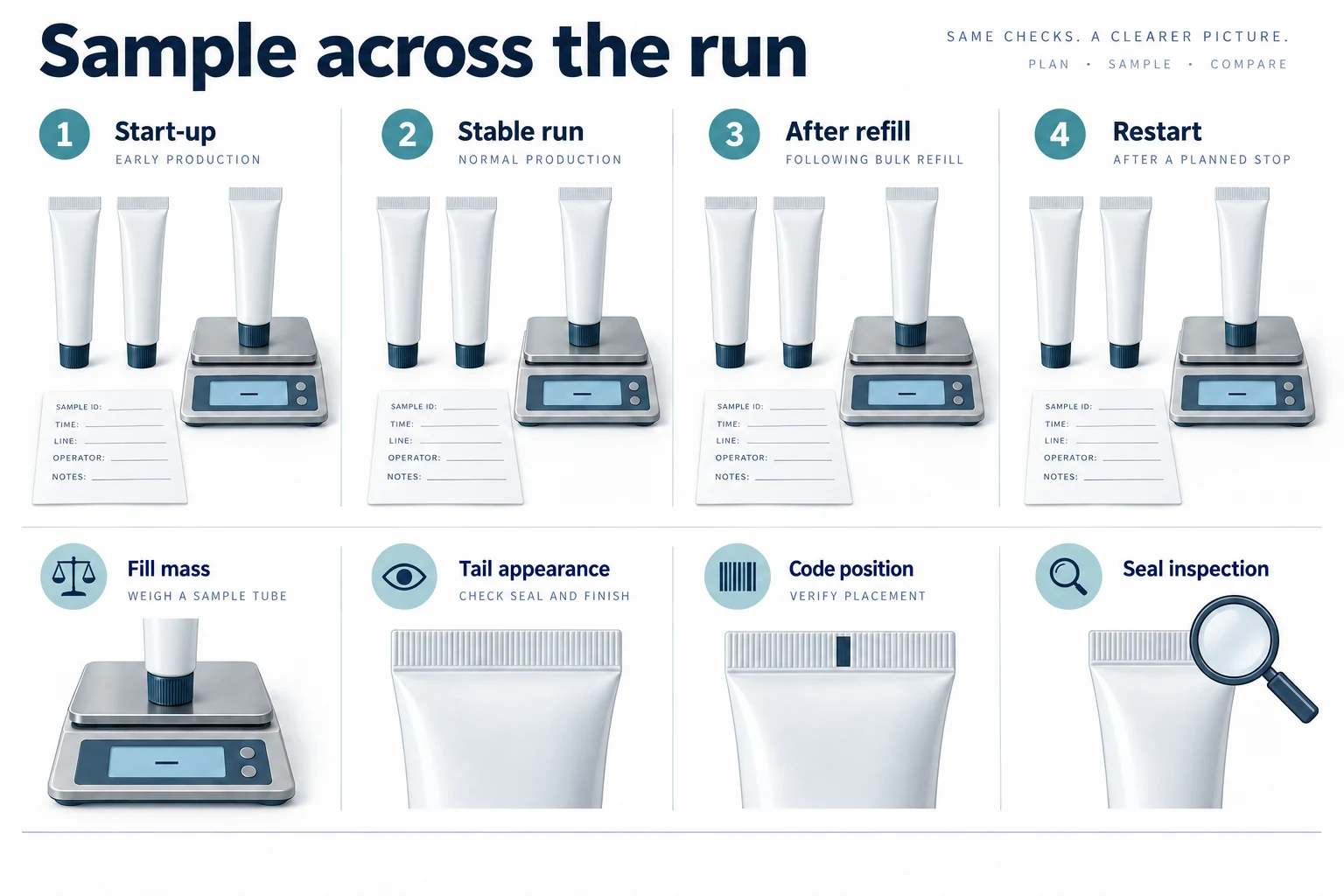
What if both processes pass?
If both methods satisfy the package requirements, choose using documented operating needs. Compare tools, training, service access, available space, utility connections and the expected product portfolio. The decision can reasonably differ between plants even when the same laminate is used.
What if neither process has a stable window?
Review tube construction, product contamination, fixture support and acceptance expectations before requesting more automation. The problem may involve a package or formulation condition that neither sealer can solve alone. Include the tube supplier and product owner in the review. More power, more heat or a shorter cycle is not automatically the missing solution.
Record the reason for any material or tooling revision and repeat the affected checks. A revised sample should have a new identity so it cannot be confused with the original candidate. This keeps the final comparison defensible and prevents a purchasing decision based on samples made under different, undocumented conditions.
Which records should accompany delivery?
Keep the selected tube drawing, closure tools, approved recipe, sample results, inspection method, changeover instructions and open actions together. At commissioning, compare the installed arrangement with that file before repeating the first-piece checks. The record should make the chosen technology understandable to the production team that will operate it every day.
FAQ
Is ultrasonic always cleaner than hot air?
No. Both methods require a clean tail and correct cut-off. Cleanliness depends on the complete filling and sealing process.
Can the same laminate use both methods?
Possibly, but each method needs its own tooling and validated parameters. Test representative samples.
Which method is easier to change over?
It depends on tube formats, tooling and recipe management. Compare the complete changeover, cleaning and first-piece approval.
Is ultrasonic sealing a completely cold process?
No. Local heat is generated at the interface during bonding. Review the actual material and exposure rather than describing the process as having no thermal effects.
Should I choose using rated speed alone?
No. The required dose, closure, inspection, changeover and downstream handling determine useful production performance. Compare complete representative trials and the operating support needed for the intended formats.
Can changing tube suppliers affect the choice?
Yes. Review the sealing layers, dimensions and finished-pack evidence when the construction changes, even if the tube has the same nominal size.
Conclusion
Compare hot air and ultrasonic sealing from material compatibility, product behavior, inspection evidence and lifecycle support. Use representative factory trials and document the parameter window before approving the machine.
Request a technical review: Contact King Pack for a laminated-tube sealing review, sample trial and FAT checklist.
Equipment planning resources
The sealing method should be evaluated with the tube material, product, filling process and downstream inspection plan. See our tube filling machine range and tube sealing equipment pages for the machine functions that normally sit around the closure step.
For application context, compare the cosmetics packaging solution, pharmaceutical packaging solution and veterinary medicine solution. You can also review filling and capping line integration and the wider packaging solutions overview.
Before requesting a proposal, document the laminate structure, tail dimensions, product viscosity, fill volume, decoration limits, cleaning method and inspection requirements. Our related guidance on tube filling and sealing machine selection, choosing a tube filling machine and tube sealing quality control can help structure that information.
To compare a hot-air or ultrasonic configuration for your own tube, contact our technical team, send your requirements for a quote or review the product catalogue. Include sample tubes or drawings where available so the sealing interface can be assessed against actual material and geometry.
Need help choosing between hot air and ultrasonic sealing? Send the tube material, tail dimensions, product information and target inspection checks through our request-a-quote form for a structured equipment discussion.