
A double-head tube filling machine uses two filling heads or two coordinated dosing positions to fill tubes in parallel. It can be useful when a product owner needs more output from a compact footprint, wants to run two compatible products, or needs a practical bridge between a single-head machine and a larger automatic line. The correct configuration depends on tube size, product behavior, sealing method, changeover frequency and the level of operator involvement available at the plant.
This guide explains how to assess a double-head system before purchase. It focuses on the real engineering questions that affect a successful project: whether both heads can maintain the required dose, how the tube indexing sequence works, how the open tail is presented for filling, how sealing is controlled, and which tests should be completed before shipment.
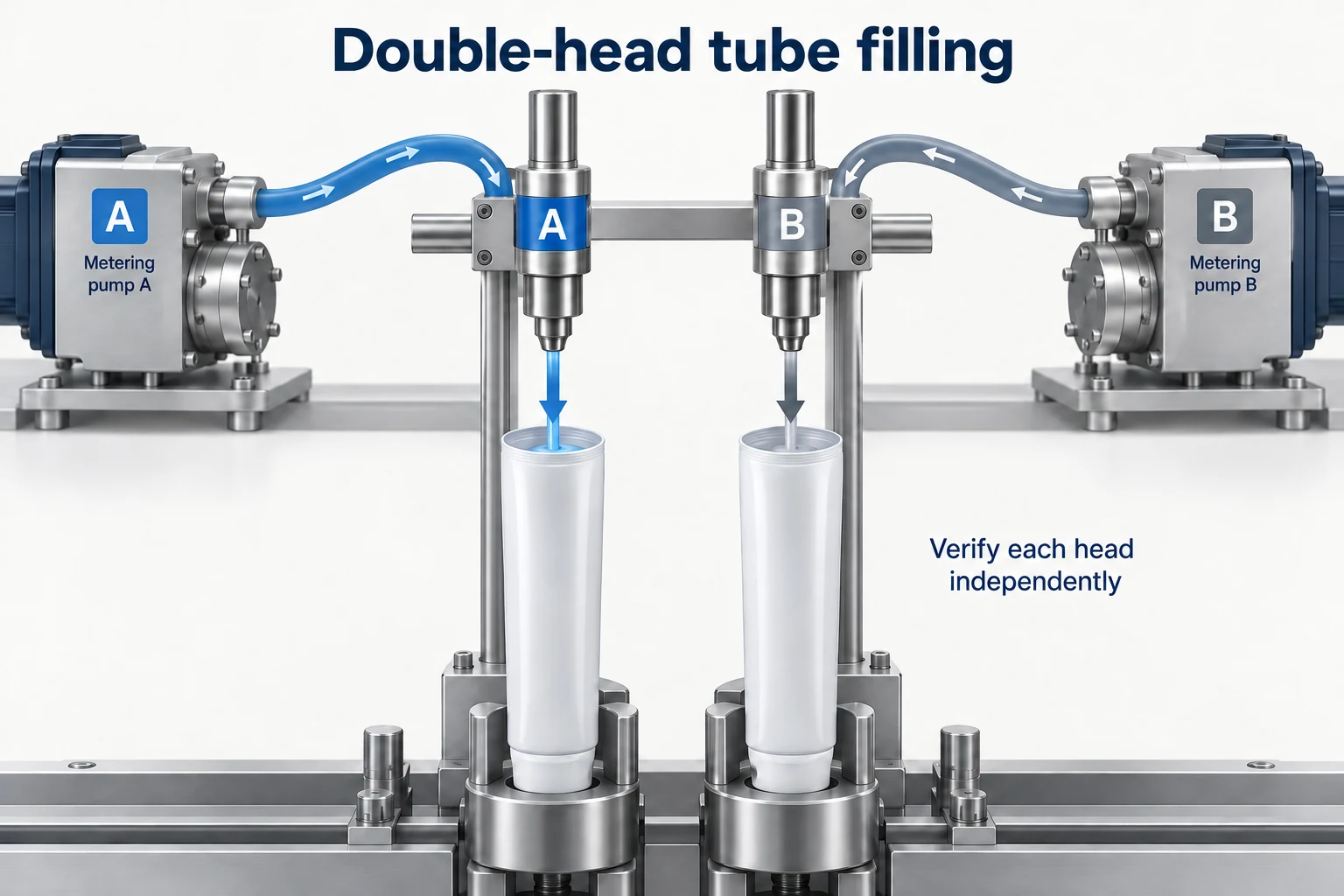
What a double-head tube filler actually changes
The second head changes the balance of the machine. Product supply, tube loading, indexing, dosing, tail sealing and discharge must stay synchronized. A supplier may describe the equipment as “two-head,” but that label does not by itself define the production arrangement. Some machines fill two tubes at one station, while others use two independent lanes or two alternating heads. Ask for a layout drawing and a step-by-step cycle description.
Parallel filling versus alternating heads
Parallel filling places two tubes under two nozzles during the same filling cycle. This can shorten the time per pair of tubes, but the pump, manifold and mechanical structure must provide consistent flow to both positions. Alternating heads use one product circuit with two timed positions. This may simplify dosing control but changes the indexing rhythm. The best option depends on the formulation and the customer’s target batch pattern.
Applications that justify two heads
Higher output for a stable SKU
A stable cream, gel or paste with a repeatable tube format can benefit from two filling positions when the single-head machine is constrained by dosing time. Before choosing this arrangement, check whether the downstream hot-air or ultrasonic sealing station can handle the same rhythm. Increasing filling speed without matching sealing and discharge capacity creates a queue inside the machine.
Some contract manufacturers use a double-head platform for related products with the same tube diameter and similar flow behavior. The product circuits may be shared or separated depending on hygiene and cleaning requirements. A shared circuit may reduce cost and simplify the frame, while a separated circuit can reduce cross-contact risk. This decision must be made from the formulation and sanitation procedure, not from the number of heads alone.
Small and medium batch production
Two heads can also support a plant that has several medium-volume orders but does not need a high-speed monoblock. A modular machine lets the team change tooling, recipes and coding settings between campaigns. The purchasing team should calculate the total changeover time, not only the theoretical filling rate.
Tube presentation and filling sequence
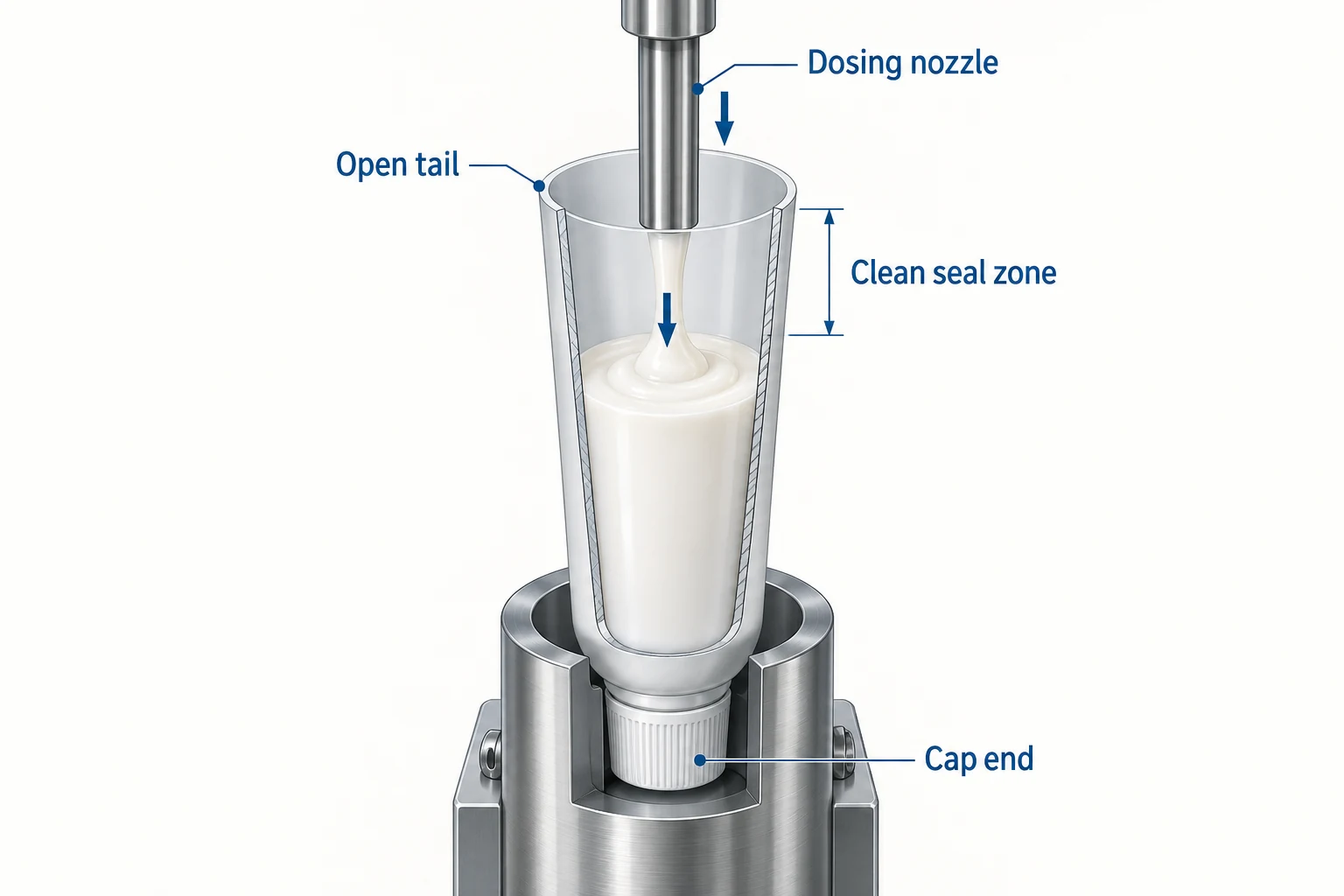
In a correct tube process, the open end of the tube tail faces upward during filling. The tube is loaded into a pocket, aligned under the dosing nozzle, and filled through the unsealed tail. After dosing, the tube moves to the appropriate heating or sealing station. A finished tube is never filled through its already sealed shoulder or cap end.
Tube holders and centerline control
Two heads make centerline control more important because a small height or position difference can create visibly different fill levels. The holder should support the tube without crushing the body. Review tube diameter tolerance, body length, tail width and any shoulder deformation that may affect insertion. If several tube suppliers are planned, request representative samples before tooling is finalized.
Nozzle spacing and product stringing
Nozzle spacing should match the tube pocket pitch and allow operators to clean the product-contact area safely. For stringy creams or gels, the cut-off motion and nozzle lift need to be checked at the same time as the dose. A small difference between the two heads can cause one tail to remain clean while the other carries a product string into the seal zone.
Dosing architecture and accuracy checks
Double-head machines may use two piston pumps, a twin-cylinder arrangement, servo-driven pistons or a common pump with a balanced manifold. Each architecture has advantages. Independent pistons provide direct adjustment, while a common manifold may reduce component count but requires careful balancing. Ask how the recipe stores the dose for each head and whether the operator can make a controlled correction without changing the other position.
How to define a useful dose test
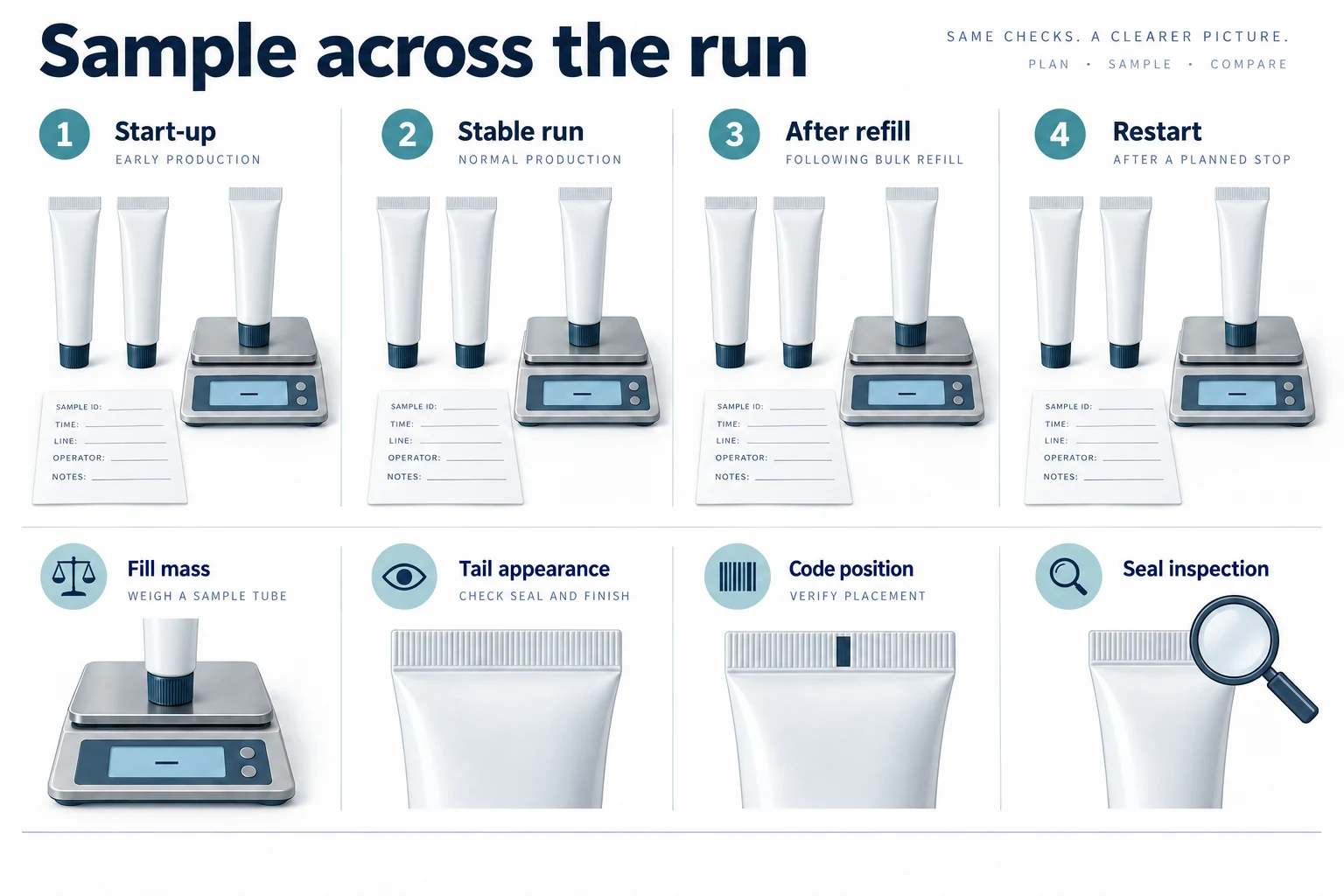
Define the target fill weight, product temperature, sample size and acceptance rule before the factory test. Test both heads separately and together. Include start-up samples, stable-run samples and samples after a short pause. Record the actual weights and the recipe version. If a substitute is used, label it clearly and confirm which results must be repeated with the customer’s toothpaste, cream, gel or paste.
Viscosity and temperature effects
Temperature changes can alter the flow behavior of creams and ointments. If the product needs warming, specify the allowable temperature range and the location of the temperature measurement. Do not assume that a heated hopper will produce the same result as a heated transfer hose. The customer’s process engineer should confirm whether heating is compatible with the formula and packaging material.
Sealing and downstream integration
Hot-air tube sealing
Hot-air sealing heats the open tail before the jaws form the seal. The heating profile, tail cleanliness and jaw pressure all affect the final appearance and integrity. On a two-head line, the seal stations must maintain consistent timing across both lanes. Check whether the machine supports a common heater or separate zones, and how operators adjust the settings during a material change.
Ultrasonic tube sealing
Ultrasonic sealing can be appropriate for compatible thermoplastic structures and may limit heat exposure around printed decoration. It requires a suitable horn, anvil, tube material and energy window. Validate the actual laminate rather than relying on a generic tube description. Ask how the supplier inspects the seal and how rejects are separated from acceptable products.
Embossing, trimming and coding
After sealing, the tails may be embossed, trimmed, coded or discharged. These functions must be positioned so that the two heads do not create a collision or accumulation problem. Request a sample of the final tube with the lot code, date code and trim profile. The sample is a better reference than a catalogue photograph.
Changeover, cleaning and maintenance
Changeover planning should cover both heads, not just the product path. Prepare a list of dosing pistons, nozzles, tube pockets, holders, sealing jaws, heaters or horns, coding parts and recipe parameters. Identify which parts are common and which are handed left or right. A clear labeling scheme reduces the risk of installing a component on the wrong station.
Cleaning access
Two heads double the number of small areas where residue may collect. Review nozzle removal, gasket access, hopper drainage and hose flushing. If the same machine will run different colors or pharmaceutical-style creams, define the line clearance method and inspection points. Cleaning time should be measured during a realistic trial, not estimated from a brochure.
Preventive maintenance
Ask for a preventive maintenance schedule for pumps, cylinders, sensors, indexing components, heaters, horns and jaw tooling. The schedule should state what the operator can inspect and what requires a qualified technician. Keep a small set of wear parts with the machine and document their identification numbers in the handover package.
Factory testing, shipment inspection and installation
A useful factory acceptance test begins with the same information used to approve the design. Run representative tubes, confirm the recipe, test both heads, inspect fill weights, inspect seals and verify the reject logic. If the customer cannot send the final product, choose a substitute with similar viscosity and document the limitation.
Shipment inspection should confirm machine dimensions, electrical cabinet labeling, air connections, guarding, spare parts and tooling. Photograph the packed machine and create a parts list before dispatch. At the customer site, installation preparation should include floor access, power, compressed air, product handling, drainage, operator space and safe access for cleaning.
Compare the proposed station and tooling scope with the tube filling and sealing equipment overview; suitability still depends on the actual product and tube samples.
Questions to ask before ordering
- Are both heads intended for one product, two products or two lanes of the same product?
- Can each head be adjusted and verified independently?
- Which tube materials and diameters have been tested?
- What is the sealing method and what evidence supports material compatibility?
- How are recipes, changeover parts and maintenance tasks documented?
- Which results will be included in the FAT and shipment inspection records?
Discuss your requirements: Send your tube drawings, product type, target fill weight and required sealing method to King Pack for a configuration review. We can identify the information needed for a meaningful double-head trial.
Layout and operator workflow
The operator workflow should be reviewed together with the machine layout. Decide where empty tubes arrive, where bulk product is staged, where finished tubes are collected and how rejected tubes are identified. A two-head machine may reduce the length of the filling cycle but increase the importance of loading consistency. If one tube is missing from a pocket, the controls should detect the condition and prevent an unwanted dose.
Recipe management
Use a documented recipe for tube format, fill weight, pump stroke, filling speed, nozzle lift, delay, sealing temperature or ultrasonic energy, coding position and reject timing. Keep the approved recipe separate from temporary trial settings. This record helps the production team compare a stable run with a later changeover and gives service staff a clear starting point.
Product-specific considerations
For creams, the priority may be a clean cut-off and a smooth seal area. For toothpaste, the team may need to manage air, abrasives or multiple colors. For gels, stringing and drip control can be critical. For ointments, temperature and shear history may affect the dose. The same two-head frame can support these products only when the dosing and cleaning configuration is matched to the formulation.
Small trial before purchase
A small trial can reveal whether the two heads respond similarly to the selected recipe. Prepare enough material to observe start-up and steady operation, then inspect filled tubes after sealing. Photograph representative samples and note the tube lot, product condition and settings. These records support the technical decision without making unsupported performance claims.
Commercial evaluation
Compare the complete ownership requirement: tooling, spare parts, operator training, cleaning time, utilities, service response and future format changes. A lower purchase price can be offset by complicated changeover or hard-to-source wear parts. Ask for a clear scope of supply and a list of exclusions so the installation team can plan the missing items early.
For contract manufacturing, also review how quickly the machine can be prepared for the next customer requirement. A flexible two-head platform is valuable when its recipes, tooling and inspection method are organized. Flexibility should be demonstrated with an agreed sample format rather than assumed from the machine name.
During commissioning, compare both stations after every meaningful adjustment. If a pump stroke is changed, inspect the first samples from both heads. If the product temperature changes, repeat the check after the machine reaches a stable condition. This simple discipline helps the team separate a mechanical alignment issue from a product-condition issue and gives the service record useful evidence.
Keep the final acceptance criteria practical: acceptable fill weight, acceptable seal appearance, code position, safe operation, repeatable changeover and documented operator training. These criteria can be agreed before the machine arrives and reviewed again during site acceptance.
Include training, spares and commissioning requirements in the equipment service and handover scope so the plant can prepare its own personnel and utilities.
Distinguish two nozzles from two independently controlled lanes
A drawing showing two heads does not establish how product and tubes move through the line. Ask whether one index presents two tubes at once, whether both heads share a manifold, whether each has its own metering chamber and whether one lane can stop independently. The answers affect troubleshooting, sanitation and the ability to run different products.
Fault isolation and usable output
If one head detects a missing tube, establish whether only that dose is inhibited or the complete cycle stops. If a seal station rejects one tube, preserve its lane identity. Otherwise a defect found at discharge may be difficult to trace back to the responsible head. Test these responses during the acceptance run using controlled challenge pieces.
For a shared product supply, verify distribution at low hopper level and during refill. Two accurate pumps can still behave differently if inlet conditions vary. For independent circuits, assess the extra cleaning, recipe and component-storage requirements. Running two products adds product-identity risk as well as mechanical flexibility.
Capacity calculation with assumptions
For planning only, saleable output can be estimated as cycles per minute multiplied by tubes per cycle, scheduled running minutes and observed good-product fraction. Add planned stops separately. This is a calculation framework, not a published machine rating. Use measured trial data only within its demonstrated conditions, and record whether both heads, sealing and coding were operating throughout.
A supplier should state how the quoted cycle changes for different fill volumes or tube materials. The slowest required operation may shift from dosing to heating, folding or discharge. Balance the complete cycle before deciding that a second head is the correct investment.
Send your specifications: Use the King Pack technical enquiry form to share the product profile, tube drawings and the conditions you need verified.
For paired heads, retain separate trend lines for fill mass and rejects. A combined total can conceal a deteriorating nozzle or valve on one side. Review each head after a tool change and identify the affected position on the maintenance record before returning the line to routine operation.
Questions for each two-head architecture
| Arrangement | Verify before purchase |
|---|---|
| Shared supply | Balanced inlet conditions |
| Independent circuits | Cleaning and product identity |
| Paired indexing | Missing-tube response per head |
| Two lanes | Reject identity and downstream balance |
FAQ
Is a double-head tube filler always twice as fast?
No. Output depends on dosing time, indexing, sealing, coding, cleaning and reject handling. Two heads can increase filling capacity, but the complete cycle must be balanced.
Can one double-head machine run plastic and aluminum tubes?
Only when the machine, tooling and sealing method are designed for both formats. Confirm tube compatibility and perform representative trials before approval.
How do I prevent one head from filling differently?
Use independent verification, balanced product supply, calibrated dosing components and a documented sampling plan. Check both heads during start-up and stable production.
What should be included in the FAT?
Include tube loading, open-tail filling, fill-weight checks, sealing, coding, reject handling, changeover and basic cleaning access. Record settings and sample results.
Conclusion
A double-head tube filling machine is a configuration decision, not simply a higher-speed label. It works well when product supply, tube handling, dosing, sealing and downstream operations are designed as one process. Confirm the tube and product requirements, run both heads during factory testing, inspect the shipment package and prepare the installation utilities before delivery.
Request a technical review: Contact King Pack with your tube size, product behavior, target output and preferred sealing method. Ask for a technical proposal, factory trial plan and installation preparation checklist.