 Skip to content
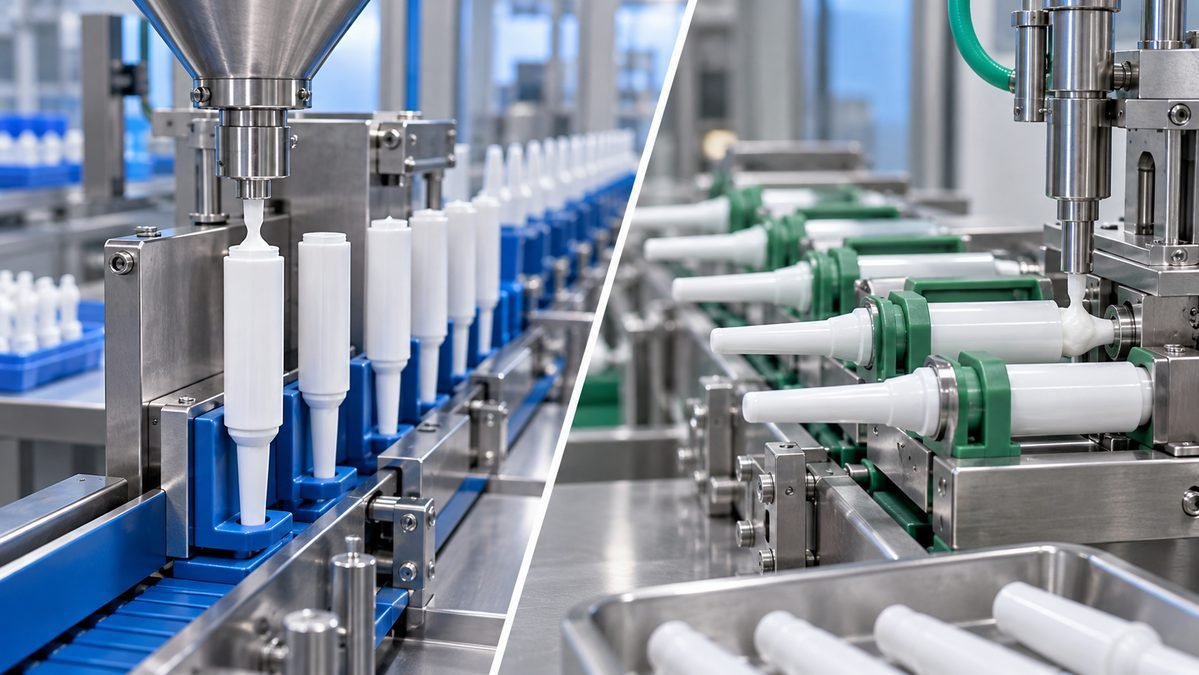
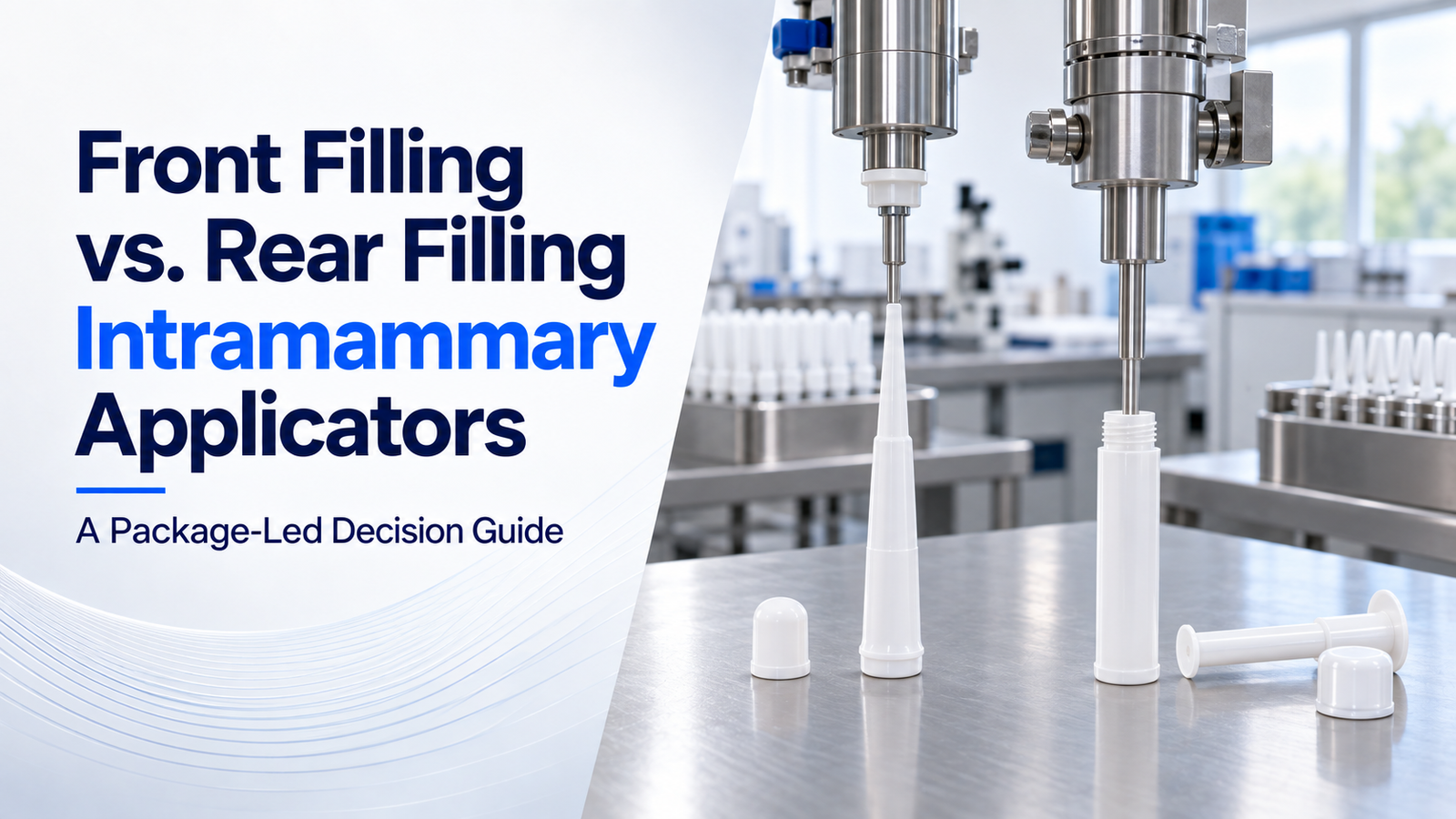
AI-generated illustration: select a front or rear filling route using the supplied applicator state.
Introduction
Front filling and rear filling are not interchangeable descriptions of the same intramammary applicator line. They are two routes through the package. The suitable route depends on how the barrel, cannula, plunger and cap arrive at the line, how the veterinary preparation behaves under pressure, and which final-package attributes the manufacturer needs to verify.
For an intramammary product, the applicator is normally a fine-tip, multi-part dose package rather than an injectable prefilled syringe. That difference changes the handling problem. The line must protect a narrow cannula, present the barrel consistently, transfer the product without uncontrolled residue at the tip, assemble the remaining components and hand off a finished applicator without damage. A drawing alone is not enough to prove the route. The project team should review physical component lots and a representative product during a factory trial.
This guide explains how to choose between front and rear filling without treating either route as universally better. It is intended for veterinary product manufacturers, engineering teams, QA staff and procurement managers preparing an intramammary filling project. It does not replace the manufacturer’s product assessment, packaging qualification or local regulatory responsibilities.
The direct answer
Choose front filling when the package design and assembly sequence require product entry through the cannula end before other components are fitted, and when the line can protect, locate and inspect that tip consistently. Choose rear filling when the barrel can be presented open at the rear, the product is better controlled through a rear-entry route, and the plunger can be inserted after filling without disrupting the dose presentation. The correct choice comes from the actual component supply state and trial observations, not from a generic syringe-filler brochure.
Need a filling-route review? Send the applicator drawing, empty barrel, plunger, cap and a description of the product. Our team can map the component sequence and identify the sample evidence needed before a quotation is finalized.
What “front” and “rear” mean on an intramammary applicator
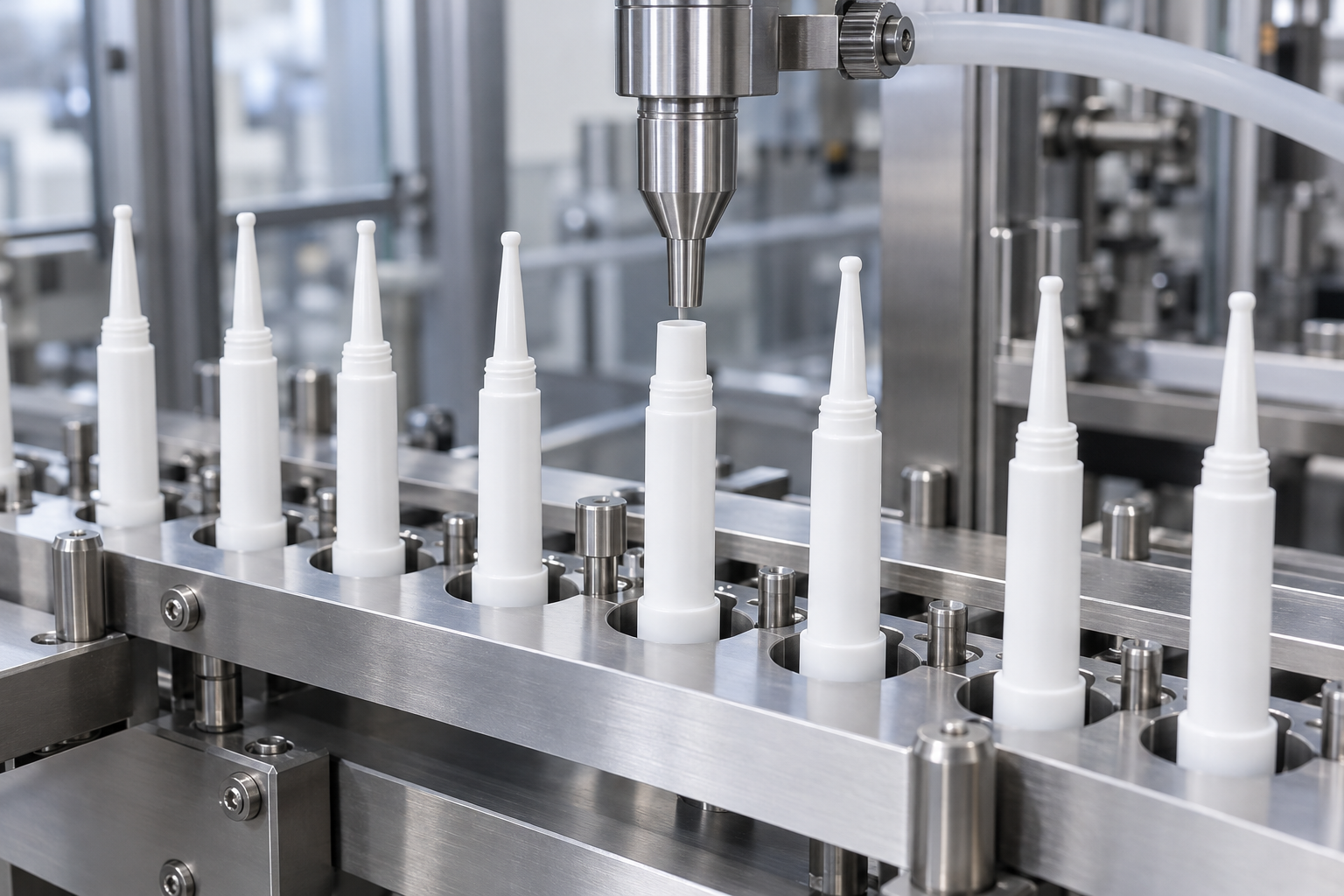
AI-generated illustration: The filling route begins with the actual package orientation and accessible opening.
The terms refer to the product-entry side of the barrel. In a front-filling arrangement, product enters through or at the cannula/nozzle end. In a rear-filling arrangement, product enters through the open barrel end and the plunger is inserted afterwards. The names sound simple, but the production implications are not.
Front filling: a tip-led process route
Front filling can suit an applicator that is supplied with a geometry or assembly state that favors controlled entry at the tip end. The system must locate the fine cannula accurately, align the fill nozzle, manage the end of the dispense and protect the tip as the part moves through later stations. A project team should ask how the line supports the barrel and how much positional variation it can tolerate. A small change in molded tip geometry can matter more than a large nominal change in barrel volume.
The practical questions are therefore about handling as much as filling: how the cannula is guided, where the package is supported, how the nozzle approaches and retracts, whether contact is permitted, and how a damaged or incorrectly oriented part is rejected. These questions should be reviewed with physical components from the intended supplier, ideally from more than one lot.
Rear filling: an open-barrel process route
Rear filling can suit a package delivered as an open barrel with the plunger supplied separately. The barrel is stabilized at the flange or body, product is dispensed into the rear opening, and the plunger is inserted after the fill. This route can offer a direct view of the barrel opening and a clear sequence for product fill followed by plunger insertion. It also makes plunger travel, insertion depth and final package appearance important process checks.
Rear filling is not automatically the answer for every thick product. The product must still enter the barrel in a controlled way, the filling position must be stable, and the post-fill plunger operation must not create unacceptable cosmetic or functional variation. The line must also protect the cannula during downstream movement even though it was not used as the entry side.
Start with the component supply state
The first decision input is not nominal output. It is the condition of each component when it reaches the filling line. Create a simple map for the barrel, cannula, plunger, cap and any tamper-evident or secondary component.
For every component, record:
- Whether it arrives loose, in trays, magazines, bags or nested presentation.
- The orientation supplied by the component vendor and whether the machine must create or verify it.
- Critical dimensions, tolerances and the surfaces used for gripping or locating.
- Material, transparency, stiffness and any propensity for static charge or surface marking.
- The acceptable cosmetic condition after handling.
- Lot-to-lot variation that could affect feeding, insertion or inspection.
This map often resolves the first route decision. A barrel that is easy to hold at the flange and supplied open at the rear may favor a rear-fill evaluation. A package whose functional assembly sequence centers on the cannula end may need a front-fill evaluation. If the available information is incomplete, the right next step is a sample trial rather than a speed assumption.
Use product behavior to test the route, not to guess it
An intramammary formulation can be a paste, cream, gel, sealant or suspension. Products within those labels can behave very differently. A single viscosity value is useful context, but it cannot fully describe yield stress, time-dependent flow, entrained air, temperature sensitivity or response to a production stop.
Product information to prepare before testing
Prepare a short, factual product brief for the trial. It should include target fill mass or volume, normal production temperature, expected viscosity range where available, batch size, transfer method, time at rest, sensitivity to shear and any cleaning constraints relevant to the product-contact path. If the finished product cannot be shipped, agree on a representative simulant and document where it differs from the real material.
The aim is not to obtain a universal machine setting. The aim is to observe how the intended material enters the actual package. During a well-prepared factory test, the team can compare start-up behavior, product presentation at the end of the fill, component positioning and the effect of a short planned stop. Those observations should be recorded with the product condition and component lot, not remembered informally after the visit.
The fill route affects what should be observed
For front filling, observe cannula alignment, nozzle approach, support of the tip, product presentation at the end of dispense and any interaction between the fill nozzle and the component geometry. For rear filling, observe the fill position in the open barrel, the transition to plunger insertion, plunger seating and the final appearance of the barrel and tip. In either route, do not rely only on a few successful samples. Review a sequence long enough to reveal recurring handling or product-flow conditions.
Protecting the cannula is a line-design requirement
Fine intramammary cannulas create a different risk profile from ordinary cylindrical containers. The applicator must be supported while moving between feeding, filling, closing, inspection and cartoning. If a guide rail, star wheel, nest or transfer point permits uncontrolled contact, the line can create scuffing, bending or inconsistent orientation even when the fill station itself performs correctly.
Ask suppliers to identify every point where the applicator is transferred. The project review should cover infeed, indexing, fill station, plunger or cap assembly, inspection, reject handling and discharge. At each point, clarify what surface controls the part and what happens when a part is out of tolerance. A practical answer includes fixture or change-part drawings, not only a statement that the line is “customized.”
Mid-article CTA — Send Your Requirements
Share the applicator drawing, component samples, target batch profile and desired downstream connection. We will help define the front- and rear-filling questions that should be answered before you issue an RFQ.
Plunger insertion is part of the filling route
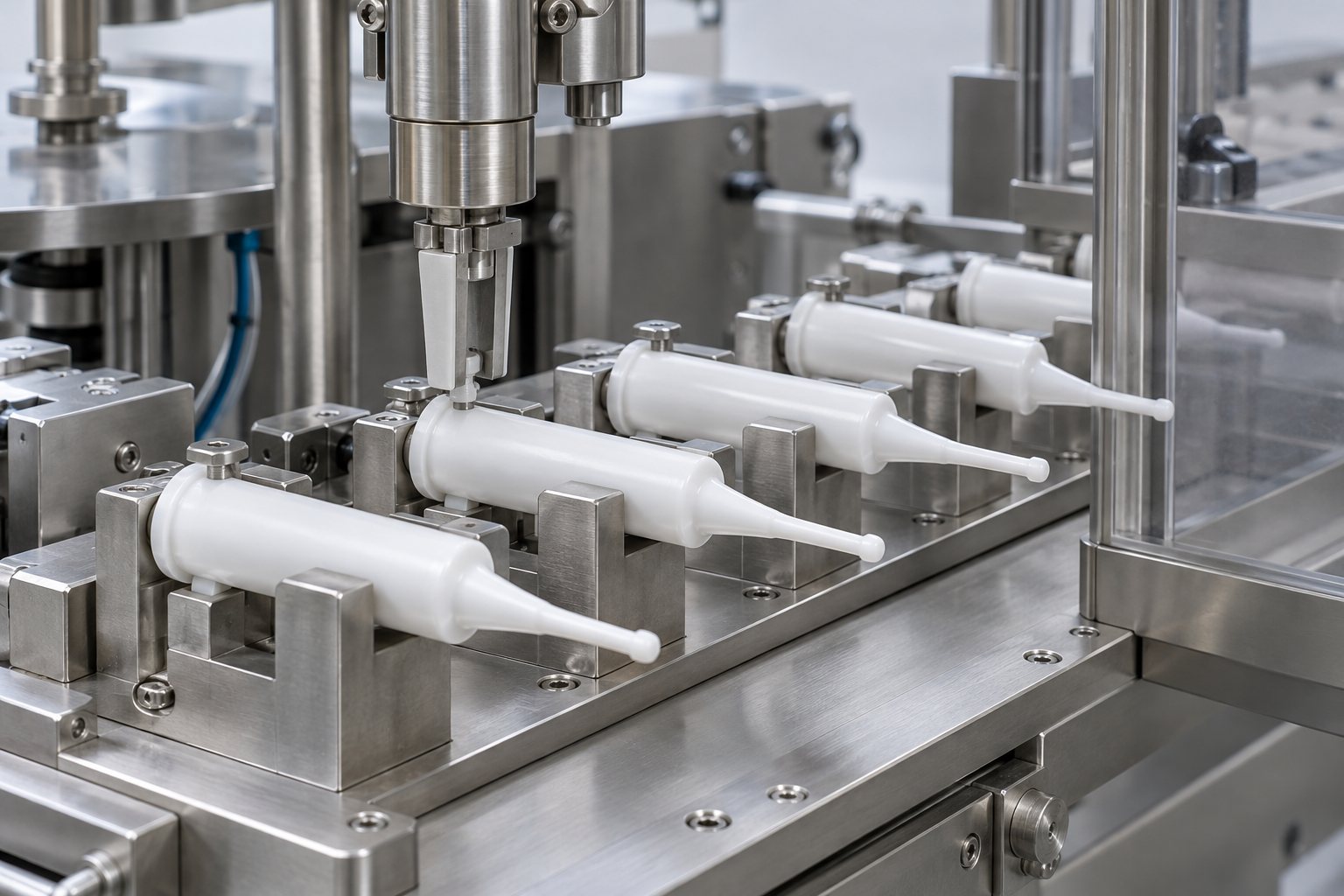
AI-generated illustration: Rear-access tooling should support the barrel body while preserving deliberate tip clearance.
For rear filling, plunger insertion follows the dose. For front filling, it may occur at a different point in the assembly sequence. In both cases, it should be treated as a defined operation rather than an afterthought. The project team needs to agree how the plunger is fed, positioned, inserted and checked.
Useful trial observations include whether the plunger remains square to the barrel, whether insertion causes visible package movement, whether the component lot changes the insertion behavior, and whether the final position can be checked consistently. Where force monitoring or position checks are proposed, the acceptance logic should be defined by the manufacturer’s quality plan. A machine supplier can provide the process data and station design, but the product owner must decide what evidence is appropriate for release.
Inspection should follow the real failure modes
The best inspection scope is not the longest list of sensors. It is a concise set of checks connected to actual package risks. For a front- or rear-filled intramammary applicator, the possible scope may include component presence, barrel orientation, plunger position, cap presence, visual package condition, fill verification and reject segregation. The suitable combination depends on the package, the product and the manufacturer’s documented quality approach.
During FAT preparation, translate each inspection requirement into an observable challenge. For example: How is a missing cap introduced and rejected? How is an out-of-position plunger identified? How is a visibly damaged cannula handled? Can the rejected part be separated from acceptable product without ambiguity? The answers should be captured in the agreed FAT protocol or a project-specific test sheet.
Compare front and rear filling with a decision matrix
A useful proposal comparison asks the same questions of both routes:
- Does the route match the supplied state of the barrel, plunger and cap?
- Which component surfaces are used to locate and transfer the applicator?
- How is the cannula protected through every transfer?
- What product conditions will be used for the trial?
- Which change parts are required for each planned format?
- What in-process observations or inspection points are included?
- What is included in the agreed trial and FAT scope?
- Which utilities, cleaning interfaces and downstream connections remain the customer’s responsibility?
This matrix makes the commercial comparison more useful than a nominal-rate table. A lower initial equipment price is not necessarily lower project risk if the proposal leaves uncertainty about component feeding, inspection, change parts or factory acceptance evidence.
Factory trial and FAT: turn the route into evidence
A factory trial is the point at which the preferred route becomes a project decision. It should use representative materials and components, an agreed sequence of observations and a record that both technical and procurement teams can review. A polished video of a few units is not a substitute for a documented test condition.
Before the test, agree what is being evaluated: component feed and orientation, package support, fill route, plunger or cap assembly, in-process checks, reject handling and the proposed range of operating conditions. State the product or simulant, component lot, change parts and line configuration. During the test, record observations rather than making unsupported conclusions. If a requirement cannot be tested at the factory, mark it as an installation, site-acceptance or customer validation responsibility.
The FAT should then confirm the supplied configuration against the agreed scope. It should not silently add claims about regulatory compliance, sterility, dosage accuracy or line output that were never tested. This disciplined boundary improves trust and helps the installation team prepare the utilities, samples and operator training needed for site acceptance.
A compact route-review record
Use this comparison to prepare supplier questions, not to assign an untested route a pass. The component state and agreed trial determine which observations are relevant.
| Decision | Front-route question | Rear-route question |
|---|---|---|
| Incoming assembly | Is the required plunger state established? | Is the open barrel supplied as expected? |
| Filling access | Can the intended tip interface accept the proposed approach? | Does the barrel opening provide the agreed access? |
| Package support | Which body features establish location without tip damage? | Which features support filling and later insertion? |
| Evidence | What was observed with identified product and components? | What filling and assembly sequence was actually demonstrated? |
FAQ
Is front filling always better for intramammary applicators?
No. Front filling is appropriate only when it matches the component design, assembly sequence and trial evidence. Rear filling may be more suitable for an open-barrel format with a separate plunger. The route should be selected from physical component and product tests.
Can one machine handle both front and rear filling?
Some projects may be configured for more than one format or route, but the scope must be evaluated case by case. It can require different stations, product paths, change parts, controls and acceptance tests. Do not assume that similar-looking syringes use the same tooling.
What should we send for a route review?
Send the product description, target fill, applicator drawing, empty barrels, plungers, caps, available component tolerances, intended operating temperature, batch profile and target output. Representative product or an agreed simulant is valuable for a meaningful trial.
Does a successful factory trial guarantee final production performance?
No. A trial reduces uncertainty for defined materials, components and conditions. Final site performance also depends on the installed utilities, operators, incoming component control, upstream product preparation and the customer’s own process qualification.
Should the selected filling route be reviewed when components change?
Yes. A changed tip, plunger interface or incoming supply state can affect the route that was demonstrated previously. Identify the changed component and review the affected access, support and assembly questions using current drawings and representative samples. Do not assume unchanged nominal volume means unchanged compatibility.
How should suppliers explain an untested route option?
They should identify it as a proposal, state its assumptions and describe the trial evidence needed. Buyers should distinguish an available configuration discussion from a route already demonstrated with their actual package and formulation.
Conclusion
Front filling and rear filling are best understood as package-led process routes. The choice should start with the condition of the barrel, cannula, plunger and cap, then be tested with representative product behavior and documented through a focused factory trial. For intramammary applications, the most important questions are often about fine-tip protection, component positioning, assembly sequence and inspection evidence—not a generic maximum speed.
Discuss your intramammary filling route
Contact Us: KINGPACK configures veterinary syringe and applicator filling projects around the actual product and package. Send your drawing, component samples and production objectives to request a technical route review, sample-trial plan or quotation for an intramammary syringe filling line.
—
