
Introduction
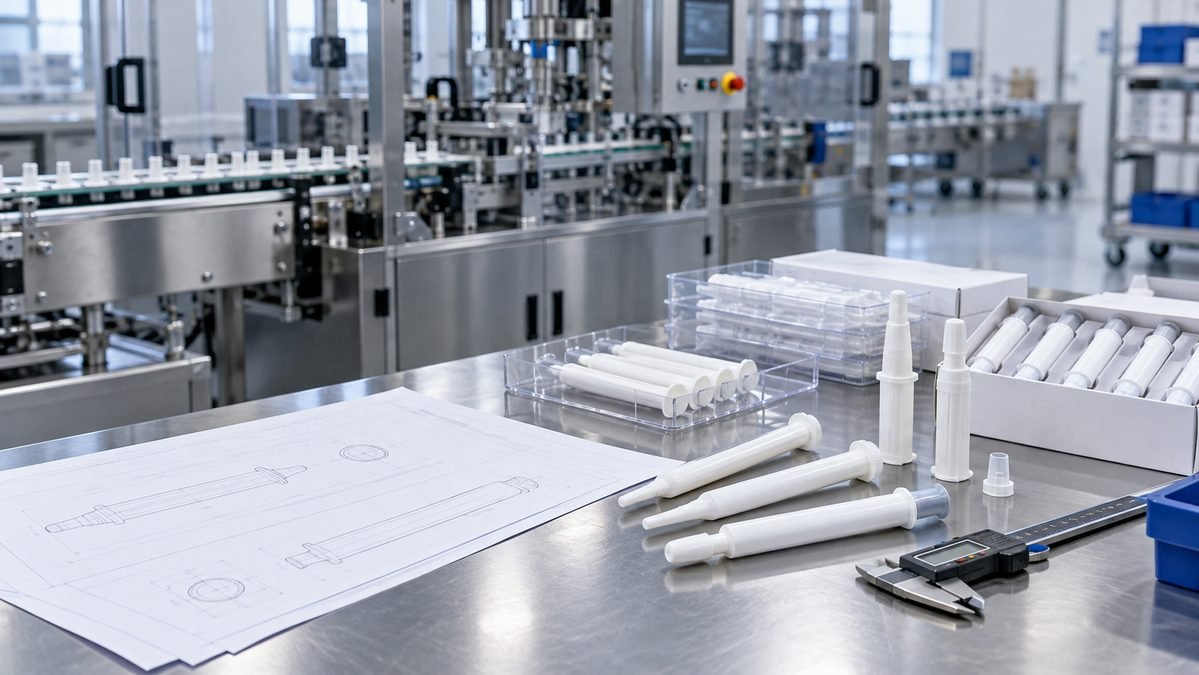
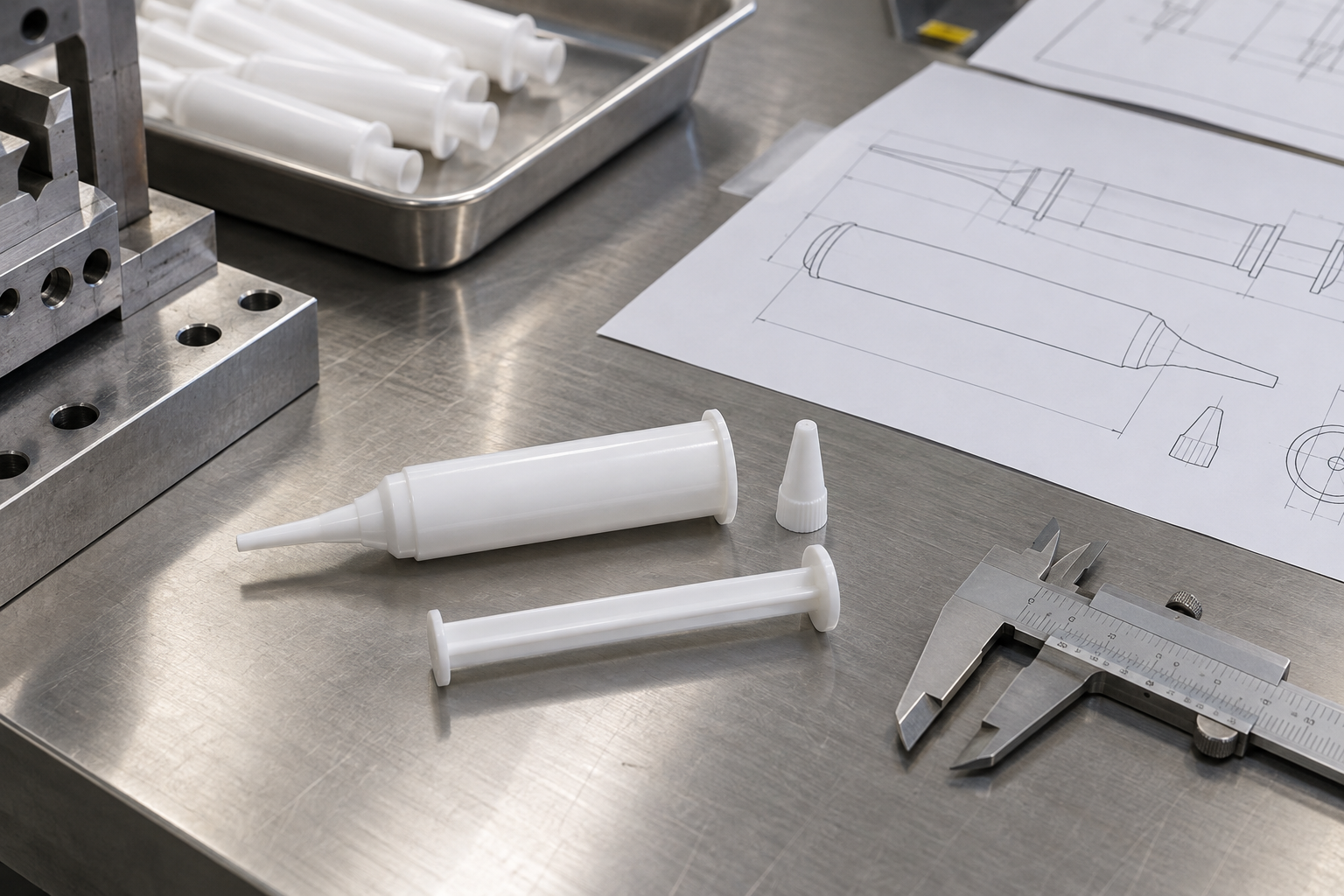
An intramammary applicator package data handover should describe the complete barrel, plunger and cap combination, its incoming presentation and the intended sequence through the line. Send current drawings, identified representative samples, permitted contact zones, assembly requirements and open questions before tooling design begins. Nominal volume and a finished-product photograph leave too many physical interfaces undefined.
This guide helps veterinary manufacturers and procurement teams prepare a package information pack for a filling and assembly project. It focuses on the information needed to discuss equipment configuration. It does not replace component qualification, product compatibility work or the customer’s approved quality requirements.
Why a package photograph cannot define the machine interface
A photograph can show overall shape and intended use, but it rarely establishes the dimensions that determine feeding and locating. The barrel flange, shoulder, taper, cap engagement and plunger interface may be hidden or distorted by perspective. Two similar-looking applicators can need different nests, guides or presentation routes.
The design team also needs to know how the parts arrive. An assembled sample does not reveal whether production barrels are loose, nested or tray-packed; whether plungers are supplied separately; or whether the cap enters the line already attached. These choices affect the first transfer and the order of assembly. Describe the supply state before requesting a fixed tooling design.
Define one format as a complete component combination
A format record should link the barrel, plunger and cap to the intended product and assembly route. Where several formats are planned, create a matrix rather than using a volume range as the sole description. Identify what is common and what differs, while leaving the equipment builder to review the actual interfaces.
| Information | Why the equipment team needs it | Suitable starting evidence |
|---|---|---|
| Barrel drawing and revision | Locating, transfer and nozzle access | Controlled component drawing |
| Plunger drawing and supply state | Pick-up, guided insertion and end position | Drawing plus separate samples |
| Cap drawing and presentation | Orientation, application and inspection | Drawing, samples and incoming-pack photographs |
| Intended assembly sequence | Defines package state at each station | Process sketch or written sequence |
| Protected surfaces | Guides support and clearance decisions | Marked drawing reviewed by the package owner |
| Format range | Defines change-part and adjustment questions | Component combination matrix |
If a component has not been finalised, label its status. A provisional drawing can support a preliminary discussion, but it should not silently become the released design basis. State who will provide the final information and what decision depends on it.
Supply drawings that answer functional questions
Use the latest controlled revision and identify units and drawing status. The equipment builder needs the dimensions and features relevant to handling, not an uncontrolled copy with handwritten changes that nobody can approve. Where a drawing omits a relevant interface, request clarification from the component owner rather than inferring it from a sample.
Barrel features
Useful information may include overall geometry, barrel outside profile, flange, shoulder, fine-tip envelope and the features intended for support. Identify any areas that must remain clear of tooling. Include the intended orientation at filling if that has already been decided. The front versus rear filling guide can help structure the discussion when access to the package is still being reviewed.
Plunger features
Describe the available pick-up surface, orientation, relevant stem or interface geometry and the proposed finished position. Avoid demanding a universal insertion stroke before the package datum and fill state are defined. A statement of the intended observable assembly condition is often a better starting point for discussion.
Cap features
Identify the orientation features, engagement surfaces and incoming condition. Explain whether cap presence, visible seating or another package condition is expected to be inspected. Those checks answer different questions and should not be combined under a vague request for complete closure inspection.
Send representative samples with identity intact
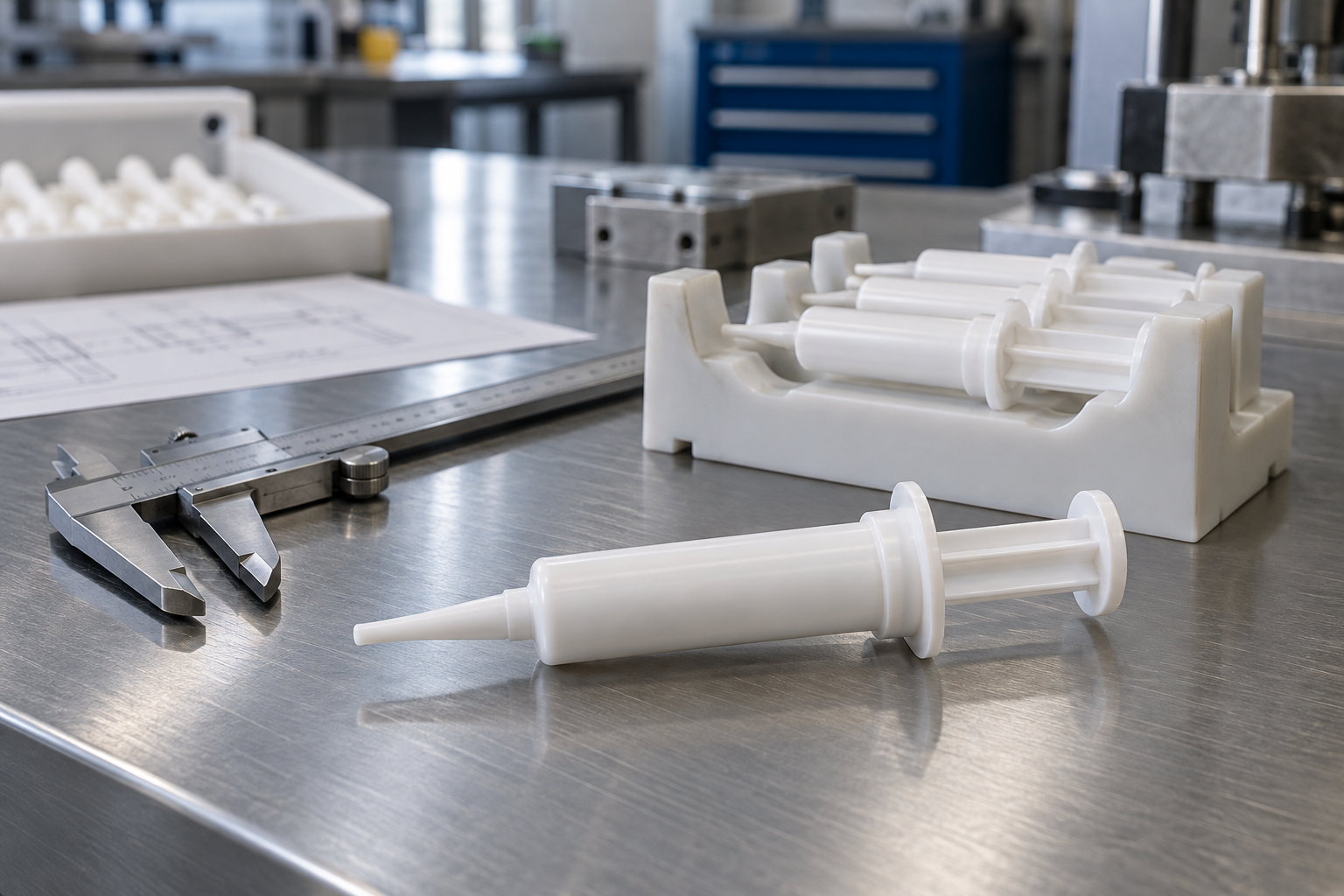
Physical samples complement drawings by revealing stiffness, surface condition, supply presentation and practical handling. Keep each set linked to its supplier lot or available internal reference. If the samples are prototypes or come from a different production process, state that limitation. An equipment review should distinguish a development sample from expected routine supply.
Include separate barrels, plungers and caps as well as assembled samples where relevant. Explain which combination is intended. If there are several cap options or a pending supplier choice, prevent the parts from being mixed in an unidentified bag. The team should be able to trace an observation to a defined component set.
Preserve the incoming pack
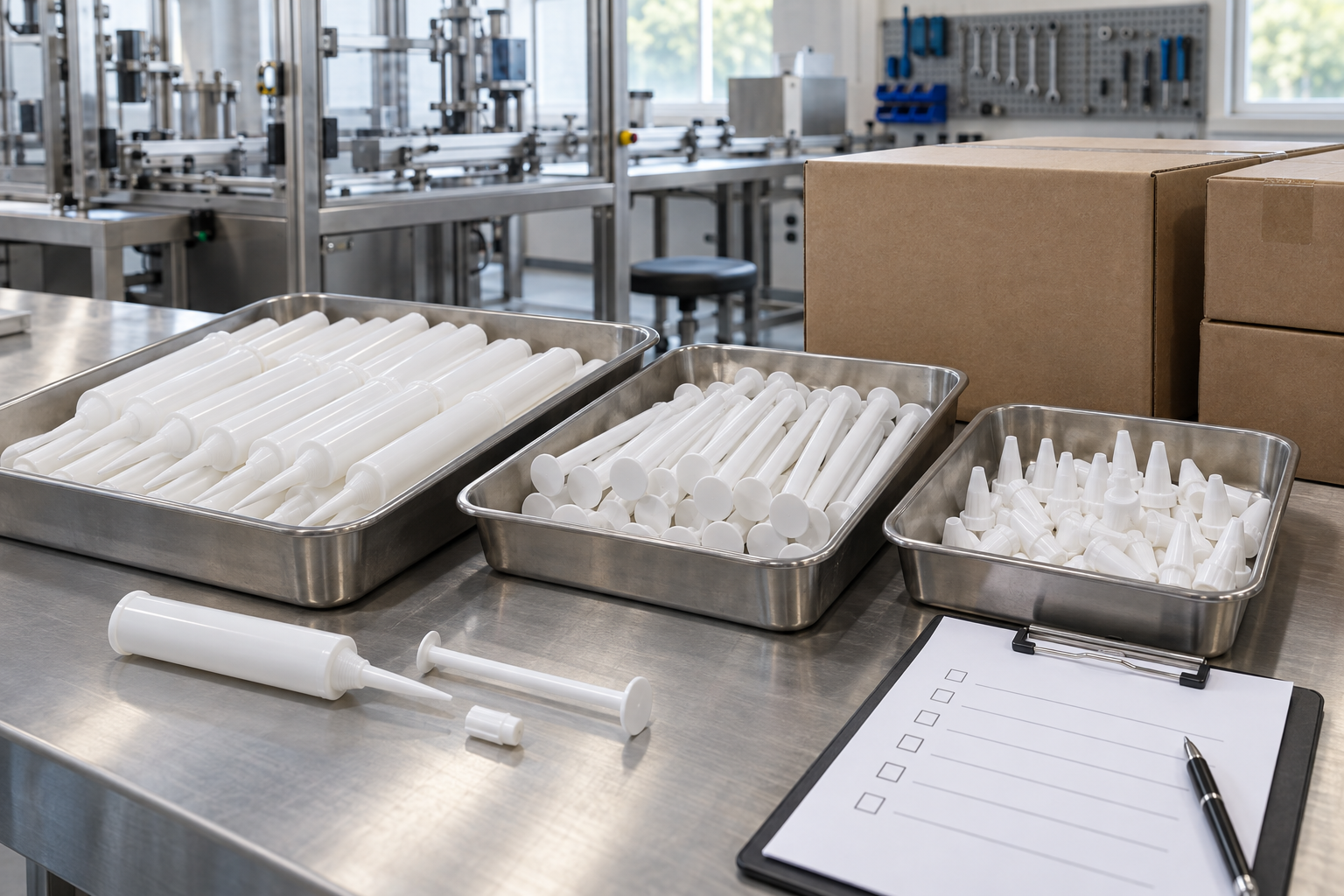
Photograph unopened and opened containers where useful, and send samples in the presentation expected for production. A tray can define orientation; a bulk pack can introduce overlap or compression; a magazine can create its own mechanical interface. Changing that presentation later may require a review even when the component drawing is unchanged.
State the sample purpose
Separate samples intended for drawing review, mechanical handling, product trials and visual references. The sample quantities and test use should be agreed with the equipment team. Avoid treating a small manually positioned set as evidence for continuous automatic feeding. The component-lot review guide explains how sample identity supports subsequent testing.
Describe the process conditions without inventing machine settings
The package handover should include the intended product application, filling route, relevant material behaviour and planned operating environment. A product name alone does not describe flow behaviour or the conditions under which it will be filled. Provide customer-approved information and identify what needs a representative trial.
The equipment builder can then discuss feeding, filling access, assembly and inspection around those inputs. Exact settings should follow the agreed configuration and trial evidence. Do not insert unsupported throughput, accuracy or temperature figures into the package brief merely to make it appear complete.
Distinguish requirements from preferences
A requirement is a condition the project must satisfy and someone is authorised to approve. A preference may be a desired layout, handling route or operator workflow that can be reviewed against alternatives. Mark the difference so procurement can compare proposals fairly. If one supplier assumes tray feeding and another assumes bulk feeding, their quotations may cover different equipment even when both reference the same applicator.
Describe downstream handling
State the intended discharge orientation and the next process, such as manual collection or an agreed secondary-packaging interface. This helps review cap protection, tip clearance and accumulation. It does not require a final carton design for every preliminary discussion, but any unresolved interface should remain visible.
Send Your Requirements: Provide your component drawings, separate samples and incoming-pack photographs. Request a package-data review that identifies the missing information before tooling is released.
Make open questions part of the handover
A useful package pack contains an open-item list. Typical questions include which cap version will be used, whether a plunger position is final, whether incoming trays can change, and which inspection features the customer will approve. Each item needs an owner, expected answer and affected design decision.
This prevents a drawing review from becoming an informal approval of missing information. It also avoids repeated email requests for the same sample. A concise record lets procurement, package engineering and the equipment builder work from the same assumptions.
Agree a release point
Before format parts are manufactured, confirm the component combination and the revision used as the design basis. If later changes affect locating or assembly features, review their impact through the project process. The release point should be clear enough that a new team member can understand why a particular nest or guide was made.
Keep alternatives distinguishable
If two component suppliers are under consideration, maintain separate sets. Ask whether both need to be assessed and whether the equipment scope assumes one approved set or a defined range. A successful trial with one set should not be represented as proof for an untested alternative.
Connect the package pack to factory testing
The representative trial and factory acceptance test should refer back to the handover record. Record the actual component set, drawing revisions, supplied presentation, installed format parts and observations. This creates continuity between the information that shaped the proposal and the samples that were tested.
Where a final product or component is unavailable, state what the factory test can answer. A dry run may show mechanical handling; a customer-approved product trial may answer filling questions. Neither should be described as broader evidence than it provides. Define what remains for site work and who owns it.
During shipment inspection, confirm the delivered tooling and documentation correspond to the tested package. Installation preparation should include the same component identity checks, along with actual site supplies and operator instructions. The handover pack should travel with the project instead of remaining in the purchasing contact’s inbox.
Review proposals against the same package basis
Procurement comparisons are useful only when suppliers are answering the same information pack. Review the stated assumptions about supply presentation, formats, assembly sequence, inspection and change parts. Ask each supplier to identify exclusions or dependencies instead of assuming that a similar machine description means equal scope.
A practical comparison checklist
- Does the proposal identify the complete barrel, plunger and cap format?
- Is incoming presentation described for each component family?
- Are permitted support and protected areas understood?
- Is the assumed assembly sequence clear?
- Are inspection questions separated from product release requirements?
- Does the trial plan identify representative samples and open decisions?
- Are format changes and downstream interfaces included or explicitly excluded?
The checklist supports an equipment discussion. It does not create a universal specification for every veterinary product. Its value comes from making differences visible before they become expensive tooling revisions.
Common handover gaps
Sending only a finished applicator
A complete assembly hides the component interfaces and does not show how the parts arrive. Send separate samples and drawings along with any finished reference.
Using nominal volume as the format identity
Similar volume does not establish equal flange, tip, plunger or cap geometry. Use component combinations and revisions to define the package.
Allowing packaging changes without engineering review
A tray, bulk bag or magazine affects separation and orientation. Preserve supply presentation in the project record and review changes that affect feeding.
Keeping unresolved decisions outside the proposal
Missing information should appear as an open item or stated assumption. Otherwise suppliers can design around different provisional details and procurement loses a fair comparison.
Use a controlled question log before tooling release
A handover rarely arrives complete in its first version. Create a question log that links each unresolved item to the component or station it affects. State the evidence needed, the person providing it and the decision that cannot be finalised without it. “Awaiting drawings” is less useful than identifying a missing cap interface revision and its consequence for the proposed capping tooling.
Separate assumptions from accepted requirements
A supplier may make a provisional assumption to prepare an initial proposal. Preserve that assumption visibly and ask the customer to confirm or replace it. Do not let an initial estimate become a tooling-release instruction merely because it has been copied into several documents.
For example, a preliminary pack might show barrels in trays while purchasing is still evaluating bulk supply. Those alternatives have different separation and transfer questions. The proposal should state its presentation basis. Finalising the route requires the chosen supply condition or an explicitly reviewed range, with the remaining evidence identified.
Resolve conflicting sources directly
When the drawing, physical sample and supplier photograph disagree, identify which source represents intended production supply. Check the revision and lot information before interpreting the difference as a machining or tooling problem. A sample may be an obsolete development part; a photograph may show an alternative pack.
Keep the resolution with the information pack. A verbal explanation is not enough when another engineer later uses the drawing to design a nest. Mark superseded files so that a convenient local copy does not become the accidental design basis.
Preserve the pack during commercial comparison
The commercial team should issue the same controlled package pack to suppliers being compared. If one receives an additional revision or an answer that changes the scope, update the common basis. This does not require distributing confidential supplier designs; it requires keeping customer inputs consistent.
Evaluate proposals against their stated dependencies, including sample availability, tooling-release decisions and inspection responsibilities. A proposal that clearly identifies an unresolved package feature may be more usable than one that lists broad capabilities without explaining how they apply to the actual applicator.
After selection, carry the same pack into the trial and factory acceptance records. Identify any new evidence and changed decisions rather than starting an unrelated document collection. This continuity is the handover article’s purpose: it connects purchasing information to engineering decisions without pretending that documentation alone proves line performance.
FAQ
What should be sent first for an intramammary line discussion?
Send current component drawings, identified separate samples, photographs of incoming presentation and a proposed process sequence. Mark provisional information clearly.
Can a photograph replace a barrel drawing?
No. Photographs provide context, but drawings establish geometry and controlled revisions. Physical samples add handling information that neither source fully captures alone.
Must the final component supplier be chosen before quotation?
A preliminary discussion can use stated alternatives. Tooling release should have a defined component basis or an explicitly agreed range supported by review.
Should the package pack contain filling accuracy numbers?
It should contain customer requirements where established. Confirm machine performance through the agreed specification and trial evidence rather than assuming values from package size.
What changes should trigger another review?
Changes to locating, tip, plunger, cap, material or supply presentation may affect handling. Use the project and customer change process to decide the required review.
Conclusion
A complete package handover connects drawings, samples, supply presentation and assembly requirements before tooling design. It gives buyers a consistent basis for supplier discussions and preserves the information needed for trials, shipment inspection and installation preparation.
Get a Technical Proposal: King Pack can review your intramammary package and intended line sequence within the confirmed equipment scope. Send the component pack and open questions to prepare a focused configuration discussion.
—