
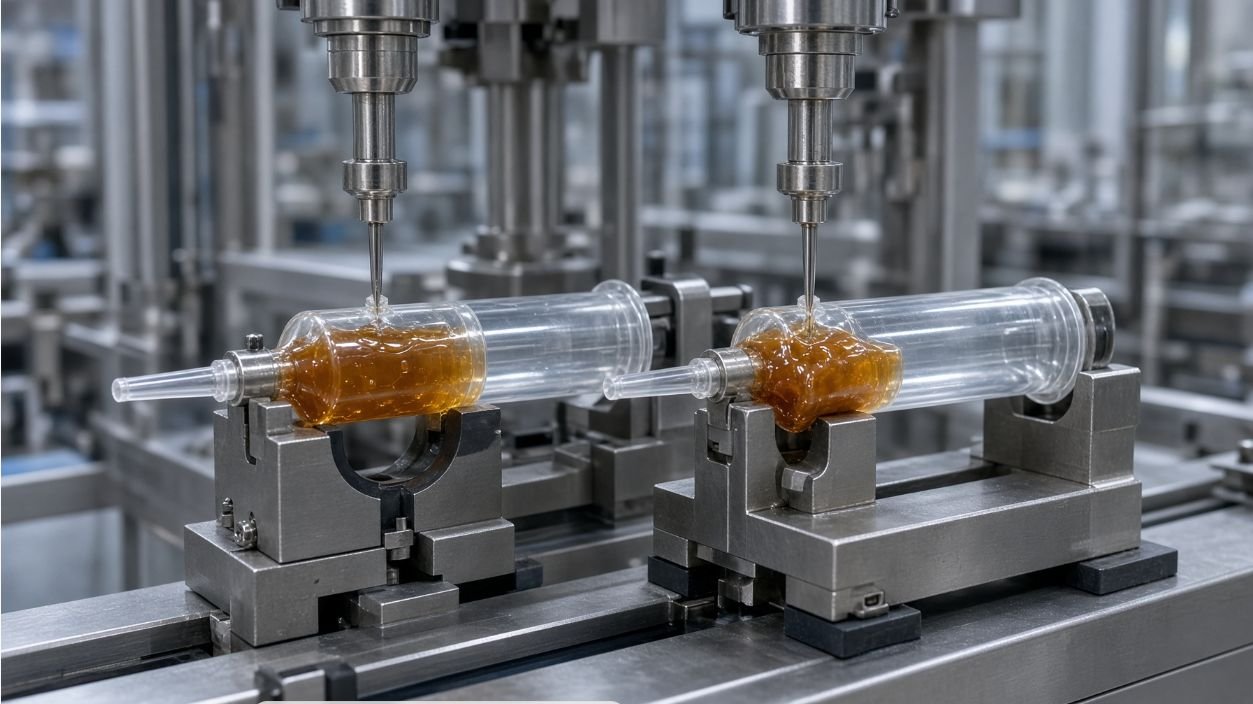
Should a gel bait syringe be filled through its tip or through the open barrel tail? The question sounds like a matter of preference, but in practice the front vs rear syringe filling decision is made for you by three things: how the barrel arrives, where the piston sits, and how viscous and air-sensitive the product is. Choosing the route before checking these inputs—or assuming every gel bait should be filled the same way—is the fastest way to order a line that needs re-engineering later. This article separates the two routes, shows what drives each one, and ends with the checklist to settle the decision through a sample trial rather than a guess.
Define Front and Rear Filling by the Entry Point
The two routes are named for where the product enters the barrel, not for what the finished syringe looks like.
- Front filling doses the paste through the dispensing end of the barrel—the tip, nozzle, or Luer-style opening. It is used when the opposite end (the tail) is already closed, most often because the piston has been seated during barrel manufacture.
- Rear filling doses the paste through the open tail of the barrel, and the piston is inserted afterward to close and seal the product in.
A key point that is easy to miss: the presence or absence of a plunger rod on the finished package does not decide the route. A cartridge sold for a bait gun and a syringe sold with its own plunger can both be rear-filled; the rod is simply added by hand, by the end user, or at a separate station. The route is a function of the open path into the barrel, not of the retail format.
Check the Incoming Piston and Plunger State
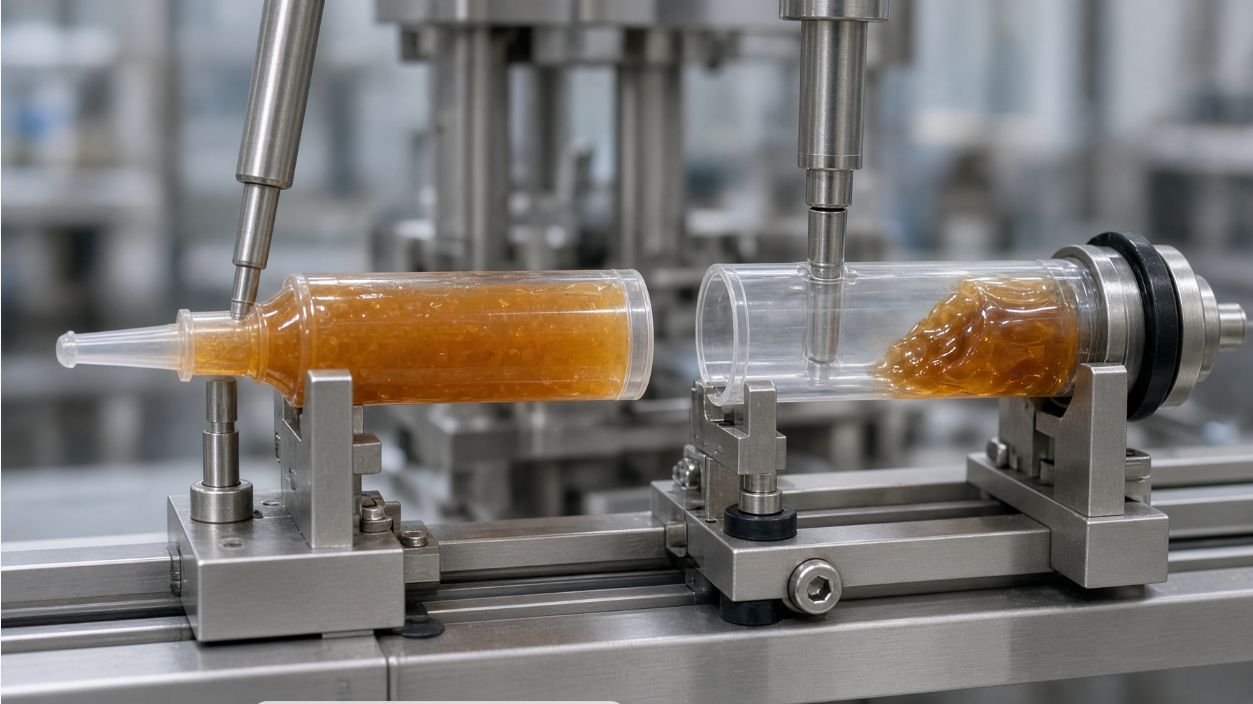
The first thing to confirm is the incoming state of the piston. This is what usually settles the route without further argument.
- If the piston arrives pre-seated at the tail of the barrel, the tail is closed and the only practical fill path is the tip—front filling.
- If the piston arrives loose, the barrel tail is open and the line can fill from the rear and insert the piston afterward—rear filling.
- If the barrel arrives with no piston at all, rear filling with on-line piston insertion is the natural choice, because the open tail gives the paste a wide entry.
The plunger rod is a separate decision. It can be supplied loose, pre-assembled, or omitted (for gun-compatible cartridges), and it affects the assembly stations and orientation rather than the fill entry point.
Compare Flow Restriction and Assembly Access
The two routes trade flow resistance against assembly work.
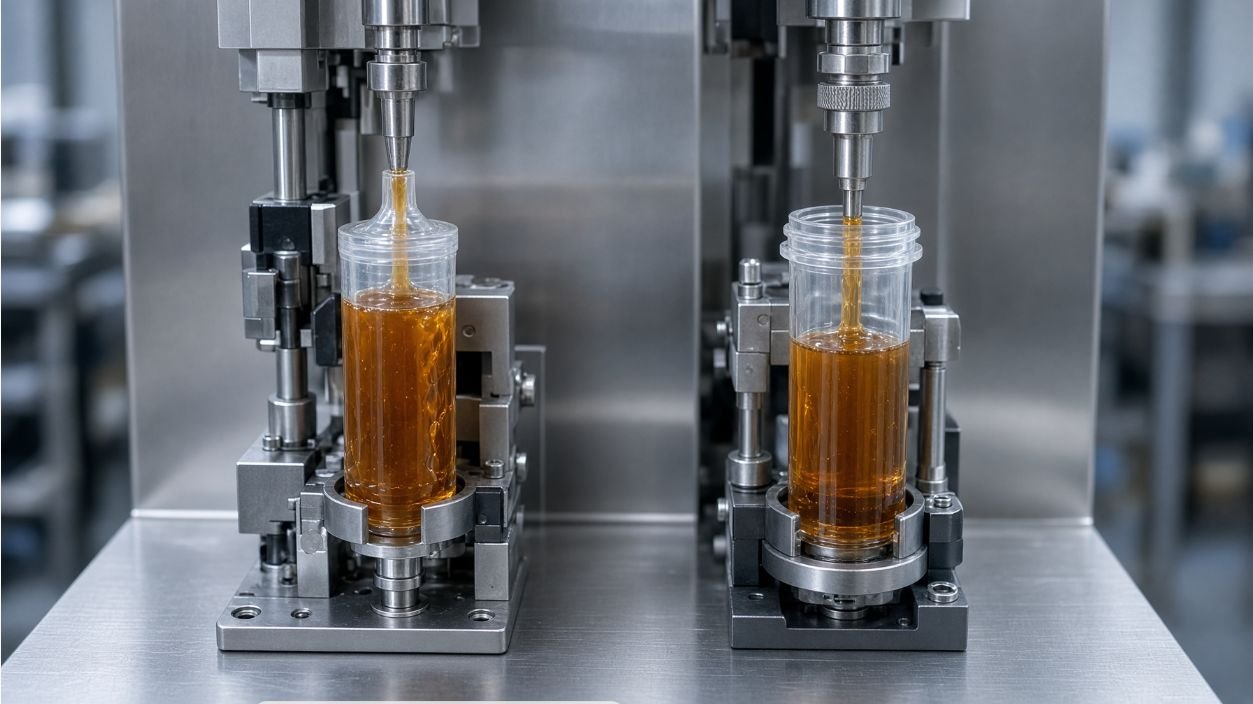
Front filling moves the paste through a narrow opening. For a high-viscosity gel this means higher fill pressure, a nozzle sized to the tip, and greater attention to stringing and cut-off at the dispensing end. The advantage is that the tail needs no further handling: there is no piston-insertion station to design, and the closed barrel is already the finished seal. Front filling fits barrels that are supplied fully assembled and pre-sealed at the tail, and products that tolerate the shear of a narrow fill path.
Rear filling moves the paste through the full open barrel diameter, which is a wider and lower-restriction path—often easier for stiff or particle-loaded pastes. The cost is the extra assembly step: the piston must be inserted after dosing, and the air beneath it must be managed so it does not leave a void in the finished barrel. Rear filling fits barrels that arrive as loose components and buyers who prefer a simpler dosing stage even if it means an extra assembly station.
Neither route is universally better. Front filling reduces stations but demands a capable narrow-path metering system; rear filling simplifies dosing but adds a piston-insertion and venting step.
| Factor | Front filling (through the tip) | Rear filling (through the open tail) |
| Typical incoming state | Piston pre-seated, tail closed | Piston loose or absent, tail open |
| Fill path | Narrow tip or nozzle | Full barrel diameter |
| Flow restriction | Higher, pressure-sensitive | Lower, easier for stiff pastes |
| Assembly steps | No piston-insertion station needed | Piston inserted after dosing |
| Venting concern | Cut-off and stringing at the tip | Air under the piston during insertion |
| Main cost driver | Metering and nozzle performance | Added assembly station and change parts |
| Best fit | Pre-assembled, pre-sealed barrels | Loose-component barrels, particulate pastes |
Review Venting and Package Support
Both routes have an air-management issue, but in different places.
In front filling, the concern is at the dispensing end: the paste must fill the barrel without trapping air at the narrow tip, and the nozzle must cut off cleanly so the product does not string or leave residue that interferes with the cap or tip. Controlled retraction (suck-back), correct nozzle geometry, and a closure sequence matched to the fill all help, but the exact parameters depend on the formulation.
In rear filling, the concern is under the piston: when the piston is pushed into a filled barrel, air can be trapped between the product surface and the piston face, leaving a bubble or a soft fill. The insertion station must let this air escape—through a venting groove, a timed insertion profile, or a small pre-dose of product—and the barrel must be supported so the fill pressure does not distort it.
Package support matters in both cases. A thin-walled barrel that deflects under fill pressure will fight a narrow front-fill nozzle just as much as a piston-insertion station. Geometry, wall thickness, and flange support are inputs that belong on the table before either route is fixed. (These package-level requirements are covered separately from a specification standpoint; the point here is only that they affect route choice.)
Select a Route for Sample Testing
The route should be confirmed with the actual product and package, not decided on paper. The incoming-structure checklist below is the minimum information to collect before a trial; it forces the buyer to state the facts that determine the route.
| Component | Question to confirm | How it affects the route |
| Barrel | Is the tail open or sealed on arrival? | Decides whether rear filling is available |
| Piston | Pre-seated, loose, or not supplied? | Pre-seated → front filling; loose/absent → rear filling |
| Plunger rod | Supplied loose, pre-assembled, or omitted? | Adds assembly/orientation steps, not fill entry |
| Tip / cap | What is the open interface—thread, snap, or Luer-style? | Sets the front-fill nozzle and closure sequence |
| Product | Viscosity, particle content, and air sensitivity? | Narrow path tolerance vs. wide-path dosing |
| Bulk packing | Are barrels oriented, bulk, or trayed? | Sets feeding and orientation stations |
With these answers, a supplier can run a controlled trial on both candidate routes (where both are physically possible) and report which one produces a cleaner fill, a more reliable seal, and a simpler changeover. The decision should fall out of that evidence, not out of a catalogue description.
Common Risks and Mistakes
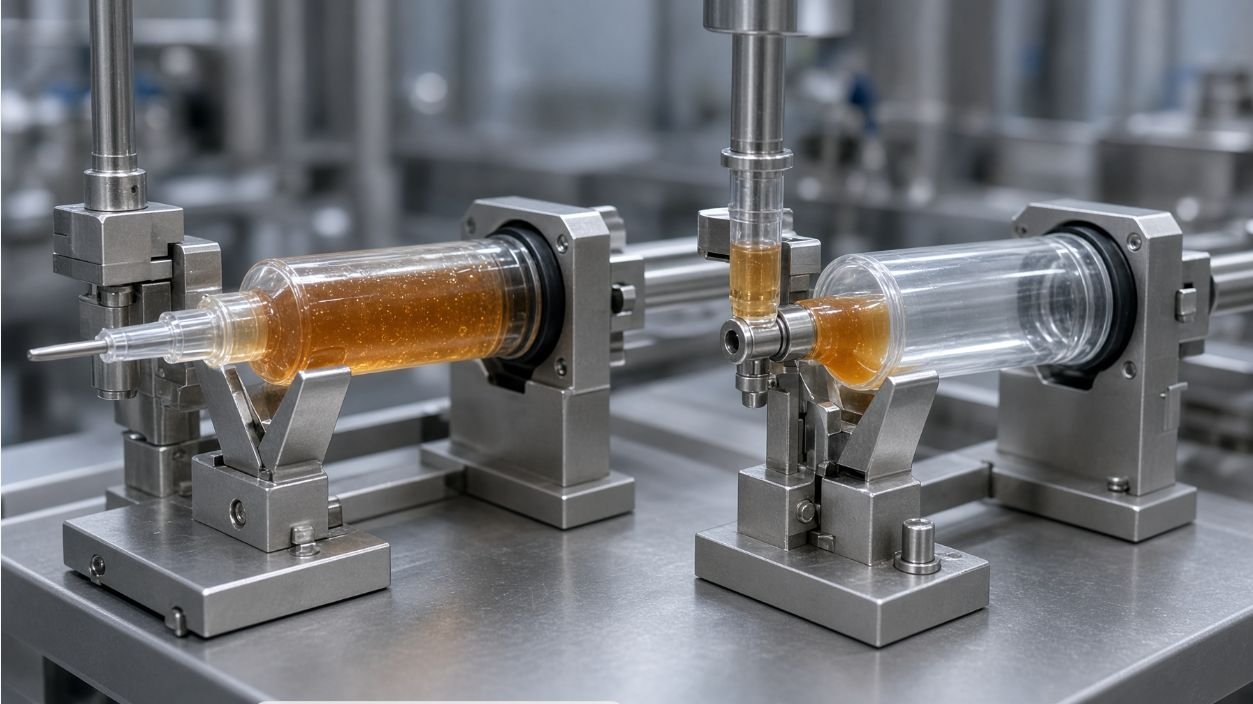
- Assuming all gel baits are front-filled. A barrel with a pre-seated piston forces front filling, but a loose-component barrel is usually rear-filled. There is no single industry default.
- Using the plunger rod to choose the route. Whether the package carries its own plunger or fits a bait gun does not dictate the fill entry point.
- Ignoring the incoming state until after quotation. Changing from pre-seated to loose pistons changes the station count and the price; the route must be fixed before a like-for-like quote is possible.
- Choosing the lower-station route on paper. Front filling saves a piston-insertion station, but if the paste cannot tolerate a narrow fill path, the saving is paid back in rejected or reworked barrels.
How King Pack Supports This Application
King Pack Machinery (Wuxi King-Pack / Wuxi Jingpai Machinery Co., Ltd., founded 2009, with a core technical team carrying more than 20 years of industry experience) treats the front vs rear filling question as an application decision, not a sales position. For a gel bait syringe project the relevant support is:
- Route evaluation from the incoming state. The configuration starts from the barrel, piston, and plunger state the buyer actually receives, rather than from a fixed machine assumption.
- Product and packaging testing. Sample trials establish whether the paste handles a narrow tip fill or is better dosed through the open tail, and how the piston and closure behave afterward.
- Configuration around the confirmed route. Dosing, nozzle or piston-insertion, venting, and package support are specified only after the route is settled.
- Factory acceptance testing. The agreed route and its fill, seal, and defect criteria are verified and recorded before the line ships.
King Pack does not present front or rear filling as universally better. The route is selected against the product and packaging a buyer supplies, and the trial evidence decides it.
Conclusion
Front vs rear syringe filling is not a matter of preference—it is the result of the incoming barrel state, the piston position, and the product’s tolerance for a narrow fill path. Front filling suits pre-sealed, pre-seated barrels and trades assembly work for a demanding narrow-path dose; rear filling suits loose components and stiff pastes and trades simpler dosing for a piston-insertion and venting step. Confirm the incoming structure, run a trial on the candidate route, and let the evidence—not a default—settle the decision.
Not sure which route your package needs? Send loose and assembled photos of your syringe, piston, plunger, tip and cap, together with product viscosity data, and request a filling-route evaluation.