 Skip to content
Reviewed and updated: August 20, 2026.
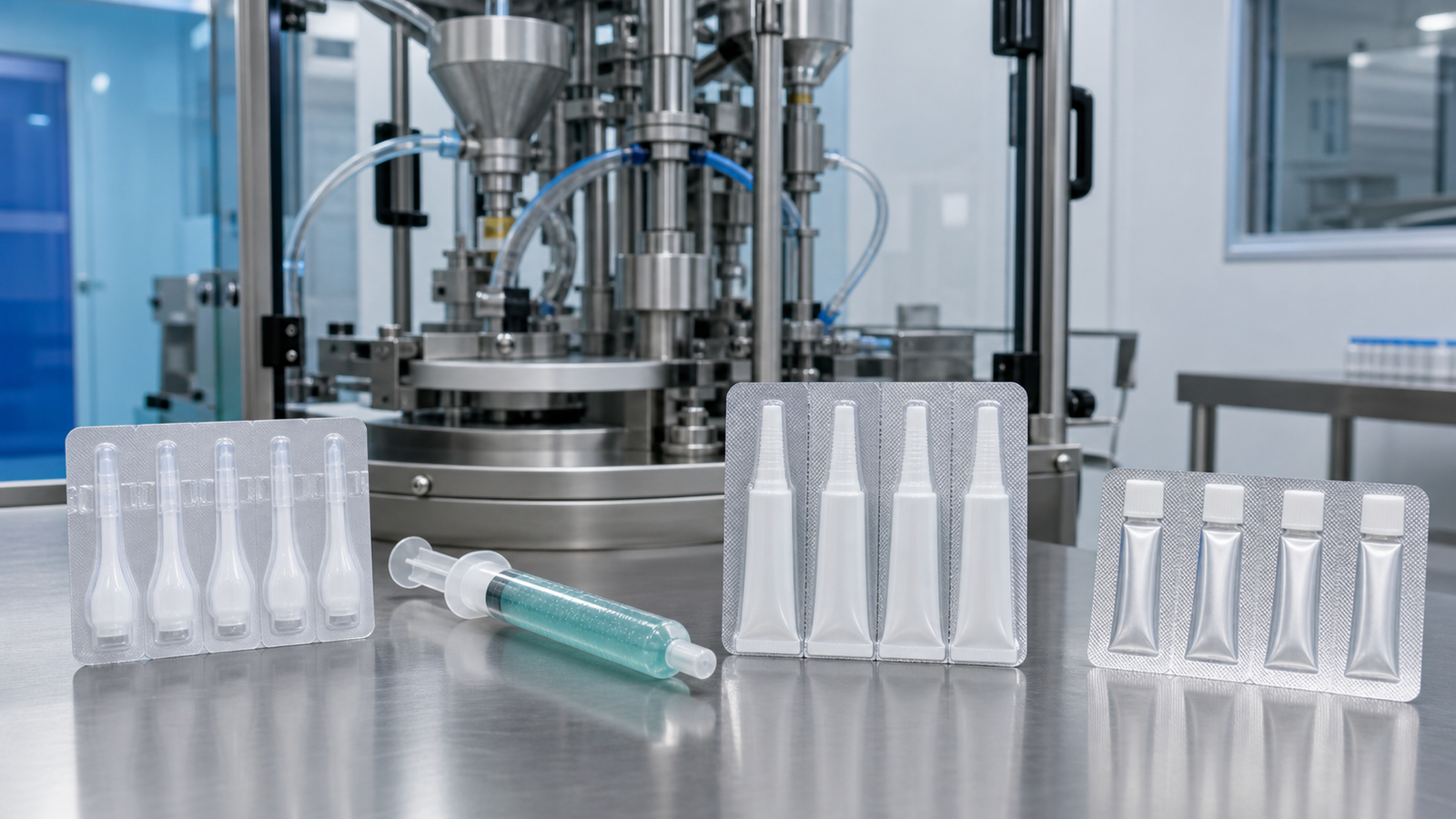
In veterinary pharmaceutical packaging, the term “single-dose tube” refers to a container that holds exactly one complete dose of a medicinal product, sealed and intended for a single administration. Unlike multi-dose containers — where the user measures out a portion each time — a single-dose tube delivers the entire labeled dose in one use, then is discarded.
This distinction matters more than it may seem. Single-dose packaging affects regulatory classification, filling accuracy requirements, container design, sealing methods, and the type of production equipment needed. For manufacturers entering veterinary markets or expanding their product range, understanding what a single-dose tube is — and what it requires from a production standpoint — is essential before selecting packaging formats or filling machines.
This guide explains the definition, regulatory context, technical requirements, and production considerations for single-dose tubes in veterinary pharmaceutical packaging.
Why This Issue Matters
Single-dose packaging classification is not a labeling technicality — it directly determines your filling accuracy requirements, seal integrity standards, preservative strategy, and regulatory documentation burden. For veterinary pharmaceutical manufacturers, misclassifying a product as multi-dose when it should be single-dose (or vice versa) creates compliance gaps that can delay product approval and trigger regulatory findings during inspections.
The production implications can be substantial. A single-dose presentation often needs tighter unit-level control because each pack contains one labeled dose. The machine and control plan should demonstrate the approved fill specification throughout the batch, using inline checkweighing or a justified sampling strategy as appropriate. Seal integrity is also central because the package is not intended for repeated opening and reclosure.
On the equipment side, single-dose production often demands higher-precision filling systems, enhanced inspection capabilities, and more rigorous batch traceability. The line must apply and verify coding at the packaging level required by the approved labeling and target market. For manufacturers planning to enter regulated markets such as the US or EU, the filling equipment must also support IQ/OQ/PQ qualification protocols and provide documentation that satisfies GMP audit requirements.
Different Production Scenarios
- Equipment needs for single-dose tube production vary dramatically based on production scale, product range, and regulatory market. Three scenarios illustrate common configurations:
Scenario 1: Small Veterinary Product Company
- A company producing 1–2 single-dose veterinary products at 10,000–50,000 units per month, serving a domestic market with moderate regulatory requirements.
Recommended approach: A standalone single-dose tube filling and sealing machine with servo-piston filling and heat sealing. Output of 2,000–5,000 tubes per hour is sufficient. Prioritize fill accuracy and seal integrity over speed. A semi-automatic machine may be acceptable for initial production, with plans to upgrade to automatic as volume grows.
Scenario 2: Regulated Market Manufacturer
A manufacturer producing single-dose intramammary tubes and spot-on pipettes for the US and EU markets, with GMP compliance, batch traceability, and IQ/OQ/PQ documentation requirements. Production volume: 100,000–500,000 units per month per product.
Recommended approach: An integrated automatic line with servo-driven filling, inline weight checking with automatic rejection, heat or ultrasonic sealing, batch coding, and cartoning. Specify electronic batch records, audit trails, and 21 CFR Part 11 controls only where the recordkeeping strategy and applicable predicate rules require them. Agree component brands or equivalents, wetted materials, and documentation standards in the URS.
Scenario 3: Multi-Format CMO
- A contract manufacturer running 5+ single-dose products in different tube formats (pipettes, syringes, intramammary tubes) with frequent changeovers and varying viscosities.
Recommended approach: A modular filling system with recipe-based changeover, interchangeable feeding and sealing tooling, and quick-clean product contact parts. The system should handle multiple tube diameters and sealing methods. Flexibility and changeover time (target: under 20 minutes) are more critical than maximum speed. Invest in a machine with PLC recipe management and documented changeover procedures.
This decision affects your total cost of ownership as well. While single-dose containers may have a higher per-unit cost than multi-dose packaging, they can reduce product waste, eliminate preservative efficacy testing, and simplify the regulatory pathway. Understanding these trade-offs before selecting equipment ensures that the production line is configured for the right format from day one.
What Is a Single-Dose Tube?
Definition
A single-dose tube (also called a single-dose container or unit-dose container) is a pharmaceutical packaging format that contains one discrete dose of a veterinary medicinal product. The entire contents are intended for a single administration to one animal.
According to general pharmaceutical packaging principles (applicable across human and veterinary medicine):
> A single-dose container is designed for use with a single patient as a single administration. It does not require preservatives or antimicrobial effectiveness testing because the entire contents are used at once.
Key Characteristics
| Characteristic | Single-Dose Tube | Multi-Dose Container |
|---|---|---|
| Contents | One complete dose | Multiple doses |
| Preservatives required | Depends on formulation and approved preservative strategy | Yes (to prevent microbial growth) |
| Opening mechanism | Break, snap, or cut seal | Reclosable cap or closure |
| After opening | Discard | Reseal and store |
| Fill accuracy requirement | High (must match label claim) | Moderate (average fill across doses) |
| Regulatory classification | Single-dose / single-use | Multiple-dose |
| Typical examples | Spot-on pipettes, oral gel syringes, intramammary tubes | Bottles with screw caps, multi-dose tubes |
Single-dose tubes are intended for one administration and are generally not designed for repeated entry or reclosure. The preservative strategy, fill acceptance criteria, and container-closure requirements must still be justified for the specific formulation and approved market.
Common Single-Dose Tube Formats in Veterinary Medicine
- Spot-on pipettes — small rigid or semi-rigid applicators for topical parasiticides
- Oral gel syringes — single-dose dewormer paste syringes (e.g., equine dewormers)
- Intramammary tubes — single-dose antibiotic tubes for mastitis treatment in dairy cows
- Eye/ear ointment tubes — single-dose applicators for ophthalmic or otic treatment
- Nutritional supplement tubes — single-dose vitamin or mineral paste applicators
Regulatory Context: Why Packaging Classification Matters
United States
For US animal drugs, FDA reviews the exact immediate-container, outer-package, insert, and other labeling as part of the application. Small containers can be subject to space-based labeling provisions, so the approved labeling — not a generic packaging rule — should drive the final coding and artwork plan.
European Union
Regulation (EU) 2019/6 sets requirements for immediate packaging, outer packaging, package leaflets, and small immediate packaging units. EMA’s current veterinary QRD templates support those requirements; for initial marketing-authorisation applications validated on or after 10 March 2025, EMA lists version 9.1 as the current template.
Production Implications
Packaging classification affects the product specification, fill-control strategy, seal validation, coding, stability program, and documentation. Requirements differ by product and market, so define them in the user requirement specification and confirm them with the regulatory and quality teams before machine configuration.
Official references: FDA animal-drug labeling overview; Regulation (EU) 2019/6; EMA veterinary QRD templates.
Technical Requirements for Single-Dose Tube Production
Container Design Considerations
| Factor | Requirement |
|---|---|
| Material compatibility | Must not interact with the product (LDPE, HDPE, PP, aluminum, or laminates) |
| Wall thickness | Consistent — affects sealing temperature and strength |
| Opening design | Must allow complete emptying of contents |
| Seal design | Must be tamper-evident and prevent leakage |
| Labeling surface | Must accommodate required label information |
| Light protection | Amber or opaque material if product is light-sensitive |
The container design for a single-dose tube must balance product protection, filling efficiency, and user convenience. Wall thickness must be consistent to ensure uniform sealing. The opening design must allow complete emptying of contents. The material must be chemically compatible with the product and provide adequate barrier properties against moisture, oxygen, or light as needed.
Filling Requirements
Single-dose tube filling often demands tighter unit-level control than a larger multi-dose pack. The acceptance criteria should come from the product specification and validation strategy:
| Parameter | Single-Dose Requirement | Multi-Dose Tolerance |
|---|---|---|
| Fill accuracy | Application-specific validated tolerance | Application-specific validated tolerance |
| Drip control | Critical — no external contamination | Important but less critical |
| Air entrapment | Must be minimized | Must be minimized |
| Batch coding | Every individual unit | Every container |
| Weight check | Inline checkweighing or a justified sampling plan | Risk-based control plan |
Sealing Requirements
The seal on a single-dose tube must:
- Be hermetic to prevent contamination and evaporation
- Withstand transport and storage conditions
- Be easy for the end user to open (without tools)
- Not create sharp edges or debris
- Be tamper-evident (the user can see if the seal has been broken)
Sealing methods include:
- Heat sealing — for plastic and laminate tubes
- Ultrasonic sealing — for heat-sensitive or multi-layer materials
- Metal folding — for aluminum tubes
- Membrane sealing — with a peelable foil under a cap
Production Process for Single-Dose Veterinary Tubes

Step 1: Container Feeding
Empty tubes are loaded into a hopper or magazine. The feeding system must:
- Handle the specific tube dimensions and material
- Orient tubes correctly for filling (open end up or down)
- Prevent deformation of lightweight containers
- Feed at a rate matching the filling speed
Step 2: Filling
The filling station dispenses the exact volume of product into each tube:
- Servo-driven piston fillers — for medium to high viscosity products
- Peristaltic pumps — for low viscosity liquids
- Auger fillers — for pastes and powders
- Time-pressure fillers — for precise micro-volume dosing
For single-dose tubes, the filling system must maintain accuracy across the entire production run, with regular in-process checks.
Step 3: Sealing
The sealing station creates the final closure:
- Heat jaws close and seal the tube opening
- Temperature, pressure, and dwell time are controlled
- Seal integrity is verified (visual inspection, leak detection, or peel testing)
Step 4: Coding and Inspection
Each sealed tube receives:
- Batch number
- Expiry date
- Manufacturing date (if required)
Inline inspection checks for:
- Fill level (by weight or visual)
- Seal integrity
- Print quality (batch code readability)
Step 5: Secondary Packaging
Sealed and coded tubes are loaded into:
- Blister packs
- Trays or inserts
- Cartons with leaflets
- Shrink-wrapped bundles
Step 6: End-of-Line Packaging
Final packaging includes:
- Case packing
- Shrink wrapping
- Palletizing
- Final weight check and label verification
Single-Dose vs. Multi-Dose: How to Choose

When Single-Dose Is the Right Choice
- The product is potent or hazardous — precise dosing minimizes exposure risk
- The product is sensitive to repeated entry and the single-use presentation supports the approved microbial-control strategy
- The target user needs simplicity — pet owners, farmers without veterinary training
- Regulatory requirements mandate single-dose packaging for the product type
- The dose is small enough that multi-dose packaging would be impractical
When Multi-Dose May Be More Appropriate
- The product is used repeatedly over time (e.g., daily supplements)
- The dose varies by animal weight — the user adjusts the amount
- The product is stable after opening and does not require preservatives
- Cost optimization favors larger containers over multiple small units
- The application method does not benefit from pre-measured dosing
Cost Considerations
| Factor | Single-Dose | Multi-Dose |
|---|---|---|
| Per-unit container cost | Higher | Lower |
| Product waste | Typically lower when the full dose can be expelled | Moderate (leftover product) |
| Filling equipment cost | Higher (precision required) | Moderate |
| Production speed | Moderate | Moderate to high |
| Regulatory testing | Depends on formulation, package and market | Depends on formulation, package and market |
| Distribution cost | Higher (more packaging per dose) | Lower |
| User convenience | High (no measuring) | Moderate (measuring required) |
Common Challenges in Single-Dose Tube Production
1. Maintaining Fill Accuracy Across the Production Run
Single-dose tubes require consistent fill volumes throughout the batch. Temperature changes, product viscosity shifts, and pump wear can all affect accuracy over time. Regular in-process weight checks and automatic correction systems help maintain compliance.
2. Seal Integrity on Small Containers
Smaller single-dose tubes have less seal area, making seal integrity more challenging. Sealing parameters must be precisely controlled, and seal testing must be part of the standard production protocol.
3. Container Deformation During Handling
Lightweight single-dose tubes can deform under pressure from feeding mechanisms or conveyor guides. Gentle handling systems and custom tooling reduce this risk.
4. Changeover Between Products
Running multiple single-dose products on one line requires quick changeover. Modular tooling, programmable recipes, and easy-clean designs minimize downtime between batches.
5. Regulatory Documentation
Each batch of single-dose products requires complete traceability documentation. The filling machine should support batch record generation, electronic signatures (if required), and audit trail capabilities.
Common Mistakes in Single-Dose Tube Production
Mistake 1: Selecting Multi-Dose Equipment for Single-Dose Products
A standard tube filling machine may not meet the unit-level accuracy, handling, and sealing requirements of a small single-dose format. Evaluate the equipment against the approved specification using the actual product and container rather than relying on a generic machine class.
Mistake 2: Neglecting Seal Integrity Testing
Single-dose containers have no reclosure mechanism — the seal is the only barrier. Skipping inline seal integrity testing (visual inspection, leak detection, or peel testing) risks shipping leaking units, which can lead to customer complaints, product returns, and regulatory findings.
Mistake 3: Overlooking Batch Coding on Individual Units
Batch and expiry information must appear at the packaging level required by the approved labeling and target market; small immediate containers may have specific space-based rules. Machines without inline coding capability require secondary labeling operations, adding cost and complexity. Ensure the filling line includes a coding station (inkjet, thermal transfer, or laser).
Mistake 4: Ignoring Validation Documentation Requirements
Single-dose veterinary products for regulated markets require IQ/OQ/PQ documentation. Selecting a supplier that cannot provide validation protocols or material certificates creates regulatory compliance gaps that are expensive to close after installation.
Mistake 5: Choosing Based on Purchase Price Alone
A cheaper machine with lower fill accuracy, higher maintenance requirements, or poor after-sales support will cost more over 5 years than a higher-quality alternative. Evaluate total cost of ownership, not just the invoice price.
How to Select a Filling Machine for Single-Dose Tubes
Key Evaluation Criteria
| Criterion | What to Check |
|---|---|
| Fill accuracy | Can the machine demonstrate the approved tolerance at your target volume? |
| Volume range | Does it cover your current and planned future products? |
| Container compatibility | Can it handle your tube material, size, and shape? |
| Sealing method | Is the sealing technology appropriate for your container? |
| Speed | Does it meet your production volume requirements? |
| Changeover | How long to switch between products or sizes? |
| Cleaning | Does it support CIP or easy disassembly for cleaning? |
| Components | Are electrical and pneumatic parts from recognized brands? |
| Documentation | Does the supplier support IQ/OQ/PQ? |
| After-sales | Are spare parts and technical support accessible? |
When selecting a filling machine for single-dose tubes, evaluate the following criteria: fill accuracy at your target volume, volume range flexibility for future products, container compatibility (material, size, shape), sealing method appropriateness, production speed, changeover time between formats, cleaning and sanitation support, component quality, documentation and validation support, and after-sales service accessibility.
Standalone vs. Integrated Line
- Standalone machine — suitable for single products or low to medium volumes
- Integrated line — better for multiple products, higher volumes, and full traceability
Total Cost of Ownership
The purchase price is only one part of total cost of ownership. Buyers should also model commissioning, maintenance, consumables, changeovers, downtime, product giveaway, and the cost of supporting the machine over its expected service life.
- A complete TCO analysis should include:
- Machine purchase price (baseline)
- Shipping, import duties, and customs clearance
- Installation and commissioning (supplier on-site support + internal labor)
- Operator and maintenance training
- Initial spare parts package (2-year supply recommended)
- Annual preventive maintenance (labor + replacement parts)
- Annual consumables (sealing jaws, pump tubes, gaskets, filters)
- Downtime cost (lost production during breakdowns and changeovers)
- Product waste (overfill, rejected units, seal defects)
- Energy consumption
A machine that costs 20% less to purchase but has 30% higher downtime, 15% more product waste, or 50% higher spare parts costs will have a higher 5-year TCO. When comparing machines from different suppliers, use a structured TCO comparison table with the same cost categories for each option.
The most significant hidden cost is often product waste. A machine that overfills by 2% on a product with high-value active ingredients can waste more money in one year than the price difference between a budget machine and a professional system. Always factor filling accuracy into the TCO calculation.
How to Evaluate a Supplier
Selecting the right equipment supplier is as important as selecting the machine itself. The supplier’s engineering capability, component quality, documentation standards, and after-sales support determine whether your machine performs reliably for years — or becomes a source of ongoing problems.
Manufacturing and Engineering Capability
Verify that the supplier manufactures the core filling and sealing components in-house rather than assembling generic sub-assemblies. Request photos or videos of their manufacturing facility, and ask for references from similar veterinary applications. A supplier that has built machines for spot-on pipette production understands the specific challenges of micro-volume filling and lightweight container handling.
Component Quality
Check whether the supplier uses internationally recognized component brands: Siemens, Schneider, or Omron for electrical systems; Festo, SMC, or equivalent for pneumatic systems; Yaskawa or equivalent for servo motors. These brands ensure global availability of spare parts and reliable performance. Avoid machines with proprietary or region-locked components that are difficult to source.
FAT and Trial Support
The supplier should offer — and encourage — Factory Acceptance Testing with your actual product and pipettes. FAT is your opportunity to verify fill accuracy, seal quality, and production speed before the machine ships. A supplier that discourages FAT or cannot provide trial facilities should be approached with caution.
Validation and Documentation
For regulated projects, define the required qualification support, material certificates, manuals, schematics, and spare-parts documentation in the URS. Confirm which items are included in the base scope and which are optional before purchase.
After-Sales Support
Evaluate the offered warranty period and scope, documented lead times for common and custom spare parts, remote technical support availability, and on-site installation and training options. A supplier with a local service partner in your region is significantly better than one that can only offer remote support from overseas.
When Does Automation Make Sense?
Not every spot-on production operation requires full automation. The decision to invest in automated filling and sealing equipment should be based on clear production indicators rather than the assumption that more automation is always better.
- Automation typically makes sense when one or more of the following conditions apply:
- Sustained production volume makes manual filling labor-intensive or inconsistent
- The approved product specification calls for a tolerance that manual or semi-automatic filling cannot maintain consistently
- Labor costs are rising, or the available workforce lacks the precision and consistency needed for manual micro-volume dosing
- Regulatory requirements demand batch traceability, electronic records, or audit trail capabilities that manual processes cannot provide
- Product waste from manual filling (overfill, spillage, container damage) is eating into profit margins
- Multiple product formats require frequent changeover, and recipe-based automated systems can reduce changeover time compared to manual reconfiguration
Conversely, automation may not be justified when production volumes are low or intermittent, when the product is still in R&D or clinical trial phases, or when the operation is a temporary pilot line. In these cases, a semi-automatic machine provides filling precision and seal quality without the capital investment of a fully automated line.
The key is to match the automation level to your actual production needs — not to your aspirational volume. A machine that is too automated for your current needs adds unnecessary complexity and cost; a machine that is not automated enough creates a production bottleneck that limits growth. Plan for your expected volume in 2–3 years, not just today’s output.
How King Pack Supports Single-Dose Tube Production
King Pack Machinery (Wuxi King-Pack Machinery Co., Ltd.) has been providing filling and packaging solutions since 2009. For single-dose veterinary tube applications, King Pack offers:
Machine Configuration
- Customized tube filling and sealing machines — configured for your specific tube format
- Standalone single-dose fillers — for dedicated product lines
- Complete filling and packaging lines — from filling to cartoning
What King Pack Evaluates Before Configuration
- Tube drawings and samples (dimensions, material, seal design)
- Product samples (viscosity, filling behavior, temperature sensitivity)
- Target fill volume and accuracy requirements
- Production speed and changeover needs
- Regulatory documentation requirements
- Secondary packaging format
Production Philosophy
King Pack focuses on stable, repeatable production rather than theoretical maximum speed. Each machine undergoes Factory Acceptance Testing (FAT) with the customer’s actual product and packaging materials.
Component and Support Standards
- Internationally recognized electrical and pneumatic components
- Technical documentation (operation manuals, spare parts lists, maintenance schedules)
- IQ/OQ/PQ support
- Operator and maintenance training
- Spare parts planning and availability
FAQ
What is the difference between a single-dose tube and a multi-dose tube?
A single-dose tube contains one complete dose of product, sealed for a single administration. A multi-dose tube contains multiple doses and is reclosable, allowing the user to dispense portions over time. Single-dose tubes require higher fill accuracy and do not typically need preservatives.
Do single-dose veterinary tubes require preservatives?
Not automatically. A single-use presentation avoids repeated entry, but the formulation’s preservative and microbial-control strategy still depends on product characteristics, manufacturing controls, shelf life, and the approved regulatory dossier.
What fill accuracy is required for single-dose tubes?
The validated fill acceptance criteria depend on the formulation, target volume, analytical method, container, and market. Define the requirement in the product specification and confirm capability with a statistically justified filling trial.
Can a standard tube filling machine handle single-dose tubes?
A standard tube filling machine can handle single-dose tubes if it meets the accuracy requirements and is configured for the specific container format. However, single-dose production often benefits from machines with higher precision filling systems, inline weight checking, and enhanced documentation capabilities.
What sealing methods are used for single-dose tubes?
Common sealing methods include heat sealing (for plastic and laminate tubes), ultrasonic sealing (for heat-sensitive materials), metal folding (for aluminum tubes), and membrane sealing (with peelable foil). The method depends on the container material and design.
How does single-dose packaging affect regulatory classification?
Single-dose packaging may simplify some regulatory requirements (e.g., no preservative efficacy testing) while tightening others (e.g., fill accuracy, seal integrity, labeling). The specific impact depends on the market and product type. Consult your regulatory counsel.
What is the typical production speed for single-dose tube filling?
Production speed depends on the fill volume, container size, and machine configuration. Typical ranges are 2,000–10,000 tubes per hour for small single-dose formats, and 1,500–5,000 tubes per hour for larger formats or higher-viscosity products.
Does King Pack offer FAT for single-dose tube machines?
Yes. King Pack performs Factory Acceptance Testing (FAT) with the customer’s actual product and packaging materials before machine shipment. This verifies fill accuracy, seal integrity, and production speed under real conditions.
Related Equipment and Resources
Conclusion
A single-dose tube in veterinary pharmaceutical packaging is a container that holds exactly one complete dose of a medicinal product, sealed for a single administration. This format affects everything from fill accuracy and seal integrity to regulatory classification and production equipment selection.
For manufacturers, single-dose production demands higher precision filling, reliable sealing, and complete batch traceability. The choice between single-dose and multi-dose packaging should be based on product characteristics, regulatory requirements, user needs, and total cost — not just container price.
When selecting filling equipment, ensure the machine is configured for your specific single-dose format, supports the required accuracy, and can provide the documentation your regulatory framework demands.
Talk to King Pack
Discuss Your Single-Dose Tube Requirements
If you are planning single-dose tube production for a veterinary product, King Pack can evaluate your tube specifications, product characteristics, and production targets to recommend an appropriate filling and sealing solution.
Discuss your project with King Pack or send your product and container specifications.
