 Skip to content
Reviewed and updated: August 20, 2026.
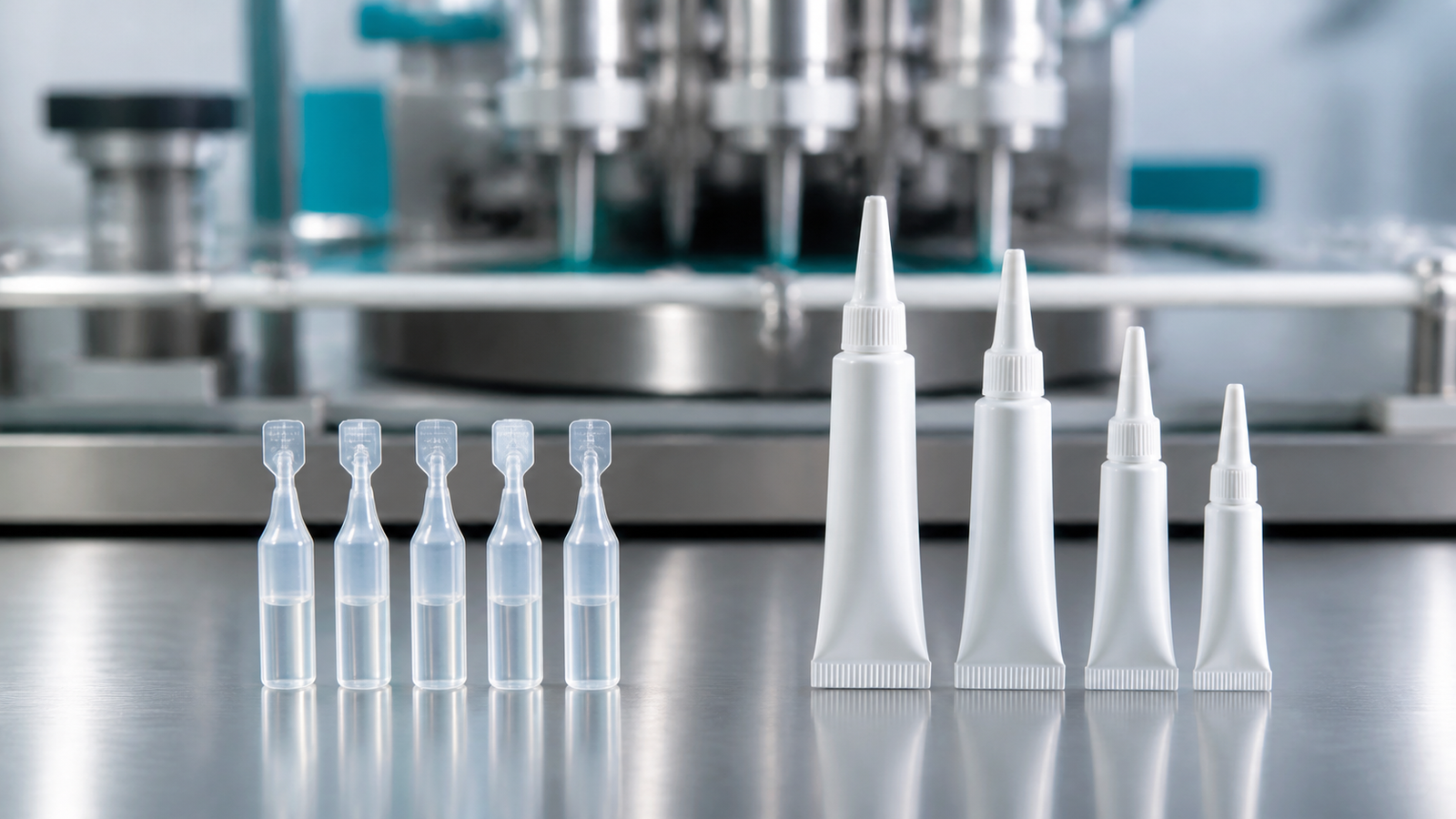
When sourcing packaging for a topical veterinary product, the choice between a spot-on pipette and an applicator tube affects far more than just the container. It determines your filling method, sealing technology, production speed, dosing accuracy, and even which regulatory path applies.
Many buyers use the terms “pipette” and “applicator tube” interchangeably, but in veterinary packaging, these are distinct container formats with different engineering requirements. Choosing the wrong one — or selecting filling equipment without understanding the difference — leads to dosing errors, seal failures, and production line incompatibility.
This guide explains the real differences between spot-on pipettes and applicator tubes, how each one affects your production process, and what to consider when selecting filling and sealing equipment.
Why This Issue Matters
Choosing between a spot-on pipette and an applicator tube is not a packaging preference — it is a production engineering decision that affects filling technology, sealing method, line speed, regulatory classification, and equipment investment for years to come.
A manufacturer that selects a pipette format without understanding its micro-volume filling requirements may end up with a machine designed for larger tubes that cannot achieve the necessary dosing accuracy. Conversely, investing in a high-precision pipette filler for a product that would work better in a standard applicator tube means paying for capability you do not need. Either mismatch results in wasted capital, production inefficiency, and potential quality issues.
The format decision also determines your sealing technology, container handling system, changeover complexity, and even the cleanroom requirements. Spot-on pipettes demand bottom-up filling with drip control; applicator tubes may require auger fillers for pastes and metal folding for aluminum tails. These are fundamentally different machine configurations, and attempting to force one format onto a machine designed for the other leads to chronic production problems.
For procurement managers and production engineers, understanding these differences before committing to equipment is essential. The cost of choosing the wrong format extends beyond the container price — it includes machine reconfiguration, lost production time during changeovers, and potentially an entirely new equipment purchase if the first machine cannot handle the work.
What Is a Spot-On Pipette?
A spot-on pipette is a small, rigid or semi-rigid, single-dose container designed to deliver a precise volume of liquid directly onto an animal’s skin. It is typically used for flea and tick treatments, topical dewormers, and hormone therapies.
Key Characteristics
- Volume: 0.1–5 mL (micro-dose to small dose)
- Material: LDPE, HDPE, or multi-layer co-extruded plastic
- Shape: Narrow, elongated body with a snap-off or twist-off tip
- Sealing: Heat-sealed, ultrasonic-sealed, or cap-closed at the open end
- Dosing: Single-dose — the entire contents are applied in one use
- Application: Direct skin contact; product absorbs transdermally
Typical Products
- Flea and tick spot-on treatments (e.g., fipronil, imidacloprid solutions)
- Topical dewormers (e.g., eprinomectin, moxidectin)
- Hormonal treatments (e.g., estrus synchronization)
What Is an Applicator Tube?
An applicator tube is a broader category of container used for oral or topical veterinary products. It is generally larger than a spot-on pipette, may be semi-rigid or flexible, and is designed for products that are applied by squeezing through a nozzle or opening.
Key Characteristics
- Volume: 1–30 mL (sometimes larger)
- Material: LDPE, HDPE, laminated plastic, or aluminum
- Shape: Wider body with a defined nozzle or opening
- Sealing: Heat-sealed tail (for flexible tubes) or screw cap (for rigid tubes)
- Dosing: Can be single-dose or multi-dose depending on design
- Application: Oral dosing (into the mouth), topical application, or intramammary infusion
Typical Products
- Oral gel dewormers (e.g., fenbendazole, ivermectin paste)
- Calcium gels for dairy cows
- Intramammary antibiotic tubes
- Nutritional supplement pastes
- Eye and ear ointments
Spot-On Pipette vs Applicator Tube: Head-to-Head Comparison
| Feature | Spot-On Pipette | Applicator Tube |
|---|---|---|
| Typical volume | 0.1–5 mL | 1–30 mL (or larger) |
| Container rigidity | Rigid or semi-rigid | Semi-rigid to flexible |
| Body shape | Narrow, elongated | Wider, cylindrical |
| Opening design | Snap-off or twist-off tip | Nozzle, orifice, or screw cap |
| Sealing location | Open end (top seal) | Tail end (bottom seal for flexible) or cap |
| Sealing method | Heat seal, ultrasonic, or cap | Heat seal, metal fold (aluminum), or cap |
| Dosing type | Single-dose only | Single-dose or multi-dose |
| Dosing precision | High (pre-measured) | Moderate to low (user-controlled for multi-dose) |
| Application route | Topical (skin) | Oral, topical, intramammary |
| Product viscosity | Low to medium (liquid to gel) | Medium to high (paste, gel, ointment) |
| Filling direction | Bottom-up or nozzle insertion | Top-fill (open nozzle end) or bottom-fill |
| Container handling | Lightweight, small — requires precision feeding | Heavier, larger — easier to handle |
| Production speed | Moderate (limited by precision requirements) | Moderate to high |
| Typical machine type | Customized pipette filling machine | Standard tube filling machine or modified |
How the Differences Affect the Filling Process

Filling Accuracy
Spot-on pipettes require significantly higher filling accuracy because each container holds exactly one dose. A 0.5 mL pipette filled at ±1% means a tolerance of just ±0.005 mL. Applicator tubes, especially larger-volume oral pastes, can tolerate wider fill variations because the product is often dosed by weight or length of extruded paste.
Machine implication: Spot-on pipettes typically require servo-driven peristaltic pumps or precision piston fillers. Applicator tubes can often use standard piston fillers or auger fillers (for pastes).
Filling Direction
Spot-on pipettes are often filled bottom-up (the filling nozzle inserts into the pipette body and fills from the bottom) to minimize air entrapment and foaming. Applicator tubes with a defined nozzle opening are typically filled from the open tail end (for flexible tubes) or through the nozzle opening (for rigid tubes).
Machine implication: Spot-on pipette fillers need a bottom-fill mechanism with precise nozzle positioning. Applicator tube fillers use top-fill or tail-fill configurations.
Product Viscosity Handling
Spot-on products are generally low to medium viscosity (water-like solutions to thin gels). Applicator tube products range from medium viscosity gels to thick pastes (e.g., dewormer paste for horses).
Machine implication: High-viscosity products require larger-bore pistons, heated hoppers, or auger fillers. Low-viscosity spot-on products need drip-control mechanisms and suction-back nozzles.
How the Differences Affect the Sealing Process
Spot-On Pipette Sealing
The seal on a spot-on pipette is typically at the open end (the end opposite the application tip). This requires:
- Heat sealing jaws matched to the pipette’s material and wall thickness
- Precise temperature control to avoid deforming the small container
- Seal integrity testing because even a micro-leak compromises the entire dose
Some pipettes use a separate cap or plug instead of a heat seal, which requires a capping station rather than a sealing station.
Applicator Tube Sealing
For flexible applicator tubes, the seal is at the tail end (the open end that is folded or sealed after filling):
- Heat sealing for plastic and laminate tubes
- Metal folding for aluminum tubes
- Ultrasonic sealing for specific materials
For rigid applicator tubes with screw caps, sealing is replaced by a capping operation with torque control.
Machine implication: A machine designed for spot-on pipettes may not have the sealing jaw size or force for larger applicator tubes, and vice versa. The sealing station must match the container format.
Production Line Implications
Can One Machine Handle Both?

In some cases, a well-designed tube filling and sealing machine can handle both formats — but only if:
- The volume ranges overlap (e.g., 1–5 mL)
- The container diameters are within the machine’s handling range
- The sealing method is compatible (e.g., both use heat sealing)
- Quick changeover tooling is available
In practice, manufacturers producing both spot-on pipettes and larger applicator tubes often use:
- A dedicated pipette filling machine for spot-on products
- A separate tube filling machine for applicator tubes
- Or a highly customized machine with interchangeable tooling for both
Speed Considerations
| Format | Typical Speed Range |
|---|---|
| Spot-on pipettes (small volume) | 2,000–8,000 pcs/hour |
| Applicator tubes (medium volume) | 3,000–12,000 pcs/hour |
| Large applicator tubes (paste) | 1,500–5,000 pcs/hour |
Speed depends on fill volume, accuracy requirements, sealing method, and automation level.
Common Mistakes When Choosing Between Pipette and Tube Formats
Mistake 1: Selecting the Container Before Understanding the Filling Requirements
Some product developers choose a pipette or tube based on appearance rather than production feasibility. The container design must be evaluated alongside filling precision, sealing compatibility, and machine availability.
Mistake 2: Assuming One Machine Can Handle Everything Without Testing
While some machines claim multi-format capability, actual performance depends on the specific container drawing, product viscosity, and seal design. Always request a filling trial with your actual product and container before committing.
Mistake 3: Ignoring Changeover Time
If you plan to run multiple formats on one machine, understand the real changeover time. Some machines require 30–60 minutes to switch between significantly different container sizes; others with modular tooling can change in under 15 minutes.
Mistake 4: Overlooking Drip Control for Low-Viscosity Products
Spot-on products are often low-viscosity liquids that drip easily. If the filling machine lacks proper suction-back or drip-tray design, product contamination on the outside of the pipette creates packaging and quality issues.
Mistake 5: Not Considering Regulatory Implications
The choice of container format can affect how your product is classified and labeled. Single-dose pipettes have specific regulatory requirements that differ from multi-dose tubes. Consult your regulatory team early in the packaging selection process.
How to Evaluate Your Options
Decision Framework
| Question | If Yes → | If No → |
|---|---|---|
| Is the product a single-dose liquid under 5 mL? | Spot-on pipette | Consider applicator tube |
| Is the product applied directly to skin? | Spot-on pipette | Consider applicator tube |
| Is the product a paste or high-viscosity gel? | Applicator tube | Consider spot-on pipette |
| Is oral dosing required? | Applicator tube | Consider spot-on pipette |
| Does the product require tight unit-level dosing control? | Spot-on pipette | Applicator tube may suffice |
| Do you need volumes over 10 mL? | Applicator tube | Spot-on pipette not practical |
| Is the product light- or oxygen-sensitive? | Either — with appropriate material | — |
Machine Selection Checklist
When evaluating filling equipment for either format:
- Does the machine handle your specific container dimensions?
- Can it achieve the required fill accuracy at your target volume?
- Is the sealing method compatible with your container material?
- What is the real changeover time between formats?
- Does the supplier offer filling trials with your product?
- Are spare parts and technical support available in your region?
- Does the machine support your regulatory documentation needs (IQ/OQ/PQ)?
Total Cost of Ownership
When evaluating whether to invest in a pipette filling machine, an applicator tube filler, or both, total cost of ownership should drive the decision — not just the purchase price of each machine.
- Key TCO factors to consider:
- Purchase price of each machine (a dedicated pipette filler and a separate tube filler, versus one dual-format machine)
- Changeover cost if using a dual-format machine (downtime, tooling swap, revalidation)
- Product waste from format mismatch (filling pipettes on a tube machine adapted with compromise tooling)
- Maintenance and spare parts for one machine versus two
- Labor savings from automation versus manual or semi-automatic alternatives
- Regulatory documentation cost (dual-format machines may require additional validation for each format)
Depending on format range and changeover frequency, two dedicated machines may outperform one dual-format system over five years. Compare both options with actual trial data, tooling cost, downtime, and utilization rather than assuming either architecture is always cheaper.
Different Production Scenarios
The equipment implications of choosing between spot-on pipettes and applicator tubes vary significantly depending on the production context. Three scenarios illustrate common situations:
Scenario 1: New Product Launch — Format Decision
A veterinary company is developing a new topical parasite treatment and must decide between a spot-on pipette (0.5–3 mL) and an applicator tube (5–15 mL). The product is a low-viscosity liquid applied directly to the skin.
Recommendation: Spot-on pipette is the appropriate format. The low volume, topical application route, and single-dose requirement all point to pipette packaging. The filling machine should be a dedicated pipette filler with bottom-up filling and servo-driven precision dosing. Attempting to use a standard tube filler adapted for pipettes risks inadequate accuracy and poor container handling.
Scenario 2: Multi-Product Manufacturer — Dual Format Lines
An established animal health company produces both spot-on pipette treatments (liquid, 0.5–5 mL) and oral gel dewormer pastes (tube, 10–30 mL). They are considering whether one machine can handle both.
Recommendation: Two dedicated machines are typically more cost-effective than one compromised solution. A pipette filling machine for spot-on products and a standard tube filling machine for oral pastes. While some machines claim multi-format capability, the reality is that the filling technology, sealing method, and container handling are fundamentally different. A dual-format machine usually underperforms on both formats. The investment in two machines is offset by higher efficiency, fewer changeover issues, and better product quality.
Scenario 3: CMO Expanding Service Range
A contract manufacturer currently produces applicator tube products (oral gels, ointments) and wants to add spot-on pipette filling capabilities to attract new clients in the flea and tick market.
Recommendation: Add a dedicated pipette filling line rather than modifying the existing tube line. The existing tube filler’s sealing jaws, feeding system, and filling technology are designed for larger, heavier containers. Adapting it for micro-volume pipettes would require extensive retooling with uncertain results. A separate pipette line allows the CMO to market both capabilities independently and avoids disrupting existing production.
How to Evaluate a Supplier
Selecting the right equipment supplier is as important as selecting the machine itself. The supplier’s engineering capability, component quality, documentation standards, and after-sales support determine whether your machine performs reliably for years — or becomes a source of ongoing problems.
Manufacturing and Engineering Capability
Verify that the supplier manufactures the core filling and sealing components in-house rather than assembling generic sub-assemblies. Request photos or videos of their manufacturing facility, and ask for references from similar veterinary applications. A supplier that has built machines for spot-on pipette production understands the specific challenges of micro-volume filling and lightweight container handling.
Component Quality
Check whether the supplier uses internationally recognized component brands: Siemens, Schneider, or Omron for electrical systems; Festo, SMC, or equivalent for pneumatic systems; Yaskawa or equivalent for servo motors. These brands ensure global availability of spare parts and reliable performance. Avoid machines with proprietary or region-locked components that are difficult to source.
FAT and Trial Support
The supplier should offer — and encourage — Factory Acceptance Testing with your actual product and pipettes. FAT is your opportunity to verify fill accuracy, seal quality, and production speed before the machine ships. A supplier that discourages FAT or cannot provide trial facilities should be approached with caution.
Validation and Documentation
For regulated projects, define the required qualification support, material certificates, manuals, schematics, and spare-parts documentation in the URS. Confirm which items are included in the base scope and which are optional before purchase.
After-Sales Support
Evaluate the offered warranty period and scope, documented lead times for common and custom spare parts, remote technical support availability, and on-site installation and training options. A supplier with a local service partner in your region is significantly better than one that can only offer remote support from overseas.
When Does Automation Make Sense?
Not every spot-on production operation requires full automation. The decision to invest in automated filling and sealing equipment should be based on clear production indicators rather than the assumption that more automation is always better.
- Automation typically makes sense when one or more of the following conditions apply:
- Sustained production volume makes manual filling labor-intensive or inconsistent
- The approved product specification calls for a tolerance that manual or semi-automatic filling cannot maintain consistently
- Labor costs are rising, or the available workforce lacks the precision and consistency needed for manual micro-volume dosing
- Regulatory requirements demand batch traceability, electronic records, or audit trail capabilities that manual processes cannot provide
- Product waste from manual filling (overfill, spillage, container damage) is eating into profit margins
- Multiple product formats require frequent changeover, and recipe-based automated systems can reduce changeover time compared to manual reconfiguration
Conversely, automation may not be justified when production volumes are low or intermittent, when the product is still in R&D or clinical trial phases, or when the operation is a temporary pilot line. In these cases, a semi-automatic machine provides filling precision and seal quality without the capital investment of a fully automated line.
The key is to match the automation level to your actual production needs — not to your aspirational volume. A machine that is too automated for your current needs adds unnecessary complexity and cost; a machine that is not automated enough creates a production bottleneck that limits growth. Plan for your expected volume in 2–3 years, not just today’s output.
How King Pack Supports Both Pipette and Tube Applications
King Pack Machinery (Wuxi King-Pack Machinery Co., Ltd.) designs filling and sealing solutions for both spot-on pipettes and applicator tubes. Since 2009, the company has configured machines based on actual product and container requirements rather than offering one-size-fits-all solutions.
For Spot-On Pipettes
- Customized pipette filling machines with micro-volume precision
- Bottom-up filling to minimize air entrapment
- Heat-seal or ultrasonic-seal options based on material
- Dedicated feeding systems for small, lightweight containers
For Applicator Tubes
- Tube filling and sealing machines for plastic, laminate, and aluminum tubes
- Piston or auger filling for medium to high-viscosity products
- Hot-air sealing, ultrasonic sealing, or aluminum folding
- Capping options for rigid tubes with screw closures
Evaluation Process
King Pack requests the following before recommending a machine configuration:
- Container drawings and samples
- Product samples for filling trials
- Target fill volume and accuracy requirements
- Production speed requirements
- Sealing design specifications
- Regulatory documentation needs
Each machine undergoes Factory Acceptance Testing (FAT) with the customer’s actual materials before shipment.
FAQ
Can I use the same machine for spot-on pipettes and applicator tubes?
It depends on the specific machine design and your container formats. Some machines with modular tooling can handle both, but performance varies. Always request a filling trial with your actual containers and products before assuming compatibility.
Which format is more cost-effective for veterinary products?
Cost depends on volume, container complexity, and production speed. Spot-on pipettes generally have higher per-unit container costs but lower product waste due to precise dosing. Applicator tubes may have lower container costs but higher product waste for single-dose applications. Evaluate total cost, not just container price.
What is the main sealing difference between pipettes and tubes?
Spot-on pipettes are typically sealed at the open end using heat or ultrasonic methods. Flexible applicator tubes are sealed at the tail end using heat sealing or metal folding. Rigid applicator tubes use screw caps instead of heat sealing.
How do I know which container format to choose for my product?
Start with your product characteristics (viscosity, dose volume, application route) and work backward to the container format. A liquid product applied topically in a dose under 5 mL typically suits a spot-on pipette. A paste or gel applied orally or in larger volumes typically suits an applicator tube.
What filling accuracy is needed for spot-on pipettes?
The acceptable fill tolerance must be defined in the product specification and demonstrated with the actual formulation and container. Smaller target volumes often demand tighter process control, so confirm the acceptance criteria with your quality and regulatory teams before selecting equipment.
Can King Pack run filling trials before I order a machine?
Yes. King Pack recommends sending container samples and product samples for filling trials before machine configuration is finalized. This ensures the machine matches your actual production requirements.
Related Equipment and Resources
- Choose a filling machine by viscosity, container and output
- Browse tube filling and sealing machines
Conclusion
Spot-on pipettes and applicator tubes serve different purposes in veterinary packaging. The pipette is a precision single-dose container for low-volume liquid products applied topically. The applicator tube is a more versatile format for larger volumes, higher viscosities, and oral or topical applications.
The choice between them affects your filling method, sealing technology, machine selection, production speed, and regulatory path. Rather than choosing based on appearance or convention, evaluate the decision based on your product characteristics, dosing requirements, and production capabilities.
When selecting filling equipment, ensure the machine is configured for your specific container format — not just the general category. Request filling trials, evaluate changeover times, and verify that the supplier can support your long-term production and regulatory needs.
Talk to King Pack
Compare Filling Solutions for Your Product
If you are evaluating whether a spot-on pipette or applicator tube is the right format for your veterinary product, King Pack can review your product specifications and container options to recommend the appropriate filling and sealing configuration.
Discuss your project with King Pack or send your product and container specifications.
