 Skip to content
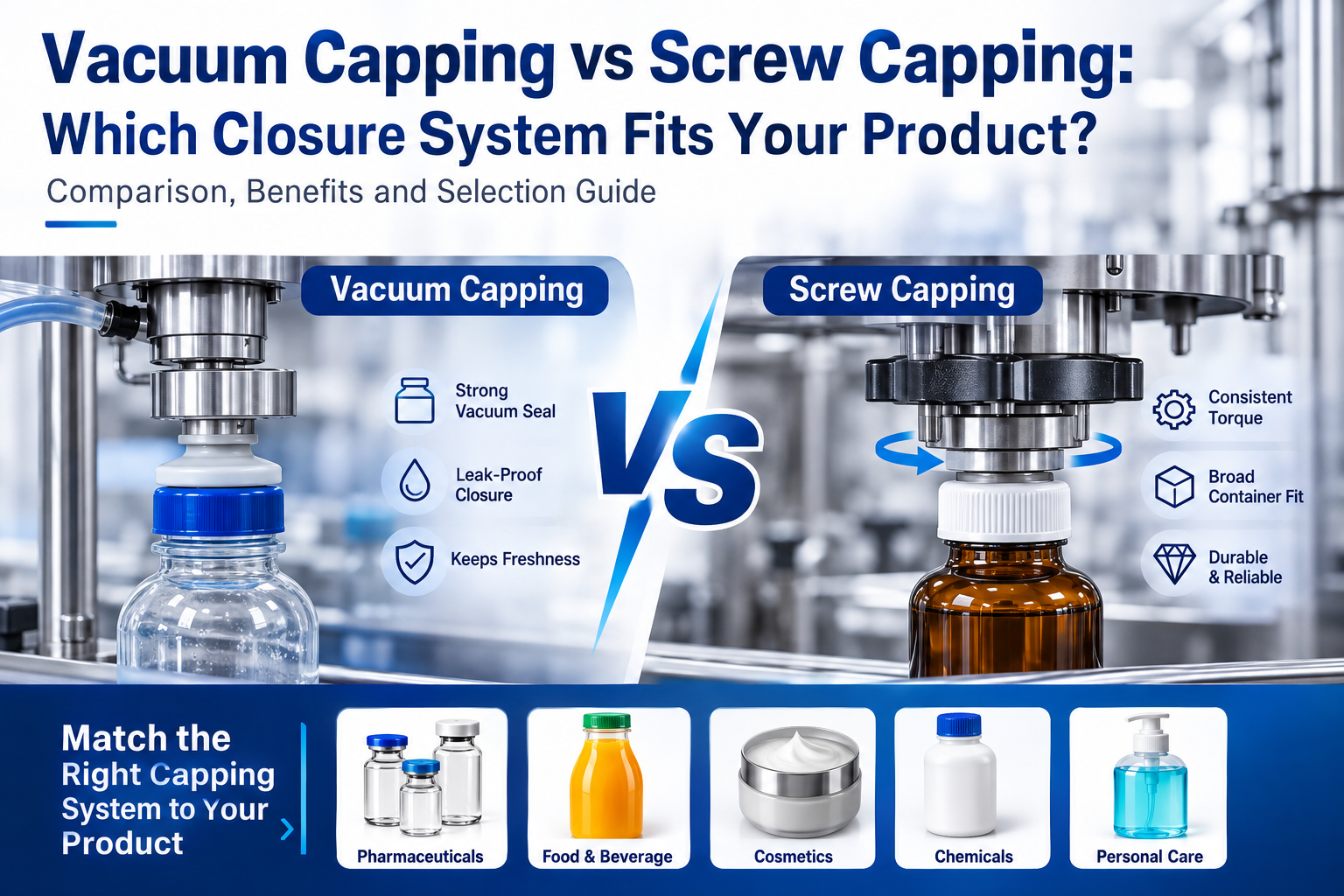
Vacuum capping and screw capping solve different packaging problems. A vacuum capping process removes or displaces headspace air and applies a compatible closure so negative pressure helps maintain the seal. A screw capping machine applies controlled rotation to a threaded closure, with seal performance created by the cap, liner, container finish and any secondary sealing system.
The terms can overlap: many vacuum-packed glass jars use twist-on lug caps, so the machine both creates vacuum and rotates the closure. The useful buying question is not simply “vacuum or screw?” It is whether the package depends on controlled headspace vacuum, controlled application torque, or a validated combination of closure, liner and thermal process.

Quick comparison: vacuum capping vs screw capping
| Decision factor | Vacuum capping | Screw capping |
|---|---|---|
| Primary process objective | Create or preserve negative pressure in the sealed headspace | Apply a pre-threaded closure at a controlled application condition |
| Common closure | Metal lug or compatible vacuum closure on a rigid jar | Continuous-thread plastic or metal cap on a threaded bottle or jar |
| Typical container | Rigid glass jar or bottle designed for vacuum service | Glass, PET, HDPE, metal or another container with a compatible thread finish |
| Main control variables | Headspace, fill/sealing temperature, residual air, steam or chamber vacuum, cap condition | Cap placement, container stabilization, application torque or head setting, liner and thread condition |
| Typical quality checks | Vacuum, safety-button position where used, pull-up/security, cap position and package integrity | Removal torque, cap height or skew, tamper band, leak or seal integrity |
| Common applications | Hot-filled sauces, jams, pickles and shelf-stable jarred foods; selected dry or specialty products | Water, oils, detergents, cosmetics, pharmaceuticals and many refrigerated or ambient liquids |
| Best reason to choose | The validated package process requires vacuum to help form or maintain the closure seal | The product uses a threaded package and needs repeatable closure application and flexible formats |
| Main misconception | Vacuum alone guarantees safety or shelf life | One torque value guarantees a good seal for every cap and bottle lot |
The key distinction: process vacuum versus application torque

Vacuum capping is a package-process choice. The headspace condition, product temperature, closure compound and container finish influence the final negative pressure and seal. Screw capping is mainly an application method: the capper rotates a threaded closure until a clutch, servo, pneumatic head or spindle system reaches its intended operating condition.
Neither process should be judged by one machine setting. Vacuum is affected by fill temperature, headspace and trapped air. Removal torque is affected by liner compression, thread friction, product contamination, time and temperature. Both packages need documented component specifications and finished-package tests.
How vacuum capping works
Mechanical vacuum capping
In a mechanical vacuum system, a filled container and closure enter an evacuated chamber or sealed capping zone. Air is removed from the headspace, and the cap is applied while the reduced pressure is maintained. This method is often considered for dry products or applications where steam contact is unsuitable, but the exact package and process must be qualified.
Steam-flow vacuum capping
In a steam-flow capper, controlled steam displaces air from the jar headspace just before the closure is applied. After sealing, the trapped steam condenses and the product cools, creating negative pressure. FDA’s inspection guidance for low-acid foods describes this process and identifies headspace, fill/sealing temperature, residual air and capper efficiency as important vacuum-formation factors.
This does not mean every steam-flow application follows the same temperature or vacuum target. Those values belong to the scheduled process, closure specification and container supplier’s recommendation. The capper is one part of the food-preservation system; it does not replace formulation control, heat treatment, sanitation or regulatory review.
Lug-cap application
A metal lug closure uses several angled lugs rather than a full continuous thread. The cap is picked up, turned a fraction of a revolution and seated against the jar finish. Depending on the design, a flowed-in compound or other gasket contacts the glass sealing land. Vacuum and mechanical lug engagement then work together to retain the closure.
The food-industry packaging line must deliver consistent fill temperature, headspace and clean jar finishes to the capper. A well-adjusted capper cannot correct sauce on the sealing land or an out-of-spec jar finish.
How screw capping works
A screw capping machine receives a pre-threaded cap, places it squarely on the bottle and rotates it while stabilizing the container. Inline spindle machines use opposing rotating wheels or belts. Chuck cappers engage the closure with a dedicated head during an indexed or rotary cycle. Servo heads can execute stored motion profiles and collect process data.
The capper’s setting is normally related to application torque or head output. Finished removal torque is measured later and may decrease or change as the liner relaxes and the package experiences storage conditions. ASTM D2063/D2063M is a recognized test method for evaluating torque retention of continuous-thread container-closure systems under controlled conditions.
Threaded closures can use liners, induction-seal foils, tamper-evident bands or other features. The screw capper must place and tighten the cap correctly, but it does not by itself prove leakage resistance, induction-seal quality or shelf life.
Container and cap compatibility
| Package feature | Vacuum-capping fit | Screw-capping fit |
|---|---|---|
| Rigid glass jar with lug finish | Strong candidate when the closure and process are designed for vacuum | Not suitable for a standard continuous-thread cap unless the finish is different |
| Glass or plastic bottle with continuous thread | Only if a validated vacuum closure/process is specifically designed for it | Normal candidate for a compatible screw cap |
| Flexible thin-wall bottle | Often unsuitable because external pressure can panel or deform the container | Possible with neck support and controlled torque; test bottle stability |
| Hot-filled sauce or jam | Common vacuum-lug application when validated with the thermal process | Possible for suitable threaded hot-fill packages, but torque alone does not create a vacuum seal |
| Cold-filled water-like liquid | Vacuum may add no useful package function | Common screw-capping application |
| Oil, detergent or cosmetic | Mechanical and chemical compatibility must be assessed; vacuum is rarely the main need | Common where threads, liner and product compatibility are qualified |
| Frequent cap-style changes | Feeder, chute, sealing shoe and jar handling may require substantial changes | Flexible spindle systems may accept more formats; chucks and tracks can still require parts |
The container finish and closure drawing control the decision. A lug cap cannot be placed on a continuous-thread finish, and a standard screw cap cannot create a qualified vacuum-lug seal. Send both drawings and physical samples when requesting a machine proposal.
Shelf life, oxygen and seal integrity
Vacuum can reduce the amount of residual gas in a sealed headspace and provides a useful seal-condition signal for many metal closures. It may also support product-quality goals related to oxidation. However, final shelf life depends on the formulation, microbial hazards, thermal process, oxygen sensitivity, container barrier, closure compound, sanitation and storage conditions.
For U.S. shelf-stable acidified and low-acid foods in hermetically sealed containers, FDA requirements may include establishment registration and scheduled-process filing. FDA’s Part 113 inspection guidance also describes capper-efficiency and closure-evaluation controls for glass containers with vacuum closures. Manufacturers should work with a qualified process authority; selecting a vacuum capper does not establish a compliant scheduled process.
Screw-capped packages can also achieve excellent barrier and seal performance. The result may depend on a compressed liner, plug seal, induction foil, tamper band or a combination. Package validation should test the actual closure system after filling, capping, thermal exposure, distribution simulation and aging as appropriate.
Speed, changeover and automation
Vacuum capping line considerations
Vacuum capping speed depends on cap feeding, jar spacing, evacuation or steam dwell, sealing-shoe engagement and the product process. A rotary vacuum system may support high output, while an indexed chamber capper may suit smaller batches. Steam demand, extraction, condensate management and guarding can influence installation.
Changeover may involve cap chute parts, jar guides, side belts, chamber tooling, sealing-shoe positions and process settings. The supplier should demonstrate changeover using both the smallest and largest planned jar.
Screw capping line considerations
Inline spindle cappers can provide broad bottle-format flexibility because containers move continuously through adjustable belts and spindle sets. Chuck systems may offer more positive engagement but need dedicated chucks or inserts. At higher speeds, rotary multi-head systems require format stars and head-by-head quality sampling.
In either case, the capper must be balanced with the filling and capping line. State sustainable accepted containers per minute, not only maximum capper cycles. Include cap replenishment, inspection and normal accumulation in the test.
Defects and quality checks
| Symptom | Vacuum-capping checks | Screw-capping checks |
|---|---|---|
| Loose or high cap | Steam or vacuum efficiency, sealing-shoe pressure, side-belt tension, lug engagement | Application setting, bottle spinning, head engagement, worn chuck or spindle |
| Cocked cap | Cap pickup, chute alignment, jar centering, product on finish | Cap placement, bottle pitch, thread start, head alignment |
| Low package vacuum | Headspace, fill temperature, residual air, chamber or steam performance, closure compound | Not normally a screw-capper metric unless the package process also requires vacuum |
| Stripped or crushed closure | Excess pressure, sealing-shoe or lug damage, finish dimensions | Excess application, cross-threading, wrong cap or damaged threads |
| Leakage | Gasket contact, finish damage, product contamination, inadequate vacuum/process | Liner, application, thread damage, induction seal or package integrity |
| Wide sample variation | Capper warm-up, component lots, multiple stations, unstable product conditions | Individual heads, cap/bottle lots, air pressure, liner relaxation |
Silgan’s steel-closure operating guidance treats pull-up, security, removal torque and closure position as different checks. It also notes that removal torque varies with glass treatment, filling and sealing conditions, package vacuum and the operator. Therefore, do not copy one acceptance number into every project; use the closure and container suppliers’ validated methods.
Cost drivers and line integration
Vacuum capping systems may require a vacuum chamber or controlled steam supply, condensate handling, extraction, specialized cap tracks and vacuum inspection. Screw cappers may require spindle sets, chucks, servo heads, torque monitoring, bottle-stabilization belts and change parts. Machine price should be compared against the complete installed scope.
Ask each supplier to identify:
- Cap and container formats included in the guarantee.
- Normal and peak accepted output for every format.
- Utilities, steam quality, air, extraction and drainage requirements.
- Cap feeding, low-level detection and jam recovery.
- Vacuum, torque, cap-height or vision inspection included.
- Reject confirmation and containment.
- Change parts, recipes, tools and changeover time.
- FAT materials, test methods and sampling plan.
- Installation, training, spare parts and service scope.
A lower-priced capper can be costly if it cannot maintain the specified vacuum or torque across component lots, or if changeovers consume production time.
Application decision scenarios
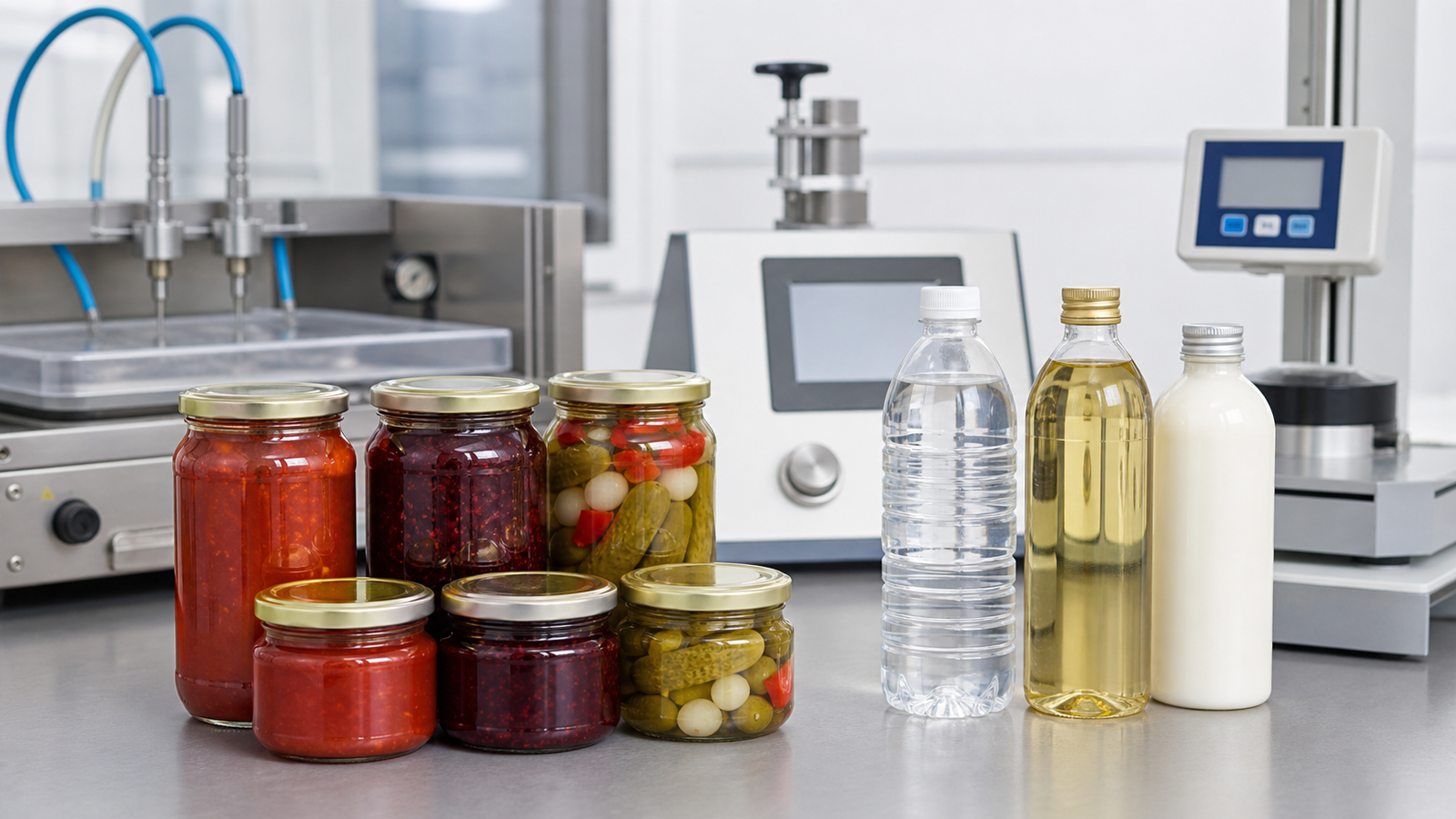
Choose a vacuum-lug system when
- The product is packaged in a rigid jar with a compatible lug closure.
- The validated process requires controlled headspace vacuum.
- Fill temperature, headspace and thermal treatment are defined by the pack owner and process authority.
- Vacuum, pull-up/security and closure position can be measured with approved methods.
Choose a screw-capping system when
- The package uses a continuous-thread closure.
- Application torque, liner compression or a secondary seal is the main closure mechanism.
- The line needs flexibility across plastic or metal caps and multiple bottle formats.
- Vacuum creation is not a required part of the package process.
Use a combined, package-specific approach when
Some closures are turned onto the container while a chamber or steam-flow system establishes vacuum. In that case, specify both the mechanical cap application and the final vacuum or integrity requirement. Do not classify the project by only one machine verb.
A practical decision tree
- Does the approved package use a lug or other vacuum closure on a rigid jar? If yes, define the vacuum process and evaluate a vacuum capper.
- Does the package use a pre-threaded continuous-thread cap? If yes, evaluate spindle, chuck or rotary screw capping.
- Is shelf-stable thermal processing involved? Engage the process authority and closure supplier before freezing machine settings.
- Does the package require both rotational application and controlled vacuum? Specify both functions and their acceptance tests.
- Are multiple closure families planned? Price separate feeding, heads, change parts and changeover validation rather than assuming one capper handles all.
King Pack’s article on hot sauce bottling machines provides a broader view of sauce filling and line configuration. This comparison focuses specifically on selecting the closure process.
Frequently asked questions
Does vacuum capping extend shelf life?
Vacuum can support seal retention and reduce headspace gas, but shelf life is determined by the full formulation, thermal process, package barrier, sanitation and storage system. It must be validated; the capper alone does not establish shelf life.
Is a vacuum cap the same as a screw cap?
Not necessarily. Many vacuum jars use lug caps that turn a fraction of a revolution, while screw caps generally use a continuous thread. Some vacuum cappers rotate the cap during application, so the process descriptions can overlap.
Which products usually use vacuum capping?
Common candidates include compatible glass jars of sauces, jams, pickles and other hot-filled or thermally processed foods. Mechanical vacuum systems can also serve selected dry or specialty products.
Can a plastic bottle be vacuum capped?
Only when the bottle and closure are specifically designed for the pressure differential. Thin-wall containers may panel or deform. Test the filled package through processing, cooling and distribution.
What is checked after vacuum capping?
Checks can include package vacuum, safety-button position, cap pull-up/security, closure position, visual defects and package integrity. The approved method and timing should come from the closure supplier and process specification.
What is checked after screw capping?
Common checks include cap presence, height or skew, tamper-band condition, removal torque and leak or seal integrity. Sample every head and allow for torque change over time.
Which system is faster?
Both technologies are available in indexed and high-speed rotary formats. Sustainable speed depends on the product, container, closure, process dwell, feeder and downstream line—not the category name.
What samples should be sent to the machine supplier?
Send production-representative jars or bottles, closures, liners, drawings, filled weights, product behavior, fill temperature, headspace requirement, target output and approved quality tests. Include all planned component suppliers.
Choose the closure process from the package requirement
Vacuum capping is the right starting point when the package depends on controlled negative pressure and a compatible rigid jar closure. Screw capping is the right starting point when a threaded cap must be applied repeatably and vacuum is not the core sealing mechanism. The final decision should be made with the package owner, closure supplier and process authority where thermal processing is involved.
Share your jar, lid, product, fill temperature and output details with King Pack. The engineering team can review whether a vacuum-lug, continuous-thread screw or combined process should be tested and how it should integrate with the filling line.
