 Skip to content

Quick decision rule: Start with a piston filling machine for viscous creams, pastes and larger doses; a peristaltic filling machine for clean, low-volume dosing where a disposable fluid path or fast product changeover matters; and a magnetic pump filler for free-flowing, non-particulate liquids when smooth electronically controlled flow and chemical compatibility can be engineered into the wetted path.
That rule narrows the field, but it does not finish the selection. The correct comparison of a piston vs peristaltic filling machine—and a magnetic-drive alternative—must include dose range, viscosity at production temperature, particles, shear sensitivity, sterility strategy, cleaning, seal and tubing compatibility, speed and total cost of ownership.
Use the table and decision process below to prepare a testable filling specification rather than choosing a pump from a generic application list.
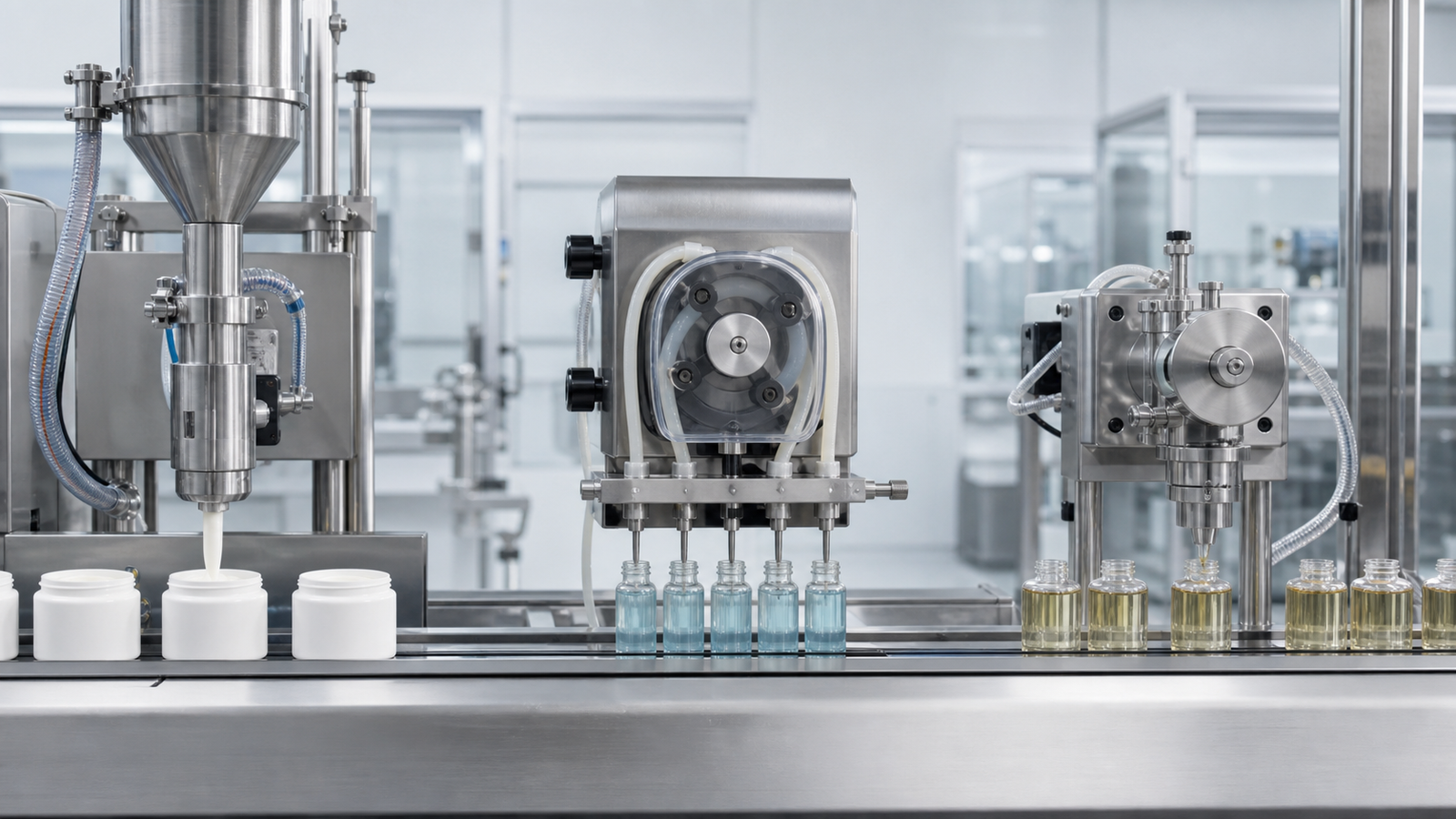
Quick Comparison Table
| Decision factor | Piston filler | Peristaltic filler | Magnetic pump filler |
|---|---|---|---|
| Metering principle | A piston displaces a defined cylinder volume | Rollers compress tubing and move a controlled volume per revolution | A magnetically coupled pump delivers controlled flow; gear designs are commonly used for dosing |
| Best starting products | Viscous creams, gels, sauces, pastes and some soft-particle products | Water-like to moderately viscous sensitive liquids; small batches; pharma/biotech fills | Free-flowing oils, fragrances, solvents, reagents and compatible chemicals without problematic solids |
| Typical strength | Positive displacement across a wide viscosity range | Product contacts only the tubing path; rapid changeover | Smooth controllable flow, compact design and no dynamic shaft seal in a magnetic coupling |
| Main limitation | More product-contact parts; cylinder/valve cleaning and seal wear | Tubing fatigue, tube-to-tube variation and limited pressure/viscosity capability | Close-clearance pumps can be sensitive to particles, dry running, wear and material incompatibility |
| Cleaning approach | Strip-down or sanitary CIP/SIP design | Replace or sterilize the tubing set; clean external pump head | Flush/CIP if designed for it; verify complete drainability and material compatibility |
| Cost pattern | Higher mechanical contact-part burden; durable seals and valves | Lower cleaning burden but recurring tubing/assembly cost | Pump and control cost plus maintenance tied to gears, bearings and wetted materials |
How Each Filling Method Meters Product
Piston: a defined chamber per stroke
The inlet valve opens as the piston retracts and draws product into a cylinder. The valve then switches to the outlet, and the forward stroke displaces the measured product through the nozzle. Fill volume is controlled by piston area multiplied by stroke length. A servo drive can adjust the stroke electronically and coordinate a slow–fast–slow profile.
The cylinder should be sized so the working doses use a controllable part of its stroke. If a project needs both 5 ml and 1,000 ml, one cylinder may be an inefficient compromise. Valve passage, nozzle diameter and suction conditions also determine whether the chamber fills completely at the target speed.
Peristaltic: tubing displacement per revolution
Rollers compress flexible tubing against a pump track. As the rollers move, the pinched section advances and draws product behind it. The dose is controlled by tubing size, pump-head geometry, revolutions, speed and cut-off position. Reversing the pump briefly can reduce dripping for some liquids.
Only the inner surface of the tubing and connected disposable assembly need contact the product. Watson-Marlow’s PF7 product information highlights this single-use fluid path and describes fast changeover, cleanroom operation and repeatable filling. Its published performance applies to that validated system and tubing; it should not be treated as a guarantee for every peristaltic filler.
Magnetic pump: motor torque across a sealed coupling
In a magnetic-drive pump, a motor-side magnet turns an internal driven magnet without a conventional rotating shaft penetrating the pump housing. In a magnetic gear pump, the gears move a defined displacement per revolution, allowing the controller to meter by motor revolutions or a calibrated flow profile.
The magnetic coupling reduces leak paths associated with a dynamic shaft seal, which is attractive for certain chemicals. It does not eliminate all wetted components: housing, gears, stationary shafts, O-rings and connectors must still be compatible. Micropump’s GB Series, for example, lists multiple metals, gear polymers and elastomers and a stated viscosity range for that model. The selection lesson is to check the full material stack and pump curve, not to rely on “stainless steel” alone.
Viscosity, Particles and Shear: The First Decision Gate
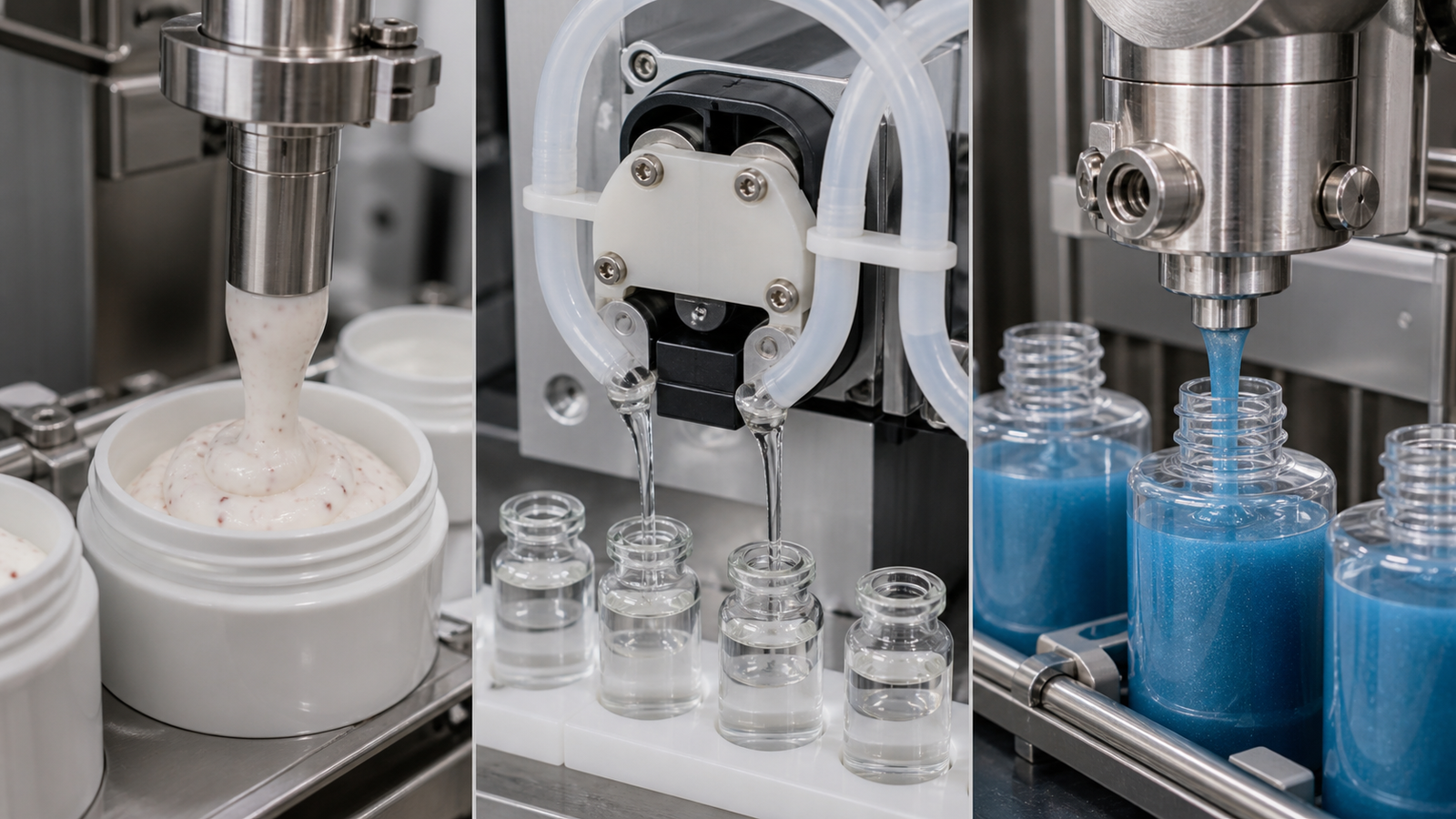
Viscosity should be reported as a range at named temperatures and shear conditions. A cosmetic cream may thin under shear; a gel can string at the nozzle; a suspension may settle; and a warm filling product can be far less viscous than it is at room temperature.
Choose a piston as the starting point when:
- The product is medium to highly viscous and must be positively drawn from a hopper.
- The fill is large enough that tubing life or peristaltic flow would be limiting.
- Soft particles can pass through a properly sized rotary or check valve without damage.
- A robust diving nozzle and suck-back are needed for stringy products.
Choose peristaltic as the starting point when:
- The liquid is low to moderate in viscosity and the dose is small or medium.
- The batch is valuable and minimizing retained product is important.
- Fast changeover between products justifies a disposable fluid path.
- Shear-sensitive liquid must avoid gears or valves, subject to tubing and pump-head validation.
Choose a magnetic pump as the starting point when:
- The product is free-flowing and contains no particles that threaten close clearances.
- Smooth, recipe-controlled flow is required across several bottle sizes.
- The chemical can be matched to available housing, gear and elastomer materials.
- Leakage control around a rotating shaft is an important design objective.
Particles are a warning sign for both tubing and close-clearance gear pumps. Peristaltic systems may deform soft particles or suffer inconsistent occlusion; gear pumps may jam or abrade. Some specially engineered pumps handle deliberate particulates, but that capability must be proven for the actual concentration, hardness and size. A large-port piston valve is often the safer starting point for chunky products, followed by a product-damage trial.
Accuracy and Repeatability by Fill Range
No pump type owns the word “accurate.” A correctly sized system can be repeatable; an oversized, worn or poorly fed system can miss targets.
Piston accuracy depends on complete cylinder charging, seal condition, valve timing and air removal. Peristaltic accuracy depends on tubing material, bore tolerance, tube loading, occlusion, fatigue, speed and calibration. Magnetic gear-pump accuracy depends on displacement, slip, speed control, viscosity, differential pressure, wear and valve cut-off.
For micro- and small-volume applications, a peristaltic system can be compelling because it avoids a small piston/valve assembly and supports direct calibration. Watson-Marlow states better than ±0.5% repeatable filling accuracy for its PF7 under its specified configuration, and its PF7+ system can add in-process weight checking and dynamic recalibration. Use that as evidence that a validated system can perform well—not as an RFQ shortcut. Your acceptance figure must be demonstrated using the proposed tube, liquid, dose, speed and checkweighing method.
For larger viscous fills, a piston often creates the dose with fewer revolutions and less cycle time than a peristaltic pump. A servo-driven cylinder can also make recipe control straightforward. At the smallest end of the same cylinder’s range, however, resolution and valve dead volume may become limiting.
For magnetic gear pumps, confirm the usable speed window and pressure. Micropump’s published GB Series data, for example, provides displacement per revolution, recommended speed and a model-specific viscosity range. These numbers show why pump selection must connect the desired dose and fill time to operating speed; running too slowly or outside the favorable pressure/viscosity region can increase slip and variation.
Sterility, Product-Contact Paths and Cross-Contamination
Peristaltic filling has a clear process advantage when a pre-assembled, sterilized, single-use fluid path is appropriate: the product can contact only the inside of the tubing and disposable connectors/nozzle. A new assembly can reduce cleaning validation effort and cross-batch carryover. It also creates responsibilities for supplier qualification, assembly integrity, extractables/leachables assessment, storage, installation technique and waste management.
A piston or magnetic pump can also be used in hygienic or aseptic designs, but the whole wetted path must be cleanable and, where required, sterilizable. Dead legs, valve seats, shaft or rod interfaces, seals, drainability and aseptic connections matter. A sanitary appearance is not a validation package.
FDA’s aseptic processing guidance treats the filling line as part of a controlled process that includes facility design, environmental control, qualification, written procedures, interventions and media fills. Pump selection can reduce risk, but no pump creates aseptic compliance by itself.
For projects involving sensitive liquid medicines, connect the pump decision to King Pack’s pharmaceutical filling solutions and define the required sterile boundary before equipment design begins.
Chemical Compatibility and Corrosion
Create a wetted-material list that includes more than the pump body:
- Cylinder, piston, valves and nozzle
- Tubing, connectors and disposable manifolds
- Gears, shafts, bushings or bearings
- O-rings, gaskets and dynamic seals
- Hoses, clamps, flowmeters and pressure sensors
- Cleaning agents, sterilants and rinse water
Compatibility depends on concentration, temperature, exposure time, pressure and mechanical stress. A tube that survives a short immersion test may swell, stiffen or shed particles after repeated compression. An elastomer compatible with the product may not tolerate hot caustic cleaning. A corrosion-resistant metal body cannot protect an incompatible O-ring.
For aggressive liquids, the chemical filling and packaging solution provides the right project context: containment, ventilation, electrical classification, guarding and spill control may be as important as dose accuracy.
Cleaning, Changeover and Maintenance
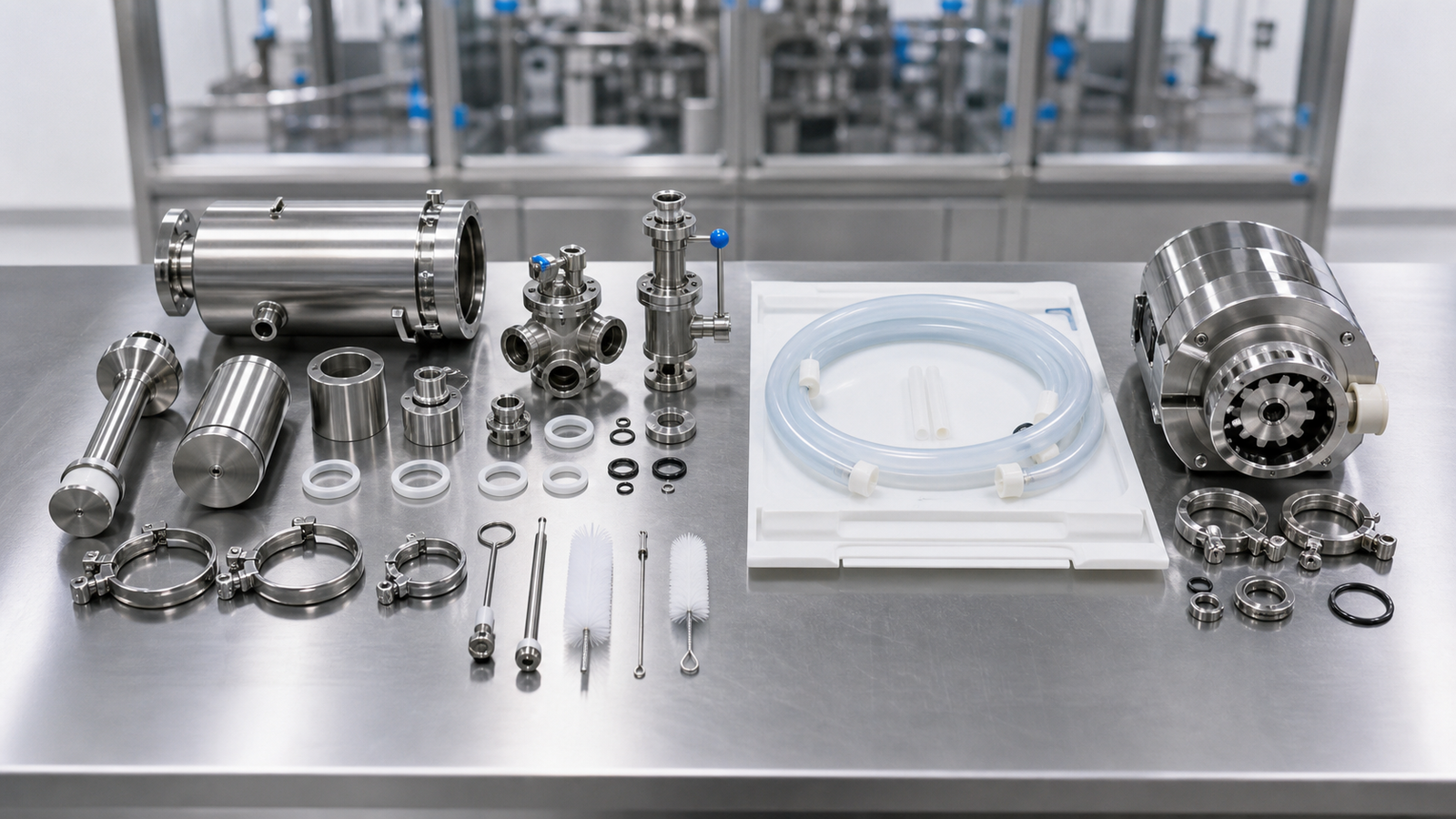
Piston systems
Piston fillers require cleaning of the product hopper, cylinder, piston, valves, manifold and nozzles. Quick-release contact parts can shorten manual cleaning, while a purpose-designed sanitary system can support CIP or SIP. Operators must inspect seals and check valves, lubricate only where permitted and reassemble without creating traps or alignment problems.
Peristaltic systems
Product changeover can be as simple as replacing the fluid path and loading a new tube set, followed by recipe selection, priming and calibration. This is valuable for multi-product, small-batch or cleanroom production. Maintenance shifts from product-contact cleaning toward tube management, pump-head cleaning, roller inspection and disciplined installation. Tube life is a process parameter: fatigue can change flow before visible failure.
Magnetic pump systems
A seal-less magnetic coupling can reduce leakage and dynamic-seal maintenance, but the internal pump still needs flushing, inspection and wear control. Gear clearances may trap product, and some designs should not run dry. CIP suitability must be confirmed for the exact pump, valve and piping arrangement. If different products share the same path, demonstrate carryover removal at worst-case locations.
King Pack’s automatic filling and capping line can combine the chosen filling technology with bottle feeding, plugging, capping, labeling and inspection. Define changeover time for the complete line, because saving ten minutes at the pump will not help if closure tooling takes an hour to change.
Capital Cost, Consumables and Total Cost of Ownership
Compare a three-to-five-year operating model, not only the machine price.
| Cost item | Piston | Peristaltic | Magnetic pump |
|---|---|---|---|
| Product-contact spares | Seals, valve parts, gaskets and possibly cylinders | Tubing sets, connectors and disposable nozzles | O-rings, gears, shafts/bushings and pump chamber parts |
| Changeover labor | Moderate; depends on strip-down/CIP design | Often low with preassembled single-use paths | Low to moderate; depends on flushing and validation |
| Product loss | Residual product in hopper, cylinder and manifold | Can be low with optimized single-use path | Residual product in pump, hose and manifold |
| Validation burden | Cleaning and reassembly procedures | Assembly qualification plus supplier and disposal controls | Cleaning, compatibility and pump-performance controls |
| Downtime risk | Seal or valve wear; misassembly | Tube fatigue, wrong loading or supply interruption | Dry run, coupling decoupling, particle damage or wear |
A peristaltic filler may cost more per batch in tubing but less in cleaning labor and line downtime. A piston filler may have a higher changeover burden yet deliver thick product quickly with durable contact parts. A magnetic pump may provide a compact and flexible recipe platform, but aggressive chemicals can require premium materials. Convert each difference into annual labor hours, consumables, product loss and lost production time.
Five Application Scenarios
1. Sterile diagnostic reagent in 2 ml vials
Start with peristaltic filling and a qualified single-use path. Test dose repeatability, tubing compatibility, priming loss, checkweighing and aseptic connection steps. The final system still needs a complete contamination-control and process-simulation strategy.
2. Facial cream in 50 ml jars
Start with a servo piston or suitable progressive-cavity pump. Compare fill time, air entrapment, nozzle diving, suck-back and surface appearance. Use King Pack’s cosmetic filling solutions to integrate jar handling and capping requirements.
3. Alcohol-based fragrance in glass bottles
Start with a compatible magnetic pump or other controlled liquid-dosing system. Verify elastomers, vapor management, grounding, applicable hazardous-area requirements and drip-free cut-off. Do not approve materials from a generic compatibility table alone.
4. Shampoo family from 100 ml to 1,000 ml
Compare a piston configuration with a progressive-cavity or other positive-displacement pump. The winner depends on the real viscosity range, foaming, changeover frequency and required output. More than one metering element may be justified across the dose range.
5. Suspension with abrasive particles
Do not default to a standard gear pump. Screen a large-port piston and a pump specifically rated for the particle size, hardness and concentration. Run an extended wear and settling trial, then inspect the product and wetted parts.
RFQ and Product-Test Checklist
Send prospective suppliers the same controlled data set:
- Product name, safety data sheet, density and viscosity range at production temperature.
- Particle size, concentration and hardness; foaming, stringing, shear and settling behavior.
- Minimum, normal and maximum fill volumes with tolerances.
- Container and closure drawings plus representative samples.
- Required containers per minute and expected batch size.
- Product-contact materials and prohibited materials.
- Cleaning, sterilization and cross-contamination requirements.
- Production environment, utilities, line layout and integration signals.
- FAT sample size, statistical calculation, checkweighing method and run duration.
- Expected formats per day, changeover target and spare-parts strategy.
During testing, record individual net weights at minimum, normal and maximum doses. Include start-up, steady production, stop/restart, low supply and normal speed changes. Inspect drips, bubbles, surface finish, particle damage and retained product. The best pump is the one that passes this defined trial with an acceptable cleaning and operating burden.
Frequently Asked Questions
Is peristaltic filling always more hygienic than piston filling?
It can simplify hygiene by isolating product inside disposable tubing, but only if the complete fluid path, connections and handling procedure are qualified. A well-designed sanitary piston system may be appropriate for cleanable processes. Hygiene is a system property, not a pump label.
Can a peristaltic pump fill viscous cream?
Some can handle moderately viscous products at reduced flow, but tube suction recovery, pressure, heat, fatigue and cycle time may become limiting. Thick creams are usually screened first with piston or progressive-cavity technology.
Can a magnetic pump run dry?
Do not assume so. Many close-clearance pumps rely on the liquid for cooling or lubrication. Confirm the specific manufacturer’s limit and add low-level or dry-run protection when required.
Which pump is best for particles?
A large-port piston system is often the safest starting point for soft particles. Specialized progressive-cavity, lobe or severe-duty gear pumps may also work. Test the actual particle size, hardness and concentration for blockage, damage and wear.
Which system has the lowest product loss?
It depends on batch size and path geometry. A short peristaltic single-use path can minimize retained volume, while a well-designed piston hopper or product-recovery sequence may be better for large batches. Measure residual product during the trial.
How often should the filler be calibrated?
Set the interval from process risk, historical drift, maintenance events and applicable quality requirements. Check after changing tubing or critical contact parts, after service, and whenever in-process results indicate a shift.
Can one machine use more than one pump technology?
Yes. A modular platform can use interchangeable pump modules or dedicated filling circuits. Evaluate changeover controls, recipes, cleaning segregation, guarding and validation so flexibility does not create operating errors.
Choose by Evidence, Not by Pump Name
The piston vs peristaltic filling machine decision becomes much easier when the product and process are defined. Piston technology is a strong starting point for viscous, larger-dose products; peristaltic technology excels where a disposable path and small clean dose add value; magnetic pumps suit compatible free-flowing liquids that benefit from smooth electronic control and a sealed coupling.
Request a King Pack pump-selection test using your product sample. Send the viscosity and density range, fill volumes, bottle and closure samples, target speed, tolerance, cleaning strategy and material restrictions. The result should be a documented configuration and FAT method—not a recommendation based on a product name alone.
Technical Sources
- Watson-Marlow Fluid Technology Solutions, “PF7/PF7+ Peristaltic Filling Machine” — https://www.wmfts.com/en-us/biopharm-products/flexicon/table-top-filling-machines/pf7pf7-peristaltic-filling-machine/
- Micropump, “GB Series Magnetic Drive Gear Pump” — https://micropump.com/products/pumps/gb-series
- ViscoTec, “Filling Pumps” — https://www.viscotec.de/en/products/filling-pumps/
- U.S. FDA, “Sterile Drug Products Produced by Aseptic Processing—Current Good Manufacturing Practice” — https://www.fda.gov/regulatory-information/search-fda-guidance-documents/sterile-drug-products-produced-aseptic-processing-current-good-manufacturing-practice
