
Introduction
Before choosing who fills the syringes, use the buying guide to define the line and the cost guide to put the fixed and variable costs on the same basis.
Every gel bait producer reaches the same question eventually: do we fill our own syringes, or do we pay someone else to fill them? The honest answer is that neither side is always right. In-house filling is not automatically better because you own the line, and contract filling is not automatically cheaper because you avoid the machine.
This article walks through the decision as a set of real costs and risks, not a pitch for either side. If you already run a filling line or are buying one, you are on the in-house side. If you send bulk paste to a third party that packs it into syringes and returns finished goods, you are on the contract side.
The question is which one fits your volumes, your formula, and what you can afford to control.
Two Ways to Put Gel into a Syringe

In-house filling means you own the equipment, run it with your own staff, and own the process end to end. You buy bulk paste from a formulator or make it yourself, then dose it into syringe barrels, insert pistons, apply tips or caps, check net content, and pack. You carry the machine, the tooling, the floor space, and the people.
Contract filling means you send your formulation, or have the filler formulate it, to a third party that runs their own line and returns filled syringes. You pay per unit or per batch, plus setup and sometimes tooling charges. You carry the relationship and the audit, but not the equipment.
The difference is not the machine. It is who carries which cost and which risk. Everything below is about moving those two things to the side that can bear them better.
Fixed Cost vs Variable Cost
Start with the cost structure, because it frames every other number.
A filling line is a fixed cost. You pay for the machine, tooling, installation, floor space, and the operators whether you fill one batch or ten in a month. That fixed cost gets spread across every syringe you fill. Below some volume, the fixed cost per unit is larger than the per-unit fee a contract filler charges.
Contract filling is mostly variable cost. You pay per unit or per batch, so you carry less capital and less idle capacity when volumes are low or lumpy. When volumes are steady and high, the variable fee keeps adding up long after a purchased line would have paid for itself.
Neither is cheaper in the abstract. The crossover depends on three numbers: your annual volume, your batch pattern, and the contract filler’s per-unit rate set against your own cost per good filled syringe. That last number is the one most producers never calculate honestly. It has to include rejects, changeover time, labor, spare parts, maintenance, and the product you give away to overfill, not just the machine price.
Do the arithmetic on cost per good filled syringe, not on units per hour. Overfill and rejects both show up on the profit line, and neither appears in a catalogue.
Capacity Utilization and Batch Pattern
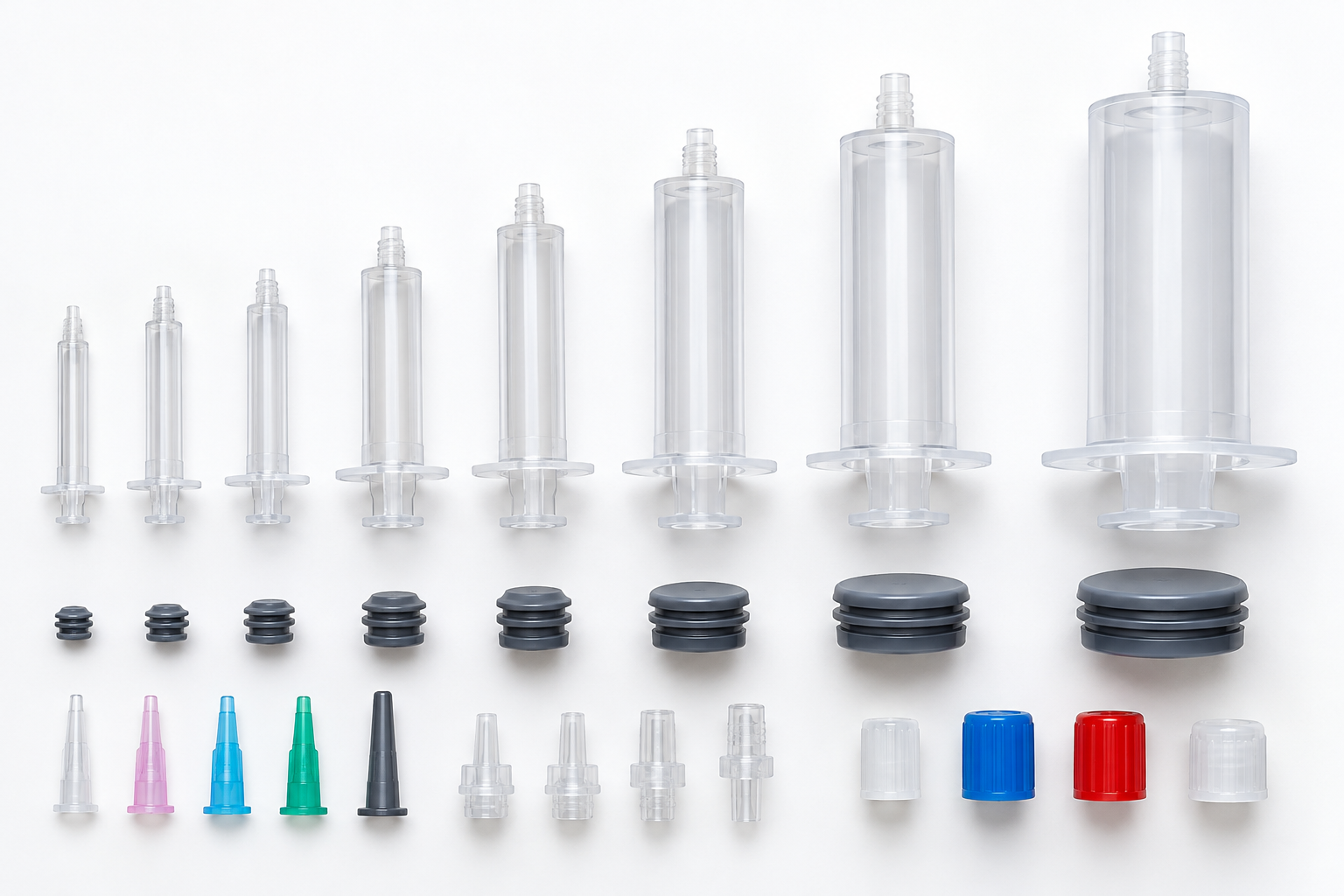
A line that runs one format at 80% utilization is a very different asset from the same line running six formats at 30%. Utilization decides whether the fixed cost is an investment or a drag, and it is set by your batch pattern, not by your ambition.
Look at how you actually fill. If you run one gel, one barrel size, and one closure in long uninterrupted runs, your own line earns its keep quickly. If you run many short runs of different formats, changeover time eats the rated output, and a contract filler with a dedicated line may fill cheaper even at higher volume.
Changeover is where short-run economics quietly fall apart. A line rated for a certain speed only produces that speed between format changes. Every format change costs you setup, calibration, and first-article checks. If those happen several times a shift, your real throughput is a fraction of the rated number. That is the difference between rated speed and actual output, and it is yours to calculate before you commit. The changeover planning article breaks down how to count those minutes.
Also factor in seasonality. Pest control products move with the season in many markets. A line sized for peak demand sits idle for months, and idle equipment still costs floor space, calibration, and maintenance. Contract filling turns that seasonal spike into someone else’s capacity problem, at a per-unit price that reflects the inconvenience.
Formula Confidentiality
This is where the decision stops being financial, and for many producers it settles things faster than the numbers do.
Gel bait formulations are valuable. The active ingredient ratio, the bait matrix, the attractant package, and the viscosity profile are the parts you do not want walking out the door. When you fill in-house, the formula stays on your floor, seen only by your own staff under your own control.
When you contract fill, the filler’s operators handle your paste, and the filler may know or infer more than you intend. Some fillers produce competing private-label products. A non-disclosure agreement helps, but an NDA is a legal tool, not a physical barrier. It does not stop a paste sample from being tested, and it only matters if you are prepared to enforce it.
You can reduce the exposure without abandoning contract filling. Formulate the paste in-house or through a separate supplier, and ship the filler only ready-to-fill bulk, so they never see the raw inputs or the recipe, only the finished bulk. Some producers pre-blend their own concentrate and have the filler only dilute and dose. The principle is to decide how much of the formula the filler actually needs to see, and give them no more than that.
If confidentiality is a hard requirement and you cannot compartmentalize it this way, that single fact can push the decision in-house regardless of what the cost model says.
Quality Control and Who Owns a Defect
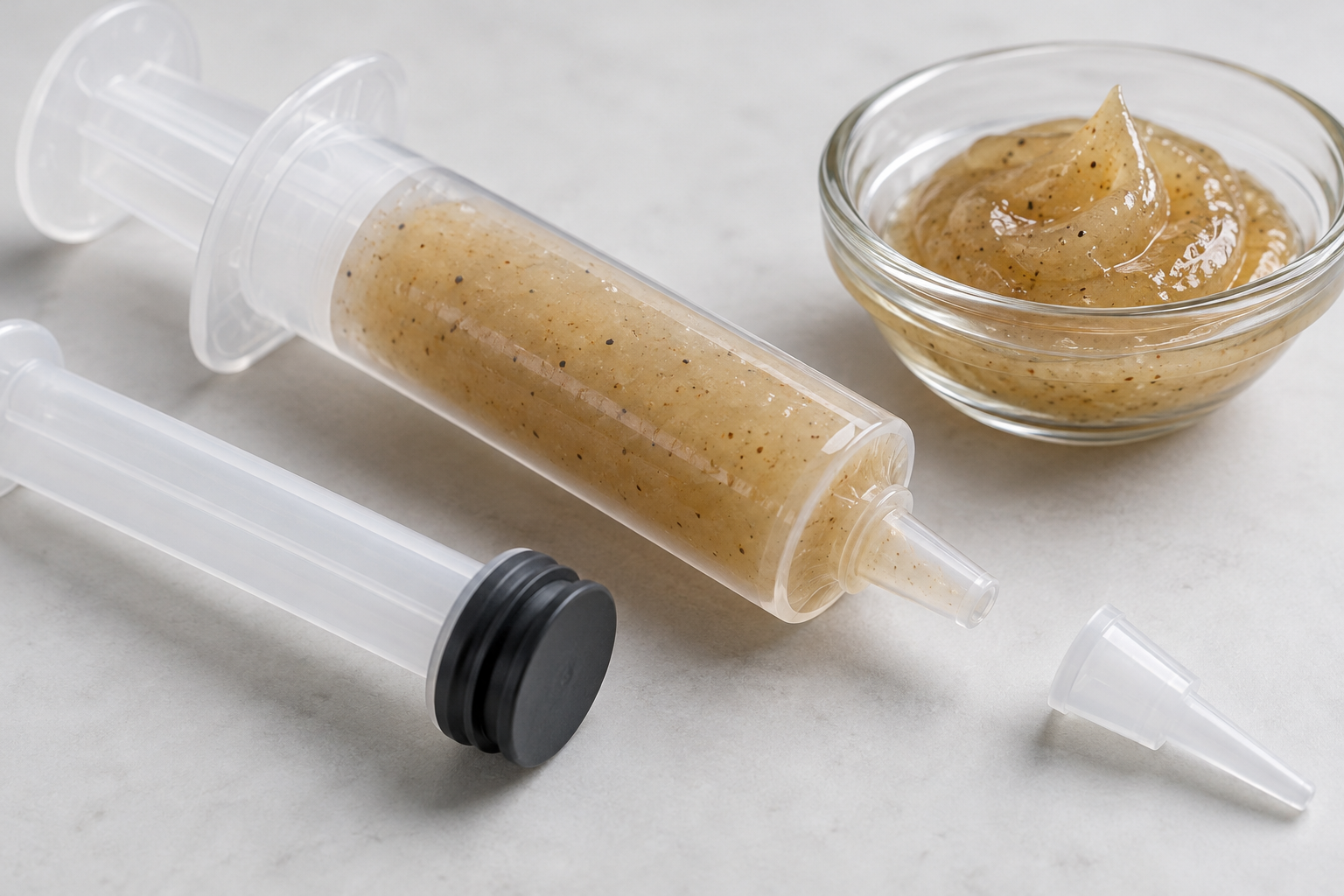
Filling is where a good formula turns into a good product, and it is also where most field defects are born. Air bubbles, stringing, short fills, piston depth, cap sealing: these are filling-line problems, not formula problems. They are covered in detail in the filling problems article.
When you fill in-house, you see every defect the moment it happens. You can trace it to a station, an operator, a batch of barrels, or a piston lot, and you can fix it before the run ends. When you contract fill, defects come back to you inside sealed cartons, often weeks later, and the root cause sits behind a process you cannot watch.
That does not make contract filling worse. A competent filler runs quality systems you may not have yet: in-line check-weighing, batch records, retention samples, and sometimes the certifications your retail and professional customers demand. The question is whether you can hold the filler to a standard you can verify.
Put the standard in writing before the first batch. Define the fill target and tolerance in grams, the measurement method, the sampling plan, and what a defect looks like. A filler that resists this is telling you something about how they run. Gel bait is sold by mass, in grams, not by volume, and a barrel’s rated volume is not its net mass. The grams-versus-millilitres article explains how to fix that spec correctly.
Lead Time and Inventory
This is often the hidden tiebreaker, because it decides who carries the waiting and who carries the stock.
Contract filling has lead time. The filler schedules your batch into their line, and your rush order sits behind everyone else’s. When a large order lands or a seasonal spike hits, you are asking another company to move for you, and your delivery promise to your own customer now depends on someone else’s schedule.
In-house filling gives you the opposite problem. You either hold finished inventory, or you hold empty barrels and bulk paste, and you tie up cash in stock. Minimum order quantities sit on both sides: a contract filler may want a minimum batch, and a barrel and closure supplier will have its own MOQ.
Decide which problem you would rather carry. If your customers order predictably and accept your lead time, the delay in contract filling costs you little. If you sell on short lead times or fill to order, the schedule control of in-house is worth real money.
Compliance Responsibility
The paperwork does not disappear when you outsource. It moves.
Insecticide products carry regulatory weight in most markets: product registration, labeling, safety data sheets, and the good manufacturing practice expectations of your retail and professional customers. A contract filler can take over parts of the production paperwork, and some hold certifications that get you into retail channels faster.
But the product registration and the market authorisation stay yours. When a batch fails an inspection or a customer finds a short fill, the responsibility lands on your brand, not on the filler’s invoice. You can pursue the filler for the loss afterward, but your customer already called you first.
Read the responsibility line the same way on both sides. If you fill in-house, you own the line’s compliance, the operator training, and the cleaning records. If you contract fill, you own choosing and auditing the filler. Neither route removes you from the chain, and anyone who tells you otherwise is selling something.
A Simple Decision Path
There is no universal answer, but there is a reliable order of questions. Work them top to bottom.
First, volume and batch pattern. Steady, long runs at meaningful volume point in-house. Lumpy, low, or many-format volumes point to contract filling.
Second, the formula. If confidentiality is a hard requirement and you cannot compartmentalize the filler’s exposure, that tilts in-house regardless of the numbers.
Third, quality control. If you already run QA systems and can hold a line to a written standard, in-house is within reach. If you have never written a fill spec, a contract filler’s systems buy you time and a working model to copy.
Fourth, lead time and inventory. Short lead times and build-to-order sales favor in-house. Predictable orders and tolerance for lead time favor contract filling.
Then apply the sequence most producers actually follow: start with contract filling, and build in-house when your own volume justifies the fixed cost. This is not a compromise. It is sequencing. You use the contract period to learn your real volumes, reject rates, format mix, and customer expectations, while carrying none of the capital risk. When the contract fee times your annual volume starts to exceed what a line would cost per good filled syringe, and the volume is steady enough to keep the line busy, you build.
If You Decide to Fill In-House
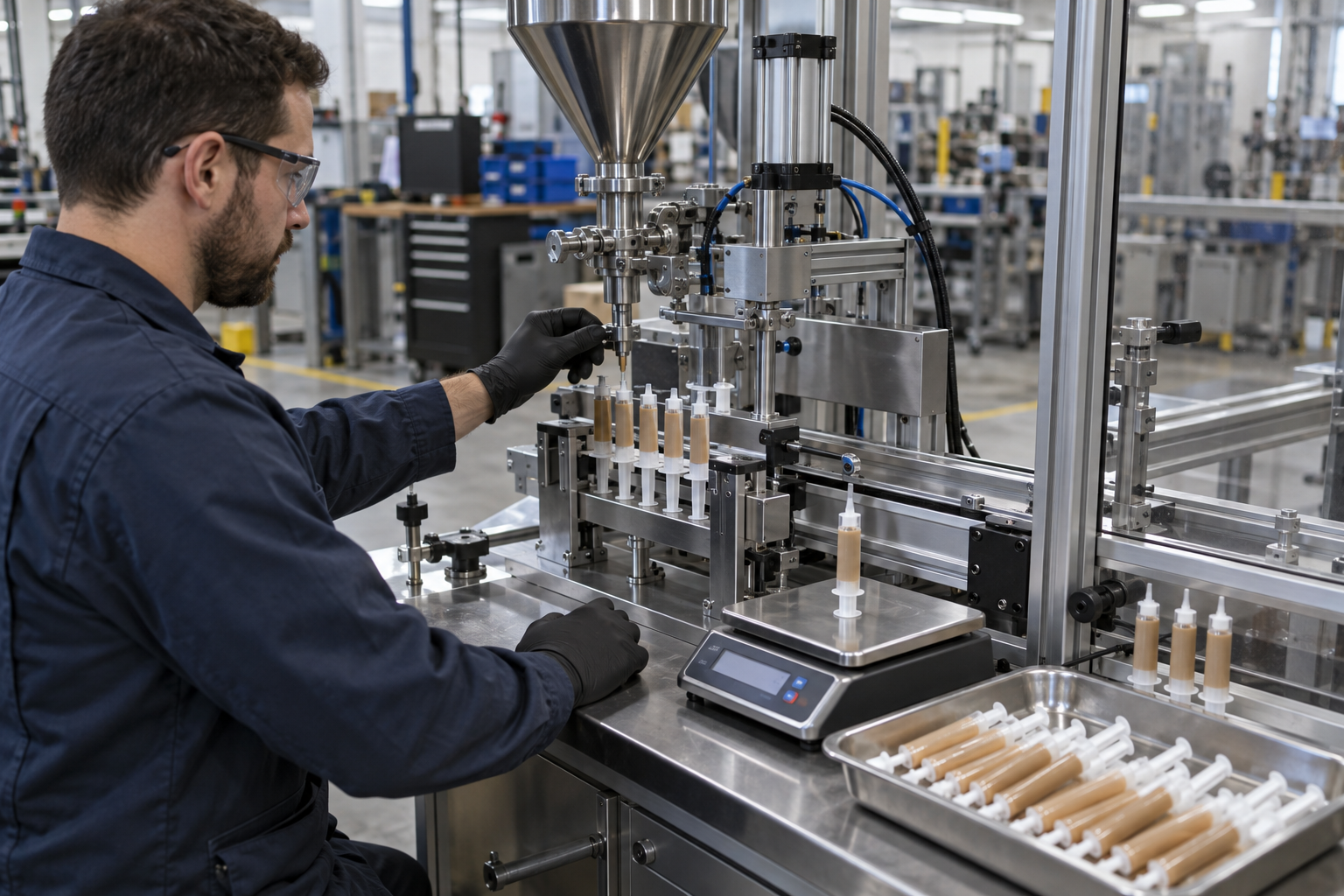
Once the decision lands on in-house, do not buy a machine yet. Buy the answer to three questions first: what do I fill, how much of it, and how will I prove it works.
What you fill determines the dosing system. Positive-displacement pumps in several families handle viscous, thixotropic, sometimes particle-loaded gel bait, but they are not interchangeable. The choice between piston, progressive cavity, peristaltic, and gear or rotary pumps depends on your paste’s viscosity, its shear behavior, and whether it carries particles. The dosing system selection article covers the trade-offs.
How much you fill sets the automation stage and the line layout. This is where the manual-versus-automatic question sits, and it is a separate decision from the make-versus-buy one you just made. Keep the two apart, or you will conflate a scheduling problem with an equipment problem. The manual-to-automatic article walks through that second decision.
Prove it works means a sample trial on your actual gel, barrel, piston, and closure, run to an agreed pass/fail, before you sign for the line. A trial that uses the supplier’s favorite material proves nothing about your product. Bring syringe samples, component drawings, the SDS, viscosity and density data, your net-content target in grams, and a list of the defects you already see. The buyer’s sample checklist article is the working list for that room.
Then write the requirements down. A user requirements specification, or URS, is a few pages that fix your fill target and tolerance in grams, your format list, your changeover expectation, your cleaning and containment needs, and your acceptance criteria. It is the document that turns "I need a filling machine" into something a supplier can quote against and you can hold them to.
Ask for a factory acceptance test written before the line ships, and a pre-shipment inspection of the packed line before it leaves the factory, with the measurement method and defect definitions agreed while everyone is still in the same room. The FAT checklist article shows what belongs in that agreement. Plan the installation and commissioning with the supplier’s engineer alongside your own operators. The people who ran your product before know its behavior better than anyone; pair them with the commissioning team and keep a written setup record for each format.
What to Demand From a Contract Filler
If the path is contract filling, you are not off the hook. You are now a buyer of filling services, and the same discipline applies.
Ask for their batch record, their net-content control method, their defect definitions, and their retention sample policy. Ask who audits them and whether they hold the certifications your market requires. Ask about their changeover process if you run multiple formats, and their minimum batch size.
Send them a written fill spec with the target and tolerance in grams, the measurement method, and the sampling plan, and make it part of the contract. Run a first-article or trial batch on your actual formulation before you commit a full production run. The cheapest batch you will ever buy is the small one that finds the problem.
Treat the relationship like a supplier you intend to audit, because that is what it is. If they will not show you the batch record or the reject log, the certification on their wall is not worth much.
FAQ
Q: At what volume does it make sense to fill in-house?
There is no single number. The crossover is where your annual volume times the contract filler’s per-unit rate exceeds your own cost per good filled syringe, including rejects, changeover, labor, spares, maintenance, and overfill. Steady, long-run volumes reach that crossover much faster than many short formats.
Q: Is contract filling more expensive than in-house?
It depends on volume and utilization. Below some volume, the per-unit fee is cheaper than carrying a line you cannot keep busy. Above a steady volume, the fee keeps adding up after a purchased line would have paid back. Compare on cost per good filled syringe, not on machine price or units per hour.
Q: How do I protect my formula if I use a contract filler?
Compartmentalize. Formulate the paste in-house or through a separate supplier, and ship the filler only ready-to-fill bulk, so they never see the raw inputs or the recipe. Back it with an NDA, but treat the NDA as a legal tool, not a physical barrier.
Q: Does outsourcing remove my compliance responsibility?
No. The product registration and market authorisation stay yours, and a batch failure lands on your brand regardless of who filled it. A contract filler can take over production paperwork and may hold useful certifications, but you still own choosing and auditing them.
Q: Can I start with contract filling and build in-house later?
Yes, and most producers do it that way. Use the contract period to learn your real volumes, reject rates, format mix, and customer expectations while carrying none of the capital risk, then build when your own volume justifies the fixed cost.
Conclusion
The in-house versus contract decision is not a moral one and not a one-time one. It is a numbers question with two non-financial riders, confidentiality and quality control, and it should be revisited as your volumes and formats change.
Most producers start on the contract side to learn their real numbers, then move in-house when the volume is steady enough to keep a line busy. If you have already crossed that point, the next step is not to buy a machine. It is to run a sample trial and write the requirements down.
Send Us Your Requirements
If the decision lands on in-house, send us your gel, barrel, and closure details, your fill target in grams, and your target output. An engineer will review your requirements, recommend a dosing system and line stage, and run a sample trial on your actual product. If you are still weighing the two routes, tell us your volume and batch pattern and we will help you work the numbers.