When manufacturers compare tube filling and sealing machines, production speed is usually one of the first specifications they look at.
120 tubes per minute.
150 tubes per minute.
160 tubes per minute.
But a number on a technical sheet does not answer the most important production questions.
Can the machine maintain stable output for an extended period?
Can filling accuracy remain within tolerance while the line is running continuously?
Will tube orientation remain consistent?
Can the sealing system produce repeatable finished tubes?
What happens when production changes from an aluminum tube to a plastic or laminated tube?
And can the complete line—not only the filling station—continue running without frequent operator intervention?
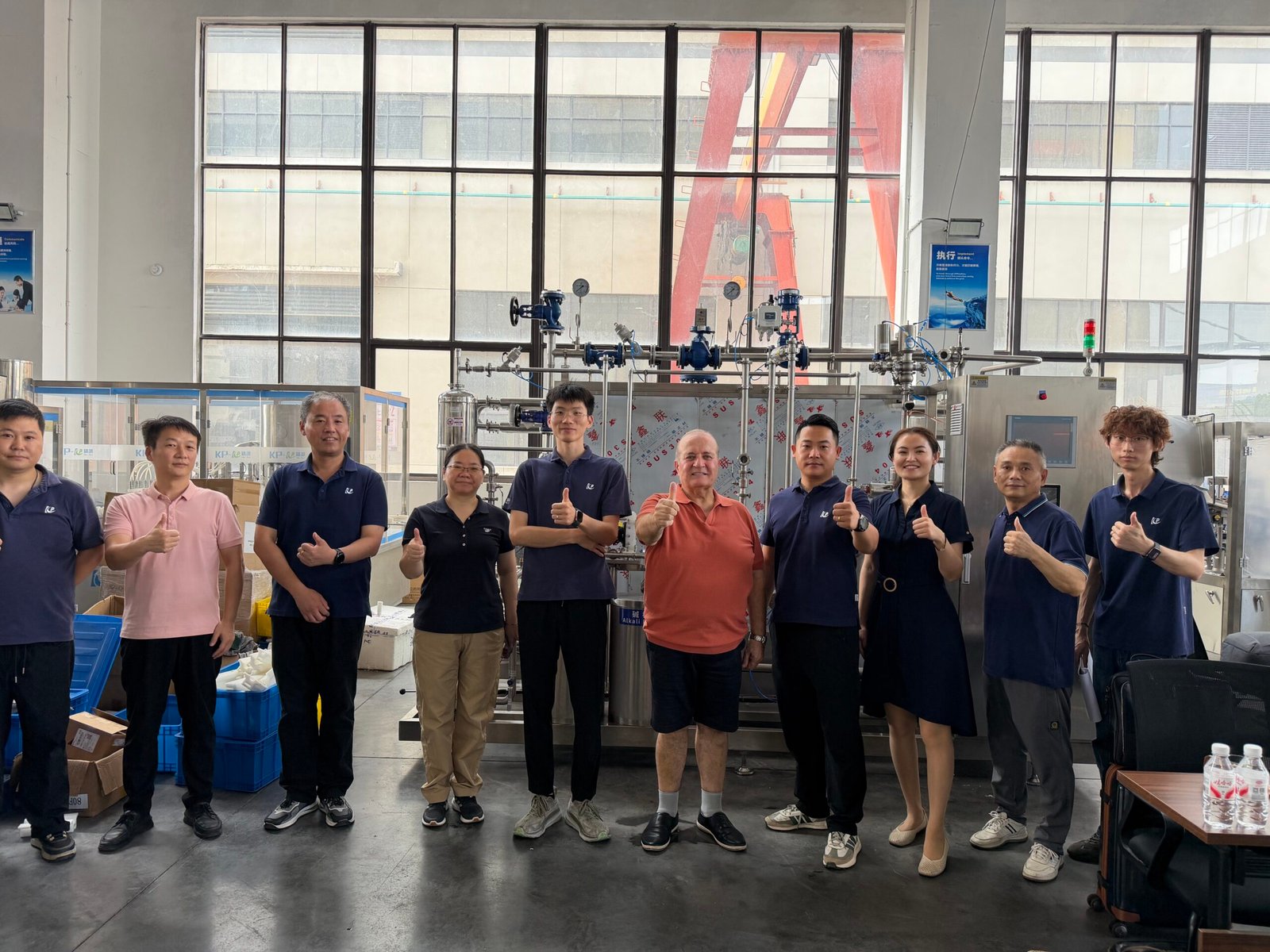
These were some of the key questions evaluated during a recent Factory Acceptance Test conducted at King Pack for an Australian customer.
The project began with an inquiry submitted through the King Pack website.
After technical communication covering tube specifications, filling requirements, production capacity and sealing methods, the project developed into a KPGFW-48-2 dual-use high-speed tube filling and sealing system capable of processing both plastic/laminated tubes and aluminum tubes.
Before shipment, the customer came to the King Pack factory for a structured FAT covering mechanical inspection, dry running, aluminum tube production, plastic tube production, filling accuracy, sealing quality, continuous operation, format changeover and final performance review.
Rather than simply showing that the machine could run, the purpose of the FAT was to answer a more important question:
Is the complete production line ready for real manufacturing conditions?
Project Equipment: KPGFW-48-2 Dual-Use High-Speed Tube Filling and Sealing Machine

The core machine used in this project was the:
KPGFW-48-2 Dual-Use High-Speed Tube Filling and Sealing Machine
Unlike a machine designed around only one tube material, this configuration supports two different sealing processes:
- Plastic and laminated tubes: internal hot-air sealing
- Aluminum tubes: mechanical folding and crimp sealing
This gives manufacturers greater flexibility when several product ranges or packaging materials need to be handled on one production platform.
Main Machine Specifications
| Parameter | KPGFW-48-2 |
|---|---|
| Number of Stations | 48 |
| Filling Heads | 2 |
| Rated Production Speed | 120–160 pcs/min |
| Filling Range | 1–250 ml |
| Filling Accuracy | ≤ ±0.5% |
| Registration Accuracy | ≤ ±1 mm |
| Plastic/Laminated Tube Diameter | Φ11–50 mm |
| Aluminum Tube Diameter | Φ11–40 mm |
| Tube Length | 60–210 mm |
| Plastic/Laminate Sealing | Internal hot-air sealing |
| Aluminum Tube Sealing | Metal tube folding |
| Tube Feeding | Automatic tube elevator |
| Servo Control | 13 servo systems |
Other filling ranges and tube specifications can be configured according to project requirements.
Why a Dual-Use Tube Filling Machine Is More Complex Than It Looks

At first glance, aluminum tubes and plastic tubes may look like similar packaging formats.
From an equipment engineering perspective, they are very different.
A plastic or laminated tube typically requires controlled heating of the inner tube wall, followed by compression, cooling and trimming.
An aluminum tube cannot be sealed in the same way.
Instead, the tail must normally be mechanically folded and compressed according to the required folding pattern.
This means a dual-use machine is not simply changing one tooling set.
The machine has to manage two different sealing principles while maintaining:
- tube positioning,
- filling accuracy,
- production synchronization,
- sealing quality,
- coding position,
- finished tube appearance,
- and continuous line stability.
For manufacturers with several SKUs, this flexibility can substantially reduce the need to invest in separate machines for different tube materials.
But it also makes FAT more important.
Inside the KPGFW-48-2 Production Process

The complete operating sequence includes multiple synchronized stations.
A typical process is:
Automatic tube loading → Tube registration → Air cleaning → QR code identification (optional) → Filling → Inspection/rejection → Aluminum tube folding or plastic tube internal hot-air sealing → Compression sealing / coding → Plastic tube trimming → Finished product discharge → Final rejection
The machine uses a multi-servo control architecture across its major motion and process sections.
The project configuration incorporates 13 servo-controlled systems, including control of the main drive, tube loading, registration, filling, sealing, folding, lifting and conveying functions.
Instead of relying entirely on conventional fixed mechanical transmission, the servo architecture provides greater control over individual processes and adjustment points.
For high-speed applications, this becomes especially important because every station must remain synchronized as machine speed increases.
FAT Stage 1: Machine Condition and Static Inspection
Before running production material, the FAT began with a complete machine inspection.
The customer and King Pack engineering teams reviewed major mechanical, electrical and safety-related areas of the system.
The inspection included:
- machine appearance and manufacturing condition,
- stainless-steel surfaces,
- mechanical assemblies,
- moving components,
- electrical systems,
- pneumatic systems,
- operator interface,
- guarding,
- emergency-stop functions,
- and major process stations.
Why perform this stage before production?
Because production testing should not be used to discover basic installation or assembly issues.
Static inspection establishes that the machine is mechanically ready before higher-speed operation begins.
FAT Stage 2: Dry Running Before Filling Product
The next stage was dry running.
The complete line was operated before formal product validation to check motion, synchronization and safety behavior.
The engineering team observed machine performance under different operating conditions, including:
- low-speed operation,
- medium-speed operation,
- production-speed operation,
- conveyor synchronization,
- tube transfer,
- station positioning,
- alarm response,
- emergency-stop operation,
- and safety interlocks.
This stage separates mechanical stability from filling and sealing variables.
If a machine is unstable during dry running, introducing product will usually make troubleshooting more difficult rather than easier.
FAT Stage 3: 25 mm Aluminum Tube Production
After static and dry-running inspections were completed, the FAT moved into formal production testing.
The first format was:
25 mm Aluminum Tube
Aluminum tubes require a completely different tail-closing process from plastic tubes.
After filling, the tube tail is mechanically folded and compressed to create the finished closure.
For this FAT, the production line was operated at the agreed FAT acceptance speed of:
110 tubes/min
The system then completed a:
30-minute continuous automatic production test.
This is an important distinction.
The KPGFW-48-2 has a rated machine capacity of 120–160 pcs/min, depending on product, tube and operating conditions.
However, FAT should not simply test the maximum number printed on the machine specification.
The correct FAT speed should correspond to the agreed customer production condition.
For this Australian project, the specified FAT operating point was 110 tubes/min.
Why a 30-Minute Continuous Run Matters
A machine briefly reaching a target speed does not necessarily prove production stability.
Many problems only appear after sustained operation.
For example:
- tube accumulation,
- intermittent feeding errors,
- registration drift,
- filling variation,
- sealing temperature variation,
- synchronization errors,
- transfer instability,
- or downstream bottlenecks.
A five-second or one-minute demonstration may not reveal these problems.
Continuous operation provides a much more realistic indication of whether the line can maintain stable production.
This is why buyers should ask machine suppliers:
“How long will the machine continuously run at the FAT acceptance speed?”
rather than only:
“What is your maximum speed?”
FAT Stage 4: Filling Accuracy Verification
Production speed was only one part of the test.
Filling performance was also checked during formal operation.
The KPGFW-48-2 is specified with a filling accuracy of:
≤ ±0.5%
During the FAT, production samples were collected in multiple groups rather than checking only one or two tubes.
For the aluminum tube test, the sampling plan included:
3 batches × 20 samples
The objective was to evaluate filling consistency across continuous production rather than judging performance based on an isolated filling cycle.
This is especially important in high-speed filling.
A machine can produce an accurate sample while running slowly but behave differently when the complete line is operating continuously.
For this reason, filling accuracy should always be evaluated together with production speed.
Speed Without Accuracy Is Not Real Production Capacity
When comparing tube filling machines, buyers frequently see specifications such as:
| Supplier A | Supplier B |
| 150 tubes/min | 160 tubes/min |
| ±1% accuracy | ±0.5% accuracy |
It is tempting to compare only the first number.
But production performance is actually the combination of:
Speed × Accuracy × Stability × Yield
A machine capable of running very quickly but generating higher filling variation, sealing defects or frequent stoppages may produce fewer qualified finished tubes over an entire shift.
This is why FAT should measure output quality at actual operating speed.
FAT Stage 5: Aluminum Tube Folding and Tail Quality
For aluminum tubes, filling accuracy alone is not sufficient.
The folding section must also create a consistent mechanical closure.
During the FAT, finished tubes were inspected for:
- tail alignment,
- folding consistency,
- compression quality,
- finished appearance,
- deformation,
- wrinkles,
- cracks,
- burrs,
- poor folding,
- and sealing integrity.
This is particularly important because the finished tube tail is both a functional closure and a visible part of the package.
Excessive mechanical force can damage the tube.
Insufficient compression may compromise sealing integrity.
The goal is therefore not simply to “fold the tube.”
The goal is to achieve:
stable closure + reliable integrity + consistent finished appearance.
One Line, Two Tube Materials: The Format Changeover Test
After completing the aluminum tube FAT, the project moved into one of the most important stages:
Changing the line from 25 mm aluminum tubes to 40 mm plastic tubes.
This was more than a diameter change.
It required switching between two fundamentally different sealing processes:
Aluminum tube: mechanical folding
Plastic tube: internal hot-air heating and compression sealing
Depending on configuration, format changeover can include adjustments or replacement of:
- tube holders,
- tube feeding components,
- registration settings,
- filling position,
- filling parameters,
- sealing tooling,
- sealing height,
- temperature parameters,
- compression parameters,
- trimming position,
- and control recipes.
After the format change, trial production was carried out before moving into the second formal FAT.
Why Changeover Capability Matters to Manufacturers
Many factories do not manufacture one SKU for the entire life of the machine.
A contract manufacturer may handle multiple brands.
A pharmaceutical or healthcare manufacturer may introduce new tube sizes.
A personal-care manufacturer may redesign packaging.
A product originally sold in an aluminum tube may later be offered in laminated packaging.
This means equipment flexibility has long-term financial value.
When evaluating a machine, buyers should therefore consider not only:
“Can this machine manufacture our current tube?”
but also:
“Can this machine support the packaging formats we may need three or five years from now?”
The ability of the KPGFW-48-2 to process both aluminum and plastic/laminated tubes was therefore an important part of this project.
FAT Stage 6: 40 mm Plastic Tube Production
Following completion of the changeover and trial adjustment, the second formal production test was carried out using:
40 mm Plastic Tubes
The complete line again operated at the agreed FAT speed of:
110 tubes/min
and completed another:
30-minute continuous automatic production run.
During this period, the teams monitored:
- automatic tube feeding,
- registration,
- filling,
- tube transfer,
- sealing,
- trimming,
- discharge,
- production synchronization,
- and overall machine stability.
Because plastic tubes use a different sealing process from aluminum tubes, the quality criteria were also different.
How Internal Hot-Air Tube Sealing Works
For plastic and laminated tubes, the KPGFW-48-2 uses an internal hot-air sealing process.
Instead of applying heat only to the outside surface, controlled hot air heats the inner tail area of the tube.
The softened sealing surfaces are then compressed together to form the seal.
The tube subsequently goes through processes such as compression, coding and trimming.
This sealing method is widely used where a clean, consistent finished tube tail is required at higher production speeds.
But the important factor is not simply generating enough heat.
The process requires balance between:
- heating temperature,
- heating time,
- tube material,
- tube wall thickness,
- compression pressure,
- cooling,
- and machine speed.
Too little energy can produce an incomplete seal.
Too much heat can deform the tube or affect package appearance.
What Was Checked During Plastic Tube Sealing FAT?
The finished plastic tubes were evaluated for both visual quality and functional integrity.
Typical inspection points included:
- straight sealing line,
- uniform compression,
- clean trimmed edge,
- consistent coding position,
- no obvious wrinkles,
- no excessive deformation,
- no cracking,
- no delamination,
- no incomplete seal,
- and no leakage.
This is why aluminum and plastic tubes should not simply use one generic FAT checklist.
Their failure mechanisms are different.
A professional FAT should evaluate each packaging format according to the relevant process.
Tube Registration Accuracy Also Matters

Modern tubes often carry printed graphics, registration marks and branding elements.
If the tube is not correctly oriented before filling and sealing, the finished tail and printed artwork may not align correctly.
The KPGFW-48-2 has a specified registration accuracy of:
≤ ±1 mm
The production process therefore includes automatic tube identification and orientation before filling.
For brands where package presentation matters, this can be as important as filling performance.
A technically acceptable tube with visibly inconsistent artwork orientation may still be rejected by the brand owner.
Optional QR Code Identification for Higher Traceability Requirements
The production sequence can also be configured with QR-code identification as an option.
For manufacturers operating multiple SKUs, batch-specific packaging or higher traceability requirements, automatic code recognition can provide an additional verification point within the tube handling process.
Rather than treating traceability as a separate manual inspection step, it can become part of the automated production process.
This is increasingly relevant for pharmaceutical, healthcare and high-value consumer products where packaging identification and production records matter.
FAT Stage 7: Complete-Line Coordination
A filling machine should not be evaluated as an isolated filling pump.
At high production speeds, the performance of every station affects the next station.
The FAT therefore evaluated the complete sequence.
For example:
Tube feeding → Registration → Filling → Sealing → Trimming → Discharge
If one section runs faster or slower than the rest of the line, accumulation can develop.
If registration is unstable, sealing appearance can be affected.
If the filling section pauses unexpectedly, downstream stations may lose synchronization.
This is why a complete line needs to be tested as a system.
FAT Stage 8: Safety and Operator Functions
Production performance is only one part of machine acceptance.

During the FAT, safety and operator-related functions were also checked.
Typical checks included:
- emergency-stop buttons,
- machine guarding,
- door interlocks,
- alarm functions,
- operating controls,
- HMI operation,
- and abnormal-condition response.
For high-speed equipment running more than 100 tubes per minute, reliable safety interlocks are essential.
A production line should not require operators to bypass safety devices simply to maintain output.
FAT Stage 9: Problem Identification, Correction and Retesting
A professional FAT is not a staged demonstration where every adjustment is hidden from the customer.
Its purpose is to identify potential problems before shipment.
During the FAT process, identified issues were recorded and followed by:
Problem identification → Cause analysis → Adjustment or corrective action → Retest → Confirmation
This closed-loop process matters.
Finding a problem during FAT is far less expensive than finding the same problem after the machine has been shipped internationally and installed in the customer’s production facility.
The objective is therefore not to prove that no adjustment will ever be required.
The objective is to close foreseeable risks before delivery.
FAT Stage 10: Final Performance Review
After the aluminum tube test, format conversion and plastic tube test were completed, the project entered final evaluation.
The teams reviewed:
- production speed,
- continuous operating stability,
- filling results,
- registration,
- sealing quality,
- folding quality,
- machine alarms,
- safety performance,
- changeover results,
- and outstanding improvement items.
The final FAT documentation then becomes a reference for the next stages of the project, including shipment, installation, commissioning and SAT.
Machine Specification vs FAT Requirement: Do Not Confuse the Two
One useful lesson from this project is that machine capability and FAT acceptance conditions are not always the same number.
For this project:
| Item | Value |
| Machine Model | KPGFW-48-2 |
| Rated Machine Speed | 120–160 pcs/min |
| FAT Operating Speed | 110 tubes/min |
| Continuous FAT Duration | 30 minutes |
| Filling Accuracy Specification | ≤ ±0.5% |
| Registration Accuracy | ≤ ±1 mm |
| Aluminum Tube Tested | 25 mm |
| Plastic Tube Tested | 40 mm |
Why would FAT be performed at 110 tubes/min when the machine is rated for 120–160 pcs/min?
Because rated capacity represents the machine’s design capability under suitable operating conditions.
FAT acceptance conditions should reflect the actual project requirement agreed with the customer.
These two figures should therefore always be clearly separated.
This makes technical communication more transparent and avoids misleading buyers with headline speed figures.
A Practical Tube Filling Machine FAT Checklist for Buyers
Before approving your next tube filling line, consider including the following items in your FAT protocol.

Machine Condition
- Verify machine manufacturing quality and overall condition.
- Check major mechanical components.
- Inspect electrical and pneumatic systems.
- Confirm guarding and safety systems.
Production Performance
- Define an agreed FAT operating speed.
- Run the machine continuously at the required speed.
- Record stoppages and alarms.
- Observe tube feeding and transfer stability.
Filling
- Use actual or representative product.
- Measure filling accuracy at production speed.
- Take samples from multiple production periods.
- Check whether accuracy changes during continuous running.
Tube Registration
- Verify artwork orientation.
- Check registration repeatability.
- Confirm registration at production speed.
Sealing
For plastic/laminated tubes:
- Check internal hot-air sealing.
- Inspect seal uniformity.
- Check trimming.
- Evaluate seal integrity.
For aluminum tubes:
- Check folding geometry.
- Inspect compression consistency.
- Check deformation and cracking.
- Evaluate finished tail appearance.
Changeover
- Test at least two tube formats when applicable.
- Record required tooling changes.
- Verify parameter changes.
- Perform production after the changeover.
Safety
- Test emergency stops.
- Test safety doors.
- Verify interlocks.
- Check alarms.
Final Acceptance
- Record open issues.
- Complete corrective actions.
- Retest affected functions.
- Confirm final FAT documentation.
Why FAT Can Reveal More Than a Price Comparison
Two tube filling machines can look nearly identical in a quotation.
Both may claim:
- automatic tube loading,
- automatic filling,
- automatic sealing,
- servo control,
- PLC operation,
- and high-speed production.
The quotation alone rarely shows how the machine behaves after 20 or 30 minutes of continuous production.
It does not show how easily operators can change formats.
It does not show whether filling accuracy changes as speed increases.
It does not show whether sealing remains consistent.
And it does not show how the supplier responds when a problem appears during testing.
That is why machine selection should not be based only on:
Purchase price.
A more useful question is:
What qualified production output can this machine repeatedly deliver over its operating life?
That is where FAT becomes part of the purchasing decision rather than simply a pre-shipment formality.
From an Online Inquiry to a Validated Production System
This Australian project started with a website inquiry.
At that stage, the customer was not purchasing a machine.
They were trying to solve a production requirement.
The subsequent process involved:
Inquiry → Application analysis → Tube specification confirmation → Technical solution → Equipment configuration → Manufacturing → Commissioning → FAT → Corrective action → Final acceptance
That process reflects an important difference between purchasing standard equipment and developing a production solution.
For a high-speed tube line, the equipment must be matched to:
- product characteristics,
- filling volume,
- tube material,
- tube diameter,
- tube length,
- production speed,
- sealing method,
- coding requirements,
- changeover needs,
- and future product planning.
The FAT is where those assumptions are finally tested together.

Conclusion: A Successful FAT Is About Production Confidence
The purpose of Factory Acceptance Testing is not simply to demonstrate that a tube filling machine turns on.
It should provide evidence that the equipment can perform the customer’s actual manufacturing process.
For this Australian project, the FAT covered:
25 mm aluminum tubes
40 mm plastic tubes
110 tubes/min FAT operating speed
30-minute continuous production
multi-batch filling accuracy inspection
≤ ±0.5% filling accuracy specification
aluminum tube folding
internal hot-air plastic tube sealing
format changeover
complete-line synchronization
safety inspection
and
problem correction and final verification.
Behind those tests was the KPGFW-48-2 dual-use high-speed tube filling and sealing machine, designed for a rated production capacity of 120–160 pcs/min and capable of handling both plastic/laminated and aluminum tubes.
For manufacturers evaluating a new tube filling line, that is the real value of FAT:
not simply seeing the machine run, but reducing uncertainty before the equipment enters your factory.
About King Pack
King Pack provides filling, mixing, tube filling and sealing, and complete packaging solutions for pharmaceutical, healthcare, veterinary, cosmetics, personal care and other manufacturing applications.
For tube filling projects, solutions can be configured according to tube material, filling volume, production speed, sealing method, changeover requirements and downstream automation.
King Pack Machinery
Website: kpfillingmachine.com
Email: info@kingpack-cn.com
WhatsApp / Tel: +86 188 5156 8556