
Last reviewed: August 26, 2026.
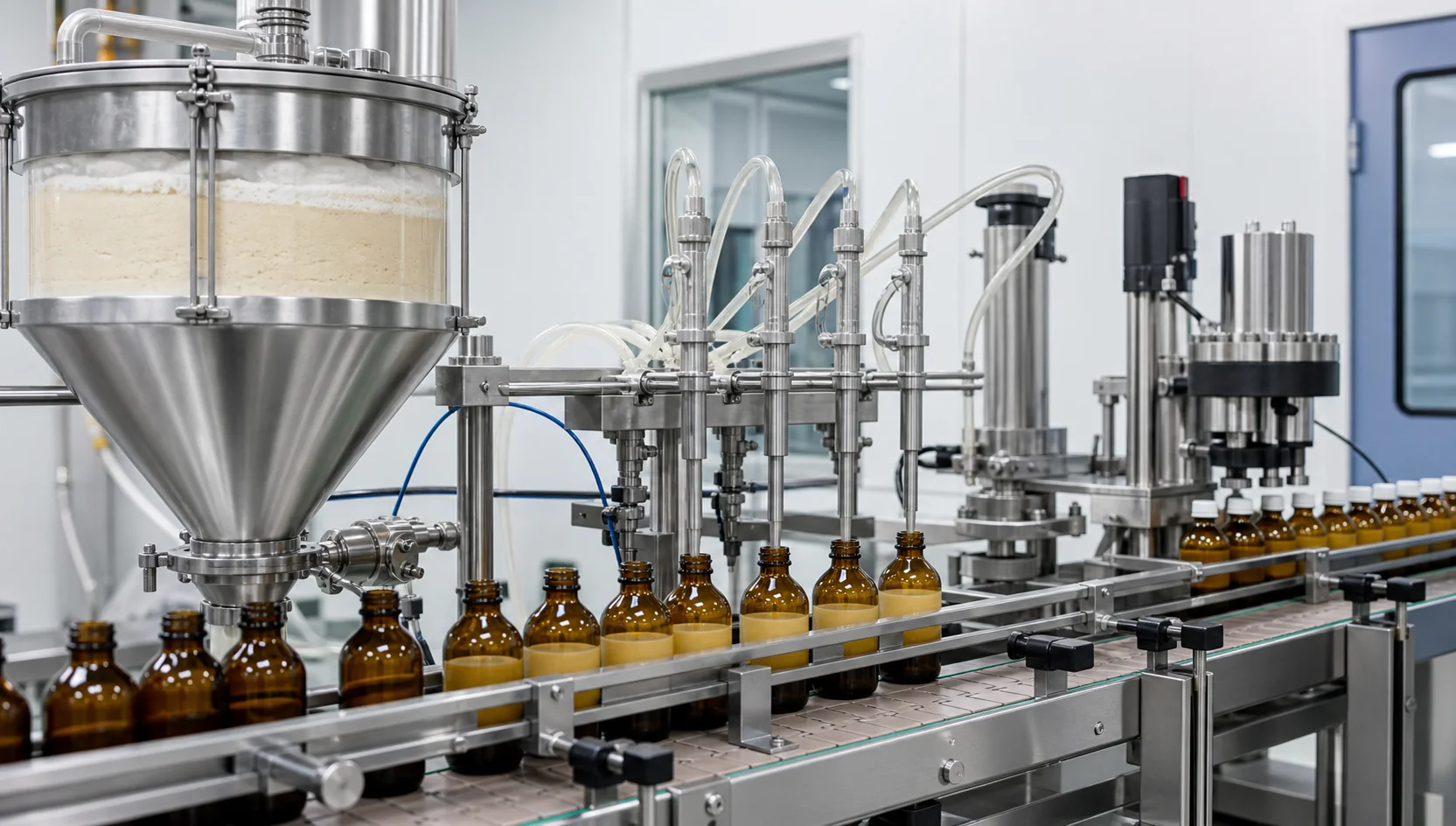
A veterinary oral suspension is not simply a “thick liquid.” It may settle while waiting, change viscosity with temperature or shear, trap air during recirculation, and deliver a different solids concentration to the first, middle and last bottles if the feed path is poorly controlled.
The filling-machine decision therefore starts upstream of the dosing pump. The bulk tank, agitation method, transfer line, buffer hopper, nozzle and in-process sampling plan must work as one system. Selecting a pump from a viscosity number alone is not enough.
This guide explains how to define that system without inventing a universal viscosity limit or accuracy claim. It supports project discussions around a liquid filling and capping line while keeping formulation development, product specifications and regulatory release decisions with the product owner.
Quick answer: For a high-viscosity veterinary oral suspension, choose a filler only after characterizing viscosity across temperature and shear, settling rate, particle size, foam tendency, dose range and bottle geometry. The preferred line normally combines controlled bulk or hopper agitation, a short and drainable feed path, a metering technology proven by product trials, positive nozzle shutoff and beginning/middle/end verification of fill mass and suspension uniformity.
Why Veterinary Oral Suspensions Are Difficult to Fill
Direct answer: Suspensions create two simultaneous control problems: moving a viscous product accurately and keeping dispersed solids representative throughout the batch and transfer path.
The FDA’s inspection guide for oral solutions and suspensions notes that suspensions may require continuous or periodic agitation during filling and that segregation can occur in delivery lines between bulk storage and the filler. It also recommends checking bottles from the beginning, middle and end rather than compositing them when evaluating segregation. The guide concerns human-drug inspection and is not a veterinary regulation, but the physical process risks are directly relevant to equipment design.
Viscosity can change with temperature, shear history and time at rest. Some products are shear-thinning and flow more easily during pumping; others recover structure after the shear is removed. Suspended particles may settle in a low-flow hose, collect at a valve or be excluded by an undersized passage. Air entrained during mixing can expand or compress during dosing and disturb volume-based measurement.
A useful project description therefore includes more than a single laboratory viscosity value. The equipment supplier needs the test method, temperature, spindle or geometry, shear condition and time history behind the number, plus observations on settling, redispersion and air release.
Build the Product Data Package Before Choosing a Filler
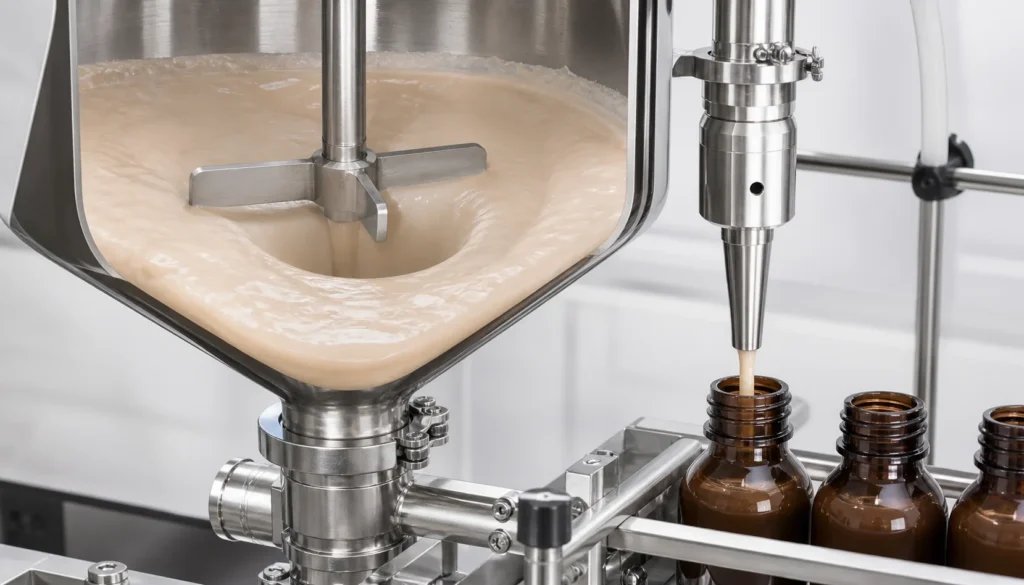
Direct answer: The fastest route to a reliable configuration is a structured sample and data package that captures product behavior, packaging tolerances and the required operating range.
If the final formulation is not yet frozen, state which properties are provisional. A machine selected against an early low-viscosity placebo may fail when solids loading or thickener level changes. A controlled design review should identify which formulation changes trigger a repeat sample trial or equipment reassessment.
- Viscosity or flow curve at the lowest, nominal and highest expected filling temperatures, with the test method stated.
- Particle-size range, solids loading, density and evidence of settling or creaming during the expected hold time.
- Redispersion behavior after a planned stop and any maximum shear or recirculation exposure.
- Foam tendency, air-release time and sensitivity to vacuum or pressure.
- Minimum, nominal and maximum fill volume or mass, including the intended in-process control method.
- Bottle drawing, neck diameter, height tolerance, stability on the conveyor and closure/insert sequence.
- Product-contact compatibility, cleaning chemistry, target residue limit and disassembly expectations.
- Required output, batch size, campaign length, SKU count, changeover time and available utilities.
Compare Metering Technologies by Product Behavior
Direct answer: No pump family is universally best. The correct choice depends on dose range, viscosity, particles, shear sensitivity, cleanability, pressure requirement and the allowed product hold-up.
A positive-displacement system is often considered for viscous products because each cycle displaces a defined volume, but its valve passages and seal design must suit the particles and cleaning method. Rotary lobe or progressive-cavity systems can provide continuous product transfer or metering in some applications, but slip, shear, elastomer compatibility and calibration behavior must be tested. Peristaltic systems isolate product in tubing and are valuable for many pharmaceutical liquids, yet tubing life, available bore, pressure and suspension behavior can constrain viscous or particle-laden products.
The existing pump comparison guide explains broad pump-family differences. For an oral suspension project, treat that page as orientation and make the final decision with actual product trials over the required dose and temperature range.
| Metering option | Potential fit | Key risks to test | Evidence to request |
|---|---|---|---|
| Servo piston / positive displacement | Viscous products and defined dose ranges | Valve passage, particle handling, seal wear, trapped air and cleaning | Repeated-dose data, teardown/cleaning review and product recovery |
| Rotary lobe | Gentle transfer or metering with suitable rheology | Slip at low viscosity, pulsation, rotor clearance and CIP coverage | Flow stability across speed, temperature and pressure |
| Progressive cavity | Steady movement of some viscous products | Elastomer compatibility, stator wear, heat and cleanability | Compatibility documents, low/high-rate trials and hold-up review |
| Peristaltic | Products compatible with available tubing and pressure range | Tubing fatigue, bore restriction, pulsation and particle/suspension behavior | Tubing-life study, calibration drift and product trial |
| Time-pressure or gravity | Only where rheology and dose allow | Strong sensitivity to head pressure, viscosity and temperature | Worst-case repeatability and level-control evidence |
Agitation and Recirculation Must Preserve Uniformity
Direct answer: Agitation should be strong enough to prevent unacceptable segregation but gentle enough to avoid aeration, damaging shear or temperature rise.
The correct impeller, speed and operating mode depend on tank geometry, rheology and settling behavior. Continuous agitation may be necessary for one suspension, while periodic agitation with validated maximum stop time may be appropriate for another. The decision should come from development data and beginning/middle/end sampling, not habit.
A buffer hopper can simplify filler feed, but it also creates another hold zone. Its volume, shape, agitator, level range and low-point geometry should be designed so the product does not form a stagnant heel or draw concentrated solids near the end of a batch. The transfer line should be as short and simple as practical, with passages sized for the product and a defined response to production stops.
Recirculation can maintain movement but may repeatedly expose the product to pump shear and can introduce air at the return. Define where the return enters, whether a vortex forms, how temperature changes and how long product may circulate before it must be re-evaluated or discarded.
Plan for stops and restarts
The line should have a written response for a short starve, a planned break and an extended stop. The response may include continued low-speed agitation, a controlled re-homogenization period, line recirculation or a quality check before restarting. The maximum acceptable stop time is a product-specific limit, not a default machine setting.
Nozzle Design Controls Drip, Stringing and Air
Direct answer: A suspension-filling nozzle should pass the product without filtering particles, close positively without long strings and enter the bottle in a controlled way that limits splash and trapped air.
Nozzle bore and internal transitions should be reviewed against particle size, viscosity and cleaning access. A narrow restriction may raise pressure, alter shear or trap solids. A wide nozzle may require a larger bottle opening and stronger shutoff control. The best geometry is normally confirmed through a sample trial with production-intent bottles.
Bottom-up filling can reduce splash and surface folding for some viscous products, but the nozzle trajectory must avoid contact with the bottle and must not trap air as it retracts. Positive shutoff reduces drip. Suck-back may break a product string, yet too much can draw air into the nozzle or change the next dose. Adjust these variables together and observe the first dose after every stop.
Bottle movement matters as much as nozzle design. Sudden indexing can throw product onto the neck finish, where it may interfere with an insert or cap. Stabilizing the bottle, controlling acceleration and allowing adequate settling time before closure insertion can protect both cleanliness and cap torque.
Control Fill Mass and Suspension Uniformity Together
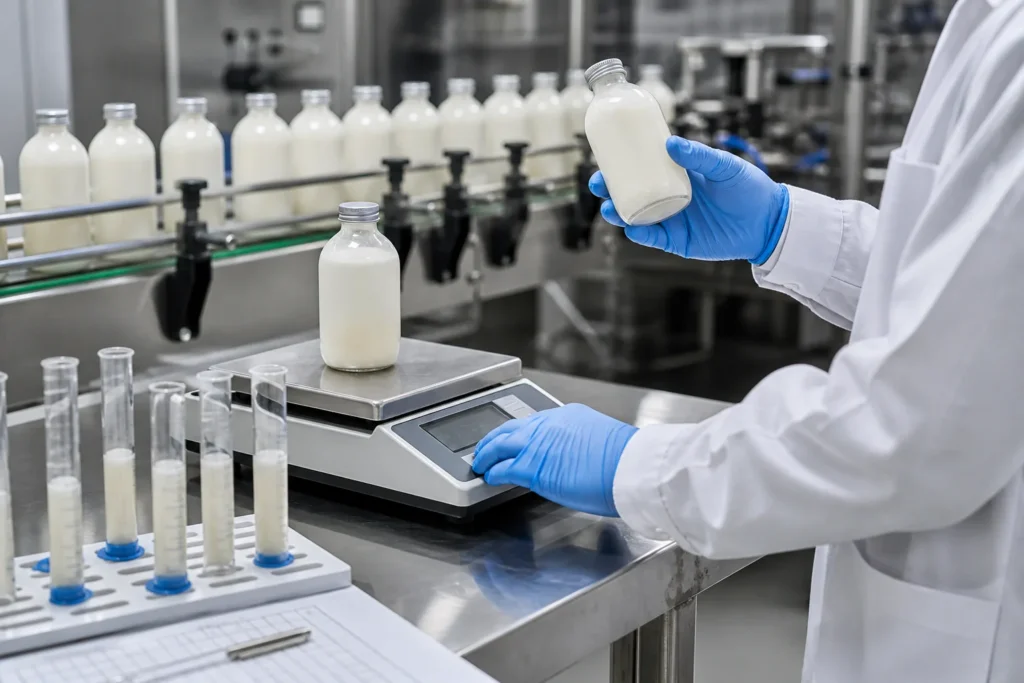
Direct answer: A correct average fill mass does not prove that each bottle contains a representative suspension. The control plan must address both quantity and composition over time.
21 CFR 211.110 requires written in-process controls to assure batch uniformity and monitor processes that can cause variability, including adequacy of mixing where appropriate. The regulation is for finished pharmaceuticals in the United States; a veterinary manufacturer must confirm the rules that apply to its product and market. As an engineering principle, however, it supports linking mixing, filling and sampling rather than validating each station in isolation.
The FDA oral-suspension inspection guide highlights beginning, middle and end sampling to check segregation. A practical protocol may also challenge low and high hopper levels, planned stops, restart, temperature extremes and the longest justified campaign. Samples should remain traceable to time and line condition. Do not composite samples when the purpose is to detect a trend across the batch.
Gravimetric checks can be useful because mass is not directly changed by product temperature in the same way as volume, but density and tare control must be understood when converting between mass and labeled volume. Acceptance limits should come from the product specification and demonstrated process capability, not from a generic machine brochure.
| Process moment | What to sample or record | Why it matters | Possible response |
|---|---|---|---|
| Start-up | First qualified bottles, bulk/hopper condition, temperature and agitation status | Reveals priming, air and restart effects | Prime or recondition using a validated procedure |
| Middle of batch | Fill mass plus representative product-uniformity test | Confirms stable feed and agitation | Adjust only within approved recipe and investigate trends |
| Low hopper level | Fill trend, solids/uniformity and agitator coverage | Exposes concentrated heel or vortex risk | Define minimum operating level or revised geometry |
| After planned stop | First units, temperature, hold time and agitation/recirculation history | Tests settling and redispersion controls | Apply approved restart and recheck procedure |
| End of batch | Last traceable bottles and remaining product condition | Detects segregation or unusable heel | Set justified recovery and batch-end rules |
Temperature and Hold Time Are Filling Parameters
Direct answer: If viscosity changes with temperature or time, product temperature and residence time must be measured and controlled as part of the filling process.
A jacketed vessel or heated hopper may improve flow for a formulation that is stable within a defined window. It can also accelerate degradation, change solvent loss, alter preservative behavior or promote settling if used without product data. Conversely, filling too cold may increase pressure, stringing and dose variation.
The URS should identify measurement points, acceptable temperature range, alarm action, maximum hold time and the status of product after an excursion. If the product is shear-thinning, a simple temperature reading may not predict the state after repeated pumping; the sample trial should reproduce the expected circulation and stop history.
The broad liquid-filler selection guide can help frame viscosity, container and output inputs. The suspension project must add settling, particle, agitation and representativeness requirements.
Cleaning and Changeover Design
Direct answer: A cleanable suspension filler needs drainable product paths, accessible valves and nozzles, controlled disassembly and a method that removes both dissolved residue and settled solids.
Settled solids can remain behind a valve seat, in a low hose loop or at the bottom of a hopper even when rinse water looks clear. The cleaning review should map every product-contact surface, identify low points and determine which parts are cleaned in place, cleaned out of place or replaced between products.
For manual cleaning, use keyed assembly or verification steps so valves, seals and nozzles are reinstalled correctly. For CIP-capable paths, define flow, temperature, concentration, contact time and return endpoint with the product owner. Cleaning validation and acceptable residue limits remain the manufacturer’s responsibility.
Changeover trials should include the worst justified formula or color/flavor transition, not only water. Record product recovery, waste, disassembly time, inspection points and the first acceptable units after restart.
URS and FAT Checklist for a Suspension Filling Line
Direct answer: A good URS converts product behavior into measurable equipment and acceptance requirements, while FAT challenges the line with representative product, containers and planned operating conditions.
FAT should use the actual product when feasible or a justified simulant that reproduces the properties driving the equipment decision. Water is rarely an adequate stand-in for a viscous, settling suspension. The protocol should state what the simulant represents and which conclusions cannot be drawn from it.
- State dose range, bottle range, closure/insert sequence and target output by format.
- Attach viscosity test data, settling/redispersion observations, particles, density, foam and temperature window.
- Define bulk tank, transfer line and buffer-hopper boundaries, including agitation and recirculation ownership.
- Identify product-contact materials, elastomers, finish, certificates and cleaning method.
- Define nozzle motion, shutoff, drip/stringing criteria and bottle-neck cleanliness.
- Specify recipe controls, alarms, level limits, stop/restart logic and reject handling.
- Agree fill-mass and product-uniformity sampling at start, middle, low level, restart and batch end.
- Run low, nominal and high dose challenges at justified temperature and viscosity conditions.
- Demonstrate sustained operation, planned stop/restart, changeover and cleaning access.
- List required drawings, manuals, spare parts, calibration documents and IQ/OQ support.
How to Evaluate a Veterinary Liquid-Filling Supplier
Direct answer: Choose a supplier that asks for rheology and settling evidence, connects the bulk-to-filler path and can demonstrate performance with representative samples.
- Review comparable applications, but confirm differences in viscosity, particles, dose, packaging and cleaning.
- Ask the supplier to explain why the proposed pump, valve and nozzle suit the product—and what evidence would change that choice.
- Require sample trials across dose, temperature, stop/restart and low-hopper conditions.
- Review P&ID or product-path drawings, layout, utilities, controls, alarms and line-balance assumptions.
- Confirm FAT/SAT acceptance, calibration, manuals, spare-parts list, training, commissioning and after-sales support.
- Verify the exact scope of CE/ISO or other documentation; do not treat a generic certificate as proof of suspension uniformity or filling performance.
How KING PACK Configures Oral Suspension Filling Projects
Direct answer: KING PACK starts with the product, dose, container and target output, then defines agitation, product feed, metering, nozzle, capping and inspection as an integrated line.
KING PACK Machinery is a China-based manufacturer of pharmaceutical, veterinary, cosmetic and liquid filling and packaging equipment, with core solutions covering tube filling and sealing, vacuum emulsifying, liquid filling, pet spot-on filling and prefilled syringe production systems.
For a high-viscosity veterinary suspension, possible project elements include an agitated or jacketed product vessel, a short sanitary feed path, a metering system chosen by trial, controlled nozzle lift, bottle handling, insert placement, capping and in-process check integration. The final configuration depends on verified product behavior; it should not be selected from a universal viscosity threshold.
Review the KING PACK filling and capping line platform and pharmaceutical-industry solutions for application context. To request a product trial, send viscosity-versus-temperature data, settling observations, particle information, dose range, bottle and closure samples, batch size and target output through the contact page.
Frequently Asked Questions
Does every oral suspension need continuous agitation during filling?
No. Some suspensions require continuous movement, while others may use periodic agitation with a validated maximum stop time. The decision must be supported by settling, redispersion and beginning/middle/end uniformity data.
Is a piston filler always best for a high-viscosity suspension?
No. Piston systems are common candidates, but valve passages, particles, air, seals and cleaning can determine suitability. Lobe, progressive-cavity, peristaltic or other systems may fit specific products. Product trials are essential.
Why can fill volume be stable while product uniformity drifts?
The metering chamber may deliver the same quantity while solids segregate in the tank, hose or hopper. Fill quantity and suspension composition therefore need separate, traceable checks.
Can the filler use strong recirculation to prevent settling?
Only if the product tolerates the resulting shear, temperature rise and air exposure. The loop should be designed and validated as part of the process, not used as an uncontrolled correction.
How can stringing at the nozzle be reduced?
Evaluate positive shutoff, nozzle bore, retract speed, fill trajectory, product temperature and carefully controlled suck-back. Any change must also be checked for air entry and dose effects.
Should beginning, middle and end samples be composited?
Not when the objective is to detect segregation over time. Keep them separate and traceable to the operating condition so a trend is visible.
Is water acceptable for FAT?
Water can test basic motion and controls but usually does not represent viscosity, settling, foam or nozzle cutoff. Use the product or a justified simulant for performance conclusions.
What is the most important RFQ attachment?
A combined product-and-package data package: rheology with test conditions, settling/redispersion, particles, density, foam, temperature/hold limits, dose range, bottle/closure drawings and representative samples.