

Last reviewed: August 26, 2026.
A spot-on pipette that looks acceptable at discharge can still seep during cartoning, transport or storage. The leak may appear at the heat-sealed tail, along a narrow channel created by product contamination, at a scored break-tip, or through a crack caused by tooling or handling. Treating every failure as “not enough heat” often makes the problem worse.
The practical task is to separate package-material variation from filling contamination, sealing-window drift, tooling alignment and downstream mechanical stress. That requires traceable samples, a root-cause tree and a test method sensitive enough for the defect being investigated.
This guide focuses on the equipment and process controls around a veterinary spot-on filling and sealing line. It does not assume that a nonsterile spot-on product must meet sterile container-closure requirements. Sterile-product methods can inform method selection, but the product owner must define the actual protection, leakage and shelf-life requirements for the marketed pack.
Quick answer: Most spot-on pipette leaks originate from one of five interacting causes: product in the seal zone, an unproven heat-sealing window, package or material variation, tooling misalignment, or a leak test that cannot detect the relevant defect. Confirm the failure location first, then challenge filling, sealing, cooling and handling conditions with actual production pipettes and a representative product or justified simulant.
What Counts as a Leaking Spot-On Pipette?
Direct answer: A leak is any unintended product loss or pathway that makes the pack fail its defined protection, dose-retention or handling requirement. The defect may be immediately visible, intermittent or detectable only after conditioning and transport simulation.
Start by recording where the product appears, when it appears and what was happening immediately before discovery. A wet tail directly after sealing suggests a different failure mechanism from mass loss after several days, a cracked applicator after cartoning or staining around a scored tip after vibration.
Do not use “leak” as one undifferentiated reject code. A useful defect taxonomy separates seal-channel leakage, low seal strength, burned or brittle seals, pinholes, cracks, poor tip formation, product permeation and closure damage. Each category should retain the packaging lot, machine recipe, cavity or station, operator, time and upstream batch reference.
Visual inspection is valuable but not sufficient by itself. A continuous-looking seal can still contain a microscopic channel, while an unattractive but continuous seal may pass the product-specific acceptance criteria. The manufacturer should define which attributes are critical and how each will be verified.
Root-Cause Matrix for Pipette Leaks
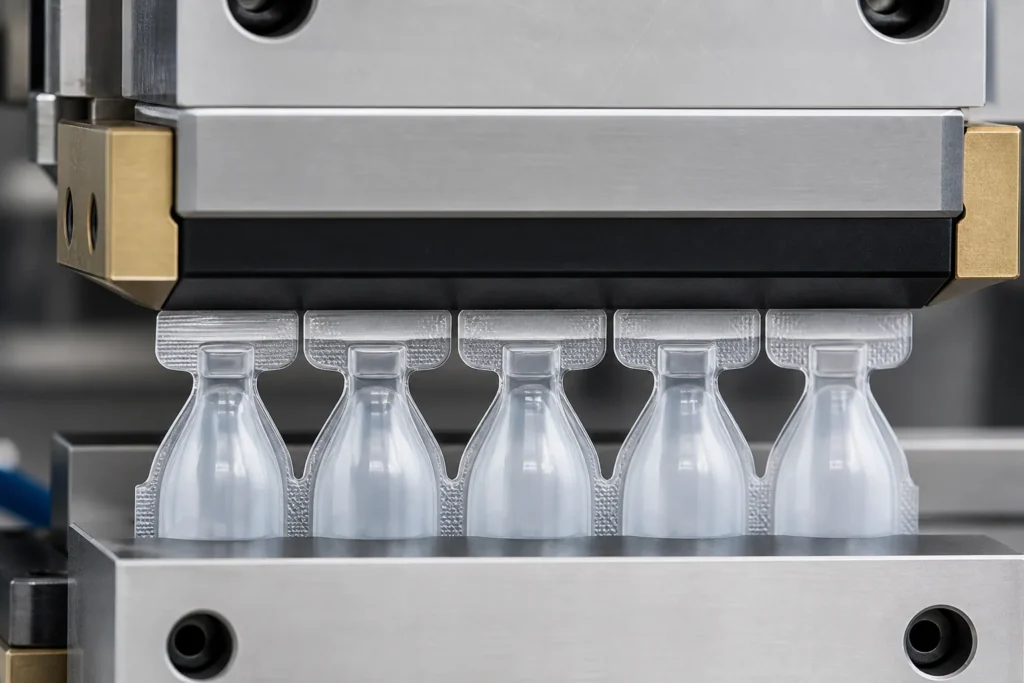
Direct answer: The fastest investigation begins with the failure signature and tests the most likely mechanism before changing multiple machine settings at once.
| Failure signature | Likely process cause | What to check | Typical corrective direction |
|---|---|---|---|
| Narrow wet path across seal | Liquid, oil or foam entered the seal zone | Nozzle cutoff, fill height, splash, drip after retract, seal-zone cleanliness | Stabilize filling and keep a verified clean seal land |
| Seal peels too easily | Insufficient or uneven heat, pressure or dwell | Actual jaw temperature, parallelism, contact pattern, speed and cooling | Develop a material-specific operating window |
| Brittle, distorted or thinned tail | Excess thermal or mechanical input | Overheating, excessive jaw pressure, long dwell, sharp tooling edges | Reduce damaging input and inspect tooling |
| Leak concentrated at one station | Holder, jaw or cutter misalignment | Station trend, cavity identification, clamp position and wear | Correct alignment and verify across all stations |
| Random pinholes or cracks | Packaging defect or downstream stress | Incoming inspection, trim edges, cartoning pressure, vibration and drop history | Control packaging quality and handling loads |
| Leak grows during storage | Chemical attack, stress cracking or seal relaxation | Material compatibility, filled-pack aging and environmental conditioning | Requalify materials and the sealing window |
Filling Controls That Protect the Seal Zone
Direct answer: The sealing station cannot compensate for a seal surface coated with product. Leak prevention therefore starts at dosing, nozzle motion and container handling.
The target fill volume must leave a defined, repeatable seal land. A package drawing should identify the allowable product area, sealing area, trim line and any break-tip geometry. If the product level approaches the seal zone, normal variation in dose, foam, package position or acceleration can create intermittent contamination.
Nozzle design should be selected against viscosity, surface tension, stringing and volatility. Positive shutoff, a controlled retract profile and an appropriate nozzle-to-package distance can reduce tails and droplets. Suck-back can help some formulations but can also draw air or destabilize the dose; it should be justified through trials rather than treated as a universal fix.
Machine recipes should link fill parameters to the matching pipette format and sealing recipe. Useful controls include package-presence detection, no-package-no-fill logic, reject tracking and alarms for temperature or pressure outside the qualified range. For high-value small doses, the existing spot-on filling accuracy guide can support the dosing portion of the control strategy, while this page remains focused on leakage.
- Confirm the pipette is fully seated and oriented before the nozzle enters or dosing begins.
- Use a controlled fill trajectory that avoids splashing onto the seal land.
- Check for post-dose drip after nozzle withdrawal and during index movement.
- Trend fill mass and leakage by machine station instead of reviewing only overall rejects.
- Define how contaminated units are detected and removed before sealing or cartoning.
Develop a Heat-Sealing Window, Not a Single Setpoint
Direct answer: A robust recipe is an operating window in which temperature, pressure, dwell time, package position and cooling jointly produce an acceptable seal across expected material and process variation.
The temperature displayed on an HMI is not automatically the temperature experienced at the seal interface. Heater location, jaw mass, warm-up time, thermocouple placement, cycling rate and room conditions can create differences. Qualification should therefore confirm actual behavior at start-up, normal speed, planned stops and restart.
Pressure and parallelism determine whether energy is distributed across the entire seal. Pressure that is too low can leave unbonded areas; pressure that is excessive can thin or damage the laminate. Dwell time interacts with both temperature and line speed. Cooling or hold pressure may also matter because a seal can be disturbed before it has developed sufficient strength.
ASTM F2029 describes laboratory practices for establishing starting relationships for heat sealing flexible materials, while ASTM F88 measures seal strength. Neither standard supplies a universal production setpoint for a specific veterinary pipette. The packaging owner must define the acceptance criteria, confirm applicability and correlate laboratory results with production performance.
Material and lot variation must be part of the study
A sealing study should include the qualified material structures, thickness tolerances, print or coating effects and representative packaging lots. Incoming material certificates are useful, but they do not replace functional trials on the production geometry. When possible, retain samples from the low, nominal and high ends of relevant tolerances.
The approved recipe should identify which variables are locked, which can be adjusted by trained operators and which require quality authorization. Uncontrolled local increases in temperature are a common reason a weak seal becomes a burned, brittle or distorted seal instead of a robust one.
Choose Leak and Seal Tests by Failure Mode
Direct answer: No single test detects every defect. Seal-quality tests, gross-leak tests and higher-sensitivity leak tests answer different questions and must be matched to the product-package risk.
ASTM D3078 covers bubble-emission testing for gross leaks in flexible packages that contain headspace gas. The standard also warns that small leaks may not be detected and that product or entrapped air can influence the result; a viscous or oily formulation can even plug a small opening. This makes the method useful for some gross-leak investigations but not automatically suitable as the only release test.
USP <1207> addresses package integrity for sterile products and stresses life-cycle method selection and validation. Most external veterinary spot-on products are not sterile products, so the chapter should not be presented as a mandatory requirement without a justified regulatory basis. Its distinction between leak tests and seal-quality tests is nevertheless a useful engineering concept.
| Method | Best question answered | Important limitation | Use in a pipette project |
|---|---|---|---|
| Visual inspection | Is the seal visibly continuous, aligned and free of contamination? | Cannot reliably detect every channel or microleak | 100% inspection or defined sampling, supported by defect standards |
| Seal strength (e.g., ASTM F88 where applicable) | Is the sealed interface mechanically consistent? | Strength alone does not prove absence of a leak | Process development, capability and change control |
| Bubble emission (e.g., ASTM D3078 where applicable) | Is there a gross leak under the selected conditions? | Sensitivity is limited; product can plug small defects | Investigation or validated sampling method |
| Dye or tracer ingress | Does the chosen tracer pass through a defect? | Method compatibility and subjective interpretation require control | Development or investigation after validation |
| Vacuum/pressure decay | Does the package lose pressure at a detectable rate? | Fixture, package volume and sensitivity must be developed | Potential deterministic test for suitable formats |
| Mass-loss/aging study | Does the filled pack retain product over defined storage conditions? | Slow and influenced by permeability and handling | Shelf-life support and material comparison |
A Practical CAPA Workflow for Recurring Leaks
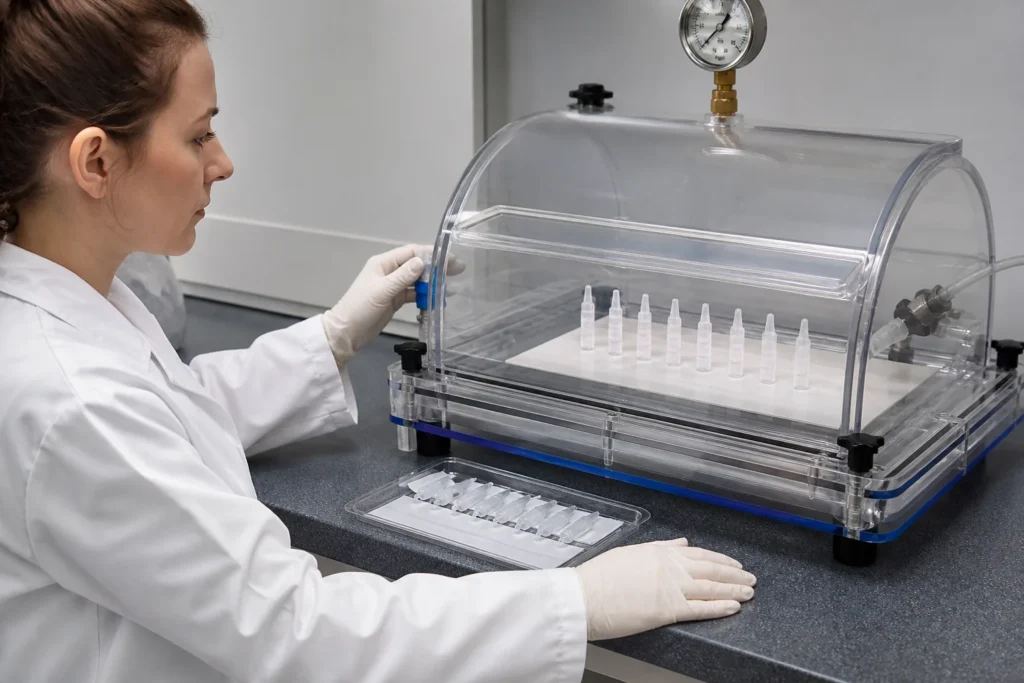
Direct answer: Contain the affected lot, preserve evidence and change one controlled factor at a time until the failure mechanism and correction are demonstrated.
- Contain and segregate affected units. Record packaging lot, product batch, machine recipe, station, time and downstream handling history.
- Map the leak location. Photograph and code the defect before destructive testing.
- Confirm the test method can detect a known defect of the type being investigated. Do not assume a passing gross-leak test excludes a smaller pathway.
- Review filling evidence: dose trend, nozzle movement, drip/stringing, product level and seal-zone contamination.
- Review sealing evidence: warm-up, actual temperature behavior, pressure/contact pattern, dwell, cooling, jaw condition and station trend.
- Challenge packaging and material variation with retained lots and dimension checks.
- Reproduce the failure under controlled conditions, implement the correction and verify effectiveness with an adequate sample across all stations.
- Update recipes, work instructions, maintenance limits, training and change-control records before routine release.
What to Verify During FAT
Direct answer: FAT should demonstrate the combined filling-and-sealing process on representative packaging, not merely cycle an empty machine at brochure speed.
The final FAT protocol should state the sample size, test sequence, instruments, conditioning, acceptance criteria and treatment of deviations. A successful short demonstration does not automatically establish commercial process capability; SAT, site qualification and ongoing process monitoring remain the owner’s responsibility.
- Use production-intent pipettes from more than one representative lot when available.
- Use the actual product when safe and practical, or a justified simulant matching viscosity, surface tension and sealing-zone behavior.
- Challenge low, nominal and high fill volumes within the agreed range.
- Record warm-up, normal run, planned stop, restart and sustained-run behavior.
- Verify temperature, pressure/dwell settings, recipe security and alarm response.
- Inspect every sealing station or cavity and retain traceability to the station.
- Run the agreed visual, seal-quality and leak tests with documented acceptance criteria.
- Demonstrate changeover, cleaning access, reject handling and no-pipette-no-fill logic.
How to Evaluate a Spot-On Filling Machine Supplier
Direct answer: Select a supplier that can connect packaging drawings, product behavior, sealing science and documented acceptance testing—not one that offers only a nominal speed and a generic heat-seal temperature.
- Ask for comparable packaging references and clarify what product and pipette differences limit the comparison.
- Require a sample-test plan covering filling, seal-zone cleanliness, sealing-window development and leak evaluation.
- Review layout, electrical drawings, utilities, product-contact materials, spare parts and change parts.
- Confirm how recipes, alarms, station traceability and reject logic are documented.
- Agree FAT/SAT boundaries, training, commissioning and after-sales response before purchase.
- Request CE/ISO or other evidence only where relevant, and verify the exact scope rather than accepting logos as proof of process performance.
How KING PACK Approaches Pipette Leak Prevention
Direct answer: KING PACK configures the filling, pipette handling and sealing stations around the customer’s actual package and product inputs, then uses sample trials and FAT evidence to establish the project-specific operating window.
KING PACK Machinery is a China-based manufacturer of pharmaceutical, veterinary, cosmetic and liquid filling and packaging equipment, with core solutions covering tube filling and sealing, vacuum emulsifying, liquid filling, pet spot-on filling and prefilled syringe production systems.
For a leak-sensitive spot-on project, the engineering discussion normally covers product feed, dosing method, nozzle cutoff, pipette positioning, seal-zone protection, heating and cooling control, reject logic, guarding, changeover and the customer’s test method. The relevant machine family can be reviewed on the pet drops filling solution page and the broader tube filling and sealing platform.
The most useful RFQ includes the pipette drawing, material structure, representative samples, fill range, formulation viscosity and volatility, desired output, required inspection, leak-test method and acceptance criteria. Send those inputs through the KING PACK contact page to request a configuration and sample-trial plan.
Frequently Asked Questions
Why does increasing sealing temperature sometimes increase leakage?
Excess heat can thin, distort or embrittle the material, damage coatings or create an unstable seal geometry. Temperature must be developed together with pressure, dwell, cooling and material variation, not increased in isolation.
Can product in the seal area be sealed through?
Some processes tolerate very small amounts better than others, but product contamination commonly creates channels and variability. The preferred control is to keep a defined seal land clean through fill height, nozzle cutoff and package handling.
Is ASTM D3078 enough for release testing?
Not automatically. It is a gross-leak bubble-emission method with sensitivity and product-interaction limitations. The manufacturer must validate that the selected method detects the defects relevant to the product and package.
Does a strong seal prove that the pipette is leak-free?
No. Seal strength measures mechanical separation force and can support process control, but a strong average result does not exclude a localized channel, pinhole, crack or damaged tip.
Should every sealing station be evaluated separately?
Yes during development and troubleshooting. Station-level traceability helps reveal a misaligned holder, worn jaw, heater difference or cutter problem that disappears in overall averages.
Can water be used instead of the actual spot-on formulation during FAT?
Only when the substitution is justified. Water may not reproduce the product’s viscosity, surface tension, volatility, wetting or material interaction. A better simulant should match the properties that affect filling and sealing.
What information should be sent before a sample test?
Provide pipette drawings and samples, material structure, fill range, formulation properties and SDS where relevant, target output, acceptable leakage criteria, test method, coding requirements and downstream packaging constraints.
How many samples should a FAT leak test use?
There is no universal number. Sample size should reflect the number of stations, planned challenges, defect risk and the statistical confidence required by the project’s acceptance protocol.