
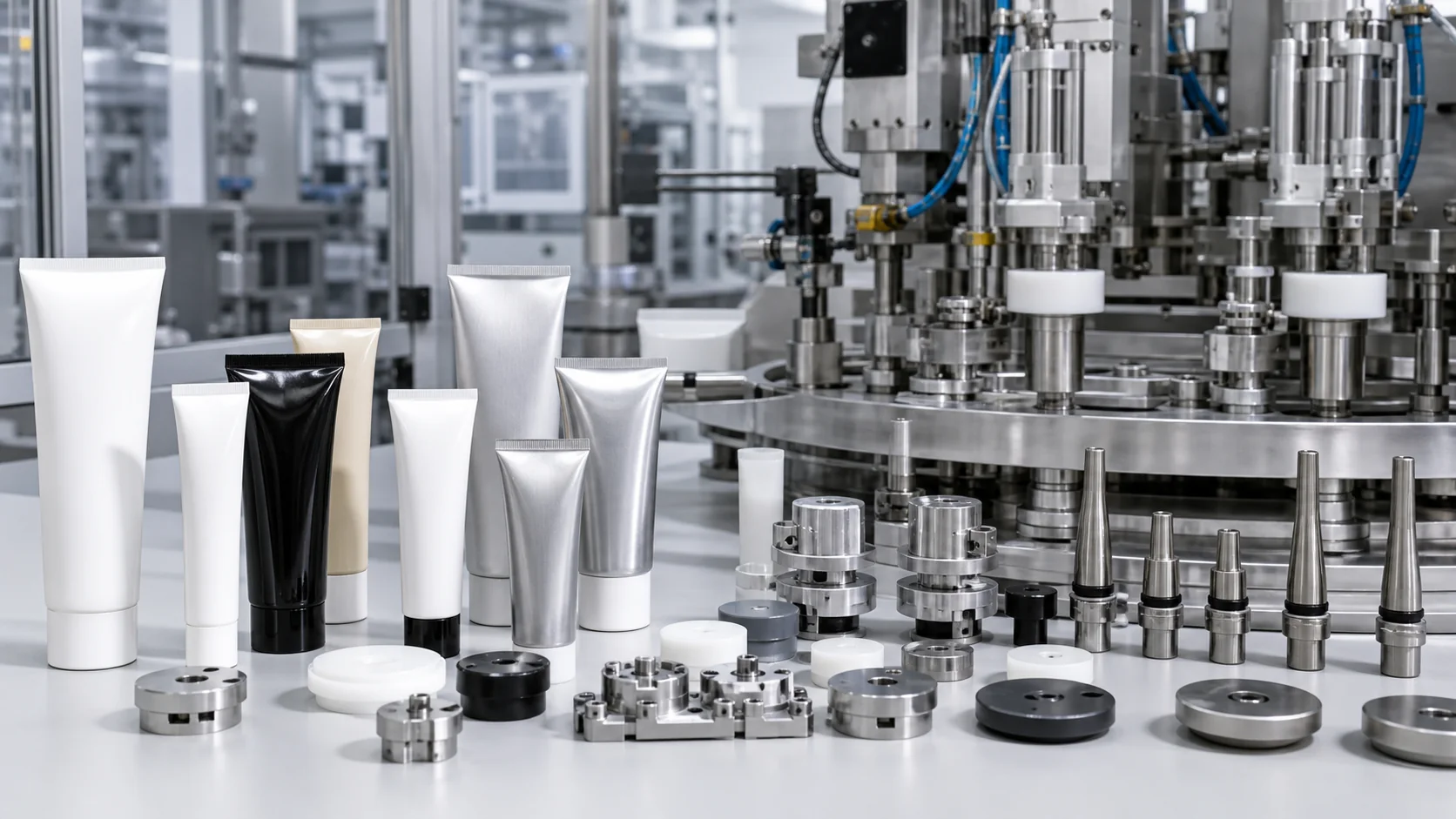
Tube filling machine change parts are not limited to tube holders. A conversion can affect infeed, artwork orientation, transport pockets, filling nozzle and lift profile, sealing or folding modules, coding, trimming, discharge and recipe parameters. Plastic, laminate and aluminum tubes may share part of the machine, but their tail-closing processes are fundamentally different.
Quick answer: obtain approved tube drawings and samples, then build a station-by-station conversion matrix. Diameter and length usually drive holders, guides and height settings. Tube material and wall construction determine whether the tail is hot-air or ultrasonically welded, high-frequency sealed or mechanically folded. A supplier should quote common stations, dedicated tooling, optional modules, stored parameters and sample-trial evidence separately.
Quick conversion matrix
| Machine station | Plastic tube | Laminate tube | Aluminum tube |
|---|---|---|---|
| Infeed and orientation | Diameter/length guides and print-mark sensor setup | Similar handling, but confirm laminate stiffness and mark contrast | Gentle handling; check denting and ovality |
| Tube holder / puck | Sized to body geometry and closure | Sized to body geometry and closure | Sized with support that avoids deformation |
| Filling | Nozzle, shutoff and dive profile selected for product and neck | Usually product-led; confirm tail support | Product-led, with careful tube support |
| Tail closure | Hot-air or ultrasonic sealing; cooling and trimming | Hot-air/ultrasonic for PBL and many ABL structures; HF may be project-specific | Mechanical folding and crimping |
| Coding | Embossing or printing at seal; artwork registration | Embossing/printing compatible with seal structure | Embossing integrated with fold tooling or separate code |
| Final inspection | Seal geometry, code, leaks and cosmetics | Seal geometry, layer response, code and leaks | Fold pattern, crimp, code, sharp edges and leaks |
The matrix is a starting point. Aluminum-barrier laminate, plastic-barrier laminate, mono-material and specialty tubes can behave differently. Confirm the actual tube specification with the tube supplier and validate it on the proposed closure process.
Start with controlled tube and product inputs
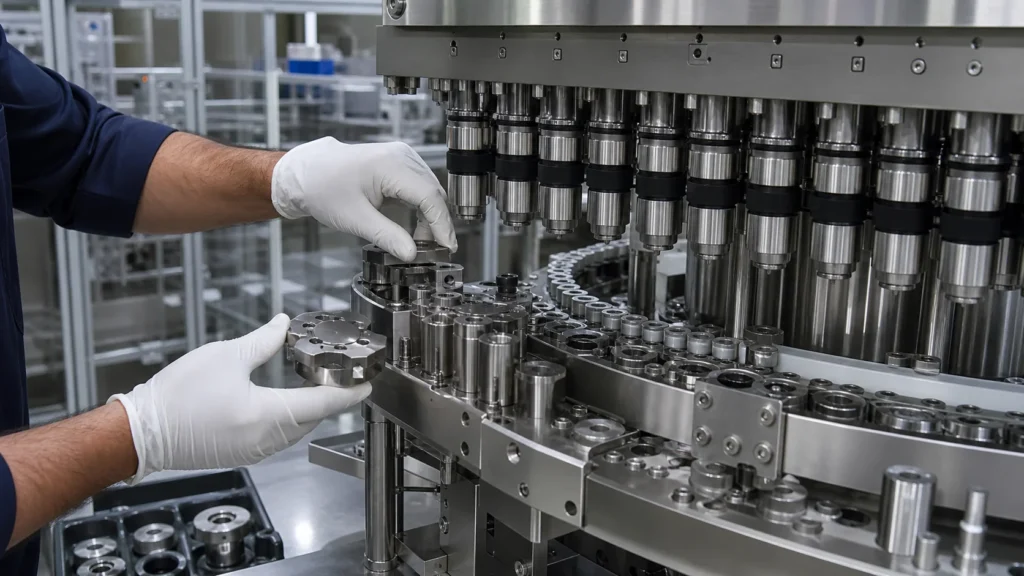
The conversion RFQ should include a dimensioned tube drawing, material structure, diameter, overall length, tail length, wall thickness or supplier specification, cap or closure, artwork orientation mark, code requirement and acceptable finished-tail geometry. Send production samples from each approved tube supplier because nominally identical drawings can differ in stiffness, ovality and print-mark contrast.
Define the product as carefully as the package. State fill mass or volume, density, viscosity versus temperature, presence of particles, air sensitivity and required filling temperature. A new tube diameter can require a different nozzle, but the product determines the bore, shutoff, suck-back and dive profile. The change-parts scope must cover product and tube together.
Create a format register with a unique format number. Link every drawing, tool, recipe, setup sheet and approved sample to that number. This prevents a similar-looking holder or sealing jaw from being used with the wrong tube.
Use the existing aluminum versus plastic and laminate tube comparison when selecting package material. Once the tube is chosen, this guide defines the machine-conversion work.
Infeed and artwork-orientation change parts
Empty tubes may enter from trays, cassettes, magazines or bulk-feeding equipment. The infeed must separate and place each tube without crushing, scratching or reversing it. Change parts can include magazine rails, guides, pick heads, transfer fingers, grippers and height stops.
Diameter and length affect the guide spacing and insertion stroke. Aluminum tubes are more susceptible to dents and permanent deformation, so contact points and gripping force deserve specific review. Plastic and laminate tubes can recover from minor deformation, but they may be slippery, electrostatically charged or inconsistent after storage.
Artwork orientation normally uses a printed eye mark or another reference. Conversion work may include sensor type, bracket position, light source, contrast setting and the mechanical rotation element. Test the darkest and lightest artwork variants, glossy finishes and registration tolerance. A mark that is visible to the operator is not automatically reliable for the sensor at production speed.
Store orientation parameters in the format recipe where possible, but retain a mechanical verification. During setup, run marked tubes through the station and measure the finished seal or code position against the artwork before filling product.
Tube holders, pucks and transport tooling
The tube holder supports the body while the machine indexes through filling and closure stations. It must locate the tube concentrically without damaging artwork or allowing excessive tilt. Diameter, body shape, closure geometry and tube stiffness determine the bore, depth and support profile.
Not every format requires a completely new holder. A modular holder may use replaceable inserts or sleeves, while a narrow format range may share a common puck. Ask the supplier to identify the proven common range and the conditions that force dedicated tooling. Avoid approving a universal claim without a sample trial.
Holder height interacts with filling nozzle depth and sealing height. A format change may need spacers, lifting cams, servo recipe values or a machine-wide height adjustment. Each changed datum should have a setup reference and gauge. Mechanical stops and clear identification reduce dependence on operator judgment.
For soft tubes, confirm support near the tail during sealing. For aluminum, verify that indexing acceleration and gripper contact do not ovalize or crease the tube before the folding station.
Filling-nozzle, dosing and dive-profile changes
The dosing system may remain common across tube materials when the product and fill range are unchanged, but nozzle geometry often changes with tube diameter, dose and product behavior. A wide nozzle can shorten filling time for a thick cream, yet it must enter the tube without contact and stop cleanly before the seal zone.
List the product-contact change parts: hopper agitator, pump cylinder or rotor, valves, hoses, manifold, nozzle, shutoff tip and seals. Identify which are format parts, product parts or wear parts. This distinction supports cleaning validation, spare-parts planning and total conversion cost.
The nozzle lift profile should be stored by format and product. Bottom-up filling can reduce trapped air; a controlled rise can keep the nozzle submerged without dragging product upward. Suck-back and shutoff timing prevent stringing. Verify the finished product level and clean-tail margin, not only dose weight.
Run the smallest tube with the highest fill and the largest tube with the lowest fill if those combinations are permitted. These cases challenge headspace, nozzle travel and product distribution differently.
Hot-air sealing tooling for plastic and laminate tubes
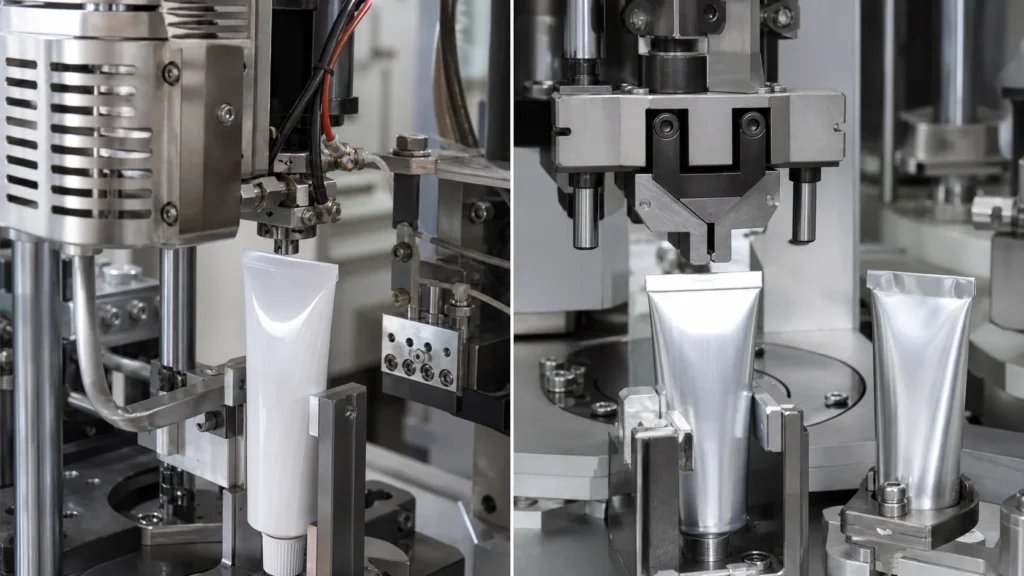
Hot-air sealing heats the inside of the open tail, then closing jaws compress the softened layers. Cooling and trimming form the final seal. Change parts can include the hot-air nozzle, sealing jaws, cooling jaws, contour insert, code characters, trimming knife, tail support and height settings.
Official Norden documentation states that hot-air systems are used for plastic and laminate tubes and that plastic and aluminum-laminate tubes can use the same general process with different tools. IWK also describes hot-air sealing for plastic, PBL and ABL structures. These statements do not make every laminate interchangeable: layer structure, thickness and barrier material still require a validated recipe and tooling set.
Set and record air temperature, flow, insertion depth, heating time, jaw pressure, cooling time and trimming position as applicable. The robust range matters more than one ideal setting. Conduct a parameter-window trial and examine seal appearance, dimensions, leak performance and code legibility.
Contour seals, euro holes and special tail shapes require dedicated jaw and cutting tooling. Confirm that the finished geometry leaves enough seal width, avoids sharp corners and matches the carton. A cosmetic contour should not compromise seal integrity.
Ultrasonic or high-frequency sealing options
Ultrasonic welding generates localized heat through mechanical vibration and can be applied to compatible plastic and laminate tubes. It uses a horn and anvil or equivalent tooling that must match the tail geometry. Changeover scope can include horn, anvil, support tooling, recipe energy, amplitude, force and weld limits.
High-frequency sealing is another option for suitable laminate structures. Norden’s service documentation describes HF sealing for aluminum-laminate tubes and notes that some systems require few or no size parts at the sealing beam. That advantage applies only to the stated machine and tube system; the full format still needs holders, guides and filling setup.
When comparing closure modules, request the compatible material range, dedicated tooling list, change time, utilities, inspection method and approved sample evidence. Do not select a sealing technology solely from energy or speed claims without the tube supplier’s confirmation.
Folding stations for aluminum tubes
Aluminum tubes are mechanically closed by folding and crimping the tail. The machine may perform a single, double, triple or saddle-style fold depending on the tube, product, code and quality requirement. Dedicated components can include pre-flattening tools, folding jaws, crimping tools, embossing characters and final-form gauges.
The tail must remain clean and correctly presented. Product in the fold can create leakage or an uneven closure. Set the fill level and nozzle cutoff to maintain a clean-tail margin, and verify the tube transport does not squeeze product upward.
Coding is often embossed during the folding process. Character holders, type sets and fold tools must be compatible. Norden notes that some aluminum coding arrangements use a saddle fold to avoid tube damage. Include code content, location, direction and readability in the approved sample.
Inspect fold symmetry, dimensions, sharp edges, code and leak performance. Aluminum does not recover from a poor mechanical setup, so trial setup should begin with unfilled or safe test tubes before product is introduced.
The tube filling and sealing machine technical guide provides more background on closure methods. This conversion guide focuses on which tools and checks change at each station.
Coding, trimming and discharge differences
Plastic and laminate tails may be embossed in the sealing jaws, inkjet coded before or after sealing, laser marked where compatible, and trimmed to a final profile. Each method affects tooling, dust or scrap handling, inspection and changeover. Confirm whether a code change is a character change, a recipe change or both.
Trimming knives and anvils are format-sensitive wear parts. Record blade condition, replacement limits and setup gauge. A blunt or misaligned knife can distort the seal or leave a poor cosmetic edge even when the weld is sound.
Discharge guides and transfer conveyors must accept the finished tail. A wide contour seal, euro hole or aluminum fold can change the product’s center of gravity and carton-loading orientation. Run the converted tube through the next machine, not only to the filler outfeed.
Setup verification and sample-trial protocol
Use a documented line-clearance and setup checklist. Remove the previous format’s tubes, product, code characters and labels. Verify every installed change part against the format register. Load the recipe, then independently confirm the critical mechanical positions.
| Verification step | What to check | Record |
|---|---|---|
| Dry transport | Infeed, orientation, holder fit and discharge | Tube count, damage and orientation result |
| Empty closure | Tail presentation, jaw/fold alignment and code | Dimensions and approved appearance sample |
| Product filling | Dose, nozzle path, air pockets and clean tail | Fill-weight data and defect photos |
| Sealing/folding window | Nominal and challenge settings | Seal/fold results and parameter range |
| Integrated run | Sustained speed, rejects and downstream transfer | Good output, rejects, stops and causes |
| Post-run inspection | Tool wear, residue and loose components | Maintenance and cleaning sign-off |
The trial should use production tubes from the intended supplier and the actual product where practical. If a simulant is used, document why it represents viscosity, temperature and cleaning behavior. Approve master samples for artwork alignment, seal or fold, trim and code.
Do not reduce acceptance to “machine ran.” Require a defined quantity at sustained speed, fill-weight criteria, closure inspection, leak method, code verification, reject reconciliation and changeover evidence.
Build the change-parts RFQ by station
Ask the supplier for a bill of format parts that identifies part number, station, material, quantity, format coverage, storage method and recommended spares. Separate standard included parts, dedicated change parts, optional sealing modules and wear parts. Request photographs or drawings to reduce ambiguity.
Define the promised changeover boundary. Does the quoted time include cleaning, cooling, removal, installation, recipe loading, first-piece adjustment and quality approval, or only the mechanical swap? Compare suppliers using the same boundary.
Provide a change-part cart or shadow board with labeled positions. Heavy sealing beams or folding modules may need lifting assistance. Safe handling and storage prevent damage to precision tooling and reduce the risk of installing the wrong part.
For a real dual-material project example, review the King Pack dual-type tube filling and sealing machine factory test. Project evidence should still be matched to the buyer’s tube samples and acceptance criteria.
How King Pack scopes a tube conversion
King Pack can review tube drawings, materials, diameters, lengths, artwork marks, products, dose ranges and coding needs to prepare a station-by-station format scope. Depending on the machine, a project may use common transport stations with dedicated holders, nozzles, sealing or folding tooling and stored recipes.
For plants planning several tube families, provide the complete format matrix at the start. Designing space, controls and guarding for a combination closure system is easier before manufacture than adding an unplanned module later. The proposal should state what can run on the base machine, what requires a change-part set and what requires a separate station or option.
Frequently asked questions
Which tube filling machine change parts are normally diameter-specific?
Common diameter-related parts include infeed guides, transfer fingers, holders or pucks, centering pieces, nozzle size or alignment parts, sealing or folding tools and discharge guides. The exact list depends on the machine architecture.
Can plastic and laminate tubes use the same hot-air sealing station?
Often they can use the same station architecture, but different nozzles, jaws, recipes or other tooling may be required. Confirm the exact laminate structure, thickness and approved parameter window through trials.
Can one machine run plastic and aluminum tubes?
Yes, when it is designed with both a welding system for plastic/laminate and a folding system for aluminum, or with an approved combination module. The transport and filling formats still require their own change-part review.
Does changing tube material always require a new filling nozzle?
No. The nozzle is mainly driven by product, dose and tube opening, but a new diameter or clean-tail requirement can force a different nozzle or dive profile.
What information is needed to quote a format set?
Provide tube drawings and samples, material structure, diameter, length, closure, artwork mark, fill product, dose, code, finished-tail requirement, output and downstream package details.
How should changeover time be compared?
Use the same boundary for every quote. Include line clearance, cleaning, cooling, tool exchange, recipe loading, adjustment, first-piece inspection and quality release if these activities matter to production.
What should be approved during a tube trial?
Approve orientation, fill weight, air-pocket control, clean-tail margin, closure geometry, leak result, code, trim, cosmetics, rejects and sustained operation. Retain signed master samples and the parameter record.