 Skip to content
Last reviewed: September 14, 2026.
A veterinary liquid filler needs heating, cooling or controlled temperature hold only when product data show that temperature materially affects viscosity, uniformity, foam, volatility, dose delivery, chemical or physical stability, or package performance. The target is not simply hot fill or cold fill. It is a justified product temperature window that can be measured and maintained from bulk hold through the dosing point.
Begin with formulation and development data, then confirm the equipment configuration with representative product and package trials. The existing liquid filling machine selection guide owns the broad viscosity-container-output decision; this article stays within temperature control, thermal interfaces and operating-state evidence.
Quick answer: Use ambient or cold-flow filling when the approved product remains stable, homogeneous and consistently doseable across the actual room, hold-time and batch conditions. Add a heated hopper or jacketed path when controlled warming is necessary to keep feed and cutoff inside the validated viscosity window and the formulation tolerates the exposure. Add cooling or a defined maximum hold when heat, volatility, foam, oxidation or stability limits require it. Specify measurement points, alarms, recipe limits, startup and shutdown rules, and confirm the design with representative trials; temperature must never be used to mask an unsuitable dosing system or unstable formulation.
1 Build a Product Temperature Design Window
Direct answer: Translate formulation knowledge into a documented minimum, target and maximum temperature at each relevant process location.
Collect viscosity against temperature using a defined method, spindle or geometry, shear condition and equilibration time. Record density, surface behavior, foam tendency, volatility, evaporation, crystallization, phase separation, suspension settling, microbial or chemical sensitivity and any package interaction that changes with temperature.
Distinguish bulk-storage, transfer, hopper and nozzle conditions. A product can leave a jacketed vessel at target temperature yet cool through a long hose, warm near a motor or lose volatiles in an open hopper. Map expected residence time and ambient range for the actual batch and operating schedule.
The product owner should approve the window and test methods. A machine supplier can design controls around the stated limits but should not invent stability criteria. Treat unknown relationships as development work before final URS approval.
| Input | Question | Equipment consequence |
|---|---|---|
| Viscosity-temperature curve | Does flow or cutoff change in the proposed range? | Pump, nozzle, jacket and setpoint |
| Stability window | What exposure and time are acceptable? | Maximum temperature and hold timer |
| Volatility | Does warming increase vapor or concentration change? | Closed feed, venting and cooling review |
| Foam and air | Does agitation or warm transfer increase entrainment? | Gentle feed, deaeration and level control |
| Package behavior | Does temperature affect container or closure? | Fill point, cooling and closure timing |
2 Decide Whether Ambient or Cold-Flow Filling Is Sufficient
Direct answer: Use the simplest thermal configuration that keeps the product inside its approved window through the full batch and all defined operating states.
Ambient or cold-flow filling is appropriate when product viscosity, uniformity and dose response remain acceptable across the qualified room range, expected storage-to-line transition, hopper level and batch duration. Confirm performance at realistic lower and upper conditions rather than one comfortable laboratory temperature.
Check startup after transfer, normal running, replenishment, low hopper level, short stops and long stops. A product may dose well after prolonged laboratory equilibration but arrive at the line with temperature gradients. Define how the batch is conditioned and mixed without introducing air.
Avoid adding heat as a default response to slow flow. First review pump sizing, suction conditions, hose diameter and length, valve restriction, hopper head, nozzle geometry and dosing range. Heating can change product or vapor behavior and may create a new control burden.
3 Justify a Heated Hopper or Jacketed Product Path
Direct answer: Add controlled warming when the approved process requires it to maintain feed, dosing or cutoff—not merely to achieve a higher nominal speed.
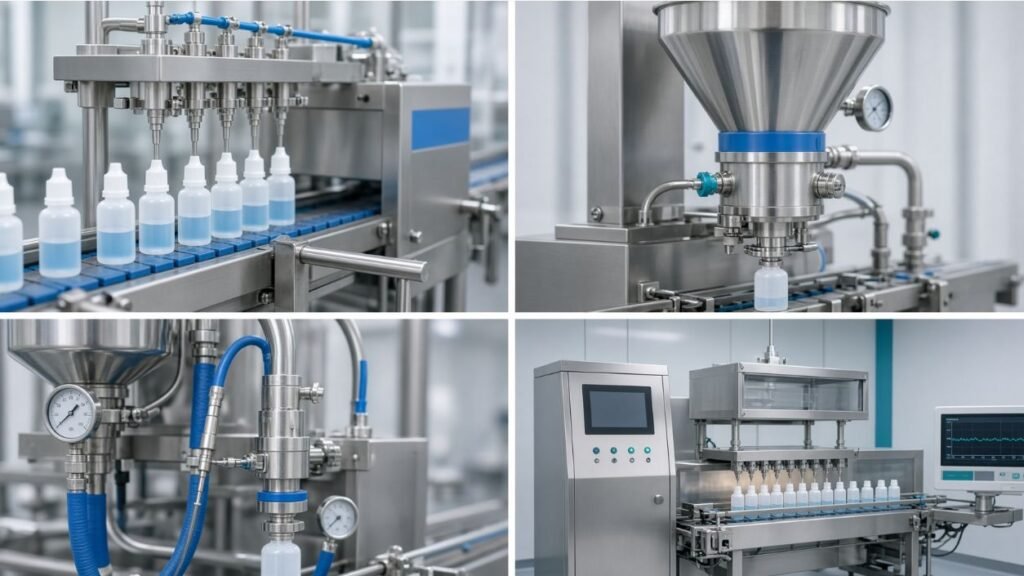
Determine whether the hopper alone is enough or whether the vessel outlet, hose, pump, manifold and nozzle also need temperature control. Partial heating can create cold spots, pressure variation or product buildup. Conversely, heating every component can increase residence time at temperature and complicate cleaning.
Select a heating medium and surface-temperature control compatible with the formulation, equipment and safety assessment. Avoid unmonitored hot surfaces. Define setpoint range, ramp, overshoot protection, sensor location, circulation state, insulation, drainability and cleaning access.
Confirm that warm product does not foam more, lose volatile components, oxidize, separate, dry at the nozzle or affect the package. The KING PACK pet drops filling equipment provides a relevant veterinary-liquid configuration reference, but representative trials and the owner's approved tests must establish suitability. A visually smoother fill is not sufficient evidence of stability.
| Thermal option | Use when | Key risk to confirm |
|---|---|---|
| No active control | Ambient range stays inside the product window | Seasonal and hold-state variability |
| Heated hopper | Condition must be maintained mainly at the feed reservoir | Gradients, residence time and mixing |
| Jacketed path | Cooling along transfer or dosing path changes performance | Cold spots, hot surfaces and drainability |
| Cooling or heat removal | Maximum temperature or volatility controls the process | Condensation, viscosity rise and utilities |
4 Address Volatility, Foam and Flammability Before Heating
Direct answer: A thermal decision must include vapor generation, ignition risk, worker safety and product-concentration effects where relevant.
Collect flash point, vapor pressure or other applicable safety data, composition, ventilation needs and incompatible materials from approved sources. Involve the site's safety and engineering specialists. Heating a volatile liquid can increase vapor generation even when the original ambient process appeared simple.
Where flammable vapor may be present, assess area classification, electrical suitability, bonding and grounding, ventilation, closed transfer, temperature limits, alarms and shutdown according to applicable law and site standards. OSHA guidance for heated flammable-liquid equipment describes temperature controls, alarms and shutdowns as important safeguards; it does not replace a project-specific hazard assessment.
Foam is a separate but related risk. Review bulk mixing, pump suction, return flow, refill height and nozzle entry. Heating may reduce viscosity but can also change surface behavior or gas release. Test temperature and mechanical handling together.
5 Design the Hopper and Transfer System Around Residence Time
Direct answer: Temperature control is credible only when the product's path, mass and time at each condition are known.
Size the hopper from replenishment strategy, level-control band, cleaning and batch-end residual rather than filling speed alone. A large heated hopper may extend exposure; a very small hopper may cycle temperature or require frequent refill. Record minimum working level and sensor coverage.
Map vessel outlet, transfer pump, hose, valves, filters if used, hopper inlet, dosing pump and nozzle. Estimate heat loss or gain and identify dead legs or poorly drained pockets. Use the KING PACK filling and capping line platform to review downstream integration, while confirming thermal suitability from project data. Insulation can reduce utility demand but may hide leaks unless designed for access.
Define whether product recirculates. Recirculation may support uniformity or temperature but can add shear, air, residence time and cleaning complexity. Establish flow, return position, allowed duration and stop condition from product data rather than adding a loop as a universal solution.
6 Choose Measurement Points That Represent the Product
Direct answer: Measure where the result supports a decision, and understand the difference between jacket, surface and actual product temperature.
Typical points may include bulk outlet, hopper product zone, jacket supply and return, manifold or dosing head, and a qualified manual verification point. Sensor number and position should follow volume, mixing, heat-transfer and risk. One wall sensor may not detect a cold center or a hot boundary layer.
Specify sensor type, range, accuracy requirement, mounting, cleanability, calibration access, response time and failure behavior. Avoid claims of exact control performance until the final system is tested. Record which sensor drives the controller and which points provide monitoring or verification.
During qualification and process studies, compare displayed values with approved reference measurements under full, normal and low-level states. A stable display is not proof of uniform product temperature if the sensor sits outside the representative zone.
7 Define Recipes, Alarms and Interlocks
Direct answer: The control system should keep operation inside the approved thermal state and make deviations visible without replacing the manufacturer's quality decisions.
Specify permitted setpoint ranges by product, user roles, recipe version control, high and low alarms, deviation delay where justified, sensor-failure response, heater or cooling failure, agitation permissives and data recording. The site should define who can change limits and how changes are approved.
Consider permissives for filling start, restart after a hold and continued operation. Do not automatically release product based only on a temperature value when mixing, hold time, stability or quality results are also required. The batch procedure and quality system own disposition.
Review alarm rationalization and challenge methods. At FAT, simulate out-of-range values and sensor faults safely, verify indication and equipment response, and capture the record. At SAT, confirm the same logic with final utilities and site interfaces.
8 Write Startup, Hold, Restart and Shutdown Rules
Direct answer: Transient states often create more temperature and dosing variation than steady production and must be designed into the operating procedure.
For startup, define product conditioning, mixing or gentle agitation, transfer sequence, minimum and maximum temperature, stabilization time if justified, priming, startup segregation and first-off tests. Record actual values and times rather than relying on operator memory.
For holds, define short and long durations, whether temperature and mixing continue, whether recirculation is allowed, sampling needs and the restart sequence. Product in a small nozzle or hose may change faster than the bulk. Include the operating state in trial and qualification samples.
For shutdown, define product recovery, heating or cooling stop, safe draining, residual handling, cleaning start and maximum dirty hold. Prevent empty heated components from exceeding safe surface conditions. The procedure should also address power loss and utility interruption.
9 Connect Temperature to In-Process Controls
Direct answer: The approved process should link product temperature with dose, appearance, uniformity and other relevant quality attributes using justified sampling.
21 CFR 211.110 requires written in-process controls where applicable to monitor output and validate processes that can cause variability. For a veterinary liquid project, the manufacturer should decide which temperature, dose, clarity, homogeneity, pH, density, assay or other checks are relevant to its product and market.
Plan samples across startup, normal running, replenishment, low hopper level, defined hold and restart. Record product temperature, sensor readings, hopper level, recipe, time and machine state with results. This allows investigation of thermal versus mechanical causes.
Do not convert a convenient equipment display into a product specification. Limits and methods must be approved through the product and quality system. Use machine alarms as operating controls and retain quality-unit decisions for material disposition.
10 Turn the Decision into a URS and Sample-Test Plan
Direct answer: The URS should state the product window, required hardware and challenge evidence without prescribing unsupported performance claims.
Provide product temperature limits, viscosity-temperature data, stability and volatility information, batch size, hopper band, transfer distance, fill range, containers and closures, desired output, room range, utilities, cleaning limits, control and record requirements, and approved test methods.
Use representative product and components. Challenge lower, target and upper allowed temperatures where safe and approved, plus startup, normal, low level, stop, restart and shutdown. Observe dose, feed pressure or behavior, air, foam, drip or stringing, package cleanliness, closures, residual and cleaning access.
At FAT, verify sensors, calibration records or certificates as scoped, recipes, alarms, interlocks, data capture, heat-up or cooldown behavior and planned failure responses. Site qualification should repeat relevant tests with final utilities, environment, procedures and operators.
| Risk | Trial or FAT challenge | Required evidence |
|---|---|---|
| Viscosity change | Lower, target and upper approved temperature | Dose and cutoff results by condition |
| Thermal gradient | Full, normal and low hopper level | Mapped product and sensor readings |
| Hold behavior | Defined stop and restart | Time, temperature and first-off results |
| Control failure | Alarm, sensor or utility simulation | Indication, response and record |
| Cleaning | Drain and teardown after conditioned product | Residual locations and access review |
11 Review the Thermal Interface with KING PACK
Direct answer: KING PACK can review the product window and process path to define whether ambient feed, heating, cooling or temperature hold is justified for the filling system.
KING PACK Machinery is a China-based manufacturer of pharmaceutical, veterinary, cosmetic and liquid filling and packaging equipment, with core solutions covering tube filling and sealing, vacuum emulsifying, liquid filling, pet spot-on filling and prefilled syringe production systems.
For a veterinary liquid line, the review can cover bulk connection, transfer, hopper volume, jacketed surfaces, insulation, mixing, pumps, hoses, dosing, nozzles, sensors, recipes, alarms, stops, cleaning access, utilities and FAT. The KING PACK pharmaceutical and veterinary solutions page provides the broader industry context. The manufacturer retains responsibility for stability limits, hazard assessment, approved methods and product release.
Send the approved filling-temperature window, viscosity-temperature curve and method, volatility and safety data, batch and hold conditions, fill range, package samples, room range, utilities and acceptance methods through the KING PACK contact page. These inputs support a focused product-path and control review.
Frequently Asked Questions
When does a veterinary liquid filler need a heated hopper?
Use one when controlled warming is necessary to keep the product inside its approved feed, dose and cutoff window and the formulation tolerates the exposure. Confirm with representative trials.
Is hot fill the same as using a heated hopper?
No. A heated hopper may maintain processability during dosing; hot fill can also imply a product or package process objective. Define the actual quality purpose and temperature window.
Can temperature compensate for the wrong dosing pump?
It should not. Review pump, suction, hose, valve and nozzle design first. Temperature control must remain within approved product and safety limits.
Where should temperature be measured?
Choose points that represent bulk, hopper and dosing risks. The number and position depend on volume, mixing, heat transfer and residence time.
What should happen after a long filling stop?
Follow a defined hold and restart procedure covering temperature, mixing or recirculation, allowable time, segregation, checks and authorization.
How does volatility affect the decision?
Warming may increase vapor generation, concentration change and safety risk. Review closed transfer, ventilation, temperature limits and applicable hazard controls.
What should FAT prove?
FAT can verify thermal hardware, sensors, recipes, alarms, interlocks, records and defined challenges. It does not establish product stability limits or replace site qualification.
What information should be sent to KING PACK?
Send the approved temperature window, viscosity-temperature data and method, volatility and safety information, batch and hold conditions, package samples, utilities and test methods.
