
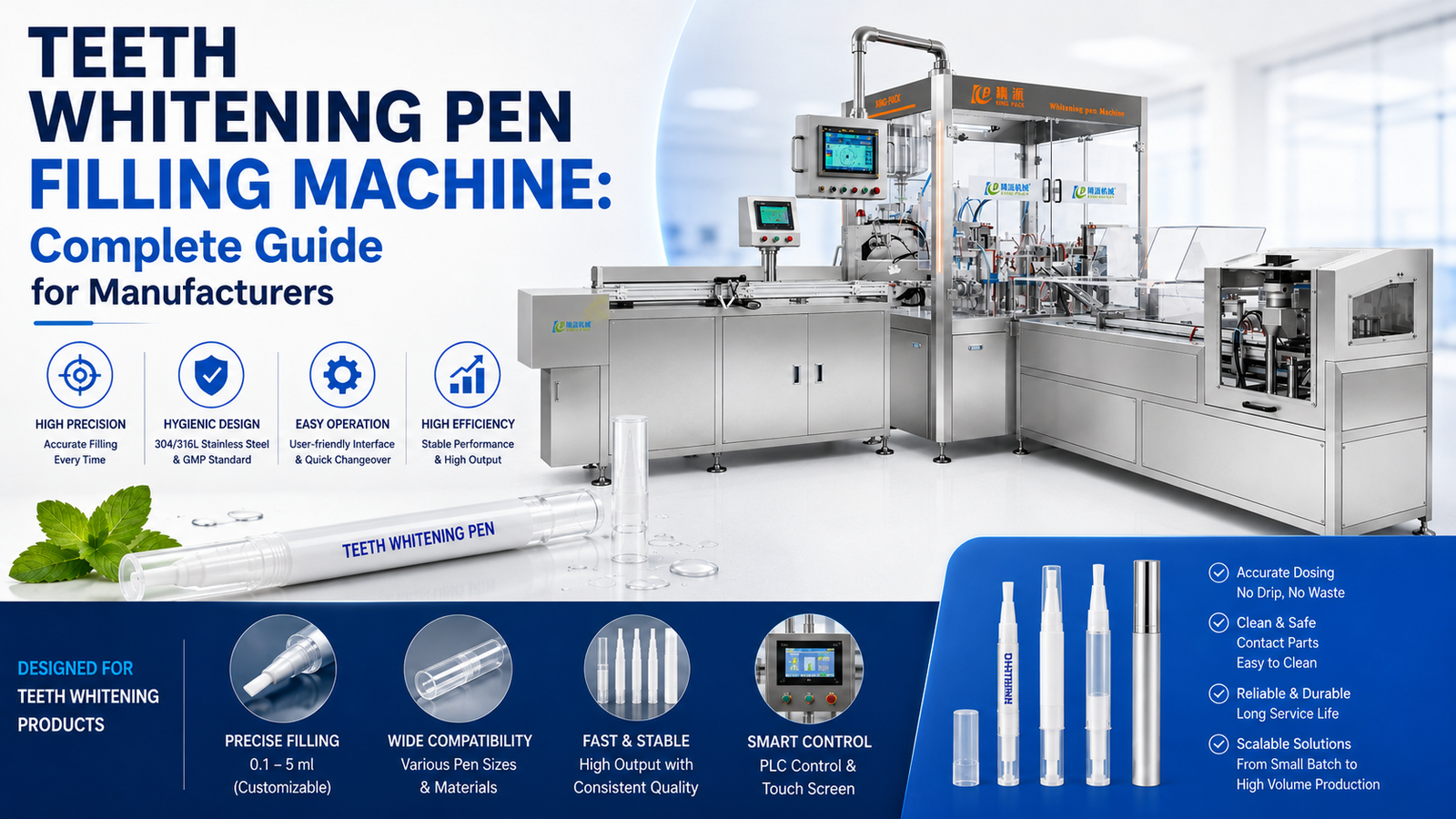
Teeth whitening pens are one of the fastest-growing formats in oral care — but they are also one of the most demanding products to fill on an industrial scale. A typical pen contains only 2–4 ml of gel, dispensed through a twist mechanism onto a brush tip. That means every fraction of a milliliter of dosing error is a visible quality problem, every air bubble trapped in the gel reservoir is a consumer complaint, and every leak is a returned shipment.
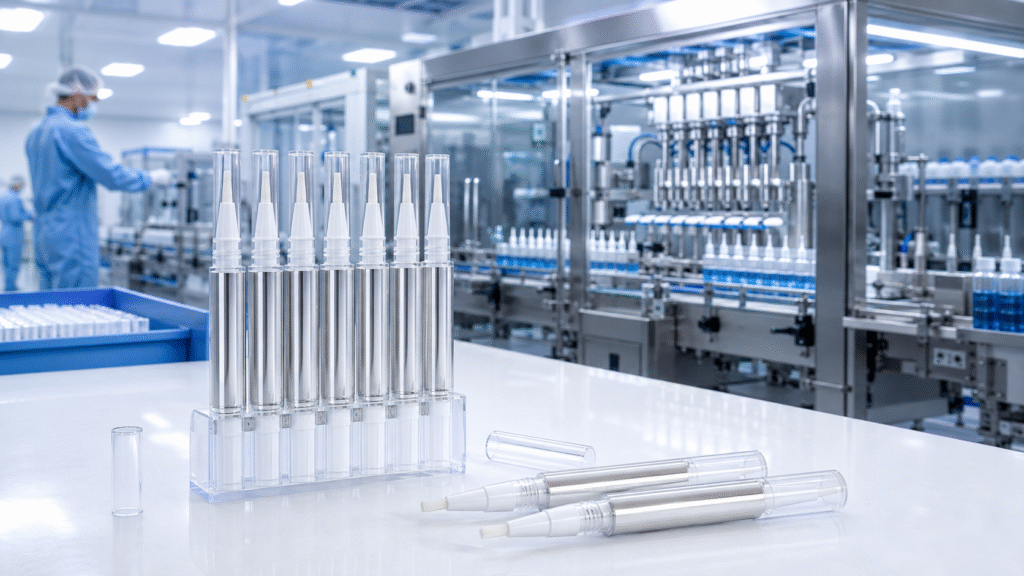
Manufacturers moving into whitening pens usually discover these problems after they have already committed to equipment. A filling line that works well for shampoo bottles or tubes will not automatically handle a thixotropic peroxide gel in a 3 ml pen barrel. The gel chemistry, the packaging format, and the filling technology have to be matched as one system.
This guide explains how teeth whitening pen filling works, which technical factors determine filling quality, and how to evaluate a filling machine supplier before you invest — whether you are producing 5,000 pens a day for a private label brand or hundreds of thousands per day as a contract manufacturer.
Why Filling Accuracy Defines the Whitening Pen Business
Before comparing machines, it helps to understand what is economically at stake. Whitening pen filling is not a high-volume, low-value operation like bottled water. It is a low-volume, high-value operation: the gel itself — whether based on hydrogen peroxide, carbamide peroxide, or PAP (phthalimidoperoxycaproic acid) — is often the single most expensive component of the finished pen.
This changes the economics of filling in three ways:
- Overfilling directly destroys margin. Consistently overfilling a 3 ml pen by 5% means giving away 5% of your active gel on every unit. Across a million pens, that is 150 liters of finished product lost — enough to fill 50,000 additional pens.
- Underfilling creates legal exposure. Declared content is a regulated claim. Underfilled pens can trigger customer disputes, e-commerce returns, and in some markets, regulatory attention.
- The active ingredient is unstable. Peroxide-based gels degrade when exposed to air, heat, and contamination. Poor filling practice — trapped air, long material residence time in the hopper, aggressive shear — reduces the remaining activity of the gel before the pen even ships.
In other words, the filling machine is not just a packaging step. It is the process step that protects both your margin and your product’s shelf life.
How a Teeth Whitening Pen Filling Line Works
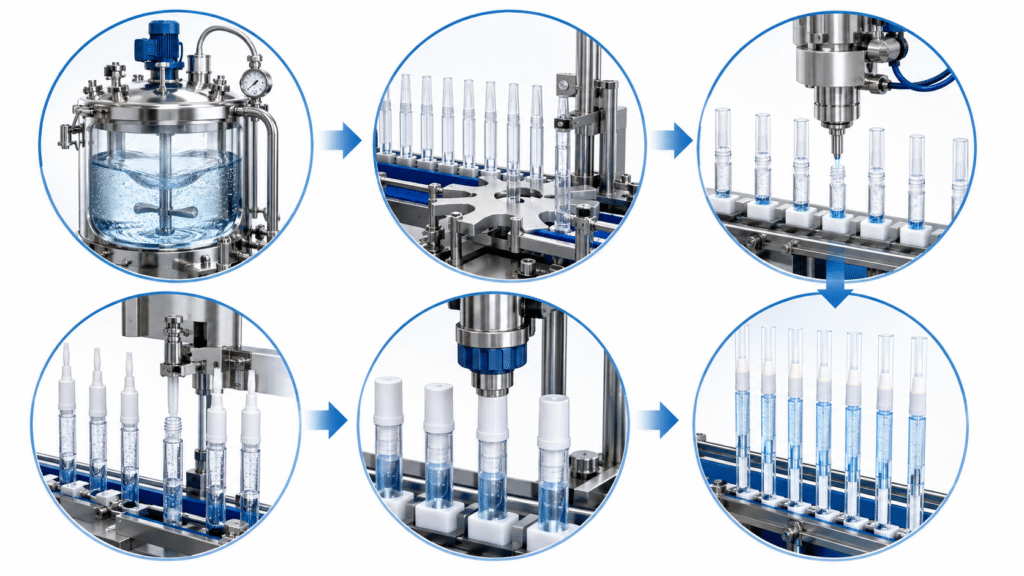
A complete whitening pen filling line is not a single machine. It is a sequence of operations, each of which must be synchronized with the others:
1. Gel Preparation and Degassing
The whitening gel is typically prepared in a vacuum emulsifying mixer, where the active ingredient, thickeners, stabilizers, humectants, and flavoring are homogenized under vacuum. Vacuum processing matters twice here: it produces a smooth, bubble-free gel, and it limits the oxygen exposure of peroxide actives. If the gel arrives at the filler full of micro-bubbles, no filling machine downstream can remove them.
2. Pen Body Feeding and Orientation
Empty pen barrels — often supplied in bulk — are fed by a vibrating bowl feeder or unscrambler and oriented into pucks or nests on a rotary table or linear conveyor. Because pen bodies are small, light, and not always perfectly symmetrical, feeding reliability is a real bottleneck on cheap lines.
3. Metered Gel Filling
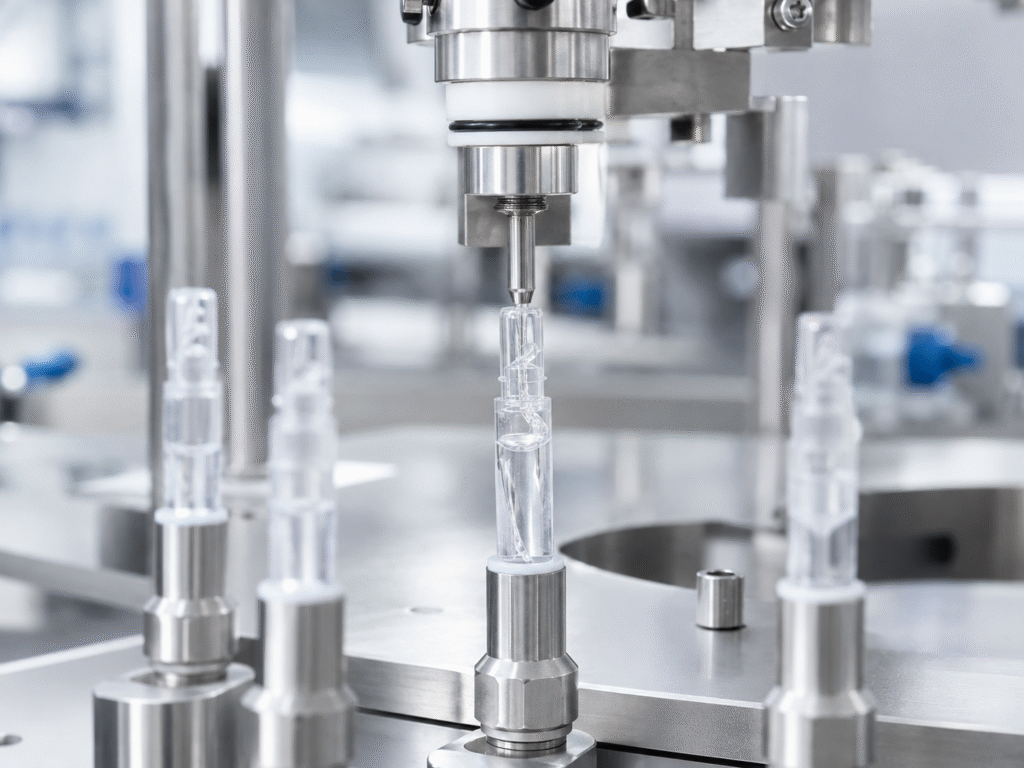
This is the core step. Modern lines use a servo-driven piston dosing system: a ceramic or 316L stainless steel piston draws a precise volume of gel from a pressurized hopper and dispenses it into the pen barrel. Key sub-functions include:
- Suck-back (anti-drip) — after each dispense, the nozzle retracts a small volume to prevent stringing and dripping of viscous gel onto the barrel rim, which would contaminate the seal.
- Bottom-up filling — the nozzle descends into the barrel and rises as it fills, preventing air entrapment and splashing.
- Nozzle heating (optional) — for highly viscous or temperature-sensitive formulations, a heated nozzle and hopper jacket keep viscosity in the optimal dosing window.
4. Plug, Wiper, and Brush Assembly
After filling, a wiper/plug combination is inserted into the barrel, and the brush-tip cap is applied. On pen formats with a brush applicator, cap pre-assembly (brush already molded into the cap) simplifies this step into a single pick-and-place plus torque capping operation.
5. Torque Capping
The cap is threaded on with controlled torque. Whitening pens are carry-around products: under-torqued caps leak in a handbag; over-torqued caps frustrate consumers and can crack the barrel. Servo capping heads with adjustable, recipe-stored torque values are the professional solution.
6. Coding, Labeling, and Cartoning
Batch or lot coding, sleeve or wraparound labeling, and cartoning follow downstream — and for export-oriented producers, serializable coding supports traceability requirements. A complete filling and packaging line integrates all these steps into one coordinated system.
7 Key Factors That Affect Filling Quality
1. Gel Viscosity and Rheology
Whitening gels are typically high-viscosity and often thixotropic — they thin under shear and thicken at rest. The filling system must be selected for the gel’s actual behavior at filling temperature, not its datasheet value at 25 °C. A piston filler handles this predictably; gravity or timed-flow filling does not. For a broader comparison of filling technologies, see our article on piston vs peristaltic vs magnetic pump filling.
2. Dosing System Type
Servo piston dosing offers ±0.5% or better accuracy and recipe-based volume changes. Peristaltic pumps are gentler and cleaner but have accuracy and tube-wear limitations with abrasive or highly viscous gels. Timed-pressure filling is the cheapest and least accurate option — adequate only for tolerant products.
3. Fill Volume and Container Tolerance
Filling 2–4 ml into a narrow pen barrel exaggerates every tolerance. If the pen barrel’s internal volume varies ±3% from your packaging supplier, no filler alone can guarantee declared content. Verify both dosing accuracy and container tolerance together, ideally by gravimetric sampling during a real production run.
4. Air Entrainment
Air in the gel reservoir causes twist-mechanism malfunction, inconsistent dispensing, and consumer-visible bubbles. Air is introduced in three places: poor gel preparation, splash filling, and material recirculation loops. Bottom-up filling, vacuum-prepared gel, and a hopper design without dead zones all reduce it.
5. Material Compatibility
Hydrogen peroxide and carbamide peroxide are oxidizing agents. Standard 304 stainless steel and many elastomers will corrode or degrade in continuous contact. Product-contact parts should be 316L stainless steel (or ceramic for dosing cylinders), with peroxide-compatible seals such as PTFE or EPDM specified by the supplier.
6. Changeover and Format Flexibility
Contract manufacturers and multi-brand producers run multiple pen diameters, volumes, and cap styles. Recipes stored on the HMI, tool-free format changes, and servo adjustments make a 20-minute changeover possible; manual retooling can consume half a shift.
7. Hygiene and Cleanability
Whitening pens sit at the boundary of cosmetics and oral care. Depending on your market, you may need to demonstrate GMP (ISO 22716 for cosmetics) or pharmaceutical-style hygiene. Look for smooth welds, tool-less disassembly of product-contact parts, CIP capability, and documentation that supports your audit.
Machine Configuration Comparison
| Factor | Low-Cost Benchtop / Semi-Automatic | Professional Monoblock Line |
| Dosing control | Pneumatic / manual adjustment | Servo piston, recipe-based |
| Filling accuracy | ±1–3% | ±0.5% or better |
| Output | 15–30 pens/min | 40–120 pens/min |
| Anti-drip / suck-back | Basic or none | Servo suck-back + bottom-up fill |
| Capping | Manual or simple press | Servo torque control, per-recipe |
| Changeover | Manual retooling, 1–4 hours | Recipe recall, 15–30 minutes |
| Data recording | None | Batch records, audit trail options |
| Material compatibility | Often unspecified | 316L contact parts documented |
| Validation support | None | FAT / SAT / IQ-OQ-PQ options |
| Long-term stability | Moderate | High |
The price gap between these two columns is real, but so is the capability gap. For a launch-scale brand producing one SKU at modest volume, a semi-automatic machine may genuinely be the right first step. For contract manufacturing or multi-SKU production, the professional line repays its cost in yield, labor, and rejected batches.
Which Configuration Fits Your Production Scenario?
Scenario 1: Startup Oral Care Brand
- Volume: 5,000–20,000 pens/day
- 1–2 SKUs, single market
- Limited capital and technical staff
Recommendation: A semi-automatic filling and capping machine with an inline feeder. It delivers accurate dosing at launch volumes, needs one or two operators, and can later be retained as a backup or small-batch machine when you scale. Prioritize dosing accuracy and material compatibility over speed.
Scenario 2: Established Cosmetics Manufacturer Adding Whitening Pens
- Volume: 50,000–200,000 pens/day
- Multiple brands and formulas, frequent changeovers
- Existing GMP (ISO 22716) quality system
Recommendation: A monoblock rotary or linear line integrating feeding, filling, plug insertion, torque capping, and coding. Insist on recipe management, 316L contact parts, and validation documentation (FAT with your own gel). Budget for a vacuum emulsifying mixer if gel preparation is not already in-house.
Scenario 3: Contract Manufacturer (CMO) for Global Brands
- Volume: 200,000+ pens/day
- Many SKUs, peroxide and PAP formulas, export markets
- Customer audits, traceability, serialization
Recommendation: A fully automatic line with servo dosing, integrated weight checking, vision inspection for cap and fill level, audit trail data capture, and line-level SCADA or MES connectivity. The ability to prove consistency — not just achieve it — is what wins and keeps CMO contracts.
6 Common Mistakes When Buying a Whitening Pen Filling Machine
1. Testing the Machine with Water Instead of Your Gel
Water is the easiest liquid to fill in the world. Your peroxide gel is one of the hardest. A FAT (factory acceptance test) with your actual product, at your production temperature, is the only test that means anything. Serious suppliers encourage it; avoid the ones who resist it.
2. Buying on Maximum Rated Speed
A machine rated at 80 pens/min may sustain 55–60 pens/min with a viscous gel after feed interruptions, cap misfeeds, and quality checks. What you should request is the stable, verified output with your product — and the rated output with the supplier’s test liquid, so you understand the derating.
3. Ignoring Gel–Material Compatibility
Ordering a standard cosmetic filling machine for a hydrogen peroxide gel without verifying contact materials is a shortcut to corrosion, gel discoloration, and contamination findings. Get the material list in writing, part by part.
4. Forgetting the Packaging Tolerance
Fillers are blamed for underfills caused by pen barrels that vary in internal volume. Specify pens from your packaging supplier with a documented internal volume tolerance, and sample-verify incoming lots gravimetrically.
5. Skipping the Preparation Step in the Project Scope
If the gel is prepared badly, filling suffers. Especially for peroxide formulas, plan gel preparation (vacuum mixing, degassing, temperature control) as part of the line project, not as an afterthought.
6. Underestimating After-Sales Reality
Ask exactly: What spare parts ship with the machine? What is the guaranteed response time for remote diagnostics? Who performs installation and operator training, and is it included? The answers matter more in month 18 than on quotation day.
Buyer Checklist: What to Confirm Before Ordering
Before you sign, confirm each of the following in writing:
- Gel viscosity and rheology at filling temperature (measured, not assumed)
- Fill volume range and target accuracy (with your product)
- Pen barrel dimensions and internal volume tolerance
- Required output, stated as stable pens/min with your gel
- All product-contact materials (316L or ceramic; peroxide-compatible seals)
- Capping type and torque range (brush cap, torque control method)
- Changeover time between your formats, demonstrated
- Cleaning method (tool-less disassembly, CIP options)
- Electrical supply and compressed air specifications for your factory
- GMP documentation package (material certificates, wiring/pneumatic diagrams)
- FAT with your own gel, including gravimetric accuracy verification
- SAT, installation, commissioning, and operator training scope
- Spare parts list and consumables pricing
- Warranty terms and remote support availability
How to Evaluate a Whitening Pen Filling Machine Supplier
Rather than comparing slogans, evaluate suppliers on verifiable capability:
Filling specialization. Does the supplier genuinely fill small-format gel products, or is your pen one of fifty applications in a catalog? Ask for reference installations with similar products and volumes.
Engineering capability. Can they review your gel data, pen drawings, and output target, and propose a configuration with documented reasoning? A supplier who asks detailed questions about your gel is a better sign than one who quotes instantly.
Component transparency. Professional lines name their components: Siemens or equivalent PLC, servo systems from established brands, specified seal materials. “Imported parts” is not a specification.
Testing culture. Will they run your product before shipment and let your team witness it? Will they provide the gravimetric fill-accuracy report from that run?
Documentation. If you operate under ISO 22716 or pharma-style GMP, you need the machine documentation (IQ/OQ/PQ support, material certificates, calibration records) to slot into your quality system — not a generic manual.
Lifecycle support. Spare parts availability, remote diagnostics, and on-site service response are what determine uptime in year two and beyond.
Total Cost of Ownership: Price Is Only the First Line
A useful way to compare an inexpensive semi-automatic machine with a professional line is to model five-year costs:
| Cost Element | Low-Cost Semi-Automatic | Professional Automatic Line |
| Initial investment | Lower | Higher |
| Operators per shift | 2–3 | 0.5–1 (with line supervision) |
| Gel giveaway (overfill) | 2–3% typical | <0.5–1% achievable |
| Rejected units / rework | Higher | Lower (in-line checks) |
| Downtime | Manual interventions, retooling | Recipe-based changeover |
| Spare parts & seals | Frequent, quality varies | Predictable, documented |
| Documentation for audits | Minimal | Complete |
On a high-value gel, the overfill and reject differences alone often exceed the equipment price gap within a few years. Run this calculation with your own gel cost per kg before concluding that the cheaper machine is cheaper.
When Does Automation Make Sense?
Automation is justified when one or more of these is true:
- Daily volume exceeds roughly 15,000–20,000 pens, where manual or semi-automatic filling can no longer hold labor cost per unit
- Filling consistency complaints or audit findings are recurring
- Multiple SKUs make changeover speed a daily cost
- Labor availability or turnover is destabilizing output quality
- Customers (brands) demand batch documentation you cannot produce manually
If none of these apply yet, a well-specified semi-automatic servo machine is a rational first investment — and its dosing head technology should be the same as on the automatic line you may buy later.
How King Pack Supports Teeth Whitening Pen Filling
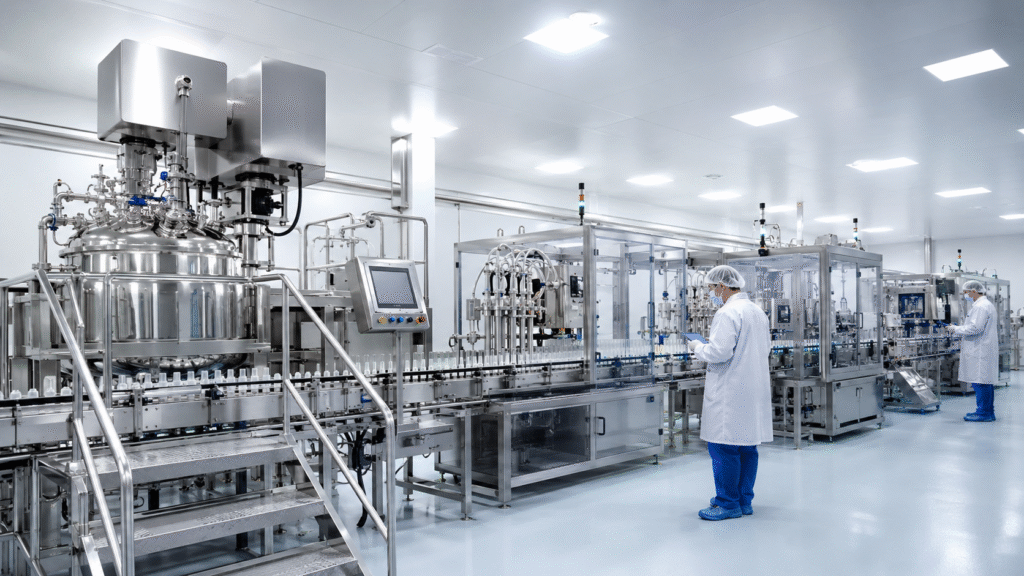
For manufacturers building or scaling a teeth whitening pen line, King Pack Machinery supplies filling and packaging equipment designed around small-format, high-value gel products. Configurations for whitening pens include:
- Servo piston dosing with accuracy of ±0.5%, recipe-based volume management
- Bottom-up filling with servo suck-back for bubble-free, drip-free dispensing
- 316L stainless steel product-contact parts with peroxide-compatible seals (PTFE / EPDM)
- Servo torque capping with recipe management for repeatable, documented cap application
- Vacuum emulsifying mixers (e.g., KPZ-500L) for gel preparation and degassing as part of the same process chain
As a manufacturer of both preparation and filling equipment, King Pack can engineer the whitening pen line as one coherent process — from gel deaeration through filled, capped, coded, and cartoned pens. Equipment can be tested at FAT with your own gel and pen components before shipment, with material certificates, wiring and pneumatic documentation, and IQ/OQ/PQ support available for customers operating under GMP quality systems.
With production lines supplied to more than 40 countries, King Pack routinely handles the practical questions that decide line performance: your gel’s viscosity behavior, your pen’s dimensional tolerance, and your factory’s real output target.
→ Discuss your teeth whitening pen filling requirements with King Pack
FAQ
How accurate is a teeth whitening pen filling machine?
A professional servo piston filling machine achieves ±0.5% or better on volumes of 2–4 ml, verified gravimetrically. Pneumatic semi-automatic machines typically achieve ±1–2%. Actual accuracy depends on gel viscosity stability, temperature control, and the internal volume tolerance of the pen barrel, which is why testing with your own product before shipment matters.
Can one machine fill different gel formulas and pen sizes?
Yes, if the machine is recipe-based. Servo dosing lets you store volume, speed, and suck-back parameters per product, and quick-change format parts handle different barrel and cap dimensions. Confirm the supported diameter and volume range against your current and planned SKUs before ordering, and ask for the demonstrated changeover time.
What type of filling system is best for whitening gel?
For high-viscosity peroxide or PAP gels, servo-driven piston dosing with 316L or ceramic cylinders is the industry standard: it handles viscosity, delivers accuracy, and resists chemical attack. Peristaltic pumps suit gentler, lower-viscosity gels but are limited by tube wear with viscous media. Gravity or timed-flow systems are not recommended for this product.
Why do air bubbles form in whitening pens, and how are they prevented?
Bubbles come from gel preparation (mixing in air), splash filling, and material recirculation. They are prevented upstream and at the nozzle: vacuum emulsification and degassing during gel preparation, bottom-up filling with a descending nozzle, controlled fill speed, and hopper designs without dead zones. If bubbles are your main defect, audit the preparation step first.
What should I provide when requesting a quotation?
Gel data (viscosity at filling temperature, density, active ingredient), pen drawings or samples (barrel dimensions, cap type, brush format), target output in pens per minute or per day, fill volume, accuracy requirement, your electrical and air supply, and any GMP or documentation requirements. With this, a serious supplier can propose a specific configuration rather than a generic quote.
How much does a teeth whitening pen filling line cost?
Cost depends on automation level and configuration: a semi-automatic servo filling and capping machine occupies the lower end of the range, while a fully automatic monoblock line with inspection and cartoning represents the higher end. Rather than comparing list prices, model total cost of ownership — operators, gel giveaway, rejects, and downtime usually decide the better long-term value.
Do whitening pen filling machines need to meet GMP requirements?
For cosmetic oral care, most markets require manufacturing under cosmetic GMP (ISO 22716 in the EU; analogous FDA requirements for the US market). The machine supports this through hygienic design, cleanable contact parts, and documentation — material certificates, FAT/SAT records, and IQ/OQ/PQ support. If you produce for pharmaceutical-channel products, request pharma-grade documentation explicitly.
How do I test the machine before it ships?
Schedule a factory acceptance test (FAT) with your own gel and pen components: run at production speed, take gravimetric samples at start, middle, and end of the run, check capping torque consistency, and witness changeover. A supplier confident in their machine will encourage this — and the FAT report becomes part of your equipment qualification file.
Conclusion
Choosing a teeth whitening pen filling machine comes down to matching three things as one system: your gel’s rheology, your pen’s packaging tolerance, and the dosing technology of the machine. Specify accuracy in writing, verify material compatibility against peroxide chemistry, test with your own product before shipment, and evaluate the supplier’s engineering and documentation capability as seriously as the price.
If you are evaluating a new whitening pen or oral care filling project, King Pack can review your product, container, required capacity, and production process before recommending an equipment configuration — from gel preparation through filling, capping, and end-of-line packaging.