
Introduction
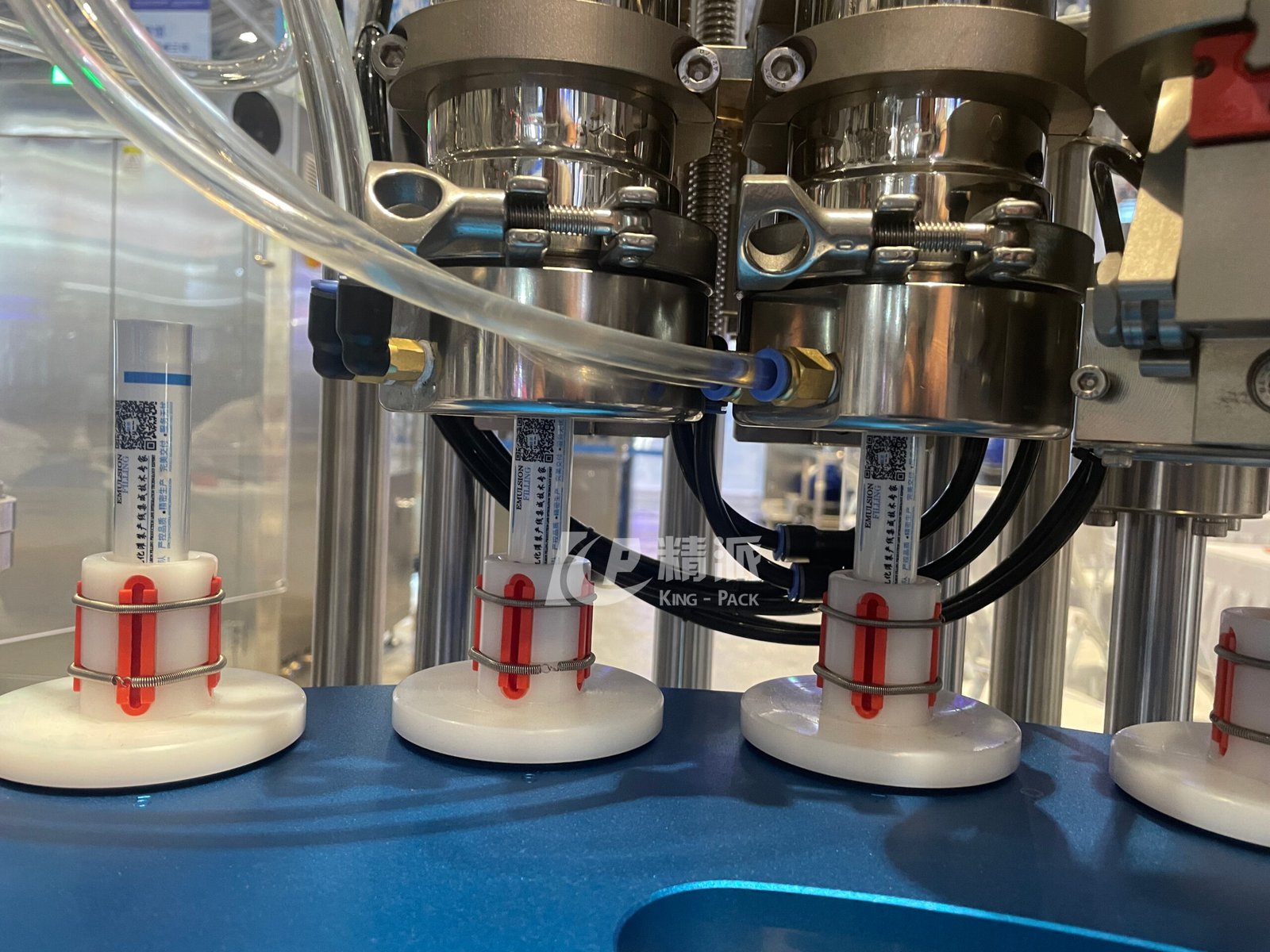
Premium anti-aging creams are among the most technically demanding products to fill and seal. The active ingredients that make these formulations valuable, retinoids, peptides, hyaluronic acid, encapsulated antioxidants, are also among the most sensitive to mechanical stress, temperature, and air exposure during the filling process. A machine that handles standard moisturizers adequately can degrade expensive anti-aging actives before the tube is even sealed.
The right automatic filling and sealing machine for premium skincare is not just about speed and accuracy. It is about protecting what makes the product worth its price point.
This article covers the formulation characteristics that matter most in machine selection, the technical features that separate adequate equipment from genuinely appropriate equipment, and how to match machine capability to the requirements of luxury skincare tube production.
The Anti-Aging Skincare Market Context
The business case for investing in specialized equipment is clear from market data. According to Grand View Research, the global anti-aging products market was valued at $55.66 billion in 2025 and is projected to reach $107.61 billion by 2033 at a CAGR of 8.9%, with moisturizers, creams, and lotions accounting for 39.5% of market share. That dominant product segment is primarily filled and sealed in tubes.
According to Precedence Research, the global anti-aging cosmetics market size was $56.71 billion in 2024 and is expected to reach $101.46 billion by 2034 at a CAGR of 5.99%, with facial creams and lotions holding approximately 52% of product segment revenue. These numbers reflect the scale of manufacturing investment this product category requires.
Brands competing in this space are not competing on price. They are competing on demonstrated efficacy, premium presentation, and consumer trust in ingredient quality. Every one of those competitive dimensions is affected by filling equipment choice.
Understanding Anti-Aging Cream Characteristics for Filling
Typical Viscosity and Texture Profiles
Premium anti-aging creams typically range from 30,000 to 200,000 cps, with rich textured products at the upper end. Many use emulsion systems that are shear-thinning, flowing more easily under applied force and recovering viscosity at rest. That behavior is useful for filling if the machine applies controlled, consistent force, but it creates problems if the shear is applied unevenly across a production run.
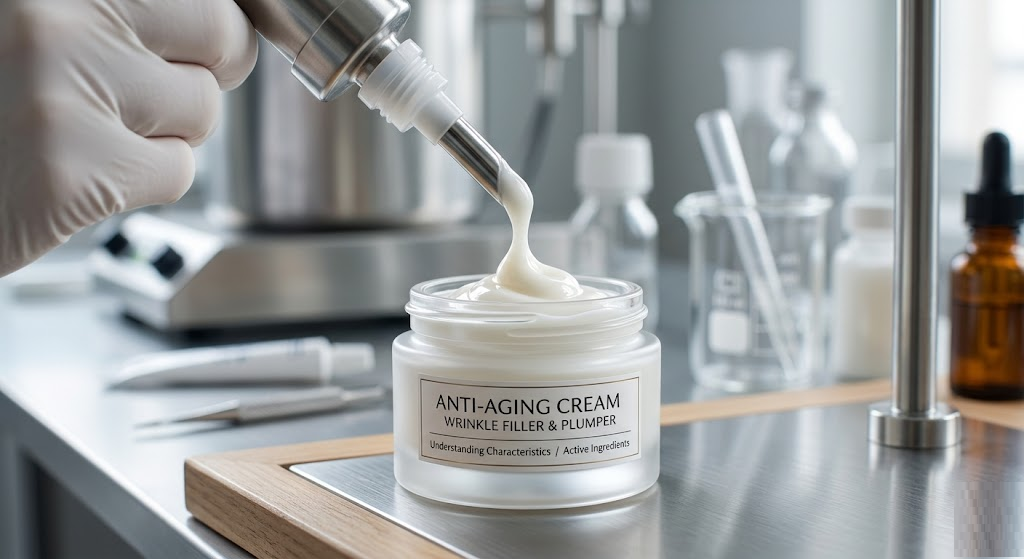
Some premium formulations include encapsulated actives, suspended particulates, or microsphere delivery systems. These increase apparent viscosity and introduce particle content that affects nozzle behavior and pump selection.
Sensitive Active Ingredients and Stability Concerns
The active ingredients that drive premium pricing in anti-aging creams are frequently the most filling-sensitive components:
- Retinoids and retinol derivatives: Oxidize rapidly on exposure to air. Fill process air exposure must be minimized.
- Peptides: Shear force can disrupt peptide chain structure, reducing efficacy. Low-shear filling mechanisms are essential.
- Encapsulated actives: Microencapsulation breaks down under excessive mechanical stress, releasing actives prematurely before consumer use.
- Vitamin C derivatives: Highly susceptible to oxidation and temperature degradation.
- Hyaluronic acid: Shear sensitivity varies by molecular weight. High molecular weight HA degrades under aggressive pumping.
A standard automatic tube filling and sealing machine pumping mechanism optimized for non-sensitive formulations applies mechanical force at levels that are genuinely damaging to these compounds. The machine fills the tube correctly in terms of volume, but the product inside the tube is no longer the product the formulator developed.
Aesthetic and Functional Demands
Premium skincare tube filling carries visual expectations that mass-market filling does not. The tube shoulder must be clean of cream residue.
The seal must be visually invisible from the front of the tube. Fill level must be consistent because consumers notice when a premium tube feels light. Any air bubbles trapped in the cream body are visible as voids at the tube shoulder, which signals poor quality at the point of purchase.
Key Challenges in Filling and Sealing Premium Anti-Aging Creams
| Challenge | Cause | Required Machine Response |
| Active ingredient degradation | Shear force from pump mechanism | Low-shear piston system |
| Oxidation of sensitive actives | Air exposure during fill | Nitrogen blanketing option, minimized dead space |
| Air bubble voids in cream | Air entrapment during mixing and fill | Controlled fill speed, vacuum deaeration option |
| Inconsistent fill weight | Viscosity variation between batches | Servo-controlled stroke, inline check-weighing |
| Product residue on tube shoulder | Poor nozzle cut-off | Anti-drip suck-back nozzle |
| Seal failure on luxury tubes | Temperature miscalibration on premium laminates | Closed-loop sealing temperature control |
| Active compound thermal degradation | Elevated temperature in product pathway | Temperature-controlled hopper and filling cylinder |
Achieving Ultra-Precise Fill Weights with Minimal Waste through the Packaging Machine
Premium anti-aging creams command high unit costs. A 2% overfill on a cream with expensive peptide actives at scale represents real material cost. Fill accuracy at ±0.5% or better is achievable with servo-driven piston filling systems and is the appropriate specification for high-value skincare production.
Inline check-weighing after the fill station provides real-time fill weight monitoring. For premium SKUs, this is the difference between discovering fill weight drift at the end-of-batch audit and catching it on the third tube.
Gentle Handling to Preserve Active Ingredients
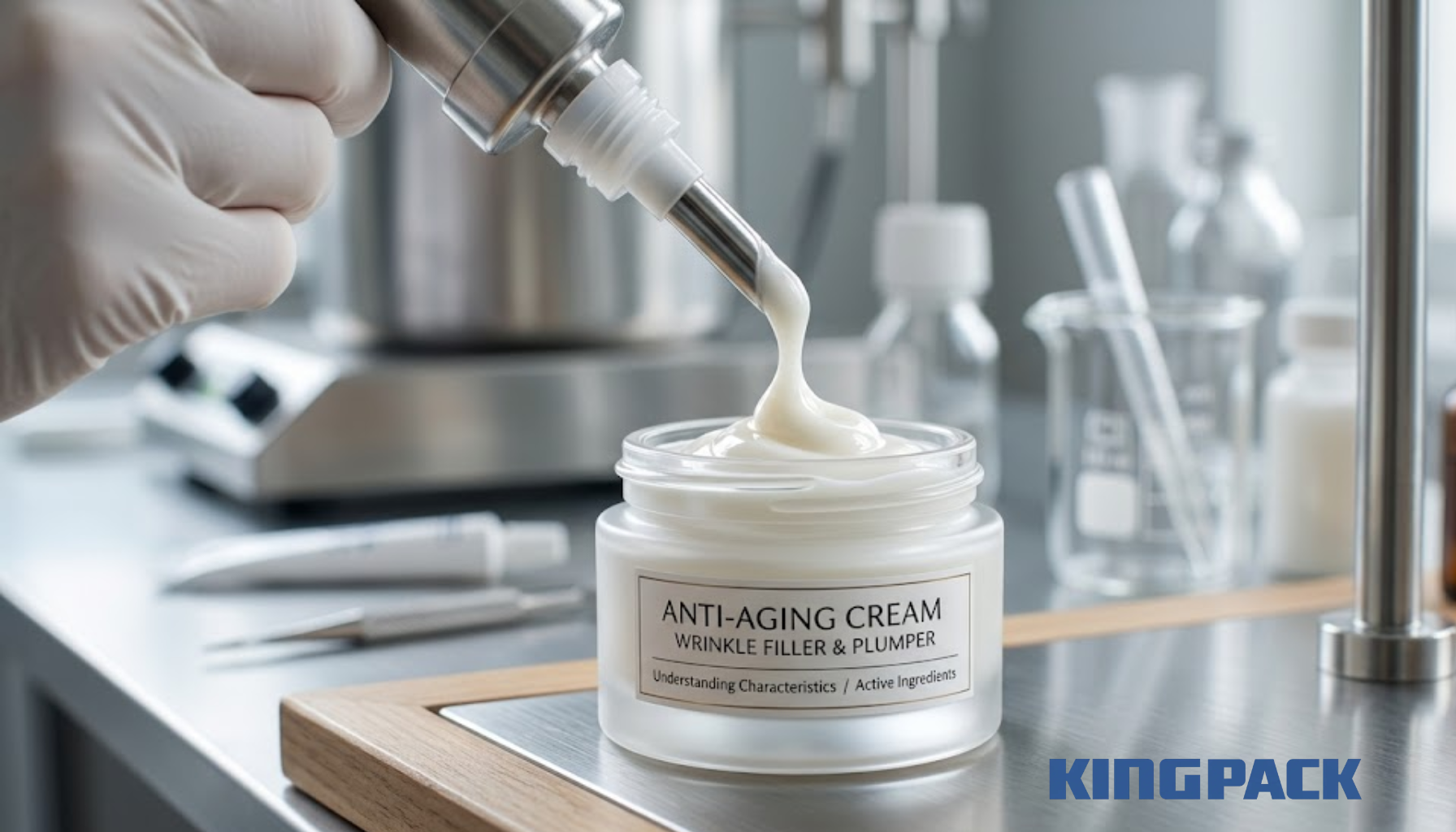
Piston filling systems move product through positive displacement, applying force as a pushing motion rather than through a pump gap or rotary element. The shear forces generated by a piston system are substantially lower than those from gear pumps or standard peristaltic systems at comparable viscosity ranges.
Nozzle entry speed, fill rate, and piston return speed should all be independently controlled to minimize turbulence in the product stream during the fill cycle. For encapsulated actives especially, rapid pressure changes during filling can rupture the capsule shell.
Preventing Oxidation and Contamination
Retinol and vitamin C derivatives in particular degrade meaningfully on short-duration air exposure. For formulations containing these actives, the filling machine should minimize the air headspace in the product pathway. Nitrogen blanketing of the hopper provides an inert atmosphere above the cream surface, limiting oxidation during the time the product sits in the hopper between fill strokes.
Hygienic design throughout the product contact path also matters. A machine with dead legs where product accumulates and stagnates between production batches creates contamination and degradation risk that no cleaning procedure can fully mitigate.
Essential Features of a High-Quality Automatic Filling and Sealing Machine
Modern automatic filling and sealing machine specifications for premium anti-aging skincare require a combination of features that standard cosmetic filling equipment does not offer as standard:
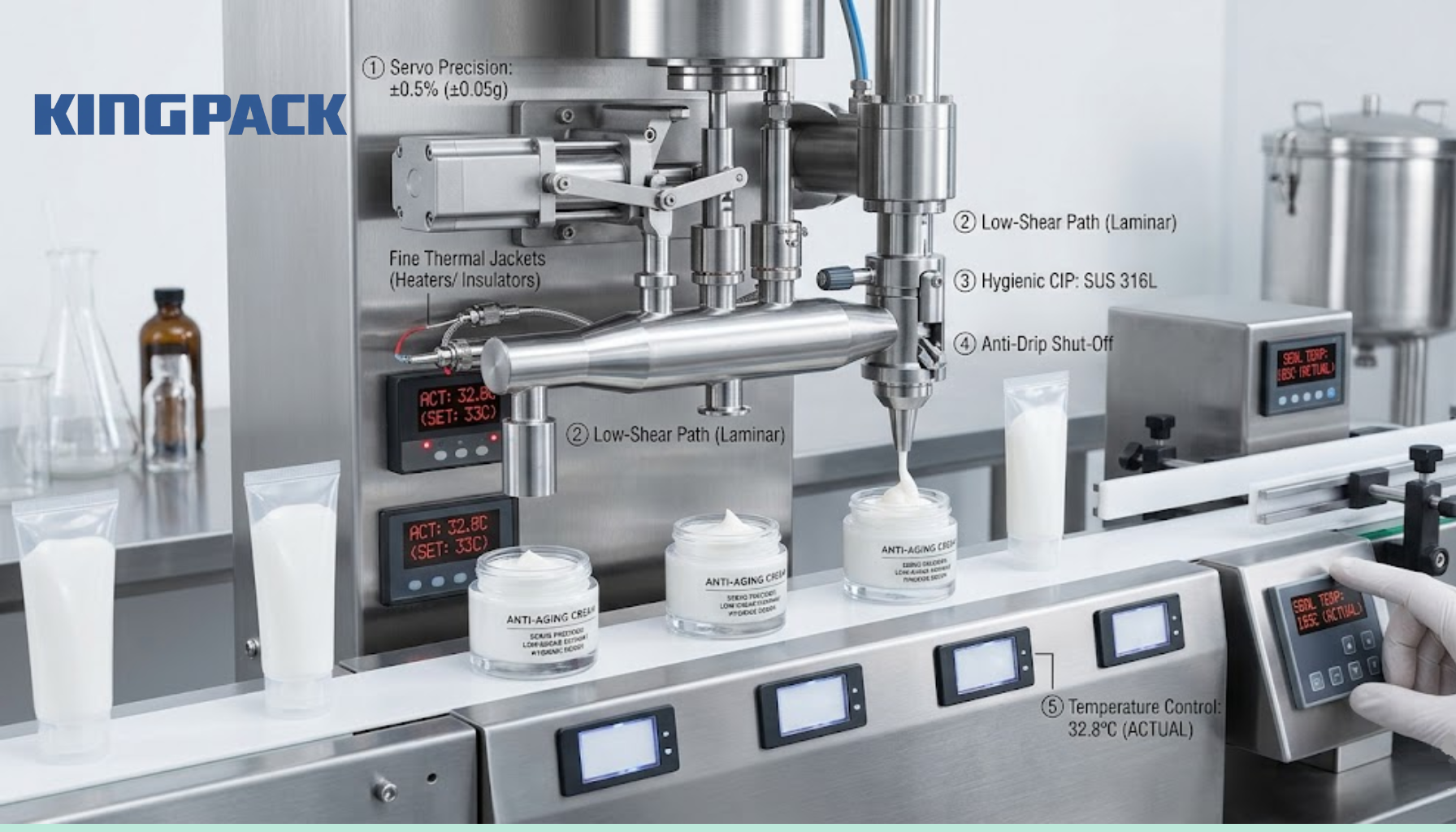
Servo-driven precision filling: Piston stroke length controlled at the servo level, maintaining ±0.5% fill accuracy across viscosity variation between batches. Fill volume adjustment from the HMI without mechanical component exchange.
Low-shear product pathways: Large bore filling cylinders with smooth internal surfaces, gradual taper nozzle geometry, and controlled fill speed profiles that keep product flow in the laminar rather than turbulent regime.
Temperature control from hopper to nozzle: Heated or insulated pathways maintaining product temperature within the optimal range for the formulation. For heat-sensitive actives, the temperature window is defined by the formulator and must be respected throughout the machine cycle.
Anti-drip and clean cut-off nozzle design: Suck-back valve or shutter mechanism at the nozzle exit that retracts cream cleanly after each fill stroke without leaving residue on the tube shoulder.
Advanced sealing with closed-loop temperature control: Closed-loop hot air sealing that maintains actual delivery temperature at the set point regardless of production speed or ambient variation. Adjustable jaw pressure for different tube wall thicknesses and materials.
CIP-compatible hygienic design: All product contact surfaces in SUS 316L stainless steel with accessible cleaning pathways. For premium skincare manufacturers producing multiple SKUs, validated cleaning between runs is a quality and compliance requirement.
Our KPGFW-160 Fully Automatic Filling and Sealing Machine addresses these requirements with a fully automatic design suitable for premium cosmetic cream applications, incorporating servo-driven control, hot air sealing technology, and PLC-based parameter management for batch documentation.
Comparison: Standard vs. Premium Automatic Filling and Sealing Machines
| Factor | Standard Automatic Machine | Premium Skincare Configured Machine |
| Fill accuracy | ±1 to 3% | ±0.5% or better |
| Pump mechanism | Standard peristaltic or cam-driven piston | Low-shear servo piston |
| Temperature control | Ambient or basic heated hopper | Closed-loop regulated pathway |
| Shear force | Moderate to high | Low (optimized for sensitive actives) |
| Nozzle cut-off | Standard | Anti-drip suck-back, clean retraction |
| Oxidation protection | None | Nitrogen blanketing option |
| Sealing temperature control | Open-loop | Closed-loop real-time |
| GMP documentation | Basic | Full PLC data logging and audit trail |
| Inline quality control | Not standard | Check-weighing and vision inspection options |
Technical Considerations for Premium Skincare Production
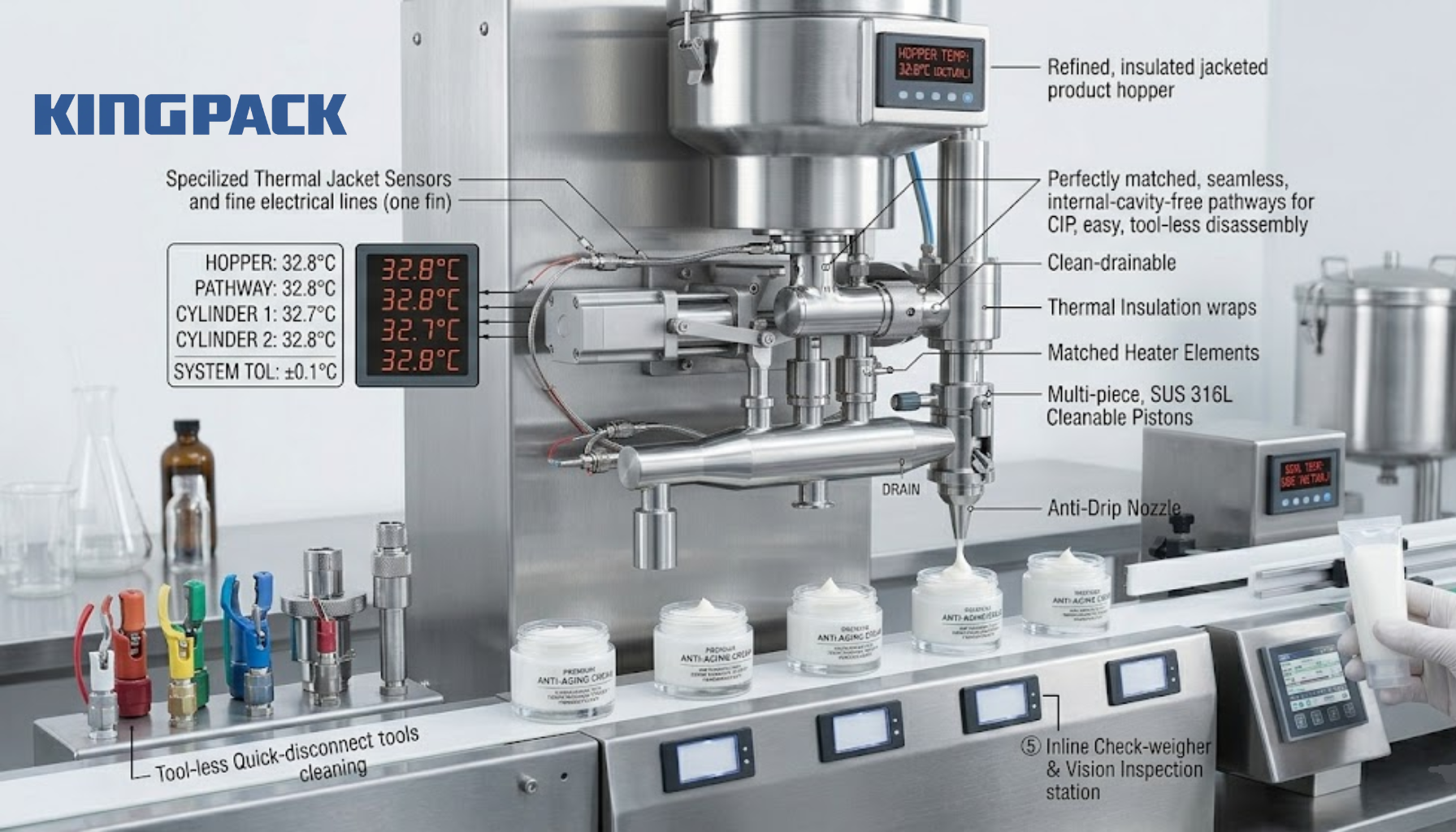
Hygienic Design and Easy Cleaning
Cosmetic GMP requirements demand validated cleaning between product changeovers across all packaging systems. While many industries rely on pouches, bags, sachets, and stand up pouches for food, snacks, yogurt, and sauce applications, premium skincare tube systems require a different design standard.
A high-end tube filling and sealing setup must support easy service access without tools. All product contact areas should be smooth, drainable, and free from trapped plastic surfaces where paste or cream can remain. This is especially important in paste-based cosmetic products used by customers in industries across the USA, China, and Netherlands, where hygiene compliance is strict.
Unlike premade pouch systems or three sides sealed bags used in food packaging, cosmetic tube systems focus on continuous flow paths that support forming, filling, and cleaning without contamination risk.
Temperature Control Throughout the Filling Process
In paste-based skincare production, temperature stability directly affects product quality. While pouch and cup filling systems often rely on heat sealing or press sealing for closure, tube filling systems require tighter control during the filling stage.
If the filling zone becomes cooler than the storage hopper, paste viscosity increases and flow consistency drops. If it becomes too warm, sensitive cosmetic actives may degrade on contact.
Advanced automation systems maintain controlled temperature across the full filling path to improve stability and improve overall benefits for customers using premium skincare products.
Inline Quality Control Integration
Modern tube filling and sealing lines increasingly integrate inspection systems similar to those used in automated pouch and bag packaging systems for food and powders.
Inline check-weighing and vision systems monitor each unit in real time. This improves consistency across production capacity and reduces defects in paste-based formulations used in cosmetic industries.
These systems also help track forming accuracy and sealing quality across each single unit produced per minute, supporting better process control compared to traditional manual inspection methods.
When to Invest in a Specialized Automatic Filling and Sealing Machine for Anti-Aging Creams
The investment case is strongest when three conditions are present simultaneously:
- The formulation contains high-cost active ingredients where fill accuracy directly affects material economics
- The brand competes at a retail price point where product quality and visual presentation are primary purchase drivers
- The product has active ingredients with documented sensitivity to shear, temperature, or oxidation
For brands launching or scaling premium skincare lines, investing in the right automatic cream tube sealer and filler from the beginning is substantially cheaper than discovering product degradation or quality inconsistency after production has scaled.
According to Mordor Intelligence, the anti-aging products market is expected to reach $63.15 billion in 2025 and grow at a CAGR of 6.62% to reach $87.01 billion by 2030, with the facial creams and lotions segment holding approximately 48% of market share. That market trajectory supports premium filling equipment investment for manufacturers seeking to participate in the fastest-growing skin care categories.
Why King Pack Automatic Filling and Sealing Solutions Deliver Skincare Excellence
We configure automatic filling and sealing machine systems for premium anti-aging cream applications with servo-driven low-shear piston filling, closed-loop temperature management, anti-drip nozzle designs, and validated sealing parameters for the specific tube materials each customer uses.
Our KPGFW-160 Fully Automatic Filling and Sealing Machine delivers sustained automatic tube filling and sealing performance for premium cosmetic cream applications with PLC-based batch documentation suitable for cosmetic GMP requirements. Fill range, tube diameter compatibility, and sealing parameters are all configured for the product and tube specification at commissioning.
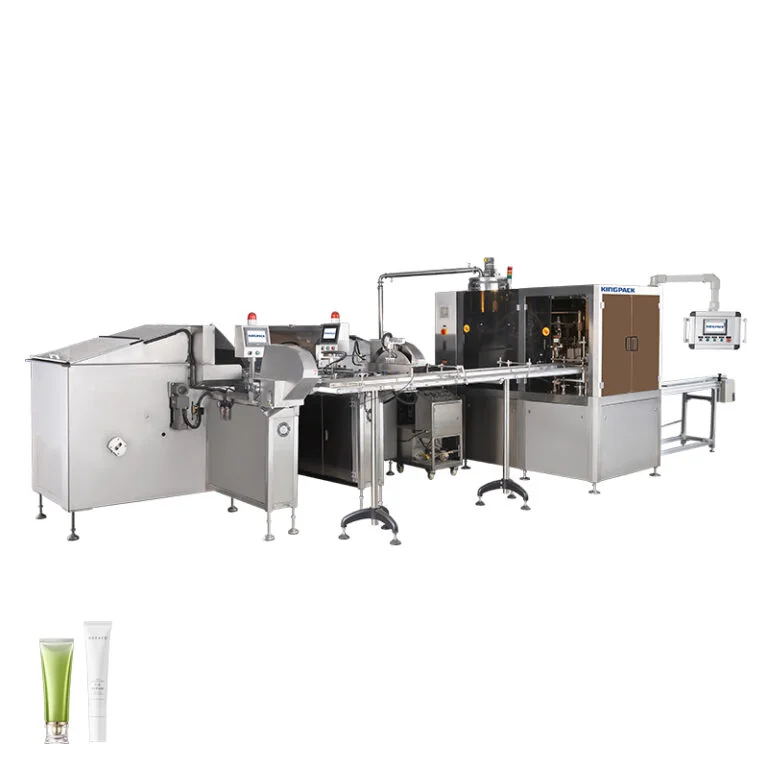
KPGFW-160 Fully Automatic Filling and Sealing Machine
For manufacturers building or scaling luxury skincare packaging lines, our engineering team reviews active ingredient sensitivity data, formulation viscosity profiles, and tube material specifications before finalizing machine configuration. That review prevents the most common quality failures from occurring at scale.
We provide complete documentation support for commissioning validation, including fill accuracy data across the full production speed range and sealing performance records for each tube format in use.
Conclusion
The automatic filling and sealing machine you choose for premium anti-aging creams either protects or undermines the efficacy of the formulation inside. Retinoids degrade under shear. Peptides lose structural integrity under excessive mechanical force. Encapsulated actives release prematurely if handled incorrectly. Standard cosmetic filling equipment does not account for these sensitivities.
A precision-engineered skincare tube filling machine built for sensitive anti-aging formulations addresses each of these risks through low-shear piston filling, temperature-controlled product pathways, oxidation protection options, and validated closed-loop sealing control. The investment pays back through consistent product quality, maintained brand claims, and production efficiency at the scale that a growing premium skincare line demands.
Contact King Pack today and let our experts recommend or customize an automatic filling and sealing machine that meets the highest standards of precision, hygiene, and skincare performance for your premium line. Reach our team at kpfillingmachine.com/contact.