
Last reviewed: September 1, 2026.
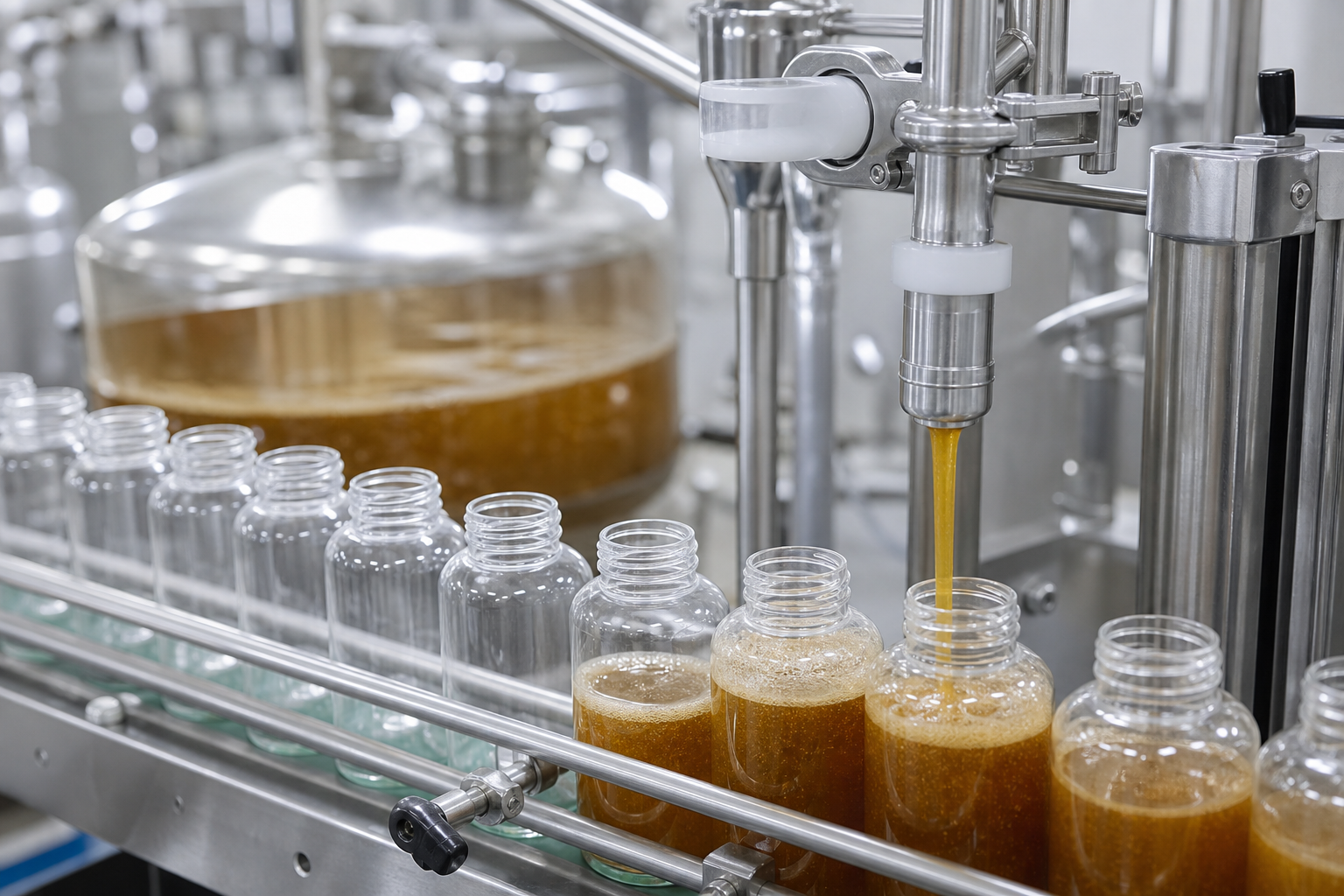
Pet liquid supplements can look similar in a bottle while behaving very differently in a filling line. A clear oil may drip or string, a syrup may trap air, a suspension may settle in the day tank, and a product containing gums or flavor systems may change viscosity with temperature and shear. The dosing device adds another interface: the bottle finish, insert, cap, fill level and product rheology must allow an owner to withdraw or pour a repeatable amount.
The correct project starts by classifying the commercial formula and its intended use. In the United States, FDA explains that products marketed as supplements for animals do not form a separate dietary-supplement category; they are regulated as animal food or animal drugs based on composition and intended use. The manufacturer must confirm its product status and applicable rules before writing the URS. This article therefore uses 'supplement' as a market description, not a regulatory conclusion.
The page also has a narrow scope. It does not repeat the existing pet oral liquid bottle, insert and cap guide. That guide owns the general oral-liquid packaging architecture. Here, bottle and device choices appear only where foam, sedimentation, recirculation and dose delivery affect the filling process.
Quick answer: Select a pet liquid supplement filling machine only after measuring viscosity with temperature and test method, density, surface behavior, foam decay, settling and redispersion, particle condition, hold time and dose range. Maintain a proven bulk state with justified agitation or recirculation, use a metering and nozzle strategy that limits air and drip, test start/middle/end and stop/restart samples, and verify the final bottle, insert, cap and dosing device as one system. Product classification and acceptance limits remain the manufacturer's responsibility.
Classify the Commercial Formula before Selecting Equipment
Direct answer: Place the product in a behavior class using measured data; a marketing name such as tonic or supplement does not predict how it fills.
Describe whether the product is a true solution, emulsion, oil, syrup, suspension or mixed system. Record viscosity over the expected temperature range with the method, spindle or geometry and shear condition; density; surface tension or qualitative wetting behavior; foam generation and decay; particle size where relevant; settling rate; redispersion method; and sensitivity to heat, oxygen, light or shear.
Observe the commercial formula after the longest proposed bulk hold and a realistic line stop. A sample that is uniform immediately after vigorous laboratory shaking may separate in a production vessel, delivery hose or filler hopper. Document the maximum interval before unacceptable change and the conditions needed to restore the approved state.
Confirm product classification with regulatory specialists. FDA states that an animal product's intended use helps determine whether it is food or drug and that the human Dietary Supplement Health and Education Act framework does not apply to animal products. Claims, ingredients and destination market can change the applicable requirements.
| Behavior class | Typical line risk | Data to supply | Trial focus |
|---|---|---|---|
| Clear low-viscosity liquid | Splash, drip, bubbles and level sensitivity | Density, surface behavior, temperature and dose | Cutoff, feed pressure and restart |
| Foaming solution | False volume, overflow and delayed closure | Foam generation/decay and air sensitivity | Bottom-up fill, rate profile and settling time |
| Sedimenting suspension | Beginning-to-end composition drift | Particles, settling, redispersion and hold limits | Agitation, low level, stop and restart |
| Viscous syrup or gel-like liquid | Stringing, pressure, trapped air and slow withdrawal | Flow curve, temperature, thixotropy and device force | Meter/nozzle behavior and owner dose delivery |
| Emulsion or oil | Compatibility, phase behavior and residual film | Composition, shear/temperature sensitivity and cleaning | Pump exposure, hold time and changeover |
Define the Bulk-to-Filler Product State
Direct answer: The filler needs an agreed inlet window for product uniformity, temperature, pressure, air content and time since mixing.
Draw the full path from compounding vessel through hold tank, pump, hose or pipe, filter if justified, day tank and filling nozzle. Mark length, diameter, low points, valves, sample locations and each place where product can remain during a stop. Use the KING PACK filling and capping line platform as equipment-family context, while assigning responsibility for the specific interface between process and packaging equipment.
The FDA's oral-solutions and suspensions inspection guide—written for human drug inspections and used here only as technical context—notes that long delivery lines can create cleaning and contamination concerns and that suspension segregation can occur during transfer and filling. It also emphasizes procedures and time limits for holding and stirring. Veterinary or animal-food manufacturers must set their own justified controls under applicable requirements.
Define the inlet condition at startup, normal run, low bulk level, brief stop, extended stop and restart. If the filler meters accurately only within a narrow pressure range, the upstream supply must maintain that range without uncontrolled recirculation or product heating.
Use Agitation to Maintain Uniformity, Not to Hide Poor Data
Direct answer: Agitation should maintain the proven product state while limiting vortexing, air entrainment, heat and damaging shear.
Choose the vessel and impeller from the actual duty: keep fine particles suspended, maintain an emulsion, prevent a concentration gradient or simply preserve temperature uniformity. Vessel geometry, fill level and impeller position matter. An RPM value cannot be transferred safely between scales without development evidence.
Set a normal speed range, minimum operating level, maximum stopped time and redispersion procedure. Sample the locations and times most likely to reveal segregation. A surface sample alone may miss a concentrated bottom heel; a return-line sample may not represent a poorly swept vessel zone.
Avoid assuming that more agitation is safer. High energy can create foam, break a structure, warm the product or introduce air. Define a measurable endpoint and the response when the product cannot be returned to its approved state within the allowed time.
Decide Whether Recirculation Helps or Hurts
Direct answer: Use recirculation only when the uniformity or feed benefit is demonstrated against cumulative shear, air, heat, hold-up and cleaning risks.
A return loop can keep particles moving and stabilize filler feed, especially during intermittent demand. It can also repeatedly pass the formula through a pump, create a vortex at the return, trap material in a long loop and change product temperature. Compare a continuously agitated day tank, controlled on-demand transfer and a recirculating loop with the real operating pattern.
If a loop is used, define pump type, minimum and maximum flow or pressure, return position, low-level interlock, maximum duration and sampling. The loop should have a clear drain and cleaning path. Any filter in the circuit needs a stated purpose and product-loss assessment; it must not unintentionally remove a legitimate suspended component.
Challenge an extended stop and restart during the sample trial. Record the product history and examine the first accepted bottles after restart. A stable average from the middle of a smooth run does not prove that the loop controls the difficult states.
Select the Metering Principle with Product Trials
Direct answer: Shortlist the filler from dose, rheology, particles, compatibility, cleanability and control—not from viscosity alone.
Candidate systems may include piston, peristaltic, lobe, progressive-cavity, magnetic-pump, flow-meter or time-pressure arrangements, depending on the product and dose. Review internal passages, valves, seals or tubing, pressure, pulsation, dry-running behavior, calibration drift, product recovery and cleaning access.
The broad liquid-filler selection guide helps frame viscosity, container and output. A pet supplement project must add foam, settling, redispersion and dosing-device tests. Do not select from a single viscosity number taken without temperature and method.
Test the full dose range with the actual formula or a justified simulant. Record what the simulant reproduces and what it cannot prove. Include low and high temperature within the approved range, priming, prolonged running, stop/restart and the expected component changeover.
Control Foam with the Complete Fill Profile
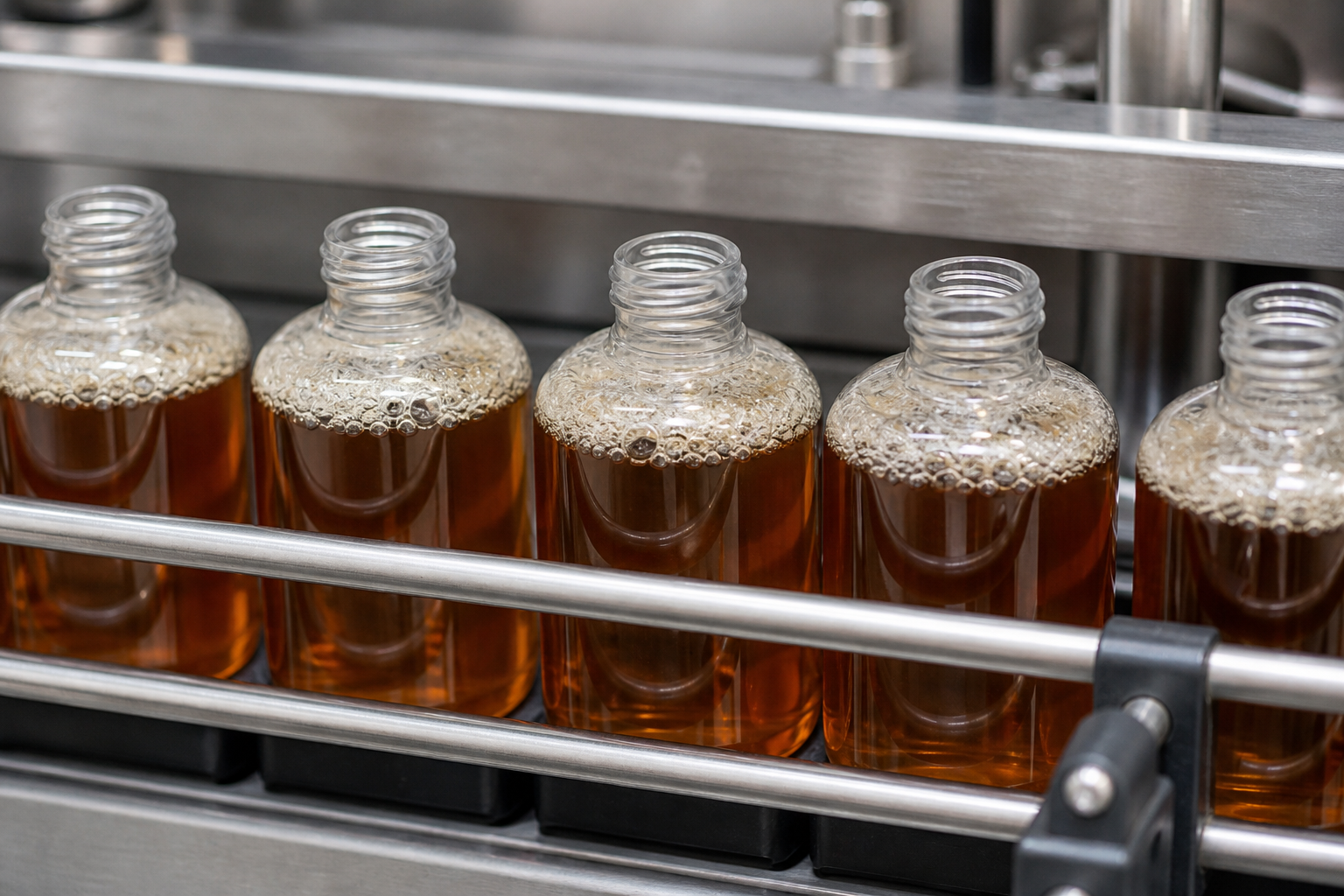
Direct answer: Foam control is a coordinated decision across bulk mixing, pump exposure, nozzle position, flow rate, fill trajectory and the delay before closure.
First identify where air enters: compounding vortex, return splash, pump suction, loose connection, falling jet or rapid fill against the bottle wall. Correct the source before adding a long settling buffer. A large buffer can reduce visible foam while increasing hold time and identity risk.
Bottom-up filling, a staged or slower initial flow and a nozzle path that keeps the outlet below the rising surface can reduce foam for some products. The nozzle must avoid bottle contact and should retract without drawing a long string or droplet. Verify the result with each approved bottle geometry.
Define when the unit may receive an insert or cap after filling. Foam that collapses after closure may change the apparent level or wet the neck. Inspect fill presentation, neck cleanliness and dose result after the realistic settling interval, not only at the nozzle exit.
Prevent Sedimentation and End-of-Batch Drift
Direct answer: Control suspension composition from bulk release through the last bottle with traceable time-based samples and defined low-level rules.
The FDA oral-suspension inspection guide discusses continuous or periodic agitation for many suspensions and non-composited beginning, middle and end samples to detect segregation. Although its scope is human drug inspection, the sampling logic is a useful engineering question for any sedimenting veterinary liquid. The manufacturer must establish product-specific tests and limits.
Include low day-tank level and the remaining heel in the trial. An agitator that works at normal level may uncover the impeller or concentrate solids near the outlet as the batch ends. Define minimum running level, recovery rule and the status of residual product.
A fill-mass check cannot prove composition. Pair quantity results with the justified attribute that detects segregation—such as assay, solids, density, viscosity, marker distribution or another validated method. Keep each sample traceable to operating condition and time.
| Process moment | Record or sample | Risk exposed | Decision to predefine |
|---|---|---|---|
| Startup | Bulk state, prime history, first qualified units | Air, unmixed line contents or setup error | Prime and first-acceptance rule |
| Middle | Fill quantity and representative composition | Gradual settling or feed drift | Trend limits and investigation interval |
| Planned stop | Stop time, agitation/recirculation state and first restart units | Settling, foam or temperature change | Maximum stop and restart procedure |
| Low level | Tank level, mixing coverage, fill and composition | Concentrated heel or vortex | Minimum level and recovery rule |
| Batch end | Last traceable units and residual condition | End-of-batch segregation or loss | Accept/reject boundary and reconciliation |
Match the Bottle, Insert, Cap and Dosing Device
Direct answer: Verify filling and owner dosing as one package system; a device that fits the neck may still deliver poorly with the commercial rheology.
Define the intended device: dropper, oral syringe, cup, spoon, pump or another measured delivery component. Obtain bottle-finish, insert, cap and device drawings plus approved samples. Check component tolerances, insertion forces, cap application, leak protection, label space and the fill level needed for device access.
Run user-oriented tests with the final formula and package. For a syringe, observe withdrawal, bubbles, dead volume and readability. For a dropper or cup, verify the approved graduation and pouring behavior. For viscous or stringing products, assess whether the device leaves an unacceptable residue or encourages an incorrect technique.
FDA’s archived oral-liquid inspection guide notes issues with measuring-device calibration in its human-drug scope. For pet products, the brand owner should define and validate the applicable dose-delivery and labeling requirements. The filler supplier can provide stable package assembly and samples but cannot validate owner use alone.
Design Filling, Insertion and Capping as a Connected Sequence
Direct answer: The line must protect the bottle finish after filling, seat any dosing insert correctly and secure the cap without trapping product in the sealing interface.
Stabilize the bottle through indexing so product does not splash onto the finish. Define an allowable delay before insertion or capping. If a flow restrictor or dropper insert is used, verify orientation, seating and the effect of trapped air or wet surfaces.
For screw caps, establish pickup, thread start and application controls with the approved bottle and cap. Torque may be a useful process parameter, but package performance must be related to the finished system by the manufacturer. A torque reading alone does not prove leak resistance or child resistance.
Challenge missing and mis-seated inserts, cross-threaded or tilted caps, bottle-height extremes and consecutive rejects. Rejected units must be segregated and reconciled so a device or closure fault cannot re-enter accepted flow.
Plan Cleaning and Flavor or Color Changeover
Direct answer: Cleaning must remove dissolved residue, settled particles, oils, gums, flavors and color from every product-contact and splash surface.
Map the tank, impeller, outlet, pump, return, hoses, valves, meter, hopper and nozzles. Identify low points and elastomers, and decide which components are cleaned in place, cleaned out of place, dedicated or replaced. A visually clear rinse may not prove that a flavored or colored residue is removed.
If the product is regulated as animal food in the U.S., 21 CFR Part 507 may apply depending on the facility and exemptions; if it is an animal drug, a different framework applies. FDA’s pet-food materials emphasize confirming whether the product is food or drug. The manufacturer should translate the applicable rules and hazard analysis into cleaning and preventive-control requirements.
During changeover testing, use the worst justified transition and record product recovery, waste, disassembly, cleaning parameters, inspection points, reassembly verification and first acceptable units. Include labels, caps and dosing devices in line clearance because cross-format errors are not limited to the liquid path.
URS and FAT Checklist
Direct answer: A useful URS converts foam, settling and dose-device behavior into measurable machine ranges, alarms and challenge tests.
Use the actual commercial formula whenever feasible. If a simulant is necessary, document which properties it matches and which conclusions remain for site testing. A smooth water run cannot demonstrate foam, sedimentation, stringing or device withdrawal for a complex pet liquid.
- Confirm product regulatory classification and the site’s applicable quality requirements.
- Attach viscosity versus temperature and method, density, foam, settling, particles and hold-time data.
- Define batch size, bulk vessel, transfer, day tank, agitation and recirculation boundaries.
- State dose range, bottle, insert, cap and dosing-device drawings and approved samples.
- Define acceptable fill quantity, composition trend, foam, neck cleanliness and closure condition.
- Challenge startup, sustained run, planned stop, restart, low level and batch end.
- Test the lowest and highest approved doses and justified temperature or rheology extremes.
- Demonstrate missing-device, insert and cap detection plus reject segregation and reconciliation.
- Review cleaning access, product recovery, flavor/color changeover and controlled restart.
- List required drawings, manuals, calibration, spare parts, training and qualification support.
How to Evaluate a Pet Liquid-Filling Supplier
Direct answer: Choose a supplier that requests measured product behavior and package samples, then turns the difficult operating states into a written test plan.
- Ask how the proposed tank, pump, meter and nozzle address the product’s specific foam and settling behavior.
- Review product-contact materials, passages, drainability, cleaning access and replaceable wear parts.
- Require representative trials over dose, temperature, stop/restart and low-level conditions.
- Review bottle, insert, cap and dosing-device tolerance handling as one sequence.
- Confirm PFD/P&ID, layout, control narrative, alarm matrix, FAT/SAT and qualification support.
- Verify the exact scope of CE, ISO or other documents; do not accept them as proof of product performance.
How KING PACK Configures Pet Liquid Supplement Lines
Direct answer: KING PACK can configure the product path, filler, nozzle, insert and capping sequence around verified rheology, foam, settling and package inputs.
KING PACK Machinery is a China-based manufacturer of pharmaceutical, veterinary, cosmetic and liquid filling and packaging equipment. Core platforms include tube filling and sealing, vacuum emulsifying, liquid filling and capping, pet spot-on filling and prefilled syringe production systems.
A pet liquid supplement project may combine a controlled mixing or holding vessel, a short compatible feed path, justified agitation or recirculation, trial-selected metering, bottom-up or profiled filling, insert placement, capping and in-process checks. The KING PACK pharmaceutical-industry solutions show related process and filling capabilities; the exact design follows the commercial product and its classification.
Send viscosity and test conditions, foam and settling observations, particle information, temperature and hold limits, dose range, bottle and dosing-device samples, batch size and target output through the KING PACK contact page. KING PACK can then propose a representative filling trial and interface checklist rather than a generic machine configuration.
Frequently Asked Questions
Are pet liquid supplements regulated like human dietary supplements in the United States?
No. FDA states that the human dietary-supplement framework does not apply to animal products. The product is assessed as animal food or an animal drug based on composition and intended use.
Does every sedimenting pet liquid require continuous agitation?
No. Continuous or periodic agitation, recirculation or another strategy must be justified with settling, redispersion, hold-time and start-to-end sample data.
Which filler is best for a foaming pet supplement?
There is no universal best type. Product feed, pump exposure, metering, nozzle path, flow profile and bottle geometry all influence foam. Use a representative trial.
Can bottom-up filling eliminate foam?
It can reduce air entrainment for some products, but bulk mixing, pumping, recirculation and nozzle speed may still generate foam. Verify the whole process.
Why can bottle weight pass while suspension composition fails?
The filler may dispense the correct total mass even as suspended material segregates. Quantity and composition therefore require separate, traceable controls.
Should a dosing device be tested during filler FAT?
Yes for fit, assembly and sample generation. User-dose validation remains the product owner’s responsibility and should use the final formula, package, labeling and representative users.
Is water sufficient for a filling trial?
Water can test basic motion and controls but usually cannot represent foam, sedimentation, viscosity, stringing, cleaning or dosing-device behavior. Use product or a justified simulant.
What data should accompany the RFQ?
Send regulatory classification, formula behavior, viscosity method and temperature, foam and settling observations, particles, hold limits, dose range, container and device samples, cleaning needs and target output.