
H1: How to Choose a Veterinary Syringe Filling Machine
Choosing a veterinary syringe filling machine should begin with the product, the complete syringe package and the acceptance test—not with a catalogue speed. Veterinary manufacturers may fill oral pastes, gels, ointments, suspensions, teat sealants, intramammary applicators or other non-sterile products. Each formulation and package combination changes the required feed system, dosing method, nozzle, air-control approach, assembly sequence and inspection plan.
This guide answers the practical buyer question: what should be frozen before requesting a quotation? The short answer is to define five connected inputs: formulation behavior, syringe geometry, target dose, process sequence and evidence required at FAT. If those inputs are incomplete, two suppliers may quote machines that appear comparable but include different operations and assumptions.

*Caption: A useful equipment review connects the formulation, package, process sequence and acceptance evidence.*
This article is for veterinary pharmaceutical manufacturers, contract fillers, engineering teams, QA/validation staff and procurement managers. It focuses on non-sterile veterinary applicators unless the project specification separately defines a qualified sterile process. A non-sterile veterinary applicator should not automatically be treated as the same equipment category as a sterile injectable prefilled syringe line.
Quick answer: what is the right selection rule?
Select the machine that can demonstrate repeatable filling and assembly with the customer’s actual formulation and syringe components under an agreed test method. Before comparing quotations, prepare:
1. Product behavior: dosage form, viscosity or flow description, density, settling, particles, foam, stringing and temperature range. 2. Package data: barrel, tip, cap, plunger or piston, dimensions, tolerances, material and bulk presentation. 3. Dose definition: mass, volume, delivered dose or another approved attribute, with the measurement method. 4. Process boundary: feeding, orientation, filling, cut-off, cap placement, plunger insertion, inspection, reject handling, coding and packing. 5. Acceptance evidence: sample size, startup and restart checks, inspection rules, cleaning access, changeover and FAT documentation.
A machine can be technically capable and still be the wrong purchase if it does not match the package presentation, product-contact requirements or downstream interface. A nominal units-per-minute figure is only meaningful when its test condition is stated.
1. Start with the veterinary formulation
The formulation controls the product path. A low-viscosity liquid may need stable transfer and controlled drip prevention. A suspension may need agitation or a carefully designed refill strategy to limit settling. A cream, ointment or oral paste may need positive-displacement dosing, a heated or conditioned hopper, a suitable nozzle and a cut-off motion that limits stringing. A gel or teat sealant may retain air and require more attention to priming and bubble control.
Prepare a product data sheet with:
- dosage form and formulation description;
- target fill quantity and allowable variation;
- viscosity data or a practical description at the intended filling temperature;
- density when mass is used to verify a volumetric target;
- suspended solids, particles or abrasive ingredients;
- heating, cooling, agitation or recirculation limits;
- foam, stringing, settling and air-retention behavior;
- cleaning agents and product-contact material restrictions;
- whether the product is shear-sensitive or temperature-sensitive.
Do not use only “veterinary liquid” or “high-viscosity paste” as the process specification. Two products with the same dosage form may require different pump, piston, nozzle and cut-off settings. If the final formula is not available, mark the engineering data as provisional and define a representative substitute test. A substitute can support mechanical design, but it cannot prove every final-product quality attribute.
2. Confirm the complete syringe or applicator
The barrel is only one part of the package. Physical samples should accompany drawings whenever possible because flexible plastic components can behave differently during indexing, gripping, cap pressing and plunger insertion than their nominal dimensions suggest.
| Package element | Questions for the supplier |
|---|---|
| Barrel | What diameter, length, flange and wall flexibility must the fixture accommodate? |
| Tip or nozzle | Is the tip open, closed, attached or supplied separately? |
| Cap | How is it oriented, fed, pressed and checked for seating? |
| Plunger or piston | Is it inserted before or after filling, and is venting required? |
| Label or code area | Where can coding be placed without interfering with handling? |
| Bulk presentation | Are components loose, nested, tray-loaded, bagged or manually loaded? |
Ask the supplier to return a configuration summary that states the proposed machine route, dosing principle, number of heads, product-contact parts, component presentation, assembly steps, inspection points and open assumptions. This prevents a common RFQ misunderstanding: the buyer expects a complete filling-and-assembly line while the quotation covers only the dosing station.
3. Define the process boundary before asking for capacity
Write the process sequence in plain language. A veterinary syringe line may include empty-barrel feeding, orientation, filling, nozzle cut-off, tip-cap placement, rear closure, plunger insertion, visual inspection, weighing, reject separation, coding, cartoning or manual packing. The exact scope depends on the package.
State which operations are included, excluded or supplied by another contractor. Also define the hand-off points. For example, if the filler discharges into a labeller, who supplies the transfer conveyor? If caps arrive in bulk, who verifies orientation? If a reject is created by a checkweigher, where is it collected and reconciled?
Capacity should be stated with assumptions:
- target saleable units per hour or shift;
- number of filling heads and formats;
- working hours and planned changeovers;
- batch size and product refill method;
- expected inspection and reject handling;
- downstream equipment speed;
- whether the figure is rated speed or an agreed FAT output.
Do not convert a maximum catalogue speed directly into a production promise. A stable laboratory demonstration, a steady-state FAT result and a saleable-shift output are different evidence levels.
4. Choose the dosing method by product and measurement basis
Volumetric and gravimetric descriptions are not interchangeable quality claims. The correct dosing method is the one that can be controlled, measured and accepted for the specific product and dose range.
Review piston or servo movement, nozzle dimensions, product-contact dead volume, hopper level, refill behavior, temperature changes and startup/restart units. If the requirement is net mass, define tare handling and weighing conditions. If the requirement is delivered dose, define how the filled applicator will be dispensed and measured. A fill-weight check may not answer a delivered-dose question.
Avoid adopting a universal accuracy percentage before the product, package, test method and sampling plan are known. Ask the supplier to explain which variables influence the result and which conditions must be controlled during FAT.
5. Compare filling direction and air-control options
Front filling introduces product through the nozzle end before remaining components are assembled. Rear filling introduces product through the open barrel end and may be paired with controlled venting and plunger insertion. Neither route is automatically superior.
The route depends on the package opening, cap state, component sequence, formulation behavior and required air condition. Ask the supplier to document the product entry point, assembly order, trapped-air control, nozzle withdrawal, stop/restart behavior and first-off handling.
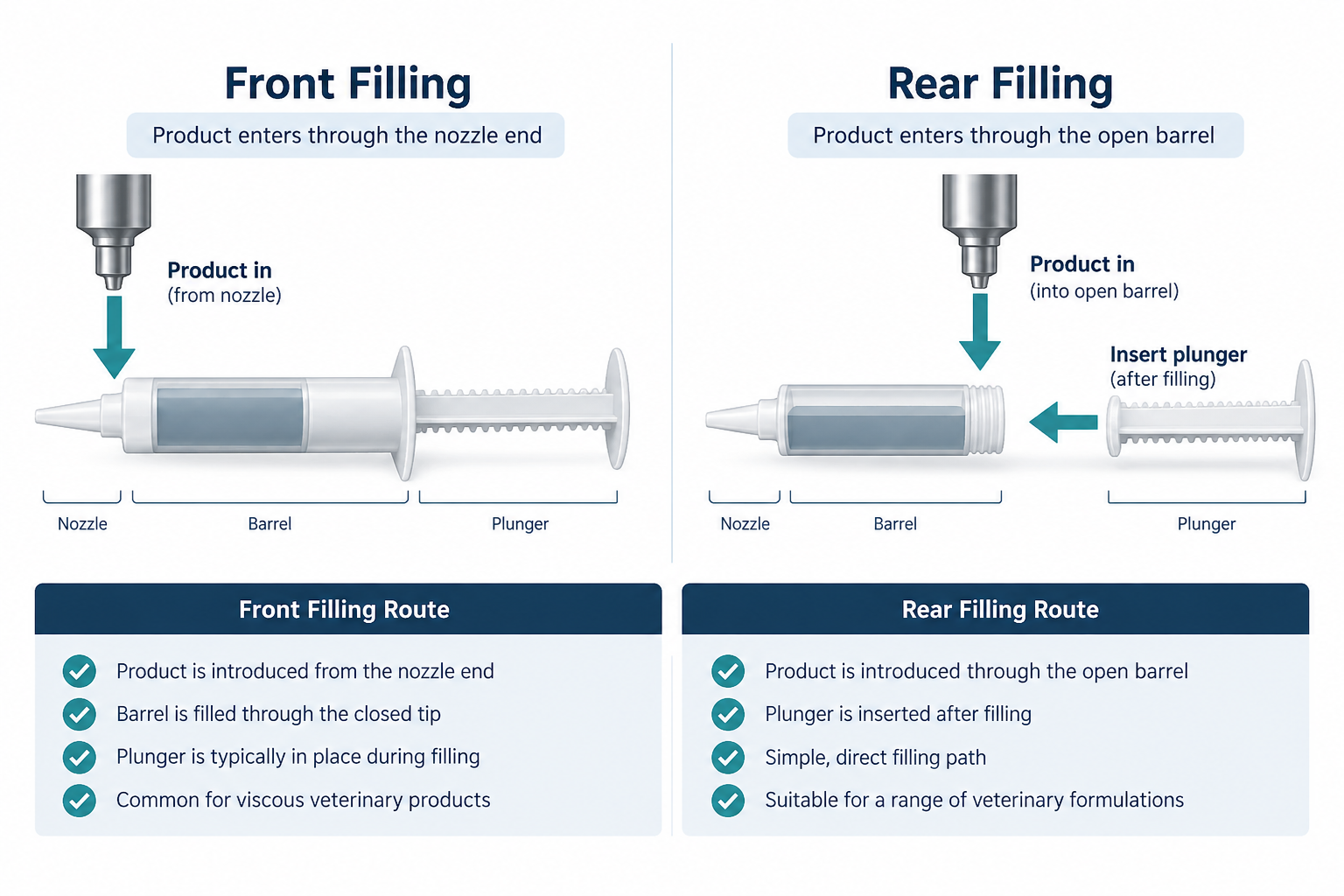
*Caption: Front filling and rear filling are package-dependent process routes that should be proven with representative samples.*
For air-sensitive gels, pastes and sealants, review upstream mixing, transfer, hopper refill, priming, nozzle cut-off and visible-void inspection together. Air may enter before the dosing head, so changing only the nozzle may not solve the root cause.
6. Include capping, plunger insertion and inspection
The line is not complete when product enters the barrel. Cap seating, plunger position and component presence can determine package integrity, appearance and usability.
Define cap orientation, feeding condition, pressing force, seating position and reject response. For plunger insertion, define insertion direction, venting sequence, position or force limits and what happens when a component is missing. If the process leaves one assembly operation manual, state that boundary clearly.
Inspection should follow actual quality risks:
| Risk | Possible control or evidence |
|---|---|
| Missing or wrong component | Presence sensing, vision or documented manual check |
| Fill variation | Periodic weighing or another approved measurement |
| Trapped air or visible void | Defined visual method or validated inspection method |
| Nozzle residue or stringing | Tip and closure-interface inspection |
| Cap not seated | Position, force or visual check |
| Plunger not in position | Position, force or end-of-line inspection |
| Damaged barrel or wrong code | Appearance and code verification |
Set the inspection method before FAT. A pass/fail discussion after the run is avoidable when sample size, device, acceptance rule and disposition of nonconforming units are agreed in advance.
Mid-article CTA
**Planning a veterinary syringe filling project? Send the formulation description, complete syringe samples, target dose, production target and process boundary to [King Pack](https://kpfillingmachine.com/contact/). A structured review can identify the correct filling route and sample-test scope before quotation comparison.**
7. Evaluate cleaning and multi-format changeover
If the line will run several products or syringe formats, include changeover in the original RFQ. Review dedicated and shared product-contact parts, nozzles, guides, fixtures, cap tooling, recipes and inspection settings.
The supplier should explain how parts are identified, removed, cleaned, stored and verified. Ask which activities are included in the quoted changeover time: mechanical change parts, recipe selection, cleaning, line clearance, first-off approval and documentation. A short theoretical changeover that excludes verification is not comparable with a fully controlled changeover.
Cleaning should be described as a workflow, not only as “easy to clean.” Identify residue-prone areas, hose and nozzle handling, tool requirements, cleaning agents, inspection points and the boundary between equipment cleaning and product-process validation.
8. Use FAT to compare suppliers on evidence
Factory acceptance testing should be a controlled product-and-package test. Request evidence for:
1. The agreed formulation or a documented substitute. 2. The actual syringe, cap and plunger components. 3. Startup, steady-state, planned stop and restart samples. 4. The agreed filling and dose measurement method. 5. Air, residue, cap, plunger and component-presence checks. 6. Reject trigger, physical separation and reconciliation. 7. Changeover or representative change-part demonstration. 8. Cleaning access and removal of product-contact parts. 9. Recorded settings, sample IDs, deviations and corrective actions. 10. Open-item ownership and shipment-release conditions.

*Caption: A useful FAT connects actual product and package samples with recorded settings, measurements and open actions.*
FAT verifies equipment behavior under defined conditions. It does not automatically qualify the product, replace site commissioning or prove every local validation requirement. Keep equipment acceptance, installation preparation, operational qualification and product-process validation as separate but connected responsibilities.
9. Compare quotations with one responsibility matrix
Put competing proposals into the same matrix. Mark each item as included, optional, excluded or subject to sample confirmation.
| Scope item | Supplier A | Supplier B | Buyer decision |
|---|---|---|---|
| Product trial | Included/optional/excluded | Included/optional/excluded | Use representative product? |
| Filling heads and dosing parts | Stated configuration | Stated configuration | Confirm dose range |
| Cap and plunger handling | Automatic/manual/not included | Automatic/manual/not included | Freeze process boundary |
| Inspection and reject | Device and location | Device and location | Define acceptance method |
| Change parts and cleaning | List and time basis | List and time basis | Compare lifecycle scope |
| FAT, documentation and training | Deliverables | Deliverables | Assign responsibilities |
Then compare assumptions behind output, format range, working hours, refill condition, changeover and downstream constraints. A lower purchase quotation may exclude format parts, product-contact spares, installation preparation, FAT support or training. Those items should be visible before a purchase decision.
RFQ package: what to send before supplier review
A supplier can make a much more useful recommendation when the RFQ includes the complete product and package picture. Send representative formulation information or safe product samples, the target fill volume and tolerance, syringe drawings, closure or plunger details, carton or tray information, expected batch size, target operating hours and the required inspection points. If the product is sensitive to shear, temperature, foaming or hold time, state that before the first trial rather than after the machine concept has been chosen.
The RFQ should also state what the customer expects the supplier to return. Typical deliverables include a process description, proposed machine boundary, utility list, format-parts list, sample-testing plan, output assumptions, FAT protocol, documentation list and an initial spare-parts recommendation. For a line with downstream equipment, identify the handoff height, product flow direction, accumulation method and control-signal requirements. These details help separate a filling-machine quotation from a complete line quotation.
Ask each supplier to identify assumptions, open questions and exclusions in writing. A simple responsibility matrix can show who supplies syringes, caps, plungers, trays, product, cartons, utilities and validation documents. It can also show which party owns transport, installation, commissioning and site acceptance. This preparation does not make every project identical, but it makes technical and commercial comparisons more transparent and gives the factory-test team a clear starting point.
10. Prepare installation and handover requirements early
Installation preparation is part of a sound equipment choice because site constraints can change the practical scope after purchase. Request the machine footprint, service clearances, lifting points, access route, door and elevator dimensions, anchor requirements, electrical and compressed-air entry points, drainage or wash-down restrictions and upstream/downstream interface conditions.
The utility list should separate confirmed requirements from values subject to final configuration. Review electrical supply and frequency, compressed-air quality and pressure, vacuum if used, heating or cooling connections, operator access, maintenance access and environmental conditions. A utility value copied from a similar model may not remain valid when the number of heads, inspection devices, heating modules or downstream units changes.
Define the handover record before FAT. It can include the approved configuration, software or recipe version, change-part identification, spare-parts list, open-item register, training plan, cleaning instructions and first-production support boundary. Shipment inspection should verify the packing list, protected product-contact parts, loose tooling, manuals and visible machine condition. At site, commissioning should re-check utilities, component presentation, safety functions and the first production-intent samples.
This evidence chain helps distinguish a machine that passed a supplier demonstration from a line that is ready for the customer’s actual site. It also makes responsibility clear when a problem is caused by a utility, component presentation, operator procedure or an equipment configuration item. Include these responsibilities in the RFQ rather than trying to assign them after delivery.
King Pack support for veterinary syringe projects
King Pack’s confirmed scope includes custom configuration, sample testing, FAT, documentation, training, after-sales support and line integration for filling and packaging equipment. For veterinary syringe projects, the technical proposal should define the product route, syringe handling, assembly boundary, inspection method and open assumptions rather than relying on one fixed machine label.
Buyers can also review the existing [veterinary syringe applicator filling solutions](https://kpfillingmachine.com/veterinary-syringe-applicator-filling-solutions/) page and the technical guide on [intramammary syringe viscosity and air control](https://kpfillingmachine.com/intramammary-syringe-filling-viscosity-air-control/). The relevant commercial next step is a product-and-package review, not a generic speed promise.
FAQ
What is the best veterinary syringe filling machine?
There is no universal best machine. The suitable configuration depends on the formulation, dose, package geometry, filling route, assembly sequence, inspection method, cleaning needs and required output under stated test conditions.
What samples should be sent to a supplier?
Send representative formulation, empty barrels, tips, caps, plungers or pistons, drawings, tolerances and the real bulk presentation whenever possible. Physical samples reveal handling behavior that drawings alone may not show.
Should a veterinary syringe line include capping and plunger insertion?
Include them when they are part of the intended process. If they remain manual or downstream, define that boundary in the URS and quotation so the supplier’s capacity and acceptance scope are not misunderstood.
How should veterinary syringe filling accuracy be accepted?
Define the measurement basis, sample size, sampling points, equipment, environmental or temperature conditions and acceptance rule for the specific product and dose. Avoid an unsupported universal percentage.
Can one machine handle several veterinary syringe formats?
It may be possible when the formats, product-contact parts, fixtures, dosing range, cap tooling and changeover method are compatible. Representative trials should confirm handling and first-off approval.
Does FAT replace validation?
No. FAT verifies equipment functions at the supplier’s site under defined conditions. Site installation, operation, cleaning and product-process responsibilities must be defined separately.
Conclusion
Choose a veterinary syringe filling machine by connecting the formulation, complete package, process boundary and acceptance evidence. Freeze the product behavior and package samples first. Then evaluate filling direction, dosing method, air control, capping, plunger insertion, inspection, cleaning, changeover, utilities and FAT documentation. This produces a more comparable quotation and reduces the risk of discovering package or product problems after installation.
Final CTA
**Send your veterinary formulation details, syringe samples, target dose and production requirements to [King Pack](https://kpfillingmachine.com/contact/). We can review the process boundary, identify the required modules and prepare a technical proposal with a practical sample-test and FAT plan.**