
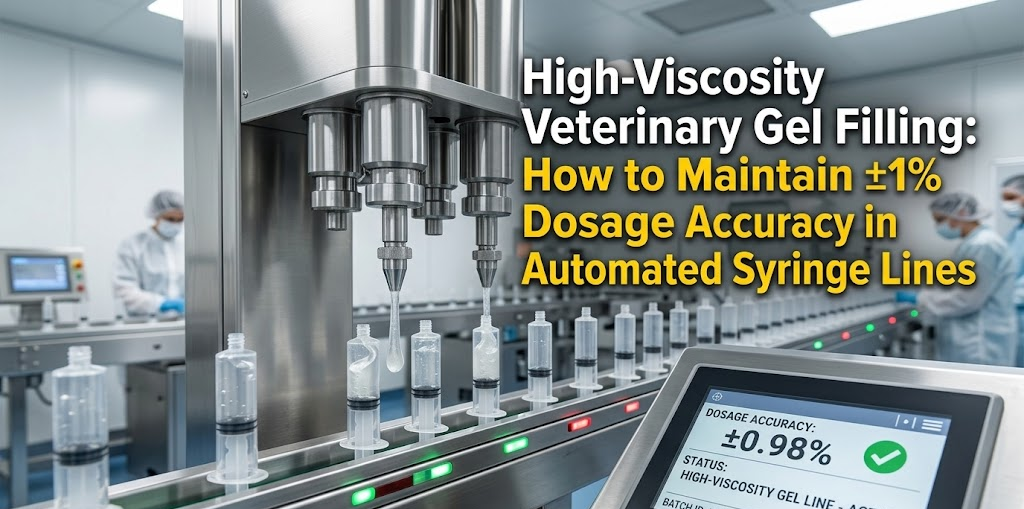
Introduction to High-Viscosity Veterinary Gel Filling
Veterinary gels play an important role in animal health. They are commonly used for antiparasitic treatments, nutritional supplements, hormone therapies, and specialty pharmaceutical products. Many of these formulations are supplied in syringes because they allow accurate administration and convenient dosing.
Unlike water-thin liquids, veterinary gels create unique filling challenges. Their thickness affects flow behavior, filling speed, pressure requirements, and dosing consistency. Even small variations can result in inaccurate fill volumes, product waste, and compliance issues.
As production volumes increase, manufacturers need automated syringe filling lines capable of maintaining tight tolerances throughout long production runs. Achieving dosage accuracy within ±1% has become a common target for high-value veterinary products.
This article explores the main challenges of filling high-viscosity veterinary gels and explains how modern automated veterinary syringe filling systems maintain consistent dosing accuracy through advanced filling technology, stable product handling, and precise process control.
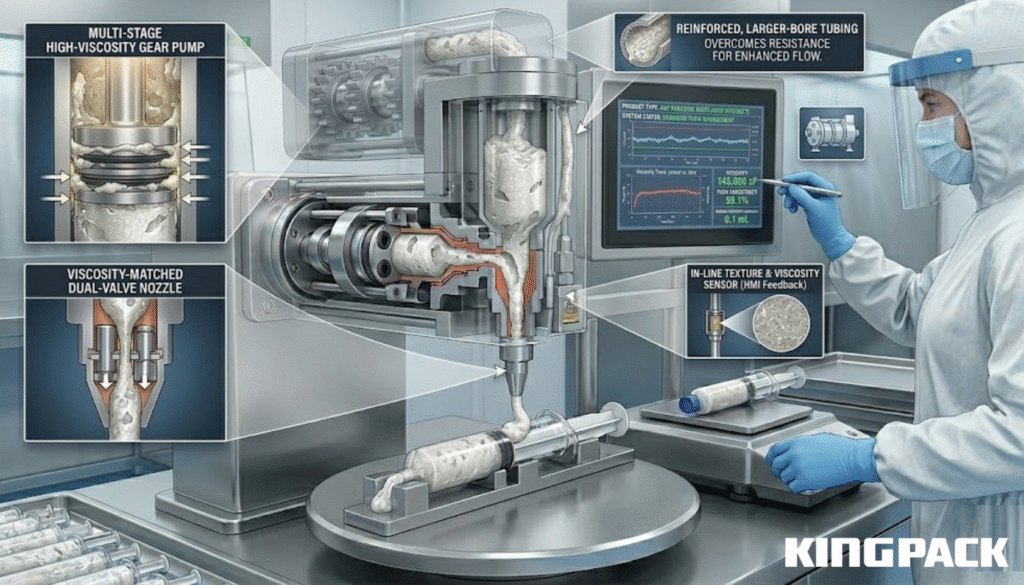
Why Veterinary Gels Require Precise Filling Control
Veterinary gels are made to deliver consistent therapeutic results in animal health treatments. Dose accuracy plays a direct role in treatment reliability and overall product performance. Every unit must be filled with care to support safe and effective use in clinical and farm environments.
Even small deviations in fill volume can become significant when thousands of syringes are produced in a single batch. Over time, these variations can lead to product loss, quality concerns, and inconsistent dosing across a full production run.
High-viscosity formulations are especially sensitive because their flow behavior changes under different processing conditions. Temperature shifts, mixing stability, and filling speed can all affect consistency, making tight control essential for producing safe and reliable veterinary medications.
Recommended Reading: Precision Filling for Pet Medicine: Challenges in Small-Dose Tube Filling and Sealing Machine Operations – King Pack Machinery
The Importance of ±1% Dosage Accuracy in Animal Health Products
Accurate dosing supports:
- Product consistency
- Regulatory compliance
- Reduced overfill costs
- Improved customer confidence
- Better batch-to-batch uniformity
According to guidance published by the Parenteral Drug Association, fill accuracy remains a critical factor in pharmaceutical manufacturing because dosage consistency directly impacts product quality.
For manufacturers producing high-value veterinary formulations, reducing unnecessary overfill can also create substantial cost savings across annual production volumes.
Key Challenges in Filling High-Viscosity Veterinary Gels
Achieving consistent filling performance becomes more difficult as product viscosity increases.
Managing Thick and Sticky Product Flow
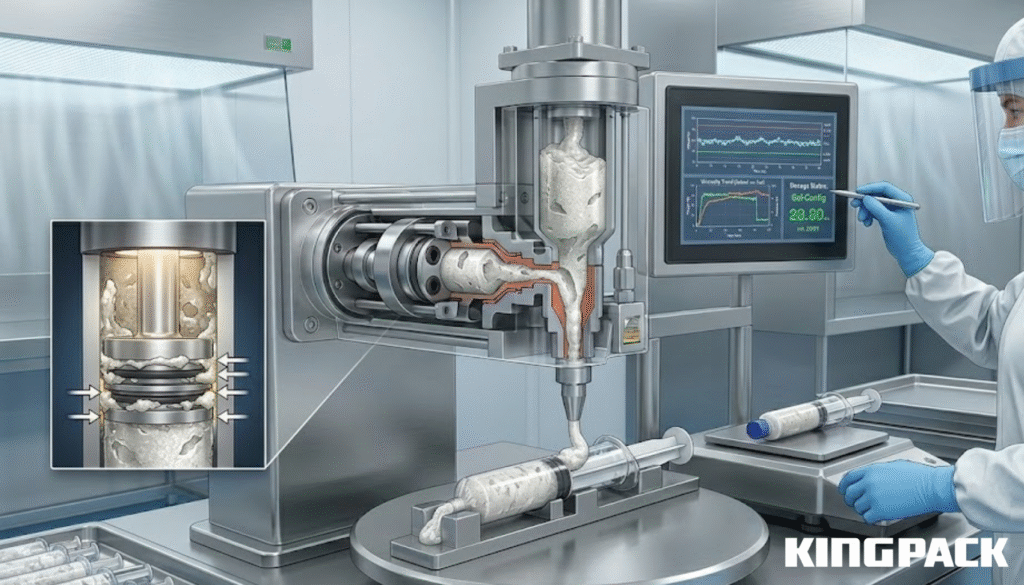
Many veterinary gels contain ingredients that create resistance during filling.
Examples include:
- Antiparasitic pastes
- Nutritional gels
- Mineral supplements
- Oil-based formulations
These products often move slowly through pumps, tubing, and filling nozzles.
As viscosity increases, greater force is required to move the product through the system. Poor equipment selection can result in inconsistent flow rates and unstable filling performance.
Preventing Air Pockets and Inconsistent Dosing
Air trapped inside the product stream can create major accuracy problems.
Common causes include:
- Improper hopper design
- Inadequate product feeding
- Excessive filling speed
- Product foaming
Air pockets occupy volume inside the syringe. This can lead to underfilled units even when the filling system appears to deliver the correct amount of material.
For veterinary pharmaceutical manufacturers, eliminating trapped air is often as important as controlling fill volume itself.
Recommended Reading: Handling High Viscosity: Engineering the Perfect Plastic Tube Filling Machine for Thick Gels and Clays – King Pack Machinery
Controlling Temperature, Pressure, and Product Stability
Viscosity changes as temperature changes.
A gel that flows smoothly at one temperature may become significantly thicker at another. This variation affects filling consistency and machine performance.
Manufacturers must carefully control:
- Product temperature
- Feeding pressure
- Filling speed
- Hopper conditions
Stable process conditions help maintain stable dosing accuracy.
How Automated Syringe Lines Maintain Dosage Accuracy in Veterinary Medicine
Modern automated syringe filling lines incorporate multiple technologies designed to maintain precise dosing across varying production conditions.
Servo-Driven Piston Filling for Precise Volume Control
Servo-controlled piston systems are widely used for high-viscosity products because they provide excellent volume control.
Unlike conventional filling systems, servo drives allow precise adjustment of piston movement during each cycle.
Benefits include:
- Improved repeatability
- Consistent fill volumes
- Better control of thick formulations
- Reduced product waste
Many pharmaceutical filling systems use servo technology to achieve tight filling tolerances during syringe production.
This approach is particularly effective when processing veterinary gels that require high precision.
Recommended Reading: How Small Pet Pharma Factories Can Cut Costs: ROI Analysis of Drop Filling Machine Investment – King Pack Machinery
Stable Product Feeding and Hopper Design
Even the most accurate filling system cannot compensate for unstable product delivery.
Proper hopper design helps maintain a consistent product supply throughout production.
Important features include:
- Agitation systems when required
- Controlled feeding pressure
- Smooth product pathways
- Dead-zone reduction
A stable product feed reduces fluctuations that may affect fill volume accuracy.
Anti-Drip Nozzles for Clean and Accurate Syringes Filling
Stringing and dripping are common problems when handling thick gels.
Advanced filling nozzles help minimize these issues by controlling product release at the end of each filling cycle.
Anti-drip designs provide several benefits:
- Cleaner filling operations
- Better dose control
- Reduced contamination risks
- Lower product waste
This becomes increasingly important during high-speed production.
Real-Time Monitoring and Filling Parameter Adjustment
Modern filling lines often include automated monitoring systems.
These systems track critical process variables such as:
- Filling volume
- Production speed
- Product pressure
- Equipment performance
Operators can make adjustments before deviations affect product quality.
Recommended Reading: Tube Packaging Solutions in the Pet Care Industry: King Pack’s Advanced Manufacturing Standards – King Pack Machinery
Essential Equipment for Veterinary Gel Syringe Filling
Multiple machine components work together to maintain dosing accuracy throughout production.
High-Viscosity Gel Filling Machines
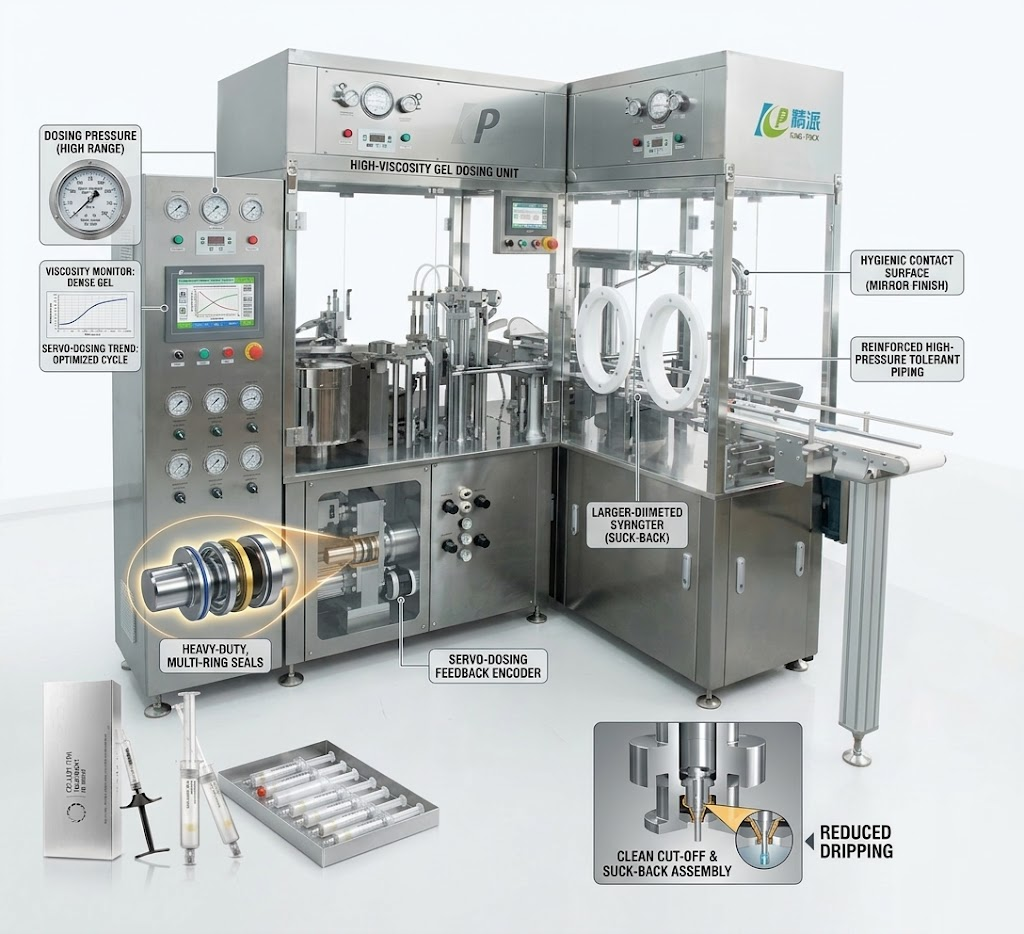
High-viscosity formulations require filling systems designed specifically for thick products.
Important capabilities include:
- Servo-controlled filling
- High-pressure handling
- Precise volume control
- Hygienic product contact surfaces
Equipment designed for low-viscosity liquids may struggle when processing dense veterinary gels.
Automatic Syringe Loading and Positioning Systems
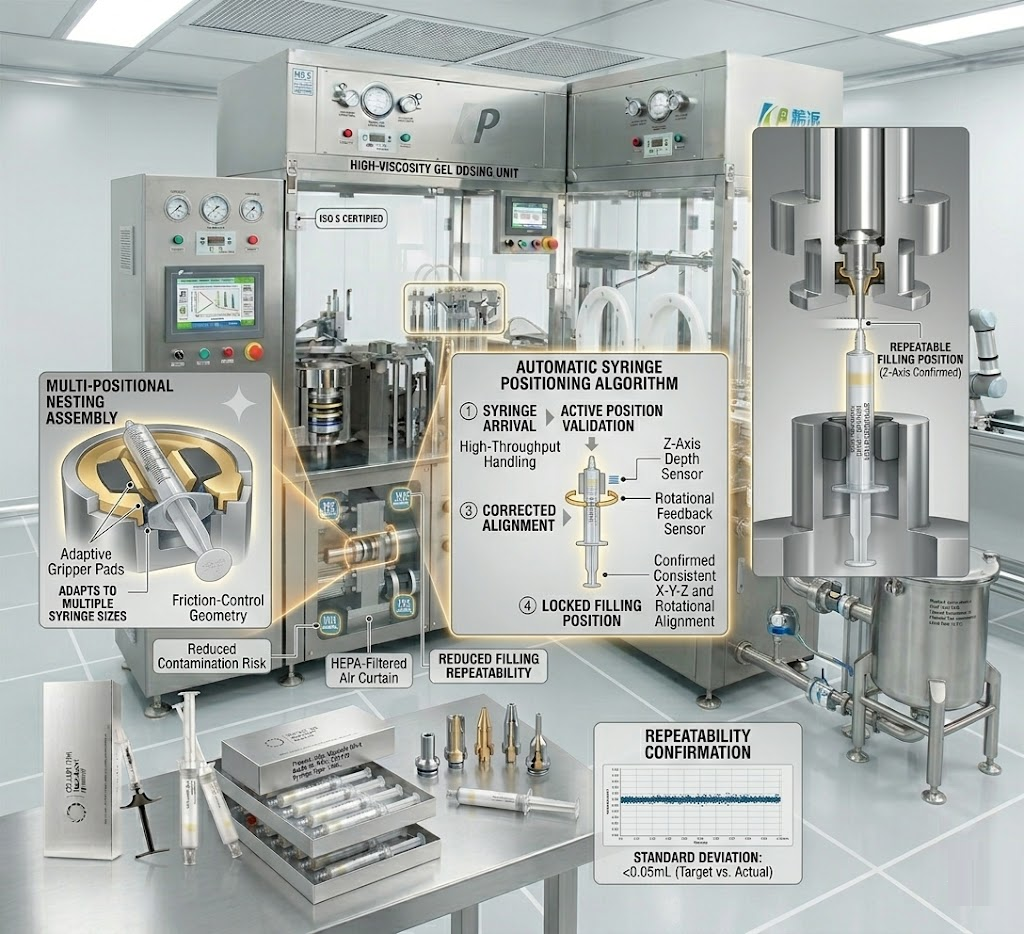
Accurate syringe positioning helps maintain filling consistency.
Automated handling systems reduce variability by placing each syringe in the correct filling position before product dispensing begins.
Benefits include:
- Improved throughput
- Reduced manual handling
- Better filling repeatability
- Lower contamination risk
Syringe Filling and Capping Machines
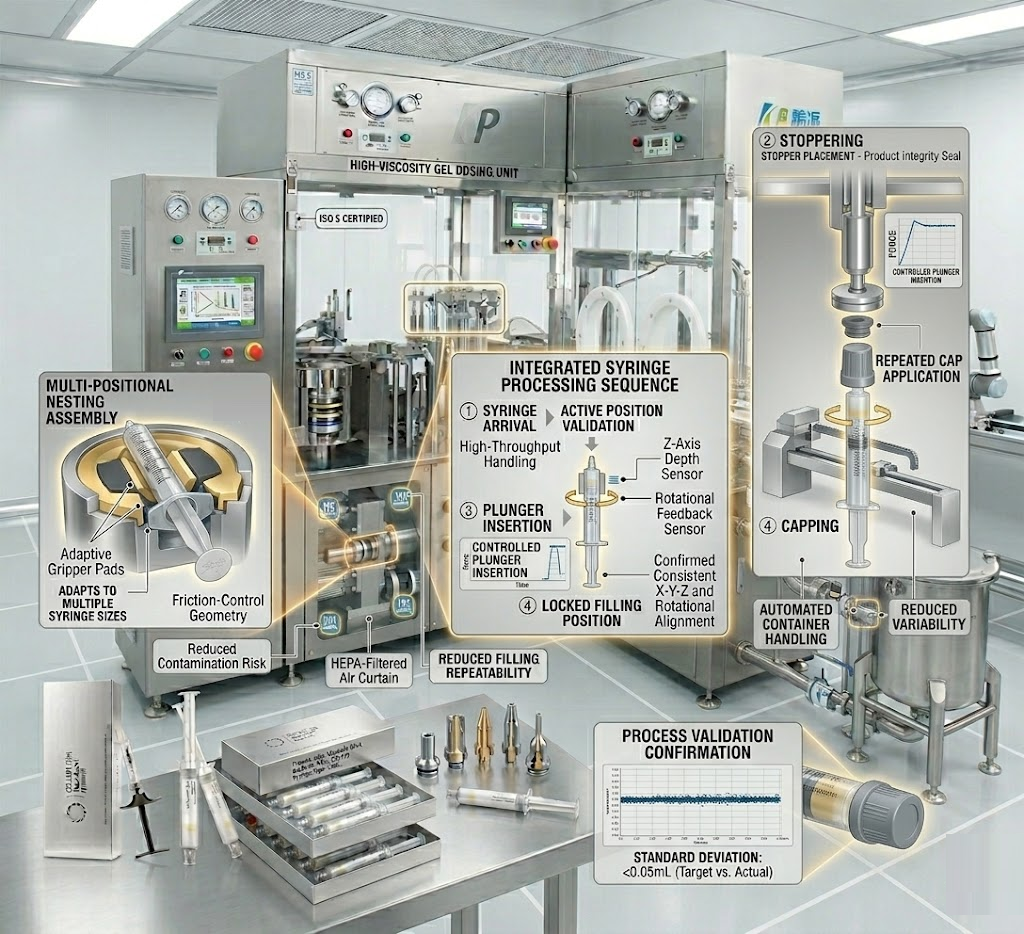
After filling, syringes must be properly sealed.
An integrated syringe filling and capping machine helps maintain product integrity throughout the process.
Key functions include:
- Filling
- Stoppering
- Plunger insertion
- Capping
- Container transfer
Combining these operations within a single system reduces handling requirements and improves production efficiency.
Inspection and Rejection Systems for Quality Assurance
Automated inspection systems provide an additional layer of quality control.
Typical inspection points include:
| Inspection Item | Purpose |
|---|---|
| Fill Volume Verification | Detect underfilled or overfilled syringes |
| Air Bubble Detection | Identify trapped air |
| Closure Inspection | Verify proper sealing |
| Container Integrity Check | Detect damaged syringes |
| Automatic Reject Function | Remove non-conforming units |
These systems help manufacturers maintain consistent quality standards throughout production.
Process Factors That Affect ±1% Dosage Accuracy
Equipment plays an important role, but process conditions also influence filling performance.
Product Viscosity and Rheological Behavior
Different types of veterinary gels respond differently during filling. Some formulations become easier to pump when subjected to pressure, while others remain thick throughout the process. Products like antiparasitic pastes and nutritional gels can behave very differently even when they appear similar.
Understanding these flow characteristics helps manufacturers make the right equipment choice, select suitable filling options, and adjust process settings. Accurate rheological information is especially important when using automated systems across a wide range of medical products and applications.
Filling Speed and Cycle Time
Increasing production speed can improve output, but excessive speed may reduce filling stability and accuracy. Manufacturers must find the right balance between production goals and product performance.
Key considerations include:
- Production targets
- Product characteristics
- Accuracy requirements
Careful optimization allows facilities to maintain throughput while producing less waste. A professional approach to process development also helps operators get consistent results across different product types and production conditions.
Syringe Size, Nozzle Design, and Fill Volume
The dimensions of the syringe and filling components have a direct impact on dosing accuracy. Due to this, selecting the right configuration becomes even more important when handling high-viscosity formulations.
Important factors include:
- Syringe diameter
- Fill volume
- Nozzle geometry
- Product viscosity
Manufacturers often evaluate several equipment options before making a final choice. Detailed product information gathered during testing helps determine which setup delivers the best performance across a broad range of veterinary and medical products.
Cleaning, Changeover, and Batch Consistency
Cleaning procedures play a major role in maintaining product quality. Residues left behind after production can affect future batches and create challenges during inspection or final packaging operations.
Proper cleaning helps maintain:
- Product purity
- Free process consistency
- Equipment performance
Many facilities establish pre-production cleaning checks for tools and verification procedures before each batch. Efficient changeover way also support quick transitions between product types, reducing downtime and helping manufacturers make better use of equipment over many years of operation. Regular maintenance and proper cleaning uses valuable process information to improve long-term reliability and consistency.
Recommended Reading: Cross-Contamination Prevention: The Gold Standard for Multi-Formula Pet Drop Production – King Pack – King Pack Machinery
Best Practices for Choosing Reliable Veterinary Gel Filling
Manufacturers that consistently achieve high dosing accuracy typically follow established process controls.
Optimize Filling Parameters Before Production
Proper process development should take place before full-scale manufacturing begins. Every type of veterinary medication behaves differently during filling, particularly high-viscosity formulations intended for syringe or needle-based administration.
Critical parameters often include:
- Filling speed
- Product temperature
- Hopper pressure
- Piston settings
- Nozzle configuration
Careful adjustment of these variables helps improve dosing consistency, product quality, and overall production safety. Early optimization also allows manufacturers to identify potential issues before commercial production starts, reducing the risk of filling errors that could affect medication performance or create challenges during needle filling operations.
Use CIP-Friendly and GMP-Compliant Equipment
Cleaning plays a major role in pharmaceutical manufacturing, particularly when facilities handle different product types over many years of operation. Selecting the right equipment helps manufacturers maintain product quality and get consistent results across multiple production batches.
Equipment should support:
- Easy cleaning and maintenance
- Hygienic operation
- Validation procedures
- GMP compliance
- Efficient changeovers between product types
Manufacturers often choose systems with SS316L product-contact components because they offer long-term durability and compatibility with pharmaceutical formulations. These materials are widely used in applications like syringe filling, sterile processing, and final packaging operations.
Before production begins, operators can review critical process information, complete pre-production checks, and verify cleaning procedures. This approach supports the many uses of modern filling equipment while helping facilities maintain compliance throughout the product lifecycle.
Reducing Product Waste During Start-Up and Changeover
Product losses often occur during startup and line changeovers.
Manufacturers can reduce waste through:
- Accurate parameter setup
- Efficient priming procedures
- Optimized product pathways
- Automated controls
For high-value veterinary formulations, even small reductions in waste can generate meaningful savings.
Why Choose King-Pack’s Automated Syringe Filling Lines?
Manufacturers producing veterinary gels require equipment capable of handling demanding formulations while maintaining precise dosing performance.
King-Pack offers syringe filling solutions designed for pharmaceutical and veterinary applications.
Precision Engineering for High-Viscosity Veterinary Products
Servo-controlled filling technology helps maintain accurate volume control when processing thick formulations.
This is particularly important for veterinary gels where product flow characteristics can vary significantly.
Flexible Solutions for Multiple Syringe Sizes and Gel Formulations
Production requirements often change over time.
Flexible filling systems help manufacturers accommodate:
- Different syringe sizes
- Various fill volumes
- Multiple product formulations
- Future production expansion
Technical Support from Testing to Commercial Production
Equipment selection is only one part of a successful project.
Manufacturers often require support during:
- Product testing
- Process development
- Installation
- Validation
- Commercial production
Technical assistance helps reduce project risks and accelerate implementation.
FAQs About High-Viscosity Veterinary Gel Filling
1. Why is high-viscosity gel filling more difficult than liquid filling?
Thicker products resist flow and require more precise control of pressure, speed, and filling parameters.
2. Can automated syringe lines achieve ±1% accuracy?
Yes. Properly configured servo-driven filling systems can achieve highly accurate dosing under controlled production conditions.
3. What filling technology works best for veterinary gels?
Servo-controlled piston filling systems are commonly used because they provide excellent volume control for viscous products.
4. How can air bubbles be reduced during filling?
Proper hopper design, stable product feeding, optimized filling speeds, and specialized nozzle technology help minimize trapped air.
5. Does viscosity change during production?
Yes. Temperature fluctuations and formulation characteristics can affect viscosity, which is why process monitoring remains important.
Request a Quote for Your Veterinary Gel Syringe Filling Line
High-viscosity veterinary products demand specialized filling technology. Achieving ±1% dosage accuracy requires a combination of precise filling systems, stable product handling, advanced process controls, and well-designed production equipment.
Manufacturers that invest in optimized automated syringe filling lines can improve consistency, reduce waste, and maintain higher quality standards across every batch.
King-Pack provides automated syringe filling solutions designed for veterinary pharmaceutical applications, including challenging high-viscosity gel formulations.
Contact King-Pack today to discuss your production requirements and request a customized veterinary gel syringe filling solution tailored to your operation.