
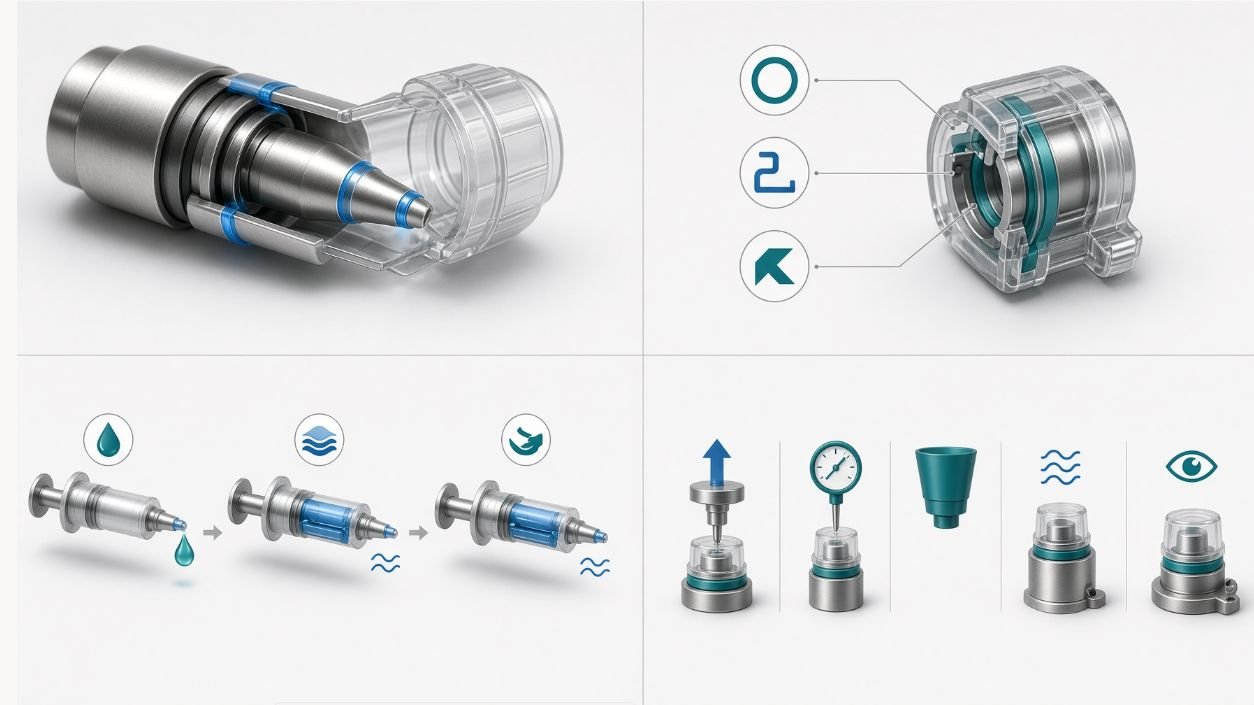
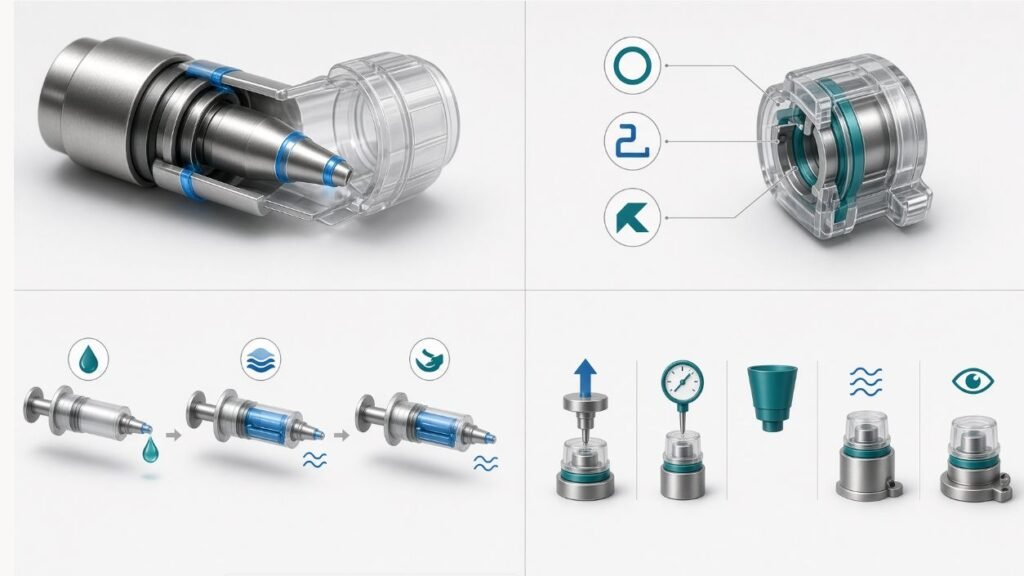
The tip cap on a gel bait syringe is one of the smallest parts on the package, but it tends to decide whether the finished unit arrives at the user's hands intact. A cap that does not match the tip geometry, that does not retain under shipping vibration, that leaks under a defined pressure test, or that carries visible gel residue at the interface will fail in the field even when the rest of the line runs perfectly. The article that follows is a working checklist for closure compatibility: what to measure on the cap and the tip, what to inspect at the closure station, and what to verify before declaring the matched set acceptable.
This article does not promise shelf-life performance, does not borrow pharmaceutical syringe standards and does not claim that any single cap design fits every barrel. Closure compatibility is a project-specific decision between the buyer, the package supplier and the line builder, made on agreed test conditions.
Closure and Tip Geometry as the First Decision
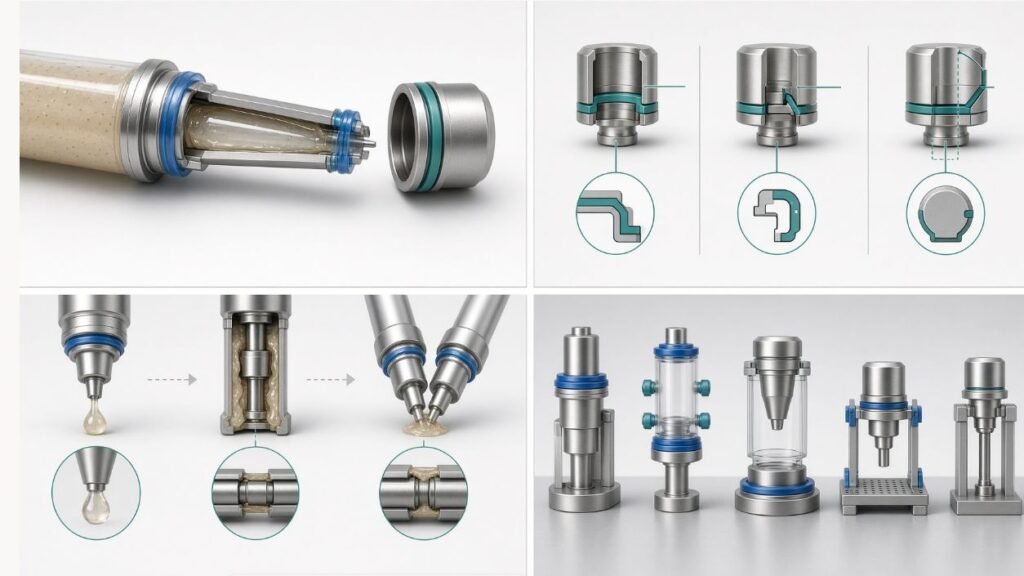
The first decision is geometry. The cap must match the tip at three levels: the sealing interface, the retention feature and the orientation feature.
The sealing interface is the surface that actually keeps the gel inside. On a gel bait syringe this is usually a press-fit plug, a snap-on cap, a threaded Luer-style interface or a custom profile supplied by the package supplier. The cap's internal geometry must match the tip's external geometry within the supplier's tolerance. A cap that seals against the wrong diameter, or against the wrong angle, will leak under vibration or under a small pressure differential.
The retention feature is what stops the cap from coming off in shipping and use. It may be a friction fit, a snap ring, a thread, a Luer lock or a tamper-evident band. The retention force has to be defined in the package drawing, measured in the incoming inspection and re-verified at FAT. A cap with no defined retention force is a recurring field failure.
The orientation feature is what stops the cap from being assembled in the wrong direction. Some caps are symmetric; many are not. Where the cap is asymmetric (a notch, a flat, a logo on top), the line must respect the orientation; otherwise the cap will seal against the wrong surface or will not retain at all.
A practical first step is to ask the package supplier for a single drawing that shows the tip with all three features labelled, and the cap drawing that shows the matching internal surfaces. If the supplier cannot produce this drawing, the closure compatibility work becomes harder and the buyer should expect more sample iterations.
Filling Residue at the Closure Interface
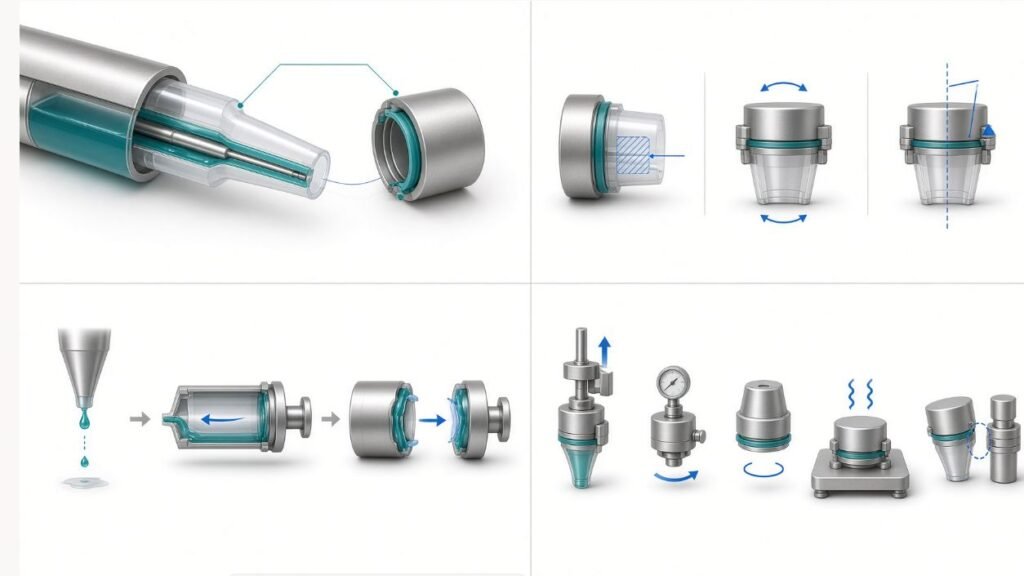
Residue at the closure interface is the most common visible defect on a gel bait syringe, and the most avoidable. It comes from three sources: gel that lands on the tip during fill, gel that migrates up the barrel wall during piston insertion, and gel that transfers from the piston or the rod during assembly. None of these is acceptable on a finished unit.
A working definition of acceptable residue at the closure interface should be agreed before FAT. Useful limits include:
- Visible gel on the outer tip surface (the surface the cap seats against). This breaks the seal; any visible film should be rejected.
- Visible gel on the cap's internal sealing surface. Same as above; the cap cannot seal against a contaminated surface.
- Gel strands between the tip and the cap during assembly. These indicate the fill cut-off or the closure seating is not clean. The fix is at the dosing or closure station, not at inspection.
- Residue at the piston-rod interface (where a rod is present). Visible residue here is a customer-experience defect even when it does not fail a leakage test.
The residue specification should be agreed in writing with photos of acceptable and rejectable units. A "clean by visual inspection" statement at FAT is not enforceable; a defined limit is.
Assembly and Retention at the Closure Station
The closure station has its own set of sub-problems, similar in structure to the piston-insertion station: alignment, support, retention and torque.
Alignment is set by the barrel nest, the cap feed and the seating tooling. The cap must enter the tip square to the bore; a cap inserted off-axis is rarely detected at the station and tends to fail later in vibration or pressure testing.
Support is set by the barrel nest. The barrel must be supported from outside during closure, not just held at the flange. A barrel held only at the flange can deform as the cap is pressed on, leaving the cap seated but the package distorted.
Retention is the force or torque needed to keep the cap on. Where the design uses friction, the press-in force and the pull-off force are defined by the drawing and verified during the trial. Where the design uses threads or a Luer lock, the torque window is defined by the drawing and verified on a calibrated tool.
Torque control (where threads are used) is a separate sub-system. A cap installed below the torque window will loosen in shipping; a cap installed above will crack the cap or the tip. The torque window is small and is verified with a calibrated tester on a sample of finished units.
The closure station is also where the line interacts with the orientation feature (where present). An asymmetric cap on a symmetric seating tool will produce random orientation; the tool must respect the feature.
Fit and Leakage Checks on the Finished Unit
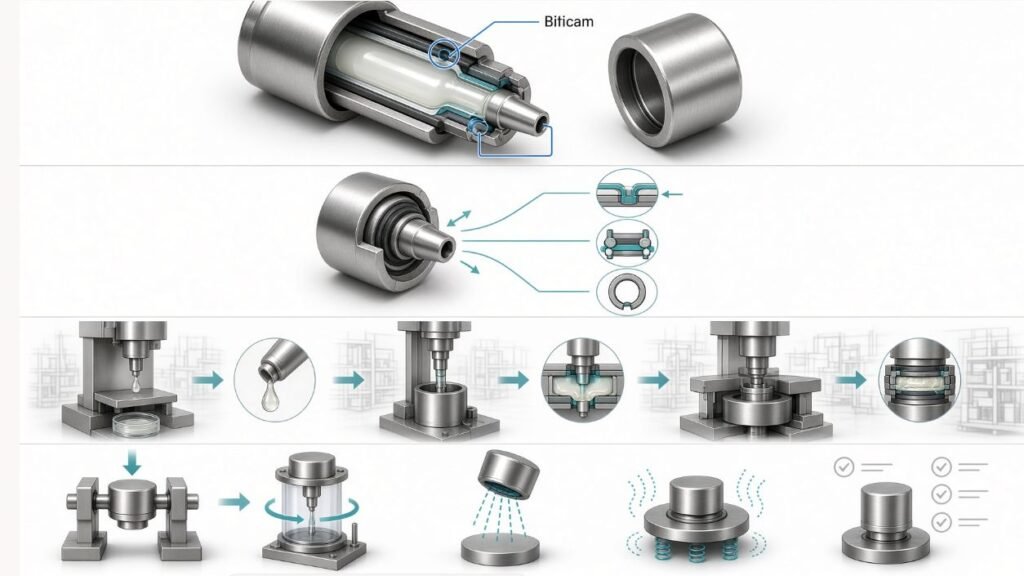
The matched closure set has to pass a defined set of fit and leakage checks before it is accepted. These checks are agreed with the package supplier and the buyer; they are not generic.
Useful checks include:
- Pull-off force test. A calibrated pull tester applies an axial force to the cap until it releases. The result is compared against the agreed minimum (retention) and maximum (ejectability) values.
- Pressure or vacuum test. A defined differential pressure (typically modest, because gel bait is not a sterile product) is applied to the closed package for a defined dwell time. Any visible leakage at the closure or the piston is a failure.
- Inversion test. The closed package is held inverted for a defined dwell time. Any gel migration toward the closure is recorded; the limit is set by the buyer and the package supplier.
- Vibration or drop test. A defined vibration profile (or a defined drop height) is applied to the packaged unit. After the test, the cap retention and the seal are re-checked. This is the closest a laboratory test comes to the actual shipping environment.
- Visual fit. The cap is inspected for full seating, orientation (where required) and the absence of visible damage on either the cap or the tip.
The test conditions are project-specific. The buyer should agree them with the package supplier before FAT, not at FAT, because the test conditions drive the closure station's settings and the inspection station's acceptance criteria.
Short-Term vs Shelf-Life Evidence
One of the most common misunderstandings in gel bait projects is the assumption that a short-term leakage test is also evidence of shelf-life performance. It is not. A cap that passes a one-hour pressure test at room temperature may fail after months of storage at elevated temperature, where the elastomer in the cap or the piston relaxes, or where the gel interacts with the closure material.
A practical position for a buyer is to keep the short-term tests as the line-acceptance gate, and to run a separate shelf-life test on a small sample of finished units. The shelf-life test is a project cost and a calendar cost; it does not block the FAT or the line acceptance, but it should be planned and resourced at the start of the project. The buyer should agree the storage conditions (temperature, humidity, orientation) and the inspection points (visual, weight loss, retention) with the package supplier and any regulatory consultant required by the target market.
A line that ships without a shelf-life plan tends to discover the relaxation or the interaction in the field, where the cost of correction is much higher than at the project stage.
Common Risks and Mistakes
- Treating the cap as a commodity. Caps and tips are matched sets; a cap from one supplier on a tip from another rarely seals the way either drawing claims.
- Accepting "clean by visual inspection." A defined residue limit with photos is enforceable; a generic phrase is not.
- Skipping the pull-off or torque test. Retention is a number; without a number, the closure is a guess.
- Confusing short-term leakage with shelf-life performance. Short-term tests gate the line; shelf-life tests gate the product.
- Designing the closure station without the orientation feature. An asymmetric cap on a symmetric seating tool produces random orientation, which fails field use.
- Borrowing pharmaceutical closure standards. Gel bait is not a sterile product; tightness and integrity targets are project-defined and are not inherited from PFS or vial closure standards.
How King Pack Supports This Application
King Pack Machinery (Wuxi King-Pack / Wuxi Jingpai Machinery Co., Ltd., founded 2009, with a core technical team carrying more than 20 years of industry experience) supports closure compatibility as part of the package review that precedes the line configuration. The relevant support is:
- Closure review before quotation. King Pack reviews the cap and tip drawings, the retention features and the orientation features, and confirms with the buyer which closure-station sub-systems are required.
- Closure tooling matched to the cap design. Seating nests, retention stations and torque tools are configured against the cap geometry provided by the buyer; torque windows and press-in forces are confirmed during the sample trial.
- Inspection scope agreed in writing. Residue limits, retention limits and leakage test conditions are agreed before FAT, so that acceptance is a comparison against an agreed list rather than a discussion at the test.
- Shelf-life evidence flagged as a separate workstream. King Pack notes that short-term line acceptance does not substitute for shelf-life evidence and supports the buyer in planning a separate shelf-life test where the project requires it.
King Pack does not claim a universal closure station that fits every cap and tip. The right station is the one matched to the buyer's matched closure set, against agreed test conditions.
Conclusion
Closure compatibility is a project-specific decision made on agreed test conditions, not a generic statement that "the cap fits the syringe." The work is to set the geometry, retention and orientation features first, agree the residue limit with photos, define the closure station against alignment, support, retention and torque, and run the fit and leakage tests at conditions the buyer has agreed with the package supplier. When those are in place, the closure is verified. When they are not, the cap is the part that tends to fail first in the field.
Ready to verify your closure set? Send your barrel, tip and cap drawings, two samples of each component in the incoming state, and the conditions your finished units must survive (vibration profile, storage condition, drop height). King Pack will confirm the closure-station scope and the test conditions the line must pass.
Last reviewed: September 14, 2026.