
Introduction
Running a single production line that handles both plastic pipettes and glass bottles sounds like an engineering compromise. In practice, with the right modular filling line architecture, it is one of the most commercially sound investments a veterinary or pharmaceutical manufacturer can make.
In this article, we explain how a modular filling line works, why the differences between pipette filling and glass bottle filling require specific engineering solutions in single dose pipette filling. We also cover the ROI case for multi-format filling lines and where our King Pack configurations fit into that picture.
Why Flexibility Is Critical in Modern Filling Lines
Growing Demand for Multi-Format Packaging in Pipette Filler
According to Grand View Research, filling machines led the pharmaceutical packaging equipment market and accounted for 35.6% of global revenue in 2024, with flexibility of modern filling machines allowing pharmaceutical companies to accommodate various container sizes and formulations, contributing to streamlined production processes.
The product mix that veterinary and pharmaceutical manufacturers are asked to supply has widened significantly. Spot-on treatments go into single-dose plastic pipettes. Oral liquids, ophthalmic drops, and tinctures go into glass dropper bottles. A manufacturer producing both product types on two separate dedicated lines is carrying twice the capital cost, twice the floor space requirement, and twice the validation burden.
Short Product Life Cycles and SKU Expansion
According to Global Growth Insights, with over 1,200 clinical trials in progress globally focusing on personalized therapies in 2024, the need for flexible, quick-changeover filling machines is rising, with modular machines that handle varied volumes and multiple container formats in particular demand across niche therapeutic producers.
Product launch cycles in veterinary pharmaceuticals have shortened. New combination antiparasitic formulas, weight-specific dosing variants, and seasonal product launches all create new SKUs that require filling capability quickly. A dedicated line for each SKU is neither practical nor financially viable. A multi-format filling line that can be reconfigured between formats in minutes is.
Cost Pressure to Avoid Multiple Dedicated Lines
According to GM Insights, the global modular packaging equipment market was valued at USD 14.2 billion in 2023 and is estimated to grow at a CAGR of over 5.2% from 2025 to 2034, driven by the high level of scalability modular systems provide, allowing companies to rapidly change packaging lines for new products without completely reconfiguring the whole system.
Floor space in a GMP facility is expensive. Every square meter allocated to a second dedicated filling line is a meter that cannot be used for storage, quality control, or future capacity expansion. A single modular filling line covering both pipette and glass bottle formats uses that space more efficiently.
Recommended Reading: Pharmaceutical Emulsion Mixer Machine: Vacuum Emulsifying Mixer Machine – King Pack Machinery
Key Differences Between Pipette and Glass Bottle Filling
Container Structure and Handling Requirements of Pipet Filler
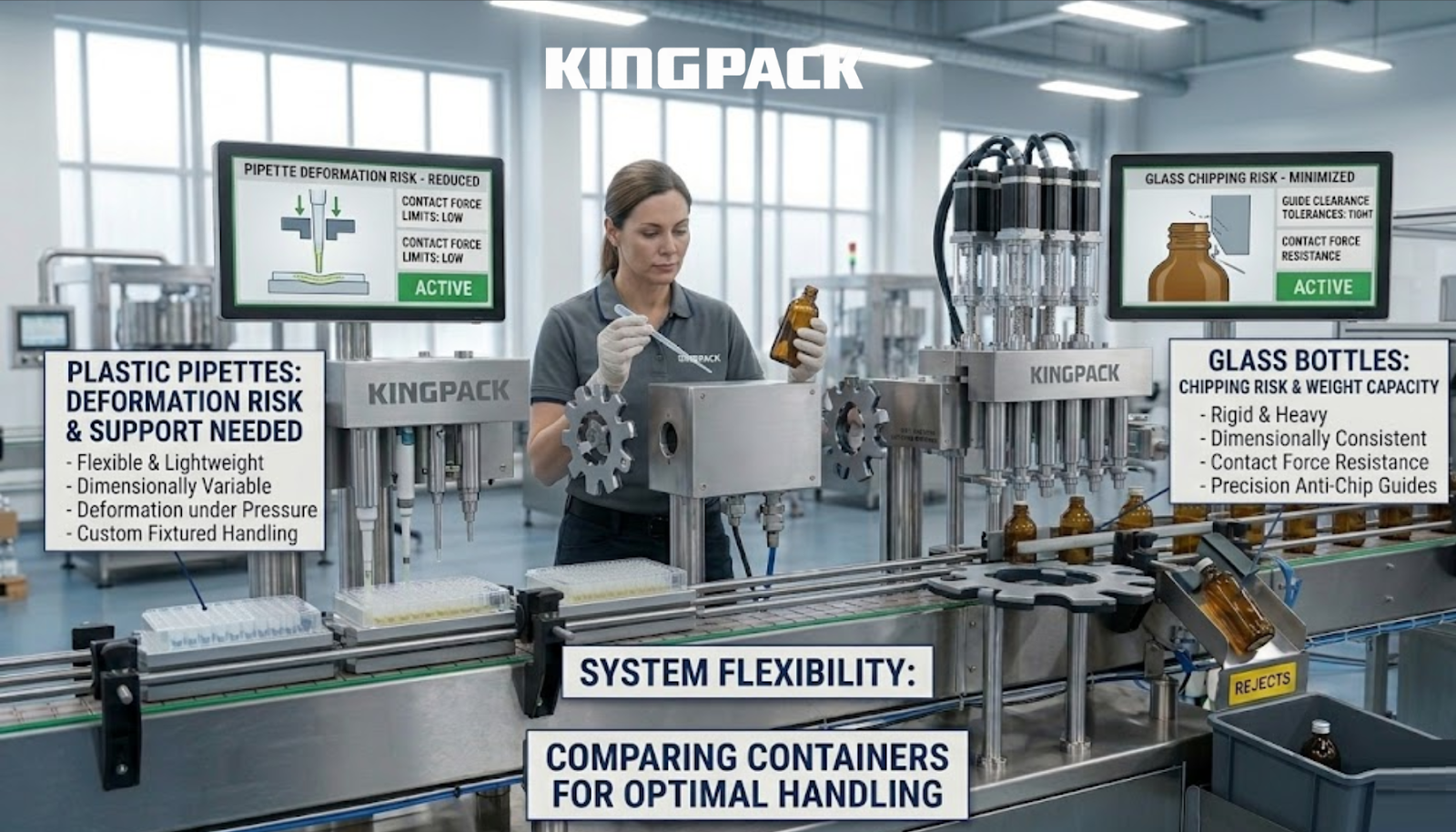
Plastic spot-on pipettes and glass dropper bottles differ in how they must be handled during filling. These differences define how a system is designed to operate with stability and accuracy.
Plastic pipettes are lightweight, flexible, and dimensionally variable. Many formats, including serological pipettes, can deform under pressure. Their narrow neck and unstable base mean they cannot stand during filling without a fixture. A pipet filler or manual pipette filler setup must hold each unit in place so the system can dispense the required aliquot without distortion. Controlled handling is critical to let the user achieve accurate filling at production speed.
Glass dropper bottles are rigid and stable. A glass pipette or bottle format can tolerate higher contact force without deformation. Their consistent shape supports smooth conveying. The risk shifts to surface damage. Impact must be controlled to avoid cracks or chips. The higher weight also requires the conveyor to adapt when switching between product types.
Filling Volume and Accuracy Expectations
| Container Type | Typical Fill Volume | Accuracy Requirement | Primary Challenge |
| Spot-on plastic pipette | 0.3 ml to 5 ml | ±1% | Micro-volume precision, oil viscosity |
| Veterinary dropper bottle | 5 ml to 30 ml | ±1% to ±2% | Bubble prevention, sterile filling |
| Oral liquid glass bottle | 15 ml to 100 ml | ±1% to ±2% | Consistent flow at higher volumes |
| Ophthalmic glass dropper | 3 ml to 15 ml | ±1% | Sterility, particle control |
At the pipette end, accuracy demands are strict. A 0.5 ml fill allows only ±0.005 ml deviation. The system must use controlled motion to dispense each dose with repeatable accuracy. This level of control is common in research and cell culture applications where serological tools are used for precise liquid handling.
Capping and Sealing Differences
Plastic pipettes are sealed through heat or twist-off tips. Glass bottles use inserts and screw caps. These caps must be applied with controlled force by the system, not by hand, to maintain seal quality.
Because of these differences, modular filling lines use interchangeable stations. One setup offers pipette formats, while another handles bottle sealing. This approach allows the same line to support a wide range of container types without compromising accuracy or stability.
Recommended Reading: How to Achieve ±1% Filling Accuracy for High-Value Pet Spot-on Treatments – King Pack Machinery
What Is a Modular Filling Line?
Definition and Core Concept
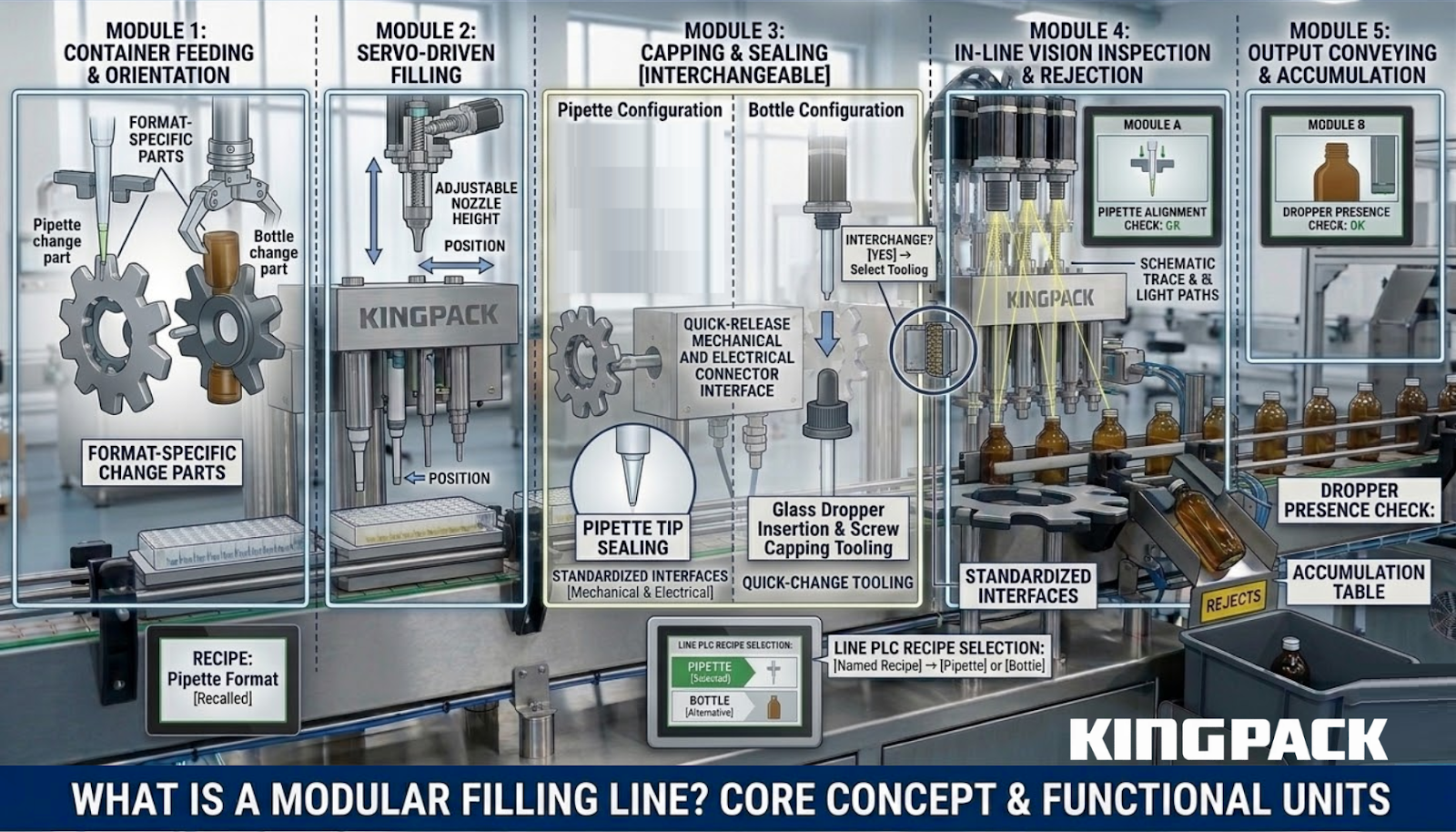
A modular filling line is built from independent units, each handling a defined step, connected through standardized mechanical and electrical interfaces. This structure makes the system easy to adjust, expand, or upgrade without redesigning the full line. Each module connects in a controlled sequence, much like components arranged in a box layout for clear process flow.
The difference from a conventional line is flexibility. A module can be removed or replaced without affecting the rest of the system. For example, a pipette sealing unit can be swapped for a glass bottle capping unit in the same frame. Operators can switch formats through a simple HMI press, with color coded settings that help avoid setup errors.
Typical Modules in a Flexible Filling System
A flexible system for pipettes and glass bottles includes these modules:
- Container feeding and orientation module, with format-specific parts for different shapes and sizes
- Servo-driven filling module with adjustable nozzle height and position to control volume and meniscus level
- Capping and sealing module with interchangeable tooling for multiple closure types
- In-line inspection and rejection module with clear visual feedback, often using blue or green indicators for status
- Output conveying and accumulation module designed for smooth transfer between stations
Each module runs under PLC control. Recipes are stored and recalled through the interface, so operators can switch formats quickly and keep operation consistent. This setup supports easy validation and stable performance across batches.
Engineering Design for Dual-Format Filling Capability
Adjustable Conveyor and Guide Rail Systems
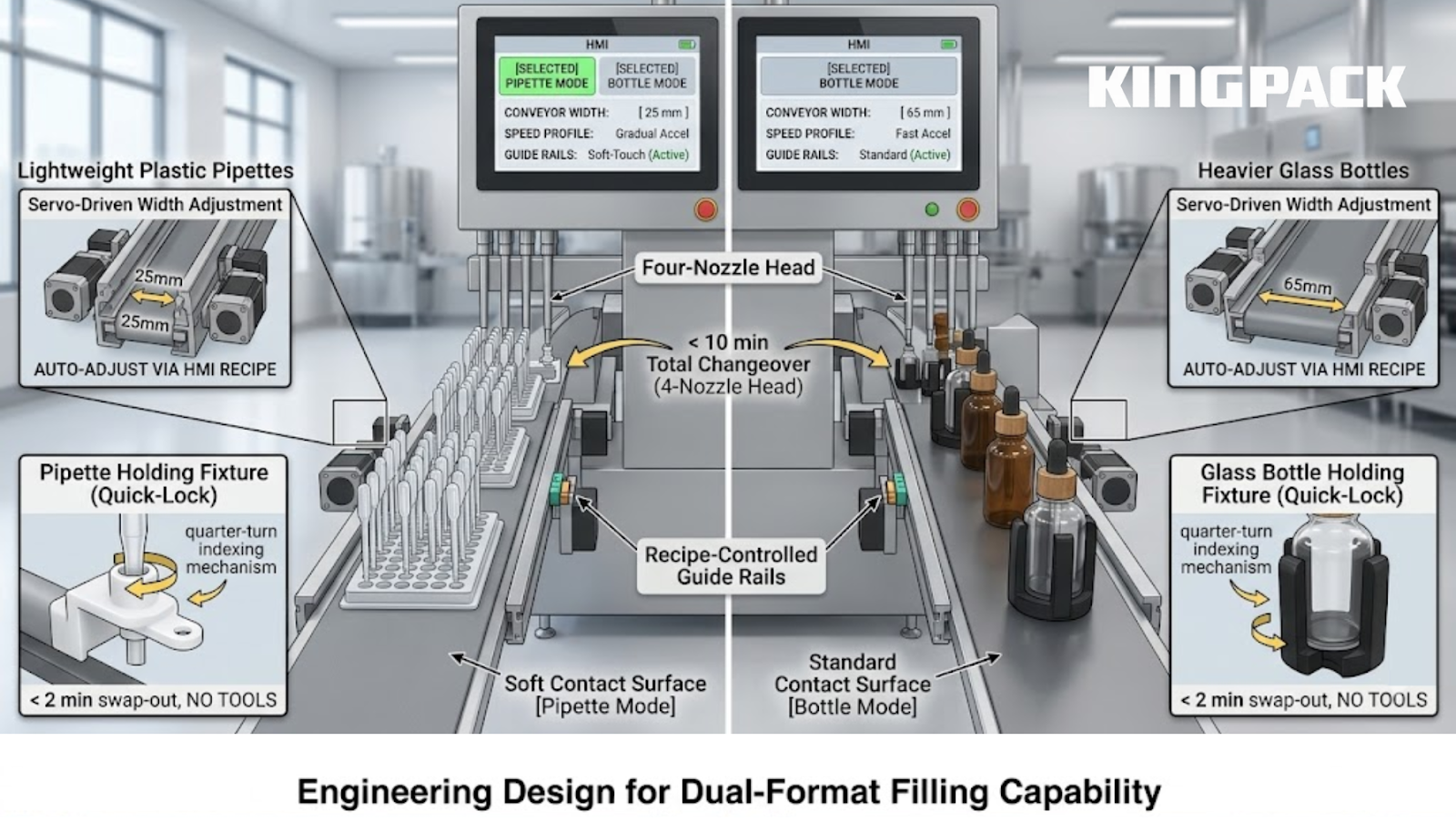
The conveyor must handle both lightweight pipettes and heavier glass bottles without manual change. Our modular lines use servo-driven width adjustment controlled through the HMI. Guide rails shift automatically when a new recipe is selected, which removes manual steps and reduces errors.
The surface and motion profile also change with the product. Pipettes move on a softer surface with controlled acceleration to prevent damage. Glass bottles run on a standard surface with higher speed. This controlled movement helps maintain fill accuracy and reduces risk during transfer.
Universal and Changeable Tooling Fixtures in Manual Pipette Filler
Tooling fixtures at the filling station are format-specific. A pipette holder supports thin walls during filling. A bottle holder keeps rigid containers stable.
Our quick-lock system allows fast changeover. Fixtures can be removed and installed without tools, using a quarter-turn lock. The system is designed for easy handling, with color coded points such as red or blue markers to guide correct placement. This reduces setup mistakes and keeps the process reliable.
A full changeover between pipette and bottle formats across a multi-nozzle head can be completed in minutes. This level of flexibility allows the same line to handle multiple product types without stopping production for long periods.
Achieving High Precision Across Different Formats
Servo-Driven Filling Systems
The filling mechanism must deliver ±1% accuracy at both ends of the format range, from a 0.5 ml spot-on pipette to a 30 ml glass dropper bottle. A single filling mechanism cannot achieve this through time-pressure control, because the flow dynamics at 0.5 ml and 30 ml are too different for a single pressure and timing combination to handle accurately.
Servo-driven piston filling solves this by controlling volume through physical displacement rather than inferred flow rate. The piston stroke is set digitally for each fill volume, and the servo motor executes that stroke with the same precision regardless of the target volume. A 0.5 ml fill and a 30 ml fill use the same mechanism, the same accuracy standard, and the same calibration verification process.
Our pharmaceutical and medical filling lines at King Pack use servo-driven piston dosing as the standard filling mechanism across all modular configurations, covering the full volume range from sub-milliliter pipette formats to larger glass bottle fills.
Recipe-Based Parameter Switching
Every format running on a multi-product filling line has a defined set of production parameters: fill volume, fill speed, nozzle height, conveyor width, conveyor speed, capping torque, and inspection thresholds. On a conventional integrated line, switching between formats requires manual adjustment of each of these parameters in sequence, which is time-consuming and introduces the risk of incorrect settings.
Our modular filling line configurations store all of these parameters together as a named product recipe in the line PLC. When the operator recalls a recipe through the HMI, all parameters update simultaneously. The line is ready to run the new format as soon as the physical tooling change is complete.
This recipe management approach also supports compliance documentation. Each recipe is version-controlled, and the recipe version active during a production batch is automatically recorded in the electronic batch record. Changes to a recipe require authorized access and generate an audit trail entry.
Consistent Flow Control for Different Liquid Types
Oil-based spot-on formulations and aqueous glass bottle products behave differently inside a filling system. Oil is viscous, sensitive to temperature, and can string at the nozzle. Aqueous solutions are low-viscosity and tend to foam or trap air.
Our flexible filling system manages both through interchangeable nozzle assemblies. Each setup is selected based on the liquid property and how the system must aspirate and dispense it during the filling cycle. For oil-based pipette products, the nozzle includes anti-drip shut-off with vacuum cut-off to pull liquid back cleanly. This creates a more powerful controlled finish at the tip.
For aqueous glass bottle products, a bottom-up filling nozzle is used. It fills from the base and allows air to escape upward as liquid rises. This method reduces foam and keeps the fill stable. The addition of this controlled flow approach improves accuracy and consistency across different product types.
The nozzle change is part of the standard format changeover. It uses the same tool-free quick-lock connection as the holding fixtures, so operators can complete the switch quickly without interrupting production for long.
Recommended Reading: No More Overflow: Bottom-Up Filling Technology for High-Foam – King Pack Machinery
Quick Changeover: The Core of Modular Efficiency
Tool-Free Changeover Design
The commercial value of a modular filling line depends entirely on how fast and reliably it can switch between formats. A changeover that takes four hours provides far less flexibility than one that takes thirty minutes. The engineering decisions that determine changeover time are made at the design stage, not during installation.
We design every wetted component connection on our modular lines for tool-free removal. Tri-clamp connections replace threaded fittings on all product contact parts. Filling head assemblies separate from the dosing unit without tools. Nozzle assemblies, container fixtures, and conveyor guide components all use indexed quick-lock connections that allow removal and replacement in seconds.
Digital Recipe Recall via HMI
Physical changeover and digital parameter switching must happen in parallel for changeover time to be minimized. Our HMI-based recipe management allows the operator to recall the new format recipe at the start of the physical changeover. By the time the physical tooling swap is complete, all electronic parameters have already updated. The line is ready to run immediately after the last physical component is locked into place.
According to Packaging World’s analysis of changeover efficiency in pharmaceutical lines, manufacturers who implement recipe-driven format changeover with tool-free mechanical design consistently report changeover time reductions of 60% to 75% compared to conventional manually adjusted lines, directly increasing the number of production runs achievable per shift.
Reduced Downtime Between Batches
The financial impact of changeover time reduction is direct. Every hour a filling line spends changing over between formats is an hour it is not producing. For a line running at 4,000 units per hour, reducing changeover time from three hours to forty-five minutes recovers 2.25 hours of production time per changeover event.
At ten changeover events per month, that recovery represents 22.5 hours of additional production capacity monthly, without any change to the line speed or operating hours.
Automation Integration in Modular Filling Lines
Integration with Capping, Labeling, and Cartoning
A modular filling line gains its full value when filling, capping, labeling, and cartoning are all integrated into a continuous automated process. Each downstream module receives the container from the previous module through a controlled transfer that maintains orientation, spacing, and speed without manual intervention.
Our modular filling line designs at King Pack include integration interfaces for capping, labeling, and cartoning modules from the base configuration. Manufacturers can start with filling and capping, then add labeling and cartoning as production volume grows, without modifying the filling core.
Robotic Handling for Format Switching
For manufacturers running frequent format changes between pipettes and glass bottles, robotic pick-and-place systems at the container feed and output stations handle the format transition automatically. The robot end-of-arm tooling changes with the format, controlled by the same recipe system that updates the filling and capping parameters.
This eliminates the manual container handling steps that are the most common source of damage and contamination during format switching on a multi-product filling line.
Vision Inspection for Multi-Format Quality Control
An inline vision system configured for multi-format inspection verifies fill level, cap presence, label position, and container integrity for each format using format-specific inspection parameters stored in the product recipe. When the recipe switches, the inspection parameters switch with it.
According to Cognex’s manufacturing automation analysis, vision systems integrated into automated production lines reduce defect escape rates by up to 90% compared to manual end-of-line inspection, while operating continuously at production speed without the fatigue-related performance degradation that affects human inspectors over long shifts.
Recommended Reading: Vial Filling Machines & Processing Solutions – King Pack Aseptic Systems – King Pack Machinery
ROI Benefits of Modular Filling Systems
Reduced Investment in Multiple Lines
The most direct financial benefit of a modular filling line is the avoidance of a second dedicated line. A single flexible filling system covering both pipette and glass bottle formats typically costs 30% to 50% more than a single-format dedicated line, but significantly less than two dedicated lines. The capital saving, combined with the floor space saving, makes the modular approach financially compelling for most multi-product manufacturers.
Improved Equipment Utilization Rate
A dedicated pipette filling machine that runs pipette batches for three days per week sits idle for the remaining two days. A modular filling line running pipette batches for three days and glass bottle batches for two days achieves close to full utilization across the production week. Higher equipment utilization directly improves the return on the capital invested in the line.
Faster Time-to-Market for New Products
When a new product format is introduced, a modular filling line requires only a new set of change parts and a new recipe, not a new line. The change parts are designed and manufactured while the line continues to produce existing products. The new format is introduced during a planned changeover event, with no production downtime beyond the standard changeover time.
| Benefit | Dedicated Lines | Modular Filling Line |
| Capital investment | High (one line per format) | Moderate (one line for all formats) |
| Floor space requirement | High | Low to moderate |
| Changeover time | Hours to days | 30 to 60 minutes |
| New product introduction | New line required | New change parts and recipe |
| Equipment utilization | Low to moderate | High |
Lower Changeover and Labor Costs
Quick-changeover filling machine design reduces the labor hours spent on each format transition. Fewer operators are needed during changeover, and the reduced changeover time means fewer overtime hours to recover lost production following a format switch.
Common Design Mistakes in Flexible Filling Lines
Manufacturers who invest in modular filling line capability but specify the equipment incorrectly consistently encounter the same problems:
- Overcomplicated mechanical design with too many adjustment points, making changeover faster on paper than in practice
- Slow changeover due to manual adjustments that were not replaced with tool-free equivalents during design, negating most of the modular efficiency benefit
- Poor compatibility between modules from different suppliers, creating integration problems at commissioning that delay production startup
- Ignoring liquid property differences between formats, then discovering that the same nozzle configuration cannot handle both oil-based pipette products and aqueous glass bottle products accurately
- Lack of standardized tooling across similar container sizes, requiring a separate set of change parts for each individual SKU rather than covering a range with a single set
Why King Pack Modular Filling Lines Deliver True Flexibility
At King Pack, our modular filling line designs are built around the practical requirement to switch between pipette filling and glass bottle filling quickly, accurately, and with minimal operator intervention. We design the tooling, the recipe system, the conveyor adjustment, and the nozzle configuration as an integrated system, not as independent components that the customer must make work together.
Our multi-format filling line configurations cover spot-on pipette filling from 0.3 ml to 5 ml and glass dropper bottle filling from 3 ml to 100 ml on the same line platform. Servo-driven piston dosing delivers ±1% accuracy across the full volume range. Tool-free change parts and HMI recipe management bring changeover time to under one hour for a full format switch.
For veterinary manufacturers running spot-on pipettes alongside ophthalmic or oral liquid glass bottle products, our flexible filling system provides a single validated platform for both product categories, with full GMP documentation support for the line qualification and cleaning validation required for each format combination.
Contact King Pack to design a customized modular filling line that supports both pipette and glass bottle production on one platform.