
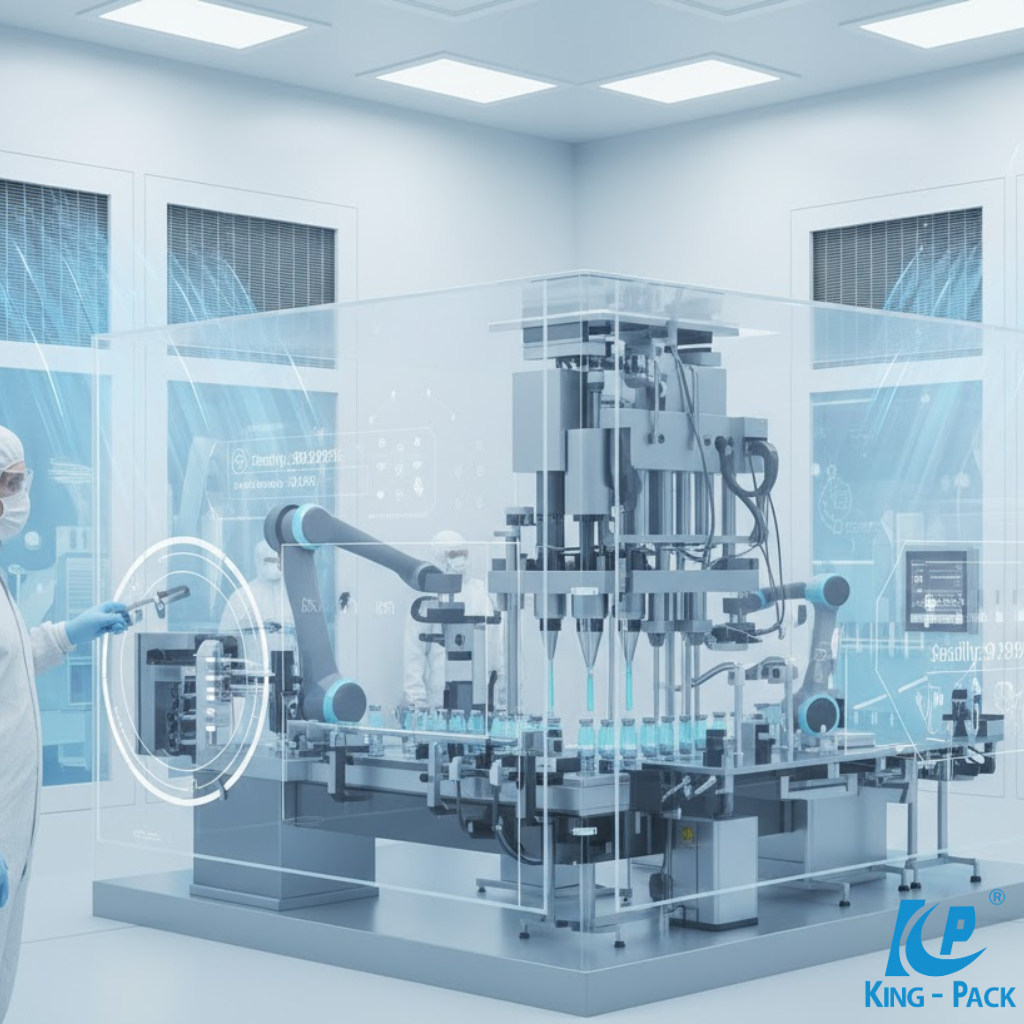
An aseptic vial project must coordinate container preparation, filling, stoppering, capping, environmental control and batch documentation. This guide focuses on line design: the critical zone, RABS or isolator integration, depyrogenation interfaces, monitoring and validation. For machine options by liquid, powder and lyophilized product, see King Pack’s vial filling machines and complete processing lines.
Use this article as an engineering-planning guide rather than a universal specification. Cleanroom classification, barrier strategy, product-contact materials, dosing limits, data records and acceptance criteria must be defined for the actual product and facility.
Challenges & Objectives in Vial Processing
Microbial, particulate and endotoxin risks must be controlled throughout injectable-product processing. The appropriate controls are determined through the site contamination-control strategy, product risk assessment and applicable regulatory requirements—not from a general contamination percentage.
No filling machine alone can guarantee sterility. Equipment design should support the manufacturer’s validated process through controlled product paths, cleanable surfaces, appropriate barriers, monitoring and defined operator interventions.
Critical filling and stoppering operations can be arranged under suitable unidirectional airflow, RABS or isolator protection. Needle, pump, valve and product-path choices should be based on the formulation, fill volume, cleaning method and required intervention strategy.
Enclosures, RABS and isolators can reduce open exposure at critical operations. The selected barrier, airflow, transfer method and monitoring plan must align with the facility’s contamination-control strategy and be verified during qualification.
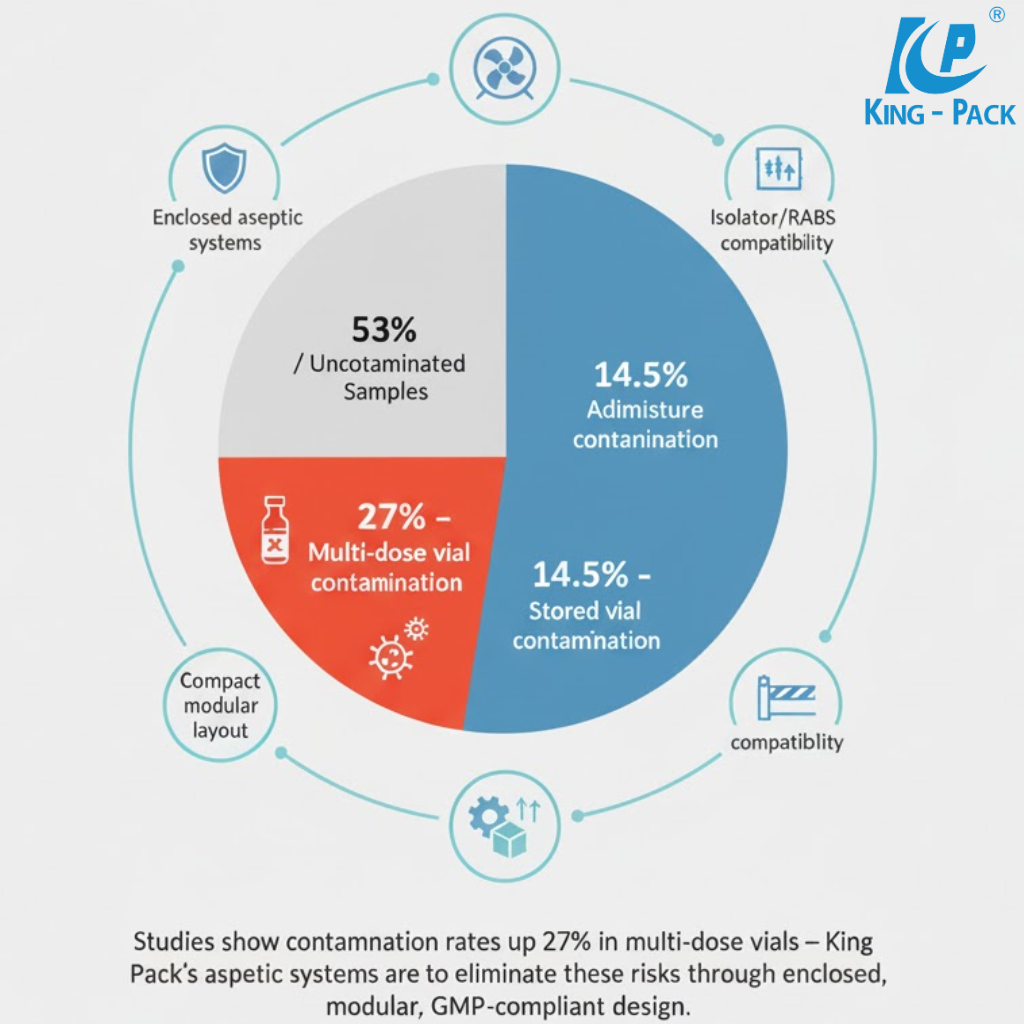
Cleanroom zoning and available floor space affect line layout. Integrating washing, drying or depyrogenation, filling, stoppering and capping can reduce transfer points, but maintenance access, operator flow and safe interventions must remain part of the design.
A coordinated line can simplify container transfer and controls. Servo-driven dosing, torque monitoring, component feeding and change parts are selected project by project; their repeatability and changeover performance should be demonstrated with the actual containers and components.
HMI and PLC controls can manage recipes, alarms and operating parameters, while coding, inspection and labelling systems can be connected downstream. Required access levels, audit records and data interfaces should be defined in the URS.
RABS or isolator compatibility should be decided from the contamination-control strategy, required interventions, component transfer, decontamination method and available cleanroom infrastructure. The layout must allow safe operation, cleaning and maintenance without compromising the critical zone.
Reduced manual transfer can support a more controlled process, but waste handling, cleaning access, utilities and drainage restrictions are facility-specific. These interfaces must be reviewed during layout and design qualification.
Equipment can be designed to support a GMP project and the required cleanroom interfaces, but compliance applies to the validated facility, process and quality system as a whole. Material certificates, drawings, control records and acceptance tests should be included according to the project scope.
Recommended Reading: Maintenance Tips for Vial Filling Machines to Ensure Longevity – King Pack Machinery
Core Modules of the Vial Processing Line
Washing & Depyrogenation (Container Decontamination)
Vials used in pharmaceutical production often contain traces of glass dust, lubricants, or manufacturing residues. These contaminants can compromise drug purity if not removed properly. Washing is the first step in vial preparation.
Purified water or Water for Injection (WFI) sprays both inside and outside each vial, dislodging particles and residues. Multi-stage washers combine ultrasonic cleaning, pressure rinsing, and filtered air drying to achieve consistent results.
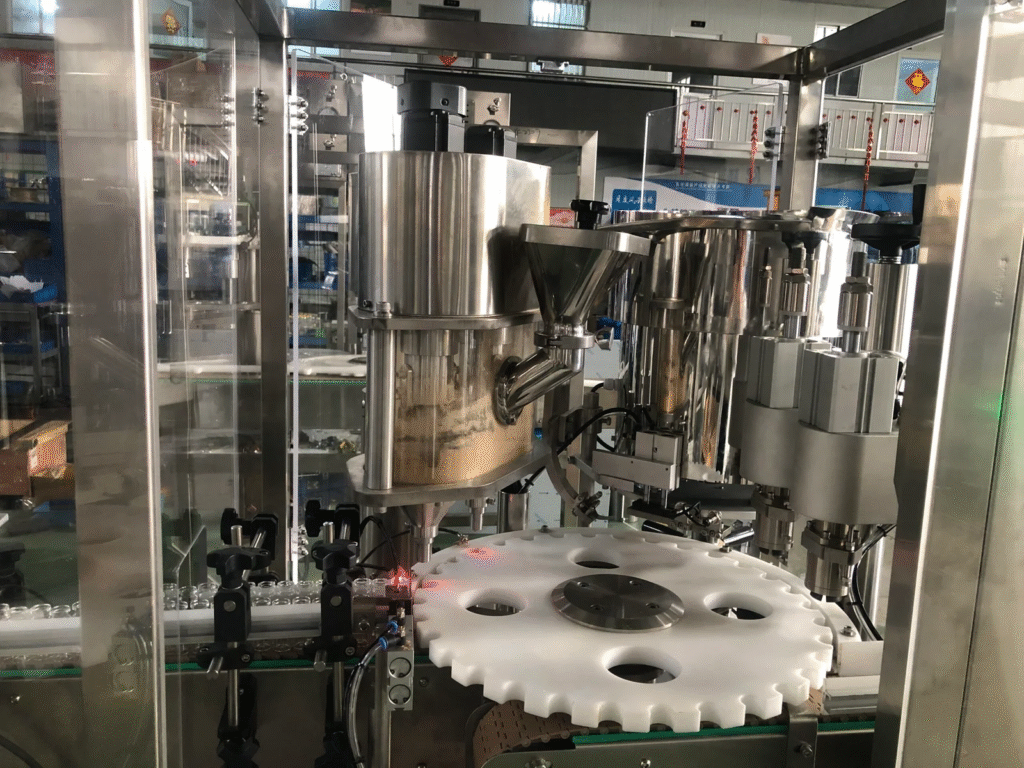
After washing, depyrogenation removes endotoxins that could cause fever or immune reactions in patients. This process uses high heat to destroy pyrogenic substances on the vial surface.
Depyrogenation tunnels maintain stable temperatures between 250–350°C for 30–60 minutes.
According to FDA and WHO guidelines, these conditions achieve a minimum 3-log reduction in endotoxin levels, ensuring vials are sterile and safe for aseptic filling.
King Pack’s integrated washing and depyrogenation systems minimize handling between stages. Vials move automatically from the washer into the depyrogenation tunnel under a protected environment, preventing recontamination.
Control parameters, recipe management and batch records should be defined in the URS. Their operation, access controls and traceability functions must then be tested during FAT, site qualification and process validation as applicable.
Key washing parameters:
| Process item | Define and verify |
| Washing recipe | Water quality, spray sequence, container coverage and drying |
| Depyrogenation tunnel | Temperature profile, airflow, belt speed and container load |
| Acceptance criteria | Required endotoxin reduction and study protocol |
| Line interface | Transfer protection, pressure cascade and monitoring points |
Aseptic Filling & Stoppering (Liquid / Powder Filling)
Filling is one of the most critical operations in sterile drug manufacturing. It must be performed under Grade A aseptic conditions, equivalent to ISO Class 5 air cleanliness. These areas are dedicated to high-risk activities such as vial filling, stopper bowl handling, and product transfer.
Laminar airflow systems deliver a steady stream of HEPA-filtered air, maintaining particle-free zones and protecting the open vials during filling.
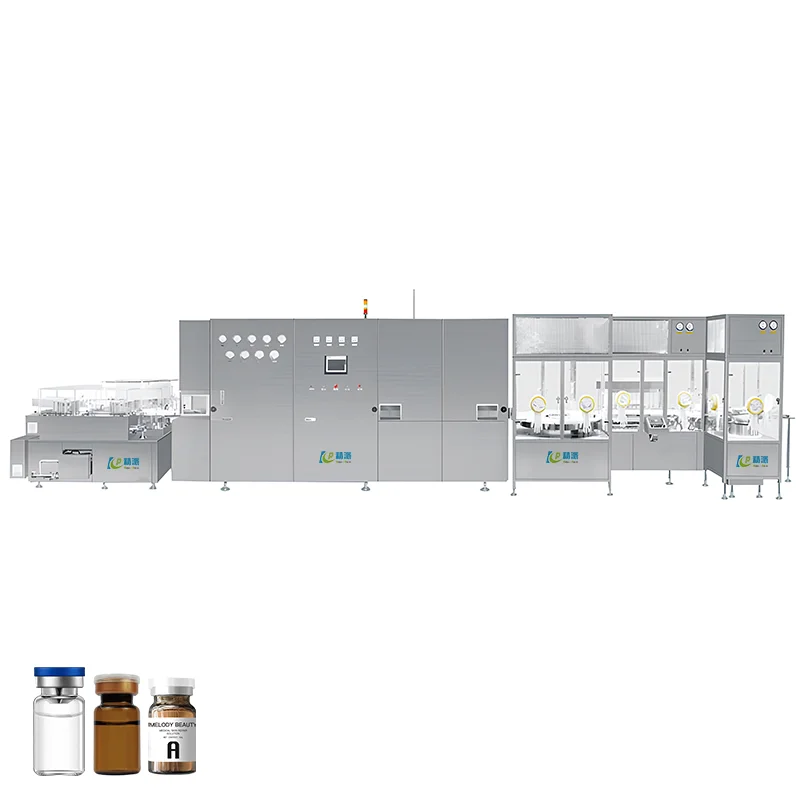
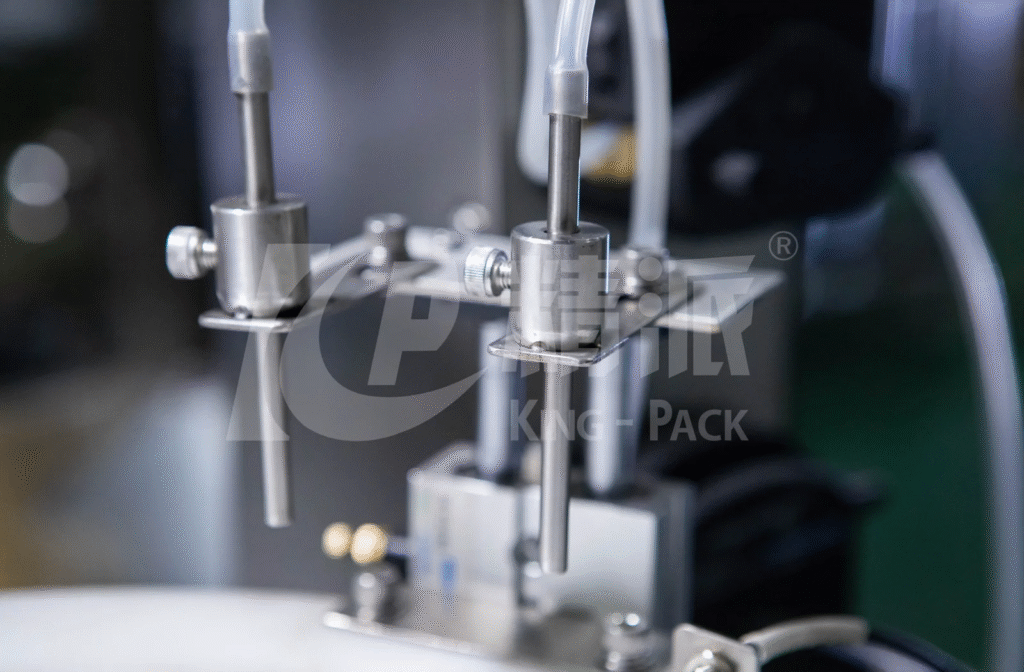
Different pharmaceutical formulations require different filling mechanisms. King Pack’s vial filling systems are designed for flexibility, precision, and contamination control.
- Piston filling – Often considered for viscous liquids; accuracy must be verified across the required fill range.
- Peristaltic pump filling – Suitable for biologics and vaccines, preventing shear stress.
- Time-pressure filling – Adjusts to liquids with varying viscosities.
- Powder filling – Supports lyophilized and dry pharmaceutical products.
Filling accuracy depends on the dosing principle, formulation, fill range, speed and sampling method. Agree the acceptance limit and test protocol in advance, then verify performance with production-equivalent material during trials and FAT.
Stoppering should occur within the defined critical zone, with the stopper feed, placement method, interventions and airflow protection designed for the process. The configuration and acceptance tests depend on the vial, stopper and barrier system.
| Design item | Project decision | Verification |
| Critical zone | Barrier and airflow concept | Qualification and intervention assessment |
| Dosing | Pump type and fill range | Product trial and agreed accuracy test |
| Stoppering | Closure feed and placement method | Container-closure challenge |
| Monitoring | Alarms, sensors and records | FAT/SAT functional tests |
| Output | Target rate and batch pattern | Demonstrated stable run with project materials |
An integrated filling and stoppering system can reduce manual transfer and support controlled processing. Sterility assurance, fill accuracy and closure performance still require defined procedures, qualification and ongoing process monitoring.
Recommended Reading: A Detailed Guide to Vial Filling Machine Types – Principles and Selection | King Pack – King Pack Machinery
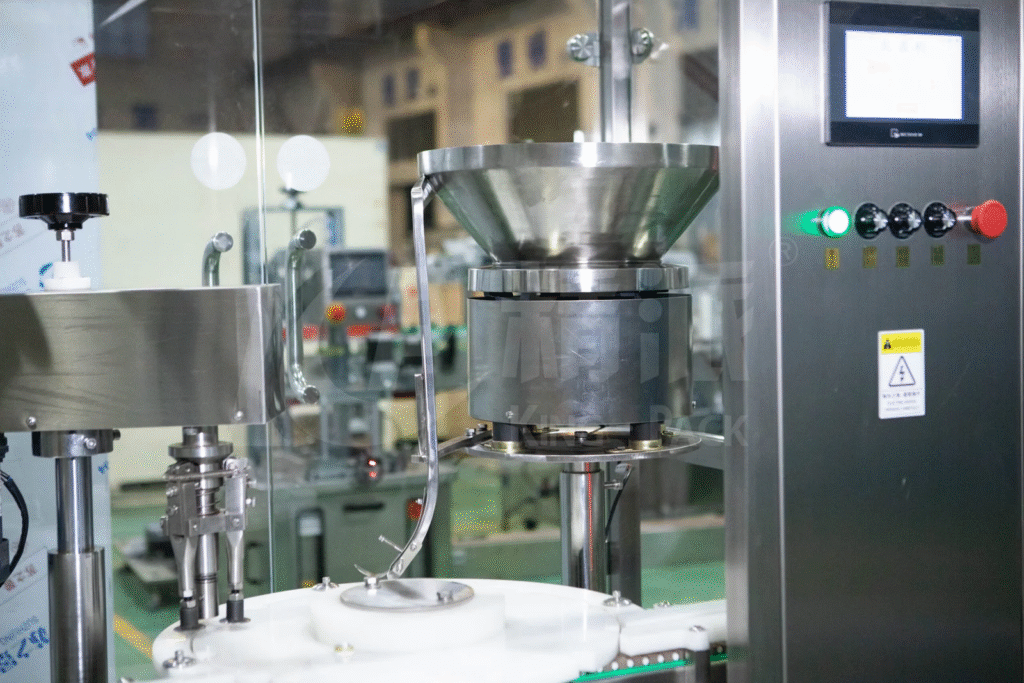
Capping & Closure (Aluminum, Flip-Off, Bio-Set, etc.)
The capping stage provides the final mechanical seal that protects sterile vials from contamination and leakage. After stoppering, aluminum caps are crimped securely over the rubber stoppers using controlled mechanical pressure.
The capping process must achieve the closure specification defined for the vial, stopper and cap system. Acceptance criteria can include visual checks, crimp dimensions and project-specific container-closure tests.
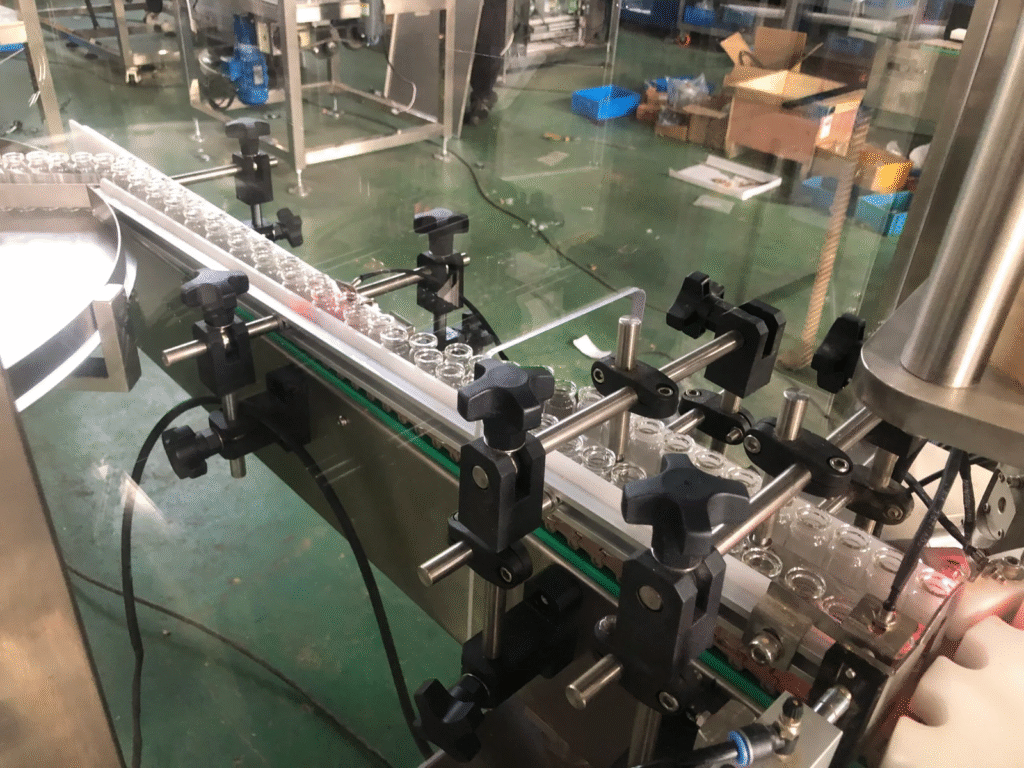
Common closure styles include:
- Aluminum flip-off caps – Allow easy access while maintaining tamper evidence.
- Tear-off caps – Used for products requiring complete removal before use.
- Color-coded caps – Aid in quick batch or formulation identification.
- Tamper-evident seals – Provide visible proof of product integrity.
Vial capping systems may use force or torque monitoring and vision inspection to check cap presence, position or crimp quality. Detection capability and reject logic must be challenged with agreed defect samples; no inspection system should be described as universally 100% accurate.
King Pack’s automatic vial capping machines integrate seamlessly with upstream filling and stoppering units. Their synchronized operation maintains line balance and avoids bottlenecks. Quick-change tooling supports multiple vial diameters and closure types, reducing downtime between product runs.
| Closure item | Confirm before design | Acceptance check |
| Vial, stopper and cap | Drawings, samples and tolerance range | Feeding, placement and handling trial |
| Crimp process | Required closure specification | Defined seal and visual criteria |
| Vision inspection | Defect classes and reject logic | Challenge set and reject verification |
| Changeover | Format range and parts | Documented changeover trial |
Capping and inspection equipment can support repeatable closure processing when correctly configured and qualified. Regulatory compliance depends on the manufacturer’s validated process, specifications and quality system.
Labelling (Self-Adhesive Label Application, Vision Inspection)
Labels carry critical product information. Regulatory requirements demand accuracy and readability. Automated systems apply labels consistently.
King Pack’s vial labelling machine features:
- Label placement tolerance defined for the selected container and label
- Multiple label stations for front/back application
- Barcode verification systems
- Vision inspection for quality control
Inspection systems verify:
- Label presence
- Correct orientation
- Print quality and readability
- Expiration date accuracy
Rejection mechanisms remove defective units automatically. Traceability systems track every vial through production.
Advanced Line & System Solutions
Integrated Turnkey Vial Filling & Capping Lines
Complete production lines eliminate integration challenges. King Pack provides end-to-end solutions from washing through inspection.
A typical automatic vial filling system includes:
- Vial washing and depyrogenation
- Aseptic filling and stoppering
- Visual inspection
- Capping and crimping
- Labeling and coding
- Final inspection
- Packaging
Single-source responsibility simplifies validation. All components communicate through unified control systems. This reduces complexity and improves reliability.
Flexible Configurations for Liquids, Powders, and Mixed Use
Modern pharmaceutical vial filling line equipment handles multiple product types. Changeover capabilities reduce downtime between batches.
Configuration options:
| Application | Typical dosing option | Key factors |
| Liquid products | Piston, peristaltic or time-pressure | Viscosity, sensitivity, fill range and product loss |
| Powder products | Project-specific powder dosing | Flowability, dose, containment and cleaning |
| Lyophilized products | Liquid filling with partial stoppering | Freeze-dryer transfer and stopper position |
| Suspensions or viscous products | Selected after material trials | Homogeneity, temperature and settling behavior |
Tool-free format changes accommodate various vial sizes. Recipe management stores parameters for each product. Operators switch formulations through touchscreen controls.
Automation, Modular Design, and Minimal Human Intervention
Automated systems reduce contamination risks. Grade B areas require particle monitoring systems with alarms when limits exceed specifications. Automation minimizes operator presence in critical zones.
Modular construction allows phased expansion. Manufacturers start with core filling capabilities. They add inspection, packaging, and downstream equipment as production grows.
Remote monitoring provides real-time performance data. Predictive maintenance identifies issues before failures. This maximizes uptime and production efficiency.
Material Handling & Loading Systems
Tray Loading and Unloading (Automatic Systems)
Vials move through production in specialized trays or nests. Automated loading eliminates manual handling in sterile zones.
Tray systems offer several advantages:
- Consistent vial orientation
- Protection during transport
- Compatible with freeze-drying
- Simplified tracking
Robotic systems load empty vials at line start. After processing, unloading systems transfer filled vials to secondary packaging. Vision systems verify tray loading accuracy.
Vial Feeding / Buffering & Integration with Other Equipment
Buffer zones prevent line stoppages. Accumulation conveyors store product between processing stages. This maintains continuous flow despite speed variations.
King Pack’s sterile vial filling solutions include optimized buffering. Proper spacing prevents vial collisions. Star wheels and timing screws provide precise positioning.
Integration with upstream equipment creates seamless workflows:
- Filling machines feed directly to inspection
- Approved vials transfer to capping
- Rejected units route to quality review
- Finished products move to cartoning
Recommended Reading: World Top 10 Vial Filling Machine Manufacturers – King Pack Global Pharma Solutions – King Pack Machinery
Supporting Technologies (Sterilization, Drying, etc.)
Depyrogenation Tunnels & Dry Heat Sterilizers
Depyrogenation tunnels use dry heat for container sterilization. Temperature zones gradually heat vials to prevent thermal shock. Peak temperatures destroy endotoxins effectively.
Tunnel zone configuration:
| Tunnel zone | Design purpose | What to verify |
| Preheat | Controlled container heating | Temperature ramp and container stability |
| High-temperature zone | Required depyrogenation exposure | Heat distribution and endotoxin challenge study |
| Cooling | Protected transfer to filling | Cooling profile, pressure and environmental protection |
Tunnel validation confirms heat distribution. Temperature mapping identifies cold spots. Biological indicators verify sterilization effectiveness.
Drying, Heat Treatment, and Thermal Management
Moisture elimination prevents microbial growth. Drying systems use HEPA-filtered air in controlled environments. Temperature and humidity monitoring confirms specifications.
Heat treatment serves multiple purposes:
- Container depyrogenation
- Component sterilization
- Product lyophilization
- Terminal sterilization
Thermal management maintains product stability. Cold chain requirements demand precise temperature control. King Pack equipment includes validated thermal systems.
Recommended Reading: How to Choose the Right Vial Filling Machine for Your Business – King Pack Machinery
Choosing King Pack vs Others
Performance under GMP / cGMP Requirements
Cleanroom grades and critical-zone requirements depend on the operation and applicable regulations. King Pack can configure equipment interfaces, materials and documentation to the project URS; final GMP compliance is established through the customer’s facility and validation program.
Documentation packages include:
- Design Qualification (DQ)
- Installation Qualification (IQ)
- Operational Qualification (OQ)
- Performance Qualification (PQ)
Validation support accelerates regulatory approval. Factory Acceptance Testing (FAT) confirms performance before shipment. Site Acceptance Testing (SAT) verifies proper installation.
Cost Efficiency, After-Sales Support, Customization
Investment analysis considers total cost of ownership. Energy-efficient components reduce operating expenses. Reliable operation minimizes costly downtime.
King Pack provides comprehensive support:
- Installation and commissioning services
- Operator training programs
- 24/7 technical assistance
- Spare parts availability
- Preventive maintenance planning
Customization addresses unique production requirements. Equipment specifications match exact product characteristics. Bottle sizes, fill volumes, and production speeds all factor into designs.
Compatibility with Isolators, RABS, or Cleanrooms
Grade A operations often use isolators or laminar flow cabinets within Grade B backgrounds. King Pack’s pharmaceutical vial filling line equipment integrates with all barrier technologies.
System compatibility:
- Open cleanroom installations
- Passive RABS configurations
- Active RABS with dedicated airflow
- Full isolator systems with H2O2 decontamination
- Hybrid combinations
Pressure differentials maintain directional airflow. Continuous monitoring confirms environmental parameters. Alarm systems alert operators to excursions immediately.
Recommended Reading: Everything You Need to Know About Vial Packaging Machines – King Pack Machinery
Conclusion
King Pack delivers complete vial filling and processing solutions. From washing through labeling, our systems handle every production stage. We design systems for both small-scale R&D labs and large pharmaceutical manufacturers, with full flexibility for vial sizes, fill volumes, and production speeds.
Partner with King Pack today to develop a vial filling line that supports your growth and upholds pharmaceutical precision at every stage.