
H1: How Much Does an Intramammary Syringe Filling Machine Cost?
The cost of an intramammary syringe filling machine cannot be stated responsibly as one universal price. The final quotation depends on the formulation, syringe geometry, filling direction, dosing method, number of heads, cap or plunger operations, inspection, change parts, cleaning requirements, documentation, FAT, installation and downstream packaging scope.
For a useful budget, separate the initial equipment quotation from total cost of ownership (TCO). A lower machine price may exclude format tooling, product trials, factory acceptance testing, spare parts, installation preparation or training. A higher quotation may include more of those items. Comparing totals without comparing scope can produce a misleading procurement decision.
This guide gives a practical way to structure an intramammary syringe filling machine cost request without inventing a market price. It is written for veterinary pharmaceutical manufacturers, contract fillers, engineering teams and procurement managers evaluating non-sterile applicator projects. If the project is for a sterile injectable prefilled syringe, the process boundary and facility requirements must be defined separately.

*Caption: A useful budget review compares technical scope, acceptance evidence and lifecycle responsibilities—not only the machine line item.*
Quick answer: what determines the cost?
The largest cost drivers are usually:
1. Product behavior and the required feed, heating, agitation, deaeration or dosing arrangement. 2. Syringe format, cap, plunger and bulk presentation. 3. Filling direction and the number of automated assembly operations. 4. Number of heads, output assumptions and the difference between rated and saleable capacity. 5. Inspection, reject handling, coding, labelling and downstream packaging. 6. Change parts, format range, cleaning access and product-contact materials. 7. Sample testing, FAT, documentation, installation preparation, training and spares.
The right budget question is therefore not “What is the price of a 10 ml intramammary filler?” It is “What complete configuration, evidence and lifecycle support are required for this product, package and production plan?”
1. Define the quotation boundary first
Before requesting a number, write a one-page scope statement. State whether the project includes only product filling or a complete applicator line.
Potential scope items include:
- empty barrel feeding and orientation;
- product filling and nozzle cut-off;
- cap or tip placement;
- plunger or piston insertion;
- in-process weighing or visual inspection;
- reject collection and reconciliation;
- coding, labelling and cartoning;
- manual loading or automatic component feeding;
- change parts for additional formats;
- FAT, commissioning, training and documentation.
Mark every item as included, excluded, optional or subject to sample confirmation. This avoids the most common cost-comparison error: one supplier prices a dosing machine while another prices filling, capping, inspection and discharge.
2. Product behavior creates equipment scope
An intramammary formulation may be a cream, ointment, suspension, gel or teat sealant. The product can influence the hopper, pump or piston, hose, nozzle, cut-off, temperature conditioning, agitation and cleaning workflow.
Prepare the following before asking for a quotation:
| Product input | Why it affects cost or scope |
|---|---|
| Dosage form and flow behavior | Influences feed, dosing and nozzle selection |
| Target dose and tolerance | Defines dosing range and measurement method |
| Viscosity and filling temperature | May require conditioning or different product-contact parts |
| Density and solids | Affects mass-to-volume checks and wear considerations |
| Settling or air sensitivity | May require agitation, controlled refill or deaeration review |
| Cleaning restrictions | Affects removable parts, materials and changeover work |
Do not assume that a product described as “high viscosity” automatically requires the same configuration as another high-viscosity product. Stringing, residue, trapped air, settling and temperature response can change the cost and test plan.
3. Syringe format and assembly are major cost drivers
The empty barrel is not the complete package. Suppliers need the barrel, tip, cap, plunger or piston, drawings, tolerances and real bulk presentation. A loose component, tray-loaded component, nest and manually oriented component can require different feeders, fixtures and handling steps.
The quotation should state whether it includes:
- dedicated or adjustable barrel fixtures;
- cap or tip feeding and orientation;
- cap pressing or seating verification;
- plunger or piston feeding and insertion;
- venting or trapped-air control;
- change parts for different barrel or closure formats;
- component-presence inspection;
- reject handling for missing or damaged parts.
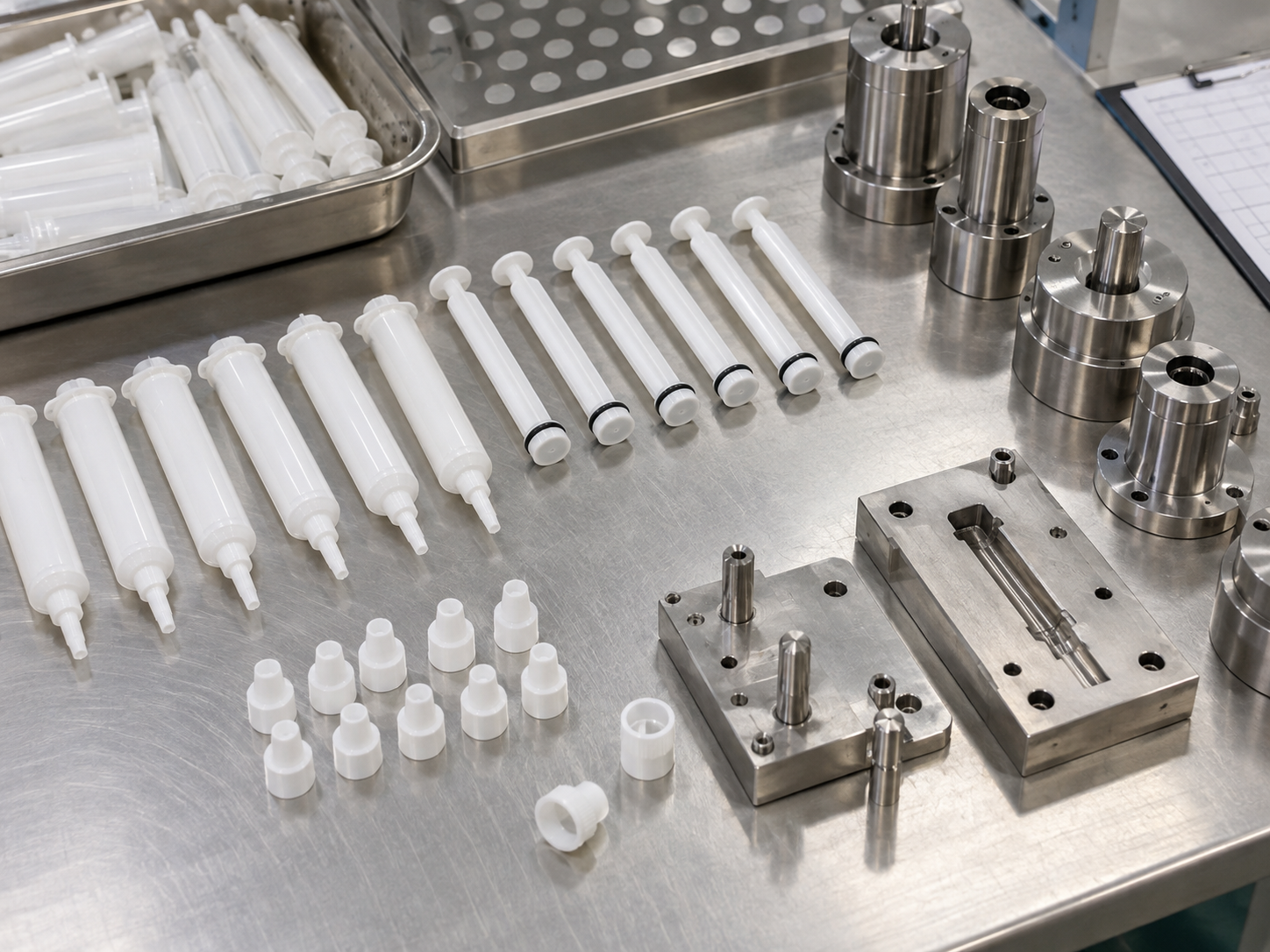
*Caption: Format components and change parts should be listed separately so the buyer can see what the quotation actually supports.*
If the line fills only and leaves assembly manual, that may be a valid project choice. It should simply be visible in the process boundary and capacity assumption. Automation scope and labour scope should not be mixed into one unclear price.
4. Compare initial purchase cost with total cost of ownership
TCO is a decision framework, not a promise of a particular payback period. A practical model can be written as:
**TCO over the chosen review period = initial equipment scope + format parts + trials and FAT + installation and training + planned maintenance and spares + utilities and consumables + changeover and cleaning labour + quality and reject costs − approved residual value or reuse value.**
The terms must be defined for the project. Do not insert a vendor’s maximum speed or an invented labour saving into the model. Use the customer’s own shift pattern, labour rate, batch plan, reject data and maintenance assumptions.
| TCO category | Questions to ask |
|---|---|
| Initial equipment | What machine modules and controls are included? |
| Format scope | Which syringe, cap and plunger formats are included? |
| Testing | Are sample trials and FAT included, optional or excluded? |
| Installation | Who prepares utilities, access, lifting and interfaces? |
| Training and documents | What manuals, drawings, training and support are delivered? |
| Maintenance | What wear parts, service intervals and spares are recommended? |
| Changeover | What parts, cleaning and first-off checks are included? |
| Quality cost | How are startup, rejects, rework and inspection handled? |
This list turns “machine price” into a responsibility map. It also lets procurement compare a lower initial quote that has many exclusions with a more complete quote.
5. Use indexed examples instead of invented prices
When a project is still at concept stage, use an indexed budget model. Set the equipment scope to 100 cost units—not 100 dollars, euros or another currency—and add the project-specific categories as separate indices.
For example:
- Base filling module = 100 units.
- Add the agreed cap and plunger operations as a separate scope index.
- Add format parts for each additional syringe or closure format.
- Add inspection, reject, coding and downstream interfaces where required.
- Add FAT, documentation, training, installation and spares according to the quotation.
The result is not a market price. It is a transparent structure for comparing supplier proposals. Once the supplier returns a formal quotation in the buyer’s currency, replace the indices with verified amounts and preserve the same scope categories.
6. Capacity assumptions change the economics
Capacity should be defined as more than units per minute. Ask whether the quoted output is:
- maximum rated machine speed;
- steady-state output during a product trial;
- saleable output after rejects;
- output before or after cap and plunger assembly;
- based on one format or multiple formats;
- based on continuous feeding or manual replenishment;
- measured before or after planned changeover and cleaning.
The same equipment may have different economic value for a single-SKU operation and a multi-SKU contract filler. A lower-speed line with faster, more predictable changeover may fit a multi-format business better than a higher-rated line that needs complex manual intervention.
Do not calculate ROI from catalogue speed alone. Use a stated production schedule, target saleable units, changeover frequency, labour model, reject assumptions and downstream constraints. If an input is unknown, label it as a sensitivity variable rather than presenting a false precision.
7. Account for cleaning, changeover and product waste
Product-contact design affects both cleaning work and waste. Review hopper residue, hose dead volume, nozzle hold-up, startup units, stop/restart units, rejected components and the handling of product left during a format change.
Ask the supplier to explain:
- which contact parts are removable;
- what tools are required;
- how nozzles and hoses are handled;
- how line clearance is recorded;
- whether parts are dedicated or shared;
- how the first-off units are approved;
- how the line is protected during a planned stop;
- which waste categories are equipment-related and which are process-related.
Avoid claiming a fixed waste reduction before measuring the actual product and process. A trial can show where material is lost, but the final improvement depends on formulation, operator practice, cleaning method and acceptance rules.
Mid-article CTA
**Need a defensible budget rather than a generic machine price? Send the formulation description, syringe drawings, complete component samples, target dose, output assumptions and desired automation boundary to [King Pack](https://kpfillingmachine.com/contact/). We can organize the quotation scope and identify which items require sample confirmation.**
8. Include FAT and documentation in the budget
Factory acceptance testing is not an optional video demonstration when the project depends on product and package compatibility. Budget for the agreed test scope and record whether it includes:
1. Customer formulation or a documented substitute. 2. Actual syringe, cap and plunger components. 3. Startup, steady-state, stop and restart units. 4. Dose measurement and sample identification. 5. Air, residue, closure and component-presence checks. 6. Inspection, reject and data-recording functions. 7. Changeover or representative change-part checks. 8. Cleaning access and product-contact-part removal. 9. Deviations, corrective actions and open responsibilities.

*Caption: FAT and shipment inspection create evidence that the purchased configuration matches the approved scope.*
Documentation and training also have lifecycle value. Ask for the general arrangement, utility list, electrical and pneumatic diagrams, contact-material list, operating and cleaning manuals, spare-parts list, FAT report, punch list, installation plan and training scope.
9. Evaluate supplier quotations fairly
Use a comparison sheet with the same rows for every supplier. Record whether each item is included, optional, excluded or conditional.
| Comparison point | Why it matters to cost |
|---|---|
| Product trial | Confirms whether assumptions require extra development work |
| Complete package handling | Prevents manual operations being hidden outside the line price |
| Number of heads and dose range | Connects output claims to the actual product |
| Inspection and reject | Defines quality hardware and operational responsibility |
| Format parts | Shows future SKU flexibility and recurring change-part cost |
| FAT and documents | Makes acceptance and commissioning responsibilities visible |
| Spares and training | Reduces uncertainty after handover |
| Utilities and site preparation | Prevents late installation changes |
Ask suppliers to describe what is not included. Exclusions are not necessarily a reason to reject a proposal, but they should be costed and assigned before purchase approval.
Build a budget sensitivity table
Before comparing supplier totals, build a small sensitivity table around the decisions most likely to change the project scope. One row can represent a single syringe format; another can represent two or more formats requiring additional change parts and recipes. Separate filling-only scope from filling plus closure handling, plunger insertion, leak inspection, labeling or cartoning. If component feeding is manual for the first phase but automatic later, show those as separate scenarios rather than hiding the future upgrade inside an uncertain average.
The same method applies to testing and installation. Compare a standard supplier-site FAT with a FAT using customer-supplied product and packaging components. Show whether installation guidance, commissioning, operator training, spare parts, software backup and a site trial are included. For each scenario, record the assumption, what is included, what remains the customer’s responsibility and whether the item is a one-time cost or a recurring lifecycle cost.
This table does not need invented prices to be useful. Its purpose is to show which unanswered questions have the greatest budget impact. Ask suppliers to return a base scope plus clearly priced options, and label each option as required, recommended or future-phase. That structure makes an internal capital review easier and helps procurement avoid selecting a low subtotal that later expands when format parts, testing, installation or support are added.
10. Include site preparation and post-installation support
The cost model should include what happens between supplier release and stable production. Request the machine footprint, service clearances, lifting points, access route, door or elevator dimensions, anchor requirements, electrical and compressed-air entry points and upstream/downstream interface information before shipment. These details allow the plant team to identify access or utility work that may otherwise appear as an unplanned project cost.
Separate confirmed utilities from final values subject to configuration. Review electrical supply, compressed-air quality and pressure, vacuum if used, heating or cooling connections, drainage or wash-down restrictions, environmental conditions and operator and maintenance clearances. A utility value taken from a similar machine can change when filling heads, inspection devices, heating modules or packaging equipment are added.
Post-installation support should also be visible in the quotation. Define commissioning assistance, operator and maintenance training, document delivery, spare-parts recommendations, software or recipe backup, remote support boundaries and the process for closing FAT punch-list items. The buyer should know which activities are included at the supplier’s site and which are expected at the customer’s plant.
Shipment inspection should check the packing list, protected product-contact parts, loose change parts, manuals, spare parts and visible machine condition. Site commissioning should re-check utilities, component presentation, safety functions, cleaning access and production-intent samples. These steps do not guarantee a particular production result, but they reduce the risk that a lower initial price is followed by unplanned installation work or missing handover information.
King Pack support for cost-controlled project definition
King Pack’s confirmed capabilities include custom configuration, sample testing, FAT, line integration, documentation, training and after-sales support. A technical proposal should separate equipment modules from optional format parts, inspection, downstream interfaces, installation preparation and lifecycle support.
For a broader engineering reference, review the [intramammary syringe filling viscosity and air-control guide](https://kpfillingmachine.com/intramammary-syringe-filling-viscosity-air-control/) and the [veterinary syringe applicator filling solutions](https://kpfillingmachine.com/veterinary-syringe-applicator-filling-solutions/) page. These resources help connect the budget discussion to product behavior and package handling rather than treating the equipment as a generic machine.
FAQ
What is the average cost of an intramammary syringe filling machine?
There is no responsible single average that applies to every project. The quotation depends on product behavior, syringe format, filling route, automation boundary, inspection, change parts, FAT, documentation, installation and downstream scope. Request a scope-based quotation instead of relying on an online price range.
What is included in a veterinary syringe filling machine price?
It may include only the core filling module, or it may include feeding, capping, plunger insertion, inspection, reject handling, format parts, FAT, training and documentation. Ask the supplier to mark each item included, optional, excluded or subject to sample confirmation.
How can I compare two syringe filling machine quotations?
Use the same responsibility matrix for both proposals. Compare product trials, package handling, output assumptions, inspection, change parts, cleaning, FAT, documents, training, spares, utilities and installation preparation—not only the equipment subtotal.
Does a higher machine price always mean lower operating cost?
No. A higher initial price may include useful scope, but its lifecycle value depends on product compatibility, changeover, maintenance, quality checks, operator practice and actual production requirements. Use the buyer’s data in a TCO model.
What information is needed for a formal quotation?
Provide formulation description or sample, target dose, viscosity or flow behavior, syringe and closure samples, drawings and tolerances, bulk presentation, target output, automation boundary, cleaning expectations, utilities and FAT requirements.
Should FAT be included in the project budget?
Yes, when product and package compatibility must be demonstrated before shipment. Define the sample, test method, acceptance rule, deviations and open-item responsibility in advance.
Can one intramammary line handle multiple formats?
It may be possible when the formats, fixtures, product-contact parts, dosing range, cap tooling, recipes and changeover method are compatible. Each additional format may require parts, testing and operational verification.
Conclusion
Estimate intramammary syringe filling machine cost from the complete project scope and TCO—not from syringe volume or catalogue speed alone. Define product behavior, package components, filling and assembly operations, inspection, changeover, FAT, documentation, installation and spares. Then use a responsibility matrix and an indexed model to compare quotations without inventing a price before the technical assumptions are known.
Final CTA
**Send your intramammary formulation information, syringe samples, target dose, output plan and automation boundary to [King Pack](https://kpfillingmachine.com/contact/). We can help structure a transparent quotation scope and identify the product and package trials needed before a final equipment decision.**